Day 3 of a 3-day Autumn Migration & Wader Spectacular tour. It was a lovely bright, sunny morning with lighter winds. The cloud gradually built from late morning and the rain finally arrived mid-afternoon. Thankfully we knew it was coming and planned accordingly. We spent the morning on the North Norfolk coast, then had a quick drive down into the Brecks in the afternoon to finish, as the weather deteriorated.
After a couple of days dominated by waders, we decided to try to find some passerines today. With persistent south-westerlies, it was not really the weather for drift migration from the Continent but we had not seen some of our more regular species over the last couple of days. We headed for the coast at Stiffkey to see what we could find.
Looking out from the car park at Greenway, we could see several Curlew, Common Redshanks and Little Egrets out on the saltmarsh. Walking west along the coast path, there were a few Goldfinches and Blue Tits sunning themselves in the bushes. A pair of Dunnocks fed on the path below. There were quite a few Blackbirds in the brambles – presumably just local birds now, but they have been very few and far between elsewhere recently.
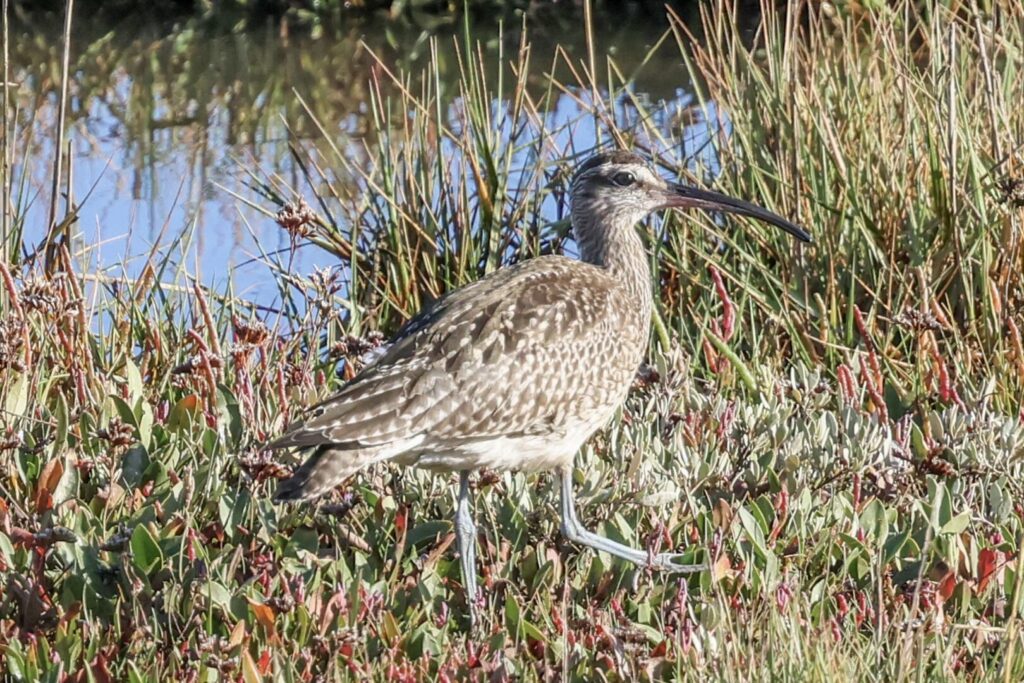
We hadn’t gone far when we noticed a curlew down on the near edge of the saltmarsh below us. It saw us too and started to walk away. It immediately looked small and when it finally turned we could confirm it was a Whimbrel. We got it in the scope and could see it shorter downcurved bill and contrasting dark cap with a central pale crown stripe. Whimbrel are just passage migrants here and most have gone through already, but a few linger on a little longer out on the saltmarsh.
There was a steady passage west of hirundines again this morning. Mostly House Martins, we could see some large groups out over the saltmarsh and a few much closer over the coast path. There were a few Swallows with them and we picked out three or four Common Swifts too. All on their way to Africa for the winter.
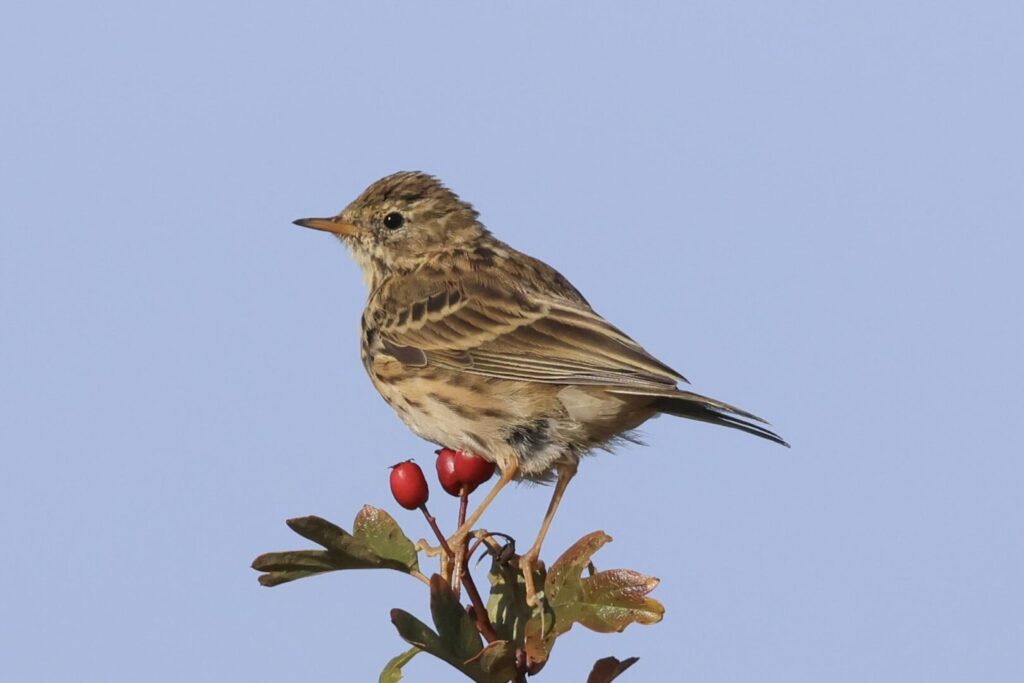
Continuing on, there were lots of Meadow Pipits perched up in the tops of the bushes, chasing round in the sunshine. It had rained (and hailed here) overnight and there was a heavy dew this morning. They had probably come up out of the wet vegetation to dry out in the sunshine. Good views now in the scope. They were joined by a flock of Linnets too.
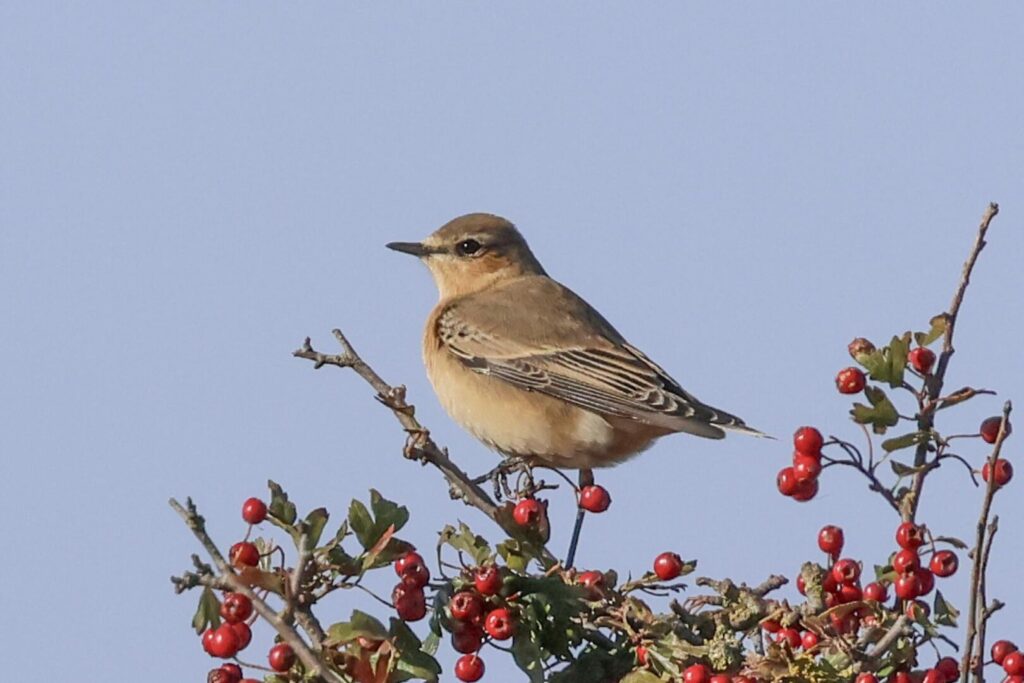
A couple of Blackcaps flicked ahead of us but kept disappearing straight back into the bushes, out of view. We looked up to see a Wheatear perched on the top of a large hawthorn by the path. Probably also avoiding the wet vegetation and enjoying the morning sun. While we were watching it, a male Blackcap came up through the leaves and berries below it, out into view.
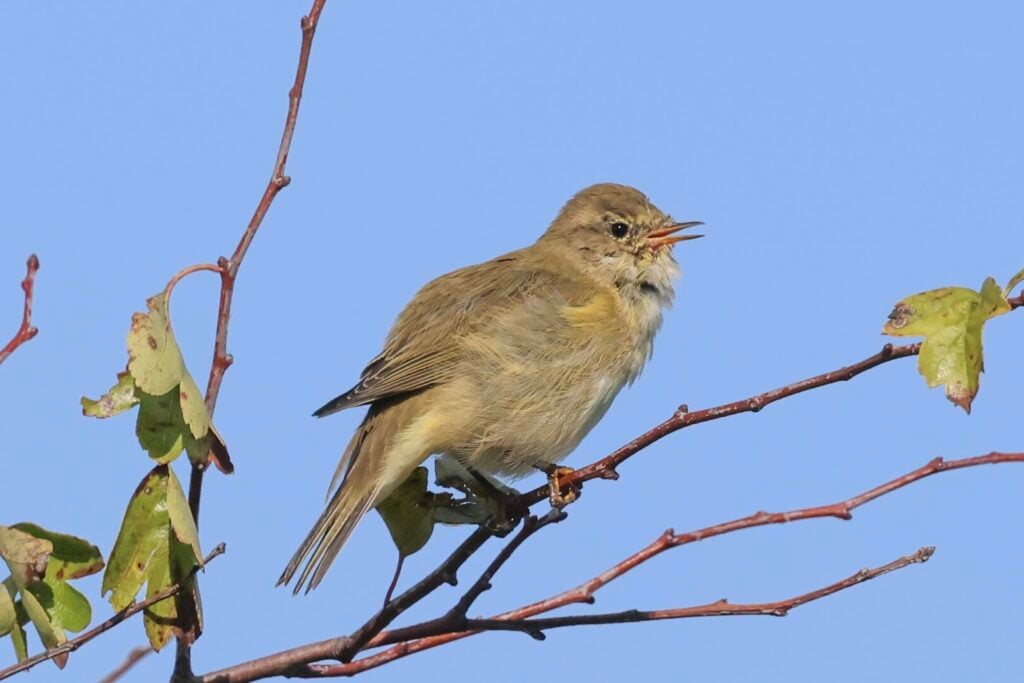
There were lots of Chiffchaffs in the bushes here too. Every few yards, one flicked up out of the hawthorns in front of us or we found small groups of two or three chasing each other in and out of the bushes. Mostly they were silent or calling but a couple started to sing briefly in the sunshine.
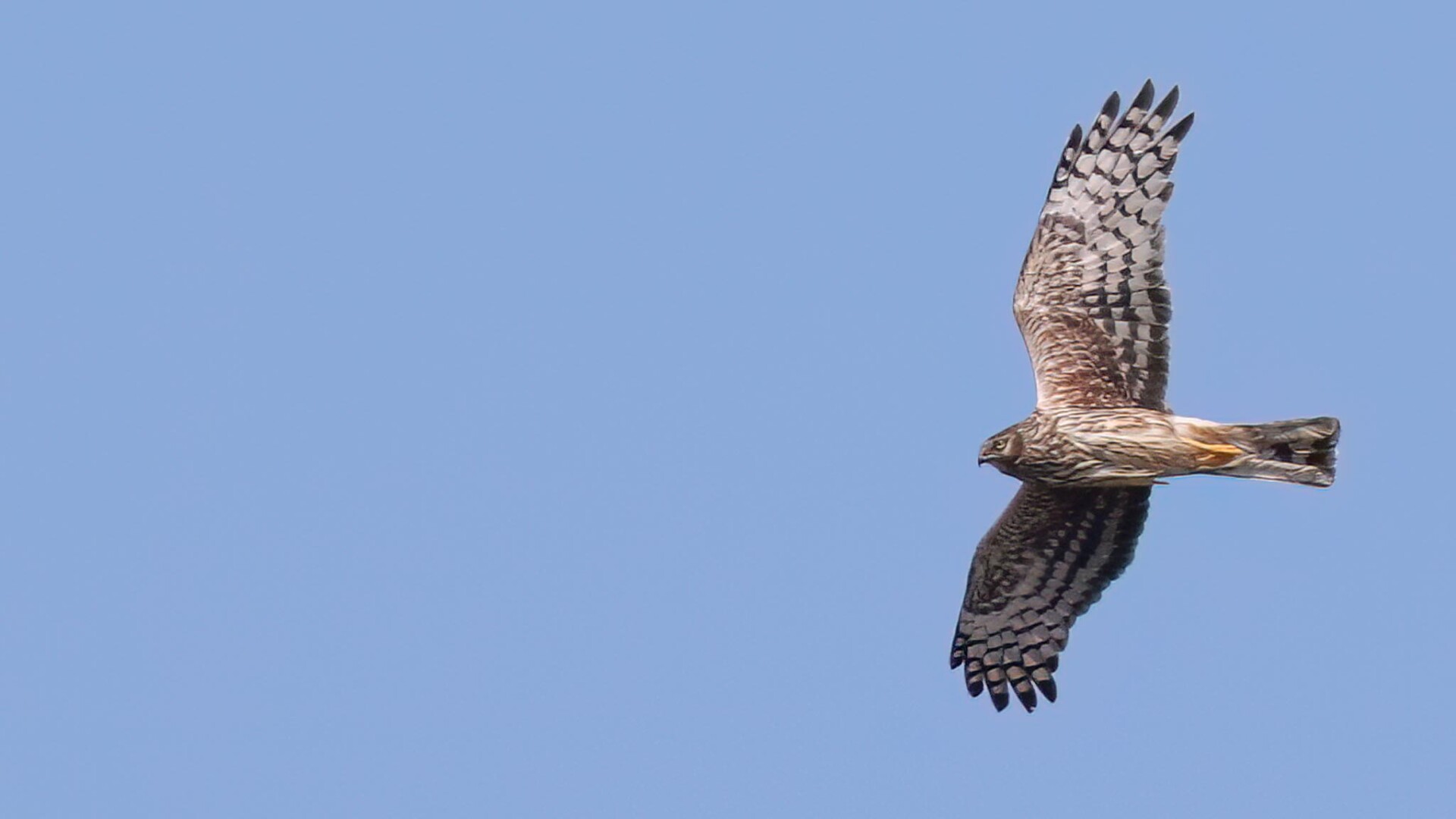
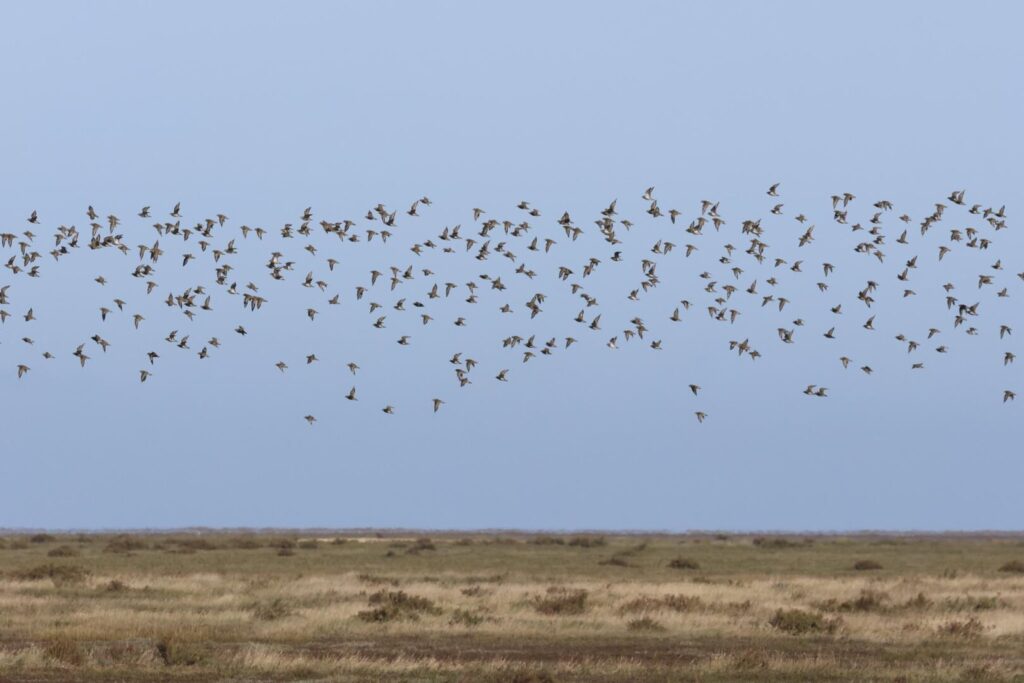
We could hear Golden Plovers calling as we walked along. Looking out over the saltmarsh now we saw a succession of large flocks dropping down out of the sky and landing in the vegetation. We got them in the scope for a closer look, one or two still with the remnants of their black summer bellies still. There were a few Marsh Harriers drifting back and forth out over the saltmarsh and one spooked them as it circled high over. They all took off and flew round calling again.
A Common Whitethroat had flicked up ahead of us briefly along the path but dropped back down again before anyone could get on it. We could see another now flicking around in the brambles which thankfully flew up to feed on the berries in the sunshine. Lovely views. A Reed Bunting was not so obliging, hiding in the Suaeda.
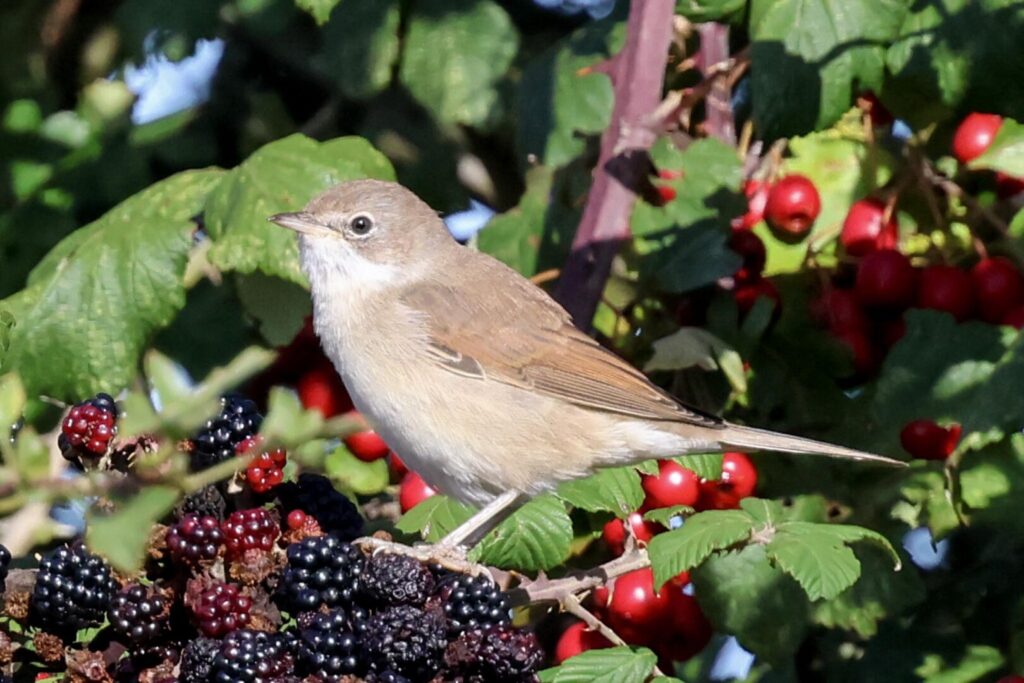
The Whirligig path was covered in a thin layer of mud after the recent high tides which was wet again after the overnight rain. As we picked our way carefully round, more Chiffchaffs, Common Whitethroats and Dunnocks flitted in and out of the bushes ahead of us. From the far side, we had a great view out over the saltmarsh. The Golden Plover flocks were still out in the sunshine. There were a surprising number of Ruff out here today too – presumably come out of the pig fields behind.
Carrying on west along the coast path, there were more of the same warblers in the bushes. We were hoping we might be able to find a lingering Whinchat here but there didn’t even seem to be so many Stonechats today. We finally found one pair just off the end of the eastern track, the male and female both perching up on the near edge of the Suaeda. While we were watching them, we scanned through the waders again and found a couple of Greenshank asleep by one of the small pools. A white-headed male Ruff was in with the others now.
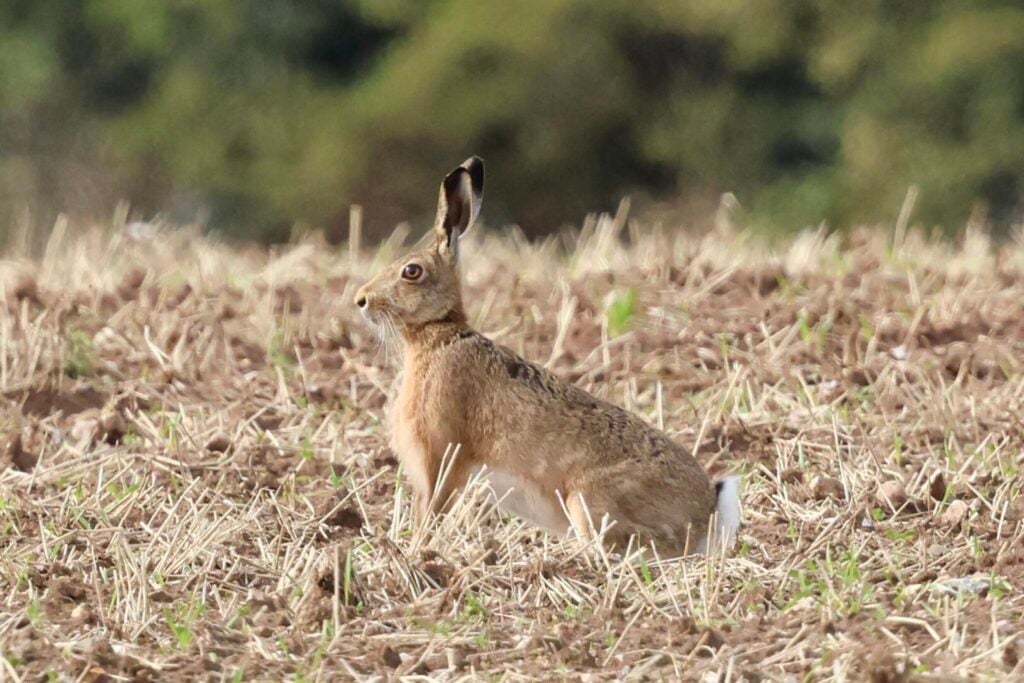
A little further up, where there was no hedge, we walked over to a fallow strip on the edge of the field just inland of the coastal strip. Several Meadow Pipits and a couple of Skylarks flew out and one of the Skylarks landed in the bare field beyond. Three Brown Hares erupted from the vegetation in front of us and ran off, flashing their long black-tipped ears. One stopped and reared up on its back legs, then ran out into the open field and stopped again half way up to look back at us.
We found another pair of Stonechats a little further on but once again nothing with them. It was not far now to the Pit, so we carried on for a quick look just in case. Not surprisingly it was very quiet today – no sign of any migrants. We decided to walk back. With more people and several dogwalkers, plus the vegetation having dried out, it was much quieter now and we saw very few birds on the way back.
After the lovely sunny morning, it had started to cloud over now. We drove over to Holkham and parked on Lady Anne’s Drive. The fields by the Drive are dry now and all we could see out in the grass were a few Greylag Geese and Curlews. There had been a few small groups of Pink-footed Geese reported along the coast today, some of the first of the autumn returning. We were hoping some might have dropped in here at Holkham but there was no sign of any now.
After using the facilities, it was time for an early lunch. It was still dry, bright and warm, even if the wind was starting to pick up a little, so we made use of the picnic tables outside. Afterwards, we had planned to have a short walk west along the edge of the pines, so see if we could add some woodland birds to the trip list and keep our eyes and ears open for Pink-footed Geese.
As we walked back from dropping the lunch bags in the minibus and grabbing the scopes, we heard Pink-footed Geese calling distantly. We looked over to see a small group circling some way off in the distance to the west. Hurrying back to the far end of Lady Anne’s Drive, we were just in time to get the rest of the group onto them as they disappeared behind the trees. We hoped they might be landing on the grazing marshes further down.
Walking down along the track, the trees were fairly quiet. We heard a couple of Chiffchaffs calling and then found a small flock of tits up in the edge of the pines. Stopping to look through them and craning our necks, we managed to pick out one of two Coal Tits and a Goldcrest. We could hear the Pink-footed Geese more clearly now, calling out over the grazing marshes.
When we got to Salt’s Hole, we could see a couple of Little Grebes diving out on the water and calling occasionally. A small raft of Gadwall were out in the middle and we got a drake in the scope to admire its intricately patterned plumage. A few Mallard were lurking on the edge of the reeds but there was noting else on here today.
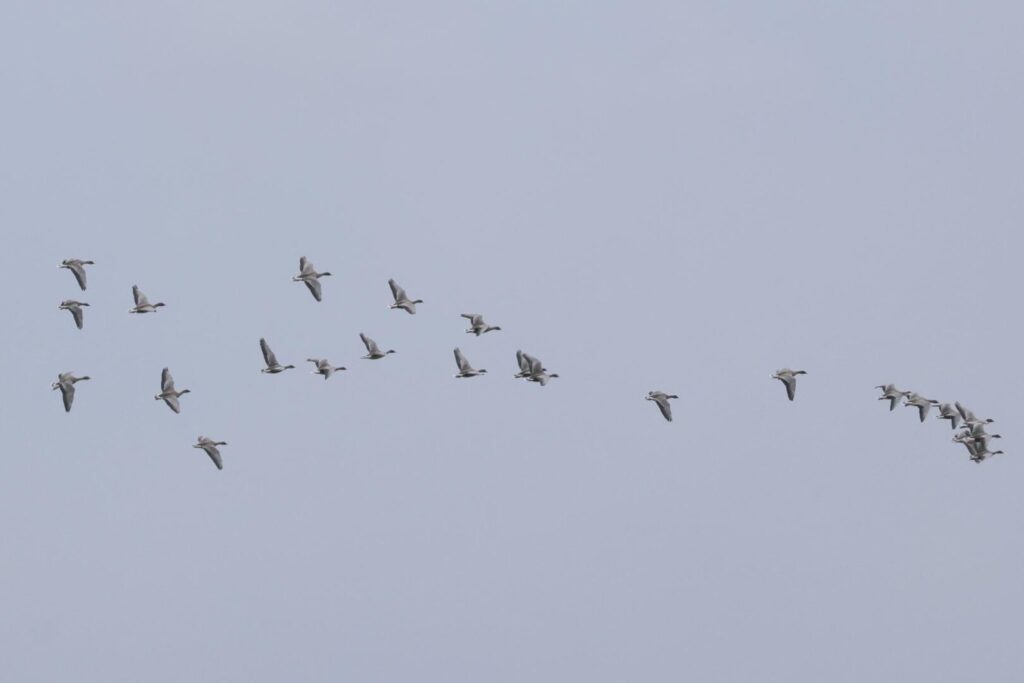
We stopped again at the gate looking out over the marshes just before the boardwalk. There was no sign of the Pink-footed Geese out on the grass but then they appeared flying in from the west. They circled round a couple of times in front of us and we hoped they might land, but eventually they headed off south west and we lost sight of them. Always a delight to hear and see the first Pink-footed Geese of the autumn, even if it is a reminder that winter is coming! A Green Sandpiper flew across briefly but dropped down behind the reeds.
We carried on to the boardwalk and stood by Washington Hide to scan. There was no further sign of the geese but we could see a Great White Egret on the pool in front of the hide. When it took off, it was chased away by a Grey Heron, a good size comparison with the heron noticeably smaller. Another Great White Egret flew up and landed again by one of the pools much further back. We could see a few waders on there too and looking through the scope, we picked out two more Green Sandpipers with the Black-tailed Godwits. Distant, but everyone got to see them this time.
The cloud was continuing to thicken and we wanted to try one more thing this afternoon, so we headed back to Lady Anne’s Drive. After a quick stop to use the facilities, and buy ice creams for those who wanted them, we got back in the minibus and headed inland. We were hoping the rain might hold off until after the 3pm forecast but just before then it started to spit initially and then progressively turned to drizzle.
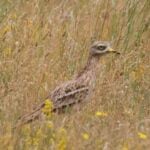
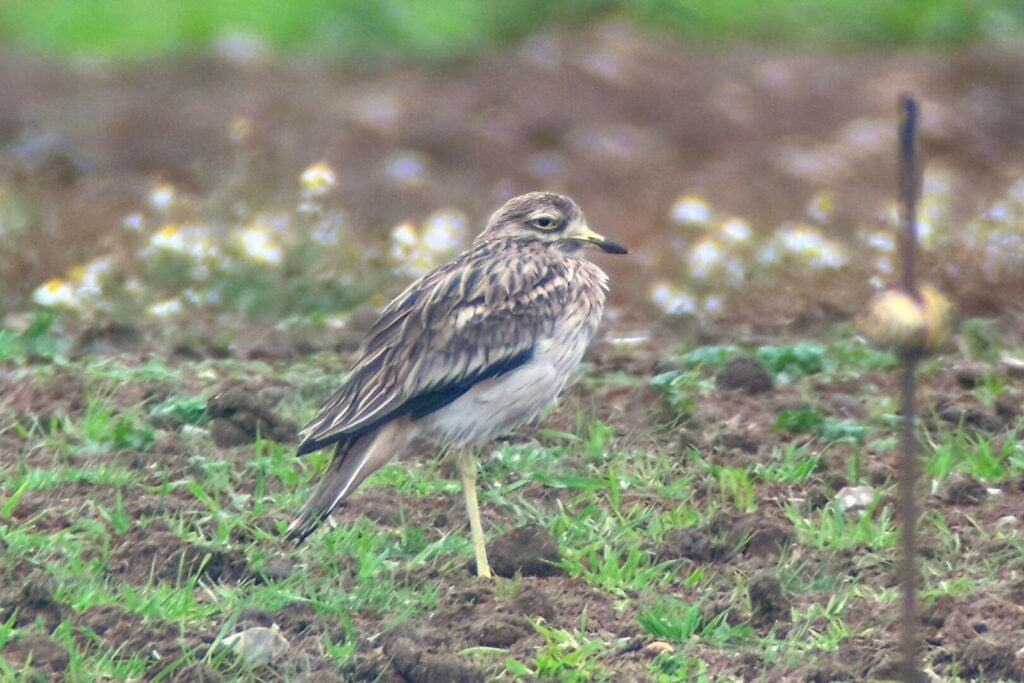
Our destination was the Brecks and thankfully the rain was still not too heavy by the time we arrived. This time of year, the Stone Curlews gather together in large flocks in favoured fields before eventually heading off to southern Europe over the middle of the winter. We pulled up by a gate and a quick look out revealed at least twenty Stone Curlews out in the field beyond, so we parked and got out. Careful not to disturb them, we set the scope up for a closer look.
The more we scanned around the field the more we saw. By the end, we had counted a minimum of 66 Stone Curlews. There were almost certainly more, hidden from view behind the vegetation where we couldn’t see them. An impressive sight.
It was a nice way to end the trip, taking us to an impressive 28 species of wader (shorebird) across the three days. After watching the Stone Curlews for a while, we headed back north, dropping one of the group off on the way to catch the bus back to King’s Lynn before finishing the tour in Hindolveston. Still time for tea and one last piece of cake for those who wanted it before the drive home.