A single-day Autumn Migration tour in North Norfolk. It was forecast to be a bright morning, clouding over with rain arriving from 3pm. It was actually a rather grey and cloudy morning, brightening up from midday. There was no sign of any rain apart from a few spits just as we were finishing up around 5pm. We had a good day birding on the North Norfolk coast.
Half of the group met in Hindolveston and we then picked up the other half in Wells. It has not been great weather recently for passerine migrants from Scandinavia with strong south-westerlies. But after a change to very mild winds coming up from the south over the last couple of days, we figured we would have a quick look first thing in Wells Woods to see if that had brought anything in.
As we walked in past the boating lake, we stopped for a quick scan. There were six Little Grebes over the far side and, as we were watching them, a Kingfisher splashed into the water nearby and flew back up into a small pine tree on the bank. Typically, just as we got the scope onto it, it dived into the water again and disappeared off up the small channel out of view.
Walking in through the birches, it seemed very quiet. There were just a few Wrens in the undergrowth and, of course, the usual abundance of Woodpigeons. Circling round the east side of the Dell we came back out onto the main path. We could hear Pink-footed Geese calling and looked up to see five fly over through a gap in the trees. There were more further up and they seemed to be landing on Quarles Marsh, so we thought we would head over that way.
Passing the Dell Meadow, a Jay flew across the path ahead of us. there were one or two Chiffchaffs in the bushes with a few Blue Tits but they didn’t seem to be part of one of the larger tit flocks we were looking for. Cutting in through the bushes, we could see some small groups of Pink-footed Geese out on the grazing marshes so we set up the scope for a closer look, admiring their delicate pink-banded dark bills.
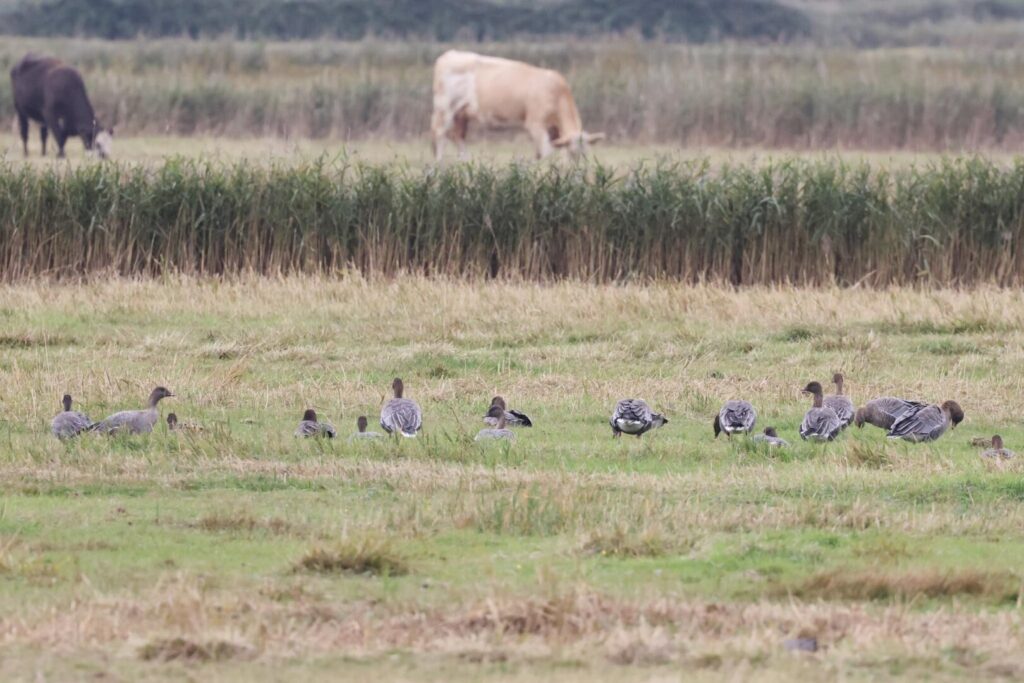
A Marsh Harrier drifted over the reeds beyond the grass. A Common Buzzard and several Red Kites appeared above the pines behind us. There were a few Swallows and House Martins circling round overhead. Hard to tell if they were local birds gathering before heading off to Africa or others stopping off on their journey.
Continuing on through the bushes, a Green Woodpecker flew up calling and landed briefly in one of the nearby trees before flying. Then a Great Spotted Woodpecker called too and we found it in a dead tree.
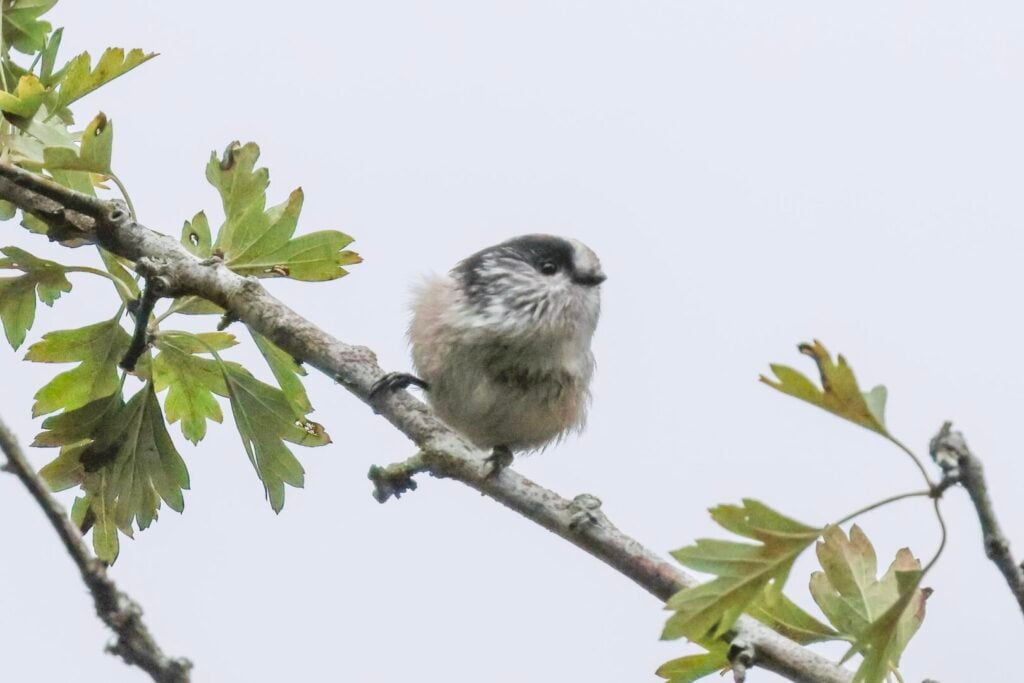
Just beyond, we came across a mixed flock working its way through the bushes. In one hawthorn, we could see several Blue, Great and Coal Tits and a couple of Goldcrests. As they flew across, we could see several Long-tailed Tits too. A couple of Treecreepers zipped across in front of us but disappeared straight into the trees. There were several Chiffchaffs and a single Blackcap briefly with the flock as well, but no signs of any other migrants.
Back across the main path, we made our way round the other side of the Dell. It was all very quiet until we found another tit flock on the NE corner. For a couple of minutes we were surrounded by Long-tailed Tits, with a couple of Goldcrests and Chiffchaffs too. A Treecreeper landed three quarters of the way up a pine trunk and we watched it climbing up until we lost site of it in the tangle of branches in the crown. Once again, we couldn’t see any sign of freshly arrived migrants in the flock.
The tits and their followers all disappeared quickly up into the pines so we decided to make our way back out of the pines and back to the minibus. We drove east along the coast road now to Cley. Stopping first at the Visitor Centre to use the facilities, we got our permits and headed out onto the reserve. There had been a Little Stint and a Wood Sandpiper on Pat’s Pool this morning, but apparently everything had been scared off by the banging of shotguns on the partridge shoot just across the road. Still, we headed over to Bishop Hide to see what might have come back in.
Along the path through the reeds, we heard Bearded Tits calling and turned just in time to catch one zip across the path behind us. Thankfully it then flew up again so everyone could see it this time, before disappearing off over the reeds. They have been very scarce here this summer, presumably after a poor breeding season, so it was good to see one.
Into the hide and the scrape did look disappointingly quiet. There were very few waders, just a small group of Avocets asleep and a two Black-tailed Godwits, both over the far side. The ducks seemed to be less affected. They are not looking their best at this time of year, with most of the drakes still in drab eclipse plumage. They were mostly Teal and a few Shoveler. A small group of Shelduck was on one of the islands.
A male Marsh Harrier drifted across over the central hides and the reeds at the back. We could see the grey in its wings. A short while later, a female came up and landed in the vegetation on the bank, where we got it in the scope for a closer look. To complete the set, a chocolate brown juvenile flew over too, at one point circling over the reeds with the female.
It was hard to tell whether the hirundines were moving through or had stopped to feed over the scrape. They were mostly Swallows but we picked out a few House Martins and then a couple of Sand Martins with them at one point too. A Kingfisher flashed across in front and away along the edge of the scrape before turning up over the bank and disappearing off over the reeds. A lone Cattle Egret flew across and disappeared off towards the Cattle on Keeper’s Marsh.
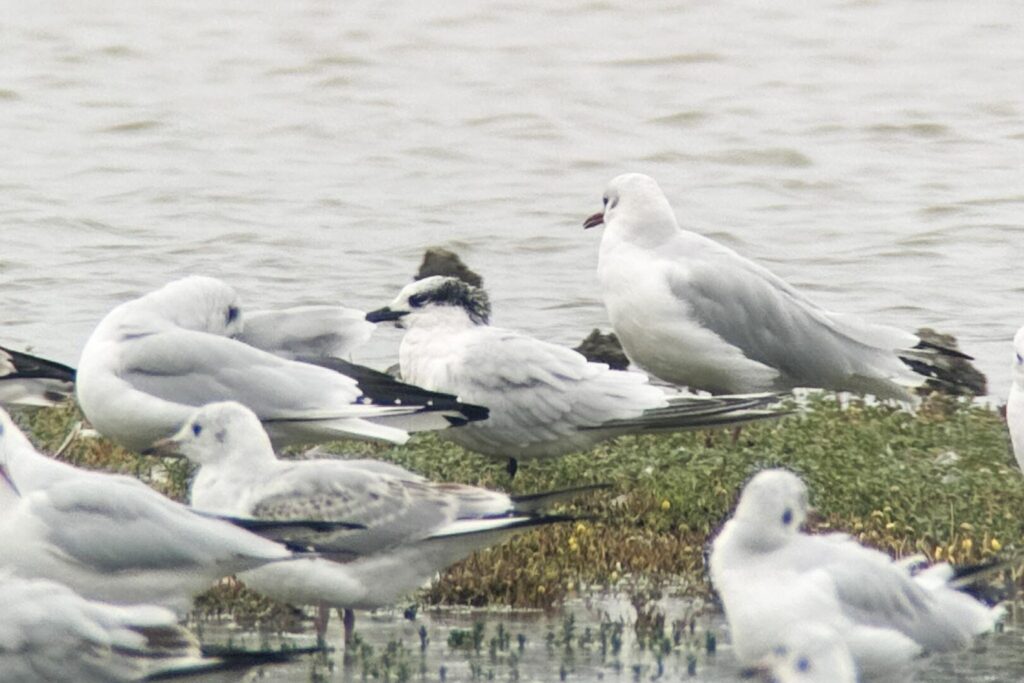
Gradually the other birds started to come back in. First the Black-headed Gulls arrived and landed back down on the water. Looking through them, we found a couple of 1st winter Common Gulls too. A couple of Sandwich Terns flew in and circled over the scrape calling. They dropped down with the gulls on one of the islands and were quickly joined by another ten. We got them in the scopes for a closer look, admiring their long black dagger-like bills with a yellow tip.
The waders started to return too. First a bigger flock of Black-tailed Godwits flew in, flashing their black and white wings. They dropped down over the far side of the scrape to join the others. Then a small group of Lapwing arrived. The Little Stint reappeared with a couple of juvenile Ruff, on the low flooded island out in the middle. The Little Stint was clearly tiny, true to its name, even by comparison with the Ruff. Another little group of Ruff dropped in, winter adults this time with orange legs and bill bases and scaly-edged grey backs.
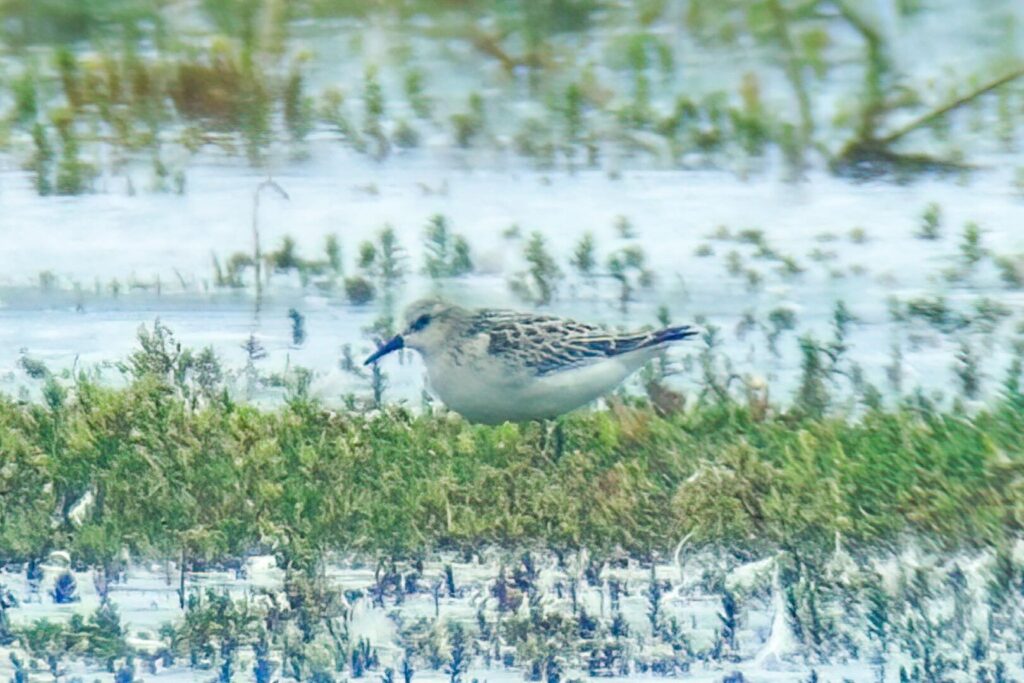
The Wood Sandpiper was the only thing we were missing still. It had been seen on one of the other scrapes, from the central hides. We were just thinking we might have to walk out there to see it when one of the group found it on one of the islands on Pat’s Pool again. It kept disappearing into the edge of the low reeds, out of view, but eventually everyone got a good look at it. At one point, the Wood Sandpiper was feeding along the edge of the vegetation with the two juvenile Ruffs for comparison.
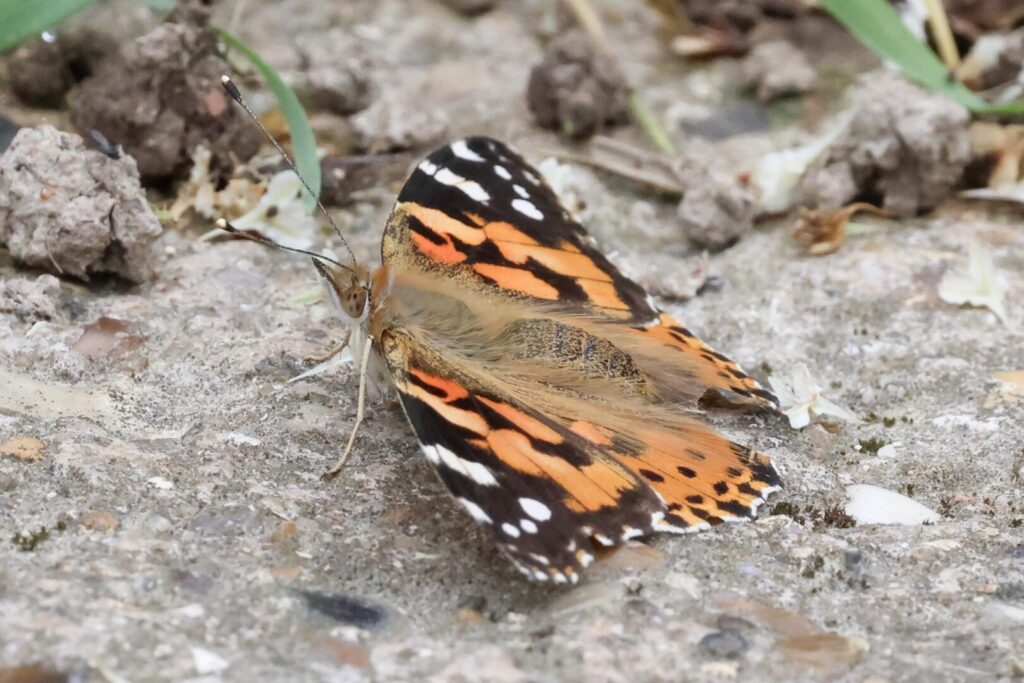
It had been a remarkably productive visit to Bishop Hide in the end, despite the best efforts of the shoot to disturb everything. Time had flown and it was already time for lunch so we walked back to the Visitor Centre. The cloud was starting to lift and it was beginning to brighten up now. As we came back into the car park, a rather pristine Painted Lady butterfly was trying to warm up on one of the logs and then on the nearby concrete path.
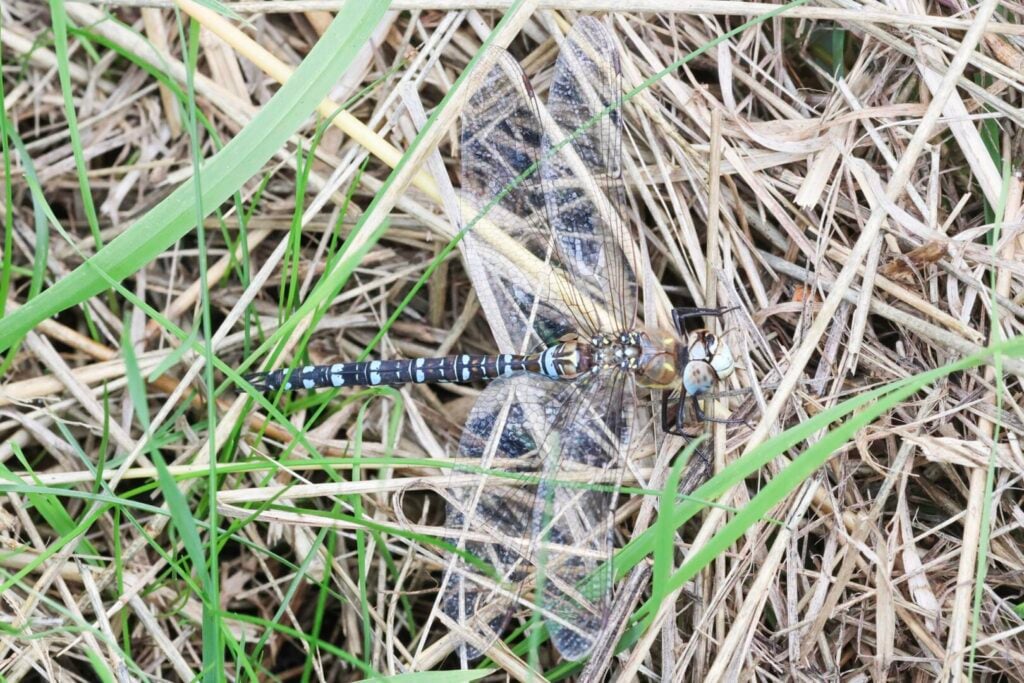
After lunch, with one eye still on the forecast for rain from 3pm, we decided to head over to the East Bank for a walk before it arrived. As we parked at Walsey Hills, a Cetti’s Warbler shouted from the brambles across the road. Snipe’s Marsh is still almost dry, so we walked past along the verge. What appeared to be a dead Migrant Hawker dragonfly was on its back in the grass so we picked it up. It was a bit of a surprise when it started to flap its wings! It fell back down and we then placed it on the brambles where it wouldn’t be trodden on.
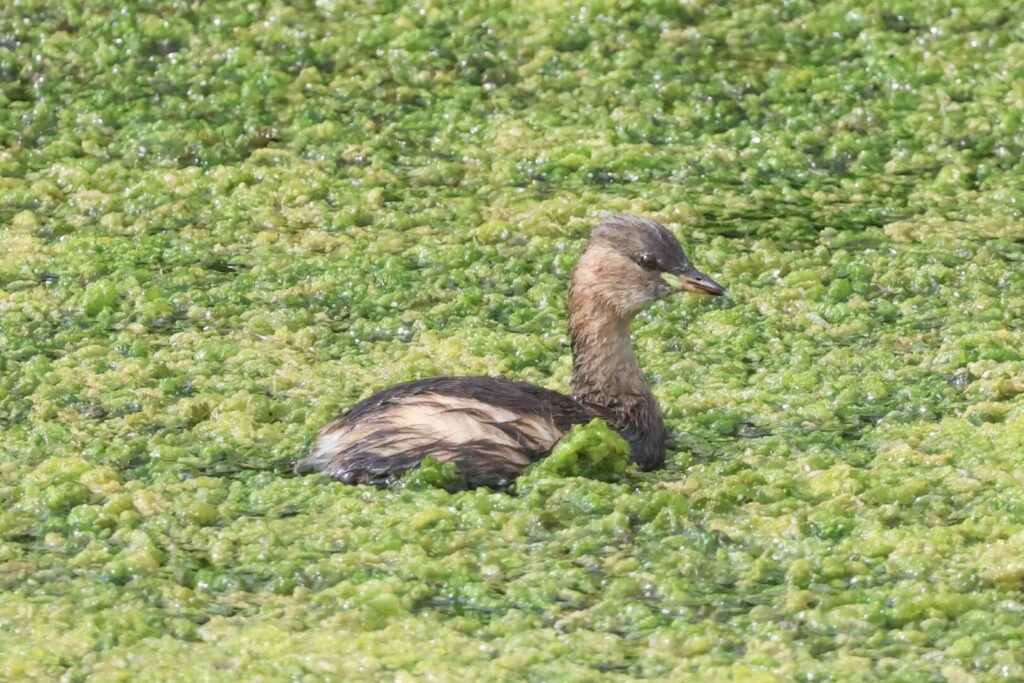
As we crossed over the road, a stream of Swallows and House Martins flew past and disappeared off west. These ones did appear to be actively migrating, on their way to Africa for the winter. Walking up the East Bank, a single Little Grebe was diving again in the blanket weed on Don’s Pool. A single Cattle Egret was just visible in between the cows further east by the road.
There were lots of geese on the grazing marshes, Greylags and Canada Geese. A couple of Egyptian Geese were asleep on one of the islands on Pope’s Pool. We got the scopes on some Wigeon first and then some Curlew in amongst the geese. A Wall butterfly was basking in the sunshine on a patch of dry grass on the bank.
A flock of Meadow Pipits was feeding on the short grass by the Serpentine. They have been arriving in off the sea in numbers in the last few days, presumably birds arriving from further north in the UK. A couple of Common Snipe flew up and landed again in the grass, but quickly disappeared in out of view. A single Common Redshank was having a bath in the water at the north end.
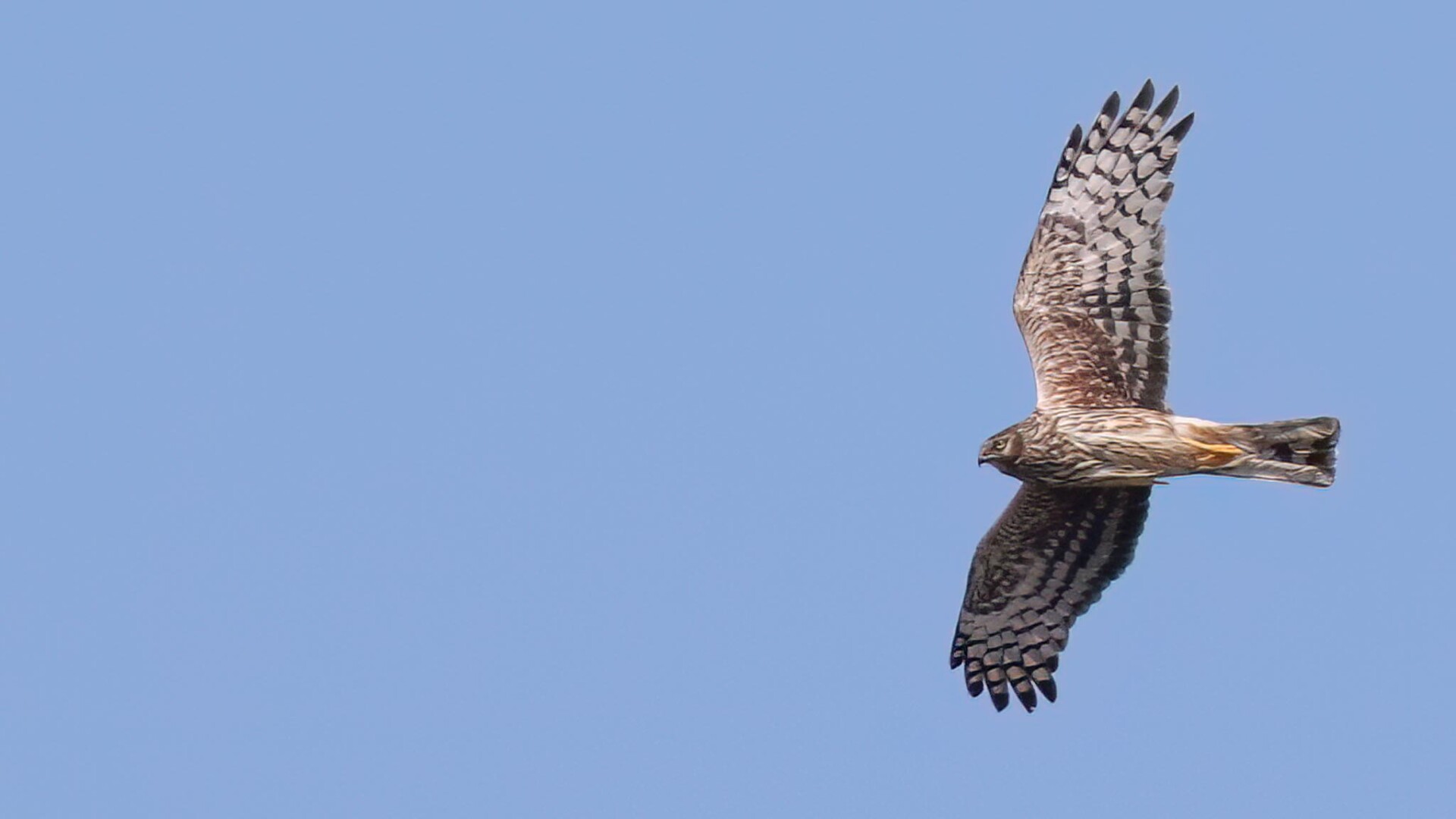
We picked up a Hobby distantly over the reeds beyond Pope’s Pool. It kept dropping down out of view before reappearing again further over. It was hunting dragonflies low over some water out of view and we could see it eating them when it came up, lifting its feet up to its bill. At one point, it was chased by a couple of Carrion Crows, effortlessly avoiding them. As it flew back we realised there was a second Hobby further over. Great to watch. One then flew across and continued feeding over the main reedbed.
Crossing the main drain, we set up the scopes to have a look at Arnold’s Marsh now. It didn’t take long to find the Curlew Sandpipers. There were five juveniles on here, feeding with the Dunlin. We had a nice comparison, the Curlew Sandpipers slightly larger and longer billed, very neat with a scaled back and unstreaked white belly, and peachy-apricot wash across the breast. Migrants on their way from central Siberia to Africa for the winter, this is the best time of the year to see them as they pass through.

There were quite a few Common Redshank and a few Curlew on here too. A small group of Black-tailed Godwits was feeding on the north side and nearby, we found a single Pintail on the water. More Sandwich Terns were roosting at the back too.
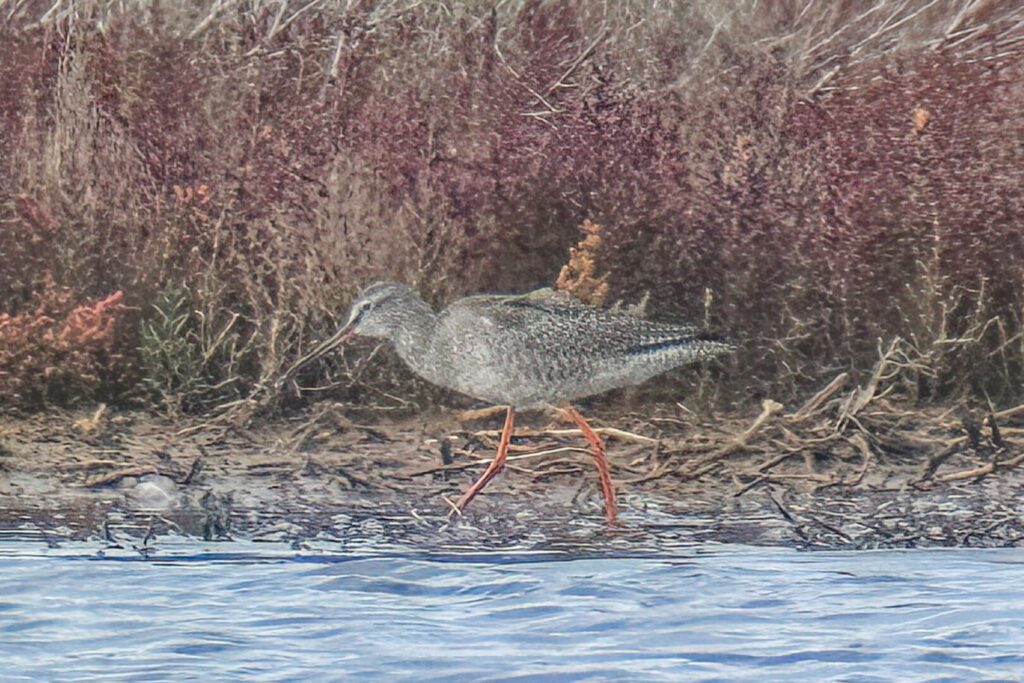
There were a few more waders on the Brackish Pool too. First, we picked up the single juvenile Spotted Redshank. Possibly one of the four we saw here last weekend, at one point we had a nice view of it in the scopes together with a Common Redshank for comparison. While we were watching it, we noticed a juvenile Knot picking its way along the edge of the same island, along with a Dunlin. An interesting selection of different waders all on the same muddy edge.
A Water Rail squealed from somewhere deep in the reedbed the other side of the main drain. A couple of Little Egrets were feeding in the shallow pools and a young Grey Heron appeared from the vegetation.
We walked on to the sea, to check it was still there. It was, and it was flat calm today. A Red-throated Diver in breeding plumage was on the water away to our right but was diving all the time and going away from us, so it wasn’t easy to see its red throat. We could see a few Sandwich Terns fishing distantly beyond and a couple of Common Terns with them at one point. A juvenile Gannet was loafing on the sea off to our left.
There was nothing new of note on the walk back. When we got to Snipe’s Marsh, we could see the pegs where the shoot had been earlier in the field behind. Ironically, a small covey of Red-legged Partridges was now out in the open in the low grass right in front of the pegs.
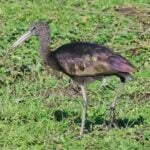
There has been a huge arrival of Glossy Ibis into the UK in the last couple of weeks. Two or three had been hanging around the reserve still in recent days, mostly on North Scrape where they could be hard to see. They had been reported earlier this afternoon again so, particularly as it would be a new bird for several of the group, we went to see if we could find them.
As we drove past Keeper’s Marsh, we could see a Cattle Egret with the cows, possibly the one we had seen heading that way earlier. There were lots of Rooks in the Eye Field and a single Skylark flew up from the grass as we walked down by the fence. It landed again and scuttled away from us.
When we got to the North Screen, there were several people looking for the Glossy Ibis. We were told they had flown over the bank on the left side out of view just before we arrived. There were a few Black-tailed Godwits and Ruff in the middle of the scrape and a scattering of brown ducks.
Looking where the Glossy Ibis were supposed to have gone, we were scratching our heads trying to work out why. It looked like thick reeds, not a place for them to feed. So we started scanning around the other edges of the scrape and sure enough quickly found them on the bank at the back instead. They were surprisingly hard to see in the grass with their heads down feeding, but from time to time lifted their heads up and then were much more obvious.
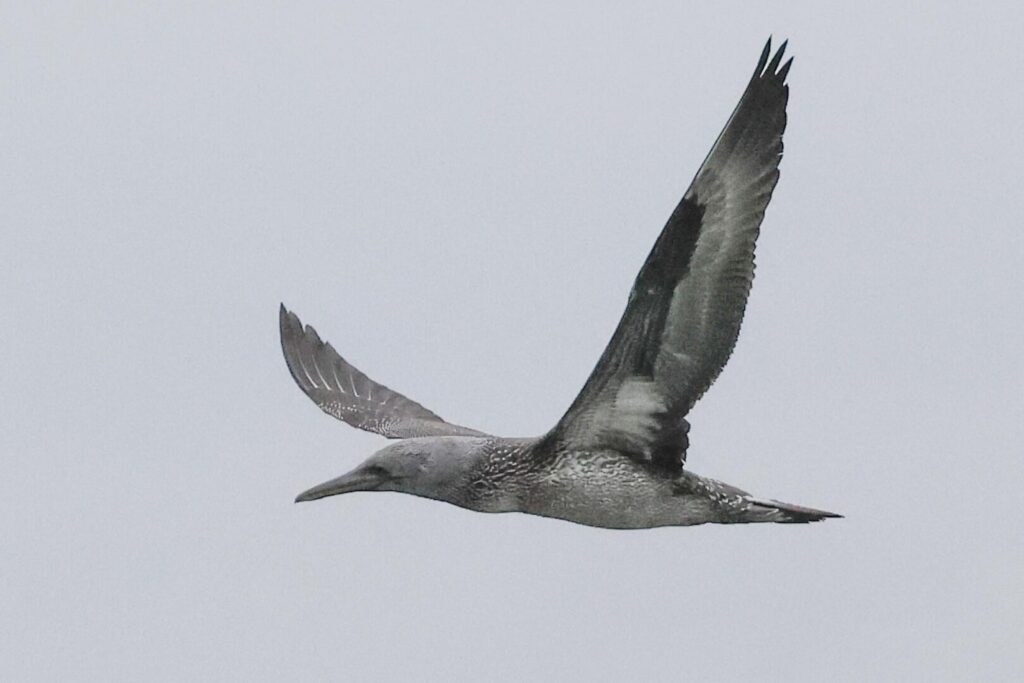
Mission accomplished here, we saw a message now that the two Pectoral Sandpipers were still at Salthouse. The same two birds we had found originally on the Serpentine last Saturday, they have stayed here all week. They can be very hard to see in the vegetation around the Iron Road pool though, so we figured they might still be there today. We had planned to try to call in there at the end of the day, so now we walked quickly back to the minibus. A couple of juvenile Gannets were now flying round just offshore and diving into the water.
Thankfully we managed to park at the start of the Iron Road and walked up to the first gate. There were people looking out further up but a quick scan around the pool and we immediately spotted the two Pectoral Sandpipers feeding in the very short vegetation on the mud. Unusually, they were right out in the open. We had excellent views of them in the scopes as they fed, noting the neatly streaked breast stopping in a clear line across the pectoral muscles before the white belly, from which it gets its name.

A couple of Common Snipe were feeding in the shallow water nearby, at one point out in the open together. The two Pectoral Sandpipers walked across just behind them at one point. We noticed two small waders flying over the reeds at the back, Green Sandpipers. They dropped down towards the scrape in front of Babcock Hide, out of view.
The weather had been very kind to us and it had remained dry all day, despite the worst prognostications of the forecasters. It had clouded over a bit more again now and we felt a few spits of rain. We thought the forecast rain had finally arrived. As time had run out anyway and we had to be heading for home, we packed up and walked back to the minibus. The rain still didn’t appear.
A nice way to wrap up the day, with first the Glossy Ibis and then the two Pectoral Sandpipers. It had been a very interesting and enjoyable day of Autumn Migration on the North Norfolk coast.