Day 2 of a Nightingales & Spring Weekend tour. Another bright and sunny spring day. It was chilly first thing but no frost this morning. The winds were lighter too and being inland, they were not so chilly. By early afternoon it was touching 20C! We spent most of the day in the Fens and stopped in the Brecks on our way back.
We had an early start this morning, as we had a long drove down into the Brecks. As we drove along the road between Weeting and Hockwold, a Wheatear flew across right in front of us, flashing its white rump.
Our first target for the morning was Nightingale. As soon as we arrived and got out, we could hear one singing. Walking down the road towards the sound, we could hear lots of warblers singing too – Blackcap, Chiffchaff, Lesser Whitethroat and Garden Warbler.
We didn’t have to go far before we found our first Nightingale in the bushes by the track. It was moving around in a large hawthorn but keeping to dense cover, stopping to sing from time to time. We stood and watched, hoping it might come out onto the edge but it didn’t. Then it flew out and across the road, lost to view.
We continued on further down the road. Two more Nightingales were singing along here but in dense cover, impossible to see. Another Garden Warbler was singing and flew out across the road in front of us. It landed in a bare tree where we could see it clearly although we were looking into the low morning sun. A second Garden Warbler came out and landed in the same tree too, before they chased off after each other. A Cuckoo was calling from behind the trees. A Kestrel hovered over the bushes nearby.
Further down, a fourth Nightingale was singing. The bushes were more sparse and open here, so it should usually be easier to see. But it had not read the script and kept mostly just out of view. Several times it came up to where we could see it but never stayed long enough for everyone to get onto it. The light wind this morning still had a chill to it, so possibly that was keeping things down. It was fabulous to be able to just stand and hear the Nightingales singing.
Eventually we realised this one would not come out into full view, so we walked back up the road and took a side path in through the bushes. The first Nightingale we had heard when we arrived was still singing here. It was briefly perched in full view in the top of a bush, with a Linnet. It dropped down into the brambles and seemed to be gradually working its way closer towards us. Just when we hoped it would come up into a small bush, it flew out and back towards the road.
We walked back down. The Nightingale came up now into a bare bush singing but it was through the other side, with lots of branches in front. Then it dropped down into the brambles again. It flew across the road and into the hawthorns the other side, where we had first seen it earlier. It was singing constantly now, with another further down in opposition. We could see it moving around in the bush but always deep in, hidden by leaves.
We took the side path again. Out into a more open area beyond, there were several more Nightingales. They really area everywhere here. A Willow Warbler was singing too. Eventually we found a Nightingale which was in some bushes next to a path. We saw it move a couple of times in the leaves and then it hopped up and out into view in a gap in the leaves. This time it stayed there for a couple of minutes, singing. Better views finally.
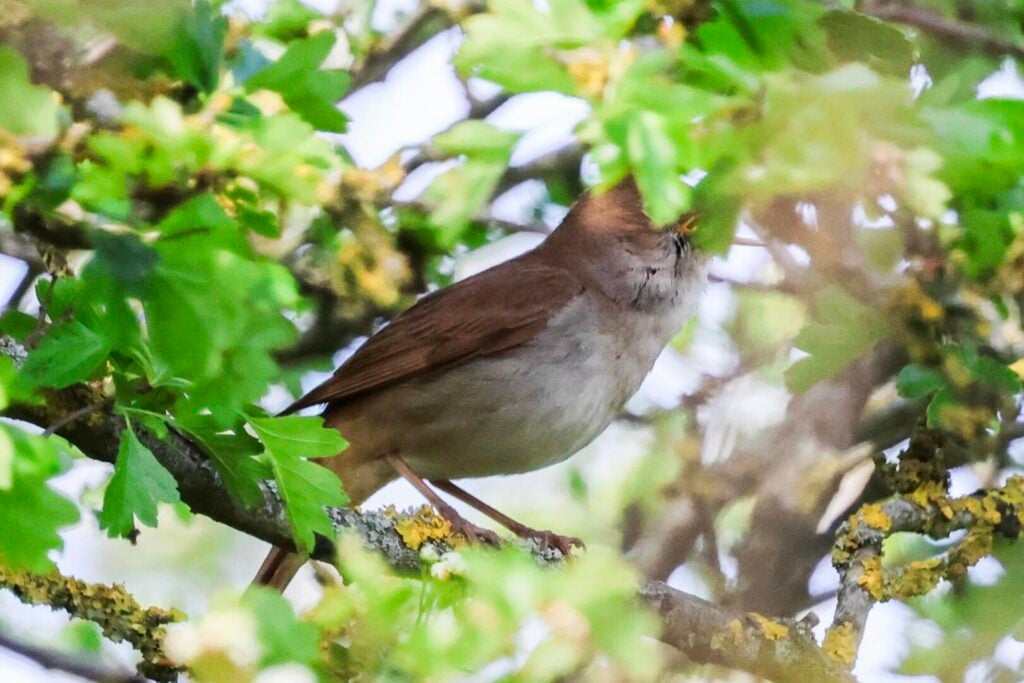
We carried on round across the top of the hill. Yet another Nightingale was singing here, at least our 8th male of the morning, but once more it was deep in cover. A Common Whitethroat was singing too. A Common Buzzard was hovering over the trees behind. It was already nearly 10am, so we decided to head back to the minibus.
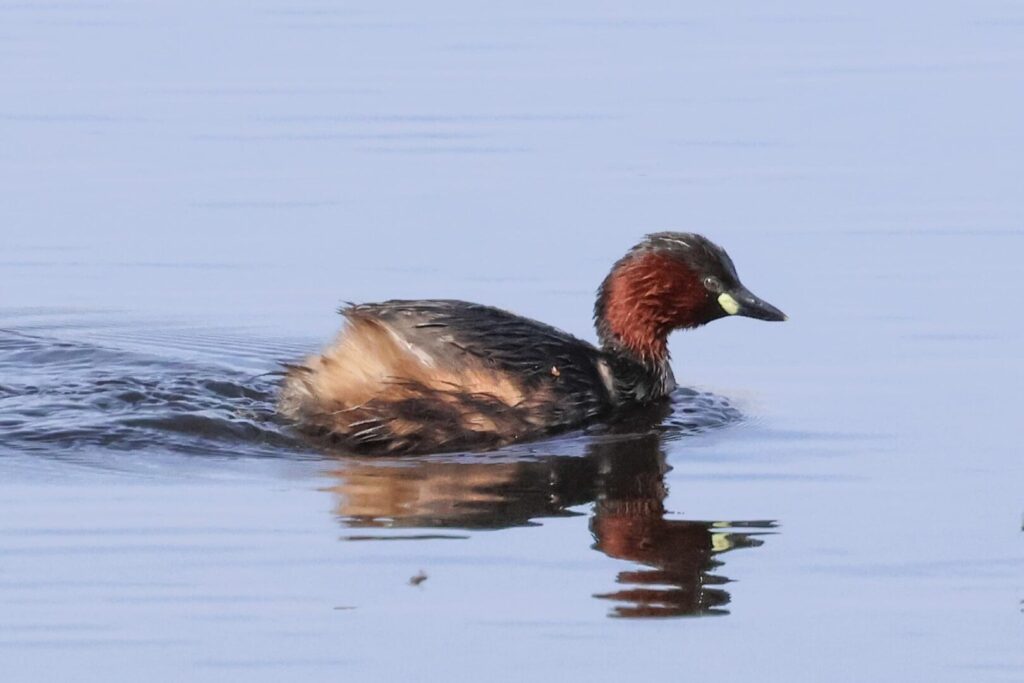
We made our way round to Lakenheath Fen next. After checking in at the Visitor Centre, we drove out to the New Fen parking area. Up to the Viewpoint, it seemed very quiet. We had been told it was a good place to hear Bittern booming but there wasn’t a sound. A family of Coot was on the edge of the reeds on one side of the pool. A Little Grebe was further back and then another swam out into the middle much closer.
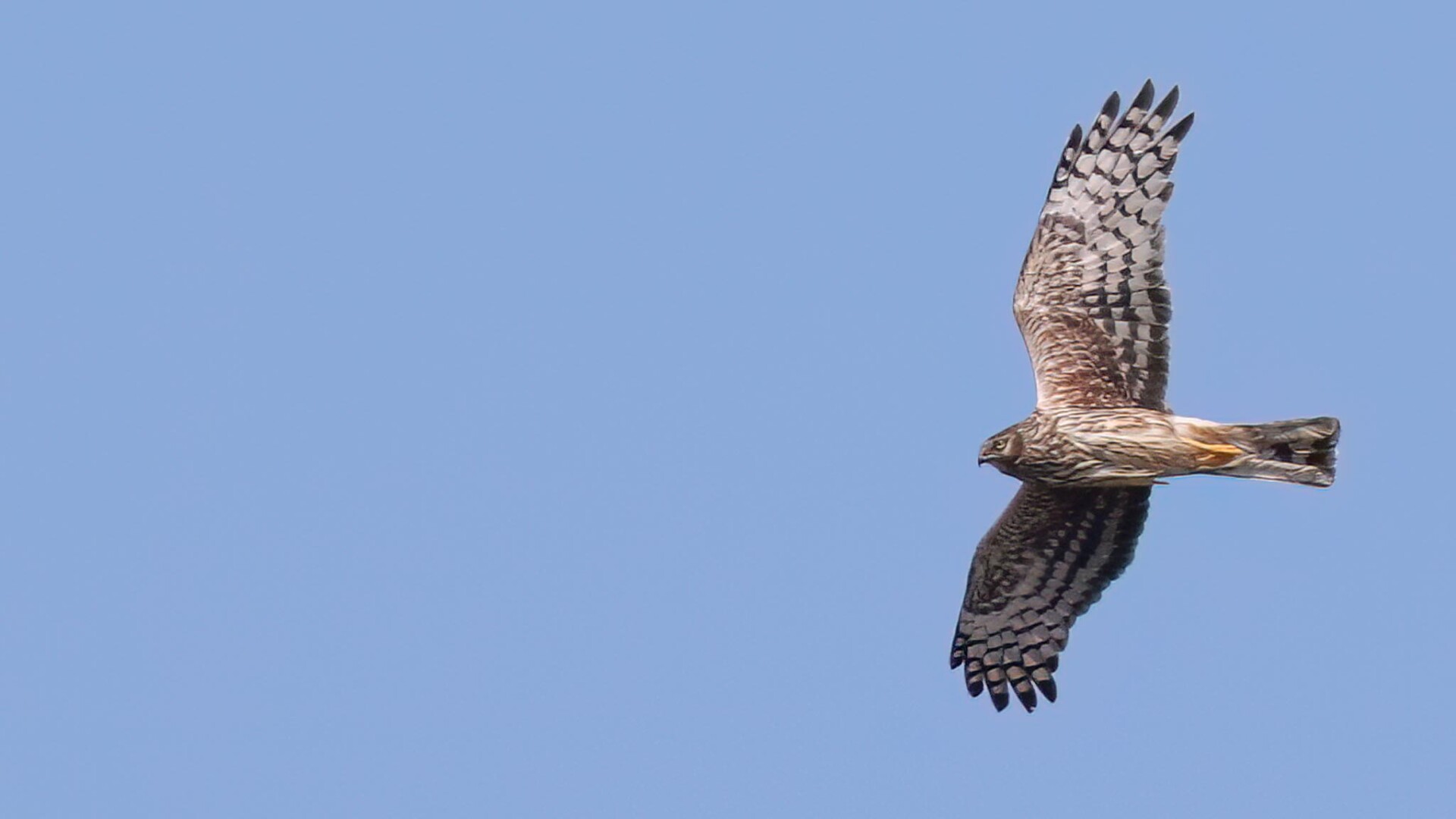
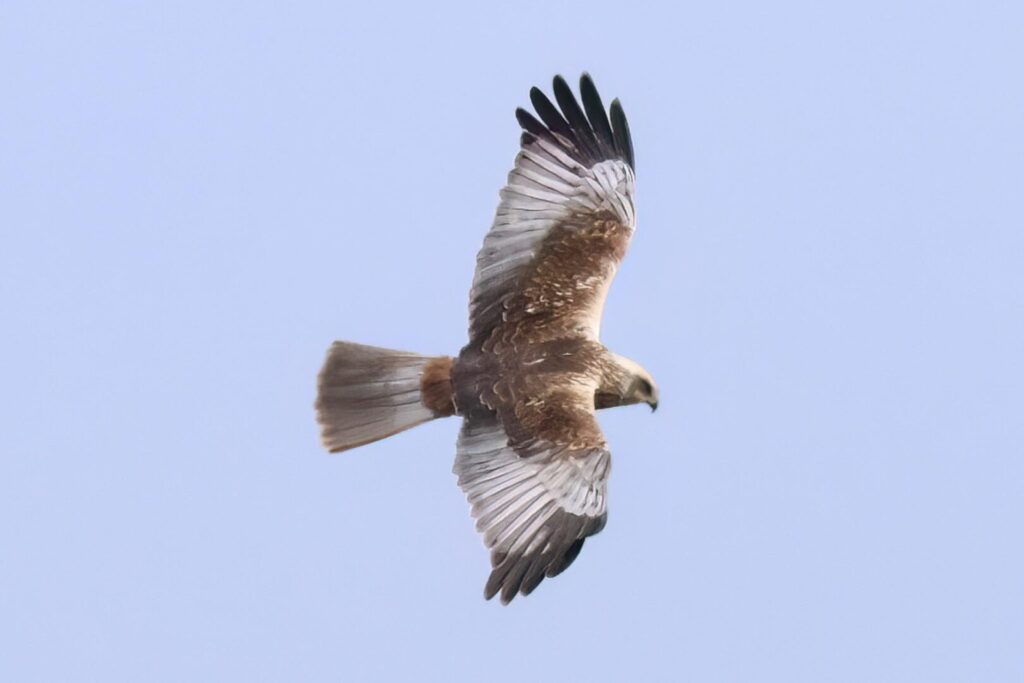
We decided to move on. Several Sedge and Reed Warblers were singing. A male Marsh Harrier came in with prey and circled over the reeds. A female came up next to it but the male didn’t seem to want to give her the food at first. They flew across and were half hidden behind the reeds when he finally made the food pass. She caught it and dropped down while he continued to circle above.
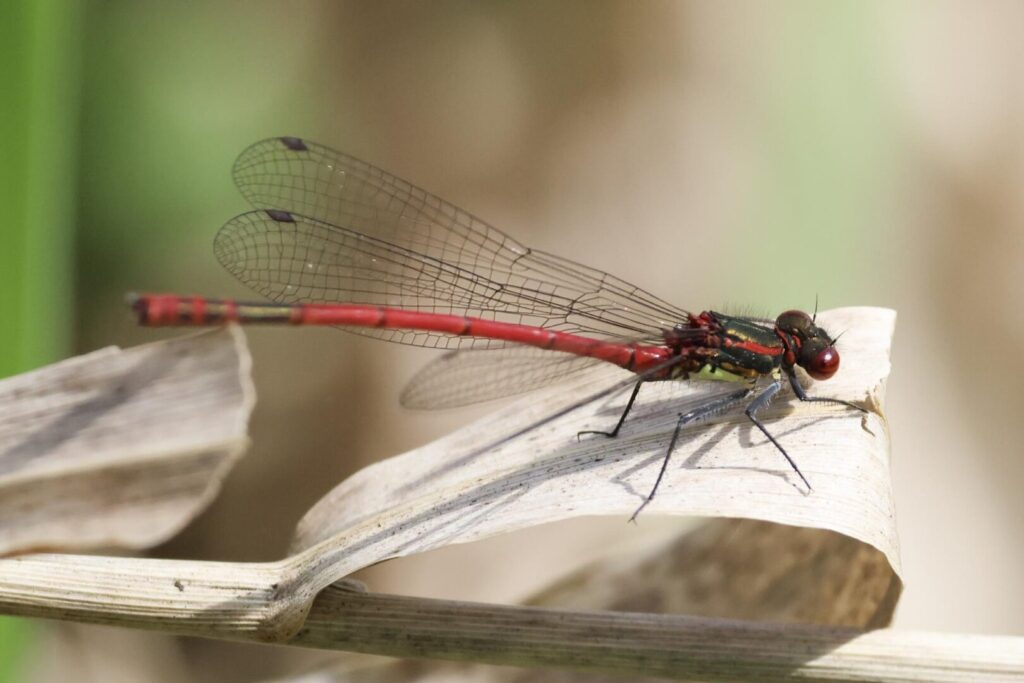
As we got past Trial Wood, it was a bit of a surprise that we hadn’t heard a single Cuckoo calling yet. A Large Red Damselfly landed on the reeds by path and further on, a Hairy Dragonfly was hawking round by the path. Our first dragonfly of the year. A Great Crested Grebe was on one of the larger pools in the reeds.
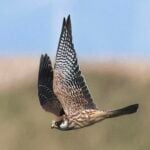
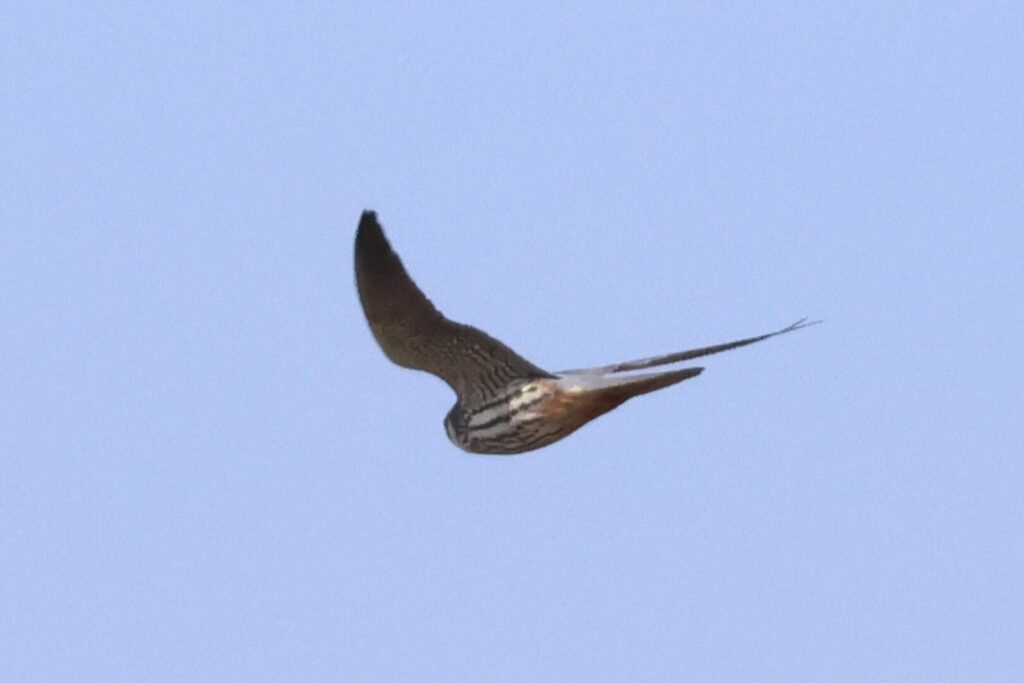
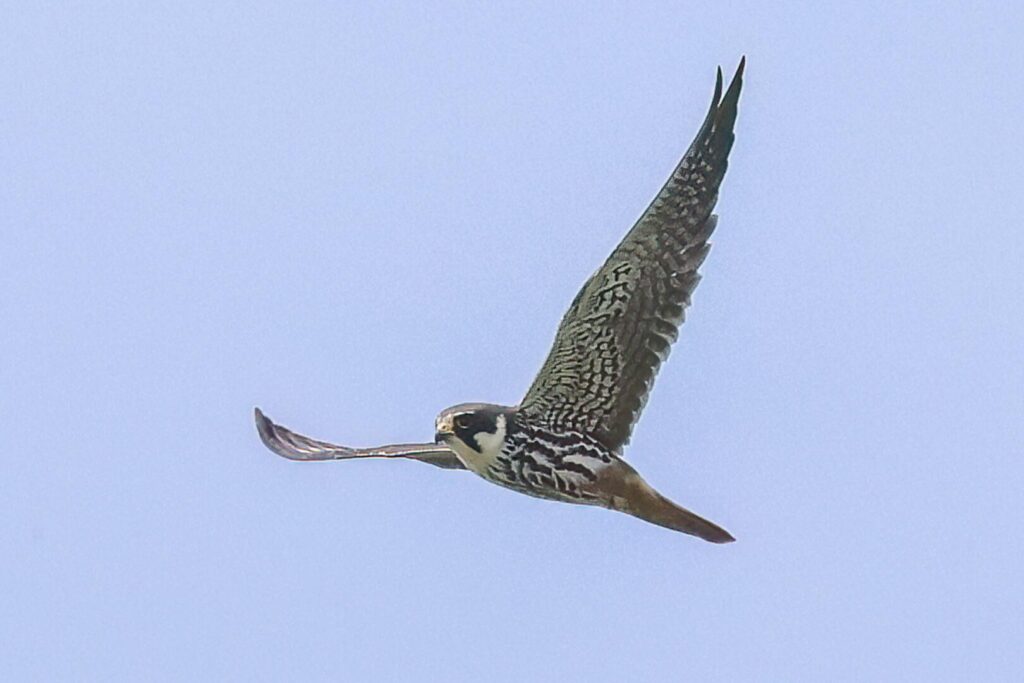
Just before we got to New Fen Viewpoint, we saw several Hobbys beyond the trees, at least 8. From the Viewpoint itself, we had a clearer view and could see there were more, up to 14 now. They were all very distant but interesting to watch them catching and eating insects on the wing.
It had been an early start and we had brought it with us, so we stopped now for an early lunch. A Bittern boomed briefly, right in front of the viewpoint. We scanned the reeds just in case, but unsurprisingly it was not in view. A Cuckoo now started calling behind us in the distance. It sounded like it was in Trial Wood, just where we had expected to hear one as we walked out.
A Kingfisher called but we couldn’t see it at first. Then it flashed out from behind the willow just to the right of the viewpoint. It splashed down into the water and then flew back up and behind the tree again. Too quick for most of group to see. Thankfully it then did it a second time, and caught a fish. Everyone saw it this time.
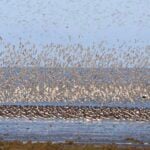
The Hobby numbers were gradually increasing, each time we counted again. One or two flew in from behind us a bit closer but were always going quickly away by the time we picked them up. By the end, we had counted a minimum of 33 Hobbys in the air together, an impressive number. Quite a spectacle and amazing to watch them at their spring gatherings like this. A Sparrowhawk circled up at one point too and several Marsh Harriers were back and forth over the reeds.
A Cetti’s Warbler kept shouting from the bushes in front. We heard Bearded Tits calling and had a brief flight view as two shot across and disappeared over the bank to our left.
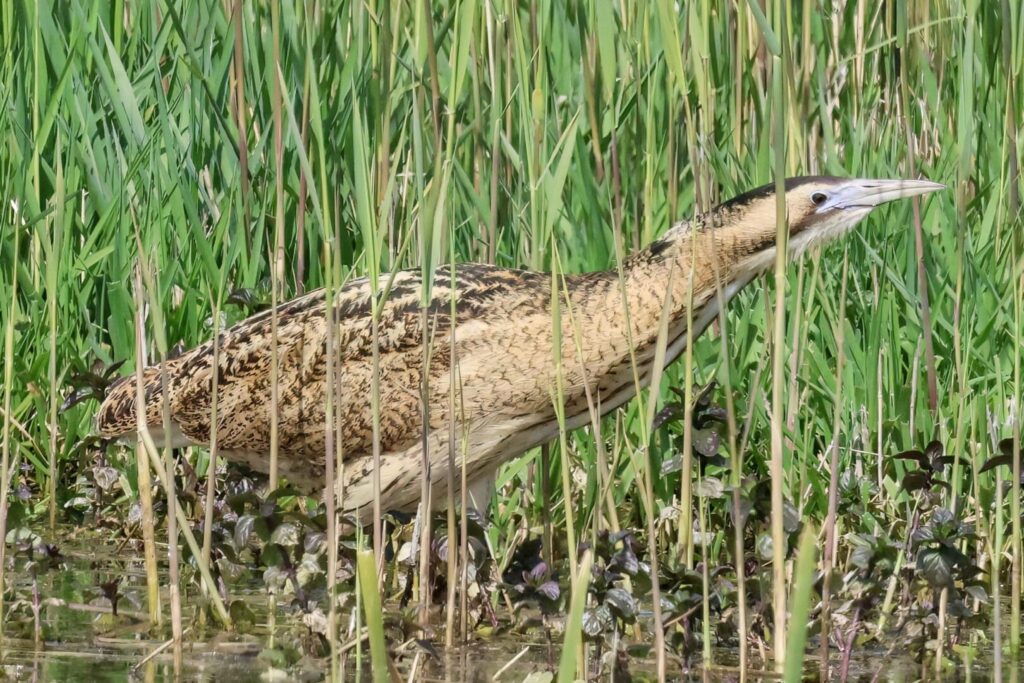
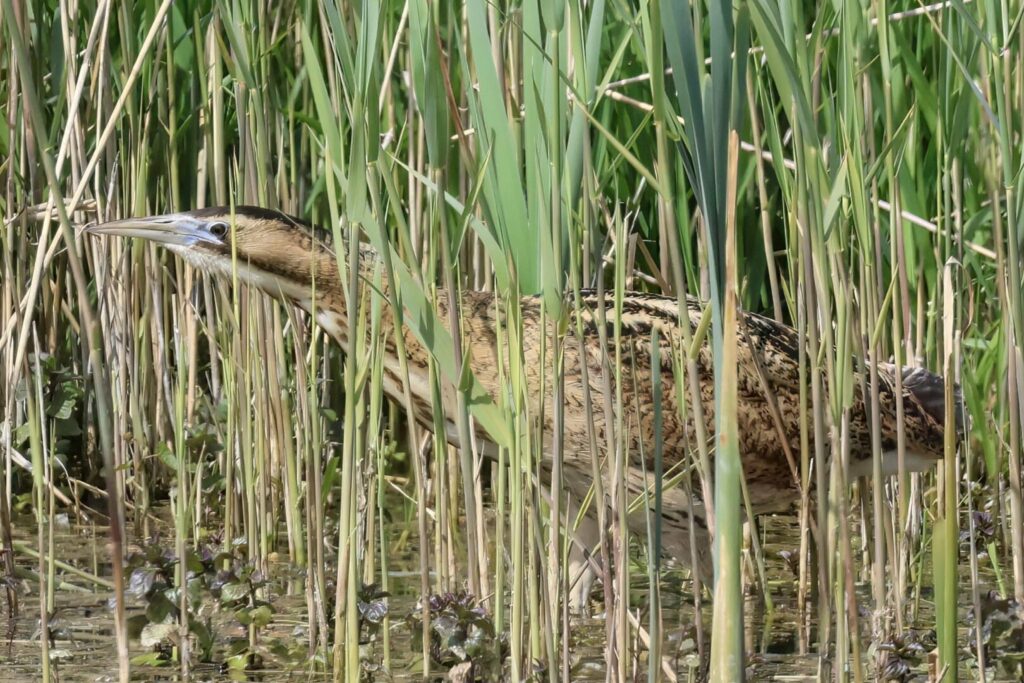
Some movement on the edge of the reeds just across the pool in front of us caught our eye. A Bittern walked right out into the open. A male with blue facial skin, it was probably the one we heard booming from pretty much the same spot earlier. It stalked slowly round the edge, showing off its large feet and long toes as it stepped, a fantastic view of what is normally such a secretive species. Then it walked into the reeds in the near corner. Wow!
The Cuckoo was still calling and someone picked up one flying in along the edge of West Wood behind us. It landed in the poplars and we could still hear it. But despite scanning with the scope, we couldn’t see it in all the branches and leaves. After a while, one Cuckoo flew out and was chased by a second.
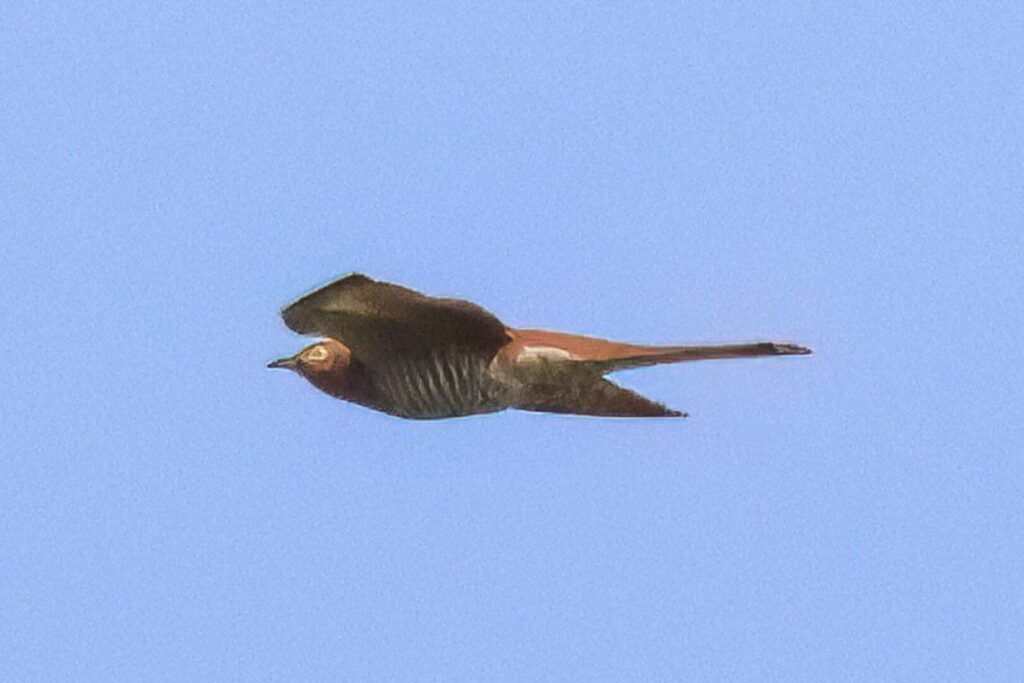
It seemed to be that the male Cuckoo was now chasing a female. We just had a glimpse of colour as they flew over through the sun and checking photos later we confirmed that the female was a rufous (or hepatic) morph. The females occur in two forms, normal grey ones and rufous ones, the latter quite scarce in UK.
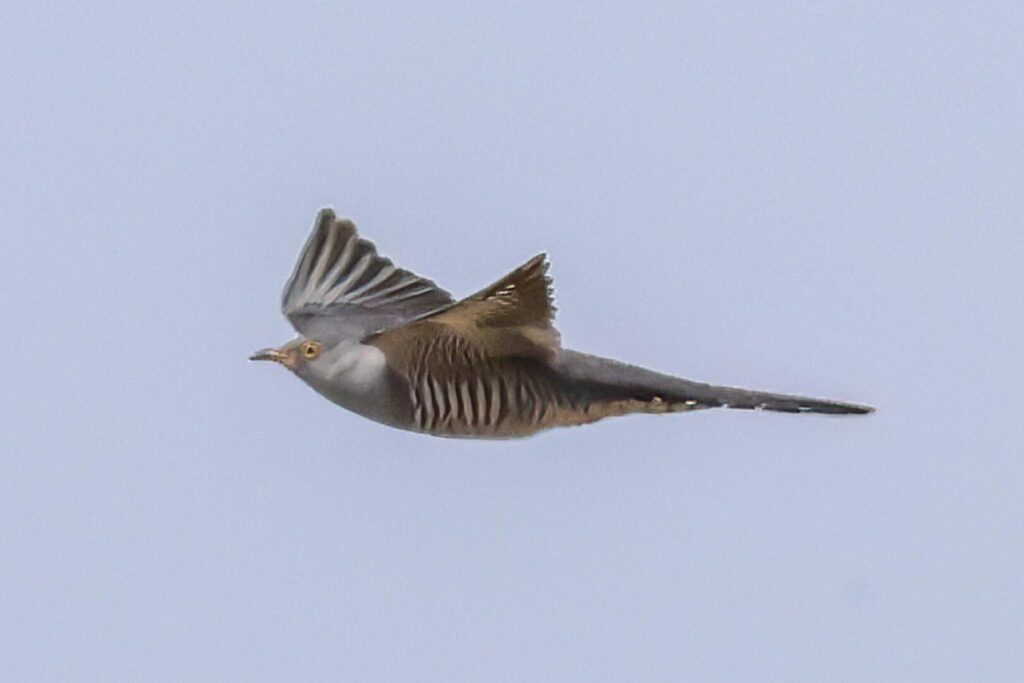
The two Cuckoos disappeared round behind all the bushes off to our right. A little later, the male flew out again and across in front of us.
A couple of people at the Viewpoint had brief glimpses of possible Cranes but they never came up properly. They are busy nesting and not very active at the moment. We did hear them calling at one point. Several Water Rails were calling too, from deep in the reeds.
As if once wasn’t enough, the Bittern now reappeared, walking back the other way. More great views. This time, it was stalking more slowly in the shallows, fishing. It stopped every few steps, wobbling its body and head from side to side, and then stabbed its bill into the water. It was pretty successful too and caught something several times. Eventually it disappeared back in where we had seen it emerge first. Amazing!
We had certainly been spoiled here today, so we decided to head back to the minibus. On our way past, the Bittern was booming in New Fen now too. We drove back to the Visitor Centre and stopped for ice cream in the sunshine. Afterwards, we walked out to check the Washland and see if any of the Garganey were still there.
A couple of the locals were already here, and had found a pair of Garganey at the back of Hockwold Washes. We got the male in the scopes and admired its long white eye stripe, despite there being a bit of heat haze now. There was a nice selection of other ducks too, Shoveler, Teal and Gadwall.
Scanning around the edge, we found several too waders. Four Avocets, three Black-tailed Godwits, two Ruff, several Redshanks and Lapwings. A Great White Egret was stalking in the shallow water in one corner.
There were a couple of Hobbys way off in the distance beyond the Washes, and was we looked over we picked up another one flying in much closer. It flew in along the line of the river and then past right in front of us. Much better views now and a great complement to the spectacle of the numbers out at Joist Fen.
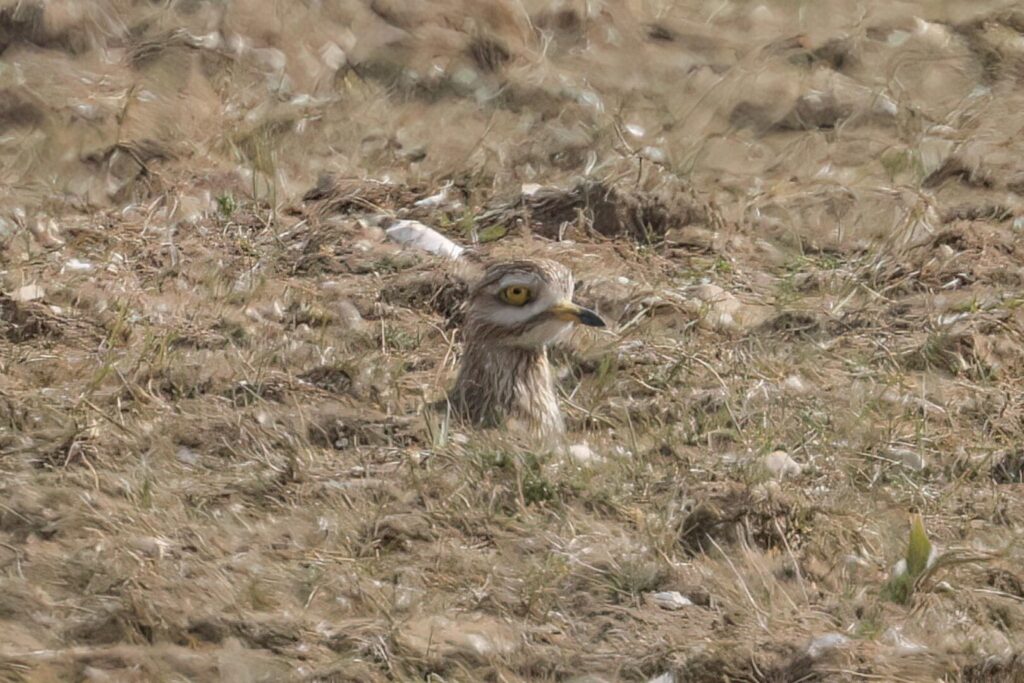
Back to the minibus, and we had time for one last stop. We drove back round to Weeting. Out at West Hide, two Stone Curlews were out in the cultivated area in front. They were hunkered down when we arrived, and all we could see were there heads and backs. Very well camouflaged against the dry sandy soil. They were dozing at first, occasionally opening their eyes so we could admire their bright yellow irises.
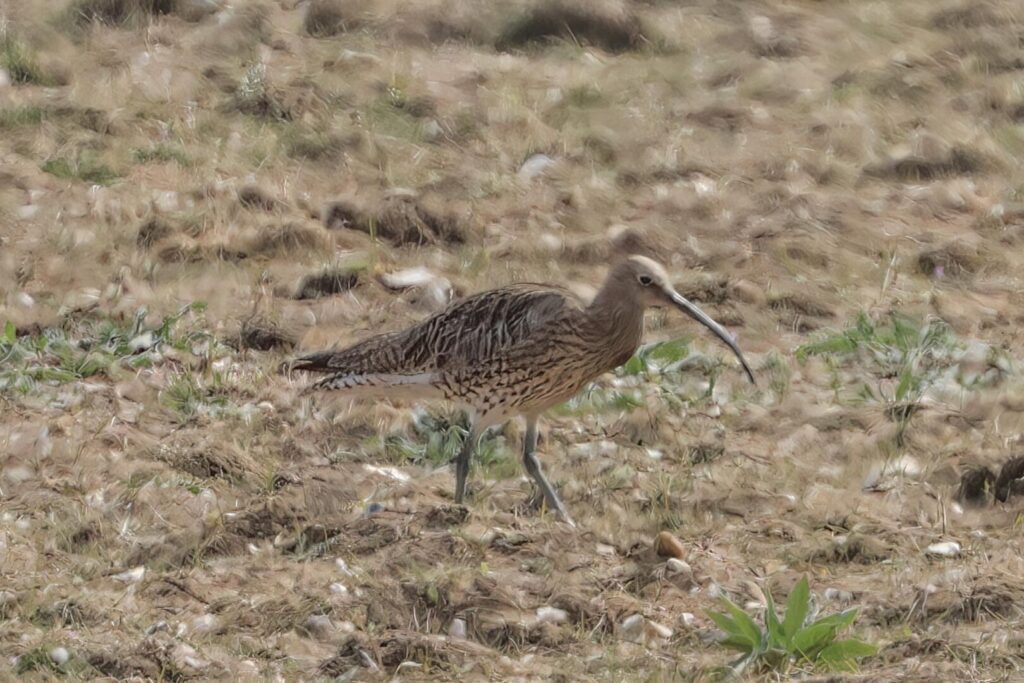
A (Eurasian) Curlew was on its nest in the cultivated area a little further over too. Not closely related to the Stone Curlew (which is actually a member of the Thick-knee family but has a haunting call a bit like a regular Curlew), but they share a liking of similar habitat to breed in here. The smaller male Curlew flew in and landed away from the nest. Then it slowly walked over, looking round all the time presumably to check for predators, then the two birds swapped places. The female then flew off to the fields to feed.
There were several Lapwing out on the grass, one pair with four small juveniles further back. A Wheatear flicked around up on the ridge beyond. They used to breed here but these days are just passing through. A Mistle Thrush was feeding in the grass to the right of the hide.
After a while, one of the Stone Curlews stood up and had a preen. Then it walked over to a shallow scrape in the ground, bowing with its tail raised. It sat down on the scrape and then the other one got up too. When it walked over to where the first was sitting, the two swapped places. Not clear what they were doing, but hopefully they will be about to nest.
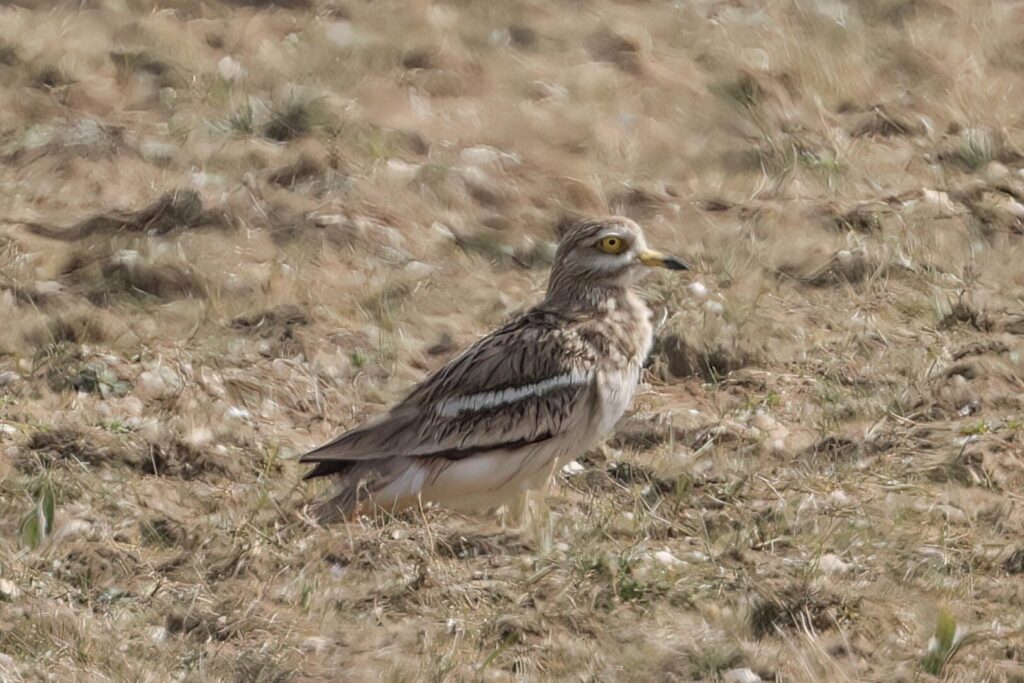
It was a great end to the day, watching the Stone Curlews and other birds on the Brecks heath. Then it was time to head back. People had long drives to get home and there was still a last chance for tea and cake waiting for those who wanted it first.