Day 1 of a Nightingales & Spring Weekend tour. A hard frost overnight and some patchy mist which burnt back first thing. Then it was a glorious sunny spring day with pretty much wall to wall blue sky, though there was still a chill to the NW wind on the coast. We spent the day in NW Norfolk.
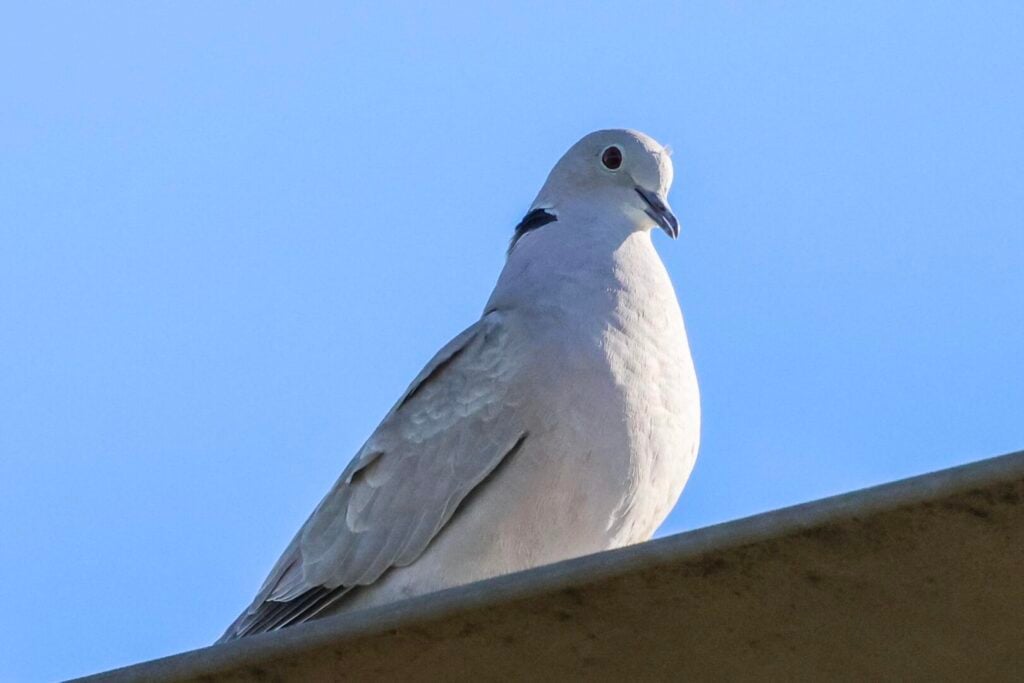
Our destination for the morning was Snettisham. As we drove in along beach road, there were lots of cars parked on the verge already and we had to park in the beach car park. As we walked back along the road, a couple of Greenfinches were calling in the bushes. In through the gates, we were hoping for a Turtle Dove again. Something caught our eye on the telegraph post but it was just a pair of Collared Doves this time, the male displaying to the female. Two Mediterranean Gulls flew past, flashing their translucent white wingtips.
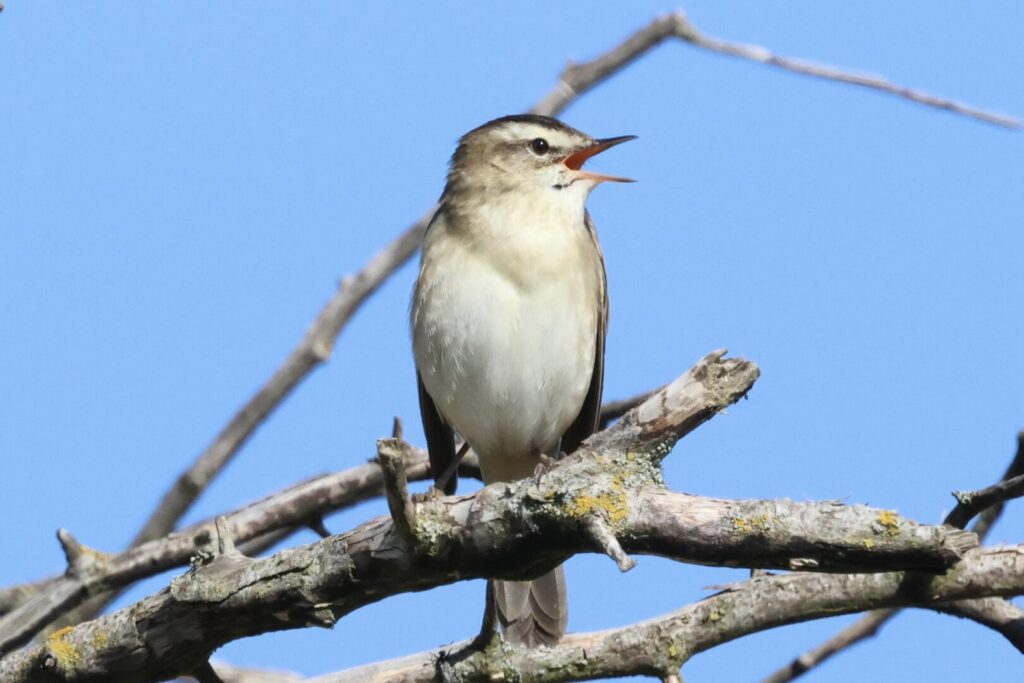
There were lots of warblers singing in the bushes, Blackcaps and Chiffchaffs. A Lesser Whitethroat flew across and landed in the tangles in front of us. A nice view briefly before it dropped back in. Another was singing its rattle song the other side of the path. Further on, we heard the first of many Sedge Warblers – we would see lots all morning here. There were lots of Common Whitethroats singing too.
When we got to the open area, a Wheatear flicked across in front of us and landed on a low bush. A smart male. There were lots of dogs out this morning and as a ball was thrown out into the middle for one, the Wheatear flushed. Several Linnets and Meadow Pipits came up from the grass and flew round too. When the dog had picked up its ball, eventually they settled down again. Nice views of the Wheatear now.

There had apparently been a Ring Ouzel here earlier but perhaps no surprise it had moved on with the amount of disturbance this morning. A pair of Stonechats in bushes behind us.
Up onto the seawall, we looked out over the Wash. The tide was out and a we couldn’t see any Ringed Plovers in the cordons now. There were lots of Shelducks and Brent Geese distantly out along the shore, and lots of Oystercatchers. A Spoonbill flew past along the edge of the water, its long neck stretched out in front.

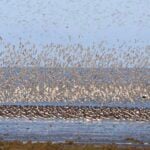
Scanning further up along the shore, we found a large flock of waders on the edge of the water. There were several Bar-tailed Godwits, some now in rusty breeding plumage. Several of the Grey Plovers were now looking very smart too, with black summer faces and bellies. A scattering of Knot and Dunlin were feeding in with them.
Back down into the middle, we continued on north. A Cetti’s Warbler shouted from the reeds and we had a quick view of it perched up before it flew off. We could hear a Grasshopper Warbler reeling but it sounded deep in. We stopped to scan but couldn’t see it. A Reed Bunting perched up. As we continued on, two Whimbrel flew over.
A Yellow Wagtail called as it flew up from the seawall ahead of us. We watched it land in the grass further up, by the fence. As we walked over, we found there were lots of Wheatears in the grass here too and perching on the fenceposts. All spring migrants stopping off here to feed. The Yellow Wagtail reappeared feeding on the path and we had a nice view until a dog appeared down from the seawall and spooked it. Thankfully it landed again a bit further back, in the safety of the fenced area.
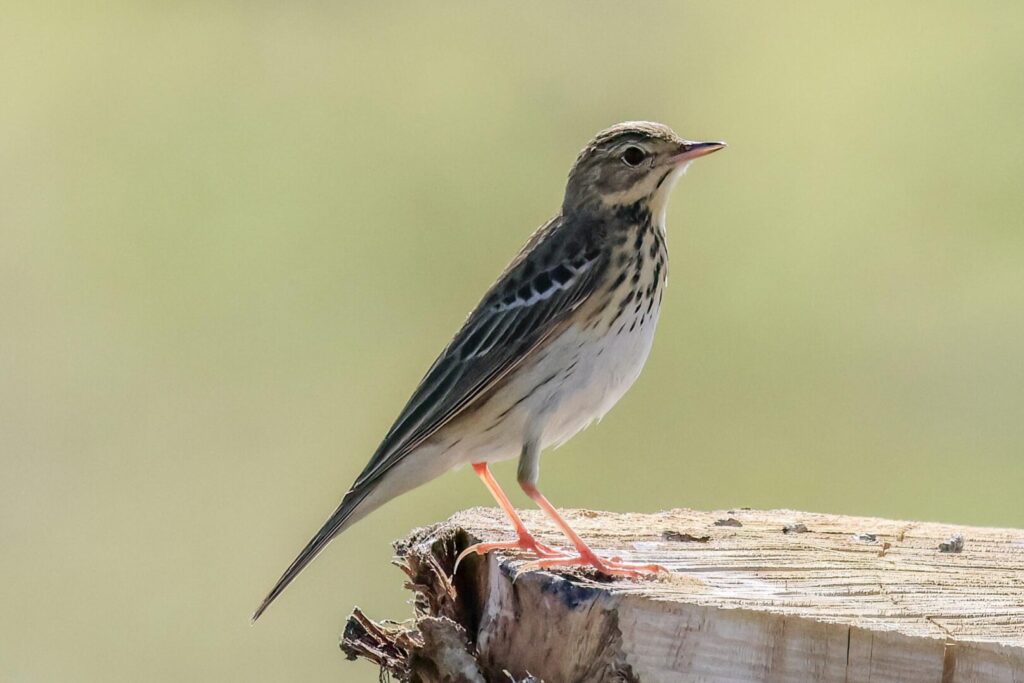
We walked on and could see the Yellow Wagtail still in the short grass beyond the fence. When it disappeared from view into a dip, we made our way over to the edge of the fence. A pipit flew up in front of us and landed on a fencepost. A Tree Pipit! We could see its white belly with fine stripes on flanks, contrasting with the yellowish ground colour to its breast. Another spring migrant. After a while, it flew back and landed back in the long grass.
The phone rang and it was one of the local birders telling us that there was a Black-winged Stilt on Ken Hill Marshes (thanks Mark!). We could see them watching it from the top of the inner seawall, only about 50 metres from us. We walked over and climbed up onto the inner seawall. It was tricky to see at first, feeding on a scrape out in the middle of the marshes, hidden behind some reeds. Then it came out into the open and we had a good view of its extra long bubble-gum pink legs, despite there being quite a bit of heat haze now.
The marshes here are drying out fast, there has been very little rain here for some time now. We had a quick scan from here and could see lots of geese, Greylags and Canada Geese and a couple of Egyptian Geese. A Spoonbill was up in the trees in the distance and another was asleep on the bank below. A Grasshopper Warbler reeled briefly behind us.
We made our way back through the middle, as we were heading for the beach car park. The first Grasshopper Warbler was still reeling where we had heard it earlier. We stopped to listen, as it seemed to be coming closer but we couldn’t see it before it went quiet.
Back to the minibus, and we could see that a White Stork had been tracked flying along the coast all the way from Sheringham to Holkham this morning. There were no updates since Burnham Overy now though. We were heading for Titchwell next, so we decided to drive round on the coast road to see if we could cut it off somewhere. When we got to Hunstanton, we had a message to say it was over Thornham and then another from Holme. Game on!
There was frustratingly slow traffic through Hunstanton but we eventually got through and somewhere to pull off the road with a good panoramic view down towards the coast. We got out to scan and immediately picked up the White Stork flying over Holme Beach Road in the distance. It flew towards the coast, circled over the start of the golf course and looked like it might head out to sea. Then it changed direction and went back the way it had come.
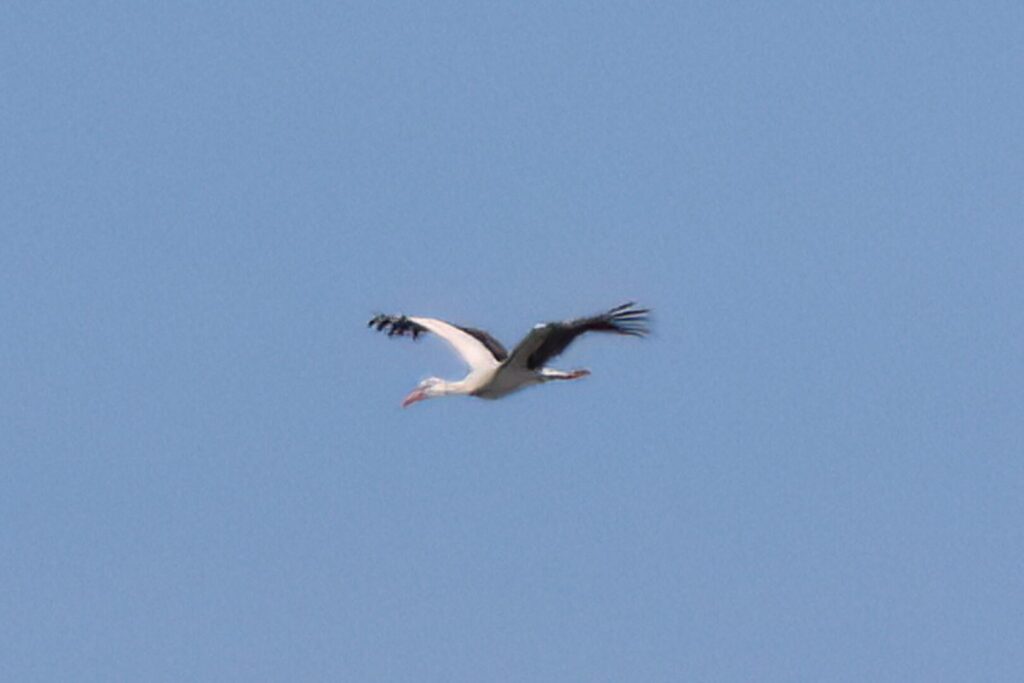
The White Stork turned again and started to head straight towards us. We thought it might eventually come right overhead but then it stopped to circle. It managed to get some more height in a thermal, then broke off and headed south west, presumably having seen the Wash ahead and figuring it might as well cut the corner. We lost sight of it as it flew over the coast road and disappeared off inland. Photos from along the coast show it was ringed with a metal ring so its origin isn’t clear, perhaps from one of the reintroduction schemes. Always great birds to watch soaring along the coast and a nice bonus.
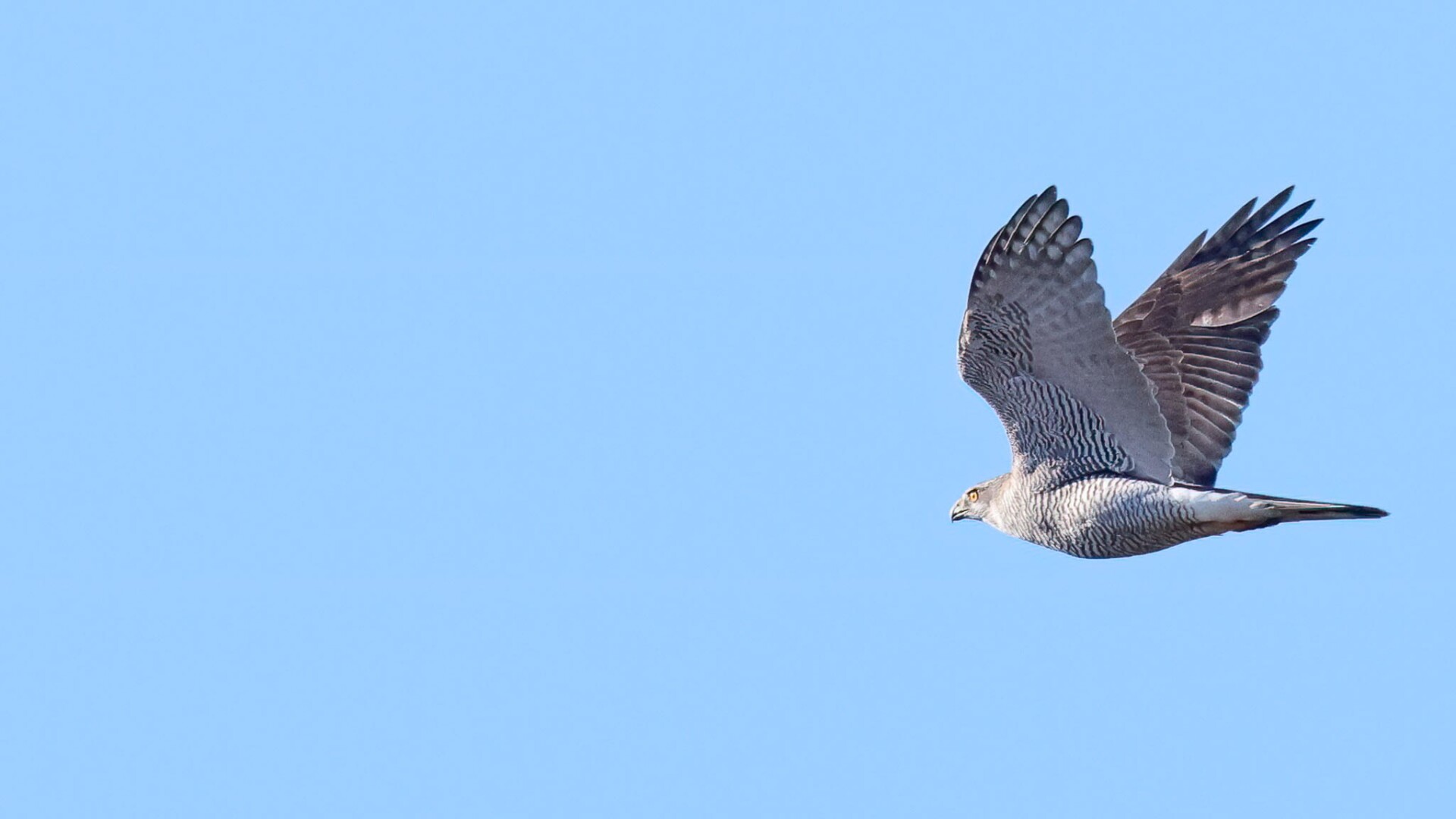
On to Titchwell and it was now lunch time. Sitting in the picnic area, a Treecreeper was in the trees behind and we could hear a Goldcrest singing. We heard and felt the whoosh of wings as a Sparrowhawk flew through between us, sat on one of the picnic tables. It seemed like it almost took our sandwiches, but was probably after one of the tame Robins waiting in the bushes just behind us. We didn’t see if it caught anything, it was over in a flash, and we managed to see it briefly again as it flew back out over the picnic area.
After all the excitement of lunch, we headed out onto the reserve. There were lots of Reed Warblers singing in the reeds now all the way along. We stopped to scan at the Reedbed Pool. A single Little Grebe and a Great Crested Grebe were out on water. Several Tufted Ducks and a couple of Common Pochard were on the main pool, and a female Pochard was diving on the Borrow Pit right below us.

A couple of Marsh Harriers patrolled up and down over the reeds at the back. Several House Martins and Sand Martins were hawking over the back of the reedbed too. A Common Snipe flew across the reeds, past us and landed on the saltmarsh behind before running into cover. Two Chinese Water Deer were out on the saltmarsh too.
On to the Freshmarsh there were lots of Avocets in front of Island Hide. A large flock of Brent Geese flew in chattering and landed on the water. The water levels are starting to drop on the first compartment now, and the islands have started to appear again. A single Ruff was feeding in between the Black-headed Gulls on one, a male in mid moult with a rather scrawny neck.

We walked on to the bund and stopped to scan. Several Little Ringed Plovers were on the next compartment and we got one in the scope so we could see its golden eye ring. Another male Ruff on here was completely different from the first, this one rusty with a white head but yet to get its ornate ruff. A close pair of Gadwall were feeding in the cut reeds just below us, giving us a chance to admire the male’s intricately patterned plumage. Three Common Terns were roosting on the island in with the gulls here but mostly asleep.

Continuing round to Parrinder Hide, we were just going in when someone coming out told us there was a Wood Sandpiper out on the scrape. The people in the hide had lost sight of it though and had no idea where it had gone. A Wall butterfly fluttering a round in front of the hide was our first of the year.
There were lots of gulls on the islands here too, including a good number of Mediterranean Gulls in with Black-headed Gulls. Nice views in the scopes. One pair of Mediterranean Gulls were standing next to a Ringed Plover on the nest. Another Mediterranean Gull had a white colour ring – it had been ringed in Netherlands or Belgium but at the time of writing we are still awaiting details. A pair of Sandwich Terns flew over but headed straight back out to beach.

We had a brief view of the Wood Sandpiper now. It was on the edge of the bund beyond the point but disappeared straight back round the corner out of view. We scanned to see if it would come back out and picked up a Common Sandpiper instead, on the bund further back.
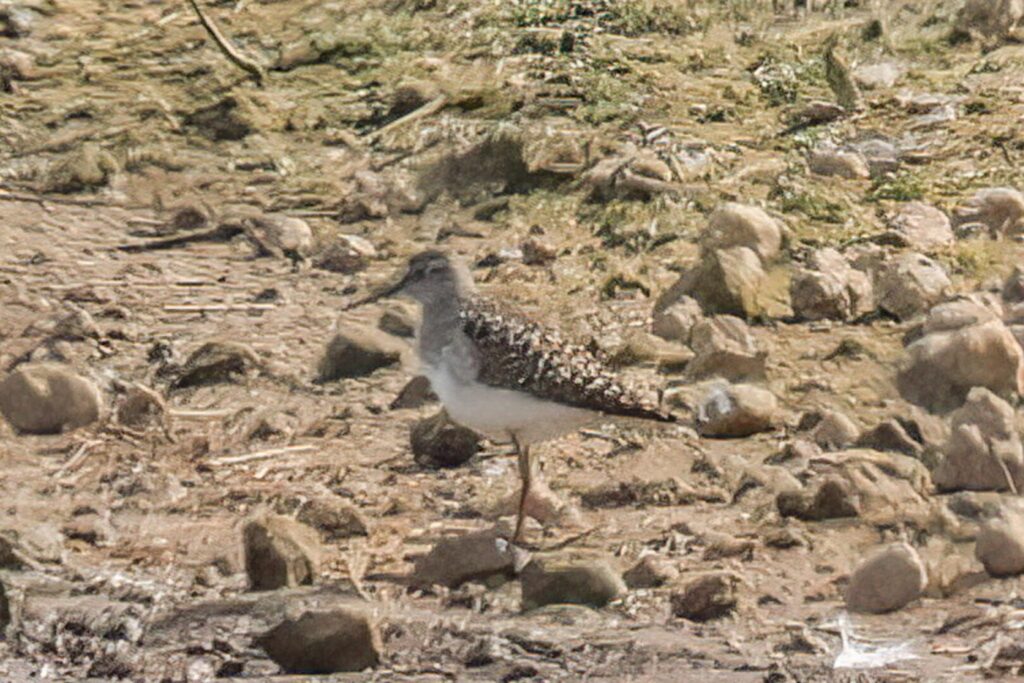
There was no sign of the Wood Sandpiper coming back round the point, so we went out and up to the terrace above the hide to see if we could see it from there. It was just visible from the far end, so we got it in the scope. It gradually worked its way towards us, picking along the water’s edge, and came round the point this time, out into full view. But it was quickly chased off by a male Ruff, a different black male this time. It disappeared round beyond the point again.
Thankfully the Wood Sandpiper finally came back out and walked towards us again. Nice views in the scopes, we could see its obvious pale supercilium and pale spangled back.
Yet another different male Ruff was preening in front of one of islands. This one was already growing its ornate ruff and fluffed it up as it preened. An Egyptian Goose was in with the Greylags on Avocet Island. A Sparrowhawk circled up over the edge of the reedbed. We were just about to leave, when a Dunlin dropped in onto the island in front of the hide with a Little Ringed Plover briefly.
We decided to brave the chill in the light breeze and walk out to the sea. There were just a few Redshanks on the side of the channel on Volunteer Marsh as we passed. Several Common Pochard were diving on the Tidal Pool. A few Oystercatchers were roosting on the island behind, a couple of Turnstones in with them. We found a single Black-tailed Godwit feeding in the deep water at the back. A Swallow flew straight through west without stopping – a migrant on its way.

Out on the beach, the tide was coming in and the mussel beds were already covered. We could see a good scattering of Sanderling up and down the shoreline. Lots of Sandwich Terns were flying round out on Scolt Head around the colony, but little more than dots in the haze from this distance. Then two Sandwich Terns flew in over the beach and right over our heads – a bit closer!
It wasn’t warm out on the beach, so we didn’t linger too long. On the way back, the two Sandwich Terns flew back past and out to sea again. The Common Terns were awake now on the Freshmarsh, so we stopped to get those in the scopes. A drake Shoveler swam across in front with its head up, giving us a good view of its massive shovel-like bill.
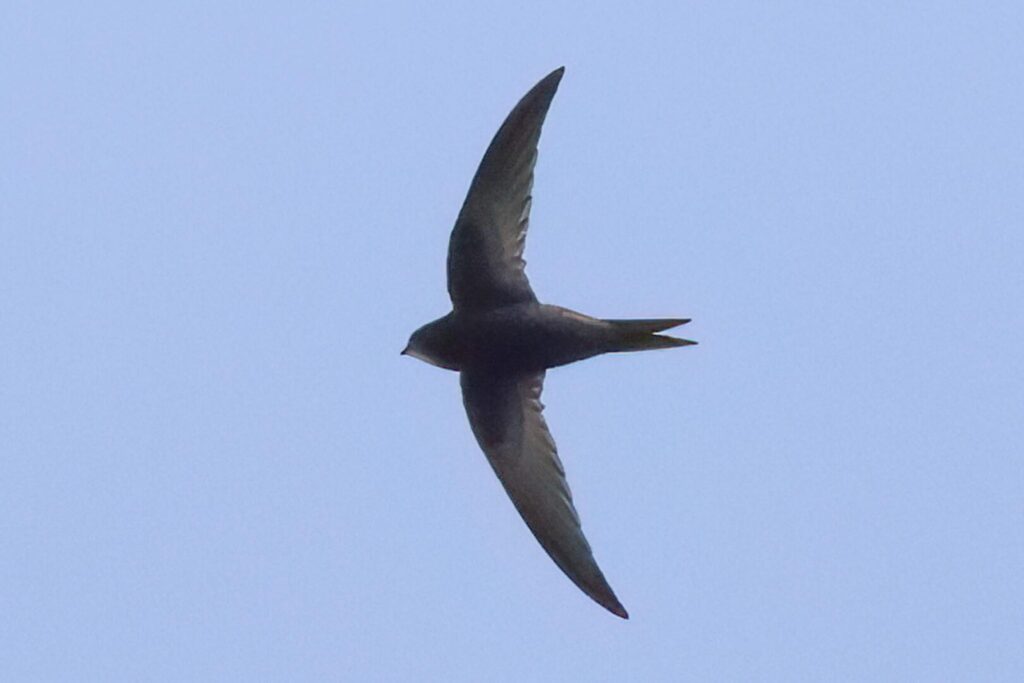
A Grey Heron flew in and landed on the reedbed pool. It couldn’t stay still, and kept flying and landing. The House Martins and Sand Martins were much closer now, over the near side of the reedbed. Several Common Swifts were in with them, zooming back and forth, so we stopped to watch.
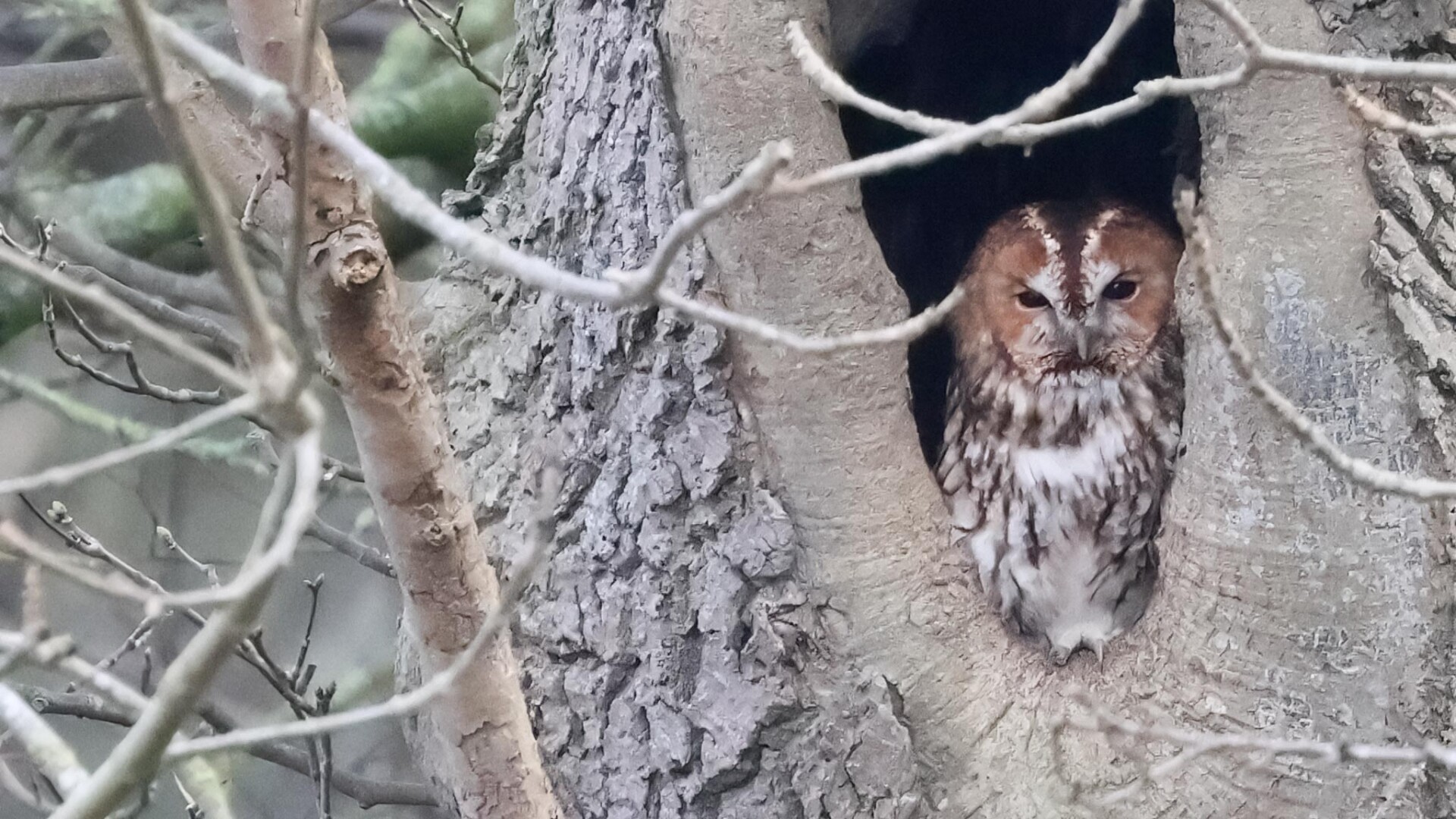
Back to the Visitor Centre, we decided to have a quick look at the tree where the Tawny Owl usually roosts, but there was no sign of it today. One of group the stayed at the feeders and had seen a Siskin come in and out by the time we got back. Scanning the trees behind, we found it now up in the willows. It flew higher up into one of the alders where we could see it feeding on cones.
It had been a lovely day of spring migration on the coast. Time to head for home now, with tea and cake waiting for us.