The second of two Winter Birds & Owls single day tours in North Norfolk. It was a very foggy start, but the fog lifted during the morning to mist and then cleared in the afternoon. Some bright, sunny spells were not in the forecast. It was milder than of late again too and stayed dry. Even the morning fog didn’t stop us getting out and seeing some birds, including some owls.
It didn’t look promising as we met early this morning. We were heading out to look for Barn Owls but the fog was very thick overnight and was showing no sign of lifting. When we got to our first stop and disembarked from the minibus, we could barely see to the far side of the field opposite.
Unsurprisingly, it was rather quiet at first. We could hear a couple of Pink-footed Geese calling and looked up to see them emerge from the fog. A Grey Heron appeared, circling down into a nearby ditch. Three Curlews flew over.
It felt highly unlikely that we would see a Barn Owl out in these conditions, although it was dry and there was little or no wind. Then one of the group spotted something flying out of the fog behind us. A Barn Owl! It wasn’t hunting and was flying high and fast, It seemed to be heading very determinedly in the direction of the barn where it roosts and we watched it disappear straight into the trees at the back of the trees in front.
While we waited for the light to improve, the next surprise was a Woodcock which shot past low over the reeds the other side of the road. Another bird presumably heading in to roost. There was no sign of the fog really lifting yet, but the forecast was still promising some improvement later in the morning. We decided to move on.
We drove round to Cley and parked at the Visitor Centre. Walking down along the path to Bishop Hide, several Reed Buntings flicked up out of the reeds ahead of us. Another Reed Bunting was feeding on the ground on the edge of the path.
From the hide, we couldn’t even see to the far side of Pat’s Pool. We could hear Wigeon calling somewhere over there in the fog. The twenty plus Avocets were visible, still out in the middle. There were lots of Teal and Shelduck out on the water too.
We were hoping to catch up with the Jack Snipe here, as it is usually close to the hide. With the benefit of a thermal imager, we could see that it was hiding in the reeds out to one side. Thankfully, we knew where it would be as it has roosted in the same place before. It was next to impossible to see though, even with the scope. We kept looking back to see if the views would improve. After a while it started bobbing up and down and briefly came out more into the open. Unortunately, before anyone could get to the scope it moved deeper into the reeds and disappeared completely.
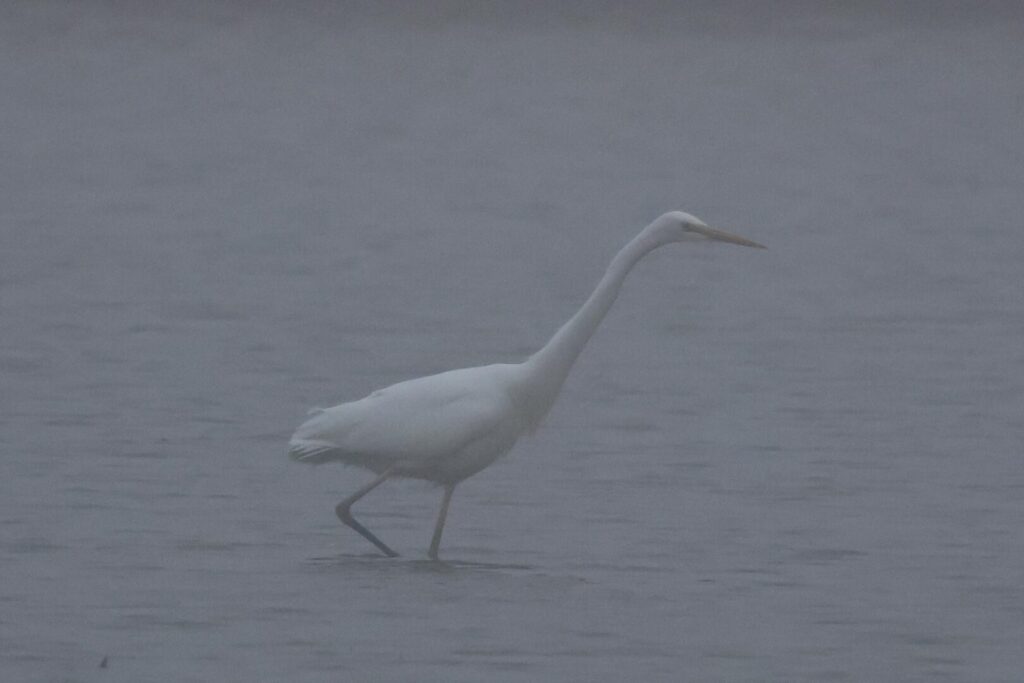
While we waiting for the Jack Snipe, a Little Egret had walked out from behind the reeds. The next time we looked back another egret was in the middle of the pool just behind. It looked a bit bigger but was that just a trick of the fog? No, this one was a Great White Egret.
With visibility so restricted, we decided to try for something else which might be within the range of visibility. Walking back towards the Visitor Centre, another small flock of Pink-footed Geese flew out of the fog overhead. We could hear Brent Geese too and could make out a group of the smaller geese with them. We could hear Golden Plovers calling in the fog overhead in the car park.
The Visitor Centre was still closed and we had a request for a loo stop. We were heading that way, so we called in at Blakeney quay to use the facilities there. The coffee stop was earlier than yesterday too although the pastries from the bakery still got the thumbs up. It was still hard to see far out across the harbour and we could only see a few gulls within view along the channel.
As we drove inland, the fog seemed to be lifting a little and the visibility improving. As we walked in along the footpath, a Song Thrush flew up from the grass. There were a few Chaffinches in the hedge. A Greenfinch flew out and a few Linnets came up from the field beyond. Further on, more Chaffinches flew up from the wild bird seed mix sown in the edge of the field. A Long-tailed Tit hopped along the top of the fence on the edge of the wood.
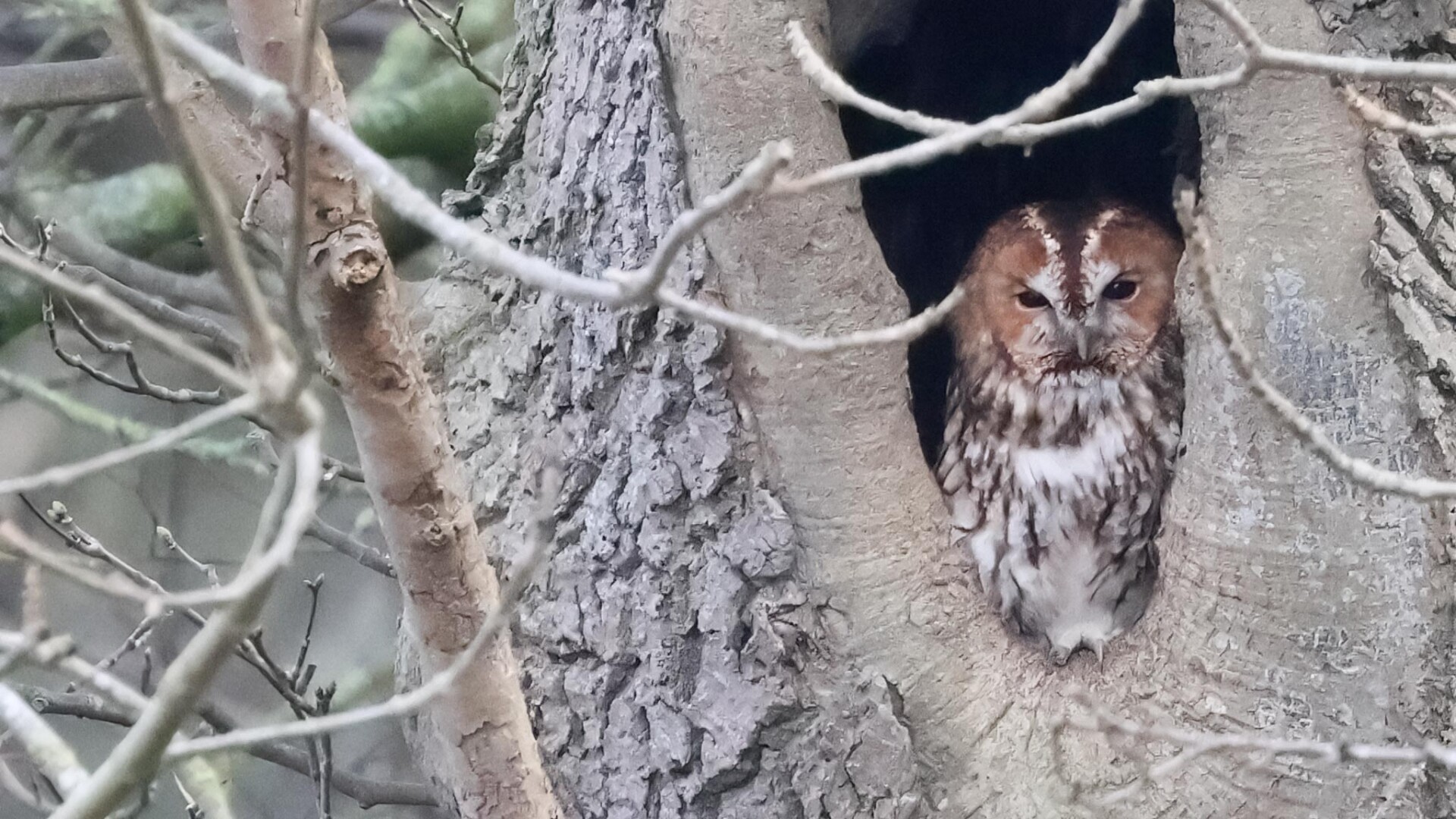
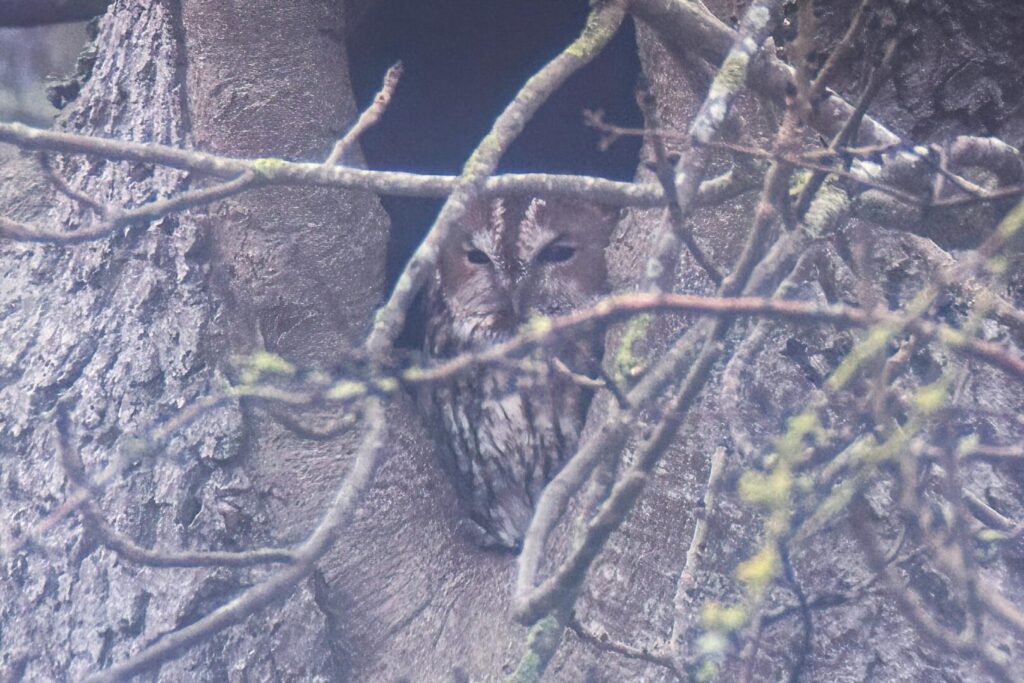
As we came round the corner, we could see the Tawny Owl was at the entrance to its tree hole again. We set up the scope and had a great view as it perched there looking back at us. It did turn round and look back into the hole at one point, thinking about dropping back in, but changed its mind and stayed put.
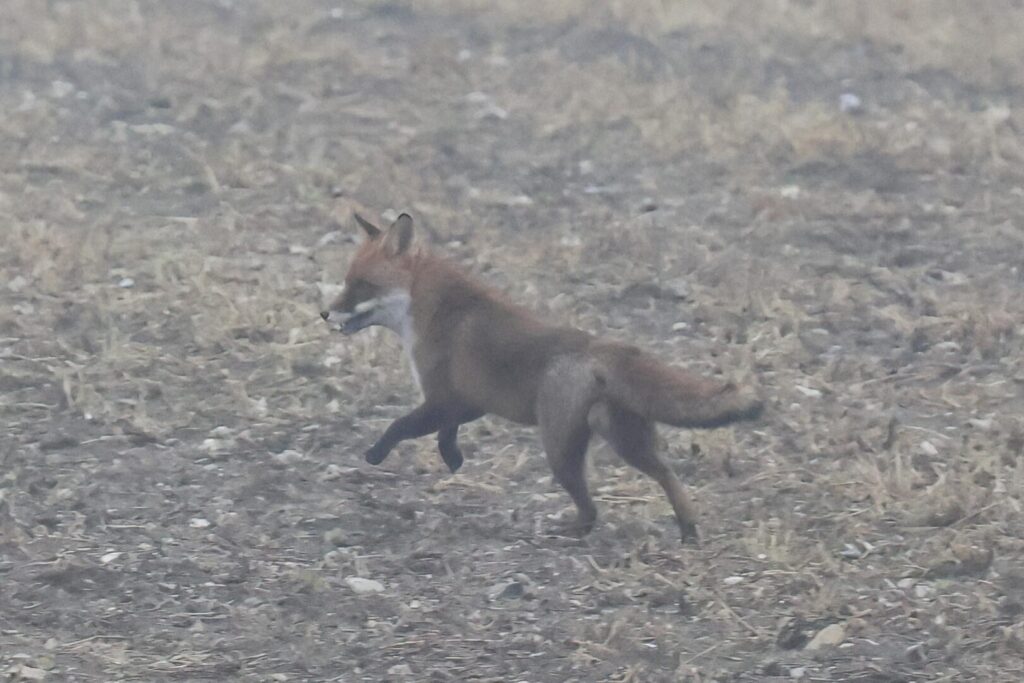
While we were watching the Tawny Owl, a smart male Red Fox ran across the path and off over the field between us and the wood. Not a species we see very often here. Norfolk is so extensively gamekeepered that numbers are kept under control and they tend to be more nocturnal as a result.
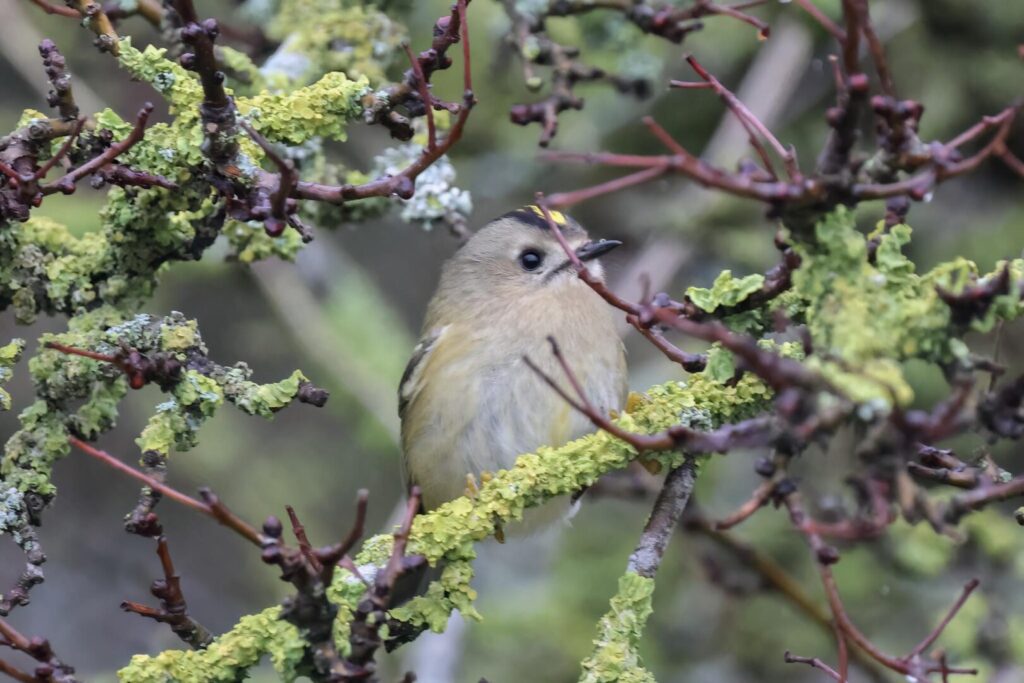
After enjoying great views of the Tawny Owl, we set off back to the minibus. Back around the corner, four Roe Deer ran out across the next field in front of us. A Common Buzzard was perched up on the bushes. We stopped to watch a Goldcrest flitting around in the hedge ahead of us.
Dropping back down to the coast road, we continued our way west. The worst of the fog had lifted but it was still very misty and visibility wasn’t great. As we stopped at Stiffkey, we couldn’t see out to the tip of Blakeney Point. Several Skylarks came up out of the fields and circled round calling.
The three Glossy Ibis had been reported on the flood again this morning, so we set off down along the permissive path to see them. We were almost there when someone coming the other way told us that they had been flushed by a Marsh Harrier and flown off. Having seen what they did yesterday, we pressed on regardless, thinking they could be hiding in the rushes. Once we got out of the trees, we looked out across the flood to see one of the Glossy Ibis out on the pool in the middle with all the ducks.
We shouted to the person who had just left and managed to call them back, while we set up the scope. Good views of the Glossy Ibis now as it stood there preening.
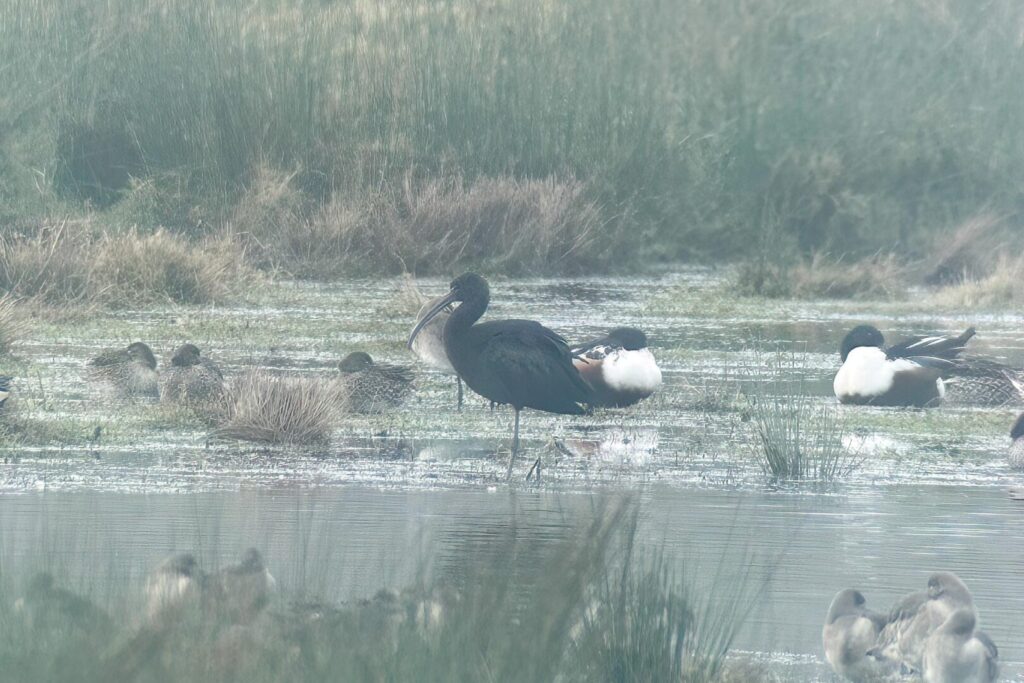
There was a nice selection of ducks on the flood again too, including several Pintail. As well as all the Greylags, two Egyptian Geese flew in and landed on the back of the water. We could see a few waders too. There were lots of Lapwing roosting on the edge of the pool and a small group of Black-tailed Godwits. Several Common Snipe were feeding in the wet grass.
After a while, the Glossy Ibis flew further back, behind the rushes. We walked back to the minibus. Given the poor visibility, we decided not to walk out to the edge of the harbour and drove on west instead. The two Cattle Egrets were still in the fields beside the road at Warham as we passed, though not feeding with the cattle today.
Our next stop was at Wells Beach. The mist had lifted and there were even some patches of blue sky and sunshine now. We walked up past the lifeboat station and scanned the harbour beyond. A Great Crested Grebe, already moulting into breeding plumage, was diving in the channel. But there was no sign of the Great Northern Diver further out on the water today.
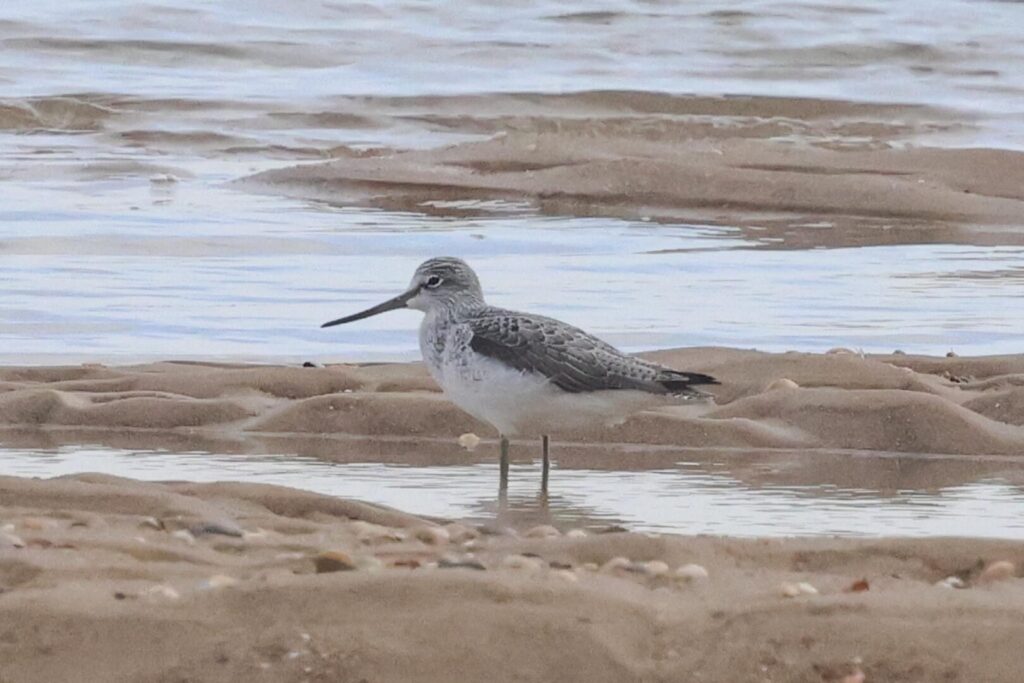
A couple of Sanderling were feeding on the edge of the outer channel. Scanning the sand opposite, we could see a nice selection of different waders. There were lots of Oystercatchers, a few Curlew and several Bar-tailed Godwits, which we got in the scope for a closer look. Checking through the Redshanks around the pools, we found a much paler Greenshank with them, although it kept disappearing behind the sandbar in front. Three Great Black-backed Gulls were feeding on a dead seal further back. A couple of Common Gulls flew up and down over the sand.
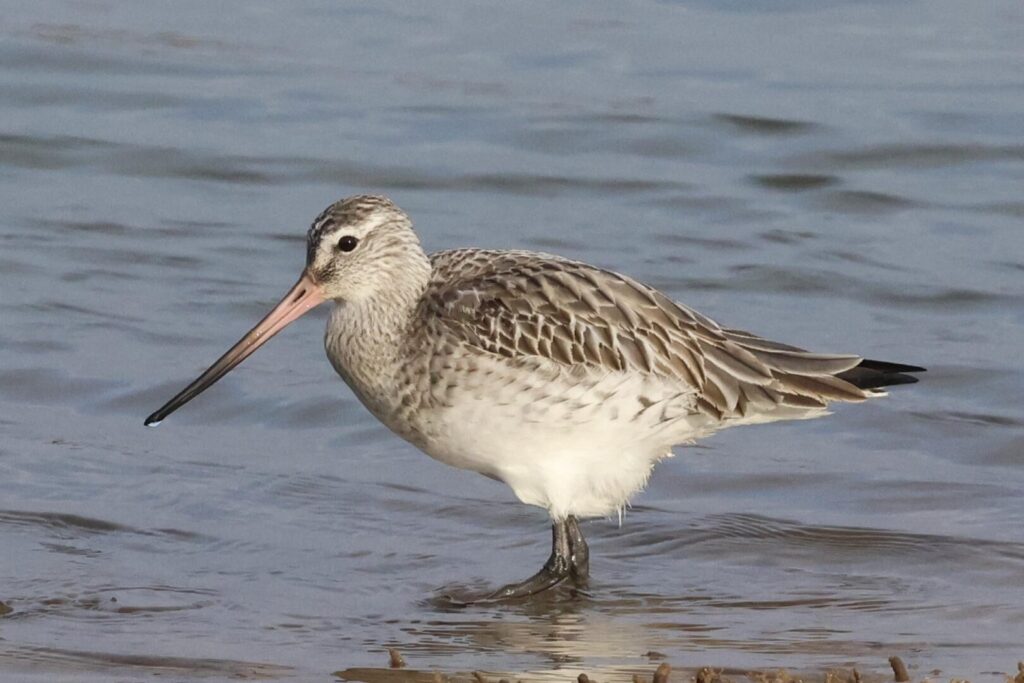
We walked down onto the sand and round on the edge of the channel to see if there was anything further up. There were a couple more Bar-tailed Godwits and a Grey Plover on the near side of the water. Good views close up.
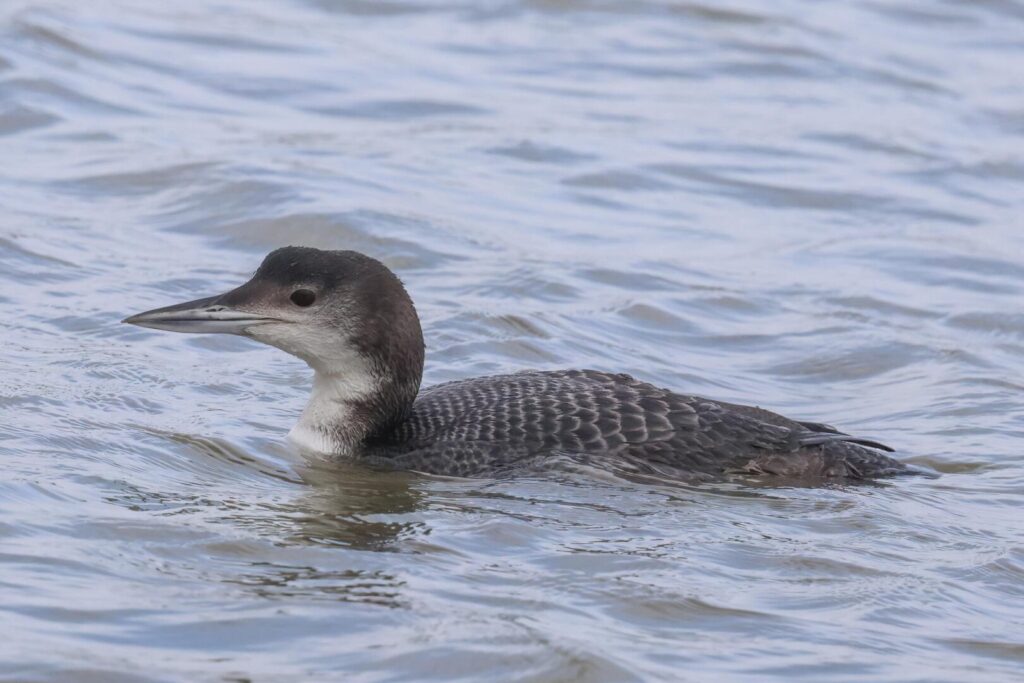
The Great Northern Diver was here now, out in the middle of the channel ahead of us. We stopped to watch it, diving continually. At one point it came up with a small crab in its huge bill which it played with briefly before swallowing. We thought it might be making its way down the channel with the tide, which was flowing out quickly. Instead, it had found a spot where it had stopped to feed.
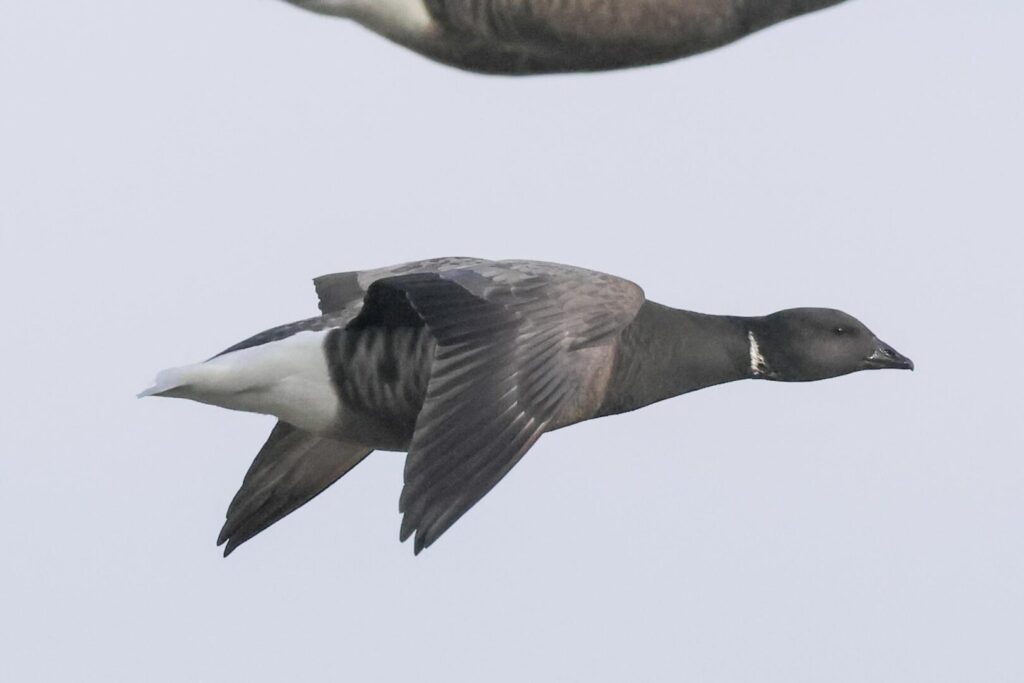
While we were watching the Great Northern Diver, a small group of Brent Geese flew past right in front of us. Two Red-breasted Mergansers flew past, heading for the outer channel.
We were looking slightly into the sun from here, so we walked a bit further up. The Greenshank was now on the near side of the channel, feeding in the small pools between the fingers of sand. When it stopped running around, we got it in the scope – a much better view than earlier.
Looking out across the harbour from here, there were lots more Oystercatchers on the mussel beds and Turnstones with them. Some large flocks of Dunlin were feeding on the mud further back, along with a few Ringed Plovers and more Grey Plovers.
The Great Northern Diver now moved a little downstream and started diving in the narrower channel. It was right in front of us now. At times it surfaced just a few metres away, completely unconcerned by us standing there. Stunning close views, we could really see the narrow pale scaling on the back. Amazing to think it had been born somewhere in the high arctic last summer and was now gracing us with its presence here.
Eventually we had to tear ourselves away and we walked back round to the car park. It was time for lunch so we made use of the picnic tables by the cafe. There was a chance to get a hot drink and food for anyone who needed it.
After lunch, we got back in the minibus and drove round to Holkham. We couldn’t see any Pink-footed Geese loafing by Lady Anne’s Drive today as we passed, so we continued on a little further and stopped to scan the grazing marshes. There weren’t a lot of geese out here either today, but we quickly found two White-fronted Geese with the Greylags.
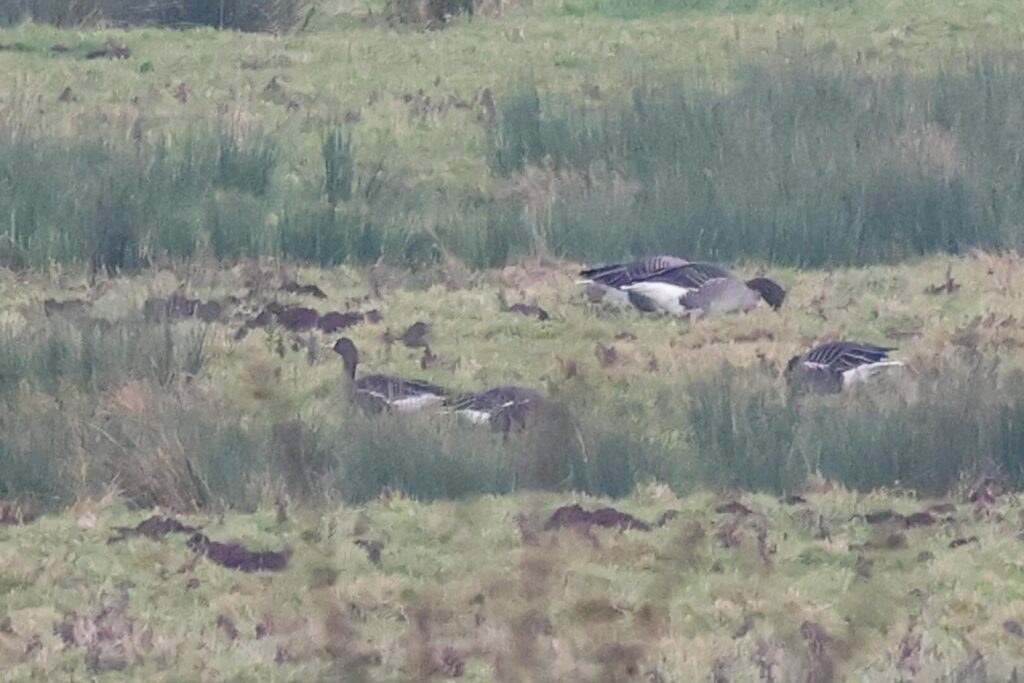
Looking further over, towards Burnham Overy Dunes, we could see some more Pink-footed Geese in the fields. There was also a nice group of Barnacle Geese. They were very distant, but such an obvious goose even at that range. An Egyptian Goose was standing in one of the trees on the edge of Decoy Wood. A Great White Egret was in amongst the Belted Galloways but then flew across in front of us. We got the scope on a Chinese Water Deer on the edge of the reeds.
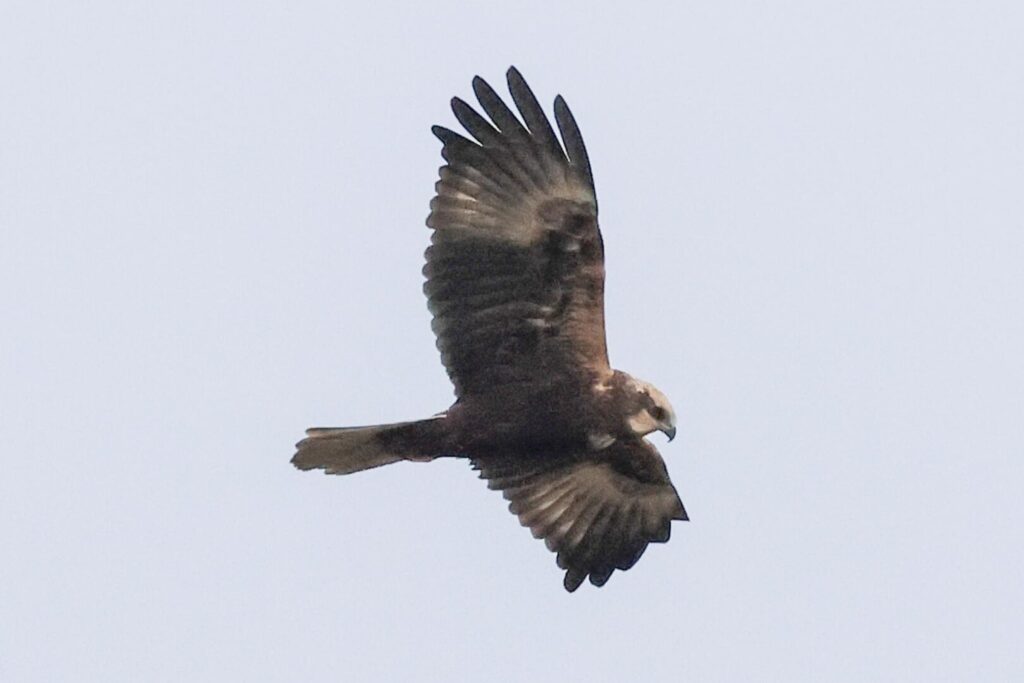
As ever, there were plenty of raptors here. Several Common Buzzards were perched in the trees and Red Kites and Marsh Harriers drifted over. A Great Spotted Woodpecker flew in over the fields and disappeared into the Park.
It was a bit early to go looking for owls again yet. Many of the group had already been to Titchwell over the last couple of days and the Snow Buntings at Weybourne would probably be a bit far to walk out to now. So we decided to make our way slowly back east. We called in briefly at North Point but there didn’t seem to be much there. A couple of Egyptian Geese on the grass one side, lots of Teal and a couple of Gadwall on the pool the other. There weren’t many gulls in to bathe. A Red Kite drifted over. We didn’t get out and carried on our way.
The next stop was at Stiffkey Greenway. Another Red Kite was out on the saltmarsh, feeding on something on one of the sewage pipe supports. By popular demand, we got it in the scope for a closer look. Apparently there had been a Merlin before we arrived but the other person here already scanning did point out a very distant Peregrine on a post. We stood and scanned for a while. Several Marsh Harriers were flying up and down out over the saltmarsh too, but no sign of any Hen Harriers yet this afternoon.
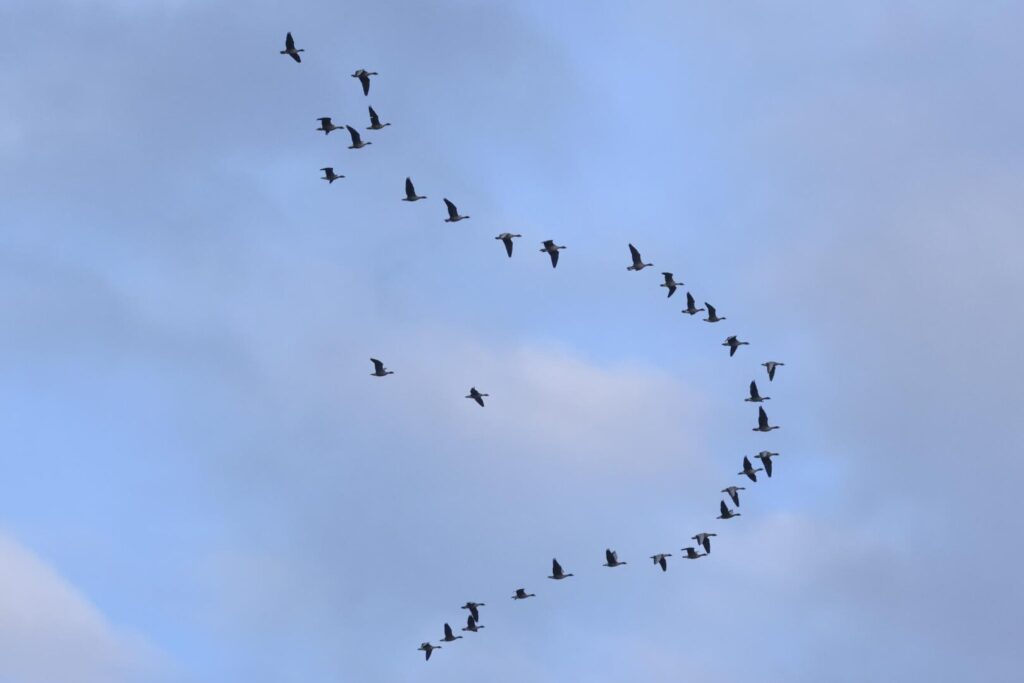
The Pink-footed Geese didn’t seem to know what they wanted to do. Several skeins flew out and landed on the sand, as if going in to roost already. It was a bit early yet. Maybe they had just been disturbed from the fields inland. As most of those then flew off inland again, some more vast skeins were just heading out the other way. Rather than fly out to the sand though, they turned and dropped down towards Wells.
As it was getting back to owls time, we set off again. Back where we had started the day this morning, the view was very different now. Gone was the thick fog and we could actually see the view now!
We walked out along the bank and scanned the marshes. Several Marsh Harriers were starting to gather ahead of going in to roost. We counted at least 8 together, with several more the other side. They kept flushing huge clouded of Lapwings from the scrapes as they drifted over. A Sparrowhawk flew across over the reeds behind us. One Kestrel was perched distantly on a gate post and then a second landed in the top of a small tree in front of us. The Common Buzzard landed in its favourite tree, waiting to head in to roost.
When all the waders came up out of the harbour in the distance, we looked across to see a Peregrine stooping through them. A little while later, it flushed all the gulls too. Several Canada Geese out over the back of the grazing marshes failed to generate much enthusiasm. A pair of Stonechats on the brambles by the ditch in front of us were more appreciated.
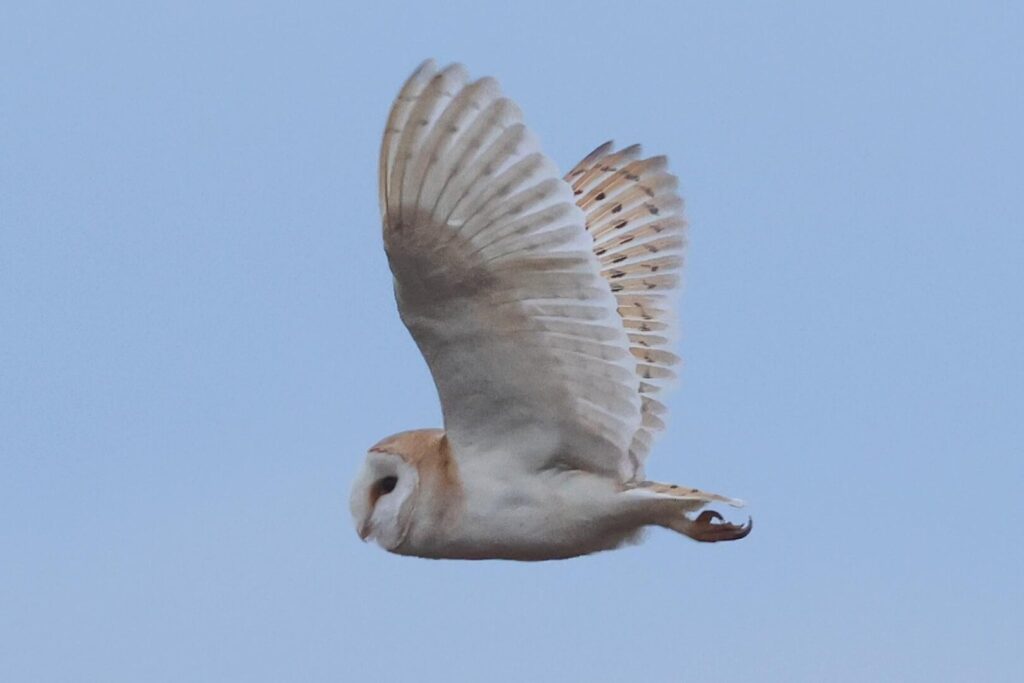
One of the group spotted a Barn Owl behind, flying out towards us from where it had roosted. It was coming out to feed, flying determinedly like the one we had seen this morning. Though the view of that was much better than this morning too! It flew right past us and we watched it disappear off into the distance. A few minutes later we saw it again, now hunting the furthest field on the back of the grazing marshes.
The light started to go and more birds headed in to roost. We watched some Reed Buntings drop into the reeds and a couple of Pied Wagtails flew over. A few Starlings were gathering on the sails of the mill. The Jackdaws and Rooks which had been up in the tops of the trees beyond, flew off up the valley calling. Then it slowly started to go quiet.
It was time to call it a night. Despite the early fog, we had seen several owls and a nice selection of other winter birds along the coast here again.