Day 1 of a 2-day Winter Weekend in Norfolk. It was a lovely day, bright and sunny, fresh but not too cold, and with fairly light winds. Perfect winter birding weather. We spent the day in the Norfolk Broads.
It was just under an hour’s drive down to the Broads this morning. On the way, we stopped at Ludham Bridge to pick up another member of the group who was filling in for a cancellation and joining us just for the day. As we loaded up, a Marsh Harrier drifted over the road and we could head a Greenfinch wheezing in trees nearby.
Our first destination was Ludham Airfield. It didn’t take long to find the herd of swans in one of the winter wheat fields. As we pulled up alongside, their heads went up so we waited for them to settle back down before we got out.
We counted 43 swans today, a mixture of Whooper Swans and Bewick’s Swans. Good to see them side by side. The Bewick’s Swans are noticeably smaller, shorter-necked, and with less yellow on their bills.

There are around 20 Bewick’s Swans here now. Numbers have increased over the last couple of weeks but still well down on where they used to be, regularly over 100 even as recently as the mid-2010s. With milder winters in northern Europe, they don’t need to come all the way to the UK these days (so called ‘short-stopping’). Good to see them here while we still can!
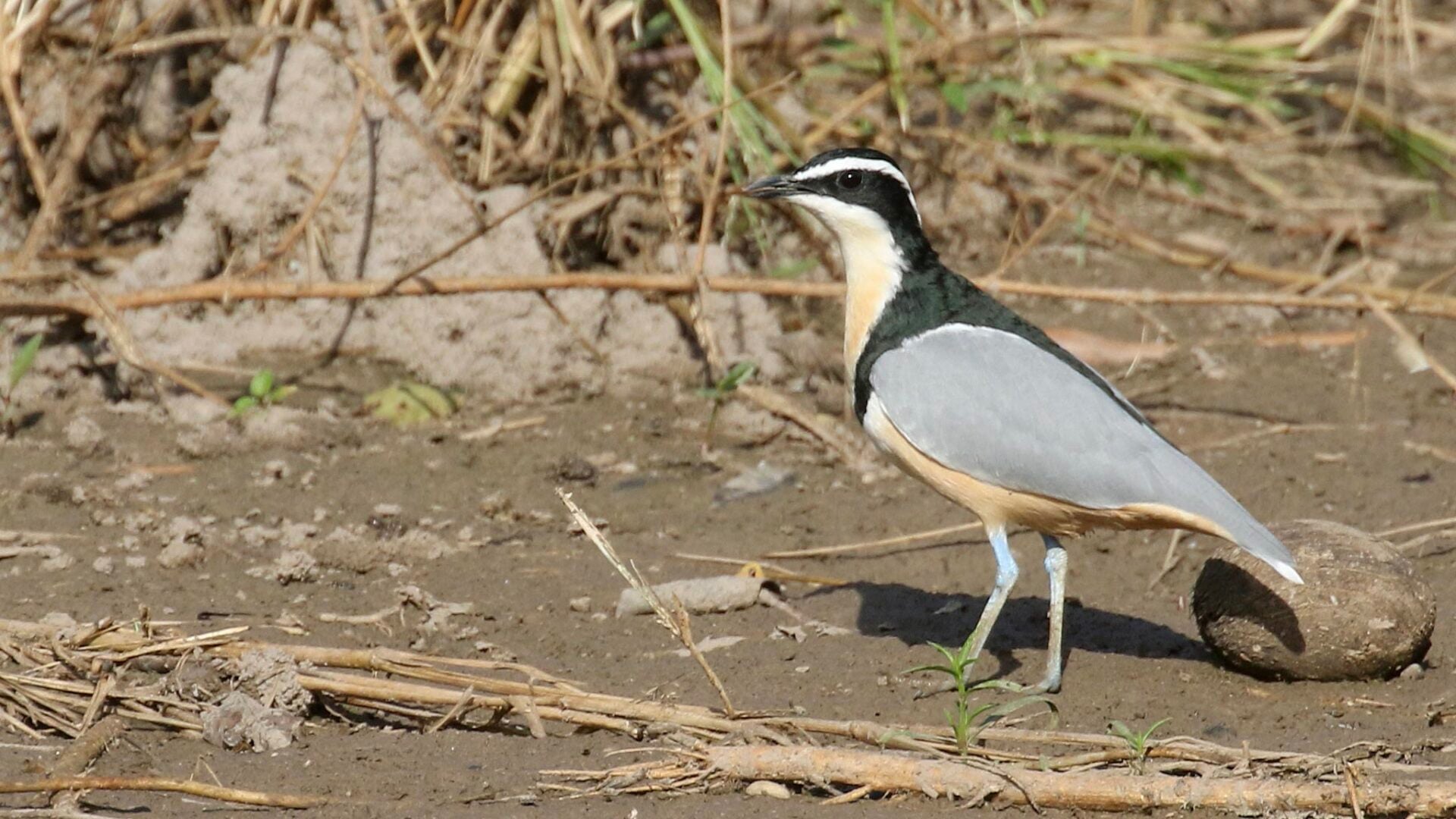
There were several Egyptian Geese over in the corner of the field too. Three Stock Doves flew round and landed in the winter wheat. Two Skylarks flew up from behind the swans calling. One of group spotted a shape out in the back of the field which turned out to be a Peregrine. Through the scopes we could see its head and shoulders sticking out above the low crop.
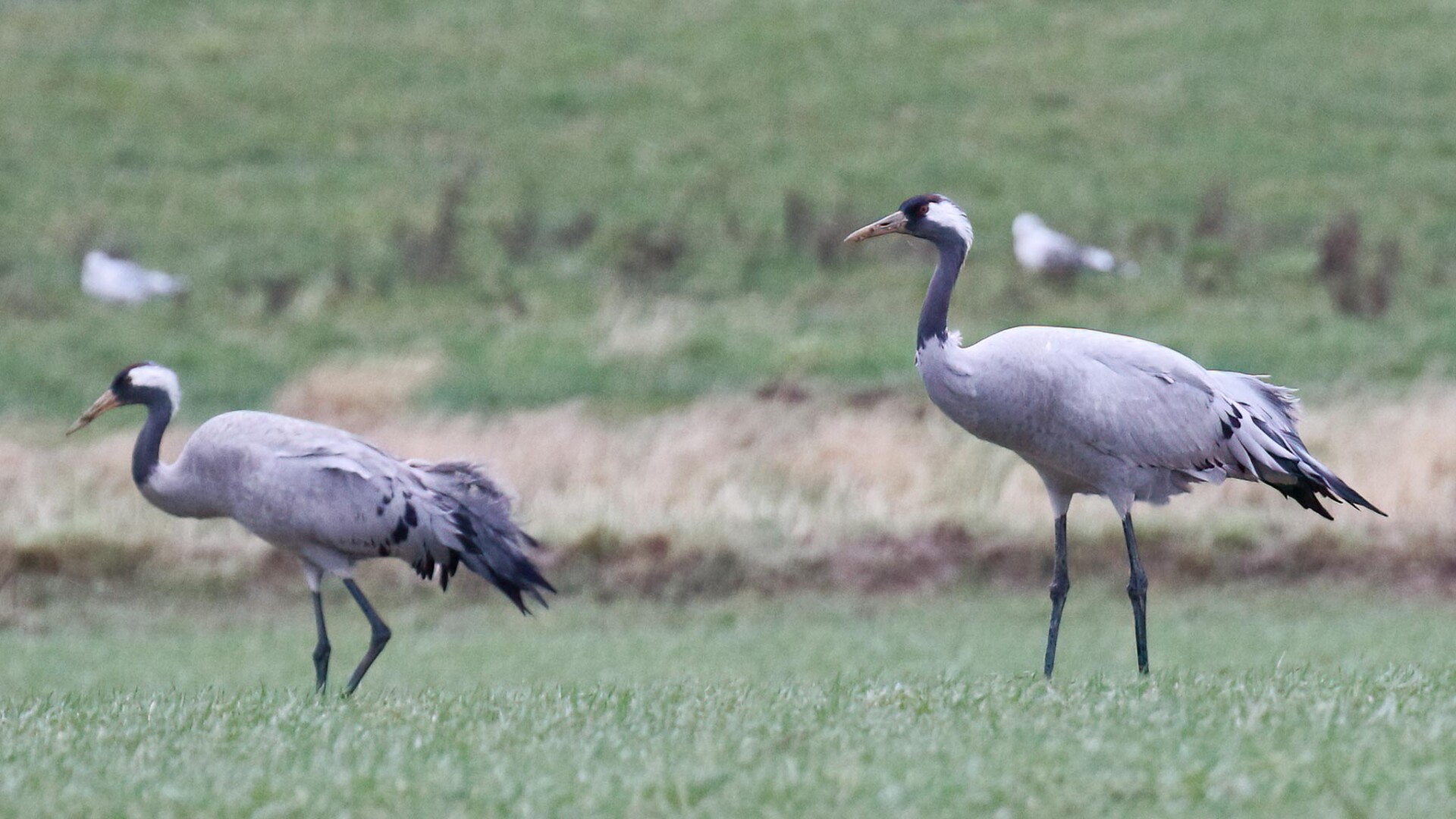
It is getting towards the end of the shooting season, and we thought there would be a risk of associated disturbance today. So we decided to go to look for Common Cranes next, in case they might get flushed. We quickly found twenty-two Cranes in one of their usual favoured fields. They were far enough away that we could get out and not disturb them. Nice views in the scopes.

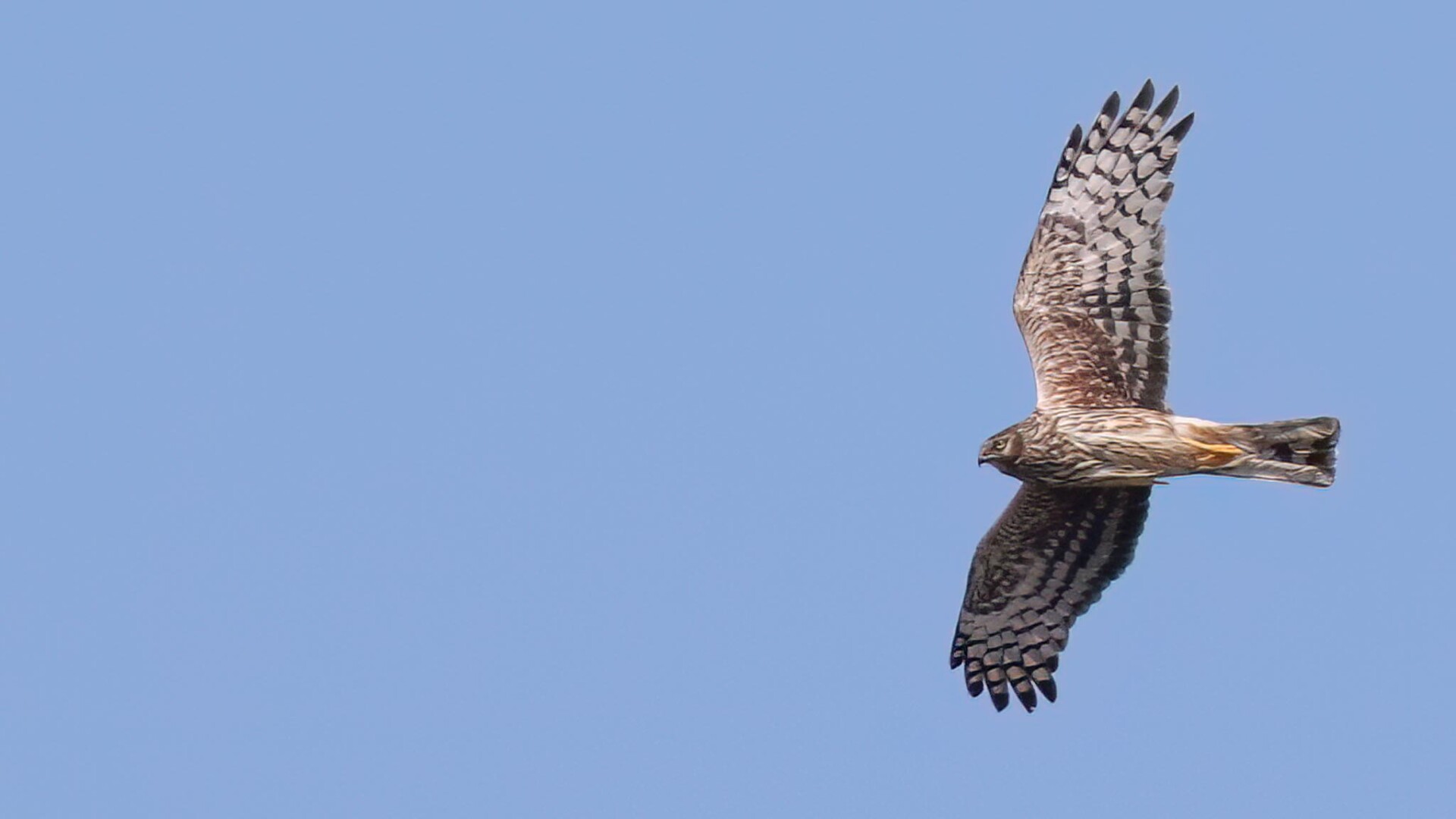
We stood and watched the Cranes for a while. A Marsh Harrier flew up and down over the maize game cover strip on the edge of the field in front of us. A couple of Reed Buntings flew out and over our heads, followed by several Meadow Pipits.

The Cranes were very settled, feeding happily. Then we spotted a man walking from a truck off in the distance, across into the fields at the back. He disappeared behind the wood in between and looked to be too far away to disturb the Cranes. Perhaps it was just a coincidence therefore when four flew up and circled round. They split into two pairs and disappeared off separately. It was a nice bright morning, so perhaps they were just off to check out and reclaim their breeding territories already.
The man walked back from the wood to his truck, so it didn’t look like he was the problem. Another pair of Cranes circled up and headed away too. Unprompted all the remaining sixteen then took off and flew past in front of us and away over the trees. Lucky we came early this morning.

We drove over to Filby Broad next. Several fishing boats were already out on the water and we could see most of the ducks were right over the far side. Still, we walked over the road and scanned from the boardwalk. There were a few Coot and Tufted Ducks in the near corner but nothing with them. A female Goldeneye surfaced a couple of times behind the trees in front.
Looking through the ducks at the back, we could see they were mainly Common Pochard and Tufted Duck. The Ring-necked Duck had been reported here again first thing today, but we couldn’t see anything rarer with them now. Perhaps some of the birds had been flushed by the fishermen and flown off to one of the other Broads nearby.
As we made our way back along the road, we could see several Tufted Ducks on the edge of the reeds on Ormesby Little Broad. We had a quick look through the scope, and found a drake Shoveler and a pair of Gadwall too. A male Goldeneye surfaced in with them at one point. A pair of Great Crested Grebes over in the corner were already coming into breeding plumage.
Walking up along the path from the car park, there were plenty of Blue Tits in the trees. A Great Tit was singing – maybe spring is not far away now! One of the group had a brief Goldcrest which disappeared into the hollies at the back.

We stood and scanned the Broad from the platform at the far end. Most of the Coot were on here today, possibly pushed across by the fishermen. Several more Great Crested Grebes were in different stages of moult. A couple of Common Buzzards, a Marsh Harrier and a Red Kite drifted over the trees at back. A Great White Egret flew in and dropped down into the reeds off to the left and we could just see the head and neck of a Grey Heron in the reeds opposite.
There had been a report of a couple of Tundra Bean Geese nearby at Martham, so we drove round there to have a look next. As we pulled up in one of the laybys, we could see lots of Pink-footed Geese in the field, where the sugar beet had been recently harvested. Two White-fronted Geese were standing on the front edge of the flock.
There was a van in the layby ahead of us, the driver outside and scanning with a scope. We could see the geese had their heads up and were looking nervous, so we stayed in the minibus. When he walked round to the back of the van and opened the tailgate to pack up, we asked him if he had seen any Tundra Bean Geese. That was too much for the geese and they all took off. We hoped they might land again in the fields nearby, where we had seen them the other day. Although we tried to follow them, they continued off towards Thurne.
We headed round to the NWT reserve at Hickling Broad next. We were hoping to walk out to try to see the Black-winged Kite at Stubb Mill and then stop here for lunch. Stubb Road seemed rather busy with cars leaving as we drove down. Perhaps no surprise when we arrived at the car park to find it completely full. A volunteer was turning cars away.
As we turned round, we could see that there was a steady turnaround with cars leaving, so we asked if we could use one of the empty spaces. Still they wouldn’t let us park. Apparently they had a boat trip running and were trying to reserve spaces in case people arriving for that needed them. With several paying trust members in the minibus, we all felt treated a bit like second class citizens here today!
If we wanted to see the Black-winged Kite, it was clear we had to find a plan B. We drove back towards the village and found somewhere else to park. Then we walked down the track towards Eastfield pumping station. When we got to the edge of the marsh, we scanned across with our binoculars and immediately saw a pale shape perched on the edge of some trees. The Black-winged Kite!

Lovely views in the scopes, as it perched there preening, turning its head. Interestingly, we were in sight of the very trees where we came to see the first Black-winged Kite to be found in the UK, back in July 2023. What was presumably the same bird as the one today was first found nearby on the Hickling reserve last September (it then disappeared and was refound a few miles away at St Benet’s in December). Could it be the same individual returning?
The Black-winged Kite was not showing any signs of flying round. We had enjoyed a great look at it, so we walked back now to the minibus. We drove round to the beach car park at Sea Palling where we could use the facilities and anyone who wanted could get a hot drink. It was now time for lunch. Not the nicest venue we have stopped but needs must today!
After lunch, we headed out onto the beach. Immediately we could see a huge number of gulls gathered offshore, flying round, on the sea and loafing on the rocky reefs behind. Someone quickly pointed out the juvenile Iceland Gull to us, standing on the rocks. We could see its very pale wings, mostly dark bill and size – slightly smaller than the nearby Herring Gulls.

There had apparently been some Caspian Gulls and a Little Gull here too. So once we had all enjoyed a good look at the Iceland Gull, we started to scan across through all the other gulls. We managed to find an adult Yellow-legged Gull – we could see its darker grey mantle than the Herring Gulls, yellow legs and clean white head. But no sign of the other gulls from here.
There were lots more gulls on the sea around the next reef further up, so we set off to walk over for a closer look. On the way, we stopped to watch the flock of Sanderling on the beach, running in and out of the waves like clockwork toys.

We thought we had a quick glimpse of the Little Gull in the melee beyond, so we walked back to the sea defences so we could get round the rocks. We quickly found a couple of Turnstones and a Purple Sandpiper on the stones just below us. The Purple Sandpiper walked into a small pool to bathe and another Purple Sandpiper appeared nearby.
When a dogwalker walked across over the stones, all the waders flew up onto the concrete blocks just behind. We could see a lot more Turnstones now and counted three Purple Sandpipers. Several Oystercatchers had appeared with the Sanderling and three Grey Plovers flew off the reef and landed on the beach too.

Looking offshore beyond the reefs, we noticed several small groups of Gannets flying past. We picked up a couple of Red-throated Divers passing too and a pair of Common Scoters. There had apparently been some Kittiwakes earlier but we couldn’t see any now.
Standing opposite the next reef, we scanned the rocks and quickly picked up a 1st winter (2nd calendar year) Caspian Gull. It was noticeably bigger than the Herring Gull beside it, with a distinctive long face. Its head was Persil-white and its pale silvery grey mantle was marked with black. Very different when you get your eye in. There was no sign of the Little Gull with all the other gulls now, but quite a lot of the feeding melee which had been here earlier had dispersed.
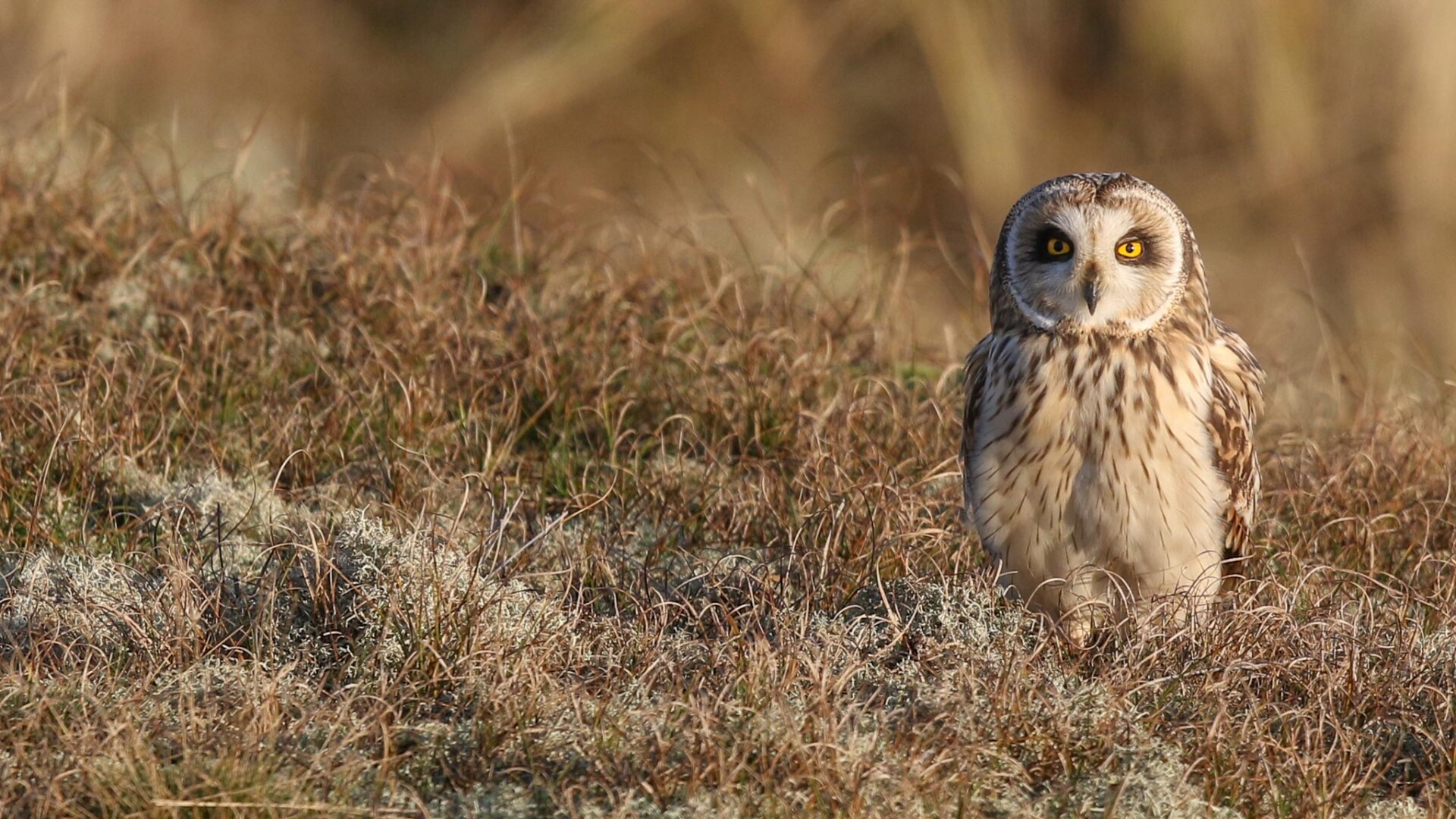
Time was running out and we still had more to do. Back to the minibus, we decided to head straight over to look for Short-eared Owls. As we walked out across the dunes, we could see a crowd of people with big cameras gathered where the owls had been roosting. When we reached them, they pointed out a Short-eared Owl asleep down in the grass right in front.

Through the scope, we could see the Short-eared Owl’s small ‘ear’-tufts flattened back on the top of its head. Despite it being a time of the afternoon when often they will start hunting, it was not showing any signs of waking up. At most, it just looked round when someone walked past between the admiring crowd and where it was roosting.
Looking offshore, we could see large groups of Cormorants flying past. A tight group of Grey Seals was hauled out on Scroby Sands in the mist in the distance. At least four Mediterranean Gulls patrolled up and down just beyond the beach.
There had been several Short-eared Owls here in recent weeks, but there was no sign of any others now. We walked on a bit further through the dunes to see if we could find them, scanning with a thermal imager to try to avoid disturbing any. More photographers were standing around in the dunes further over with even bigger lenses. We flushed a couple of Skylarks and a Meadow Pipit, but no sign of any more owls today.
As we circled back round, the Short-eared Owl was still dozing in the grass, still not showing any signs of going hunting. The sun was starting to go down. We had a long drive back so we decided to head back to the minibus. It had been a very exciting first day of winter birding down in the Broads with some great birds seen. Hopefully more to come tomorrow.