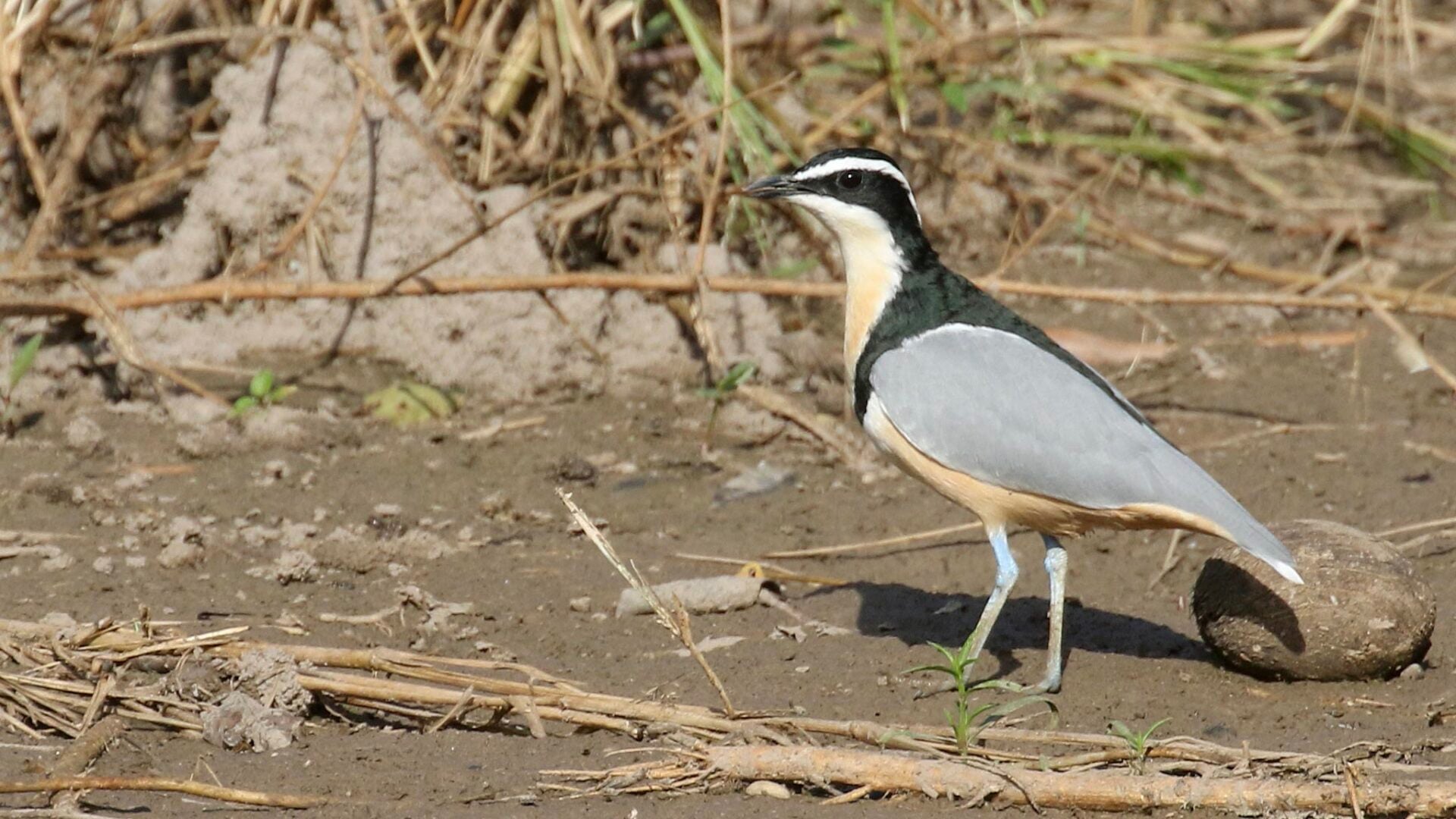
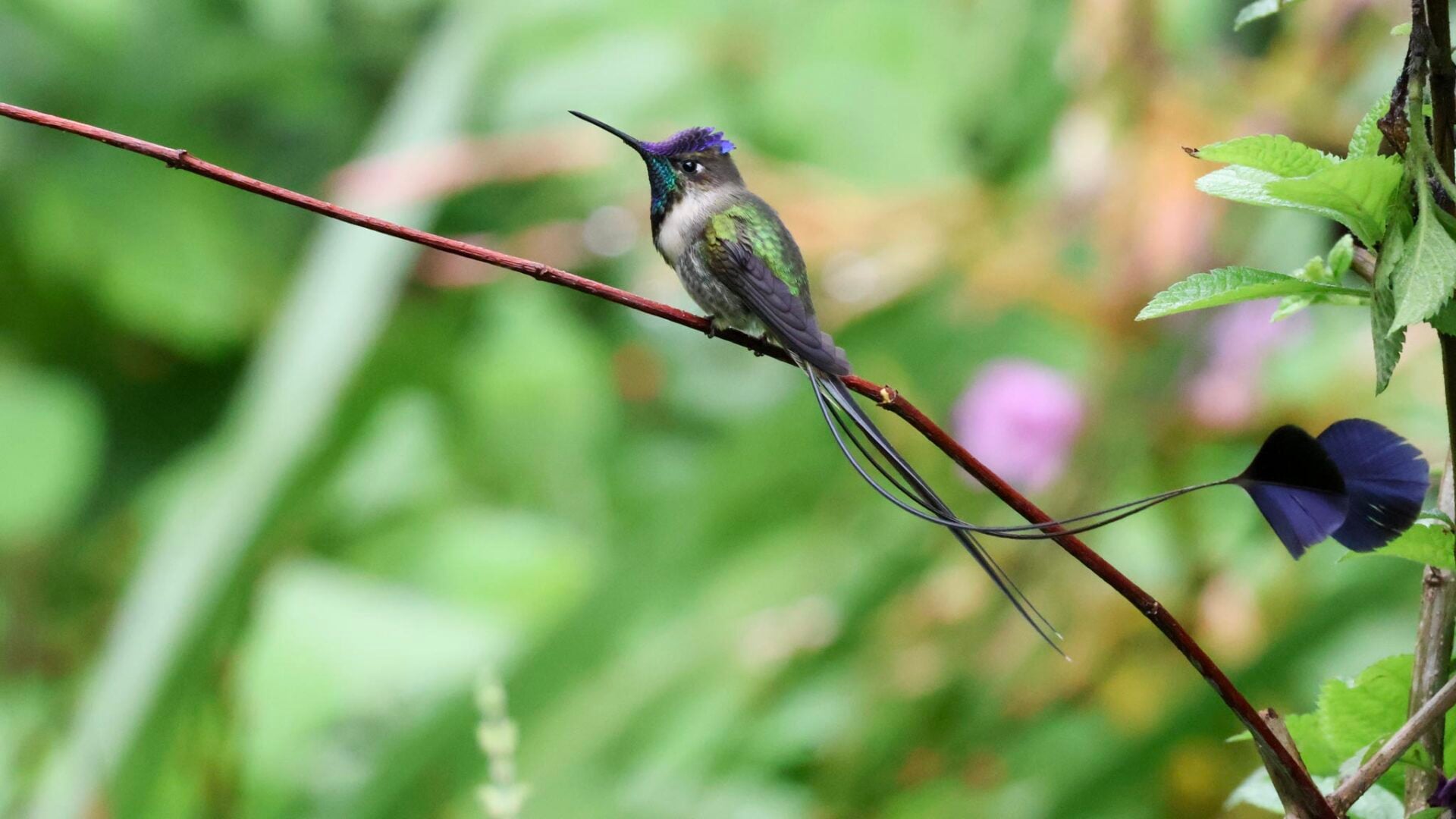
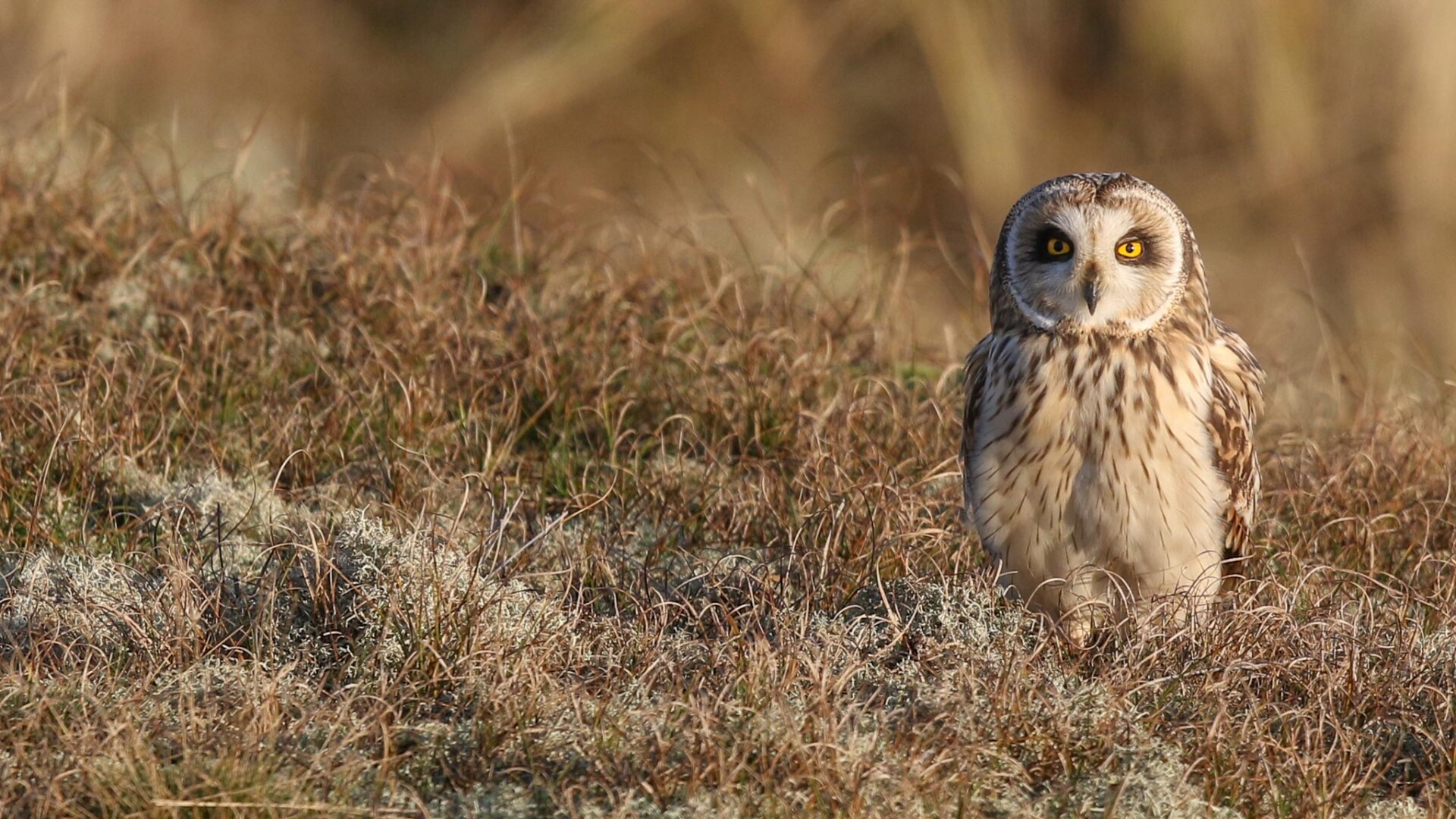
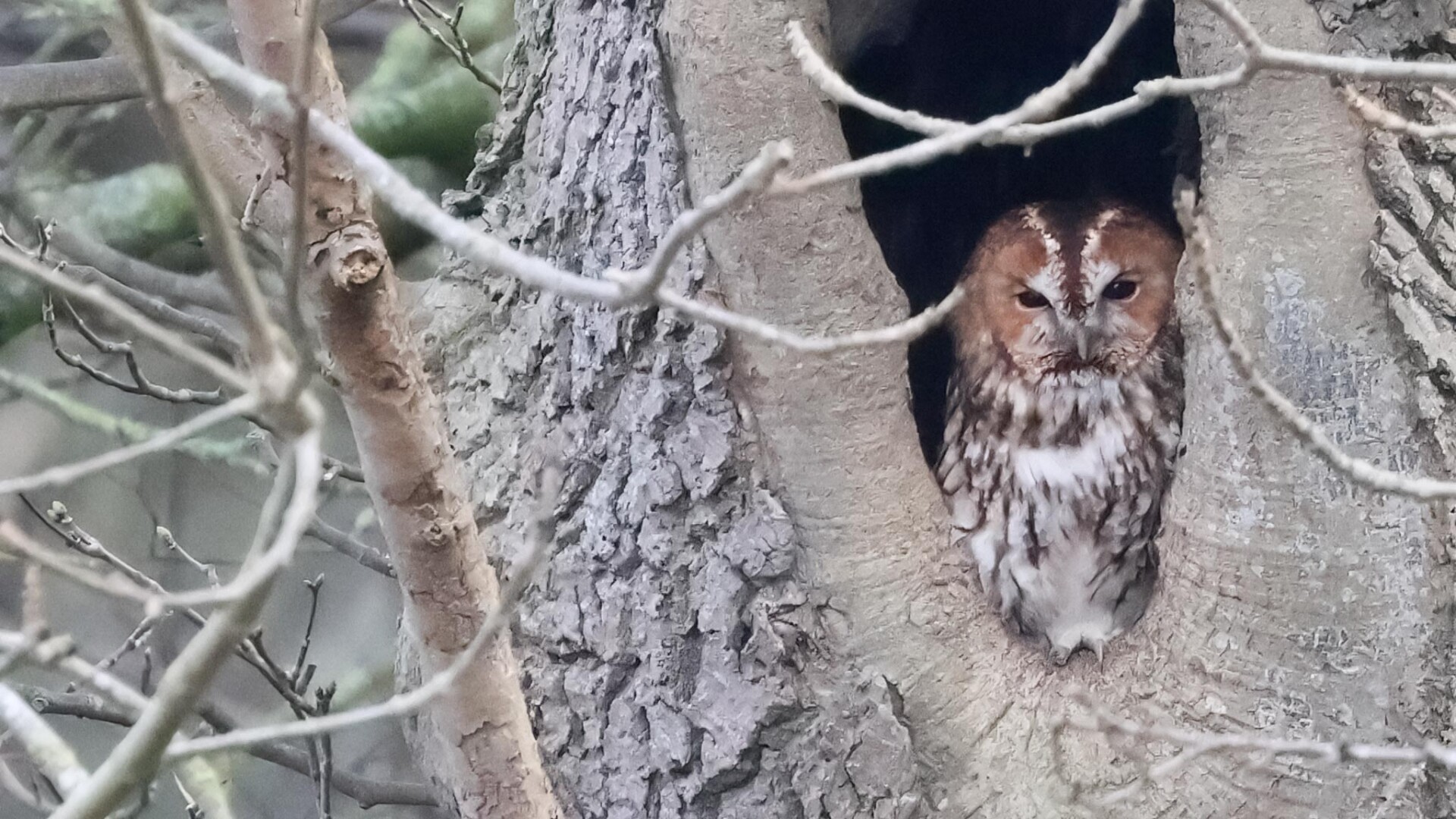
An International Tour organised in conjunction with our friends at Oriole Birding. In just a week and only in coastal The Gambia within easy reach of our hotel by the beach, we recorded a total of 255 species. From next year, we are introducing a new itinerary for this tour. As well as visiting the coast, much as we have done in previous years, we will head up river to look for the much sought after Egyptian Plover and a variety of other different species. It should be very exciting – you can read more about our 2026 Gambia – Upriver & Coast with Egyptian Plover tour here.
Tuesday 25th November
An early start this morning, we met by the Ascend Airways desk at Gatwick at 5.15am. it wasn’t busy in the airport yet today – we were quickly all checked in and there was hardly any queue for security either. Our 7.50am flight to Banjul pushed back pretty much on time and we landed about half an hour early at 1.50pm (no time difference compared to UK time, which is always a bonus travelling here). A Western Cattle Egret was feeding on the grass opposite the terminal.
After a short queue inside to pay the airport tax and get through security, and not too long a wait until our bags arrived, we went outside to board the air-conditioned coach outside which would transfer us to our accommodation at the Senegambia Beach Hotel. The trip list started in earnest in the car park, with several Little Swifts and Pied Crows around the terminal, a couple of Yellow-billed Kites overhead, and a large flock of Speckled Pigeons which kept flying up out of the cut grass.
The journey to our hotel took less than half an hour. The new road from the airport makes it so much easier, when it is open. There were a few more birds to add on the way – our first Hooded Vultures and both Laughing and Red-eyed Doves.
After checking in, we had some time to get ourselves sorted out before we met up with our local guide, Modou Jarju, up by reception. The hotel grounds are extensive and a great place for an introduction to some of the commoner birds of the Gambia. It was nice to have a walk round and get in some birding after a long day travelling. A couple of Common Bulbuls were in the bushes in front and a Yellow-billed Kite and a Hooded Vulture were perched on the roof above the restaurant. Several more kites and vultures circled overhead, joined briefly by a Lanner.

Walking down past the pool, a White-crowned Robin-Chat flicked around the balcony of one of the accommodation blocks, a Pied Crow was on the grass below and a couple of Western Plantain-eaters were in the trees above. Further on, a group of Blackcap Babblers was feeding under the bushes and our first Broad-billed Roller was perched in the tree overhead.

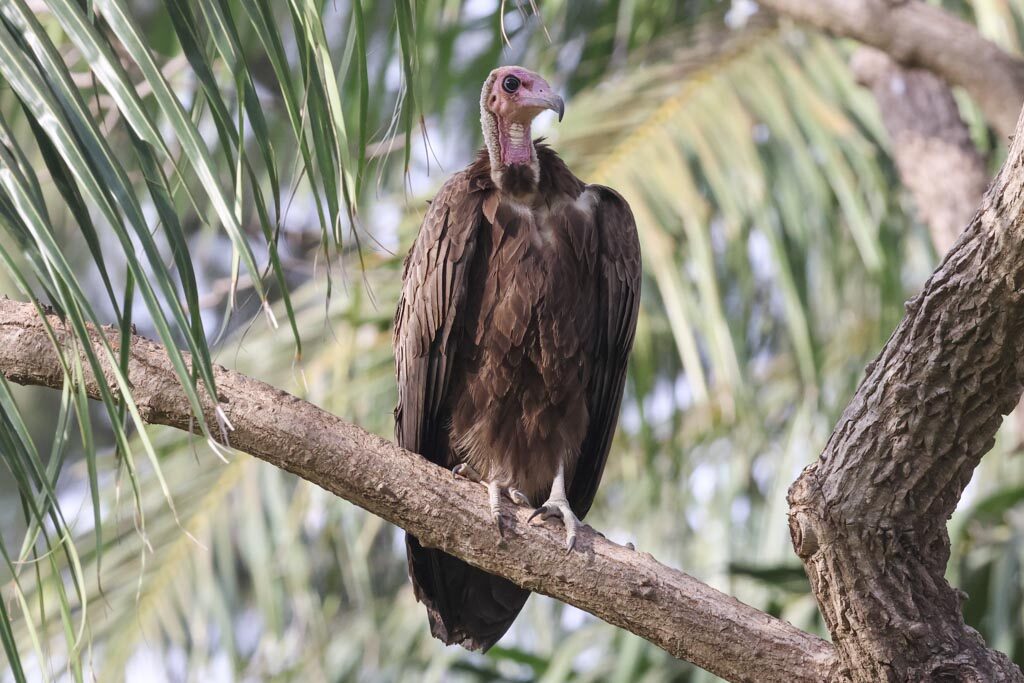
There were more Hooded Vultures standing around on the lawn beyond, with the Cattle Egrets, or up in the trees. They are fed here daily so this is always a good place to see them up close.
Modou had been whistling the call of Pearl-spotted Owlet and one answered now from the trees on the far side of the lawn, eventually coming out into the open where it gave good views.

We didn’t quite know which way to look, as a noisy group of Long-tailed Glossy Starlings and a family party of Green Woodhoopoes vied for our attention, both dropping down to feed on the grass. On top of that, a couple of Beautiful Sunbirds flew round through the trees and occasionally stopped to perch on the tops. A pair of Western Red-billed Hornbills landed in the trees above too. Several Little Swifts and African Palm Swifts zoomed overhead.
The grass below our feet was alive with African Grass Blue butterflies, along with a few Dancing Acraeas and Common Grass Yellows, a Banded Sable moth and a couple of Black Percher dragonflies.
Walking round to the area by the hotel wall, past a tree full of Laughing Doves, Modou heard a Yellow-crowned Gonolek call. We eventually had great views of it wrestling with a giant hairy caterpillar in a tree above our heads. A calling African Grey Woodpecker was not as obliging and did not give itself up.

There was more activity in the bushes by the solar panels, so Modou set up his small speaker and played a recording of birds mobbing while he whistled Pearl-spotted Owlet again. Modou’s ‘music’, something we would hear a lot over the next week. Lots of things came to see what the commotion was all about – including a couple of Beautiful Sunbirds, lots of Common Bulbuls, at least three White-crowned Robin-Chats and a couple of Western Red-billed Hornbills.
They were joined by a single Red-bellied Paradise Flycatcher, an African Thrush, a pair of Northern Grey-headed Sparrows, an Olive-naped Weaver and a Senegal Coucal which made its way stealthily through the branches. Quite some variety! Walking on, a Hamerkop was perched on the roof of one of the accommodation blocks, close to its enormous nest in a nearby tree.
The light was starting to go, so we made our way back up towards the main building and said goodbye to Modou. Everyone wanted to change some money so we had a quick walk up to the shops just outside the hotel and bought some water too. One of the group spotted a Common Evening Brown butterfly on one of the bushes in front of the money exchange. After a short break to freshen up, there was an optional quick drink before dinner up at the pool bar.
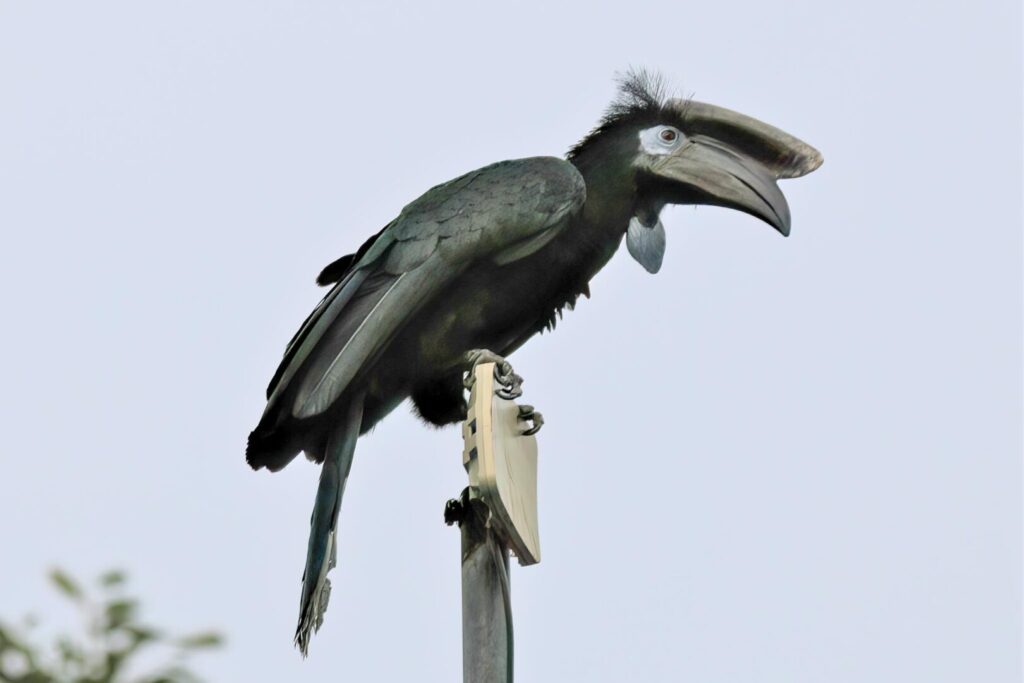
There has been a Black-casqued Hornbill seen around the grounds here occasionally for at least the last year. A very rare bird in The Gambia, native to southern West Africa across to DRC and Uganda, the nearest native populations are in Sierra Leone. It appears to be the same bird which has been present around Bakau for several years. The consensus amongst the Gambian birding community at least is that it is a wild bird, as apparently they are known make long distance feeding movements.
A couple of the group who had not come to the shops had seen it appear this evening and, as we walked up to the pool, it was still perched on the wi-fi aerial on one of the blocks. We got those who were already at the pool back to see it. It was getting dark now, but we hoped we might get better views on another day. Back at the Pool Bar, several Gambian Epauletted Fruit Bats were flying round through the trees.
Dinner was served up in the main restaurant. It was very quiet today – it is just the start of the holiday season and there seemed to be very few guests eating in tonight. After a quick run through the day’s list afterwards, it was time to head to bed after a long day.
Wednesday 26th November
We met for breakfast this morning at 7am, as the restaurant opened. It is important to make the most of the early part of the day here, before it gets too hot. Afterwards, Modou and Fanta, his assistant, were waiting for us outside with our bus and driver, Ousman. It was just a short drive from the hotel to the nearby Kotu Bridge this morning. The bridge is closed to traffic for repairs at the moment, which means that lots of cars were parked and more were turning round just before it. We walked straight down and onto the bridge, where it was quieter.
The tide was out and immediately we could see lots of birds. Where to look first? Several Pied Kingfishers were flying round and landing on the sticks in the water nearby, which a couple of Wire-tailed Swallows were also using to rest on. A Blue-breasted Kingfisher landed on the edge of the mangroves much further down before disappearing deeper in and a couple of Reed (Long-tailed) Cormorants were fishing in the channel. One or two Western Reef Herons were stalking in the shallows, a Striated Heron was well camouflaged on the mud right below us and a Squacco Heron less so, with a Hamerkop and a Grey Heron in the water nearby.
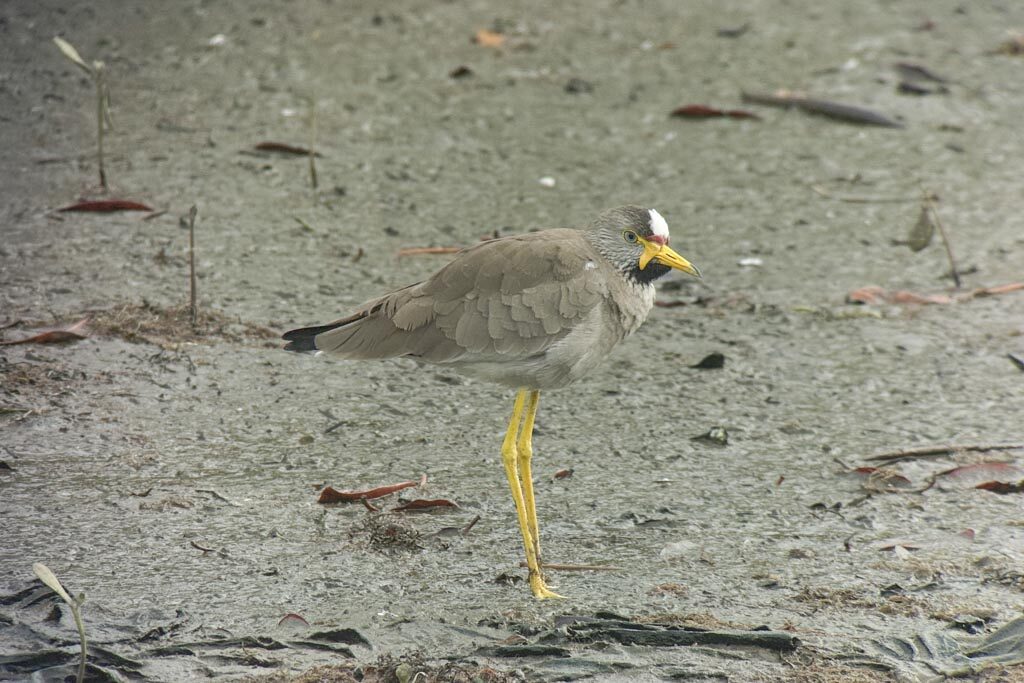
There were lots of waders gathered on the exposed mud on one side – mainly Senegal Thick-knees, Spur-winged and Wattled Lapwings. Singles of Grey Plover and Common Ringed Plover were in with them. A Common Sandpiper was on a distant sandbank and several more flew round over the water in front, and a Whimbrel was feeding on the edge of the mangroves. When a Greenshank flew in with a Common Redshank, they didn’t attract much attention from the group. Familiar species from back home, down here on their winter holidays, there were more new and exotic local birds to distract us here.
A Yellow-fronted Tinkerbird was calling persistently in the mangroves and Modou tried to whistle it in. It was a bit slow to appear at first, but then flew up into the top of the mangroves right next to the bridge. There were lots of the usual Red-eyed and Laughing Doves, plus a Vinaceous Dove which flew up and landed on a nearby lamppost. A couple of African Mourning Doves were less obliging, flying out of the mangroves but disappearing straight back in.
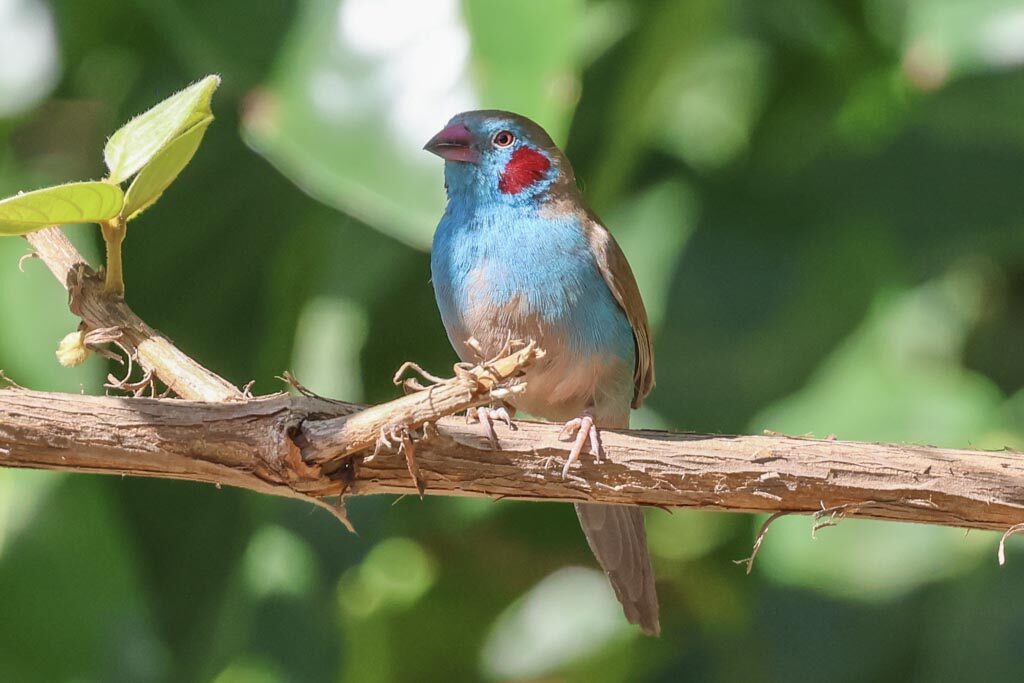
A Red-cheeked Cordonbleu appeared in the bush right next to the bridge briefly, so Modou set up his speaker and played the mobbing ‘music’ while he whistled the call of Pearl-spotted Owlet again. A pair of Cordonbleus quickly emerged to check out all the activity and were joined by a couple of Red-billed Firefinches and two Western Olivaceous Warblers. The latter are often rather shy and retiring, particularly in Europe, but we had great views here as they came right out of the bushes.
A Namaqua Dove landed in the branches above. The Blue-breasted Kingfisher flew in and landed low down in the same bush too, though hard to say it was responding to Modou’s whistles. It remained frustratingly rather well hidden for a while.
A Shikra flew out of the mangroves and low over our heads, over the bridge. We managed to get it in the scope a couple of minutes later, in some distant tall bamboo. A Little Bee-eater perched on the edge of the mangroves, just long enough for us to get it in the scopes and a few Blue-cheeked Bee-eaters were flying round high over the bushes, calling.
An African Grey Hornbill landed in the top of the mangroves. Three Yellow-fronted Canaries landed briefly in the bushes by the bridge too but flew off before we could get a good look at them. A couple of Senegal Parrots flew past but we only saw the back end of an Abyssinian Roller as it flew off away from us. One to get better views of later.
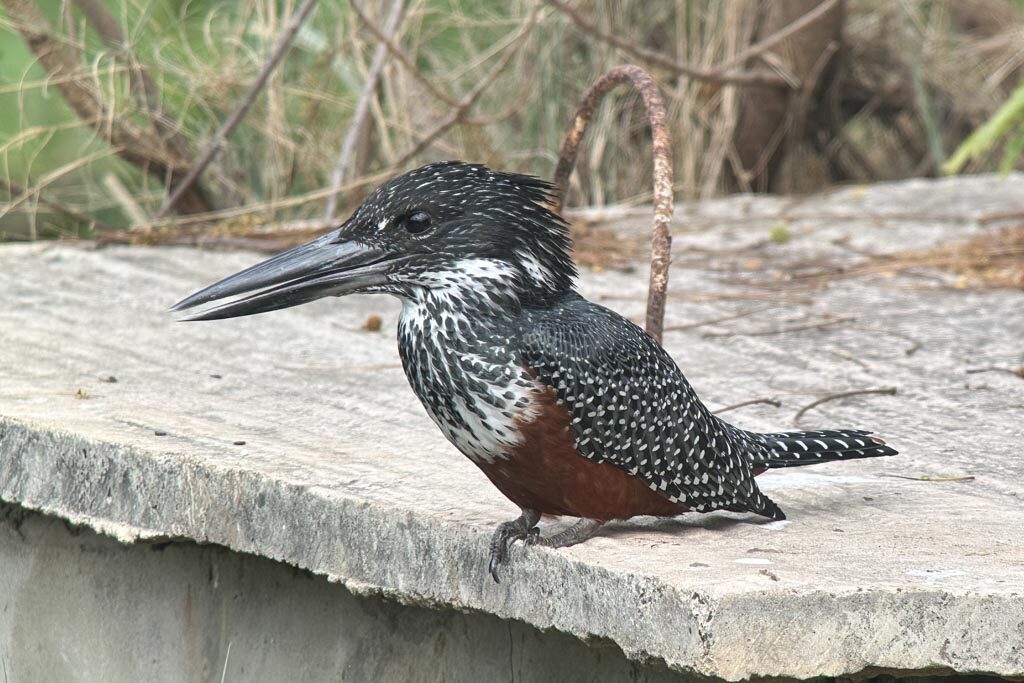
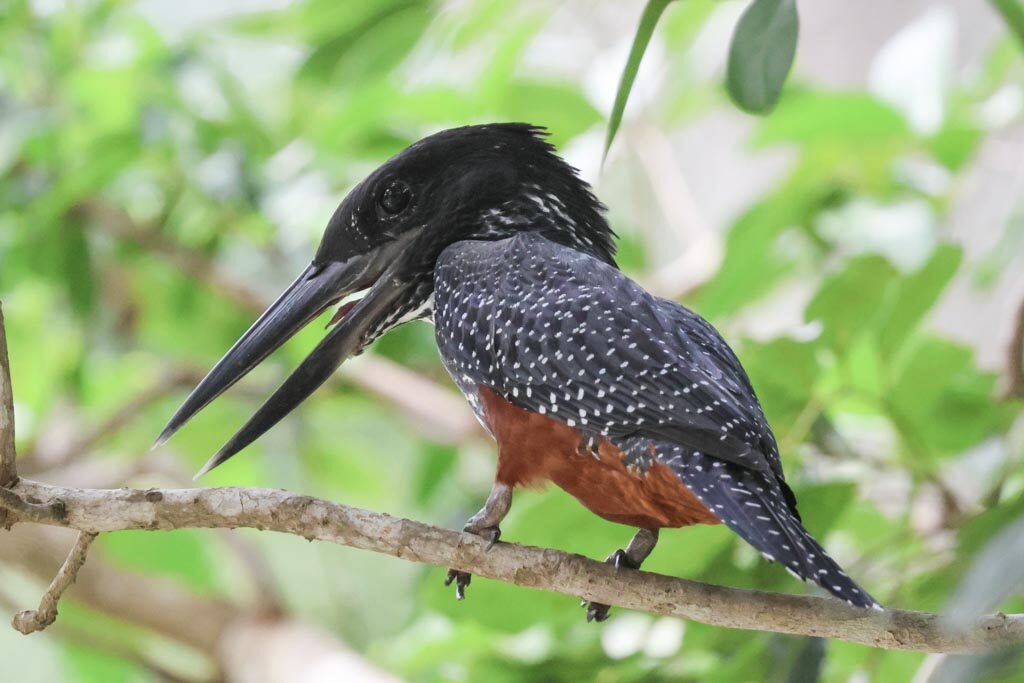
A Giant Kingfisher flew in from behind us, under the bridge and up onto the wires over the channel. We thought that was a good view, but then it came even closer, landing first on a concrete block on the bank and then on one of the posts in the water right next to the bridge, before disappearing in underneath. The Blue-breasted Kingfisher then finally came out of where it was hiding in the bush, and landed on a small rock below, on the edge of the water.
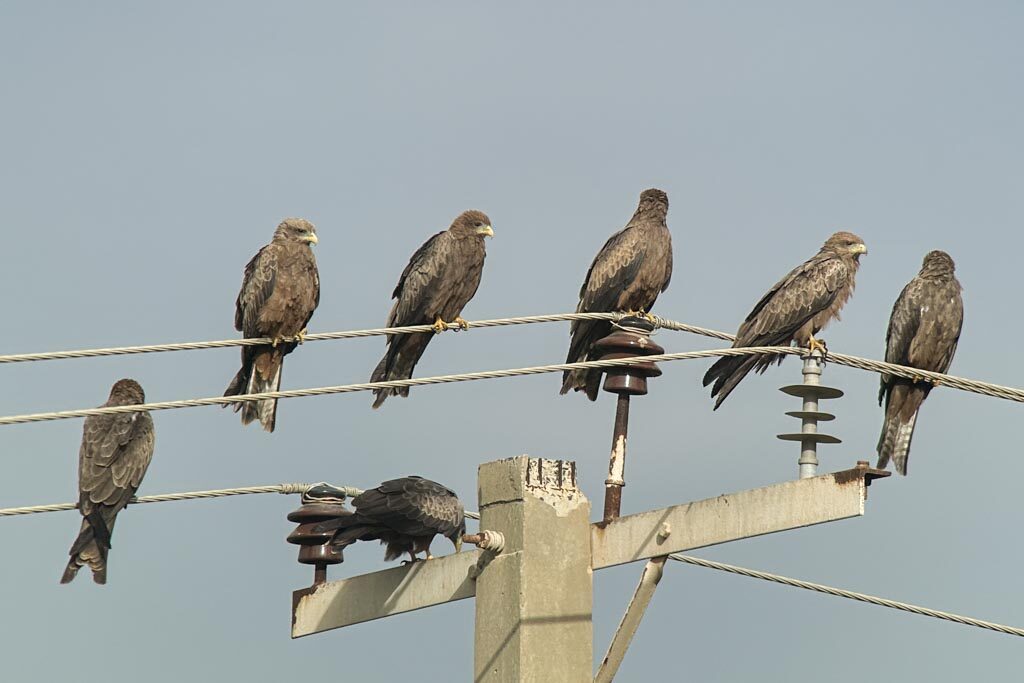
You could stay at the bridge all day and just watch all the comings and goings, but we decided to go for a walk now. In the bushes by the road, we stopped briefly to admire a young male Beautiful Sunbird and a couple of Bronze Mannikins. There were still lots of cars parked along either side of the road as we made our way up to the start of the Cycle Track. Lots of Yellow-billed Kites were gathered on the wires over the ricefields and a couple of Piapiacs were in a nearby palm.
A short diversion down a new track across the fields, we found a few Bronze Mannikins coming down onto the mud by the remains of a pool. There were lots of Village Weavers in the trees beyond and an African Monarch butterfly fluttered past. Back out onto the Cycle Track, the new birds continued to come thick and fast. We hadn’t gone far when a Bearded Barbet appeared in the top of a tree ahead of us. When it flew out, it was followed by another two.
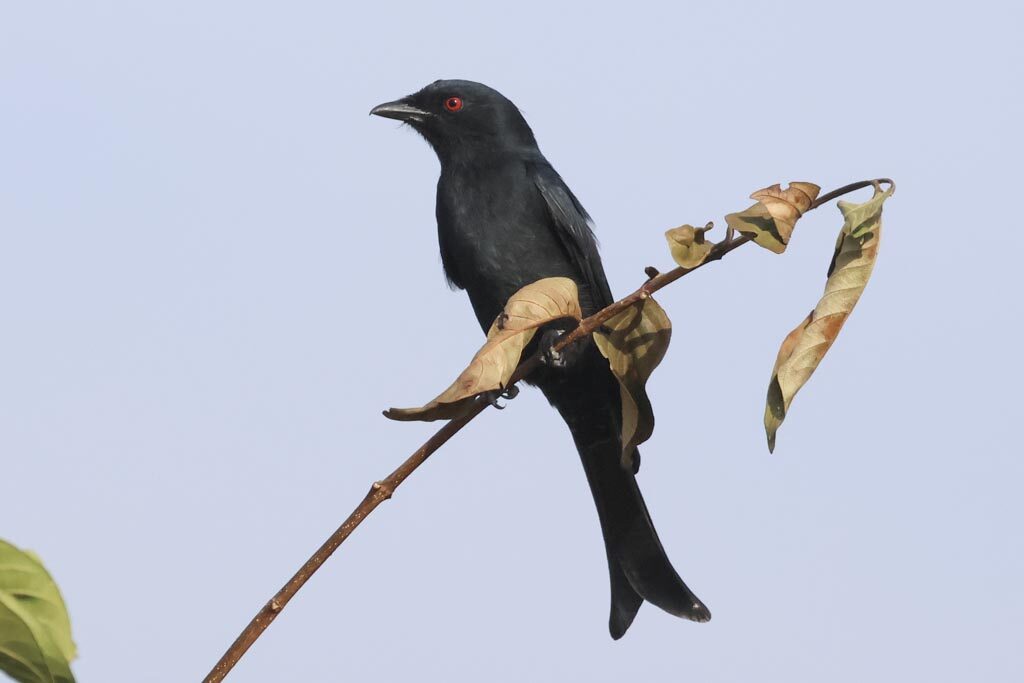
Just a few metres further on, a couple of African Golden Orioles flitted in and out of the bushes. A family of Yellow-billed Shrikes flew back and forth calling noisily, a couple of Fork-tailed Drongos perched in an acacia along with two Senegal Parrots.

We stopped to look at a Black-headed Heron in the ricefields, and several egrets including a Yellow-billed (formerly Intermediate) Egret along with a couple of Great White Egrets. Up above, a Mottled Spinetail whizzed through the trees briefly along with several Asian Palm Swifts, and the Blue-cheeked Bee-eaters here were a bit lower and closer than the ones earlier.
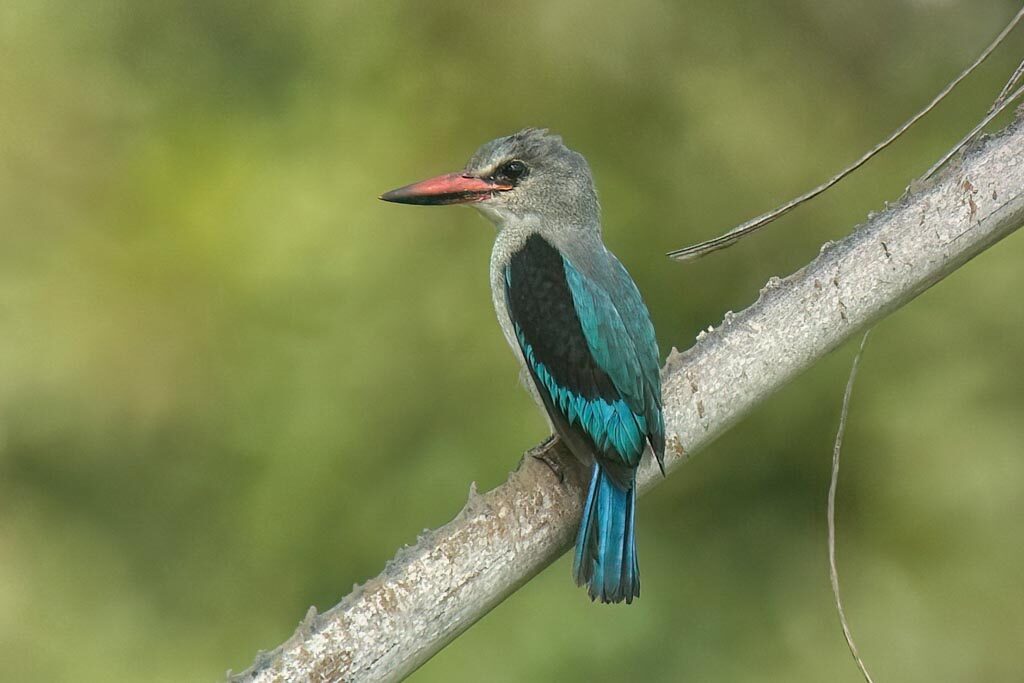
A Red-necked Falcon shot through without stopping. The Woodland Kingfisher was more obliging, posing nicely low down on a palm. On a tree by the path, a Nile Monitor was going down as an Agama lizard was on its way up below.
We took a small path down behind the ruins of the old hotel. A male Splendid Sunbird appeared briefly in a palm, then a pair of African Grey Woodpeckers in the branches of a tree ahead of us. We picked our way out around several small dried up pools to the edge of a larger one behind which still had water in it. Out in the middle are a large green plastic crocodile and a smaller blue plastic hippo – neither of which count for the list!
A small group of White-faced Whistling Ducks was gathered on the edge of the mud at the back, by the crocodile, and several Black-winged Stilts were wading in the shallow water. Nearby, behind the hippo, a single Wood Sandpiper was standing on the mud with a Common Redshank. An African Harrier Hawk was in the palms beyond but hard to see deep in among the dead fronds.
Modou set up his speaker on a nearby gingerbread plum tree. Lots of Village Weavers and Common Bulbuls came in immediately, and were joined by a Green-backed Cameroptera, a couple of Tawny-flanked Prinias and several African Golden Orioles. The Yellow-crowned Gonolek mostly stayed hidden in the leaves.
Making our way out, several White-billed Buffalo-Weavers were working on a large nest in the tree above the path now, breaking off branches to add to it. Back out on the Cycle Track, another flock of Buffalo-Weavers were feeding on the edge of the ricefields, flying up and down from a nearby acacia. Just beyond, a Northern Crombec appeared in another small tree and we watched it picking it way around the branches. We walked a little further, up to the edge of the next building compound where a Blue-bellied Roller was perched on a dead palm stump. We stopped to admire it and realised its mate was in the palms further back.

Turning round to walk back, a small cuckoo landed on the wires above the track, just ahead of us. A juvenile just moulting into adult plumage, we could see it was a young Dideric Cuckoo rather than the Klaas’s Cuckoo more expected here. We also had great views of a Tawny-flanked Prinia singing right next to the path. A couple of smart Citrus Swallowtail butterflies flew past.
We made our way back to the bridge where the bus was waiting for us. Scanning the ricefields opposite quickly, we could see some more Little Bee-eaters making sallies out from the bushes. It was midday already. The early cloud had broken a little and it was starting to warm up now, so we made our way back to the hotel.
After dropping our stuff in our rooms, we met again at the Beach Bar for lunch. A large group of Yellow-billed Kites circling out over the sea, kept swooping down to water’s surface, possibly picking up dead fish from where fishermen had been. They were joined by a single Hooded Vulture too at one point, always odd birds to see out to sea. A few terns were feeding offshore, mainly West African Crested Terns (the tern formerly known as Royal, then African Royal!) but with one or two Caspian Terns too.
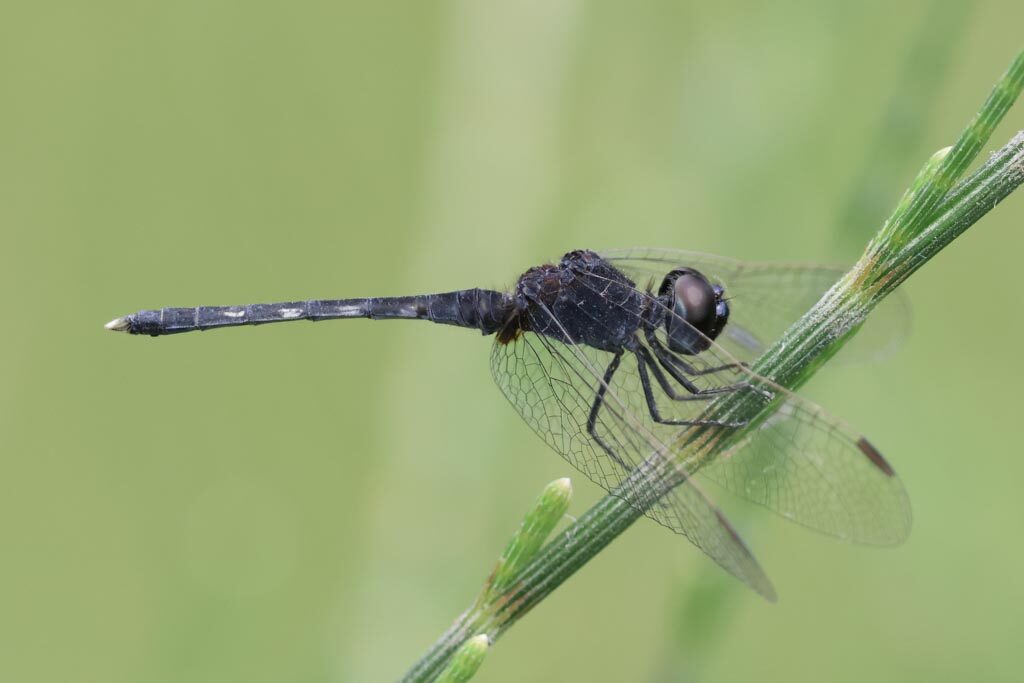
After lunch, we had a break during the heat of the day. There was a chance to have a rest or explore the grounds again, where there were lots of dragonflies and a few butterflies now active. Most of the birds had retreated to the shade.
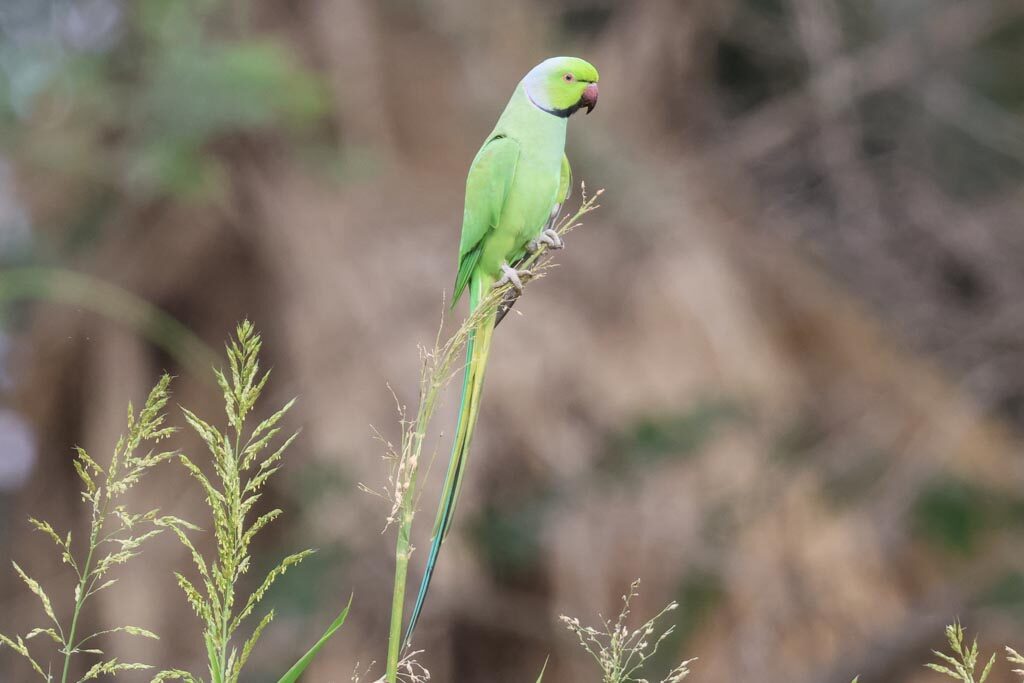
We met again at Reception at 4.30pm and went outside to find Modou and the bus waiting for us. Heading back out towards Kotu, we turned off before our usual turning and stopped in an area of open gardens and building plots, by a new hotel which is just being built. Several Western Red-billed Hornbills were in and out of the palms where a Senegal Parrot was perched briefly, before disappearing into a hole. There were lots of Rose-ringed Parakeets too, flying over and dropping down into the gardens.
A Spur-winged Lapwing was strangely stood on the ridge on the top of a large building. A Woodland Kingfisher perched up briefly. There were lots of butterflies and dragonflies in the vegetation on the verge.
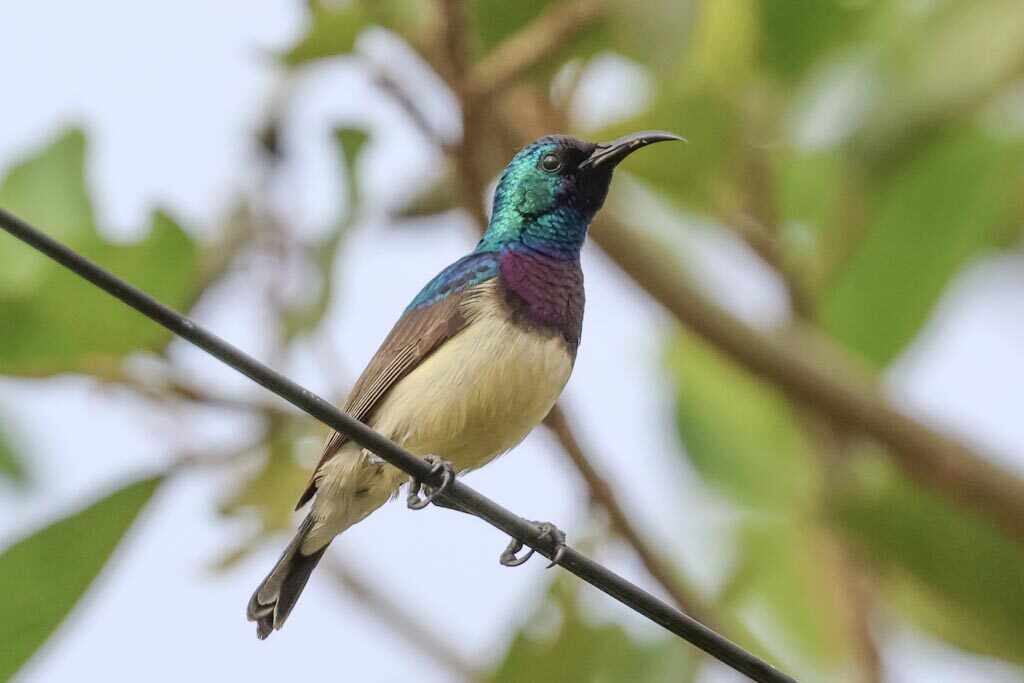
Walking further on along the road, several Beautiful Sunbirds were in the trees and they were joined by a smart male Variable Sunbird, a new one for the list. A female Village Indigobird was inconspicuous in a tree in a nearby garden and a group of African Mourning Doves were on the wires so we got them in the scope for a proper look. A couple of Bronze-tailed Starlings flew over. A small flock of Bronze Mannikins was feeding in the rice.
We turned off onto a smaller path across the ricefields, which seemed to be a popular cut-through for the locals too as it proved to be a busy thoroughfare. A large group of Spur-winged Lapwings came up from the wetter fields ahead of us but had disappeared by the time we got over there. Several Speckled Pigeons were now coming down to drink instead. A few White-billed Buffalo-Weavers were gathered around a nest in a tree on the far end of the path and a pair of Grey Woodpeckers flew in.
We came out back on the Cycle Track, where we had been this morning. The Blue-bellied Rollers were still in the trees and there were a couple of Senegal Coucals too.
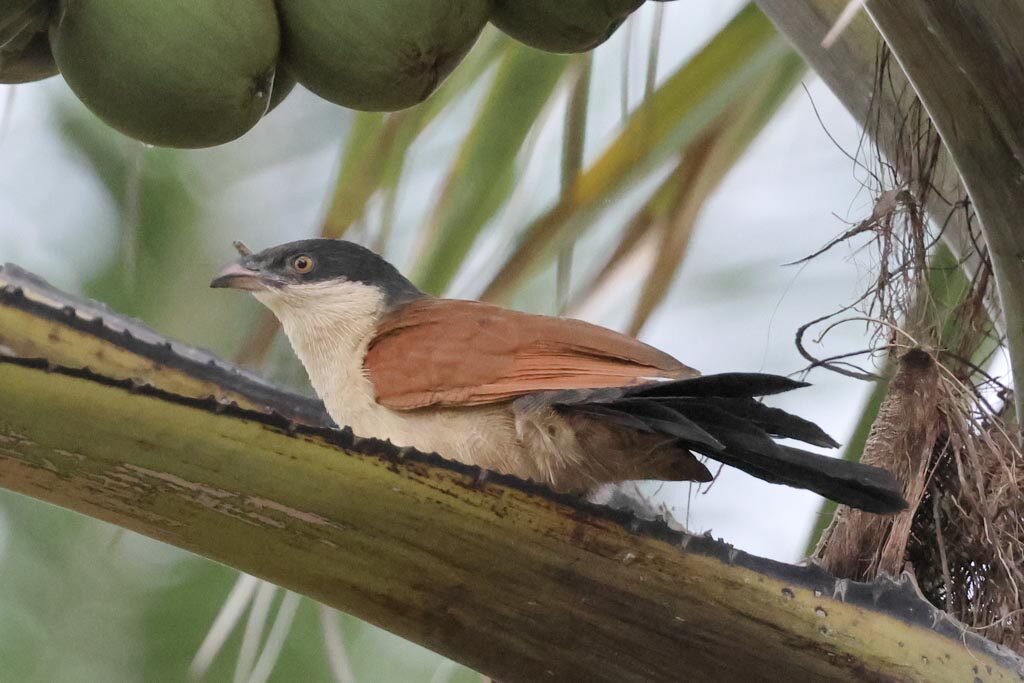
The female Grey-headed Woodpecker flew in and landed on the trunk of a dead palm where we could see she had a nest hole.

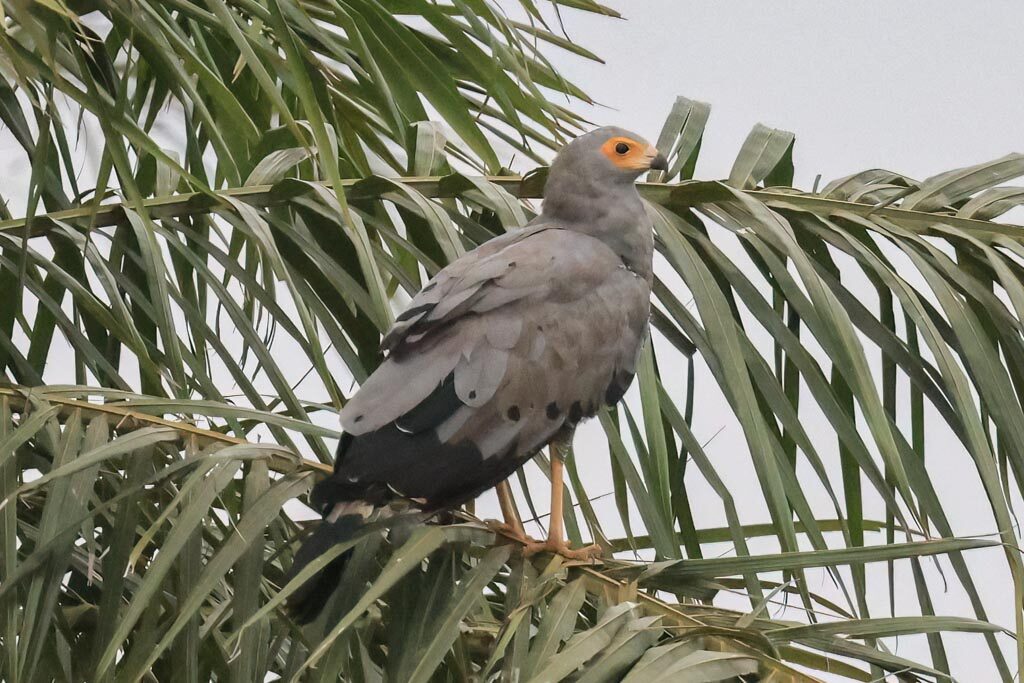
An African Harrier-Hawk was feeding in the tops of the palms in the ricefields the other side of the track, mobbed by a couple of Pied Crows. Eventually it came out into the open where we had a much better view of it than the one we had seen this morning.
It had clouded over now and was rather grey – it almost felt like it might rain. Back past the pools, the White-faced Whistling Ducks flew round calling and one of the group spotted a Hadada Ibis now on the top of a tall dead palm stump. We stopped and got it in the scope. The trees and bushes by the Cycle Track were noticeably quieter than this morning now, although we did find a family party of Red-bellied Paradise Flycatchers further along.

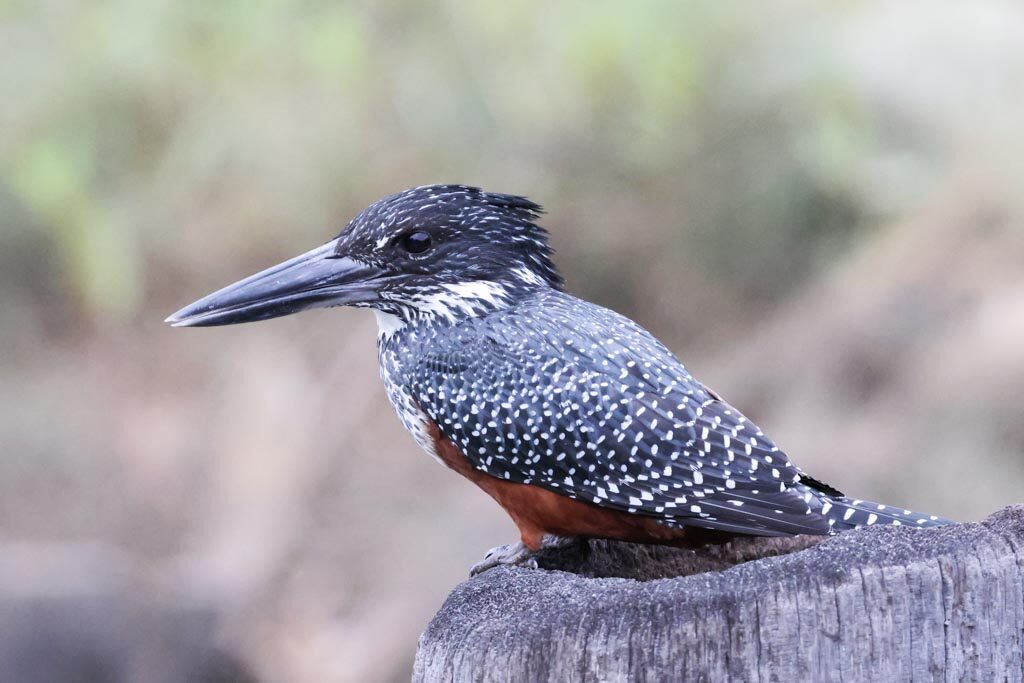
The bus was waiting for us at the start of the Cycle Track and we got onboard for the short drive back to the bridge – saving those tired legs the extra walk at the end of the day! A nice place to end the day, watching the comings and goings again. The Giant Kingfisher was back on the posts right next to the bridge, even closer than it had been this morning.
The Blue-breasted Kingfisher was a bit more obliging than it had been earlier too, perching out in the open on the posts one side of the bridge, then flying across to the sticks in the water the other side. The Thick-knees and Lapwings were still gathered on the mud and the Western Reef Herons were still fishing in the shallows. Flocks of starlings were flying over, heading off to roost. They looked to be mainly Bronze-tailed Starlings but one group of Splendid Starlings flew over too.

The light was starting to go now, so we made our way back to the bus. A selection of doves had come down to feed on the open area next to the road now it was quieter – Laughing, Red-eyed, Mourning and Vinaceous Doves and a single Speckled Pigeon with them. It was just a short drive back to the hotel from here. After a break to freshen up, we met again by the Pool Bar for a drink. Dinner was served in the restaurant, barbeque night tonight. After quickly going through the list afterwards we retired for the night. It had been a busy and exciting first full day, more to come tomorrow.
Thursday 27th November
After breakfast, we met Modou, Fanta and Ousman outside again. It was just a short drive to Brufut, made easier at the end of the journey by the fact that the old dirt road had just been upgraded to a new tarmac surface. All in the name of progress, though presumably it will only accelerate the amount of construction and development here.
Getting out of the minibus, there were lots of Elegant Acraea butterflies fluttering around the bushes and a couple of Agama lizards on the half-built wall next to us. A Grey-headed Sparrow landed on the wires and both Beautiful and Variable Sunbirds zipped in and out of the bushes in the morning sunshine. Just beyond, several Fanti Sawwings were flying round a tall tree and landing to preen in the top, so we stopped to get them in the scopes. A young Didric Cuckoo flew over.

A new house has started to spring up here even since last year, but we could still get through to the path along the edge of the forest beyond. Looking over the wall into the communal gardens the other side, a pair of African Grey Hornbills were sunning themselves in a palm. A Lizard Buzzard was calling and Modou manage to whistle it in, though it remained hard to see, tucked in round the back of the trunk of one of the large baobab trees.
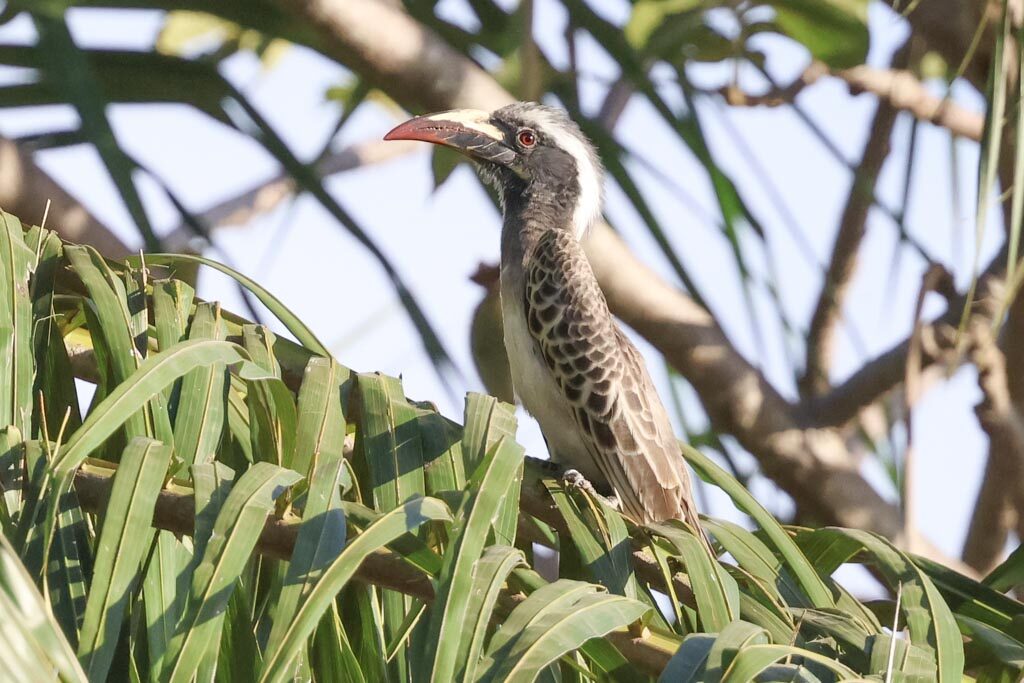
A Violet Turaco called but all we could see flying over and in the treetops were several Western Plantain-eaters. Our local guide, Madi and his assistant appeared. They would be with us for the duration of the morning here and they know where all the best birds are. We carried on a little further on the path and the Violet Turaco flew over from the garden side and into the edge of the forest. Modou tried calling it out, but then a Guinea Turaco started calling nearby. We had a brief view of that too, as it flew across between the trees.
Turning back round, we walked back to the road and got back on the bus again. It was only a very short drive but a Red-necked Falcon shot across in front of the bus on the way. We got out again, on the other side of the road now and walked in between the gardens and half-built houses. There were lots and lots of butterflies fluttering around the overgrown, weedy verges – a sight we never see back home these days. Modou could hear both Singing and Whistling Cisticolas singing distantly, in opposite directions, and decided to try for the latter. He tried calling it out but it refused to show itself. A Brown Babbler perched up nicely in the sunshine.

A little further on, a young male Northern Red Bishop came up into the top of a large patch of weeds just ahead of us and perched there obligingly for a minute or so before flying off. At the junction just beyond, we stopped and scanned while Modou played the mobbing recording and whistled the call of Pearl-spotted Owlet again. Fewer than normal birds responded today and not as strongly, but we did get a brief young male Copper Sunbird which came in briefly along with a male Variable Sunbird, a Yellow-fronted Canary and a couple of Grey-headed Sparrows.
The Whistling Cisticola started singing again and we found it rather distantly on the side of a palm tree. Thankfully it stayed put for a couple of minutes so we could get it in the scopes. Then a male Black-winged Bishop appeared behind us, one of our main targets here, in the same overgrown weedy patch where the Northern Red Bishop had been earlier. It kept flying up into the tops and then dropping back down out of view, even briefly displaying, before it flew off further back.

There were lots of Little Bee-eaters flying up and flycatching from the bushes, which we stopped to admire. Madi’s assistant had a brief view of a Levaillant’s Cuckoo flying between the palms further back but it seemed like it had flown off. Modou tried calling it out and just as he turned to go, it responded distantly. He tried again but it was showing no signs of coming back our way, so we decided to move on.
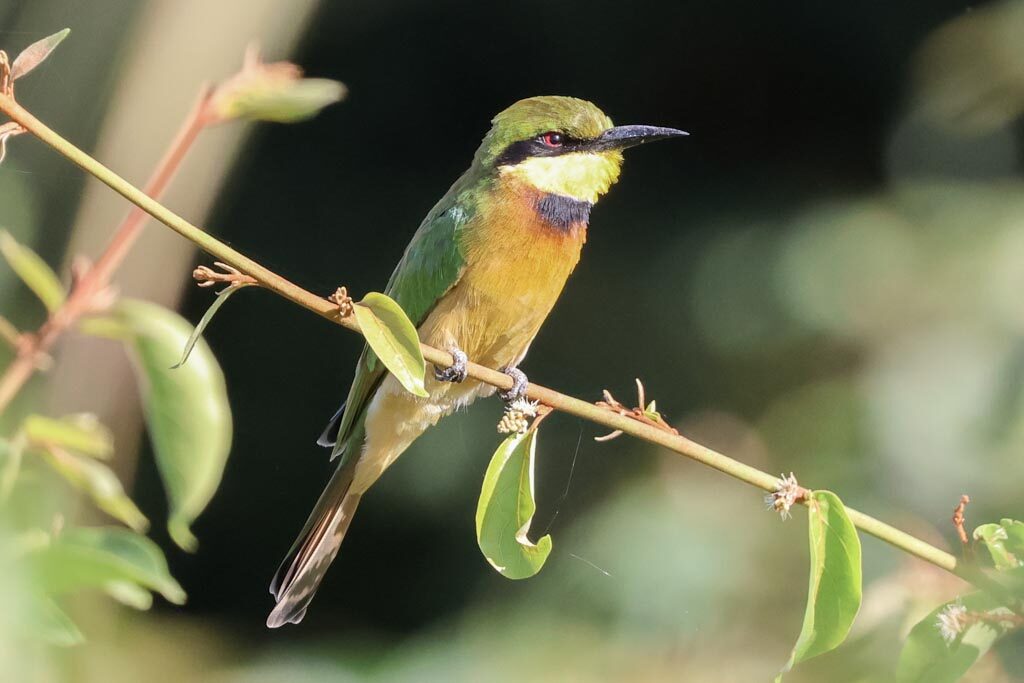
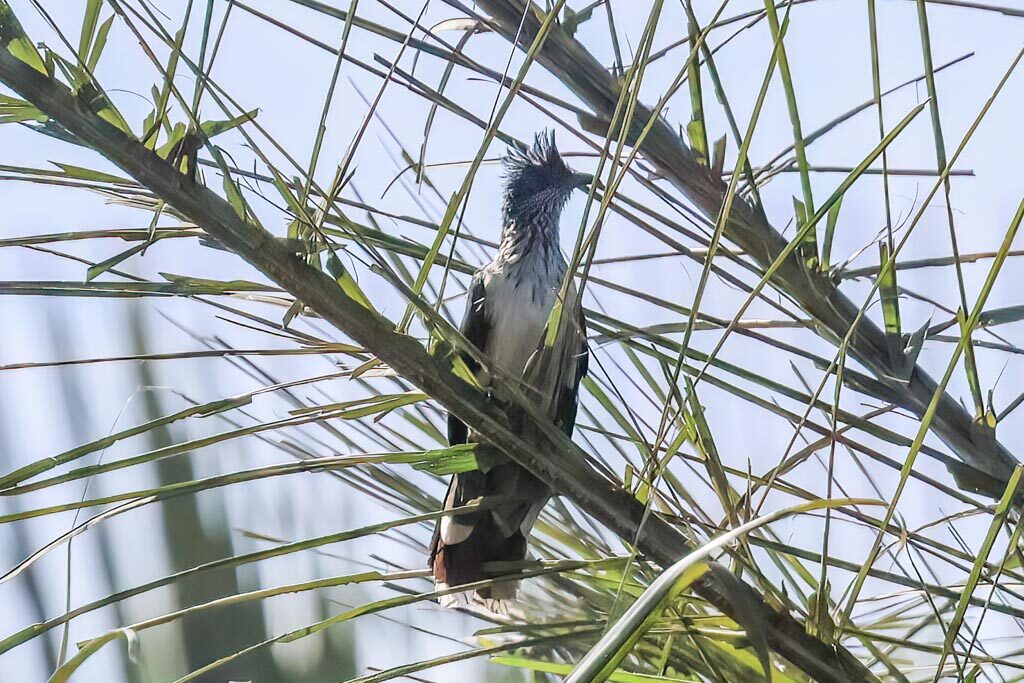
We had only gone a short way down the track when the Levaillant’s Cuckoo called again, much closer. We positioned ourselves where we had a clearer view and this time, finally, it flew out and round past us. It landed in a nearby tree, where we could see bits of it between the leaves as it clambered through the branches. Then it flew out again and landed in the open in a palm. It had certainly made us work for it but good views eventually.
We walked back out of the village to the main road now and came out opposite the entrance to the forest. Across the road, we made our way in through the trees to the drinking pots. It was getting hot now so it was a perfect time for a sit down in the shade and a break with a cold (or hot) drink. There were a few birds coming and going from the water pots. Doves were well represented – a Mourning Dove was in with several Red-eyed Doves on the bare ground, giving a very good side by side comparison. One or two of the Laughing Doves kept stopping to sun themselves.
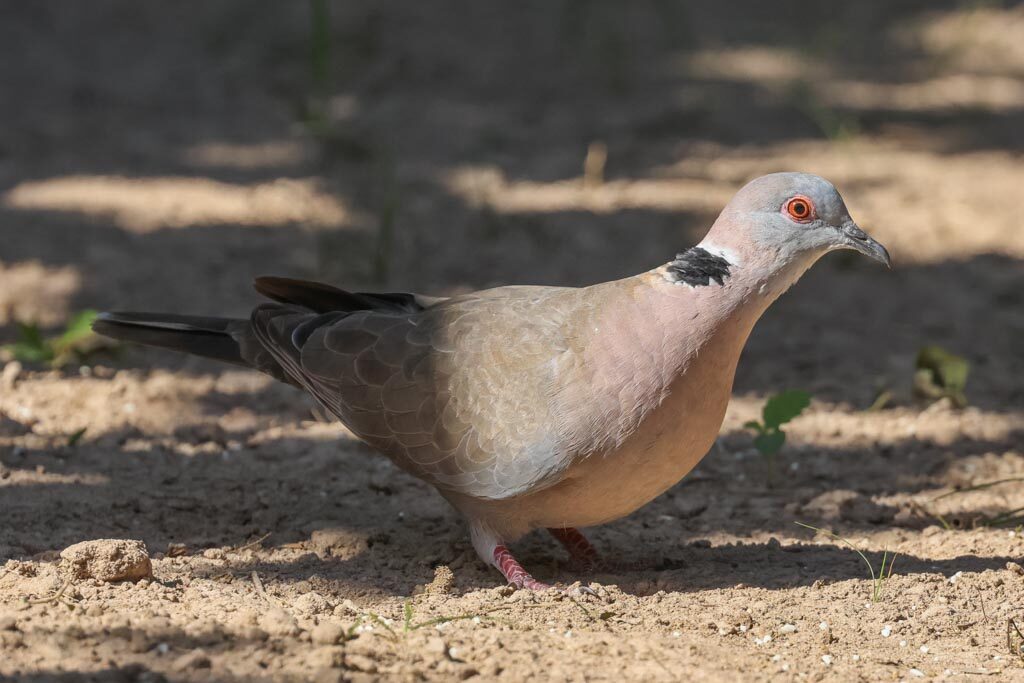
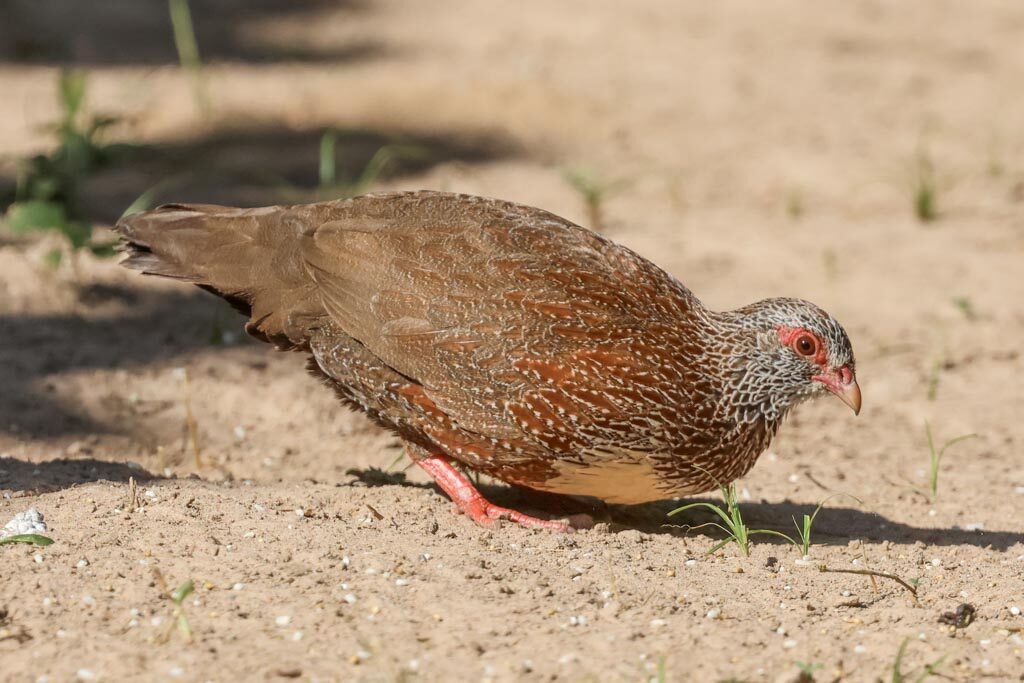
A Black-billed Wood-Dove appeared on the edge of the trees, our first of the trip, and then came out to join the other doves in the middle. Modou sprinkled some seed out on the ground and it only took about a minute before a pair of Stone Partridges came out of the trees to feed. Great views now in the open of what can be a very secretive species.
There were lots of other birds coming in to feed or drink as we sat and enjoyed our drinks. Several Red-billed Firefinches and Red-cheeked Cordonbleus dropped down to the seed but a Lavender Waxbill was a little more shy and only had a quick drink. Common Bulbuls, Village Weavers and one or two Olive-naped Weavers were in and out all the time and a very noisy group of Blackcap Babblers came in to drink at one point too. A Veined Swordtail butterfly was patrolling up and down on the sunny edge of the trees.
We were just about to move on when Madi saw a Guinea Turaco fly in to the top of the tree at the back. Typically it remained well hidden at first, in the dense leaves and creepers, but as we sat quietly and waited it slowly dropped down and came out to drink on the pot in the tree. Stunning!

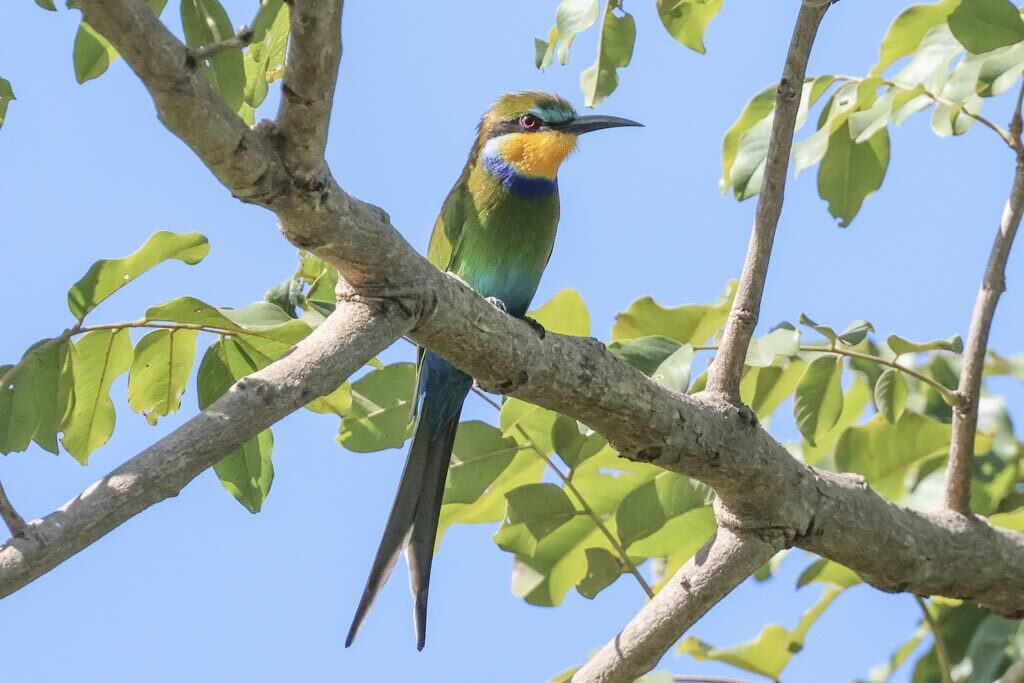
When the Guinea Turaco eventually flew back into the trees, Madi led us into the forest to look for owls and nightjars. Along the narrow path through the secondary growth, several Swallow-tailed Bee-eaters were perched in the bushes ahead of us. We stopped to admire them. A Yellow-breasted Apalis was singing nearby, so we paused again to see if that would come out. We had some quick glimpses of a pair in the trees and a bonus Senegal Eremomela which came in to investigate the mobbing ‘music’ too.
Further along the path, Madi led us off to one side, into the dense bushes. While everyone waited, one by one we went in to see where the Long-tailed Nightjar was roosting on the forest floor. Supremely well camouflaged against the brown dry leaves on the ground, even though it was only a few metres away you couldn’t see it until it was pointed out.

As we made our way back out, Modou heard an Oriole Warbler in the trees so we stopped again to see if we could see it. Modou tried to call it out but remained elusive, brief glimpses in back of tree but very hard to see and never came out. While we were waiting, an Osprey drifted high overhead with group of Hooded Vultures. Then a Palm-nut Vulture circled up too.
Continuing on deeper into the forest, we stopped again to watch an African Pygmy Kingfisher under the trees. It was hard to see in amongst all the tangled branches. A little further on, Madi pointed out the Verreaux’s Eagle Owl roosting high up in a tall tree. The other main bird we had come here to see. We got it in the scopes and had a good view, including of its pink eyelids.

Back to the drinking pots, a Pygmy Kingfisher had apparently been in here too but disappeared again now. We had another short sit down to see what else was coming in. It was much the same selection as earlier, but with the addition of our first Blue-spotted Wood-Dove which dropped down to drink. We had got the set now already. Another Turaco flew in to the tree at the back, but didn’t come down this time and disappeared out the back.
We said our goodbyes to Madi and his assistant now. Ousman was waiting for us with the bus in the shade on the side of the new tarmac road. We drove back through the houses to the main coast road again and not far to Tanji Ecolodge where we would have lunch. First, we sat down on the chairs overlooking the drinking pool. A young Snowy-crowned Robin-Chat was feeding under the trees just behind.
As we sat and watched, a succession of birds came in to the pool to drink or bathe, lots of Common Bulbuls and weavers, a couple of Red-bellied Paradise Flycatchers, an African Thrush, but no sign yet of the bird we most wanted to see here, Western Bluebill. Lunch was served, a buffet of grilled chicken and red snapper, with chips and rice. We had just finished the main course when Modou heard a Western Bluebill calling, so we quickly moved back to the chairs. They can be very shy and we had a couple of brief glimpses higher up in the trees. It was showing no sign of coming down to the pool though and then it disappeared again.
As we waited, we had time to eat our watermelon now. An African Pygmy Kingfisher came in for quick bathe, as did a much larger Blue-breasted Kingfisher. A pair of Brown-throated Wattle-eyes appeared in the trees. We could hear a Green-headed Sunbird off to our left but it did not come in today.
After a while, the Western Bluebill started calling again and finally reappeared in the trees above the pool. There were two of them now and they started to drop down a little lower towards the water. Finally everyone could get onto them. It looked like they might fly down to drink a couple of times but they were very nervous and kept changing their minds. Then they disappeared back up into the tangle of branches above.
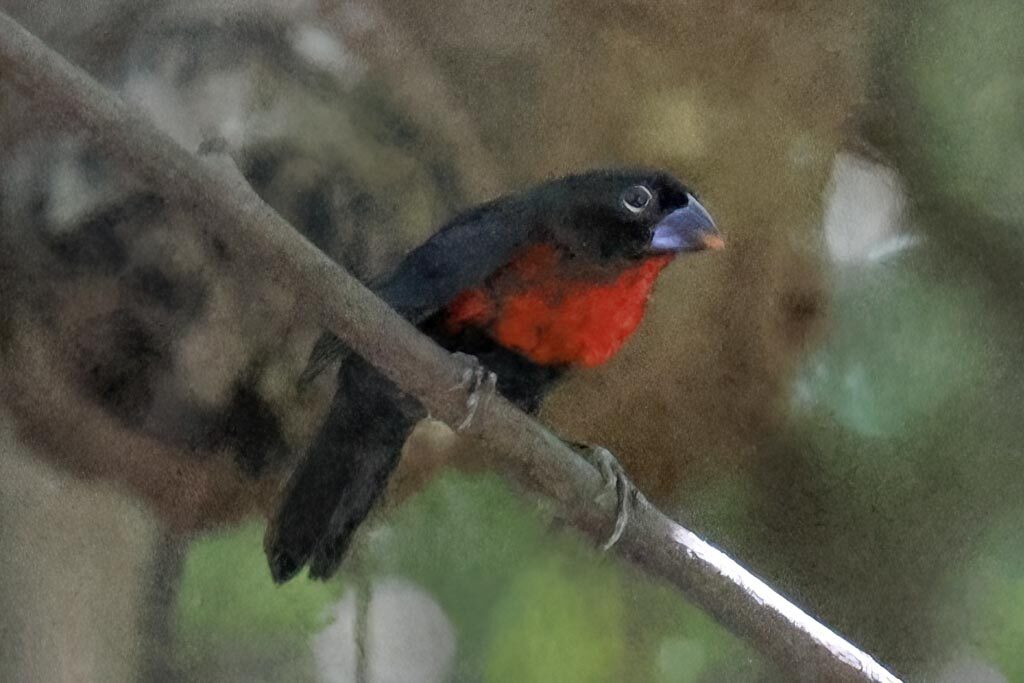
A couple of minutes later, everything scattered as an African Goshawk shot in under the trees. It flew up into the tangle above the back of the pool and landed. We could just see it in there, through the branches, before it moved a little higher up and we could only see its tail hanging down. We hoped it might come down to drink or bathe in the pool but it was probably just after the birds.
Unsurprisingly, there was no sign of anything now. It probably explained why the Bluebills were extra nervous today, if the Goshawk was hanging around. It eventually flew down and out, landing briefly again further back before off. A great bonus, as African Goshawk can be a hard bird to catch up with.
We were planning to move on soon, so it was time for a quick loo break. Typically, an African Paradise Flycatcher came in just while several of the group were off using the facilities. It had a quick dip in the pool, stopped to preen and dry itself briefly, then disappeared again. Just two more Red-bellied Paradise Flycatchers were left when everyone go back. For those who went up for a quick look out at the beach – there were some distant Lesser Black-backed Gulls on the sea and terns fishing offshore including a few Sandwich Terns, one or two Common Terns.
We wanted to make one last stop today, so we left Tanji as the heat of the day was just starting to ease and drove along the coast to Tujerang. A Western Yellow Wagtail was standing on the track with some cows as we drove in. We stopped just beyond and a Purple Roller flew across. It landed in a tree nearby, so we climbed out and got it in the scopes. An Osprey was perched in another tree behind. Modou heard a Red-winged Prinia (formerly Warbler) nearby but it wouldn’t come out and show itself.

We walked on a short way towards the sea. It didn’t take long to find several Chestnut-bellied Starlings feeding on the open ground around some cows. Four flew up into a small tree where we got them in the scopes. A Crested Lark was feeding along the edge of the vegetation below and a distant Woodchat Shrike was perched in another tree on the other side of the track, down towards the beach.
Modou tried playing his ‘music’ and quickly tempted out a Western Olivaceous Warbler, a Melodious Warbler and a Western Subalpine Warbler. This is a good area for Palearctic migrants, here for our winter. Another Osprey flew over. An Orange-flanked Skink was on the trunk of a nearby acacia.
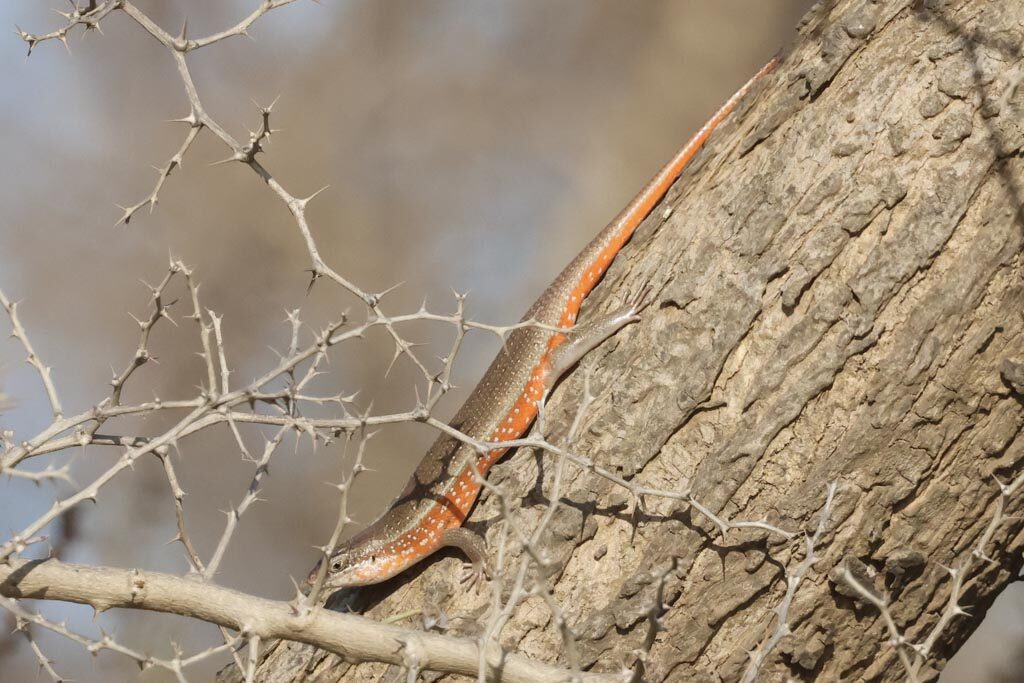
As we walked on, we found a couple more Chestnut-bellied Starlings much closer, one of which posed nicely in a tree for us. An Abyssinian Roller landed on one of the small acacias and a small group of African Silverbills was perched in another. Looking out over the sea, we picked up a distant flock of five White-bellied Cormorants flying past over the sea.

Further on, we found a Wryneck in the bushes briefly. Modou tried the mobbing ‘music’ again briefly and this time a Red-winged Prinia appeared out of the nearby weedy vegetation, followed by a surprise Reed Warbler briefly and a Melodious Warbler. The bus was waiting on the track here now, but we carried on past it. A couple of adult African Harrier-Hawks flew past, followed by a juvenile.
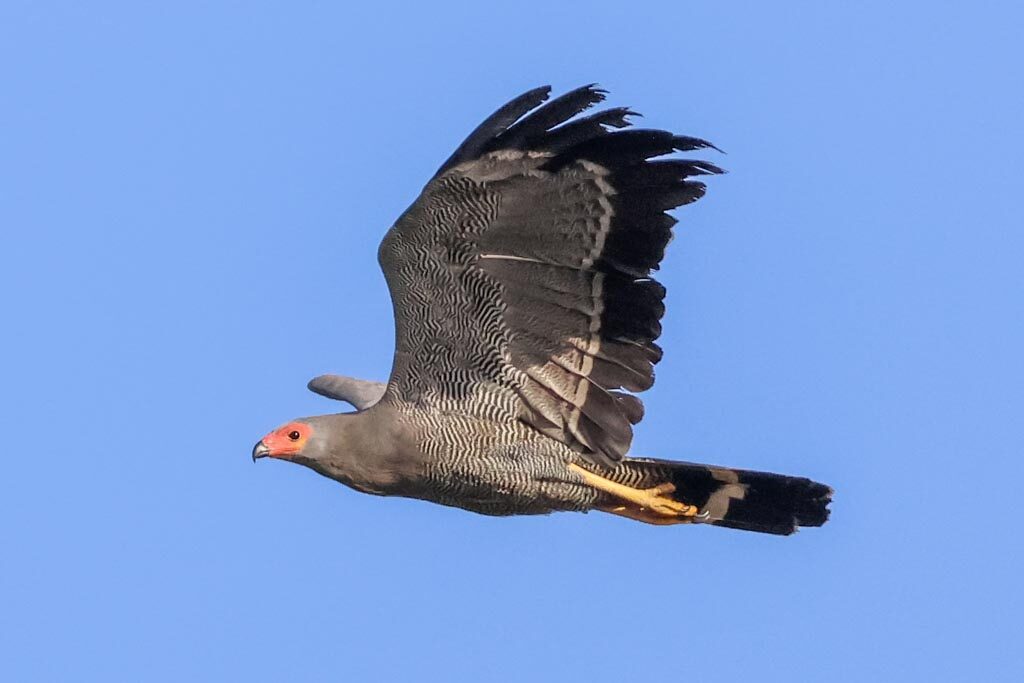
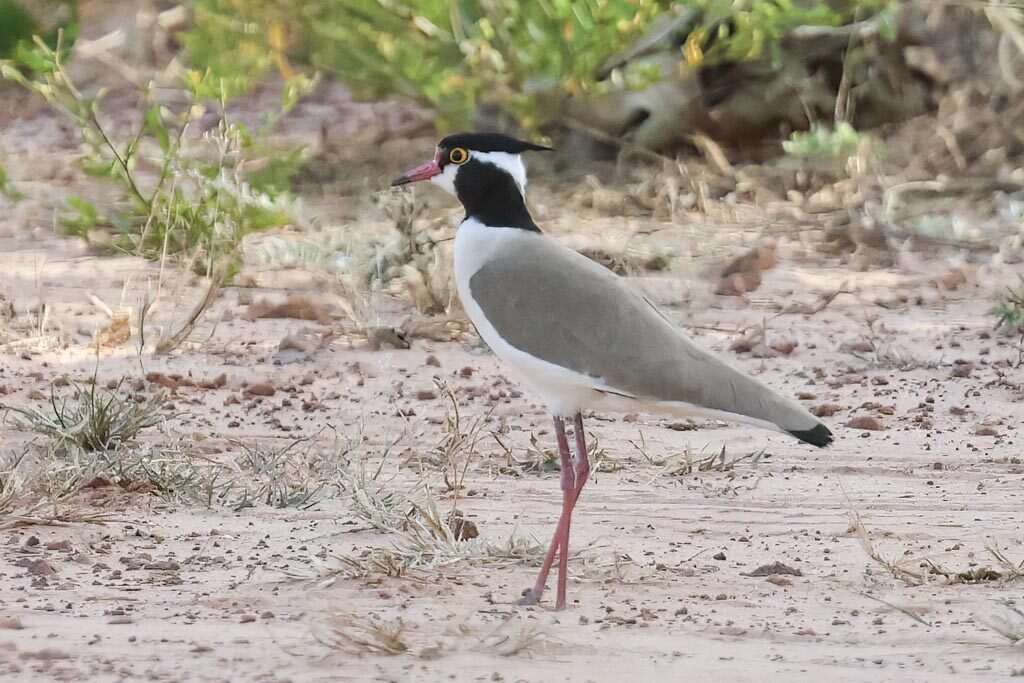
Two Black-headed Lapwings were standing on the edge of the track ahead of us, so we edged closer to try to get some photos before they flew. A Whinchat appeared in the bushes nearby, then a Northern Wheatear. Further on along the track, a Singing Cisticola perched up high in a tree singing. Another quick try with the ‘music’ produced the usual sunbirds, plus several Common Whitethroats, a Nightingale, and both Rufous and Zitting Cisticolas.
Walking on again, a couple of Yellow Penduline Tits appeared in the bushes by the track ahead of us. They flew past behind us so we walked back after them and then had great views of them feeding in the weeds. A Vieillot’s Barbet started calling and one of the group found it well hidden in the top of a leafy tree. Just beyond, we found another out in the open on a bare branch, which was easier to see.

There seemed to be birds everywhere here but unfortunately it was time for us to head back. It was about a 40 minute drive back to the hotel. We had time for a break and a chance to freshen up before we met again for a drink up at the pool bar. Dinner was served in the main restaurant again, then we had a quick run through the list there (well away from the live entertainment down by the pool). It had been a long day so we were ready for bed tonight.
Friday 28th November
Straight after breakfast, we set off for the hour-long drive down to Farasuto. Turning off the main road we made our way along the dusty street down through the houses and then out into the overgrown cultivations beyond. We drove on further and got out of the bus to explore the fields.
As we made our way in, several Yellow Wagtails flew up calling. A Woodchat Shrike kept dropping down to the ground and then flying back up to a small tree nearby and a Palm-nut Vulture flew over. We were met here by one of the guides from the Forest, Bob, who would accompany us for the morning.

Our first target here was Four-banded Sandgrouse, so we fanned out and walked on across the field. There were small groups of Wattled Lapwings hiding in the weeds, which took off noisily. A Purple Roller flew past us and landed in a small acacia tree in the middle, where we had good views through the scope. Unusually, the Purple Roller let us get quite close before it finally flew off. A Black-crowned Tchagra started singing and flew across into some larger trees where it posed nicely on the front.
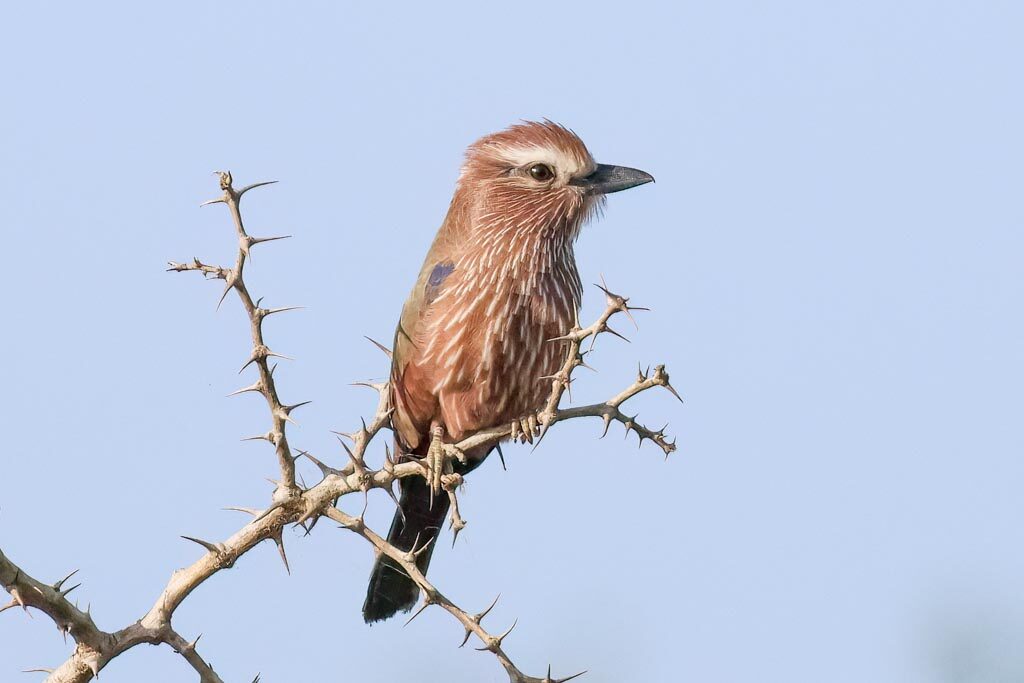
Pushing through the tall weeds on the far side, we came out into the next field. There were lots more Yellow Wagtails here and a couple of Common Whitethroats which flew up out of the vegetation. This time, Modou and Bob walked round and in from the back of the field while we waited on the edge. There was no sign of any Four-banded Sandgrouse at first, until they came down the far side and one flew up from the ground.
It disappeared straight over the tall weeds back to the first field. We couldn’t see where it landed because of the vegetation and when we walked back to the other side, it flushed again and flew straight back over to the second field. It did exactly the same thing when we tried again but third time lucky, Modou finally managed to locate the Four-banded Sandgrouse on the ground. It was hiding behind some thick weeds but Bob walked round the other side very slowly and it walked out into view. Great views now as it stood there calling.

Moving on, we walked round into the next fields. There had apparently been a Bronze-winged Courser here a couple of weeks ago. Even though it hadn’t been seen since, we made a quick sweep of where it had been. No surprise, there was no sign of it. Over on the far side, an African Cuckoo flew out of the bushes and up into a large tree in the distance. We could see it in the leaves and when it moved we had an OK view of the scopes. Then it flew out and straight towards us, turning and going past right in front of us, excellent flyby views.
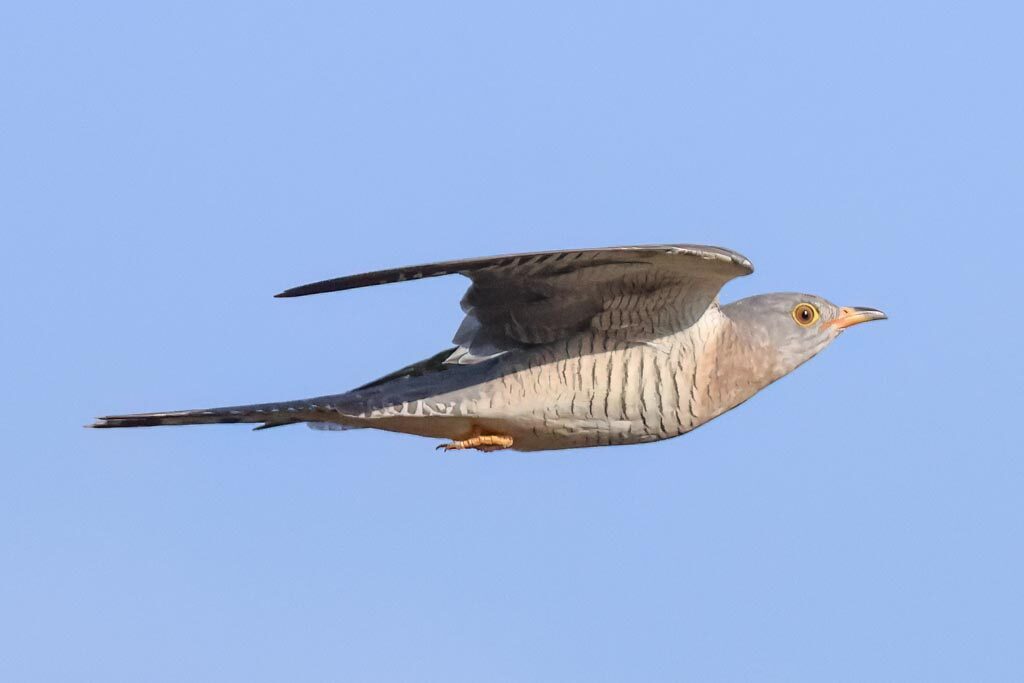
Out onto the track beyond now, as we walked back a Western Marsh Harrier drifted past and a couple of Purple Starlings flew over. A Didric Cuckoo flew across and landed in the top of a tree next to the track briefly. As we continued on, a stunning Scarlet-chested Sunbird came up out of the weeds by the track and fluttered around the flowers in the sunshine.
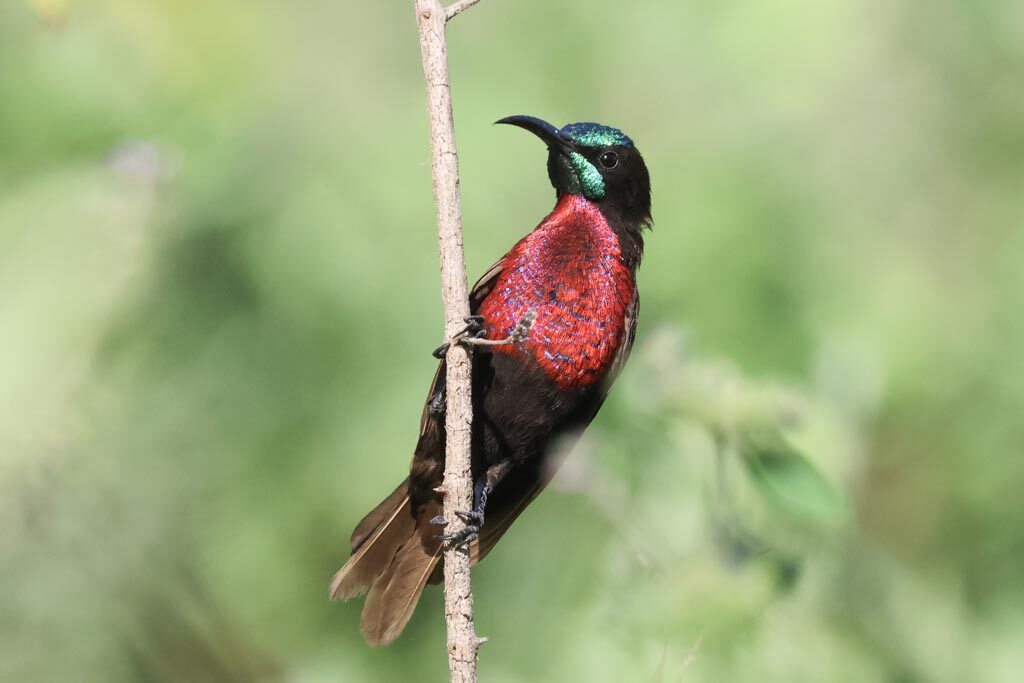
Modou set up the speaker and played the mobbing ‘music’ and as usual, lots of birds came in to investigate. These included a Chiffchaff and a Willow Warbler. It could almost have been summer back at home, apart from when they were joined by a Western Olivaceous Warbler and several sunbirds! There were a few weavers too, including a female Vitelline Masked Weaver and two or three Little Weavers.
A falcon came over the trees off to our left now. We were looking into the sun, but it looked too small for a Lanner. We managed to grab a couple of quick photos before it flew off behind us and zooming in afterwards we could see it was a young Red-footed Falcon, a rare bird here in The Gambia.
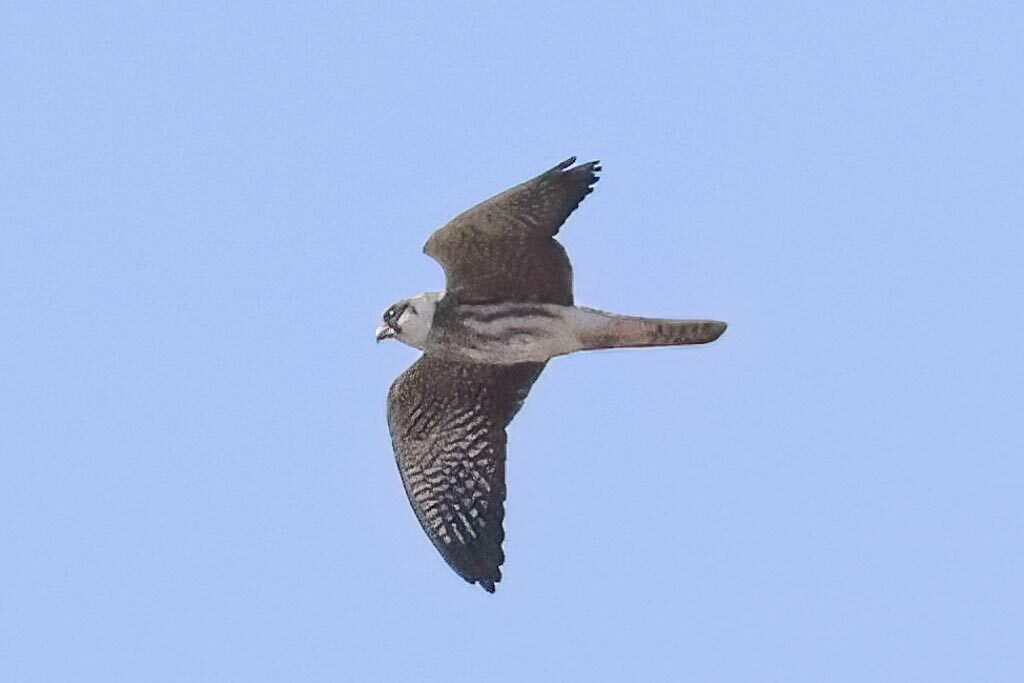
Continuing on along the track, back to where the bus was waiting, a Singing Cisticola was singing (appropriately) from the vegetation and a Black-crowned Tchagra perched nicely in the top of a nearby tree in the sunshine.
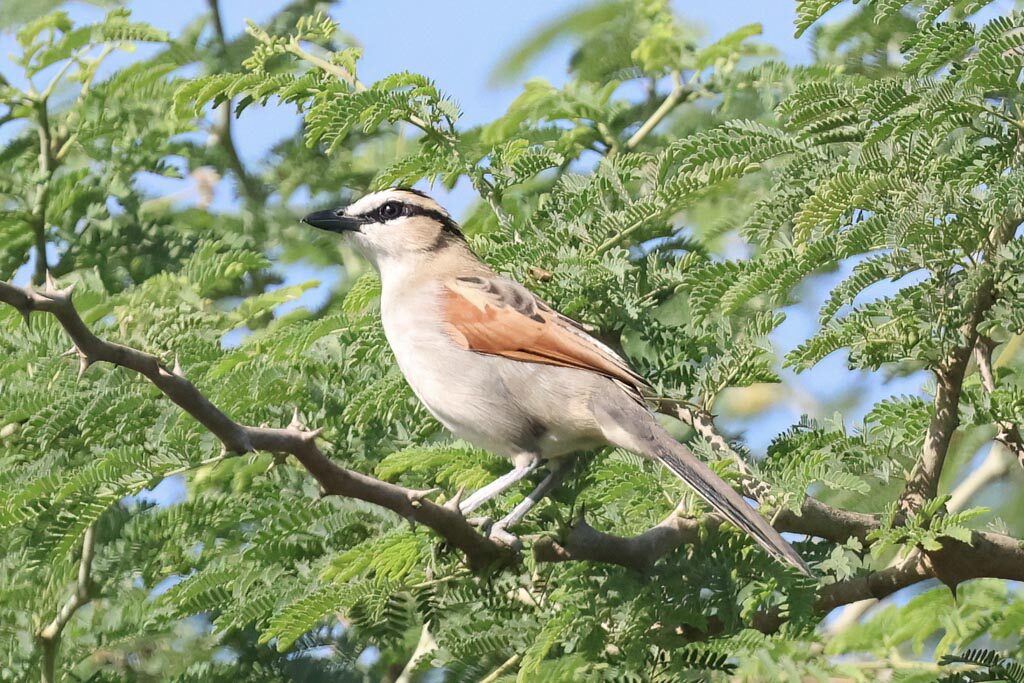
It was only a short drive on from here to the entrance to Farasuto Forest. Just inside the gates, we sat down on the stone benches. It was hot in the fields now, so nice to have a break in the shade of the trees and a chance to get a cold drink. There were lots of Black-rumped Waxbills of various ages coming down to the different drinking pots in front. They were joined at different times by a few Lavender Waxbills and a pair of Orange-cheeked Waxbills.
A small group of Brown Babblers came in to drink and a Snowy-crowned Robin-Chat had a bath. An African Pygmy Kingfisher appeared from the trees. After watching from the edge for a bit, it splashed into the water a couple of times and flew back in. We had only heard Green-headed Sunbird at Tanji yesterday, so it was nice when one appeared for a drink on one of the pots here today. A Little Greenbul dropped in briefly too.

After we had finished our drinks, Bob led us along the paths deeper into the Forest. We hadn’t gone far when we came across a large group of Olive-naped Weavers in the trees above. They are the leaders of the mixed species flocks here, so we stopped and scanned. One of the group picked up a Buff-spotted Woodpecker feeding in a dense tangle of branches and an African Paradise Flycatcher was flitting in and out just above. When the flock moved deeper into the trees, we carried on along the path and out to the pools on the far side.
As we came out into the open, two Giant Kingfishers flew off calling and landed on a tall stem on the far side of the pools. A Nile Monitor was basking on the bank by the water. This is traditionally a reliable site for White-backed Night Heron, but there was no sign of any in the usual trees where they roost today. It sounds like they have become more erratic in their appearances this year, so hopefully they haven’t been too disturbed. The trees here look less dense than they used to.
A Dark Chanting Goshawk was perched in a distant palm before flying off over the forest. We had seen one earlier fluttering around below the pots but now a Widespread Forester butterfly landed in the dappled shade on the edge of the trees.

Back at the drinking pots, another large group had arrived there now. We decided to move on and went out to where Ousman was waiting with the bus outside. Bob came with us on the short drive to a nearby patch of secondary growth.
As we walked in, we could see lots of the trees have been cut back here recently and although they are reshooting, it is getting rather thin. Still, after a quick look round Bob managed to find one of the Greyish Eagle Owls roosting in some taller trees further back. While admiring it through the scope, a second bird appeared behind it briefly, before climbing higher up and disappearing behind the leaves.

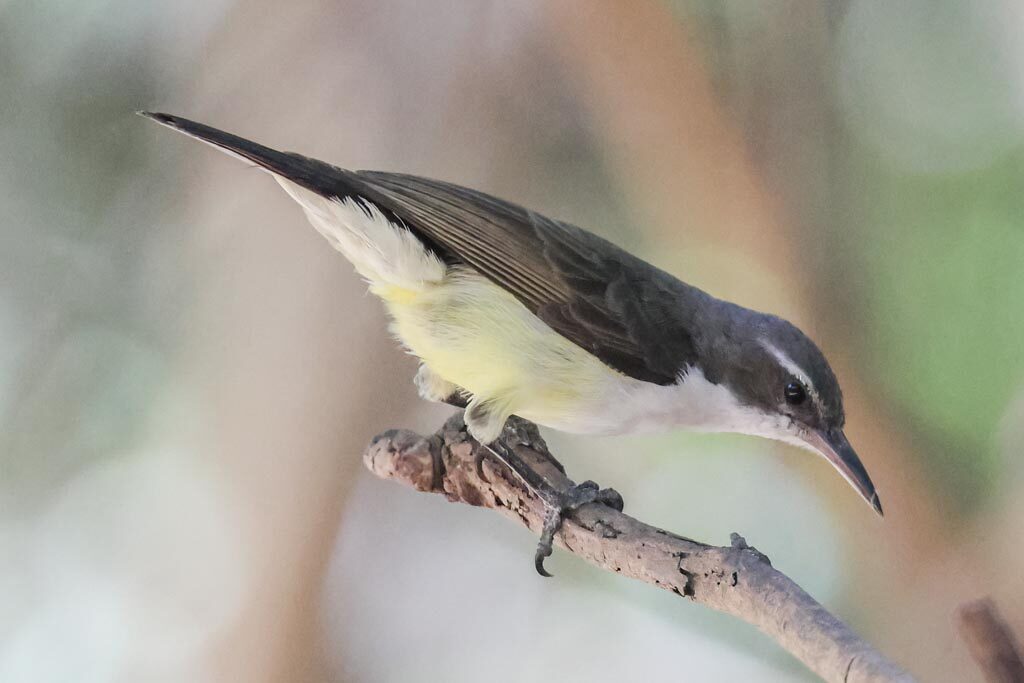
Back out by the bus, we said our goodbyes and thanks to Bob. We still had some time before we were due for lunch, so we stopped at some more drinking pots on the way. Sitting in the hide, lots of birds were coming in and out to drink. The Common Bulbuls were pretty much ever present. A succession of Northern Red Bishops in various plumages came through, including a couple of males mostly in breeding plumage. The weavers were mostly Village Weavers but with a single Little Weaver at one point. There was a good variety of waxbills, Cordonbleus, firefinches and Bronze Mannikins.
The Beautiful Sunbirds were mainly young males and there were also a couple of adult male Variable Sunbirds. A female Western Violet-backed Sunbird was a nice bonus here, coming in to the pots a couple of times. There was a young Greater Honeyguide which came in to drink too and then spent a long time in the trees above.
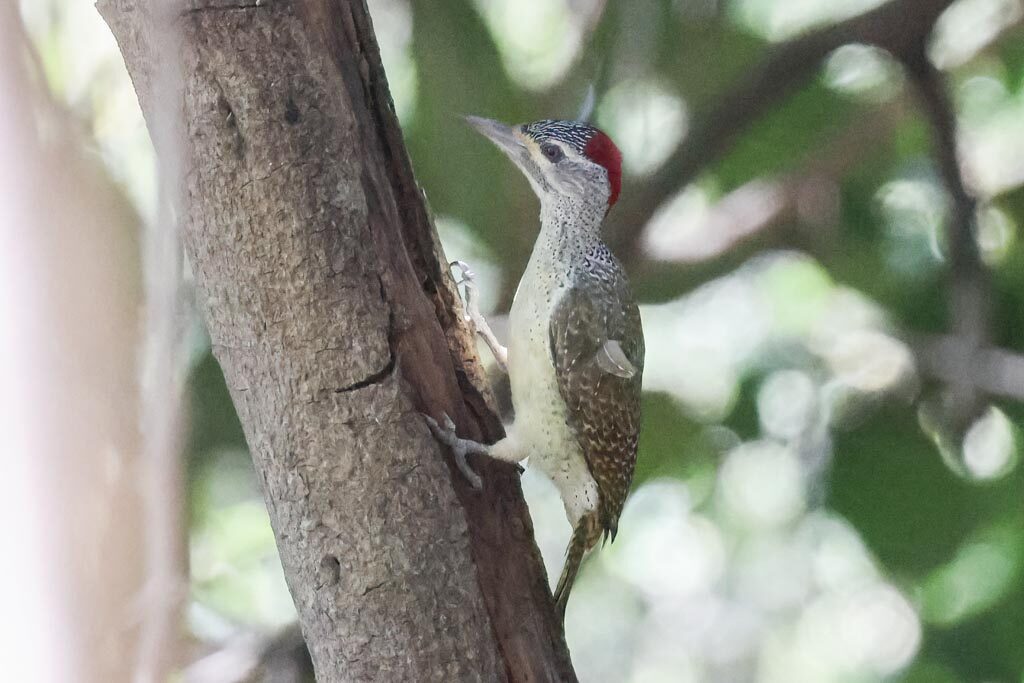
A Fine-spotted Woodpecker appeared, feeding low down in the trees at the back and on the ground too at one point. A Striped Ground Squirrel walked across through the leaf litter. Sadly the Violet Turaco didn’t come down to drink today. It flew in and landed in the tree above the closest pot but something spooked it and it flew straight back out again.
As it was nearly time for lunch now, we went back out to the bus. It was only a short drive down to the edge of the creek and the jetty opposite Baobab Island. There was no sign of the boat though and Modou had to shout a few times before the boatman eventually appeared on the far side and brought the boat over. His half-eaten sandwich was lying on the seat beside him.
While we were waiting, we picked up three African Spoonbills flying distantly over the mangroves. A Great White Egret landed in the trees on the edge of the channel off to our right and a Western Reef Heron was feeding on the far bank. Five Common Sandpipers flew out of the mangroves and chased round low over the water.
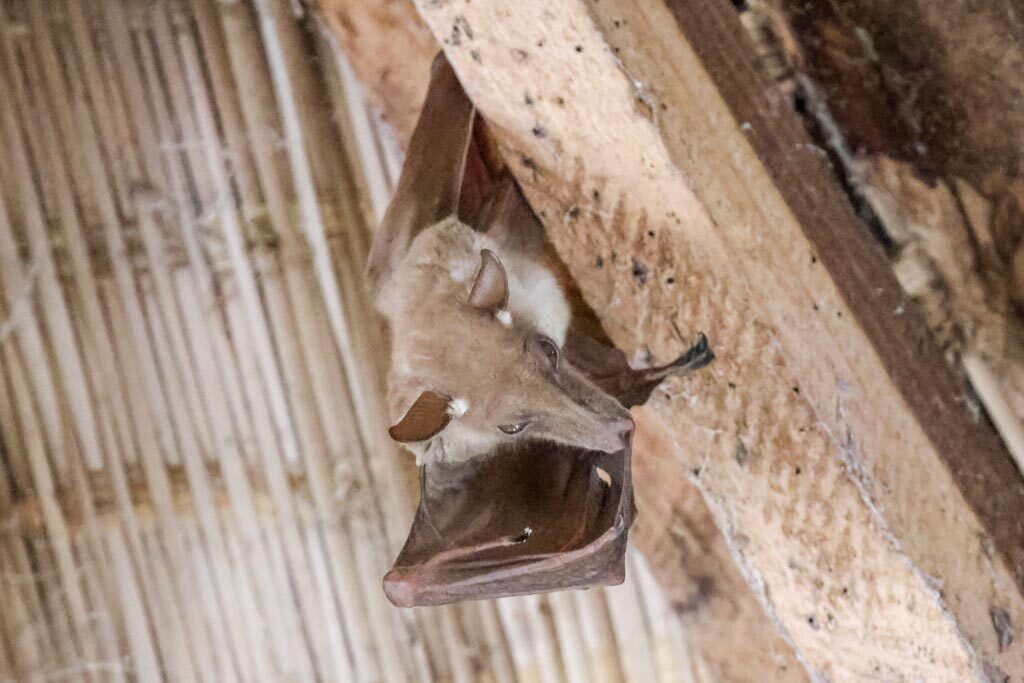
It was just a short crossing to the island and we made our way straight over to the restaurant for lunch. The usual Mauritian Tomb Bats were roosting at the top of the pole in the middle, just under the straw roof, but they had been joined today by a single Gambian Epauletted Fruit Bat too. A delicious Gambian buffet lunch was served – rice and peanut sauce, chicken yassa and grilled fish.
After lunch, we went outside to look for the resident African Scops Owl in the mangroves. It was rather well hidden today and it took a while to find an angle for the clearest view. A Mouse-brown Sunbird was flitting around in the trees behind, out over the water. When we had all had a good look at the owl, Modou played the mobbing ‘music’ and the sunbird came in a little closer, along with a Western Subalpine Warbler.
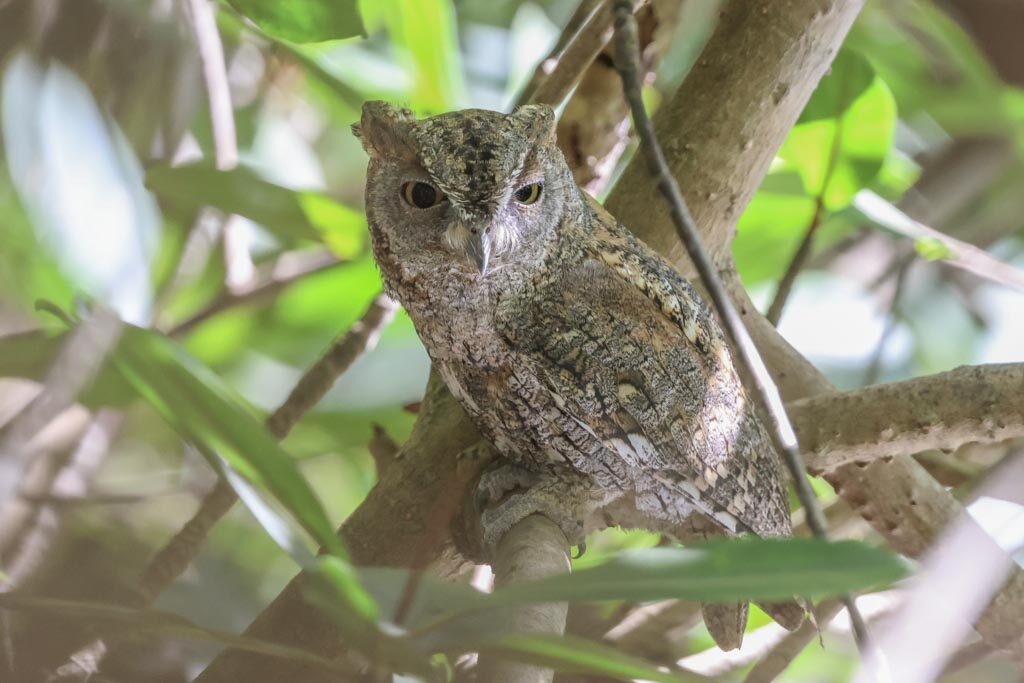
After another break in the restaurant for watermelon and coffee, we had a short walk around the island. It was rather hot now and there wasn’t much activity. There were a few Senegal Parrots and Rose-ringed Parakeets in the large baobab trees from which the island takes its name. What was presumably an African Goshawk show across low and disappeared into the mangroves. Back round by the jetty, Modou heard a Cardinal Woodpecker call and we eventually tracked down a pair to where they were excavating a nest hole in a low dead tree.
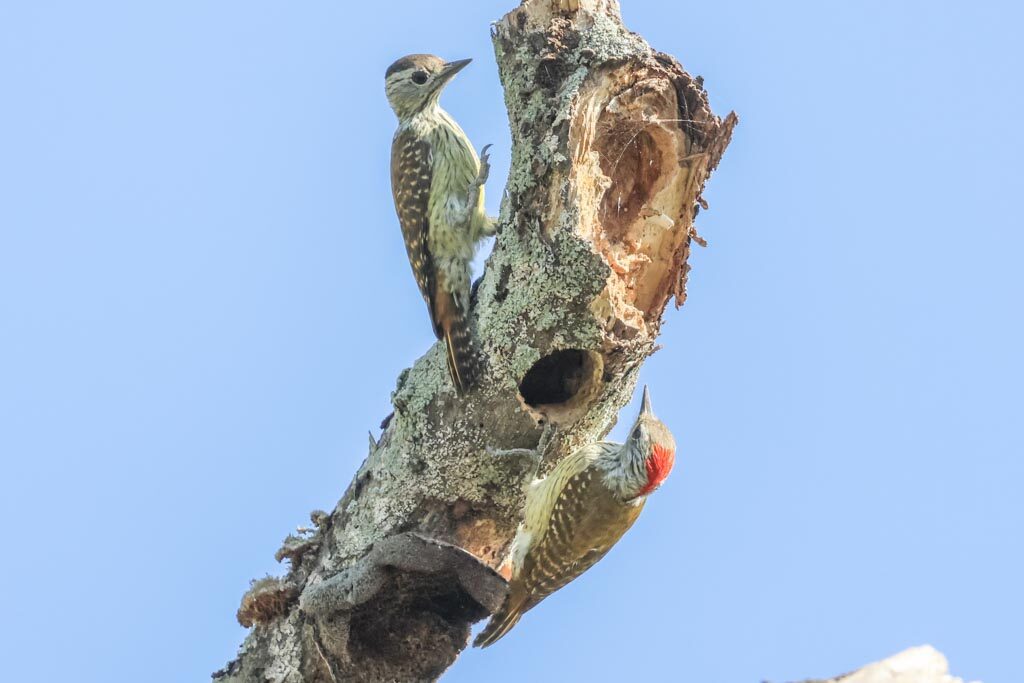
While we waited for the boat, a few Senegal Thick-knees were standing in the shade on the bank opposite along with a Greenshank. A Whimbrel and a Striated Heron flew out of the mangroves. Back on the mainland, as we walked back to the bus, several African Pied Hornbills flew up and landed in the top of a tall tree. A single Spur-winged Lapwing was standing in the shallows by the piles of old oyster shells, begging to be photographed.

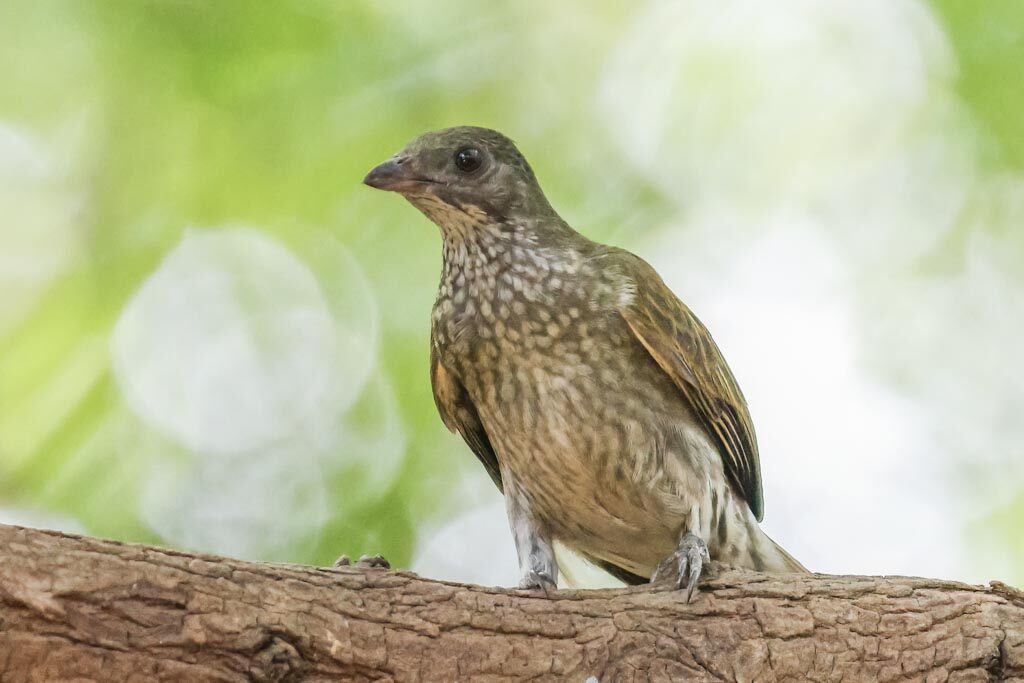
It was just a short bus ride back to the pots, where we had been before lunch. This is just about the best place to see Spotted Honeyguide, and one often comes in to drink later in the afternoon. Initially, we saw much the same birds as before. The young Greater Honeyguide was now joined by an adult male, a Gambian Sun Squirrel came down the trunk of one of the trees to drink in the pot below, and a couple of Orange-cheeked Waxbills had joined the other waxbills.
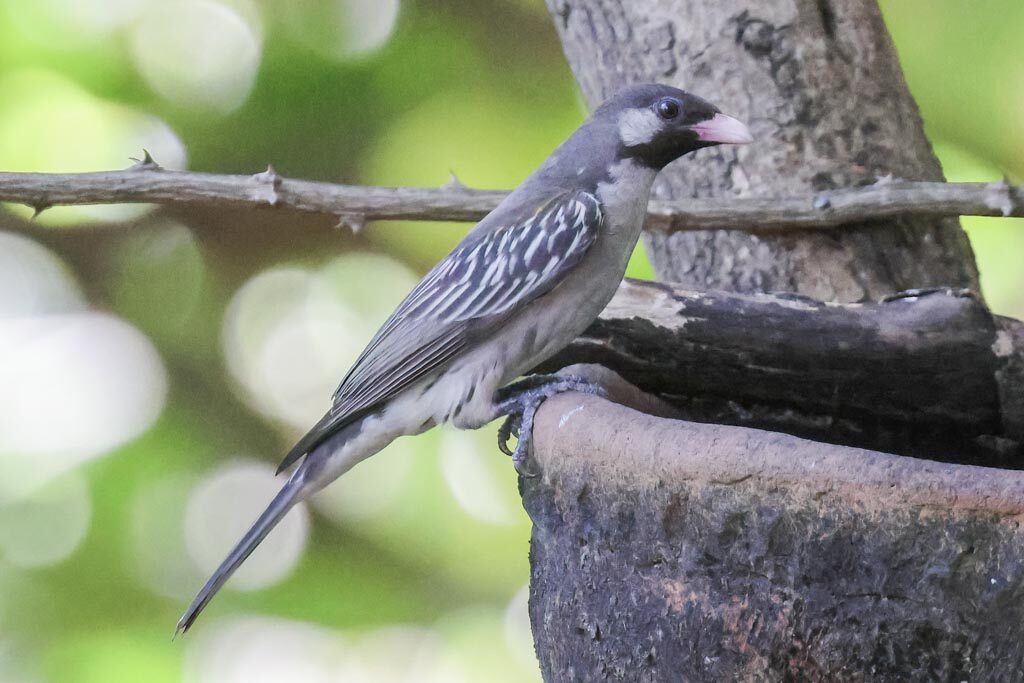
It went quiet for a while, when everything seemed to disappear, but they had possibly just been spooked when a noisy pair of Blackcap Babblers swept in. Birds slowly started to drift back and then the Spotted Honeyguide appeared. It landed in the tree above the nearest pot, right in front of us, then dropped down to drink. Great views of our main target here.
Mission accomplished and with a long drive ahead, it was time to head back. Time for one last bird for the list though. On our way back through the fields in the bus, two Northern Black Flycatchers flew up from the bushes by the track into a nearby baobab tree. It took about an hour to get back to the hotel. After a break to freshen up, we met for drinks at the Pool Bar as usual before heading up to the restaurant for dinner and today’s list.
Saturday 29th November
After breakfast, we set off straight away again for the hour’s drive down to Pirang. A Dark Chanting Goshawk was on the wires by the road. Driving down the track beyond the village, we checked the herd of cows grazing nearby but couldn’t see any Oxpeckers on them yet.
We stopped by the entrance to the old shrimp farm, where several West African and Wire-tailed Swallows were coming down to drink on a nearby pool. A flock of much larger Mosque Swallows flew over too, flashing their very pale underwing coverts. Scanning the trees in the distance, we found six Brown-necked Parrots in the tops and flying round. A Pied Hornbill was on the top of one of the bushes closer to us.
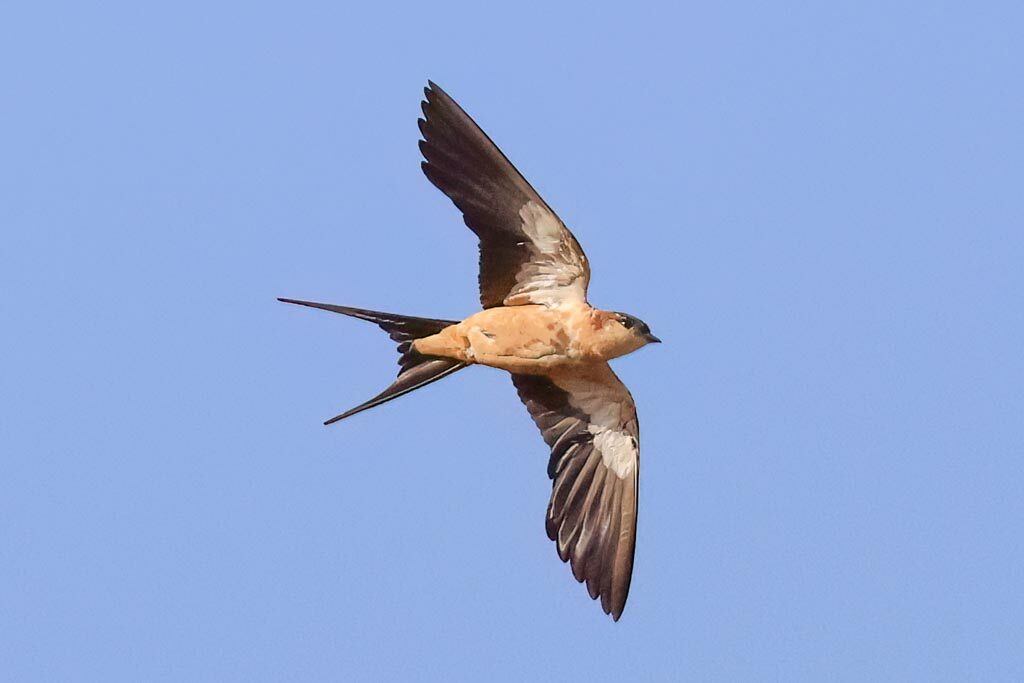
Walking in along the main track, a couple of Hamerkops came up from the rushes and there were several Cattle Egrets around the feet of the cows. Two Wire-tailed Swallows were flying round the bridge over the wide channel and landing on the side.

Beyond the next junction, three Plain-backed Pipits came out of the grass and ran out into the middle of the track.

A couple of Pied Kingfishers were fishing over the corner of the pool beyond, hovering above the water and then flying down to land on the bushes.
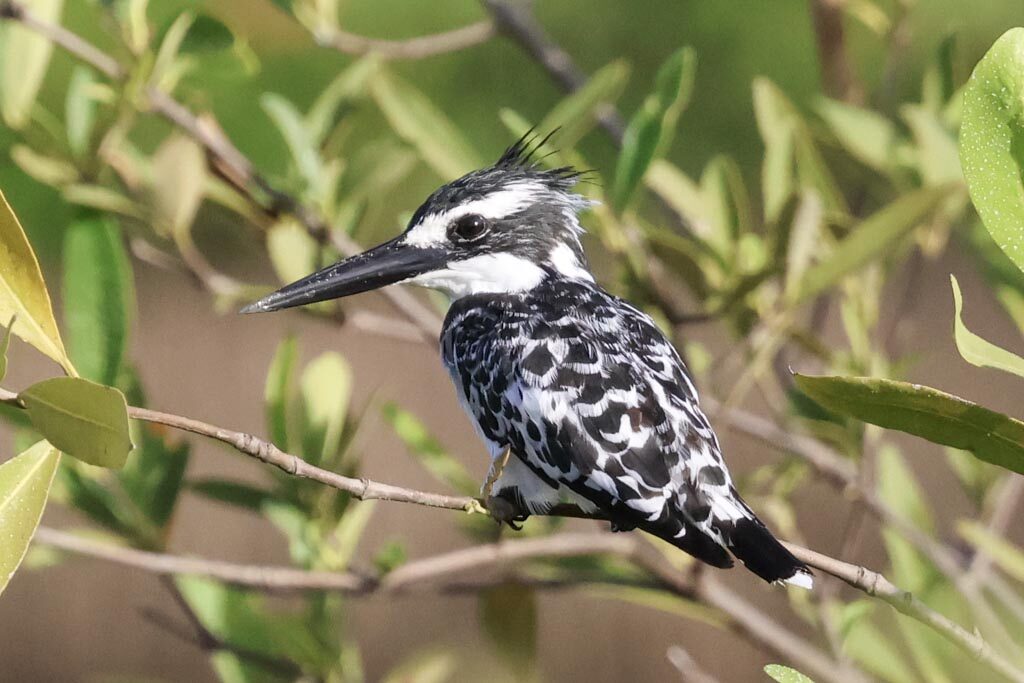
We took the narrower overgrown path to the left. Several Black-headed Weavers flew between the bushes ahead of us, all in non-breeding plumage. Looking across towards the entrance track, a Long-crested Eagle flew off through the trees chased by three Pied Crows. Out over the pools the other way, we picked up our first Pink-backed Pelican and Greater Flamingoes, Eurasian Spoonbills and a Sacred Ibis flying over. We flushed a Black-crowned Night Heron and a Striated Heron from the bushes on the banks and two Green Sandpipers flew out from the side of the creek and disappeared off over the water.
Coming out of the bushes by the first large pool, we could see a good variety of waders. Several Black-winged Stilts, lots of Common Ringed Plover and Wood Sandpipers, and one of two Greenshank, Common Redshank and Whimbrel. A couple of Gull-billed Terns flew past and we could see a single Little Tern hovering and diving in the water in the top corner. As we walked down along the bank along one side, several White-faced Whistling Ducks flew up from the back and circled round calling. One of the group spotted a distant Woolly-necked Stork over the trees behind us.
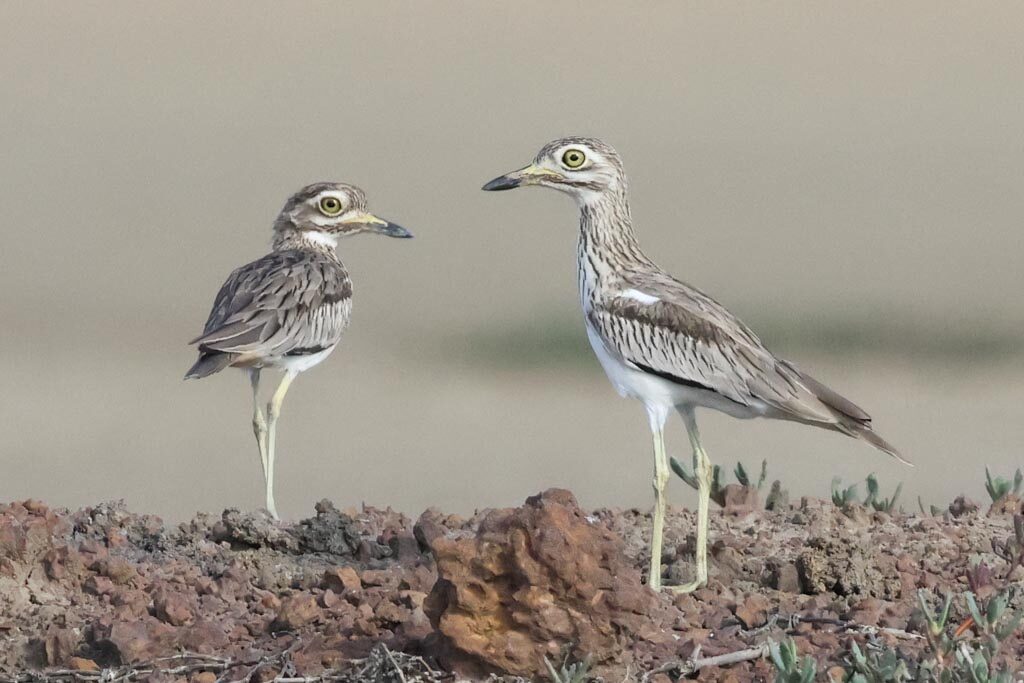
At the next junction, there were at least a dozen Senegal Thick-knees on the bank over the far side of the next channel. The pools beyond were dry, so we turned and walked down along the path on our side, then crossed over at the next bridge. There were several more Pink-backed Pelicans feeding in the channel which were moving on ahead of us, herding fish ahead of them. Looking up, House Martins and Red-chested Swallows circled over, along with several Blue-cheeked Bee-eaters.
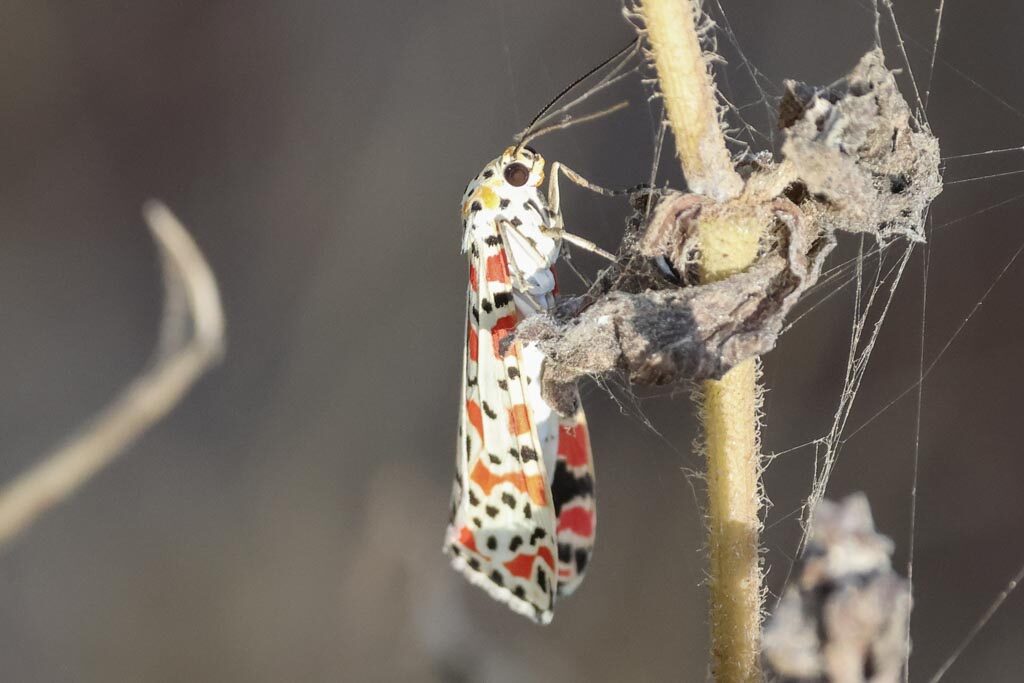
A couple of Crested Larks flew up from the bank and several Subalpine Warblers, a Common Whitethroat and a couple of Reed Warblers flitted out of the bushes ahead of us. Lots of Crotalaria Moths flew up out of the bushes as we brushed past.
The pools further up had water in them and there were lots of birds. At the first, we could see several Greater Flamingoes, Pied Avocets and a couple of Black-tailed Godwits. As we got closer, we found there were a few Ruff too, two or three Marsh Sandpipers, and a small group of Little Stints with a couple of Curlew Sandpipers. Sadly a single Kentish Plover flew off before everyone could get onto it.
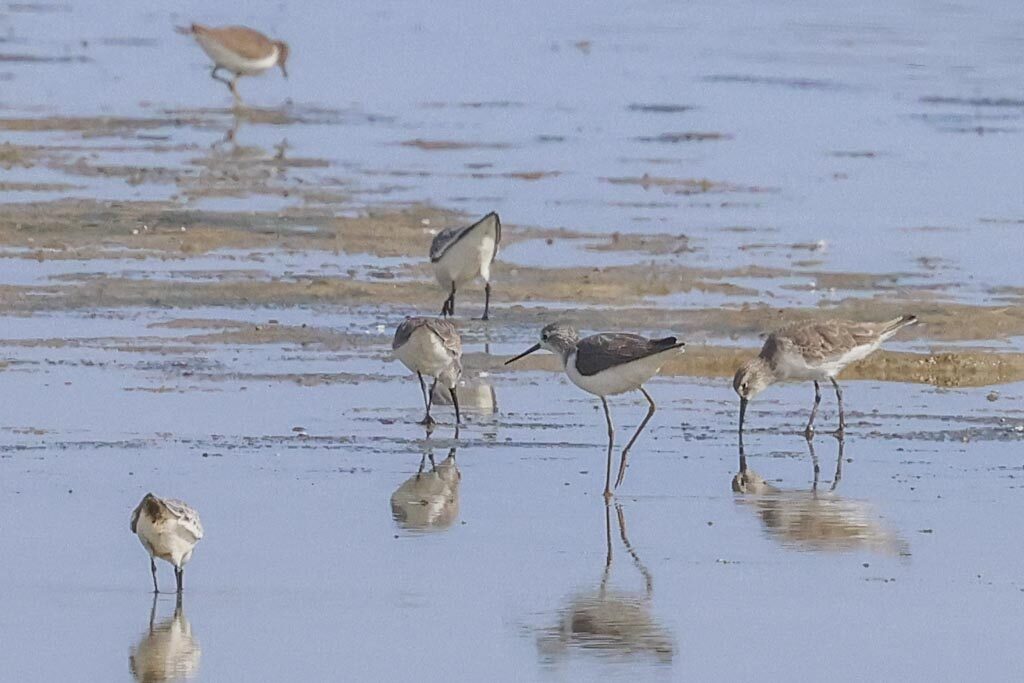
At the next pool, there were lots more small waders – at least 600 Little Stint and 20+ Curlew Sandpipers, along with a Turnstone, a Knot, a couple of Dunlin and several Sanderling. Looking through carefully, we found two Temminck’s Stints creeping around on the mud to. A scarce winter visitor in The Gambia and the first we have seen here on this tour.
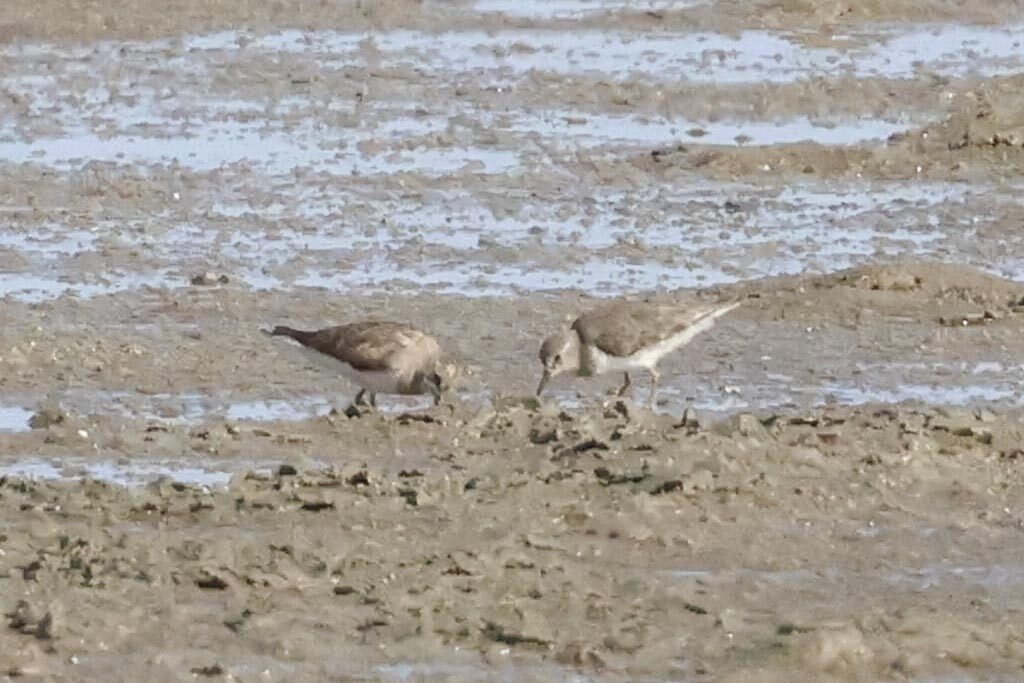
There were lots of Yellow Wagtails on the mud, and their rasping calls gave away the presence of several Iberian Yellow Wagtails. We eventually found some nice males with grey heads and white throats.
Continuing on, a small group of Spoonbills flew over, and looking up we could see it was a mixed group, including both African and Eurasian Spoonbills. They dropped down towards the channel and when we got out from behind the bushes we could see a feeding frenzy up at the far end. The Pink-backed Pelicans had presumably chased all the fish up here and now they had been joined by a large group of Herons, Egrets and Spoonbills in the shallows. We could see the pink legs of the African Spoonbills but they were feeding with their bills down in the water.
A Black-faced Quailfinch flew up from the vegetation by the path ahead of us. It circled round and then landed on the path again but further up, out of view. We walked on very slowly to try to see it but it was well hidden in the weeds now. Eventually two flew out again but this time they disappeared off over the channel and away.
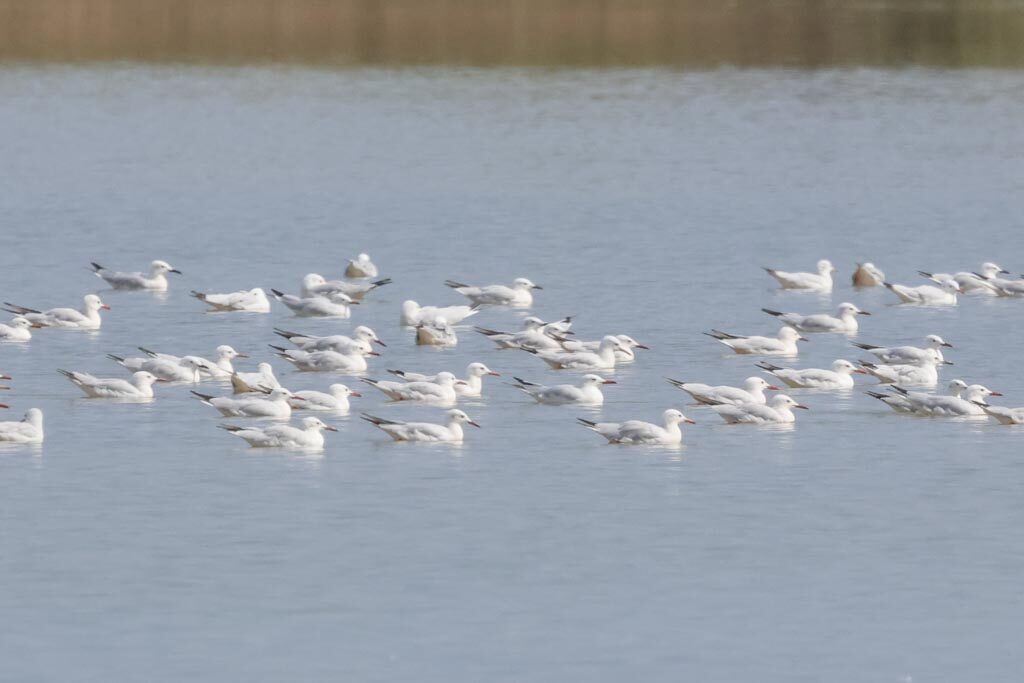
On the deeper pool over the far side, we could see a large roost of gulls and terns. Mainly lots of Slender-billed Gulls, with a smaller number of Grey-hooded Gulls and a single Lesser Black-backed Gull. In amongst them, we could see a few Caspian and West African Crested Terns. The mixed group of Spoonbills had relocated to here now and standing side by side, we had a better view of the African Spoonbills with their bills out.
As we walked down along the track beside the pool, a young Blue-cheeked Bee-eater posed on a low tree ahead of us. At the far end, another Reed Warbler was singing in the bushes.

Turning left at the junction, we made our way back along the next track. There were lots of waders on the first pool, along with a small group of Caspian Terns, and three juvenile Flamingoes. The waders were much the same as we had already seen. There were plenty of Ringed Plovers but no sign of any of the other smaller plovers we hoped to find here. A Grey Plover was on the mud over in the far corner and there were a few more Black-tailed Godwits. Lots of Yellow Wagtails flew round calling.
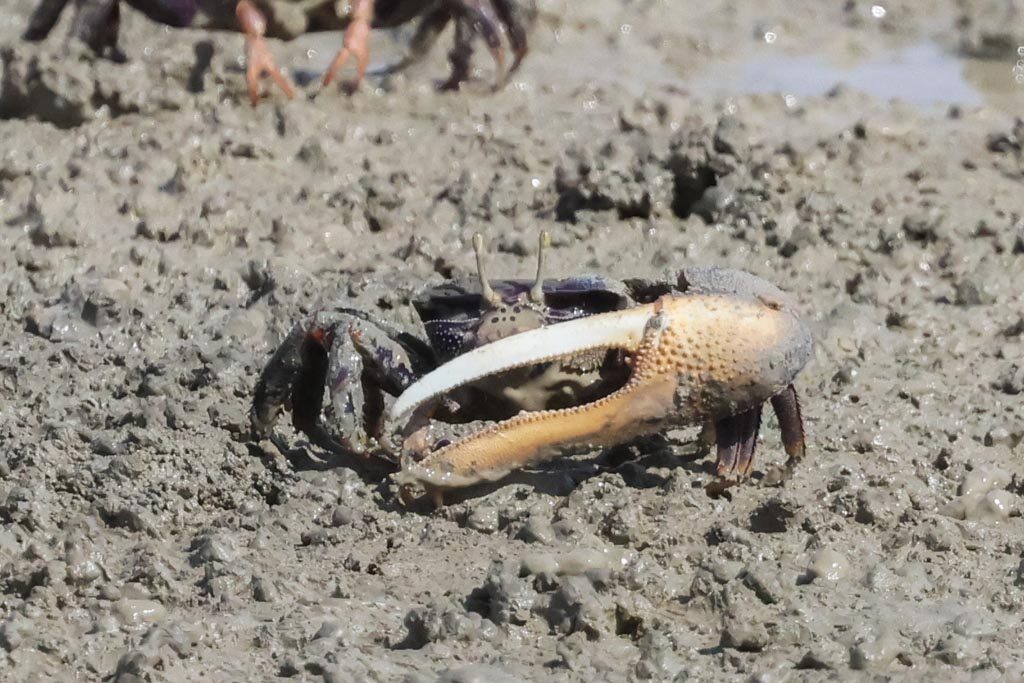
The next pools were almost dry and consequently there were fewer waders here than usual. There were lots of West African Fiddler Crabs on the mud though. The bus was waiting for us at the far end and as we crossed back over the channel a Malachite Kingfisher was in one of the bushes on the bank.
It was starting to get hot now so we were pleased to get out of the sun. As we drove back out, several Yellow-billed Oxpeckers had appeared on the cows by the track.

We drove over to Jamora Lodge, where we would be having lunch, next. We were a bit early still, so had time for a sit down in the shade, watching the comings and goings from the Village Weaver colony in the tree by the restaurant. An African Harrier Hawk came up through the branches of a tree in the edge of the ricefields just beyond, but flew off before everyone could get a look at it.

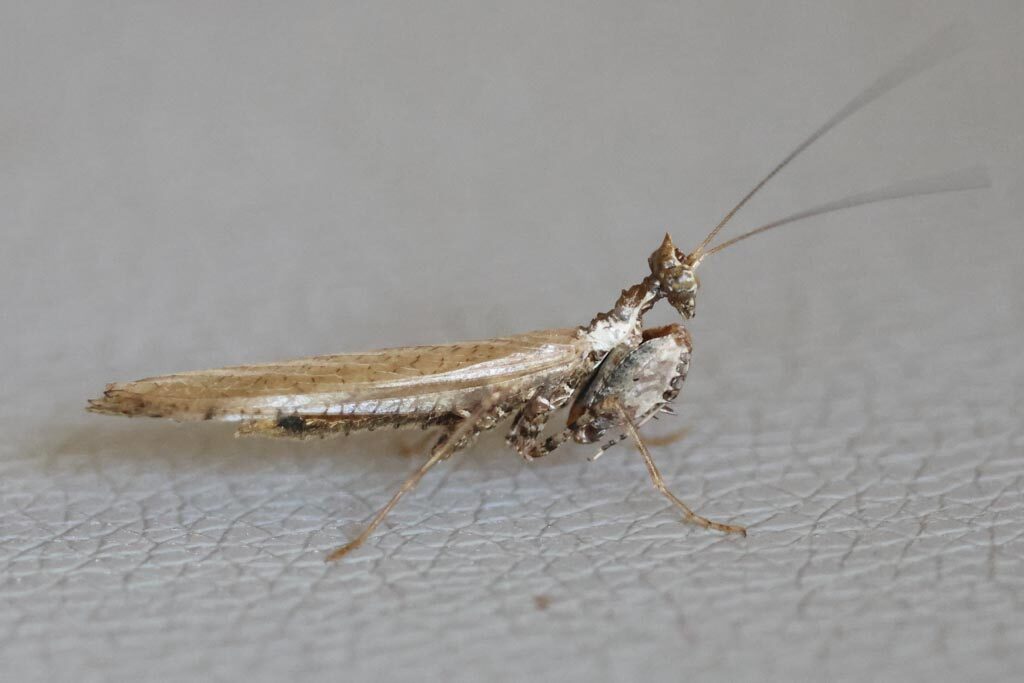
Otherwise, there was not much other bird activity now, in the heat of the day. Several butterflies and Portia Widow dragonflies fluttered around the bushes in the garden. As lunch was served, a Bark Mantis joined one of the group on their place mat.
We had planned to go for a walk in the ricefields this afternoon, as we usually do, but it was still too hot after lunch. There wasn’t much increase in activity yet. Instead, Modou decided we could drive out to a nearby area of savannah woodland to see what came in to the mobbing ‘music’.
We duly stopped on the edge of a dirt road in the middle of nowhere and got out. Modou cleared somewhere for us to stand in the shade of a nearby tree and set up his speaker. The usual selection of sunbirds, Cordonbleus and a Melodious Warbler quickly arrived. Then a Pied Flycatcher appeared too, along with a female Northern Puffback, and a Brown-throated Wattle-eye.
While we were watching the birds, Modou suddenly waved down a trike which was coming along the track past us. It turned out he knew the driver, nicknamed Dr Owl. He had a new photo hide further down, so Modou quickly arranged for us to go there next. Once we had finished with the music here, we got back on the bus and drove a short distance further on.
We stopped by a track and walked in through a small plantation of cashew trees. Dr Owl was waiting by the hide and ushered us in. Black-faced Firefinch has been seen here recently and we were quite keen to see one, a scarce bird here. We had only just arrived in hide, before we could get settled in, when a female Black-faced Firefinch dropped down by the pool in front of hide. Thankfully we all managed at least a quick look at it before it flew off. As we stood and waited, we hoped it or another would come back in.

There were lots of other birds coming in to drink and bathe now. Orange-cheeked and Lavender Waxbills, and Yellow-fronted Canaries. Vitelline Masked and Little Weavers. An African Thrush and a couple of Black-billed Wood-doves. A Pygmy Kingfisher came in to bathe but the Red-bellied Paradise Flycatcher couldn’t work up the courage. A pair of Stone Partridge were picking around in the field just behind.

There was still no sign of the Firefinch returning, so Modou decided we would have a quick look in the overgrown fields behind, as he had heard Senegal Batis calling. He set up the speaker and started playing the mobbing ‘music’ again. As usual, several sunbirds and Canaries came in very quickly. The pair of Senegal Batis appeared too and we had a nice look at them in the trees just behind.

A pair of Western Violet-backed Sunbirds appeared, good to see a male after the female the other day.

A male White-fronted Black Chat chased the female around through the trees above, singing.
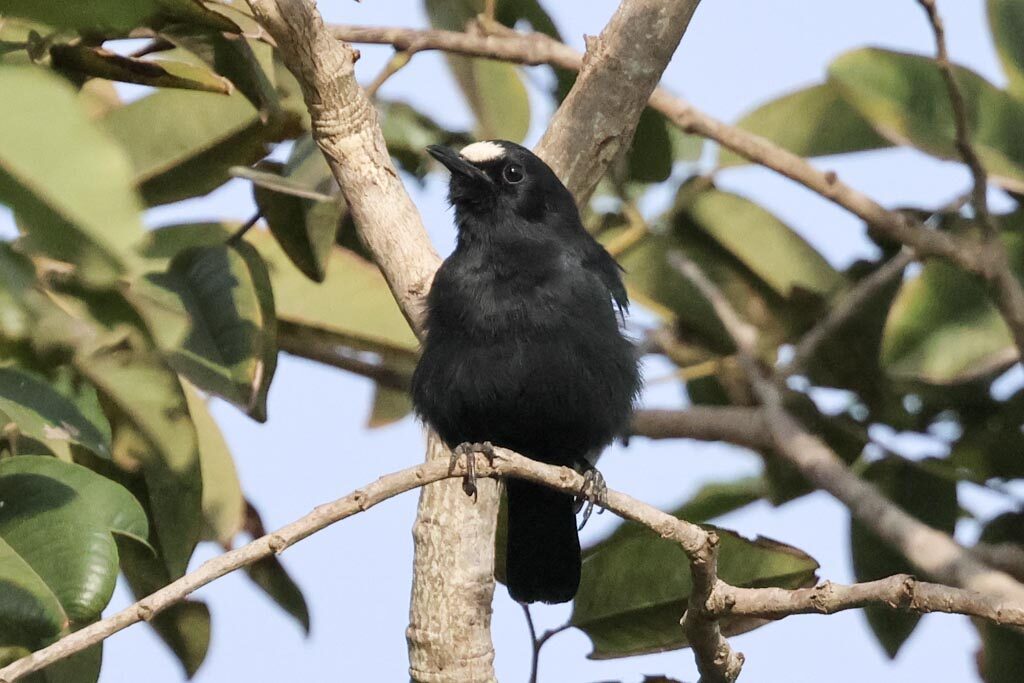
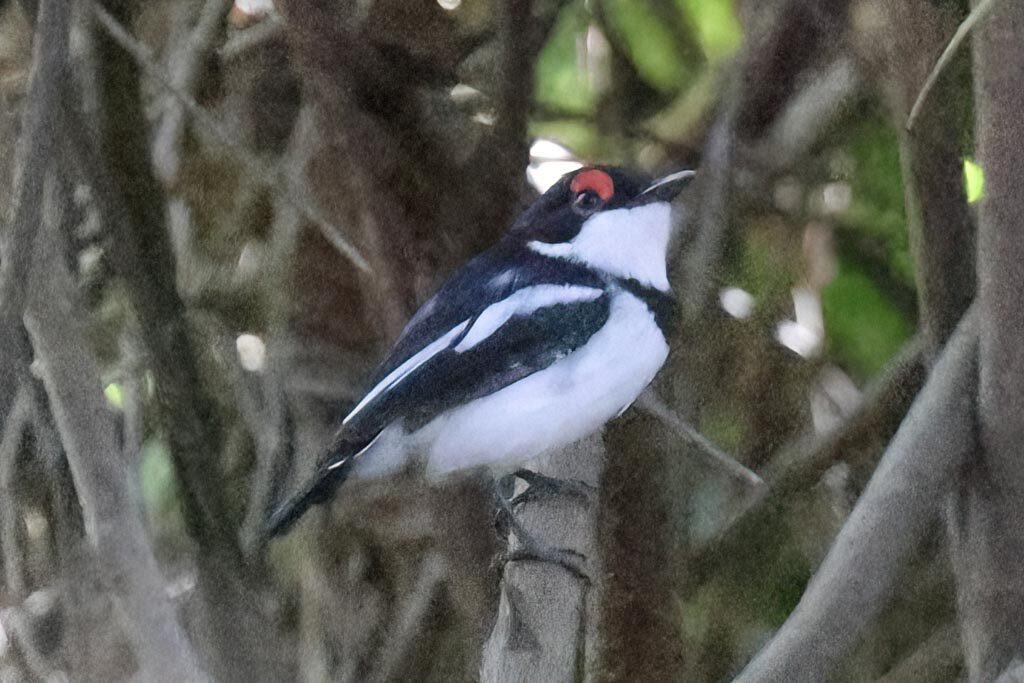
Several Pied Flycatchers flitted around and a pair of Chestnut-crowned Sparrow-Weavers came in to investigate what all the noise was about. Not a species we see very often on this tour. The Brubru in the top of the trees behind was rather skulking at first, hiding in the leaves, but eventually came out and showed itself.

A remarkable selection of birds here, we eventually had to tear ourselves away. We had intended to go back for another look in the hide but we were out of time now. It was a long drive back. Back to the bus, we had only gone a short way along the road when we stopped again briefly to watch a Dark Chanting Goshawk on the verge. Once again, we were back with enough time to freshen up before the usual drinks in the bar, dinner in the restaurant and a run through of the day’s list.
Sunday 30th November
A long drive today, down to Kartong on the southern border with Senegal border. We left before breakfast and drove down in the dark, before the traffic started to build up. There were several Senegal Thick-knees in the middle of the road with the goats in one of the villages. As we got to Kartong, it was just getting light. A couple of Hooded Vultures came up from the tarmac and the first Pink-backed Pelican of the day flew over.
We turned of the main road onto the dusty track and then down to the front of Kartong Bird Observatory. Binta had already very kindly laid out tea, coffee and hot water in flasks on the terrace for us, so after saying our hellos, we sat down to enjoy the packed breakfasts we had brought from the hotel.
There were several birds to see from the front garden, a succession of distractions over breakfast. A Purple Heron was perched on a bush in the reeds, and a succession of Ospreys, Marsh Harriers, herons and egrets flew past. A couple of Bronze-tailed Starlings were in a nearby tree, surprisingly the first we had managed to get the scopes on, and Modou found a very distant African Green Pigeon in one much further back. A Grey Kestrel flew over, very high above.
After breakfast, we walked back across the marsh and onto the track. There were lots more Bronze-tailed Starlings here, and a couple of Greater Blue-eared Starlings with some feeding in one of the small, fenced-off fields. A small group of Senegal Parrots dropped down from the trees to feed in the tall weeds by the back fence. Modou called two Yellow-gorgeted Greenbuls (the bird formerly known as Yellow-throated Leaflove!) as they flew past but too quick for anyone to get tickable views. Two Grey Woodpeckers were perched in a nearby tree and a Greater Honeyguide appeared above the track on the other side.

We could hear a Greater Swamp Warbler singing in the reeds, so we stopped to scan. At first we just found several Reed and Sedge Warblers on the edge of the reeds. Eventually the Greater Swamp Warbler came up a little further back and we could see it perched there singing. Further on a Great Reed Warbler was singing too.

There were more birds now, coming up into the tops of the trees and bushes to warm up in the early morning sun. Three Blue-bellied Rollers posed in the top of a tree above the track. Several Little Bee-eaters perched on the reed stems and posts the other side.

Then we found a Snake Eagle in the crown of a palm close to the track. The most likely option here normally is Beaudouin’s but this one looked very pale-headed. It also had a yellow cere, a young Western Banded Snake Eagle, not a species we often see on the coast.

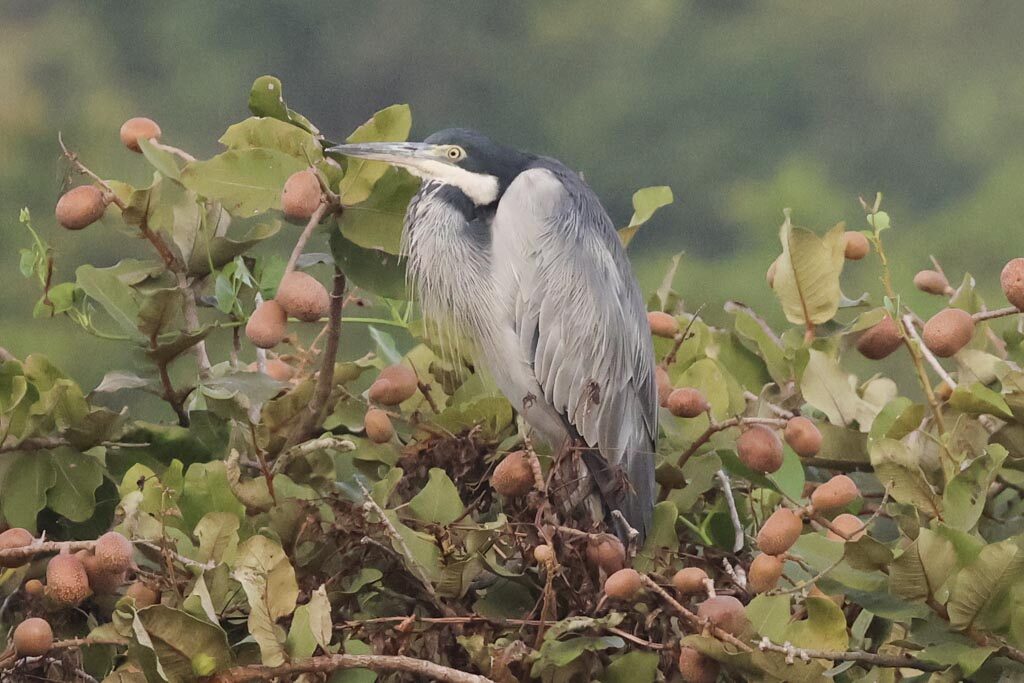
Further on, a Black-headed Heron was standing in the top of a gingerbread plum tree.
A Senegal Coucal clambered around in the bushes nearby.

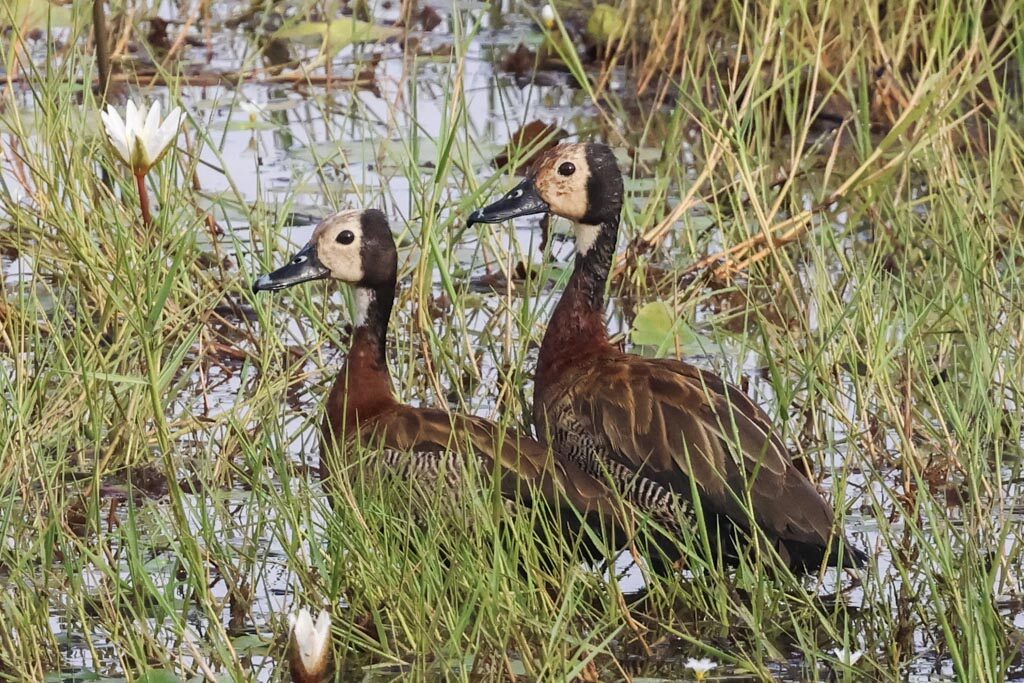
On the first smaller pool, we found a family of African Jacanas, several White-faced Whistling-Ducks, and the first of many Malachite Kingfishers. Looking over the open marshes the other side, there were lots more of the same. Two or three Common Snipe flushed from the near edge of the water as we walked past.
A Spur-winged Goose flew off one way over the track, then back across the other and landed out in the rushes in the middle of the marsh. A Giant Kingfisher flew over, chased by a Marsh Harrier.

We climbed up to the top of the low mound (nicknamed ‘Kilimanjaro’ by Modou) to scan. A single Little Grebe was diving out in the middle of the pool, amongst the flocks of White-faced Whistling Ducks. A couple of Black-winged Stilts flew round calling. As well as all the Malachite Kingfishers, there were several Pied Kingfishers around the bushes here and one of the group spotted a Grey-headed Kingfisher in the top of the trees on the other side.
We got the scopes on an Osprey which was wrestling with a large fish in a dead palm and a couple of African Green Pigeons landed in the trees at the back too, along with three Bearded Barbets. Lots of birds flew back and forth overhead, including a Palm-nut Vulture, two Black Herons (surprisingly the first we had seen all trip) and a single European Spoonbill. A Sulphur-breasted Bushshrike started calling distantly and Modou whistled back to try to tempt it in. Eventually it appeared in the top of a bare tree beyond the pool. Distant, but good views in the scopes.
As we walked down off the mound, a Vinaceous Dove was calling from the top of a bush. Further along the track, Ousman had brought the bus down so we could fill up our water bottles. The ringing camp was working here today and a couple of mist nets were strung across the nearby pool. Just beyond, we cut in round the ricefield the other side and into the open savannah woodland beyond. A Keyhole Glider dragonfly landed in the vegetation by the path.

A pair of Shikras was displaying over the trees beyond. Lots of Village Weavers flew up out of the grass into the bushes above. We could hear a Double-spurred Francolin calling, so Modou tried to walk round behind it. It was hiding in the rice crop and wouldn’t come out. As we turned to leave, another flew up into the trees behind to us. It stood in the open briefly on a bare branch before flying up higher out of view. Another bird we had seen surprisingly few of before today.
Continuing deeper in, an Abyssinian Roller was perched in the top of an acacia. There were a few raptors in the trees too. A Red-necked Falcon landed in the top of one, where we got it in the scopes. When it took off again, it shot back and forth low over the rice, looking for something to chase. A very distant Black-winged Kite landed in a low acacia but another Grey Kestrel just disappeared straight off away from us over the trees.
This is normally a great area for migrant passerines too, so we stopped and tried the mobbing ‘music’ a couple of times. Slightly disappointingly, there were just a few of the usual sunbirds, a couple each of Subalpine, Melodious and Western Olivaceous Warbler and single Chiffchaff today. Not as many birds as usual. Several people were packing away lots of mist net poles into a couple of vehicles just beyond. Probably there had been lots of disturbance from the ringing in the trees here, and it looked like everything had been caught already!
We continued on past and out into the edge of the mangroves beyond. It was warming up now and a couple of large kettles of Pink-backed Pelicans were circling up with associated Hooded Vultures and Yellow-billed Kites. Small groups of Blue-cheeked Bee-eaters swept overhead calling. There were more mist nets still up in the bushes all the way along here, as we made our way back towards the main track. We could hear the song of Nightingales, Chiffchaffs and even Iberian Chiffchaff everywhere, but it was just the playback they were using to try to tempt birds into the nets.

Out onto the track, a Namaqua Dove flew up from the edge and posed nicely for photos in a nearby dead bush. We walked down towards the beach and sat down in the shade at the beach bar for a cold drink. As well as the usual cans from the coolbox, there was delicious freshly squeezed grapefruit and orange juice on offer (or a mix of the two). Looking out to the beach beyond, there were waders on the rocks – Turnstones and Sanderlings, a single Grey Plover and a Common Redshank. Lots of terns flew past just offshore, mainly West African Crested and Sandwich Terns, along with a few Pelicans and one or two White-bellied Cormorants.
After a rest and refreshment, we set off to walk down the beach towards Senegal. Not too far along, we found the first pair of White-fronted Plovers on the sand just above the high tide line. Our main target here, they nest on the beach. Modou helpfully called another guide back who had walked straight past with the two people just ahead of us. A little further down, we found another pair.

We continued on to where there were more waders on the beach – a group of mainly Whimbrel, Grey Plover and Sanderling. With them were two Oystercatchers (sure to be voted most exciting birds of the day!) and a Bar-tailed Godwit. Often we turn back here, but with a report of several Kelp Gulls apparently here in the last few days, Modou pressed on further towards where we could see lots of gulls and terns loafing on the edge of the water.
Cutting in round the tidal pools on the edge of the mangroves, there were a few Greenshank, Redshank and Common Sandpipers on the mud and a Striated Heron flew across. When we got closer to the gulls and terns, we set up the scopes to scan through. The gulls all looked to be Lesser Black-backed Gulls, no sign of any Kelp Gulls. The terns were all Caspian, West African Crested and Sandwich Terns.
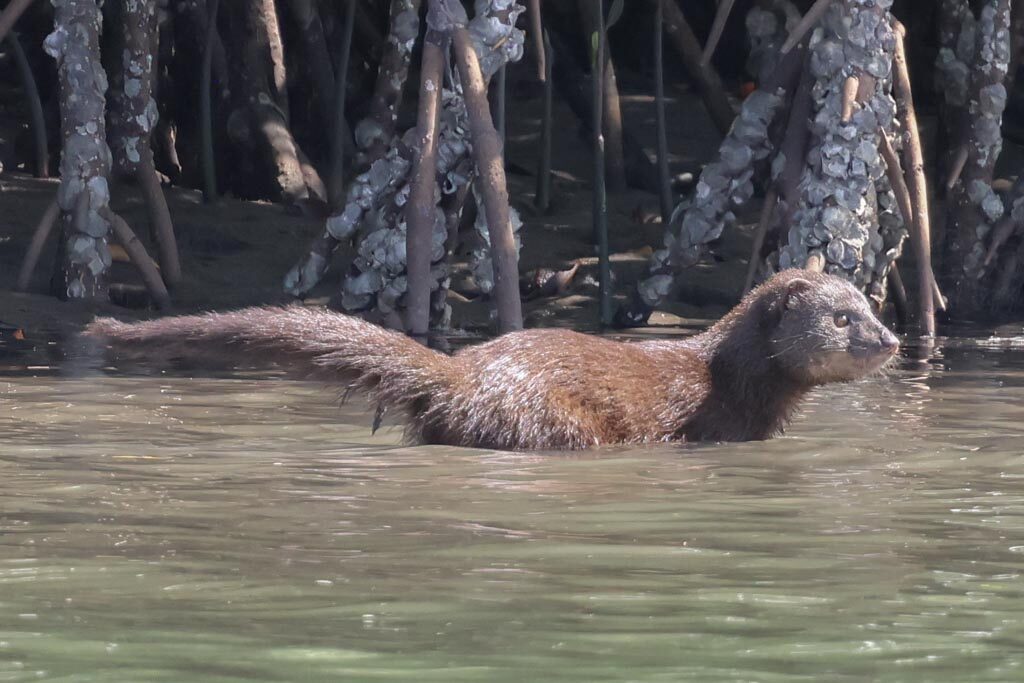
We walked back to the beach bar where the bus was waiting for us. It was just a short drive from here round to the lodge at Stala for lunch. We were just sitting down to eat when one of the group spotted a Marsh Mongoose walking along the edge of the mangroves opposite. It caught a fish and disappeared in.
After lunch, we boarded the boat at the jetty in front and set off straight away for our boat trip on the river. A Black Heron flew across and into the mangroves opposite as we boarded. It flew out again and landed on the mud just as we set off, but we were going the other way. As we motored downstream first, the tide was coming in.

A large group of Caspian Terns was loafing on the mud bank on the edge of one of the islands, a few Grey-hooded Gulls in with them. More gulls and terns were further back, including a couple of West African and Sandwich Terns and Slender-billed Gulls as well. There were also a few Oystercatchers, Greenshanks, Redshanks, Whimbrel and Common Sandpiper on the mud. There are always lots of Ospreys here, flying round or perched on the bare trees by the river.

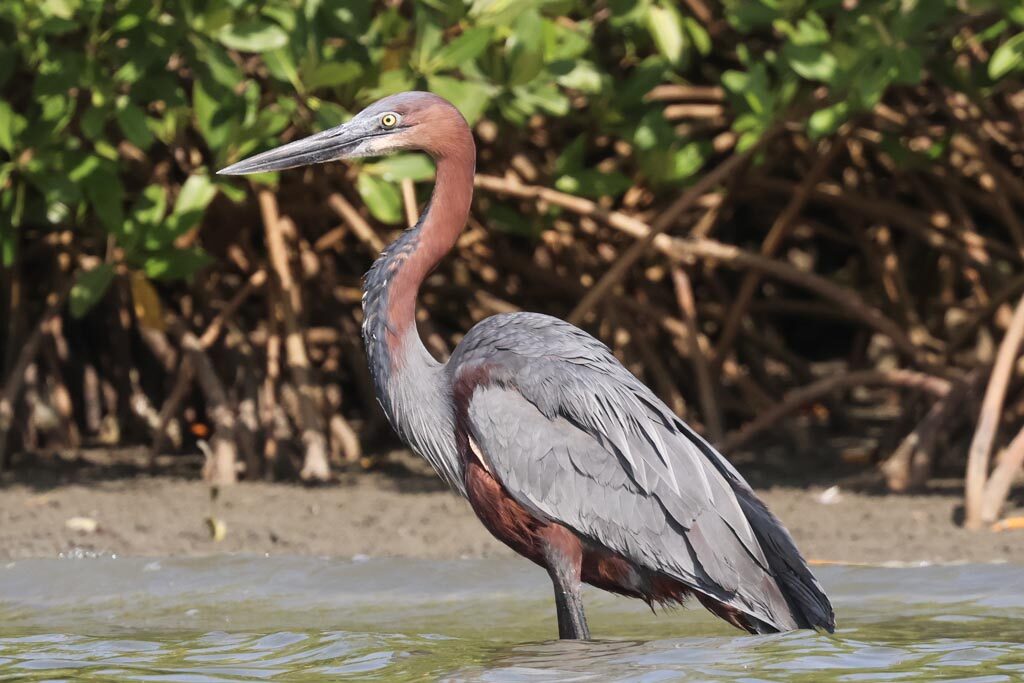
It didn’t take too long to find our first target. A Goliath Heron was standing in the shallow water on one side of the river ahead of us. It was right out in the open and then we could see why when it started bathing. Not something you see very often! We motored up closer, and had some great views before it eventually decided it didn’t want us interrupting its ablutions and flew across to other side of river.

A great start, we turned round and headed back upstream. As we passed the terns again, we had a better view of West African Crested Terns and Sandwich Terns now with the near group. A colour-ringed individual in with the Caspian Terns looks to have been ringed in Sweden (though still awaiting details back from the Swedish Museum of Natural History at the time of writing).

We continued on past the lodge at Stala. Several Pink-backed Pelicans were on the river, and swam out of our way as we approached. What was presumably the same Black Heron was now roosting with the Reef Herons in the mangroves.

Scanning ahead, we picked up an African Fish Eagle perched in a tree further on. We were just motoring towards it when another Goliath Heron appeared from behind the mangroves on the mud beside the channel. The boatman stopped to look before Modou ushered him on. When we got another view of the tree where the eagle had been it wasn’t there any more! Then we realised it was flying away, so Modou made the boatman speed up to try to catch up with it.
We thought we had missed our chance but then the African Fish Eagle started to circle and drifted back round and right over the boat. We had one last stop we wanted to make today, so we turned and headed back. On the way, Fanta spotted a West African Crocodile hiding in the mangroves.

Back on the bus, we made our way over to Konoto forest. As we walked in along the track, we came across a mixed flock of birds in the trees. A well as several Olive-naped Weavers, there was a Little Greenbul, a Red-belled Paradise Flycatcher and a brief Grey-headed Bristlebill. Further on, a Snowy-crowned Robin Chat flicked across path. We could hear a Blue Malkoha calling deeper in the trees, but despite Modou’s best efforts it wouldn’t come in.
Settling ourselves into the hide, the pool in front was all very quiet at first. Perhaps a raptor had been in here just before we arrived. Some of the group started to lose faith, but we explained that many birds come in to drink and bathe last thing before bed. A Green Hylia and a Guinea Touraco called from the trees beyond.
Then suddenly it was like a switch had been thrown. Birds started to come in from all directions. African Thrushes, Little Greenbuls, a couple of Olive-naped Weavers, several Red-bellied Paradise Flycatchers, Pygmy Kingfishers.
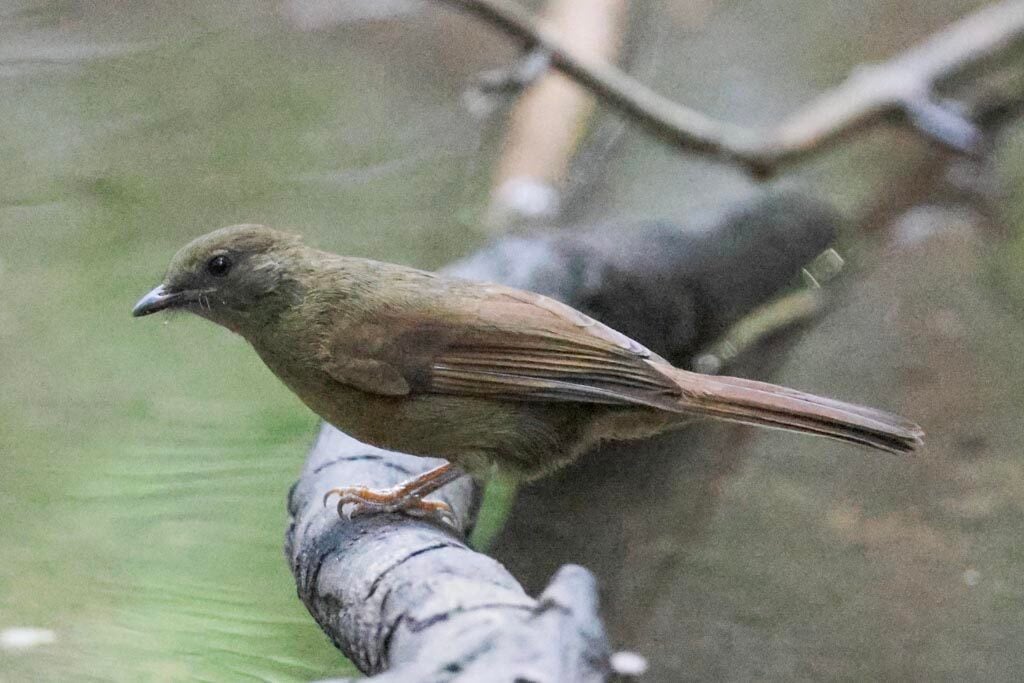
A couple of Grey-headed Bristlebills dropped down to the pool out in the open, often a hard bird to see well.

A Capuchin Babbler arrived but stayed in the trees at the back and frustratingly only a few of the group saw it. While we waited for it to reappear, first a female Western Bluebill came in to the pool, followed a little later by a male. A Buff-spotted Woodpecker was briefly in the trees behind.

Just as we were starting to lose hope that we might get everyone on to a Capuchin Babbler, a small group came in through the trees. They often arrive late for a bath. We all got to see them now, as they dropped down into the pool right in front.

The late arrival of the Capuchin Babblers meant we were later than normal back to the hotel. A quick turnaround before straight in to dinner tonight.
Monday 1st December
After the success of yesterday’s early start, we decided to do it again today. It is a long drive down to Sohm and if we stop for breakfast in the hotel, we don’t get down there until well into the morning. A combination of setting off later and the increased traffic congestion at that time. So it was a much easier run down early this morning and we arrived before dawn.
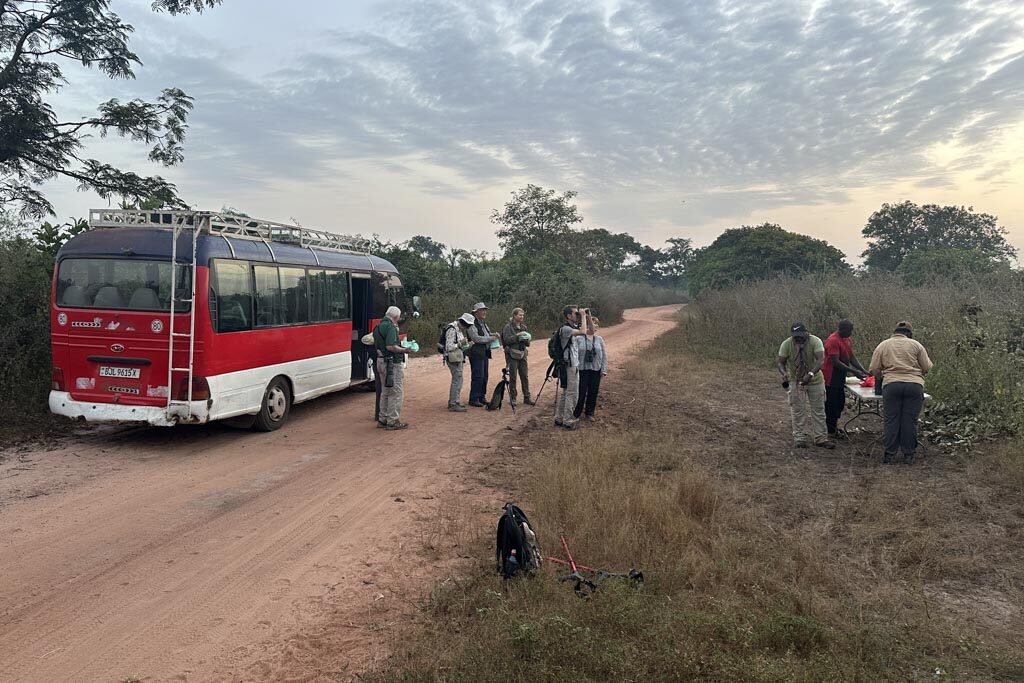
We parked on a small track through the overgrown cultivations. Ousman had a table which he got down from the roof of the bus and set up. Modou had brought tea and coffee and flasks of hot water. Once again, we had a packed breakfast from the hotel and we ate it listening to the dawn chorus and watching the sunrise. A great start to the day.
After breakfast, we walked a short way along the track and Modou hung the speaker in the bushes on one side. A short burst of mobbing music brought in a variety of birds – Vitelline Masked Weavers, a pair of Didric Cuckoos, a Snowy-crowned Robin Chat, a couple of Yellow-crowned Gonoleks, Singing Cisticola and Tawny-flanked Prinia. We had very good views of a male Northern Puffback as it clambered through the branches above the speaker.

Continuing a bit further on, we tried the ‘music’ again, at a spot where we have stopped successfully the last few years. By comparison, it was a little disappointing here this year – just a Black-crowned Tchagra and a couple of sunbirds appeared. As we cut across through the bushes to the main track, a couple of African Golden Orioles flew across ahead of us and a Copper Sunbird landed in the top of a tree. There were a couple of Mottled Spinetails in the sky beyond but they were hard to see through the branches. Better view when we got out to the open on the main track.
The track here has been widened significantly, trees cut down and bushes cut back. Short posts hammered into the ground on either side apparently mark where tarmac is going to be laid. Another area opening up for development. The bus came round to pick us up from here and we drove further down, stopping again by a small wood.
As we walked down a side track to one side of the trees, a Double-spurred Francolin ran off ahead of us. It stopped a couple of times and looked back to see if it was being followed, our best views yet. Otherwise, it was rather quiet here today. A couple of Fork-tailed Drongos appeared in the trees along with a Scarlet-chested Sunbird. Modou went into the wood to try to find the Helmetshrikes which we normally see around here but drew a blank, unfortunately.

Back on the bus, three young men held up a dead Royal Python they found on the track, for us to see as we passed. Another victim of the new road? There were a few birds to see from the bus too. We stopped to photograph a Long-tailed Glossy Starling on the verge as a Shikra flew off. An African Green Pigeon was perched in a tree and two more flew over.

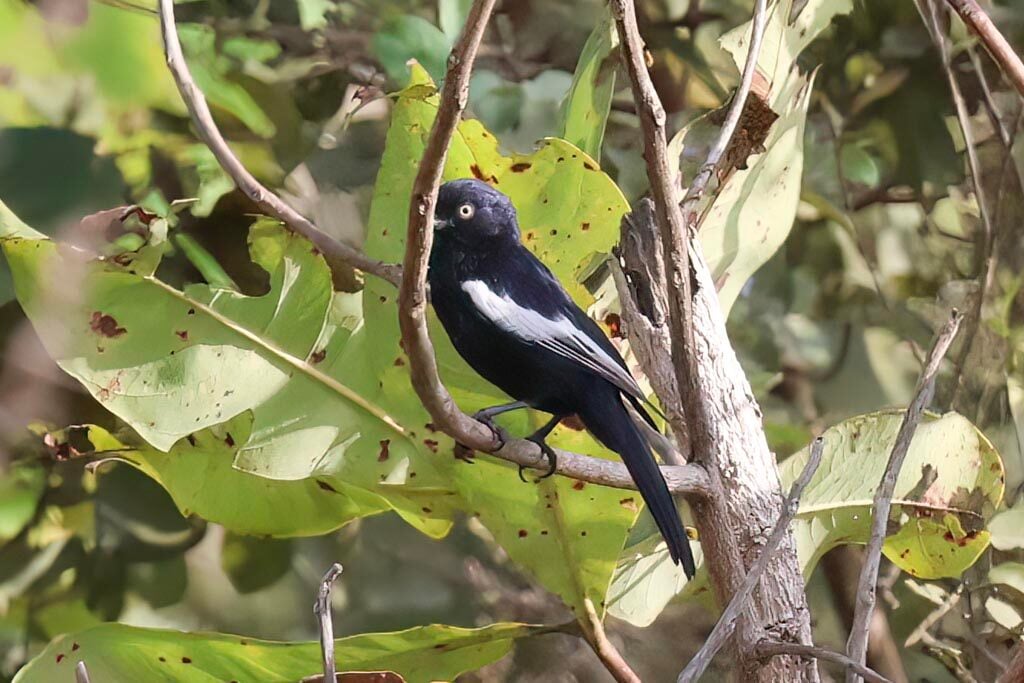
Then we found a small group of Northern Black Flycatchers and Fork-tailed Drongos in the dead branches where the verge had been cut back. The narrow track we normally take in under the pylons was very overgrown this year. Ousman did very well to get the bus down it unscathed, to where the vegetation opens out into savannah woodland.
As we got out of the bus, there were several Blue-bellied and Abyssinian Rollers on the trees nearby. Four Yellow-billed Oxpeckers appeared in the top of a palm further back. Modou heard a White-shouldered Black-Tit calling and a quick burst of ‘music’ brought it out so we could see it. Three Yellow-gorgeted Greenbuls worked their way through the trees, the first we had seen properly this trip.
As we walked across the grass in between the trees, a juvenile African Cuckoo flew across in front of us and landed in a tree. Our second of the trip, a good year for them. A Red-necked Falcon landed in the top of a nearby tree where we had a great view of it through the scopes. We picked up a couple of Pallid Swifts high in the sky overhead.

Further in, there were a few donkeys grazing by one of the pools. Four Yellow-billed Oxpeckers (or should that be Donkeypeckers?) were clinging to the flank of one of them.

Several Wattled Lapwings and a couple of Yellow-billed Egrets were round the pool too and a Green Sandpiper flew off as we walked up. Modou had been whistling the call of Striped Kingfisher for days, as we walked round any suitable habitat. One of the group, looking behind, noticed one distantly in a tree now back the way we had come. Another species we had surprisingly not come across on this trip before today. A second Striped Kingfisher joined it to mob the African Cuckoo.

A Western Bonelli’s Warbler flicked off ahead of us through the acacias and there were lots of sunbirds feeding on the flowers. Modou set up the speaker and tried playing the ‘music’, and a variety of birds came in, including four Melodious Warblers, a Willow Warbler, a Chiffchaff, a Yellow-crowned Gonolek, a Green-backed Cameroptera, a couple of Senegal Eremomelas, and a Yellow Penduline Tit. The Bonelli’s Warbler didn’t oblige though.

Further on, there were lots of Grey-headed Sparrows and Northern Red Bishops in the trees. A small group of Village Indigobirds included one or two smart, blue-black males.

As Modou went off quickly to check another pool, a Lesser Honeyguide flew past, chased by a Fork-tailed Drongo. We stood and scanned but sadly it didn’t reappear. A female Klaas’s Cuckoo did fly in and land in the top of a nearby tree, followed by a male. While we were watching it, a Wryneck appeared in the tangle of branches just below. A Yellow-billed Shrike posed nicely and a Yellow-fronted Tinkerbird hopped around in a nearby acacia.

Modou returned, having not managed to find anything else, and we started to make our way back round to the bus. It had been rather hazy with high cloud for much of this morning but it seemed finally to be warming up enough for the raptors to take to the skies. Several Hooded Vultures started to circle up. The White-shouldered Black Tit was in the trees again and we had much closer views of the Striped Kingfisher now.

Four European Bee-eaters landed distantly on the wires. A/the Lesser Honeyguide flicked across to a half-dead acacia briefly ahead of us and then disappeared back into a very large, leafy tree nearby. We thought it had gone but then it flew back out to the acacia again. We were just looking at it when we noticed a Bateleur circling up in the distance beyond. It flew off away from us and we quickly lost sight of it behind some trees. Unfortunately, none of the group felt they had tickable views.
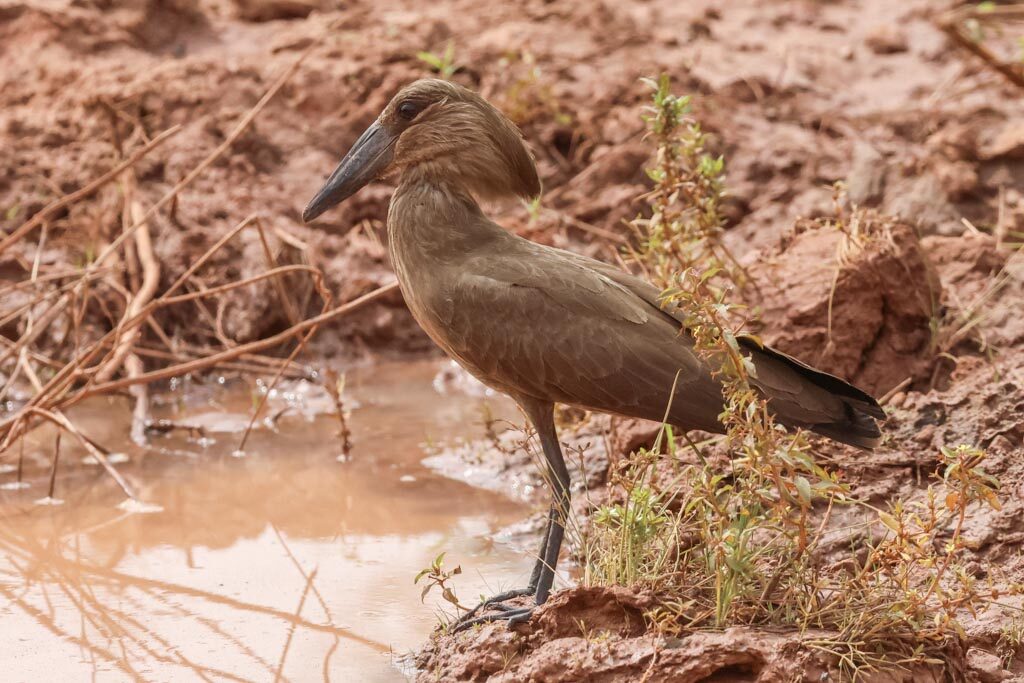
As we made our way back out on the bus, we stopped briefly at the small wood again. Modou got out and walked up along the track quickly, whistling. Still no sign of the Helmetshrikes. A Hamerkop was standing on the edge of a large puddle in the middle of the churned up track.
As we were passing, Modou decided to call in again briefly at the new hide, where we had stopped the other day. A couple of Dark Chanting Goshawks flew off through the trees as we walked in. Otherwise it seemed quieter here today, though it was the hottest part of the day now. There was no sign of Dr Owl, so we couldn’t get into the hide. We stood and watched the pool from further back for a few minutes. There were a few Lavender and Orange-cheeked Waxbills, Bronze Mannikins and Vitelline Masked Weavers again. A couple of Black-billed Wood Doves came in to drink.
It was a longer drive round to Marakissa River Camp where we would have lunch. Sitting at the tables, looking out over the river beyond, a couple of Giant Kingfishers flew back and forth. One landed in a tree right behind us at one point. There were a few Senegal Thick-knees, Spur-winged Plovers and Common Sandpipers down on the edge of the river.
This is always a good place to see West African Crocodiles and one had pulled itself out onto the bank between the boats, right by the bridge. One of the group was looking up through his camera as he walked down to the river. He was about to tread on it and got a bit of a shock when he looked down and saw a Croc looking back up at him!
Lunch was served – a delicious fusion of macaroni with beef mince and onion sauce, a speciality of the house which was much appreciated (several of the group tried to persuade Adama to give us the recipe). Over lunch, we were distracted briefly by a Black Crake which appeared on the river bank opposite, before running back into the long grass. A Pied Kingfisher caught a rather large fish and perched on the handrail of the bridge, trying to bash it into submission.
After lunch, the main event. Adama came down to the edge of the river and called, ‘croccie, croccie’. At least four Crocodiles came in to be fed now, including the one we had seen earlier. Two came out onto the bank while the other two waited in the water. Adama threw some food in to the water and a couple of pieces onto the bank in front of them. Always one of the highlights of our visit here.

We set off for a last walk, out to the road and down to the nearby bridge. A Woodland Kingfisher landed in a tree on the other side of the road. Several Hamerkops and Cattle Egrets walked around in the wet grass with the cattle just behind. Further along, an African Jacana was down in the marshy area by the road and a couple of Malachite Kingfishers were in the reeds. A pair of Levaillant’s Cuckoos flew round, back and forth over the road.

Down at the bridge, we could see a distant Squacco Heron in a tree but not much else. The reeds are very tall now and it was hard to see over to the more distant pools. So we decided to walk back along the road and then down through the fields for a closer look. As we walked in along the path, we flushed a pair of Double-spurred Francolins from the long grass.
Coming out through the trees on to the edge of the pool, we could see a Black Heron on some posts with the egrets. A couple more African Jacanas were in the marshy edge. Out in the middle, there were lots of Spur-winged and Wattled Lapwings, and a few Senegal Thick-knees around the muddy islands. There were both Green and Common Sandpipers, and a Marsh Sandpiper which was trying to hide behind a clump of grass. Plus more Pied, Giant and Malachite Kingfishers.
A Western Reef Heron was using its half spread wings to shade the water while fishing, a bit like a half-hearted Black Heron. Then we noticed the Black Heron itself had reappeared on the edge of the water and was doing the full on Umbrella Bird itself. Its wings were spread round in a circle above its head. Always a great thing to see!

It was nice standing and looking out across the pool, but we had a long drive back this afternoon. We made our way back to Marakissa River Camp. After a break to use the facilities, we started to get back on the bus. While we waited for Modou to return, Adama came over to say goodbye. While we were chatting, she asked if we had seen Northern White-faced Owl. We hadn’t!

Everyone had to get off the bus again, but it is always worth it for another owl. It was well hidden in the leaves up in a tree but with a bit of repositioning we managed to find a decent angle for the scope. A great way to end the day. Back on the bus again, this time we managed to set off back to the Senegambia without any more distractions.
When we got back to the hotel, we said our final goodbyes and many thanks to Ousman, Fanta and Modou. We had time for a break tonight before we met at the Pool Bar for drinks again. Then up to the restaurant for our last dinner and a final run though of the day’s list.
Tuesday 2nd December
There was no need to get up this morning so the chance of a lie in. Still, most of the group were up for breakfast before 8am. A large ground of Western Red Colobus monkeys were on the roof of the main building as we came out, so we stopped to watch them afterwards. The adults were mostly grooming each other, while several young ones were playing. Afterwards, there was a chance to explore the grounds of the hotel again, or go off for some souvenir shopping.

Down at the beach, there were lots of terns offshore, mainly West African Crested Terns again. A few Pomarine Skuas and young Northern Gannets were mostly very distant, off towards the horizon, though one immature Pomarine Skua did come past much closer at one point. A Whimbrel was on the beach and a Striated Heron flew in past the Beach Bar.
In the gardens, there were the usual White-crowned Robin-Chats, Blackcap Babblers, Long-tailed Glossy Starlings, Green Woodhoopoes, and more. Several of the group saw a Woodland Kingfisher and some managed to catch the Hooded Vulture feeding on the lawns at 11am. For others, there was the chance for an early lunch at the Beach Bar at the same time instead.

Checkout was 12pm and we were picked up outside at 12.45pm by the coach for transfer to the airport. All the birds which had seemed so exciting a week ago, as we arrived, the vultures and Yellow-billed Kites, Pied Crows and Speckled Pigeons, got barely a second glance now. Outside the terminal, we had to rescue our bags from the overzealous porters who had taken them all from the baggage compartments under the coach before we could even get off!
Getting through the terminal, checking in and clearing immigration and security was easy – although checking passports and tickets seemed to be just a means of gainful employment as it seemed to happen again at every turn. It is Africa after all! Our flight pushed back pretty much on time and the journey back to Gatwick progressed without incident.
When we landed, we could see it was raining outside and it was decidedly chilly walking through the terminal, a bit of a shock after 30C+ most days in The Gambia. Our baggage was unusually already waiting for us when we got to the reclaim carousel and we said our goodbyes and headed off out into the London night.