Day 1 of a 3-day Autumn Migration & Wader Spectacular tour. It was a mostly bright and sunny day, but with a blustery SW wind gusting up to 34mph in the afternoon. It felt cooler in the wind too, decidedly chilly in fact before the sun warmed up in the morning. Thankfully there was no sign of any of the forecast heavy showers in the afternoon. With a big tide this morning, today was the day for the Wader Spectacular.
We met slightly earlier than normal and headed up to Snettisham. When we got out to the edge of the Wash, it was still largely bare mud out from the seawall, so we stopped to watch. It felt decidedly chilly in the blustery wind, so it was coats on (and even gloves for some)!
There was a large group of Bar-tailed Godwits and Oystercatchers gathered on the mud away to our right, catching the early morning sunshine. A smaller flock of Golden Plover was straight out in front of us, surprisingly well camouflaged against the brown mud.
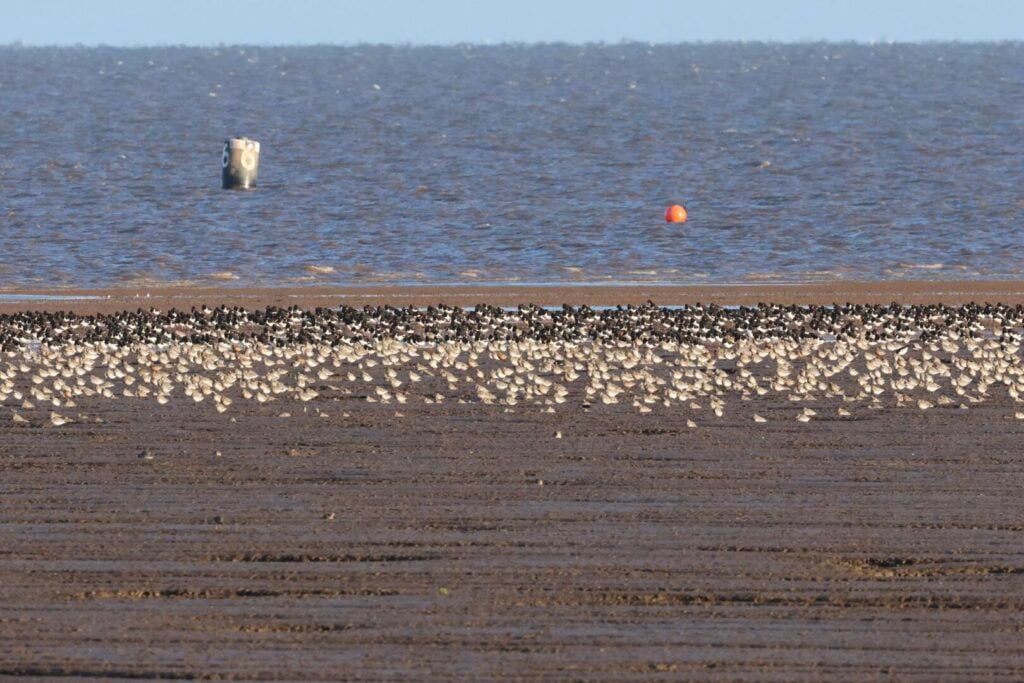
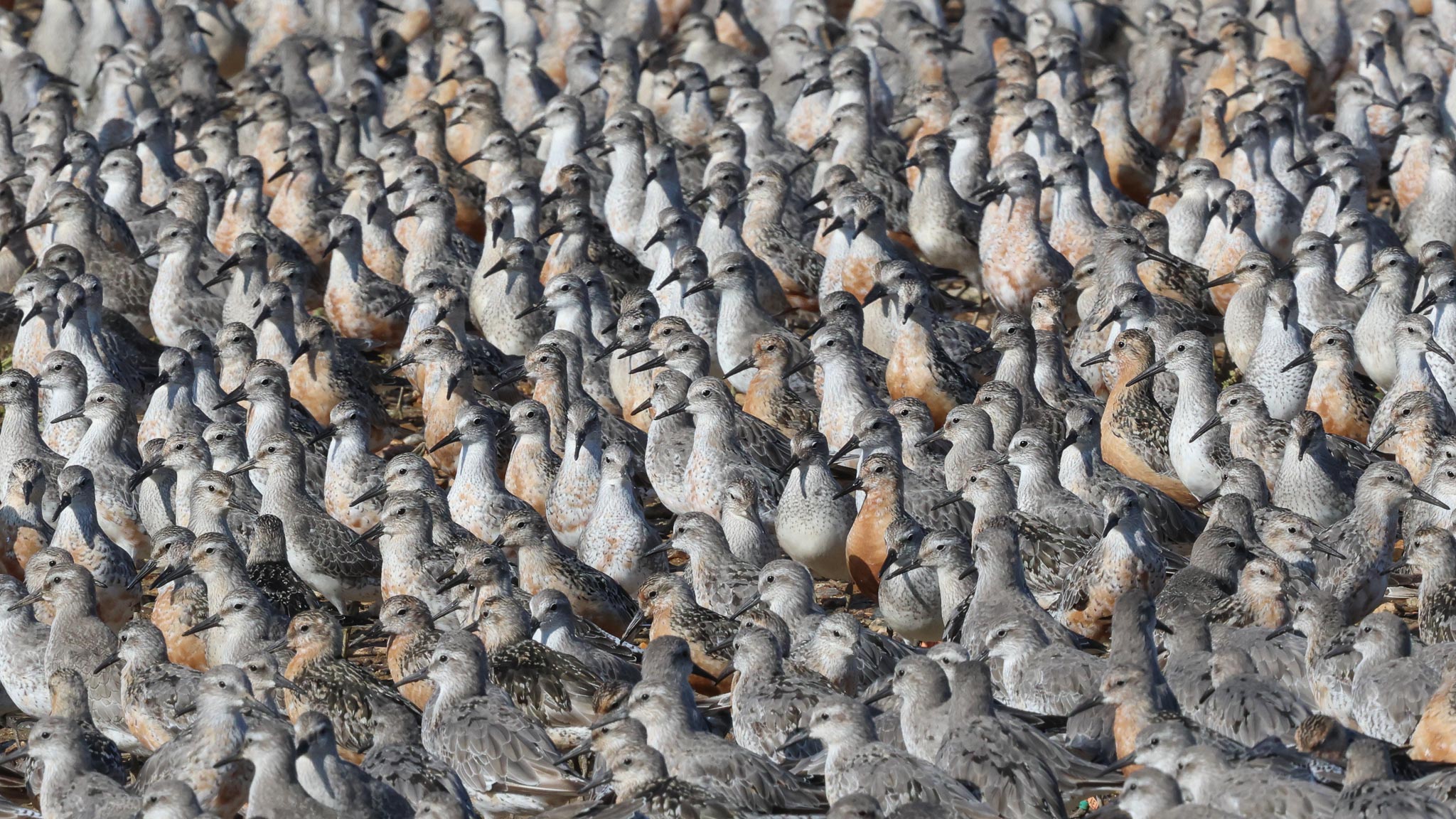
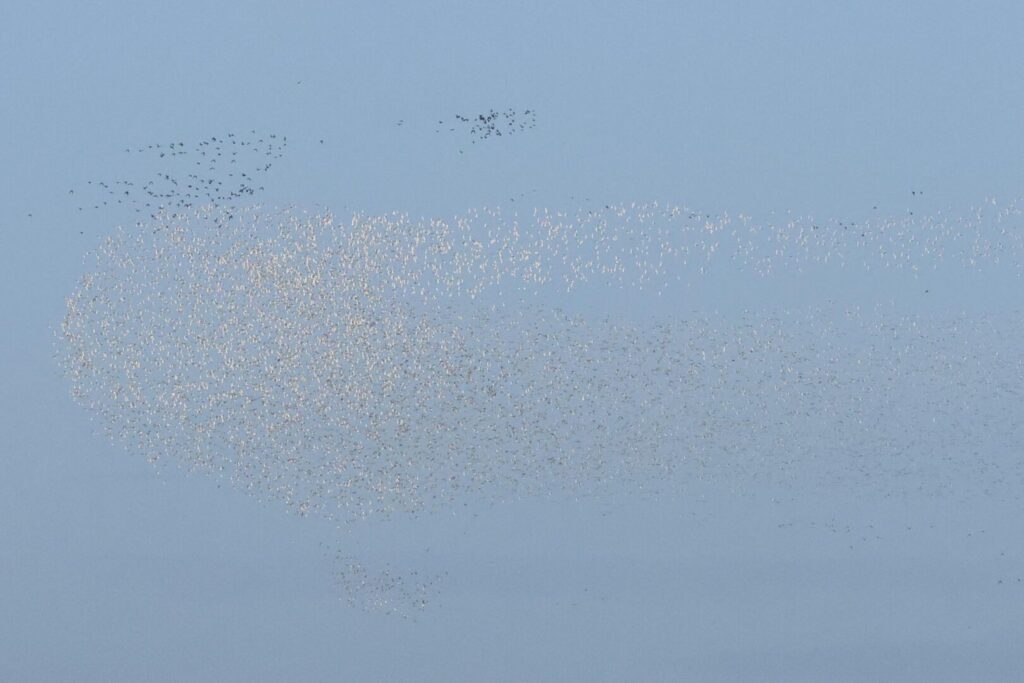
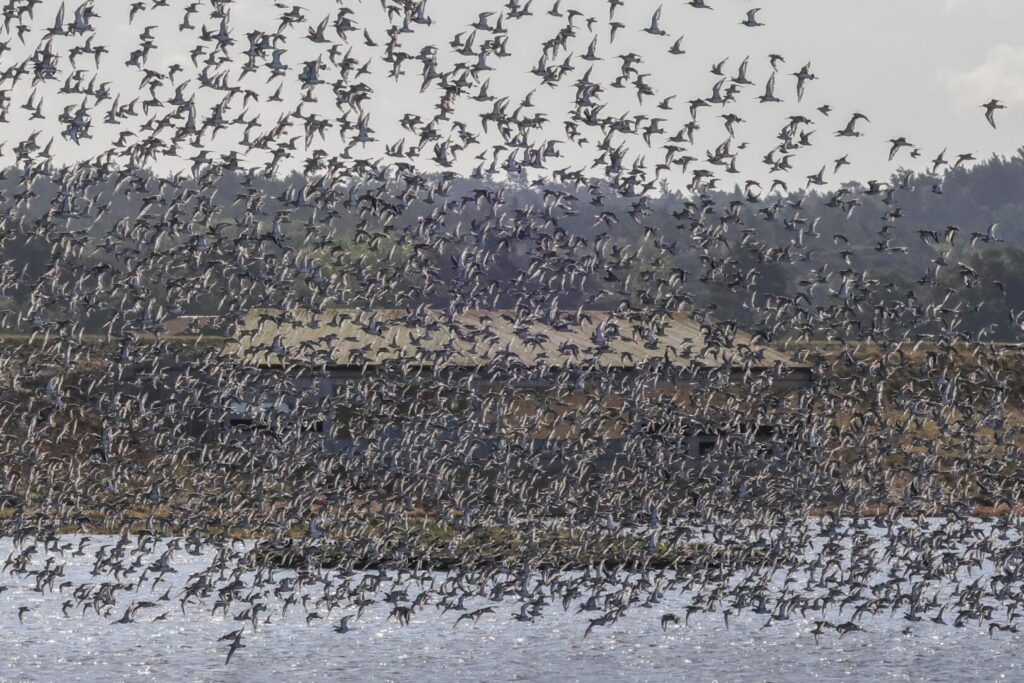
We could see some very large flocks of Knot off in the distance, out flying round out over the Wash looking like clouds of smoke. Presumably they had been flushed by something, possibly one of the local Peregrines.
There were several Redshanks and Ringed Plovers on the mud closer to us, along with one or two Sanderling and Turnstone. A trickle of Swallows flew low past us over the shore, heading south. They are on their way back to Africa now, leaving us for the winter.
The water was rising fast and soon the Bar-tailed Godwits started to take off, flying across in front of us and landing again on the dry mud higher up. More and more flew past, followed by the Oystercatchers, until the remaining mud up by the sailing club was empty. Several larger flocks of Common Redshanks flew in, heading for the Pit to roost already, not even waiting for the water to cover the mud entirely. We heard a Spotted Redshank calling and turned to see it flying in over the Pit behind us.
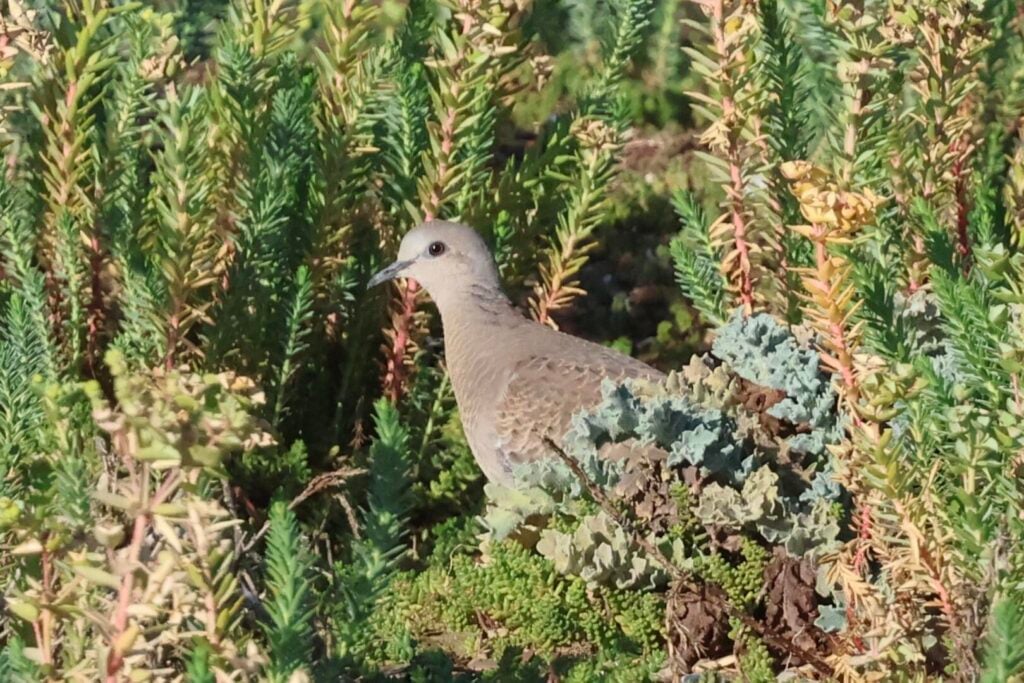
It didn’t take long but eventually all the mud in front of us was covered, so we carried on further down along the sea wall. A Turtle Dove flew across ahead of us and landed out of view on the gravel shore, behind the vegetation. It was followed by a second which landed in the open and a third which flew past us and disappeared into the thicker bushes ahead. We stopped to watched the Turtle Dove we could see as it walked further back into the vegetation and eventually disappeared out of view.
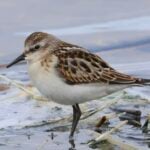
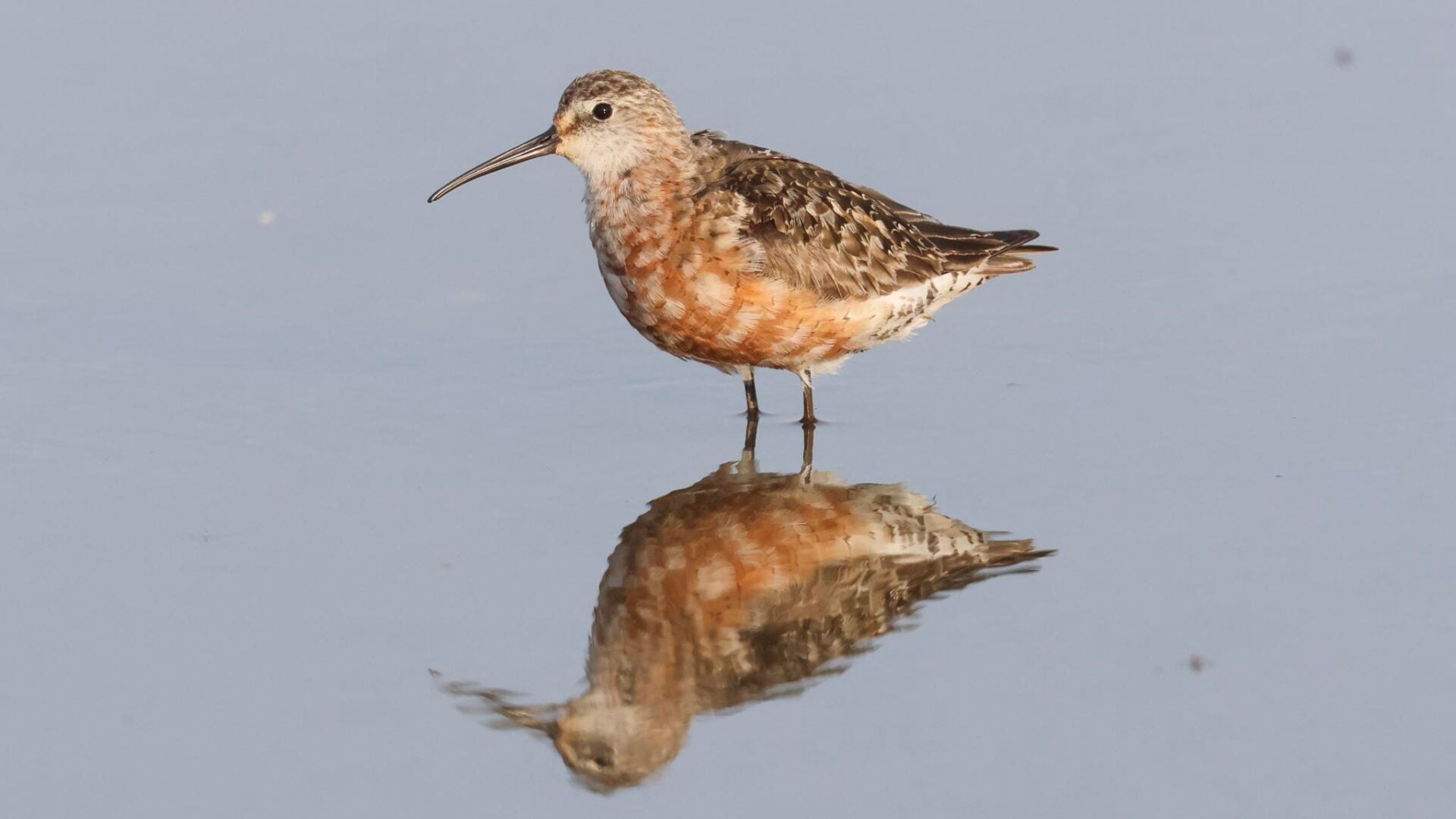
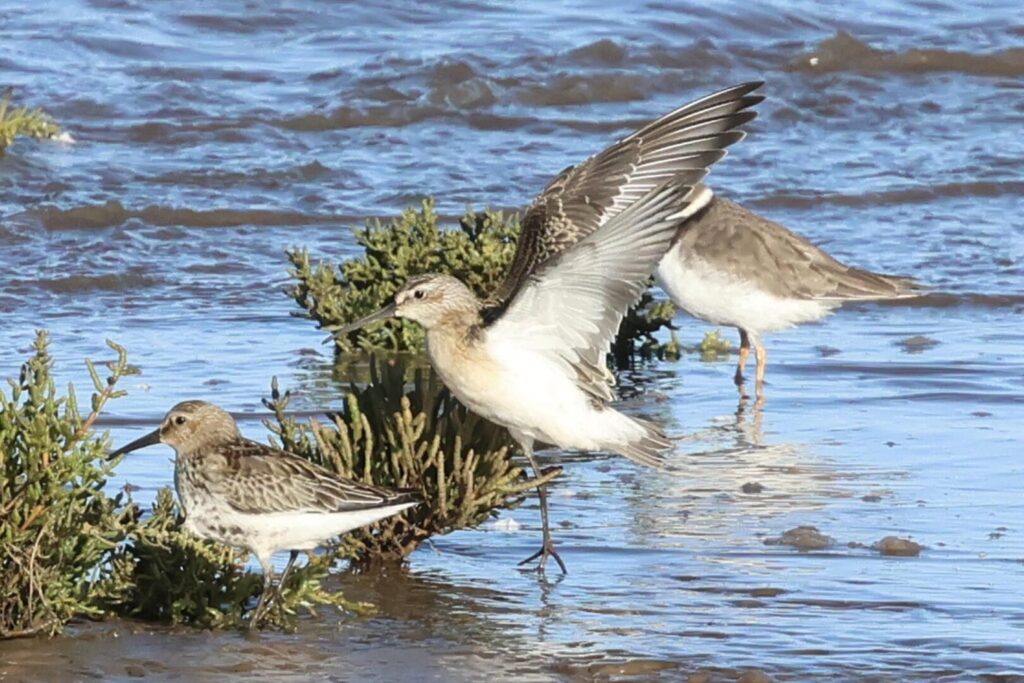
We continued on down to Rotary Hide, trying to keep ahead of the tide, and stopped again. Scanning the mud close to the shore, we found a juvenile Curlew Sandpiper which we got in the scope. A good view but it was asleep and we couldn’t see its bill, which was tucked in. A Little Stint flew past with a Turnstone for comparison, half the size, and disappeared in over the bank to the Pit behind us.
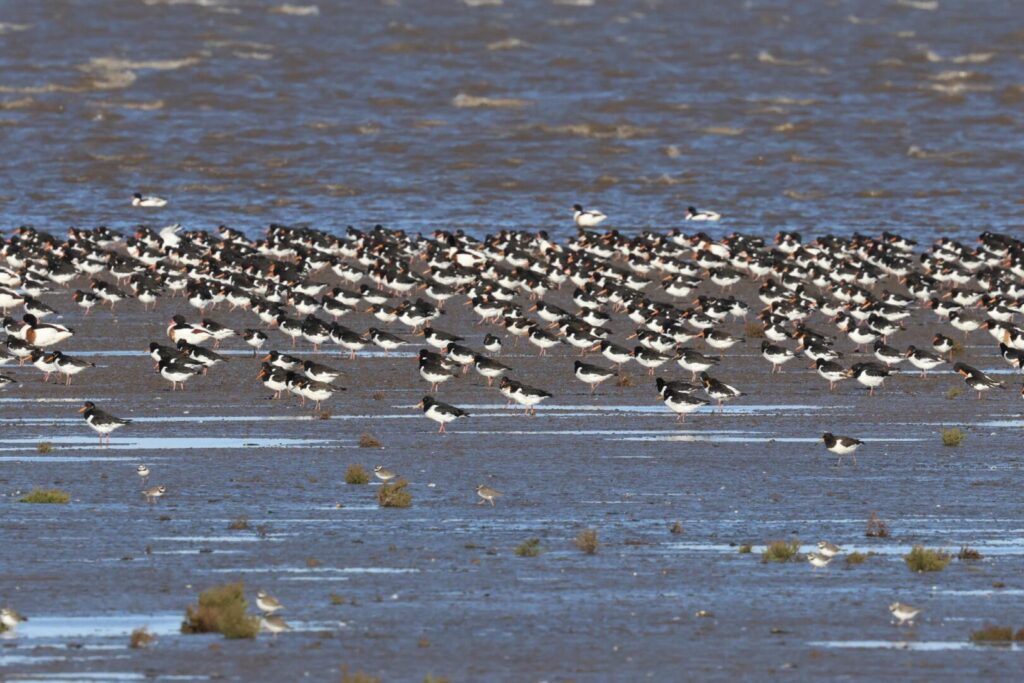
All the waders further out had a fly round, the Knot still some way off in the distance. The Bar-tailed Godwits were flying up as the rising tide caught up with them and landing again where it was still dry. In contrast, the Oystercatchers were marching away from the water. We stopped to watch the ‘March of the Oystercatchers’, always a highlight of the rising tide here.
The water was coming in fast, so we waited to see the Curlew Sandpiper wake up. It remained stubbornly asleep. Small groups of Ringed Plover, Dunlin and Sanderling dropped in, but still it barely flinched. It woke up very briefly and had a quick flap before going back to sleep, even as all the other small waders gave up. The water was lapping almost up to its belly when the Curlew Sandpiper finally woke up and gave us a proper view of its bill before flying off.
The mud in front of us was pretty much completely covered now, so we had to hurry on down to the far end to get ahead of the tide again. There were lots of people here for the Spectacular today, but we eventually managed to find a space to stand.
The Oystercatchers were still marching, but gradually started to peel off and fly in, dropping down into the Pit behind. The Bar-tailed Godwits had massed just beyond the line of saltmarsh vegetation at the front – they will always stay out here over the tide. We could see the large flocks of Knot starting to fly in from further round the Wash and land down in the last remaining corner of mud. Several Common Sandpipers flew up and down the channel just in front of us.
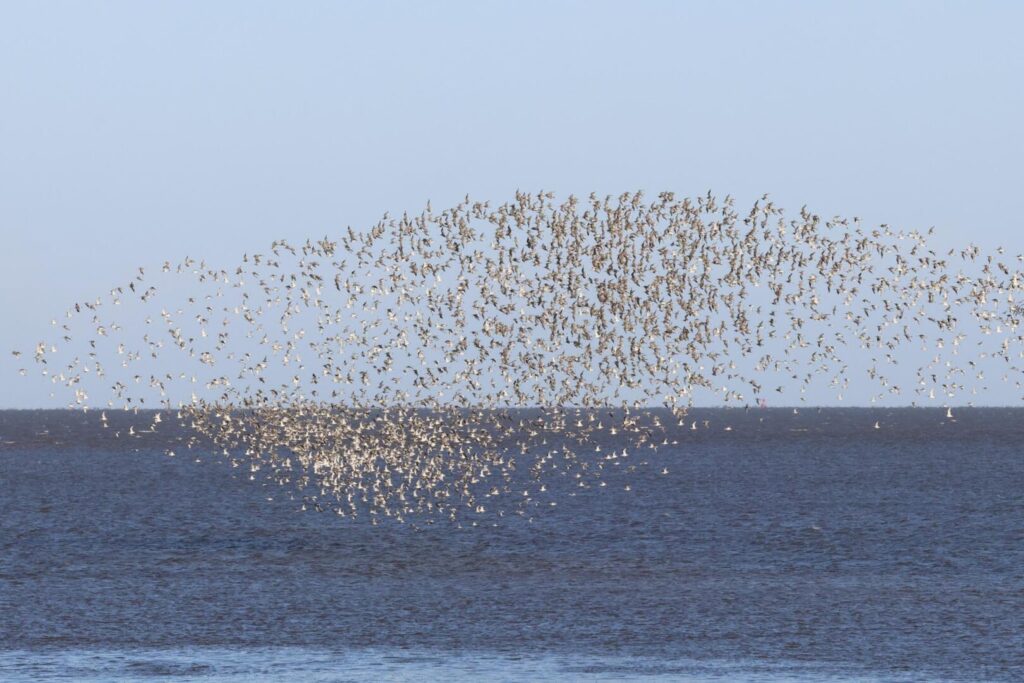
Suddenly everything erupted and took to the sky. The flocks of waders whirled round over the edge of the Wash, making shapes in the sky. We managed to spot the Peregrine further back behind them, flying in low with something in its talons. It had already made a kill.
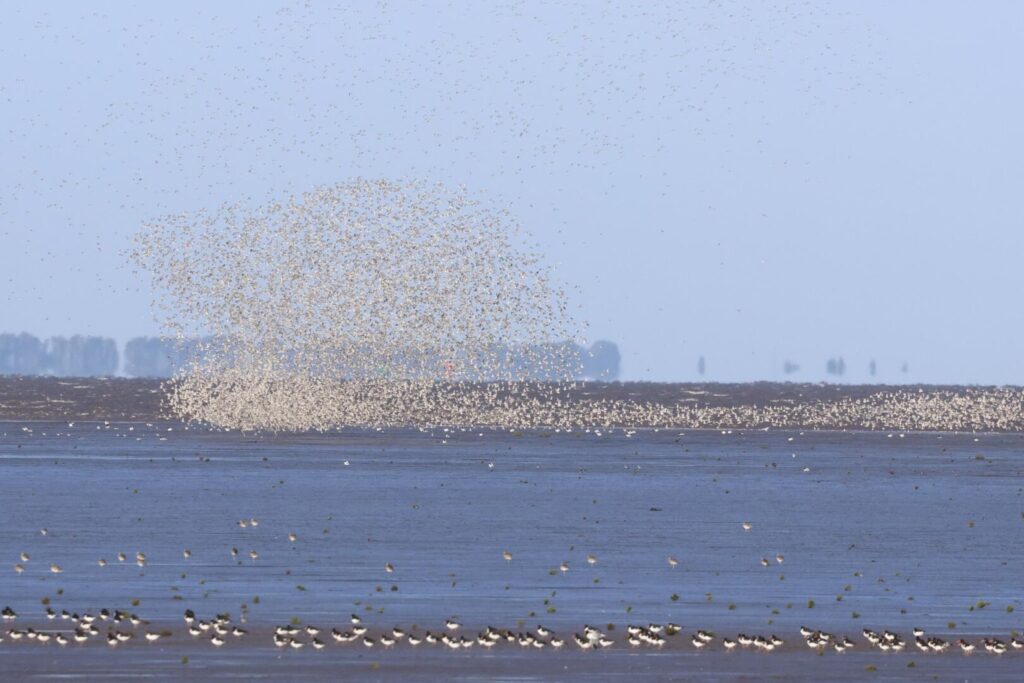
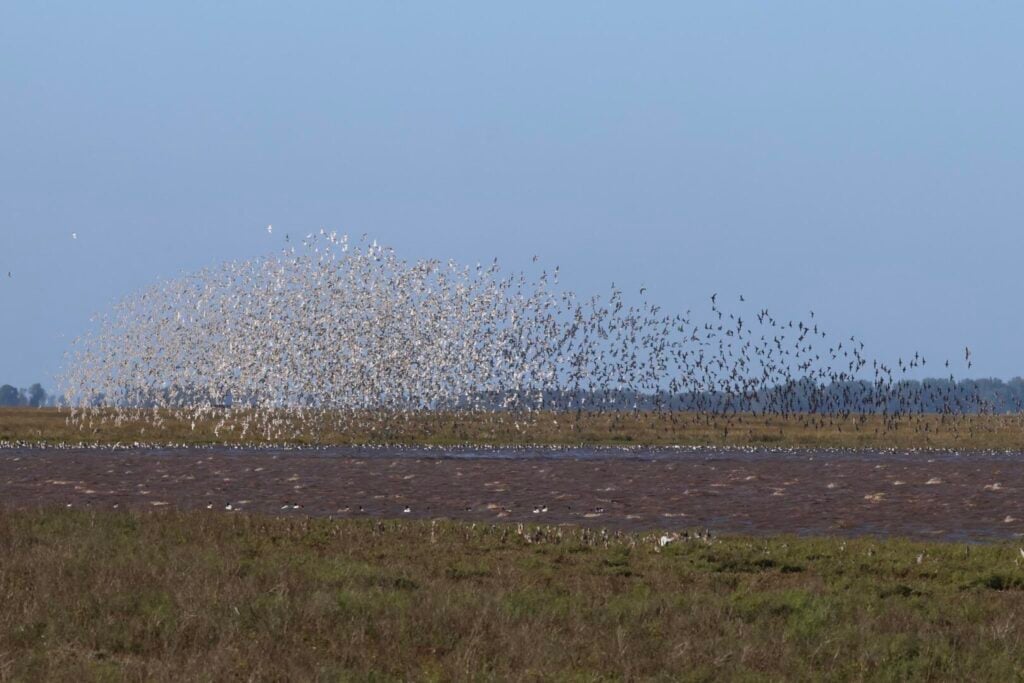
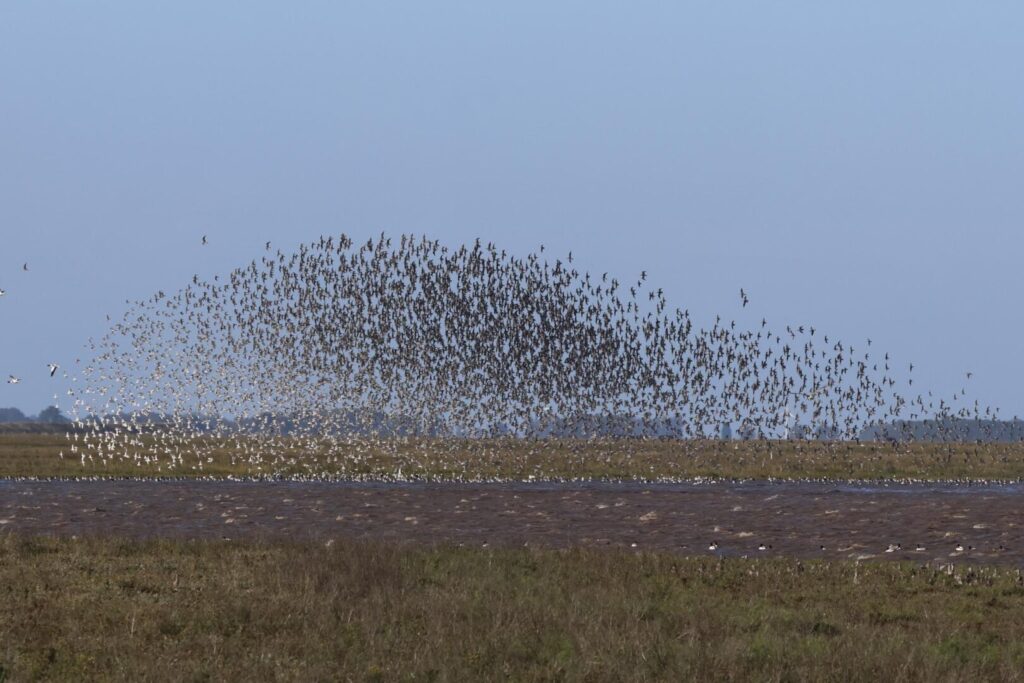
Some of the Knot decided to come in to roost early, despite there still being quite a bit of exposed mud. We turned to watch as twisting columns dropped out from the bottom of the flocks, like something was siphoning them down. The airspace over the Pit was congested with thousands of birds, so others turned and landed back down in the rapidly shrinking corner of mud.

Several large flocks of Knot towered higher and higher up into the sky. They would be safe from the Peregrines up there and could easily see out an hour or two over the high tide in the air. They got harder and harder to see, except when they turned and caught the light. Amazing to watch them in front of the moon.
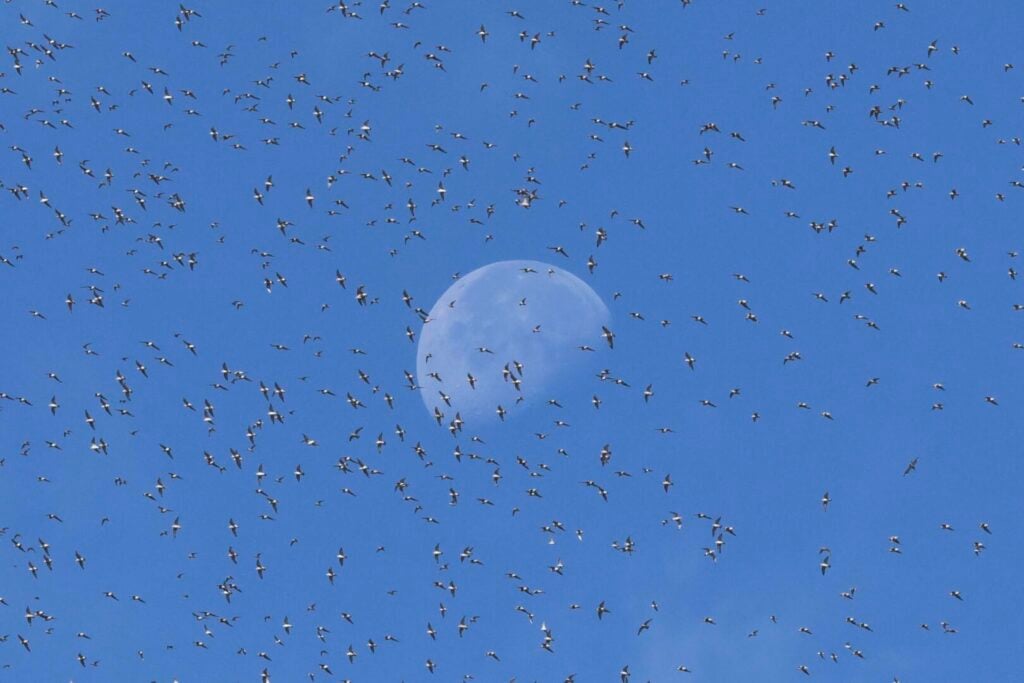
Things settled down again. Several Marsh Harriers were over the saltmarsh behind the mud, along with a couple of Kestrels. Two Red Kites circled in along the sea wall off to the south. The remaining Knot spooked again a couple of times but it was a false alarm and they quickly settled again. The corner of mud was shrinking fast, and they were increasingly tightly packed in, a recipe for trouble.
It was not a surprise when the waders all erupted again. There were still lots of Knot and they flew out over the Wash, the flocks twisting and turning, flashing light and dark, making some impressive shapes. A great spectacle to watch. We picked up the Peregrine this time as it disappeared off inland with something in its talons, presumably a different one. It was pursued by a Marsh Harrier which chased after, trying to steal its prey.
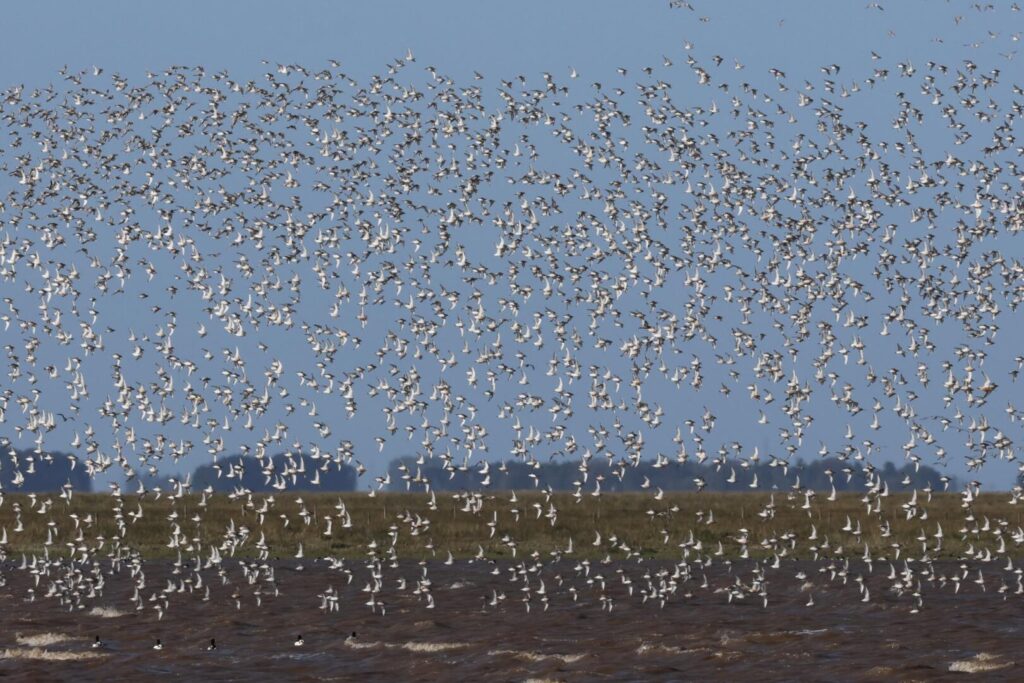
It was approaching high tide now but the strong SW wind was holding back the water, just enough to stop it covering the last corner of mud today. Some of the Knot flew in to the Pit, others joined the ones high above and a few landed back down on the mud. The Curlews had retreated into the saltmarsh and we could see their heads sticking out of the vegetation.
We turned to see lots of people had left already, missing the main event. Some had gone into the hides early and were now starting to come out. Room for us! We made our way over to Shore Hide.
Seven Spotted Redshanks were roosting out in the middle, in their usual spot in amongst the rocks. They were mostly asleep but one woke from time to time and flashed its long, needle-fine bill. All adults now moulted to silvery grey and white non-breeding plumage.

A single Common Sandpiper was walking round the shore of the nearest island. A juvenile Common Tern landed on the one of the smaller brick breeding islands in front of the hide.
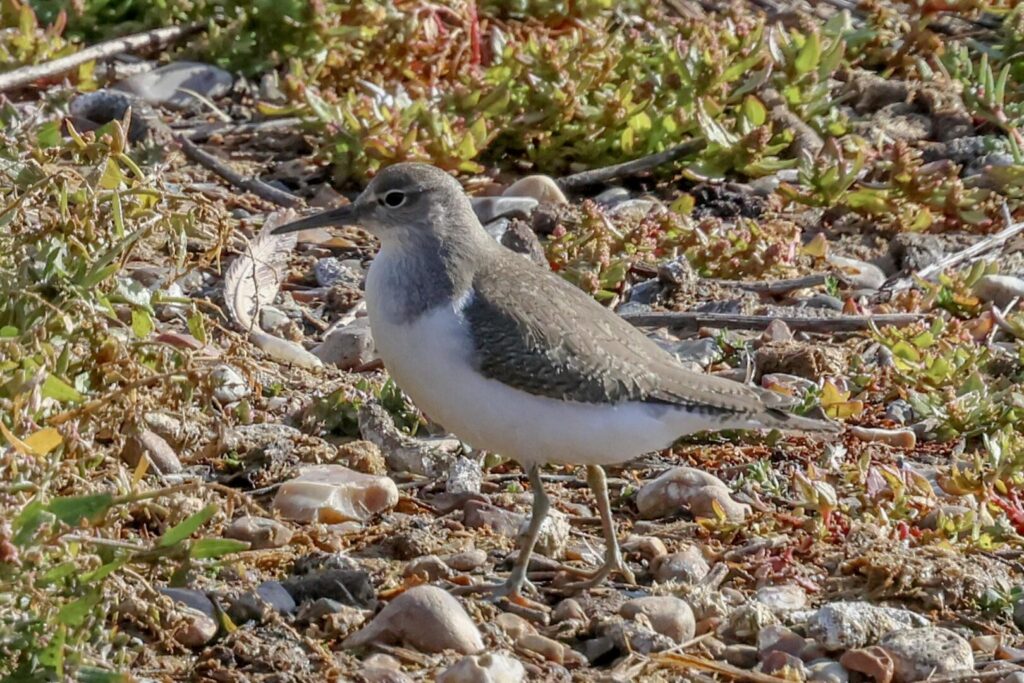
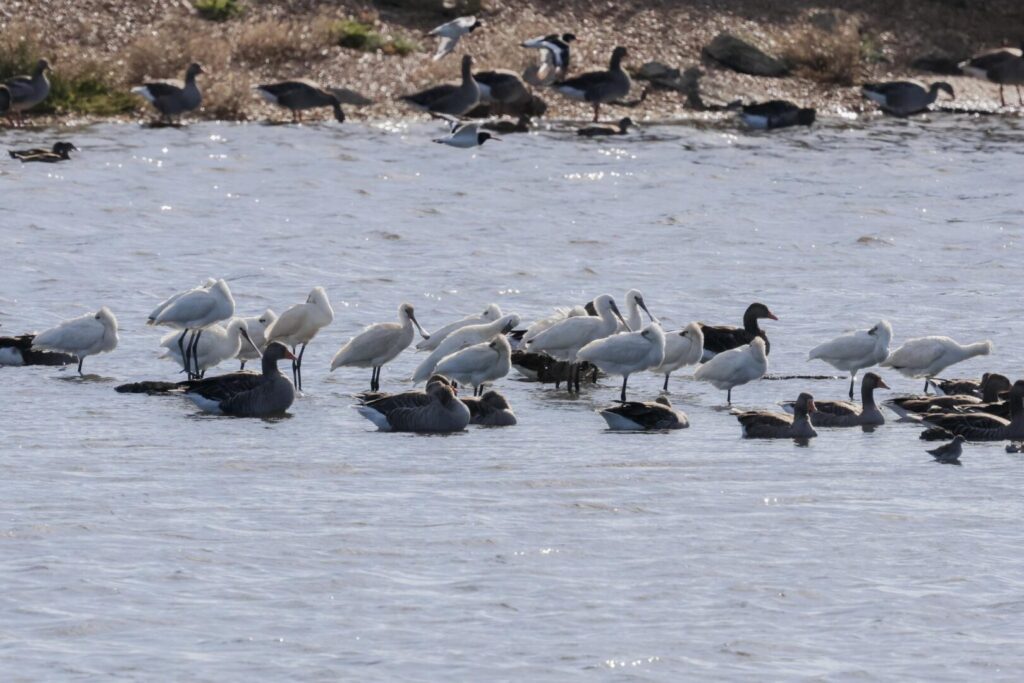
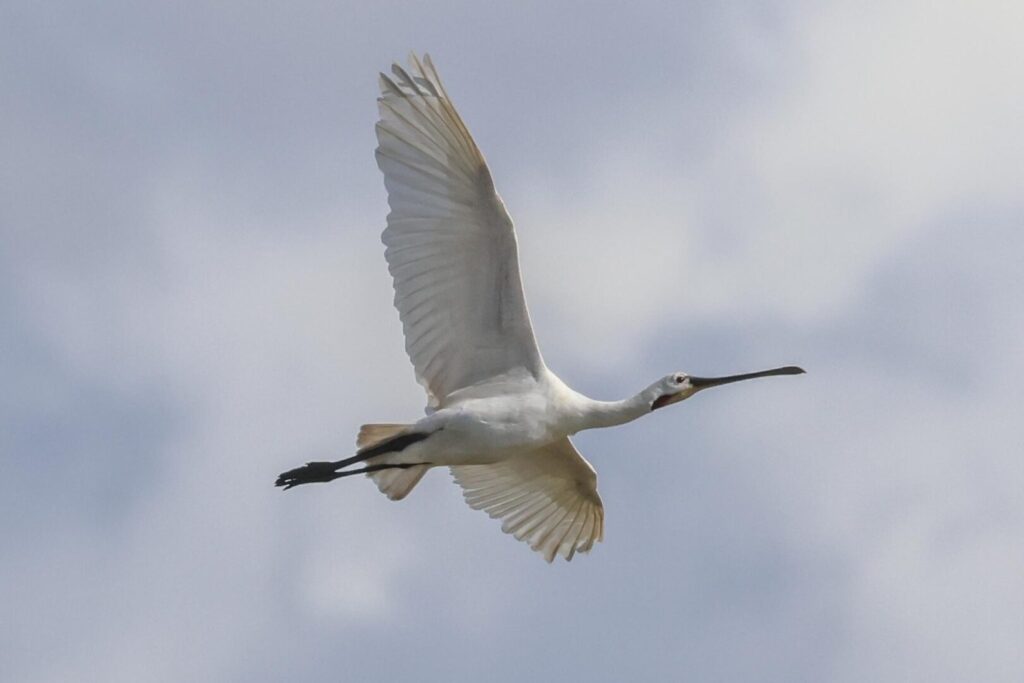
A Spoonbill flew across and landed on the far bank, where we got it in the scope. More were roosting on the gravel nearby and another group in the middle with the Greylags and Cormorants.
There were a few Knot roosting on the islands to the north of the hide, so we got some of the closer ones in the scope. A couple had most of their orange breeding plumage still. We could see a few Dunlin and Ringed Plover on the gravel to, and a group of Black-tailed Godwits in the water between the island and the bank. More Knot were on another island across the Pit further back and a single Little Stint was its own on the shore behind.

Then everything erupted as a juvenile Peregrine stooped down and in over the Pit. The Knot and other waders flew back and forth low over the water as the Peregrine kept flying up and stooping back down again. At one point, it nearly caught the juvenile Common Tern, which just managed to escape its clutches. Chaos ensued, but perhaps as a consequence it didn’t catch anything, and eventually it gave up, flying off over the hides at the south end.
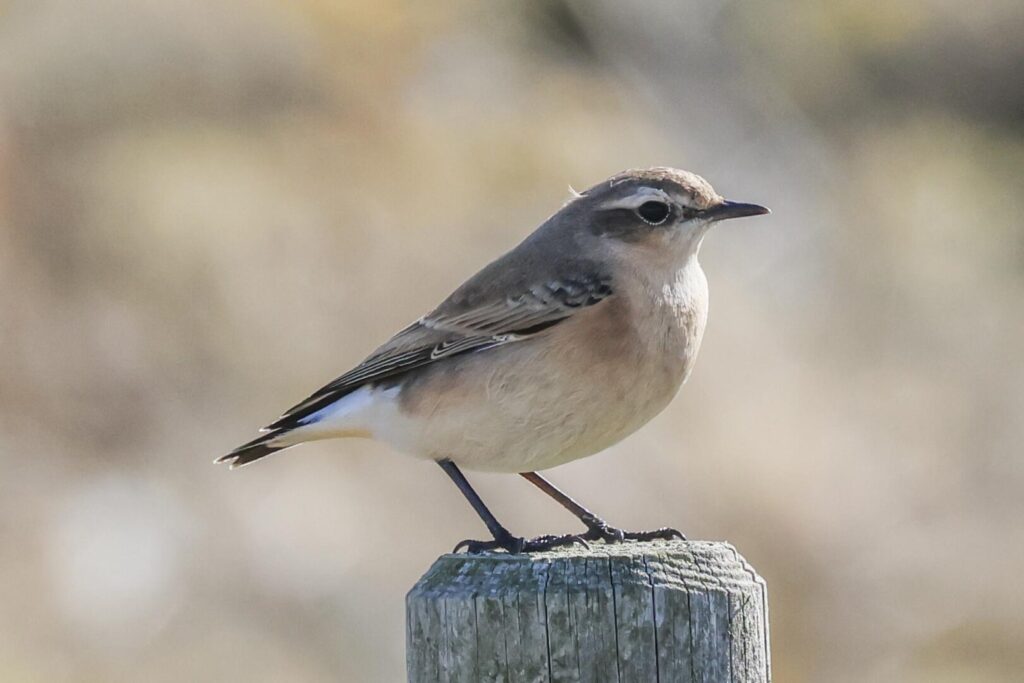
Things settled down again but there were fewer waders on the islands now. We decided to walk down and check out the far end of the Pit, stopping to watch a Wheatear feeding on the short grass by the start of the boardwalk, which flew up onto a nearby fence post. A migrant stopping off to feed up on its way south.
Despite the toggers which had taken up residence for the duration, we managed to get into South Screen. There were lots of Oystercatchers roosting on the gravel bank on the side of the Pit. Most of the waders down this end now appeared to be Black-tailed Godwits but we found a few juvenile Bar-tailed Godwits in with them. A good comparison side by side, we could see the Bar-tailed Godwits were smaller and more strongly patterned, with slightly up-turned bills. There were a few more Knot in with the godwits this end too, and several Dunlin, a couple of adults with their summer black bellies still.

A couple of Little Grebes were diving in the shallow water just behind all the waders at the front. Further back, between the rocky islands, we could see a juvenile Great Crested Grebe and a single Pintail with the Greylags. There several Wigeon, Shoveler and Teal scattered round the Pit too.
It was about time to be heading back out to the Wash, but the waders were showing no sign of going back out. We decided to have a quick look in at Knot’s Landing. There were more Black-tailed Godwits and Knot on the islands from here. Mostly in grey non-breeding plumage, a single Knot which was still fairly orange and a single Black-tailed Godwit still mostly in rusty breeding plumage stood out.
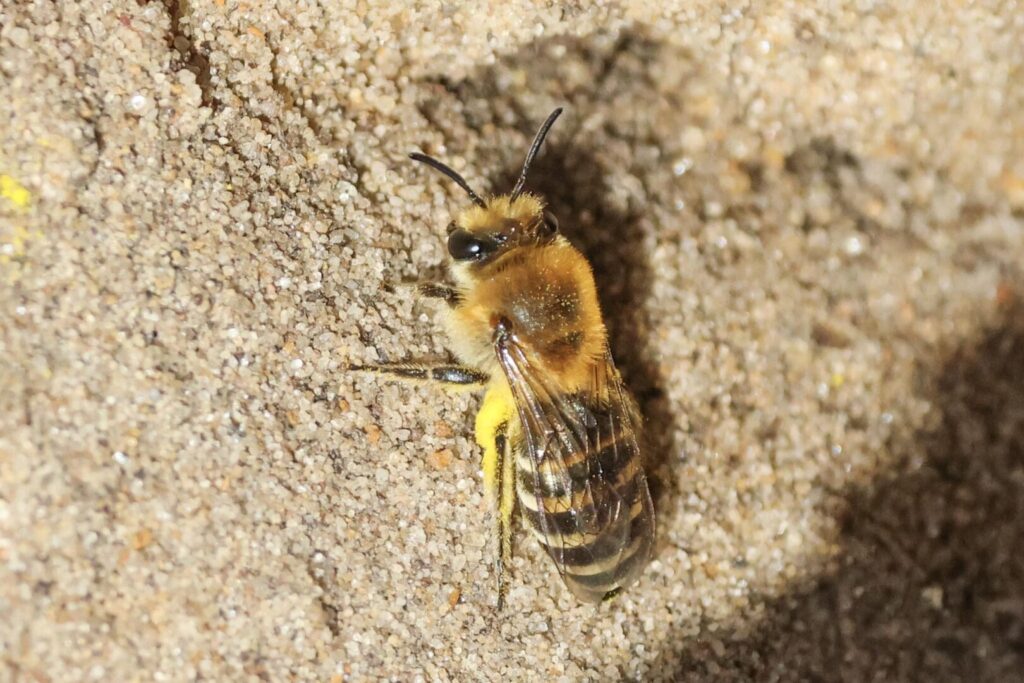
On our way back out, we stopped to look at several Sea Aster Bees (Colletes halophilus) flying around the entrances to the rabbit burrows by the path. They were not very active in the chilly wind today.
The tide was already receding fast and there was lots of exposed mud. The waders had already started to spread out again. We hadn’t seen them on the rising tide but quite a few Grey Plover had appeared now, one or two still sporting their summer black bellies, so we got those in the scope. Several Sandwich Terns were settled out on the mud too.
Some large flocks of Knot were already disappearing further round the Wash again, possibly those which had stayed out on the mud or high in the air above over the high tide. A big group of Oystercatchers had gathered out on the mud and more streamed out from the Pit and dropped down to join them. A sizeable flock of Knot then came out of the Pit over the bank further up and dropped low over the mud. They flew across and landed down with the Oystercatchers.
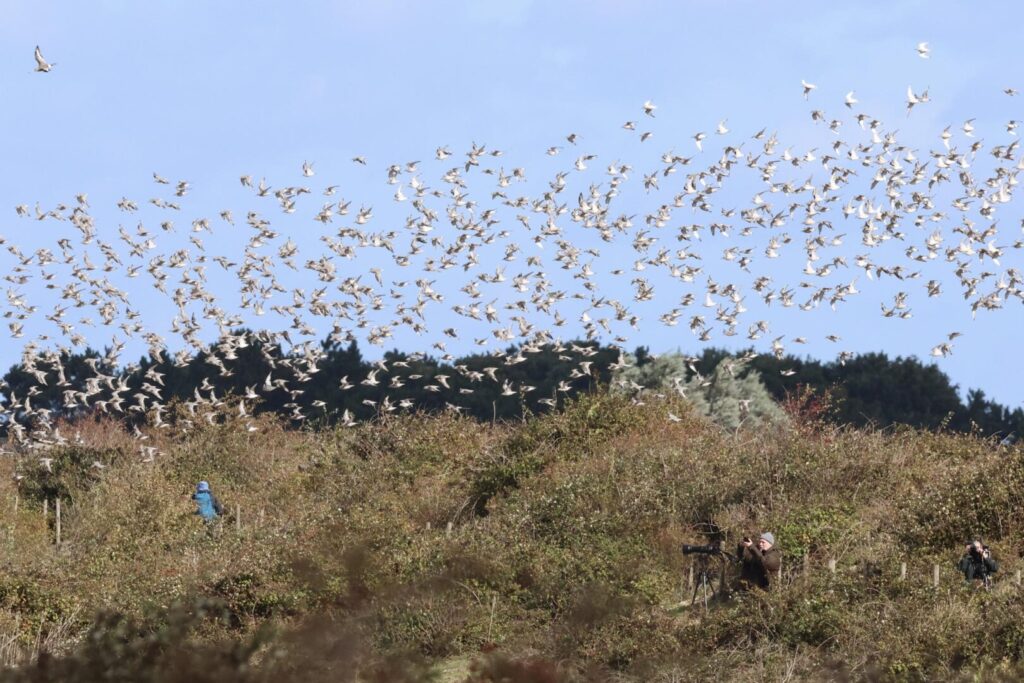
There weren’t so many of them today but the remaining waders were slow to come out from the Pit. We decided to start walking back and on our way past the Pit a couple of lines of Dunlin came out over us. Further up, lots of Sanderling were roosting on the beach.
The plan was to head over to Titchwell for lunch but when we got there we found that the car park was full. A volunteer we didn’t recognise was waving cars away at the entrance without even allowing us to pull up. We drove on and decided to turn round and go back to try Holme instead. As we passed the Titchwell entrance again, we noticed the sign had been moved aside and the volunteer was now standing on the verge. We turned in. Speaking to staff in the car park, apparently they had just five spaces now so were letting a few cars in. Lucky we turned round!
We stopped for lunch in the picnic area. It was nice here out of the wind, in the sunshine. Several Willow Emerald damselflies and a Common Darter fluttered round the nettles nearby and a Southern Hawker flew past. After lunch, we headed out onto the reserve, stopping briefly to check out the feeders were a couple of Blue Tits and Great Tits darted in and out.
There had been one or two Red-necked Phalaropes here for the last few days and we were quite keen to try to catch up with those first. They could be mobile but they seemed to favour the Freshmarsh out from Island Hide so we headed out along the main West Bank. A Wall butterfly fluttered around the bank in the shelter of the sallows.
We stopped to have a look at the Reedbed Pool on the way. There were lots of Gadwall and a few Coot out on the water. A single Mute Swan was lurking on the edge of the reeds on one side and a Little Egret the other. A Great White Egret flew up out of the reeds at the back before dropping back down again.
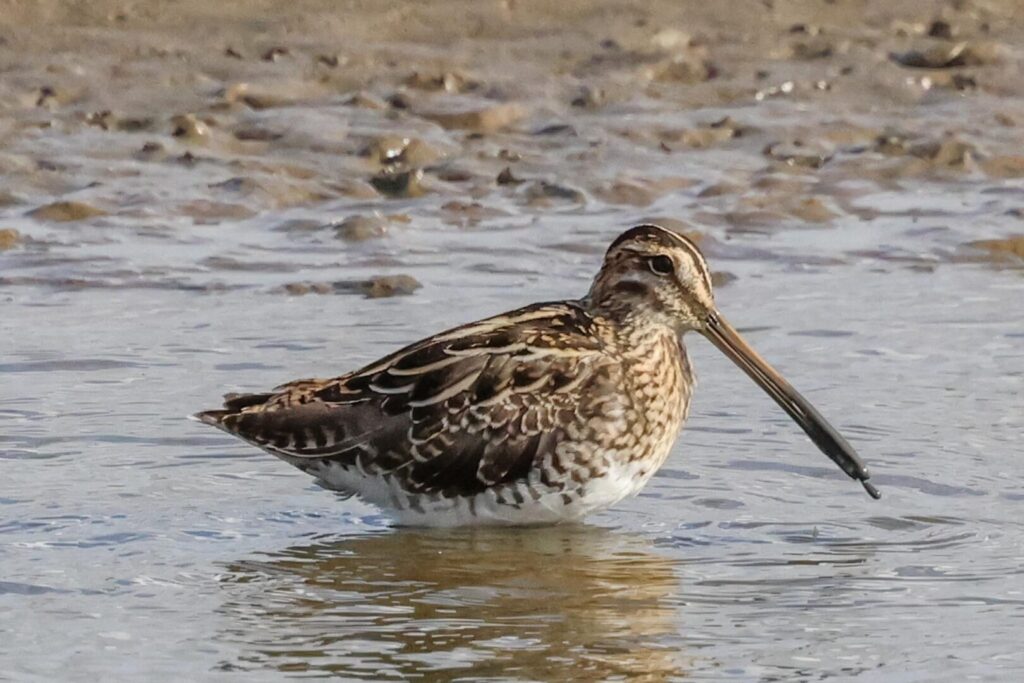
We scanned the Freshmarsh from just before Island Hide but there was no sign of any Red-necked Phalaropes in their favoured corner. Heading into the hide, we asked one of the locals walking back from the beach if there was any sign from further up but apparently they hadn’t been seen for a while. There were several close Ruff from the hide, a group of males with a much smaller female. We could see lots of Avocets and Lapwings, and we got one of several Common Snipe in the scope for a closer look. Twenty-one Spoonbills were out in the deeper water in the middle, asleep (as usual!). A Water Rail was working its way down along the edge of the reeds.
A Hobby flew across low in front of the bank at the back, down over the Freshmarsh. All the waders flushed from the far compartment. A small flock of Dunlin and Ruff flew in over the bund and circled round briefly, and we could see at least one Little Stint with them. Then we picked up a lone wader flying straight towards us, a Red-necked Phalarope. We hoped it might land but it continued straight over the top of the hide and disappeared. There was no further sign of it.
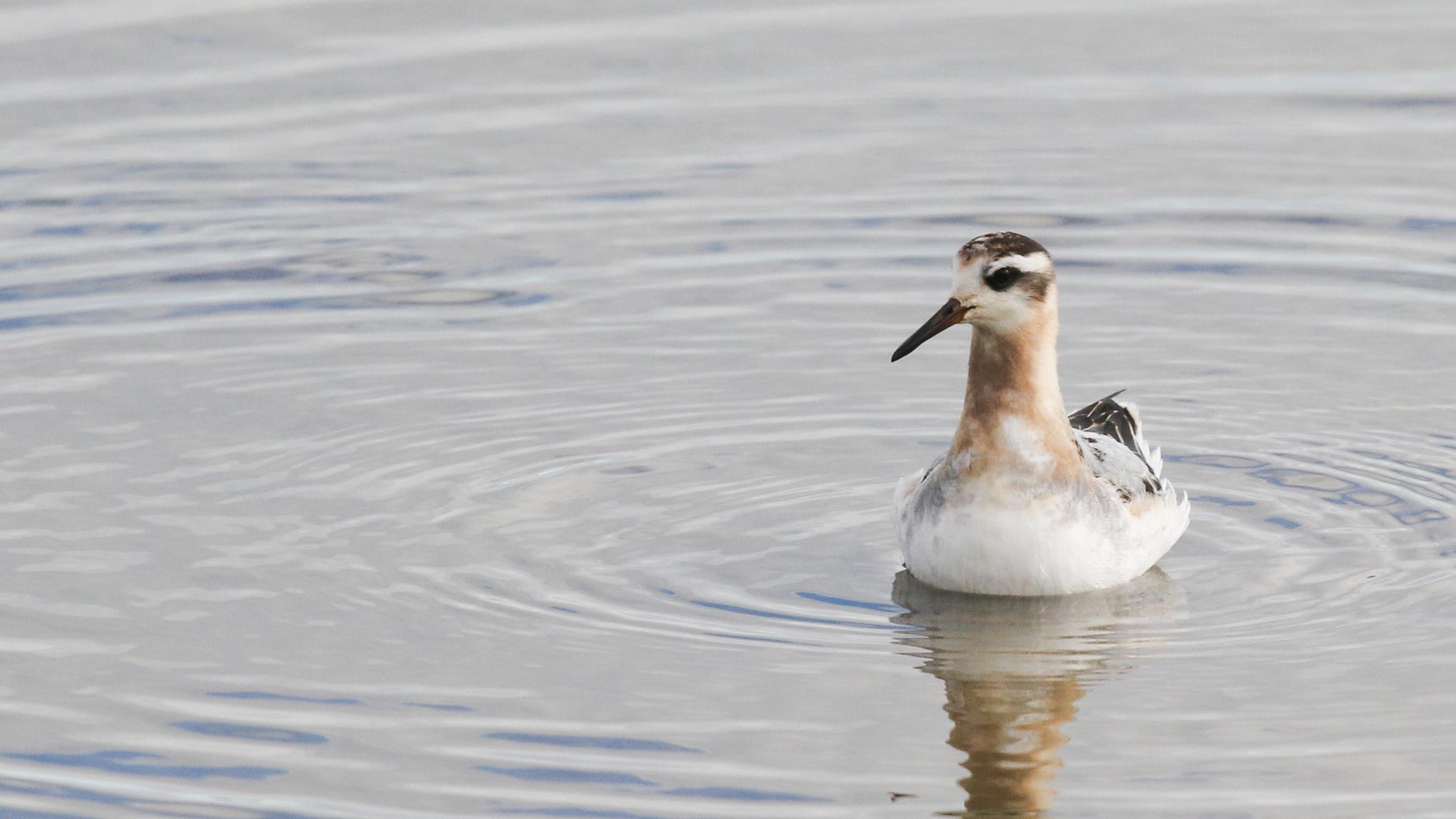
We hoped the Red-necked Phalarope might have gone back to eastern compartment, so we decided to try walking round to the end of Autumn Trail. But as we got out of the hide and up onto the bank, we happened to look back and see the Phalarope now on the water. It had landed behind one of the islands, where we couldn’t see it from inside the hide. We got it in the scope. It was a bit distant from here, but good to see – a juvenile, white below with a black mask and short, fine bill.
Once everyone had a look, we turned round and walked further up past the hide. The Red-necked Phalarope had now gone further, into to the far corner, its favoured spot. We watched it in the scope, swimming in circles, picking insects from the water’s surface. A little later, when we looked back, we could see the two Red-necked Phalaropes now, both along the back edge. The Spoonbills started flying out to feed in ones and twos.
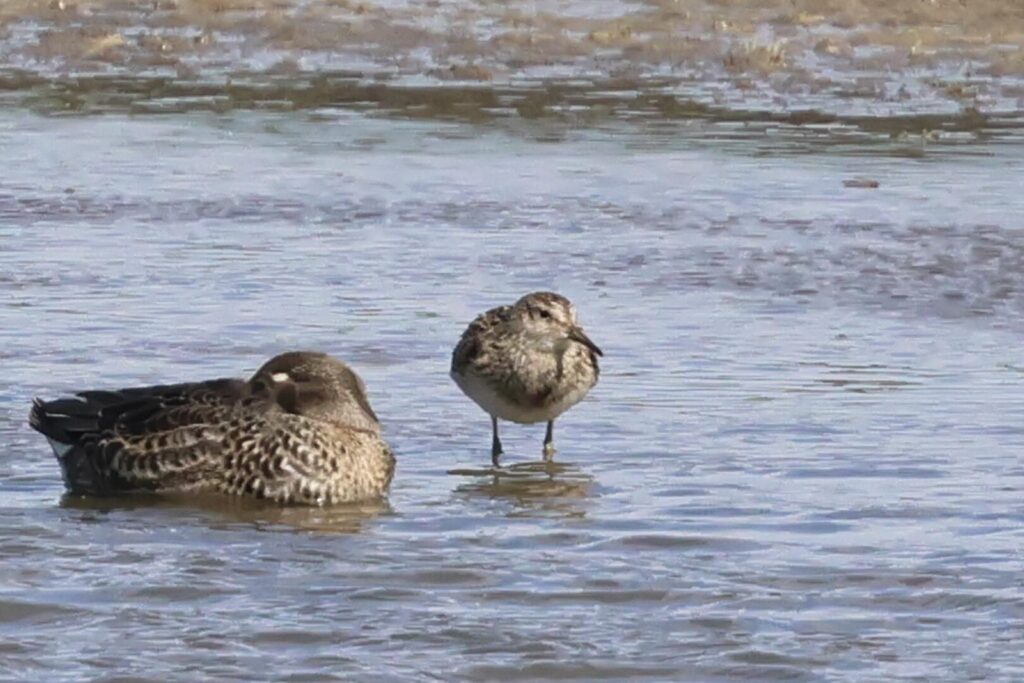
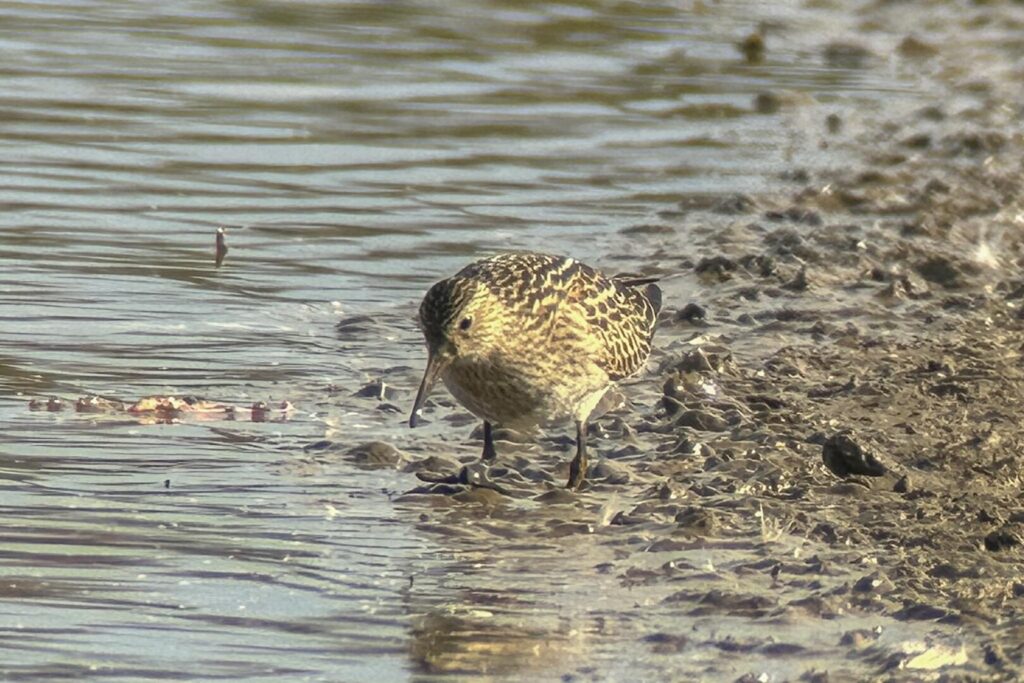
More people with scopes were gathered on the bank further up so we walked over to see what they were watching. Apparently the Pectoral Sandpiper had just dropped in. We got it in the scopes too, admiring its distinctive breast streaking ending in a neat band. It was looking nervous all the time, but thankfully we had a good look before it took off as a small flock of Starlings went low over it. We watched it fly up over the bank and strongly off away over the saltmarsh. Shortly after, the Hobby flew past again and disappeared out over the saltmarsh too.
Now we were here, we decided to head out to the sea. A close Little Egret and Common Redshank were feeding in the narrow channel by the path on Volunteer Marsh but we could only see a single Curlew in the bigger channel at the far side. There was nothing on the Tidal Pool now, so we carried on to the beach.
Scanning from the edge of the dunes, we could see several Great Crested Grebes out on the sea. We managed to find a couple of Red-throated Divers too, but they were very distant off to the west. A Gannet flew past and there were a few Sandwich Terns offshore.
Then one of the group picked up a juvenile Black Tern flying in. We watched it turn as it reach the shore and make its way slowly west just offshore, past us. It stopped to feed halfway to Thornham Point, dipping down repeatedly to the water’s surface, then it landed on the beach for a few minutes before continuing west. A Grey Seal appeared just of the beach too. There had been a couple of Ospreys here earlier but the last had disappeared off east a couple of hours earlier and there was no sign of any now.
There were lots of waders feeding out on the mussel beds but nothing we hadn’t already seen at first. We heard Greenshanks calling behind us away to the west, and next thing we looked back to see two had landed on the mussel beds. We had a good view of them feeding in the shallow water in the scopes.
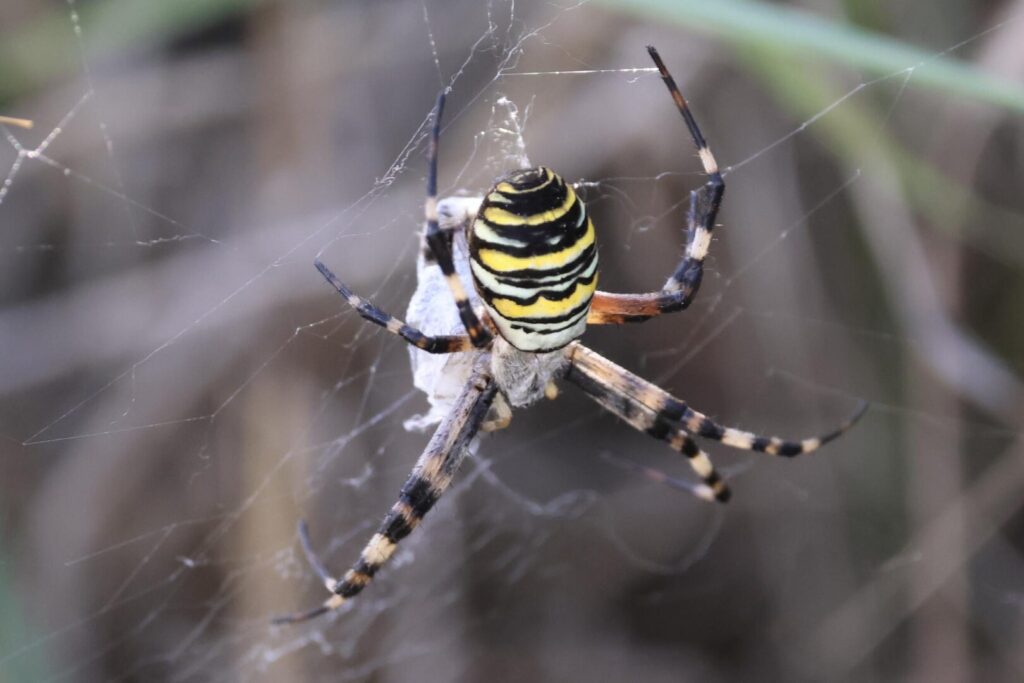
On the walk back, we stopped briefly to admire a Wasp Spider on its web on the bank by the path. Back at the Freshmarsh, while we waited for the rest of the group to catch up, we had a quick scan from the junction to Parrinder Hide. A couple of juvenile Little Ringed Plovers were now on the north-west compartment.
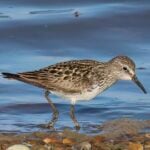
We walked down the path to Parrinder Hide to have a look at the eastern compartment. There was a flock of small waders out in the middle, but they were very jumpy and rather mobile. When they settled down, we could see they were mainly Dunlin, but there were three juvenile Curlew Sandpipers and three juvenile Little Stints with them. Good views in the scope, and nice to compare the relative sizes and bill shapes. The second juvenile Red-necked Phalarope was feeding on the mud too briefly, but then flew up with the other small waders and we couldn’t see it again.
When we had called in at the Visitor Centre briefly after lunch, we had been told there might be two Pectoral Sandpipers here. One was now out on the mud in front of the hide and flew across to the edge of the bund. It worked its way slowly down towards us. Photos suggest it might indeed have been a different individual to the one we had seen fly off earlier.
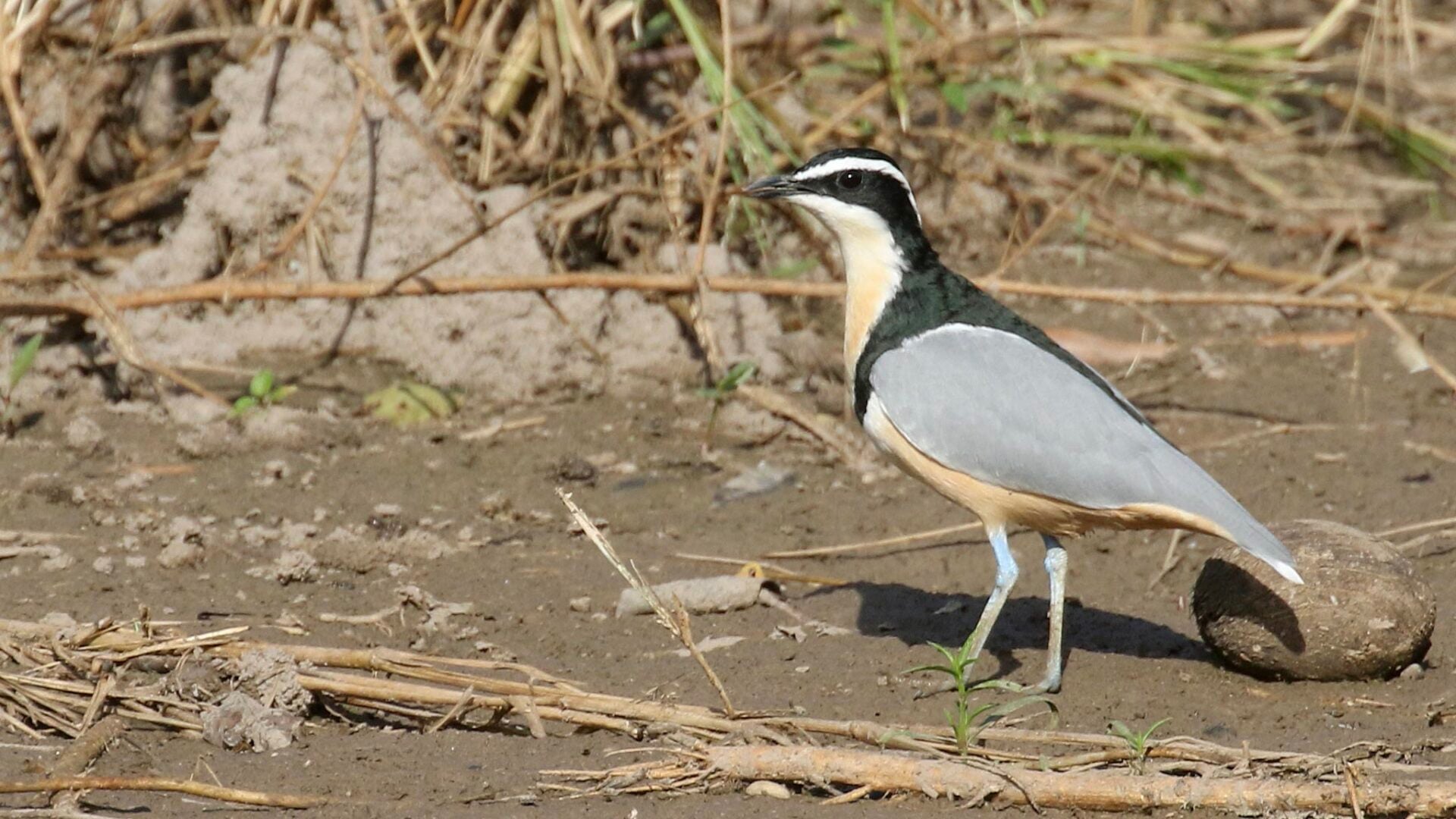
A pair of Egyptian Geese with the Greylags on the main Avocet Island were a new bird for the trip list. A Common Snipe appeared close in front of hide, feeding in the shallow water. Small flocks of Linnets kept dropping in to bathe.
It was time to start heading back. Out on the West Bank again, we found a single Golden Plover on the first compartment now, in with the Lapwings. We got it in the scope and could see the remnants of its summer black belly still.
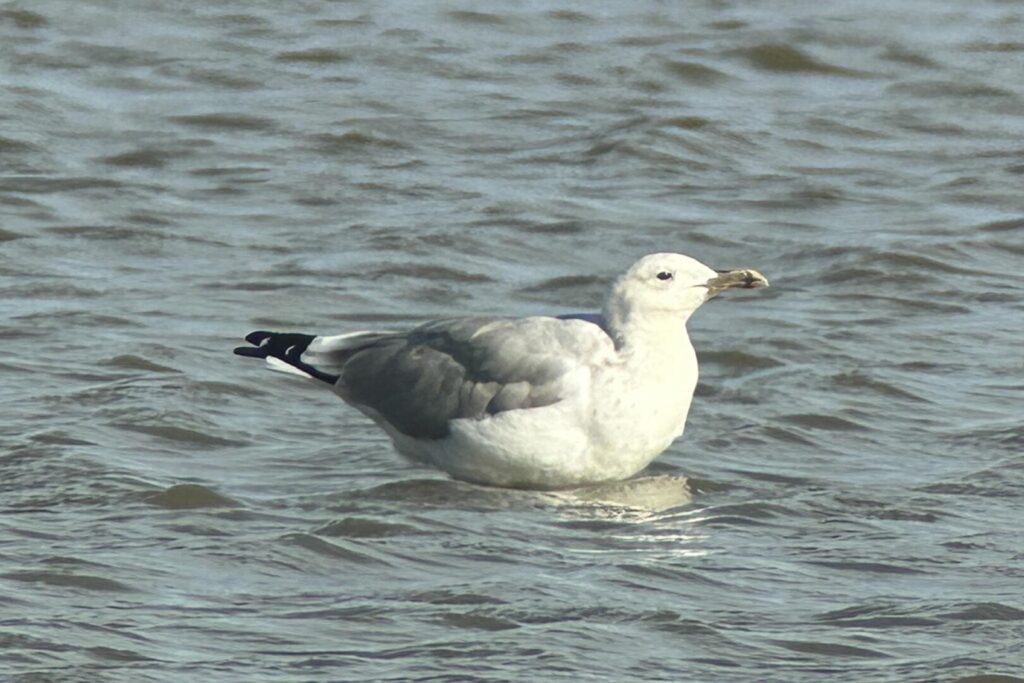
There were more gulls in to the SW compartment than there had been earlier, so we stopped again to look through them. We could see lots of Lesser Black-backed Gulls and a few Herring Gulls at first. As we scanned across, we picked out a single Caspian Gull – not quite an adult, probably in its 4th calendar year. With its dark iris, it stood out, particularly when it was joined by two Herring Gulls. With one either side of the Caspian Gull, it was a good comparison of head and bill shapes.
After an early start this morning, we had hoped for a slightly earlier finish today. There was just too much to see though and any thoughts of getting back early had gone out of the window. In fact, if we didn’t head back now we would run the risk of being late, so we had to tear ourselves away and walk back to the car park. As we drove inland, up through Choseley, there were loads of Red-legged Partridges in the road and on the verges. They are released for shooting here in ridiculous numbers, with no thought to the potential ecological impact.
As we drove on, we had a brief Yellowhammer fly out of the hedge and a Sparrowhawk came up from the side of the road. When we got back to Hindolveston, it was a bit late for tea and cake or we wouldn’t finish dinner! Plenty more time over the next two days.