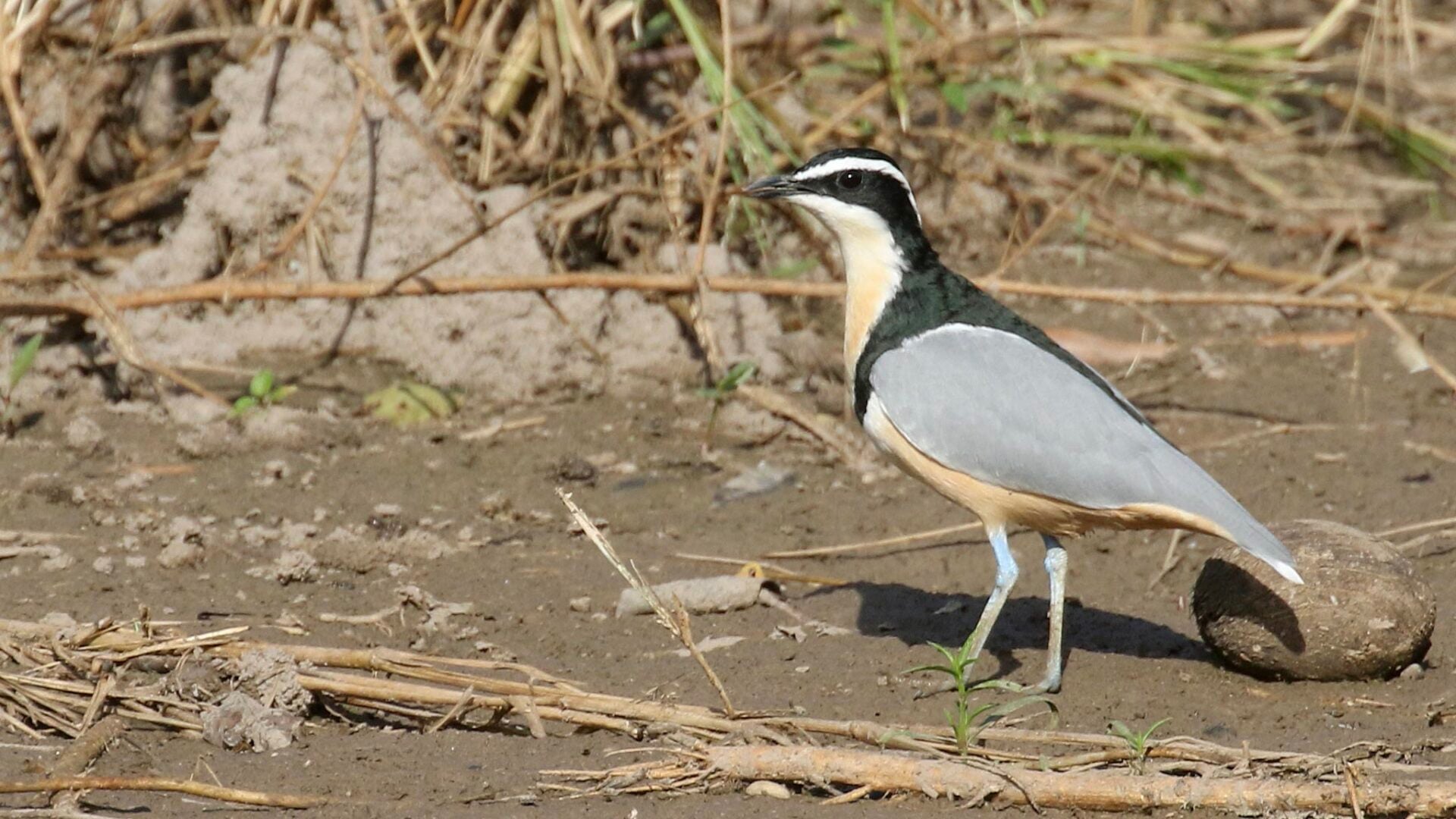
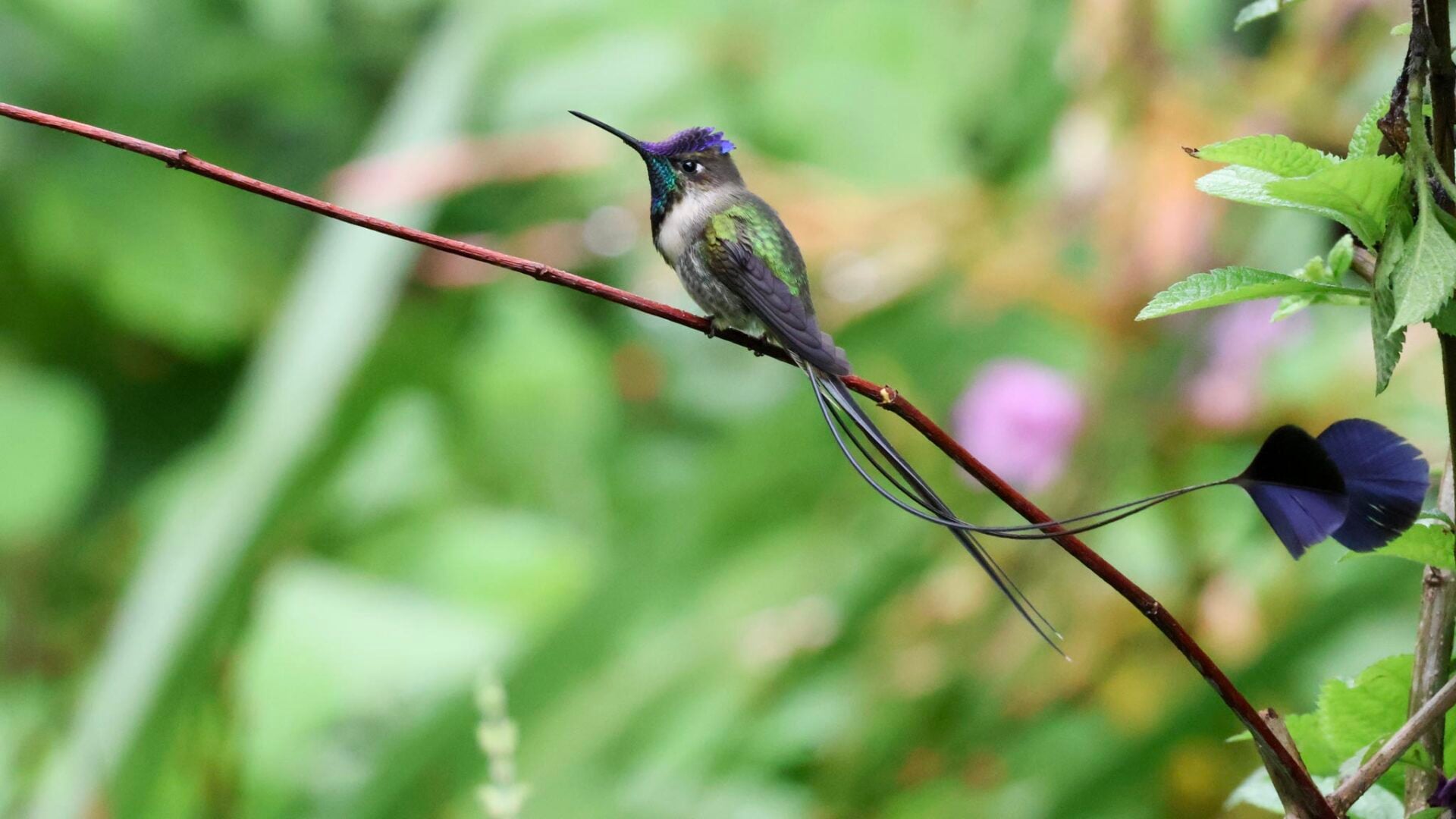
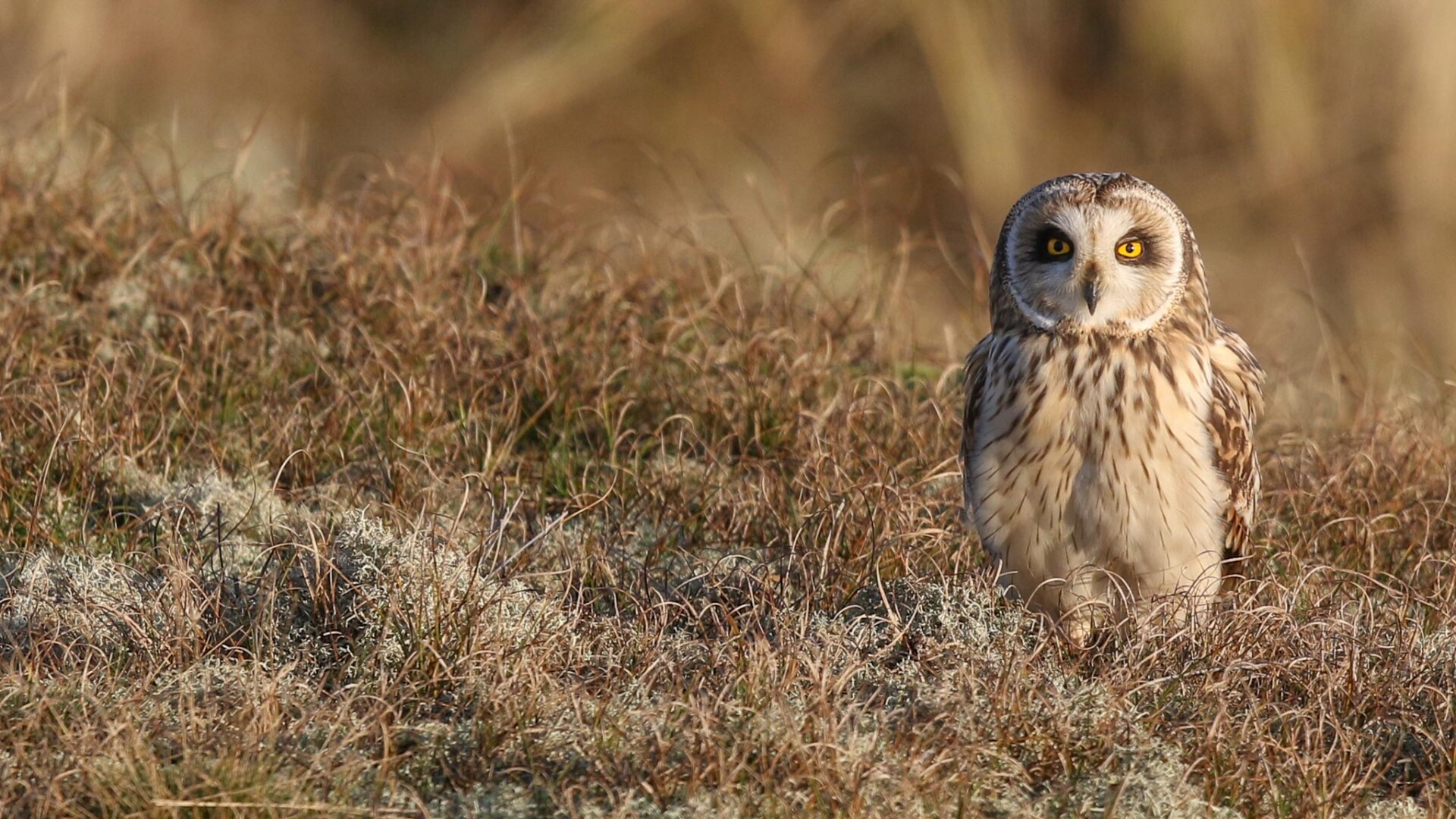
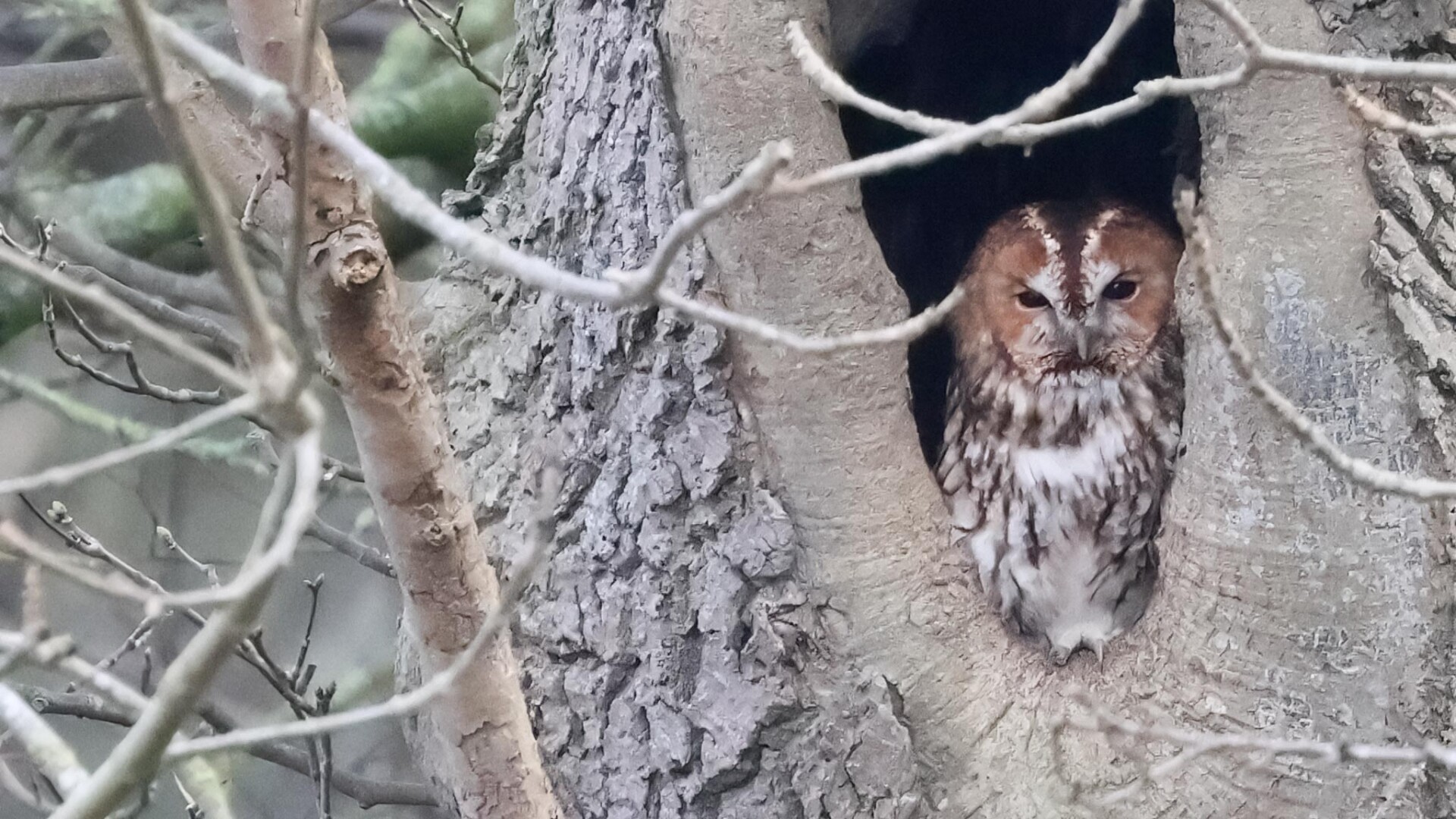
A 9-day International Tour organised in conjunction with our friends at Oriole Birding. Our regular spring visit to Romania, to the Danube Delta and the neighbouring region of Dobrogea and the Black Sea Coast.
We plan to run this tour again in 2027, on 27th May to 4th June, so if you like what you read, please get in touch. You can see details of next year’s tour here.
Wednesday 27th May
We met at the Ryanair check in desk at Stansted this morning. Everyone arrived in good time, we were quickly through bag drop and there wasn’t too long a queue for security this year. Our flight left on time and arrived in Bucharest a little ahead of schedule, although we parked out on the far side of the airfield and the bus to terminal sat on the tarmac for a bit.
Thankfully there were no problems getting through passport control and our bags were waiting on the carousel when we arrived. We met Cristian, our local guide for the week, in the arrivals lounge and walked outside to find the minibus. There were several House Sparrows and House Martins around the terminal, to get the trip list started.
We were soon underway on the 4 hour long journey to Tulcea. There was quite a bit of traffic but we eventually got out of the Bucharest suburbs and into the surrounding flat farmland. There were plenty of corvids in the fields, Rooks and Jackdaws, Hooded Crows, and a couple of Kestrels and Marsh Harriers. We stopped at a filling station about half way, a chance to stretch our legs, use the facilities and get an ice cream or coffee.
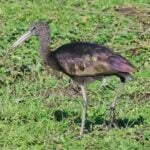
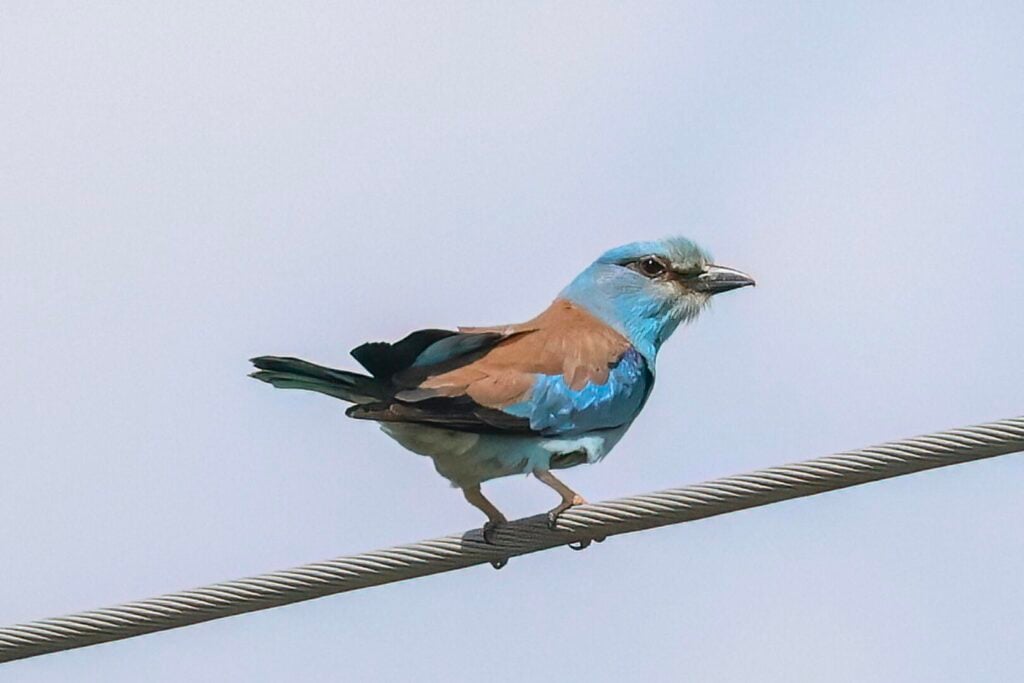
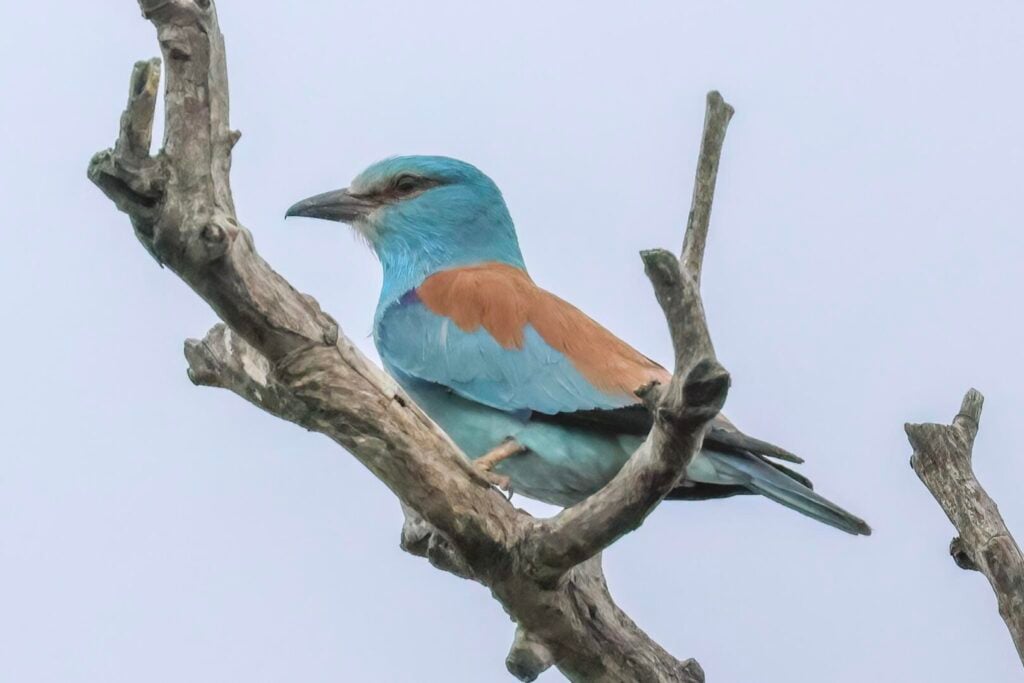
Setting off again, we hadn’t gone far when we found our first Rollers of the trip, a couple of pairs on the wires beside the road. The countryside started to get wetter as we got closer to the Danube, with ricefields and scattered pools. Several small groups of Glossy Ibis and Cormorants flew over, along with Purple Heron and Great White Egret. In the village just before the river itself, lots of White Storks were on their nests by the road. Then we crossed over the bridge and into the Dobrogea.
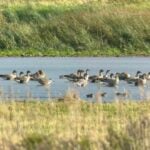
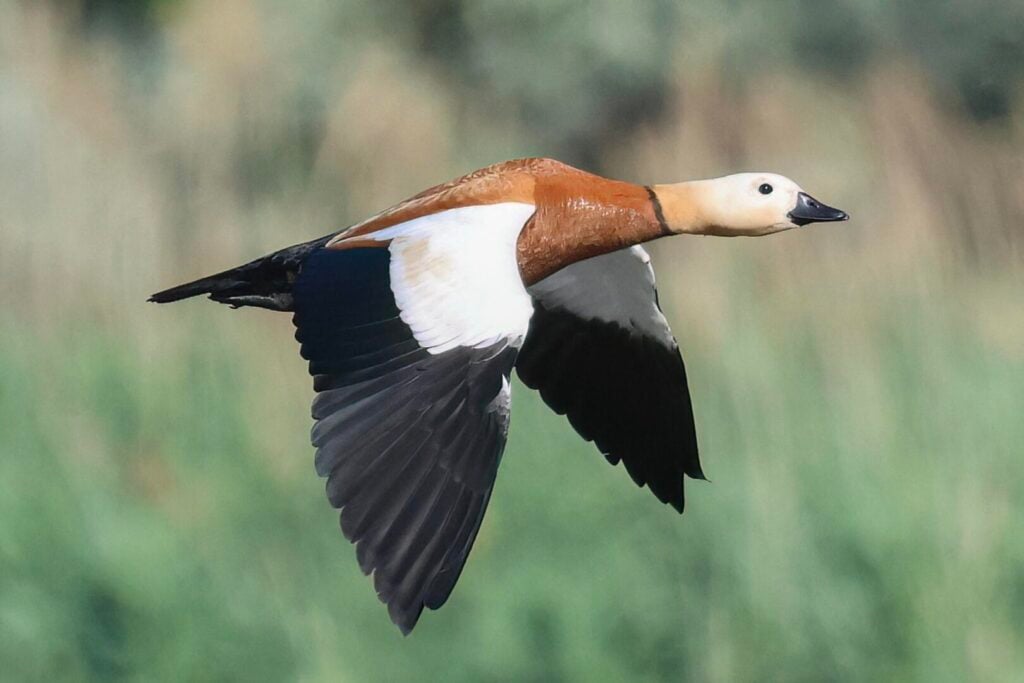
We were making good progress so had time for a short birding stop and pulled off the road at a large lake. There were lots of birds out on the water – plenty of Coot and Greylag Geese of the pink-billed eastern race, rubirostris. We could see a variety of ducks, a scattering of Common Pochard and several Ferruginous Ducks, single Garganey and Gadwall. A pair of Ruddy Shelduck with nine shelducklings was further over towards the reeds and then the male did a nice fly past.
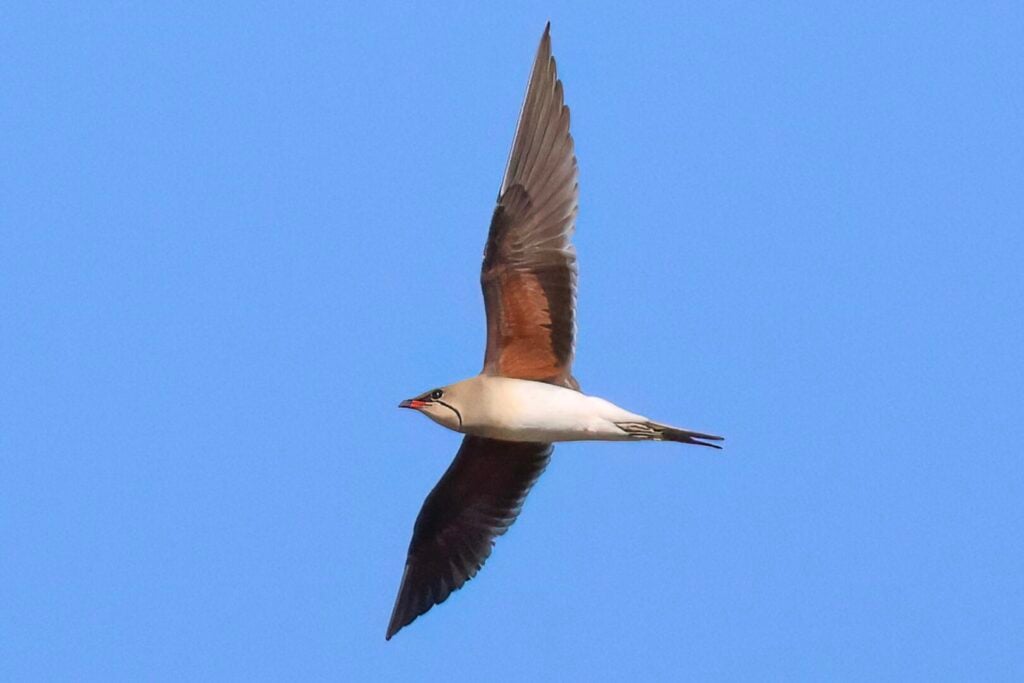
A Great Crested Grebe was diving in front of us. There were Whiskered Terns flying round calling over the water and a couple of pairs of Common Terns too, resting on some small islets. Several Black-winged Stilts were feeding in the shallows over towards the corner, and a single Green Sandpiper and a Collared Pratincole flew over.
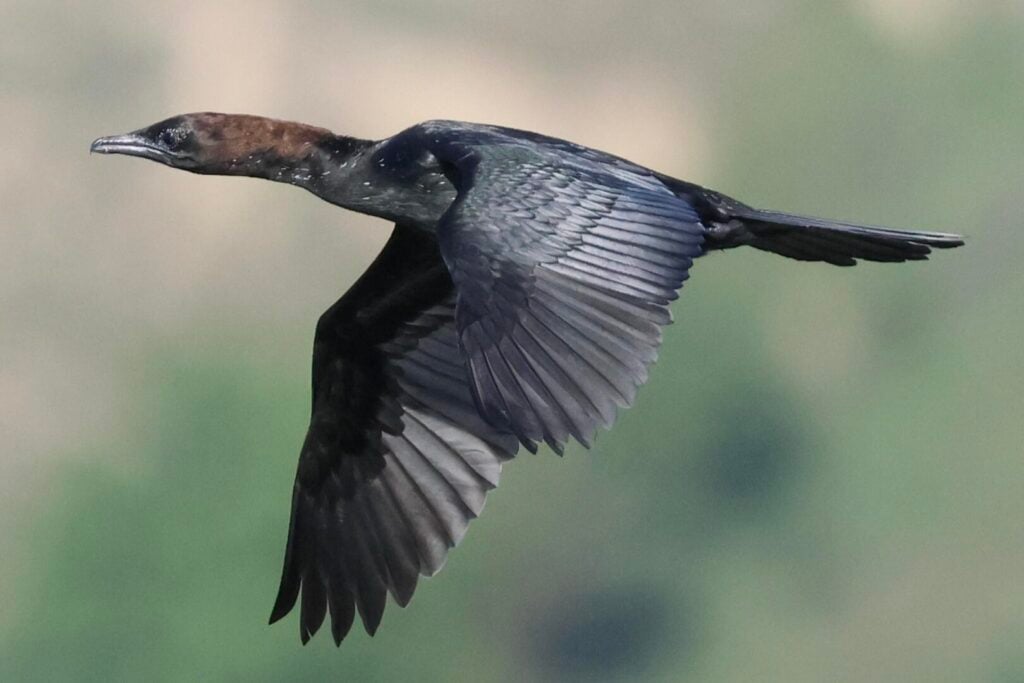
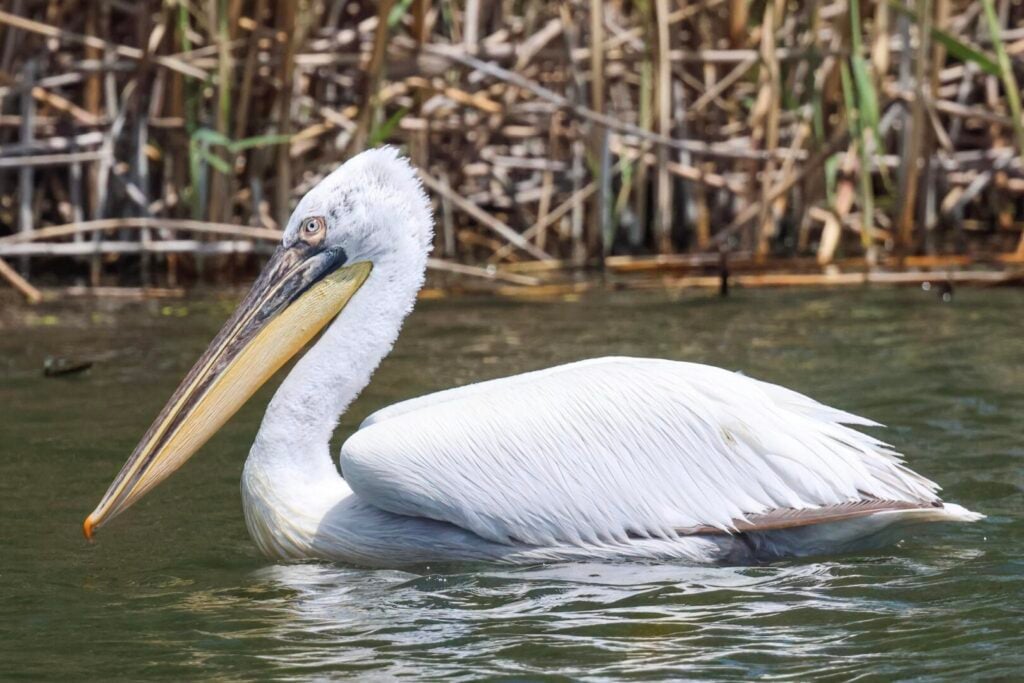
Four White Pelicans were asleep on one of the reed islands and a very distant Dalmatian Pelican was right over the far side of the lake. A couple of Purple Herons flew in and out of reeds, a Great White Egret was stalking the shallows and a Glossy Ibis circled over. Several Pygmy Cormorants were swimming, flying round or loafing on the edge of the reeds.
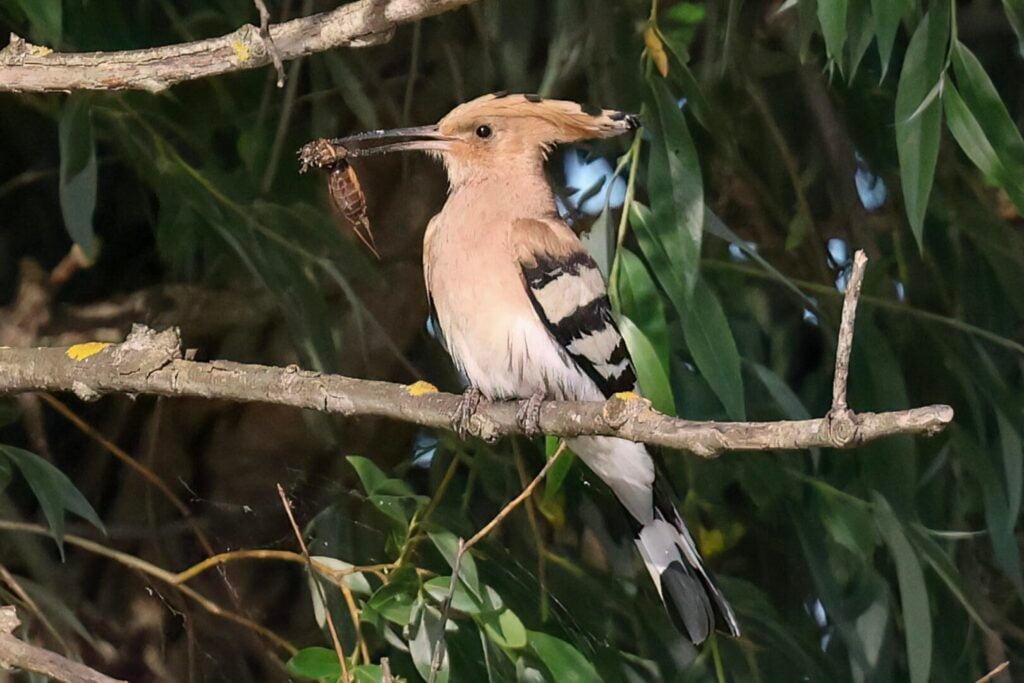
A Little Bittern flew across between two reed islands but disappeared in before most of the group could get onto it. We waited a while and helpfully it came out onto the front edge, climbed halfway up the reeds, then flew back across. We could hear Great Reed Warblers singing in the distance and a Hoopoe calling behind us which then flew back and forth a couple of times. Two Bee-eaters flew over, as did a male Red-footed Falcon and a Cuckoo.
We had seen an amazing variety of birds from here in just half an hour. But we still had another hour left to drive to Tulcea so we had to tear ourselves away. On the way, a Honey Buzzard came up over the trees beside the road and we passed another on a telegraph post a little further on. A few Yellow Wagtails flew up from the fields or the verge as we passed.
When we arrived at the port, we got off the minibus and it was just a short walk over the gangplank to the floating hotel where we would spend the next few nights. Roxana and Lili were waiting for us on board with a welcome drink and biscuits. There was a little time now to get settled into our rooms, then we came back up for dinner in the dining room.
We never go hungry on this trip, and we were served a delicious dinner – soup, followed by fillet of pike perch and then homemade cake. Cristian ran through the programme for tomorrow. Most of the group were tired after a long day travelling so we decided to do the list tomorrow night. Now, it was time for bed.
Thursday 28th May
It was cloudy at dawn and there was a brief heavy shower before breakfast. Thankfully it cleared through very quickly and that was the only rain we would see all day. There were a few Caspian Gulls flying round over the river. After breakfast, we transferred from the flotel to the small boat and set off downstream along the Tulcea branch of the Danube.
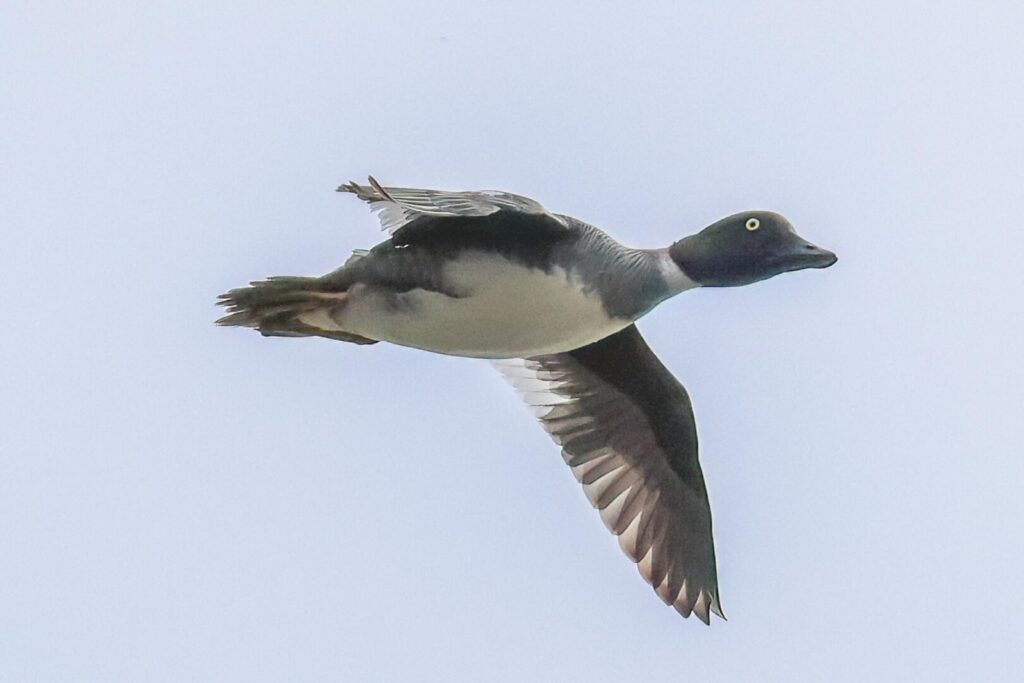
It was fairly quiet on the busy wider channel here, just a couple of Common Terns and several Mallard, until we spotted three Goldeneye on the water ahead of us. They took off before we got to them and circled round over the boat. A scarce breeder here, they are right at the southernmost extension of their range.
After a while, we turned off onto the smaller Mila 36 channel and the captain cut the engine. As we drifted with the current for a while, we listened to all the birds singing in the trees on the banks. There were several familiar voices – lots of Blackcaps, Chiffchaffs, Blackbirds and a Song Thrush. The Lesser Whitethroats sound completely different to those at home but are considered even the same subspecies.
There were lots of Eastern Olivaceous Warblers singing too, although they were hard to see in the trees, as were one or two Icterine Warblers and several Thrush Nightingales. Male Common Redstarts were singing from almost every bare tree top. There were Cuckoos everywhere too, chasing in and out of the trees.
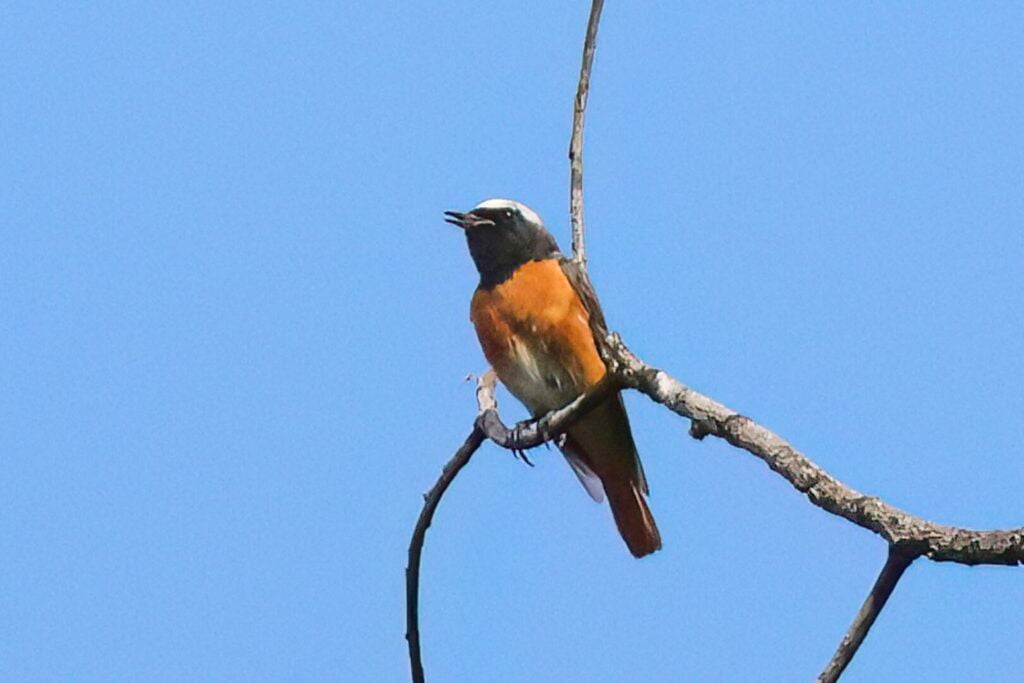
A succession of Kingfishers flew across in front of us. We stopped to watch one which we could just see in its nest hole on the bank but then it flew straight out and away. When it or its partner came back in with a fish, it wouldn’t approach the nest with us watching so we left it in peace.
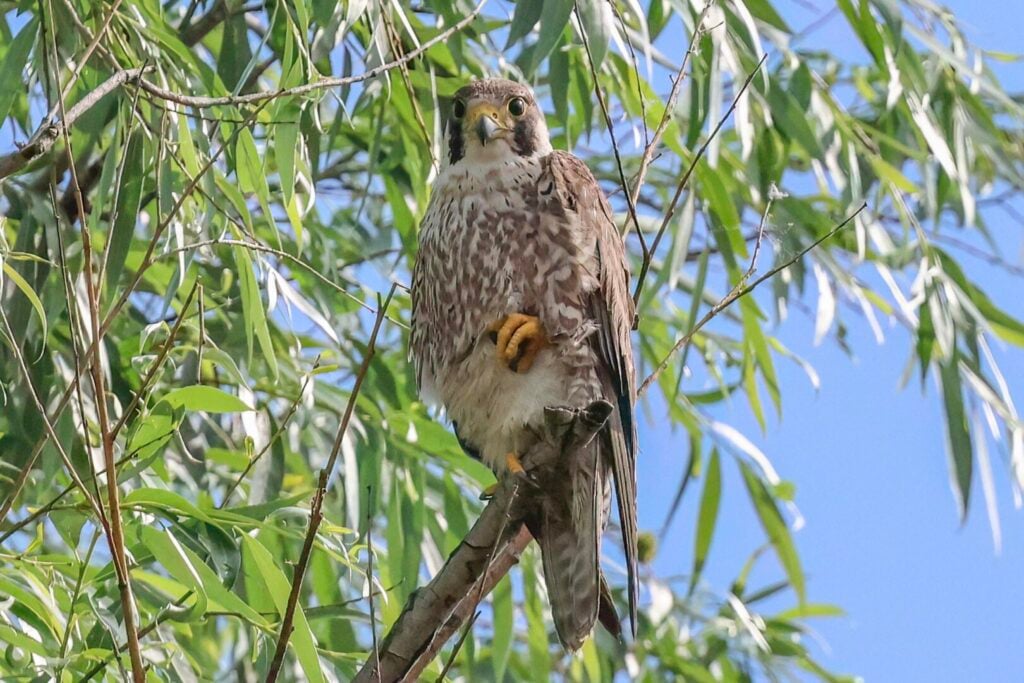
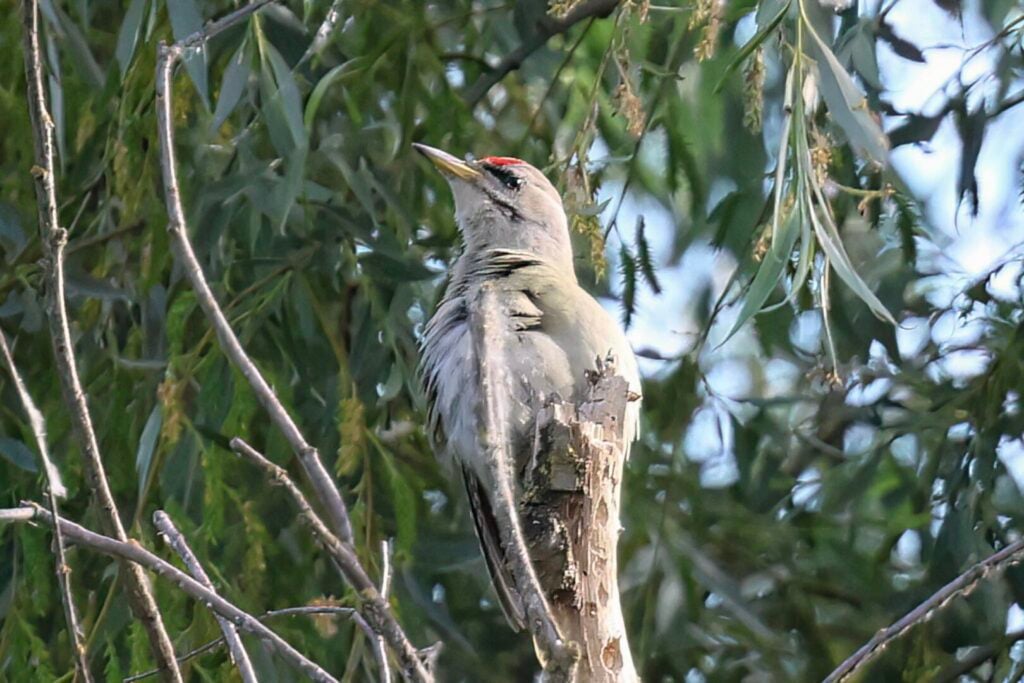
A falcon flew from the trees ahead of us and landed again, above the edge of the channel. As we got up to it, we could see it was a young Peregrine. We heard a few woodpeckers calling in the trees and had brief glimpses flying through the tops – two or three Middle Spotted, Great Spotted and a Grey-headed Woodpecker.
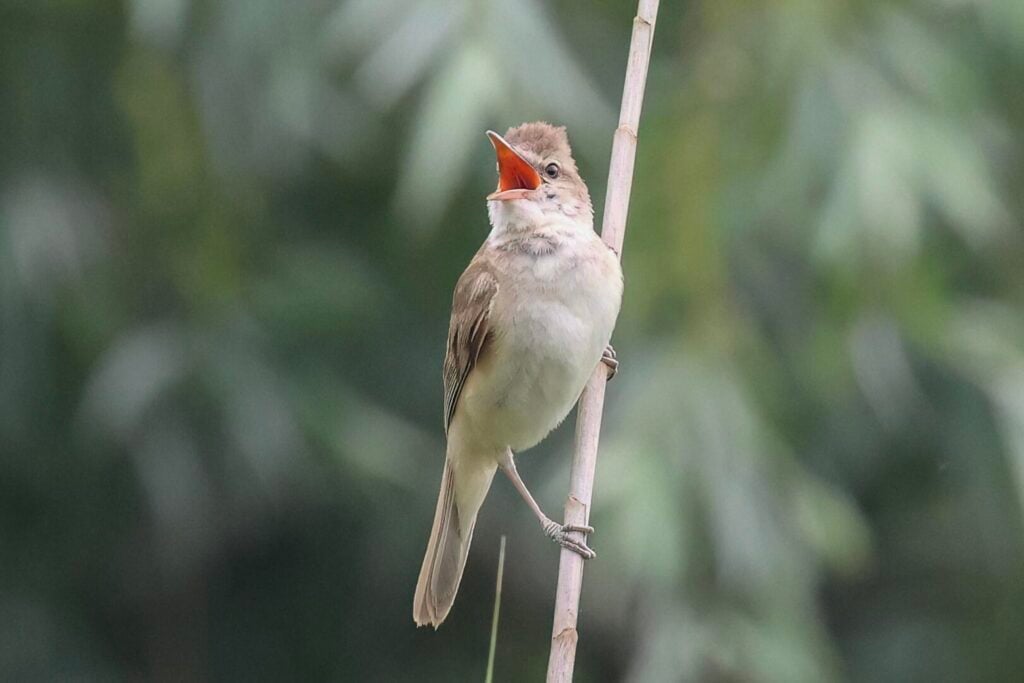
The trees gradually got thinner and were interspersed with reeds now. We heard our first Great Reed Warblers singing their loud croaking song and we stopped to look at a couple. The sound would accompany us all the way through the rest of the Delta now.
Cristian heard a Penduline Tit call and the captain manoeuvred the boat round to where we could see its nest in the lower branches of a willow, through the tops of the reeds. One of the adults was at the entrance to the nest, but tricky to see in the leaves. It dropped down into the reeds and we saw it a couple of times again moving through.
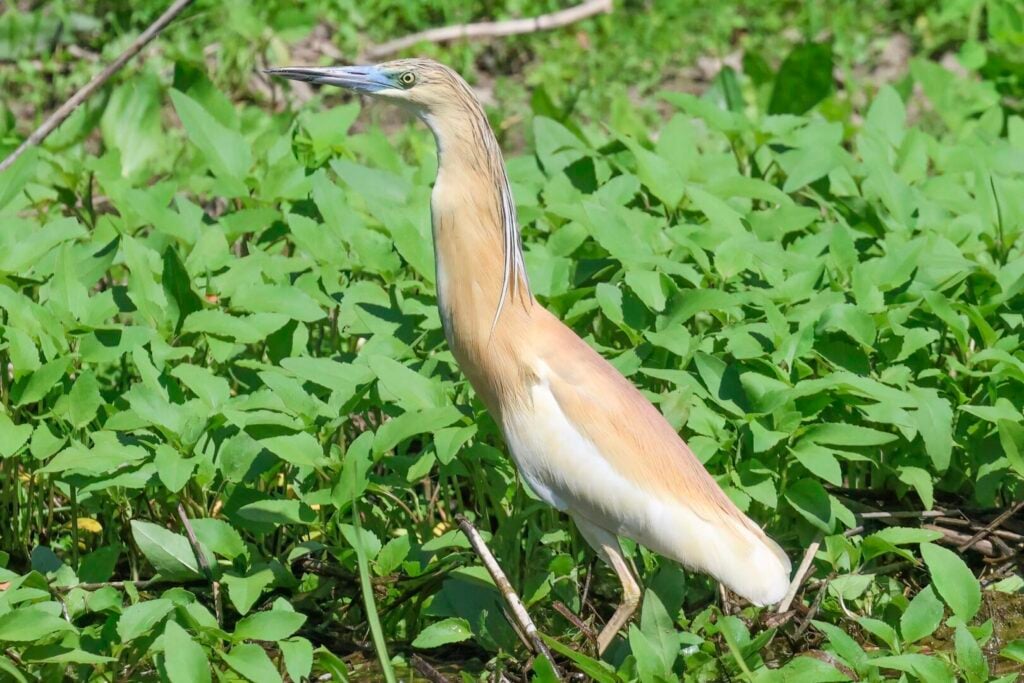
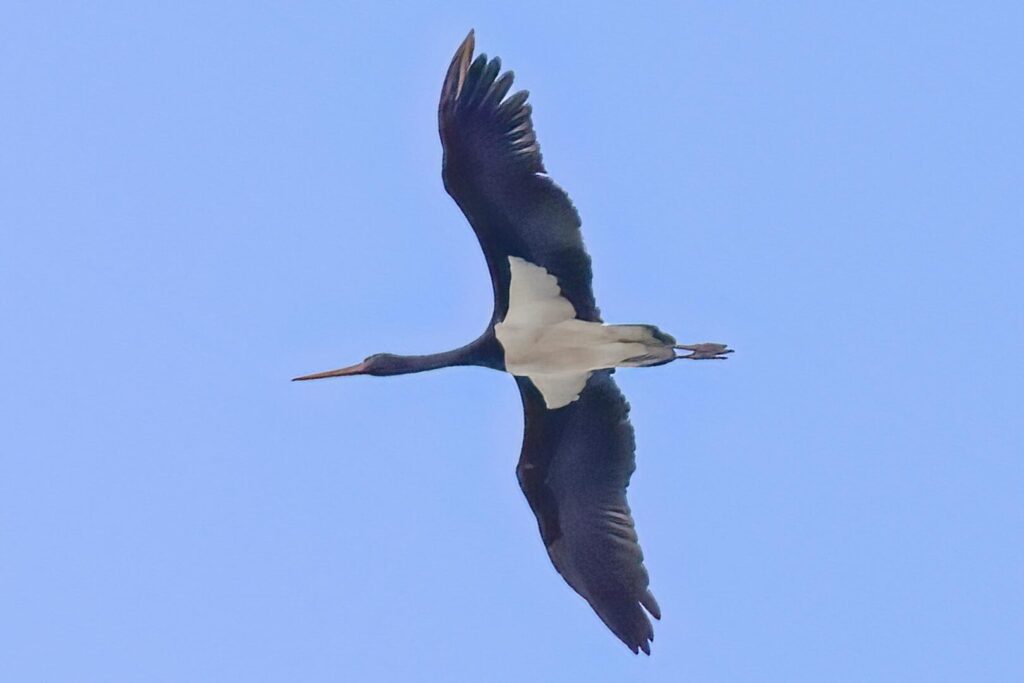
The skies had cleared now and the sun had come out. Continuing on, three Black Kites circled over ahead of us as it warmed up. Two Black Storks were already very high up in the sky. There were a few herons which flew out from the base of the trees along the bank ahead of us, including several smart Squacco Herons which posed nicely.
A succession of Glossy Ibis and Pygmy Cormorants flew over and we saw a few of the latter perched on dead any dead branches and snags in the water.
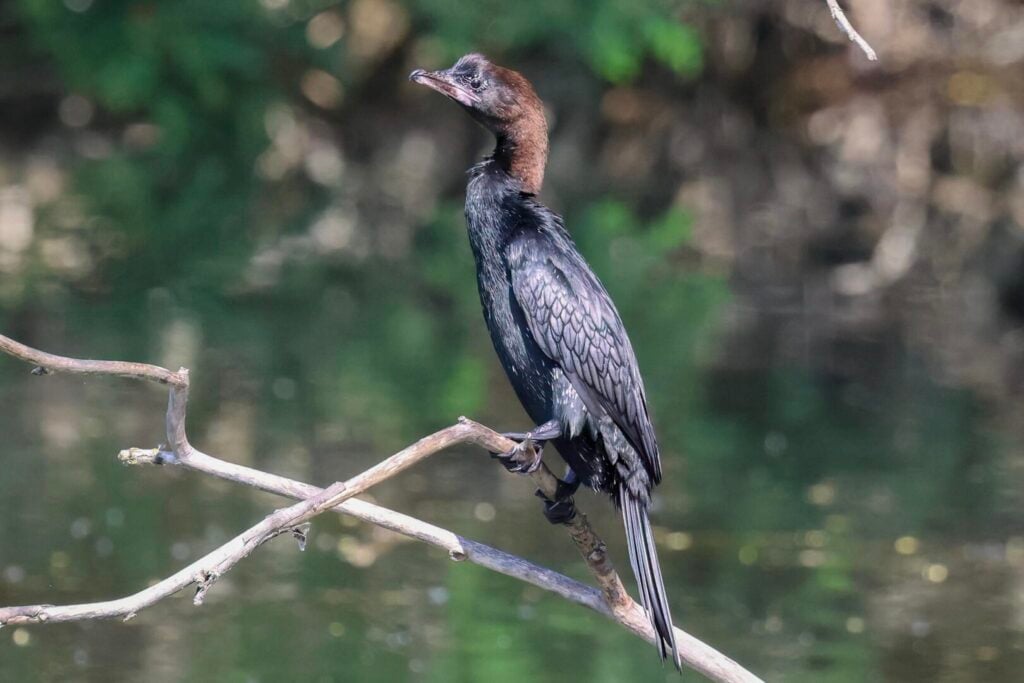
We came out onto a bigger channel lined with willows and it was time for coffee and biscuits. As usual, no sooner had the coffee been served than something appeared – this time, our first White-tailed Eagle of the trip, circling high ahead of us. Coffee cups down! It was almost immediately followed by another White-tailed Eagle much closer, which flew out of the trees right in front of us. A Honey Buzzard flew past too, going the other way. Two more Black Storks glided over, a bit closer than the previous ones.
When a small mammal swam across the channel ahead of us, we were slightly confused initially. It didn’t look like the usual Musk Rat and was too small for an Otter. It didn’t dive either but swam quickly over to the far bank. Then the penny dropped, it was a European Mink. Unrelated to the invasive American Mink, it is classed as Critically Endangered but a small population persists in the Delta. Even here, it a rare sight so a great one to come across.
It was a bit cooler today and there were not so many butterflies out. We did manage to see a couple of Freyer’s Purple Emperors briefly though, flying into the willows, and a single Red Admiral. Back out into a more open area, our first Purple Heron of the morning flew up out of the reeds. A couple of Bearded Tits flicked off ahead of us too.
As we approached a clump of trees where they have their nest, an adult White-tailed Eagle flew out and landed in a dead tree a bit further down. The captain pulled the boat into the edge of the reeds, to where we could just see the nest (from a discrete distance) and the single juvenile, almost full grown, looking down from it. As we started the engines again, the adult decided it was time to move and flew off before we could get to it for a closer look.
A couple of times, we came across large feeding groups of White Pelicans in the channel ahead of us. An impressive sight, as they swim together in a tight flock and upend in unison. As more birds could see what was happening, they flew over to join in, some dropping down quickly from great height with their feet down, while large groups still circled low above.
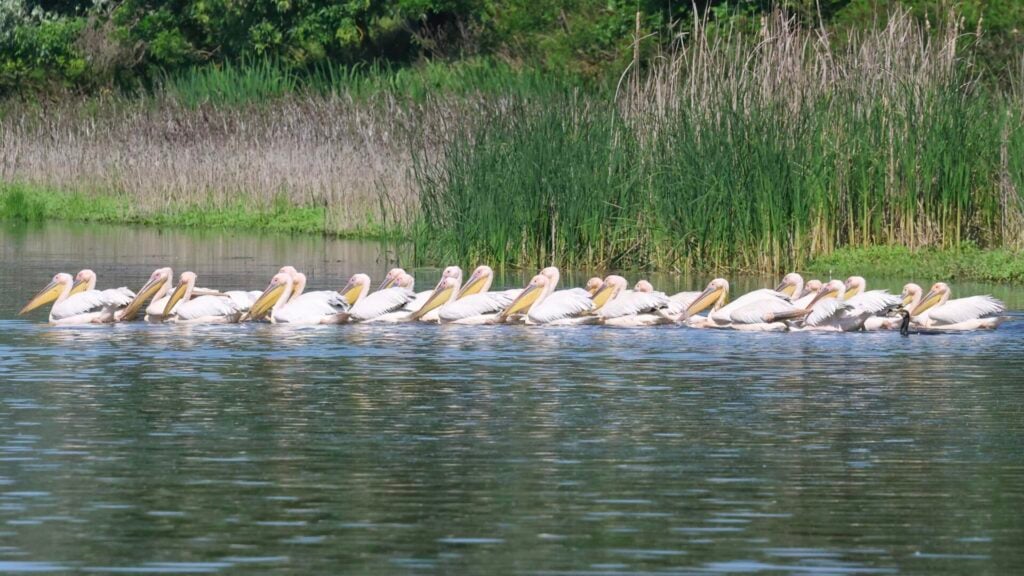
At the first group, lots of Great White Egrets, a few Little Egrets and several Grey Herons were lined up on the bank waiting for the Pelicans to push the shoal of fish into the shallows. The second group of White Pelicans was following a large gathering of fishing Cormorants. The latter find the shoals of fish and drive them out from the deeper water and the Pelicans either scoop them up or steal the catch from the Cormorants!
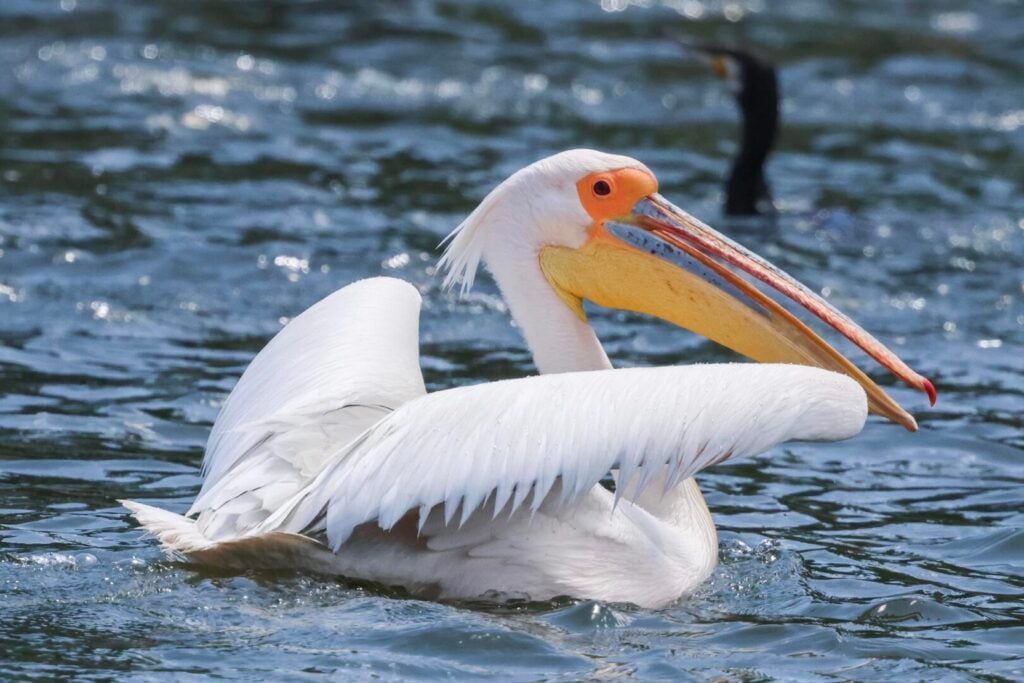
A single Dalmatian Pelican was loosely with the second group too, more typically feeding on its own. You can easily go days without finding one of these feeding flocks, so to be able to watch two today was very nice. We had spent a bit of time watching the Pelicans and we still had a long way to go to meet the floating hotel. We couldn’t get across Lake Furtuna at the moment as the water level was too low, so we had to go the longer way round.
In a more open area with floating vegetation, we saw a single Little Grebe and a couple of Great Crested Grebes, and several Whiskered Terns. Another adult White-tailed Eagle circled ahead, then flew over the boat. We passed a couple more Grey-headed Woodpeckers and a pair of Rollers in the trees but didn’t have time to stop now. Out into a more open agricultural area, several Bee-eaters were in the trees and in and out of the banks. Lots of Sand Martins were in and out of their nest holes too.
We came out onto the main Sulina channel, just as the flotel was being towed past. Perfect timing. The small boat pulled alongside and tied up and we transferred across. It was time for lunch now, another three courses. After sitting on the small boat all morning it didn’t really feel like we had earnt it but birding can be hungry work and we couldn’t refuse Lili and Roxana’s delicious cooking!
Sitting in the dining room, looking out of the windows, we could watch the Delta passing by outside. There were lots of grain boats passing on the main channel, heading to the ports further upstream. All travelling under different flags of convenience, it was interesting to see where they were registered – Guinea-Bissau, Comoros, Palau, the Marshall Islands.
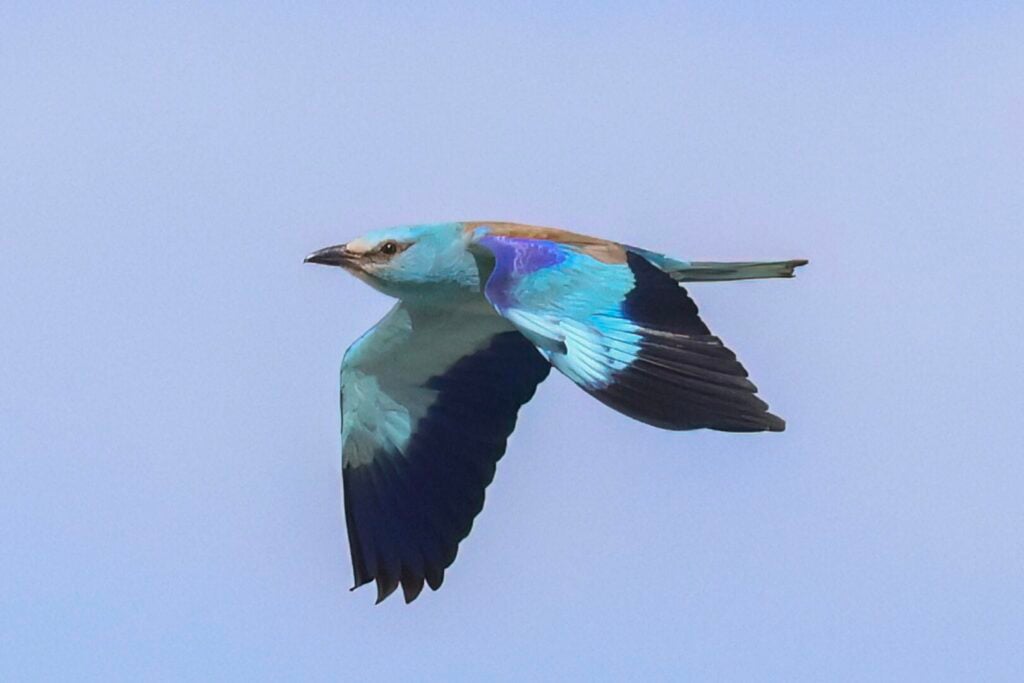
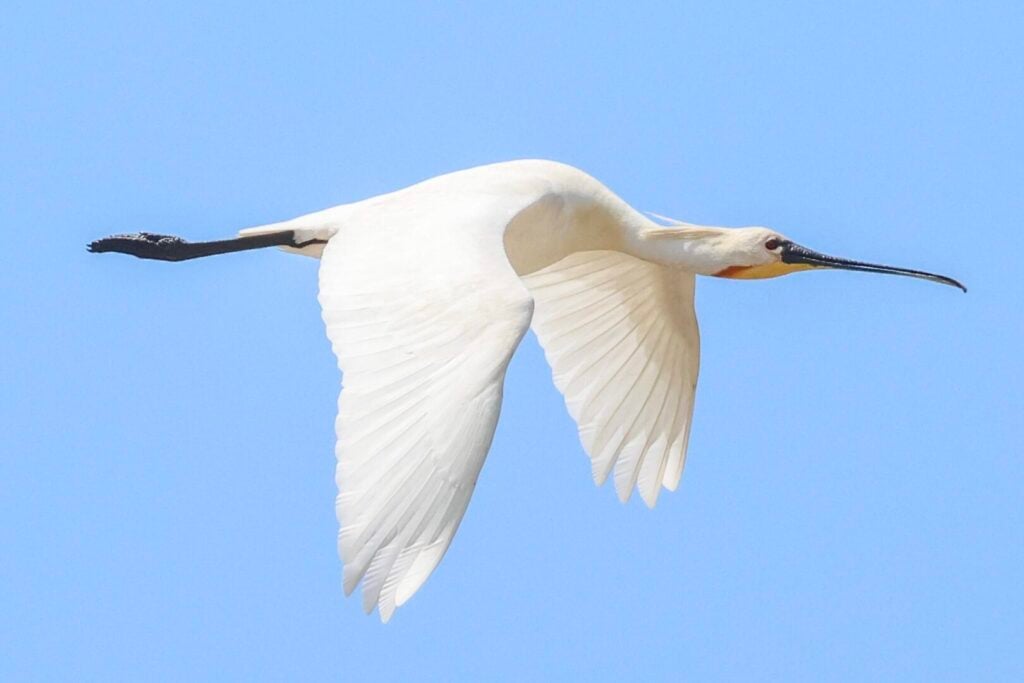
We continued on along the Sulina channel then turned off into the Caraorman Canal. There were more birds along here – a White Stork on the bank, egrets, herons, Glossy Ibis and a Spoonbill in the shallow margins, another small feeding group of White Pelicans, a Spoonbill and a female Ferruginous Duck. A couple of Rollers were perched on the bushes or flew past and a we picked up a distant Red-footed Falcon hovering.
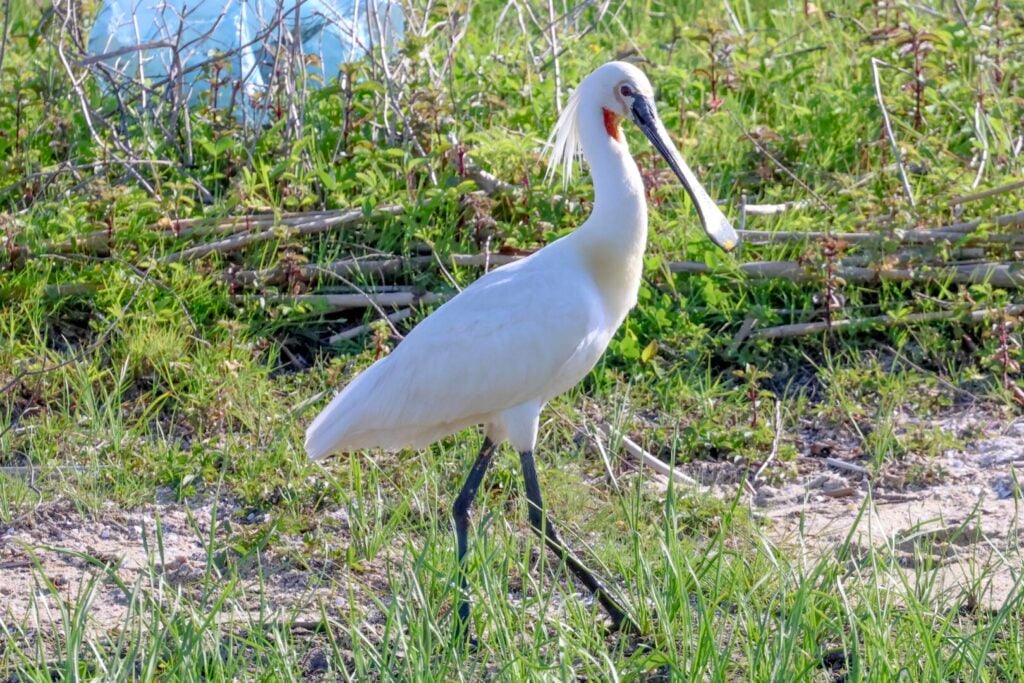
After a while, the convoy stopped and the boatmen moored the floating hotel against the bank. We met again on deck at 5pm. An Eastern Olivaceous Warbler was calling in the bushes alongside but refused to come out. We boarded the small boat again and set off back up the Caraorman Canal. Just a short way, and we turned off again into the Litcov Channel, where a lone Spoonbill was feeding on the corner.
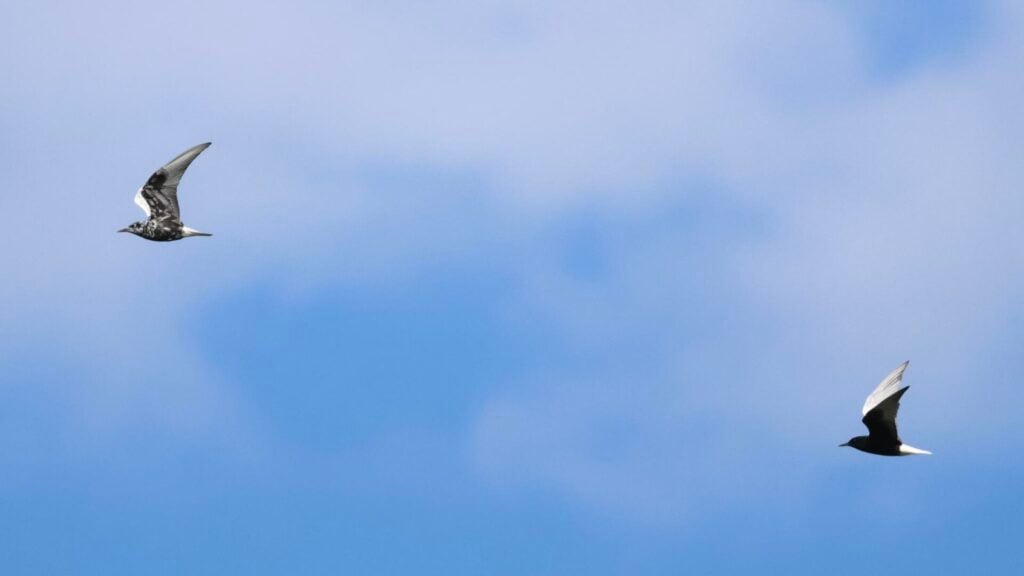
There wasn’t much along the margins of the channel today but as we cut in through the reeds, four White-winged Black Terns flew over. Three were mostly in their smart black and white breeding plumage but the fourth was still in non-breeding. We came out onto Lake Isac and scanning across we found another White-winged Black Tern and a Black Tern hawking with the Whiskered Terns low out over the water.
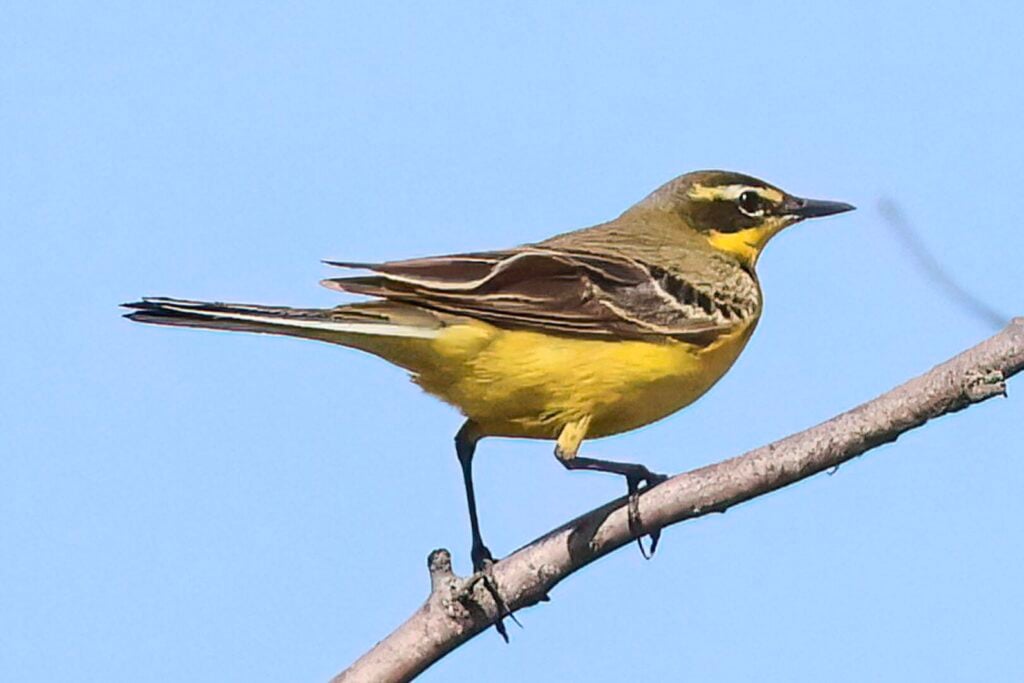
Returning back the way we had come, a Hoopoe flew across Litcov Channel in front of us and landed in the trees on the bank briefly. We then saw a couple more Hoopoes and Rollers which flew past. There were Fire-bellied Toads calling from the marshes and a Yellow Wagtail landed on the edge of the water briefly before disappearing into the vegetation. The Yellow Wagtails here are mostly of the Romanian intergrade form ‘dombrowskii’ and this was a fairly classic individual with a dark head and strong pale supercilium.
We came back out onto the Caraorman Canal but didn’t stay on it long before turning off again, this time along a small channel leading down to Lake Iacob. Several Night Herons flew up out of the base of the trees ahead of us.
Out on the lake, there were groups of loafing White Pelicans, Whiskered Terns hawking over the water, lots of Great Crested Grebes and Ferruginous Ducks and a pair of Garganey. Then we turned around and motored back out again. As we got out onto the Caraorman Canal, we heard a Lesser Spotted Woodpecker calling in the trees but it wouldn’t respond. It wasn’t far to where the flotel was moored and back on board, we had a little time to freshen up before dinner. As we ate, a Thrush Nightingale was singing outside.
Friday 29th May
From up on the top deck of the flotel before breakfast, we could hear a wonderful chorus of song, including Golden Orioles fluting, Eastern Olivaceous Warbler singing, and a Savi’s Warbler reeling. A lone Dalmatian Pelican (as they usually are) swam across the channel further up. Several Glossy Ibis, Squacco and Night Herons, White Stork and a Coot all flew past.
A Lesser Grey Shrike came over our heads, across the channel and landed on top of a willow on the far side. We heard a Grey-headed Woodpecker calling and managed to find it sunning itself on a bare branch on a nearby tree. With all this activity, we had to tear ourselves away to head downstairs for breakfast.
We left at 8.30am on the small boat. As we set off, a Grey Wagtail flew past. Motoring down along the Caraorman canal, we could hear several Great Reed Warblers singing from the reeds on the far side. A small area of shallow water and floating vegetation up by the next junction held several Coot, three Ferruginous Ducks and a Spoonbill feeding with two Glossy Ibis in the taller grass behind.
We turned in and pulled up to the bank ahead. Cristian and the captain put out the gangplank and we all disembarked. Scanning the sky over the endless marshes behind, there were lots of Common Swifts today. A Black Stork circled up with a group of White Pelicans. Walking down along the top of the bank, we heard a Little Crake calling in the reeds. Impossible to see here at this time of year but still nice to hear.
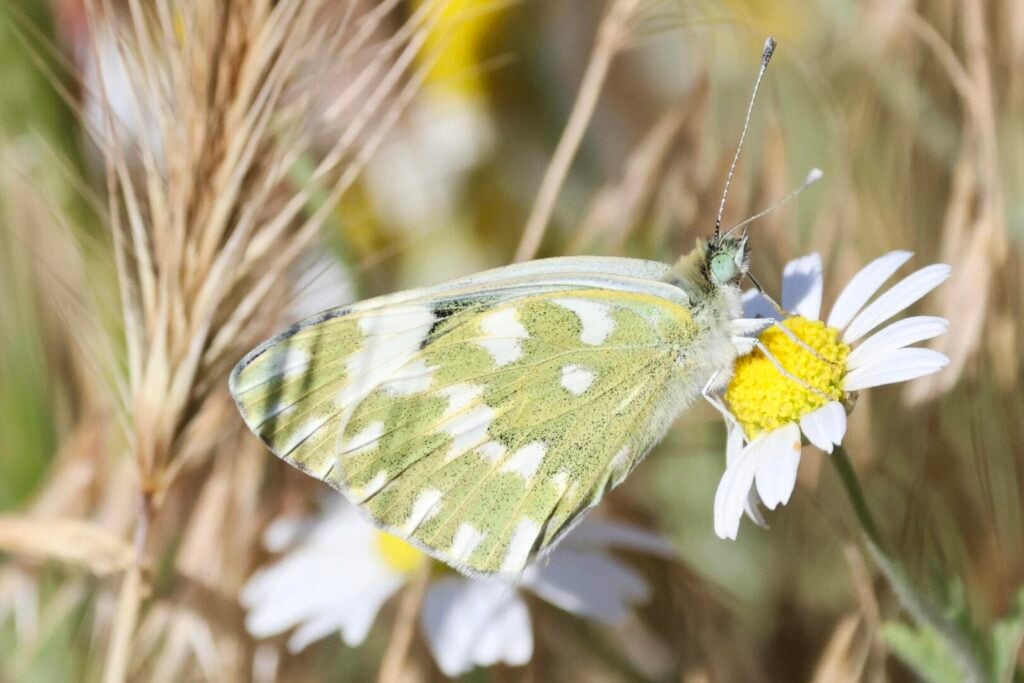
It had been a cool spring and the grass was still greener than normal on the bank, it is usually quite dry by now. It was a bit cooler this morning but we still managed to find a nice selection of butterflies – several Eastern Bath White, Painted Ladys, Small Heaths, a Cardinal basking on a leaf in the sunshine, a Large Skipper, a couple of Brown Argus and few Common Blues.
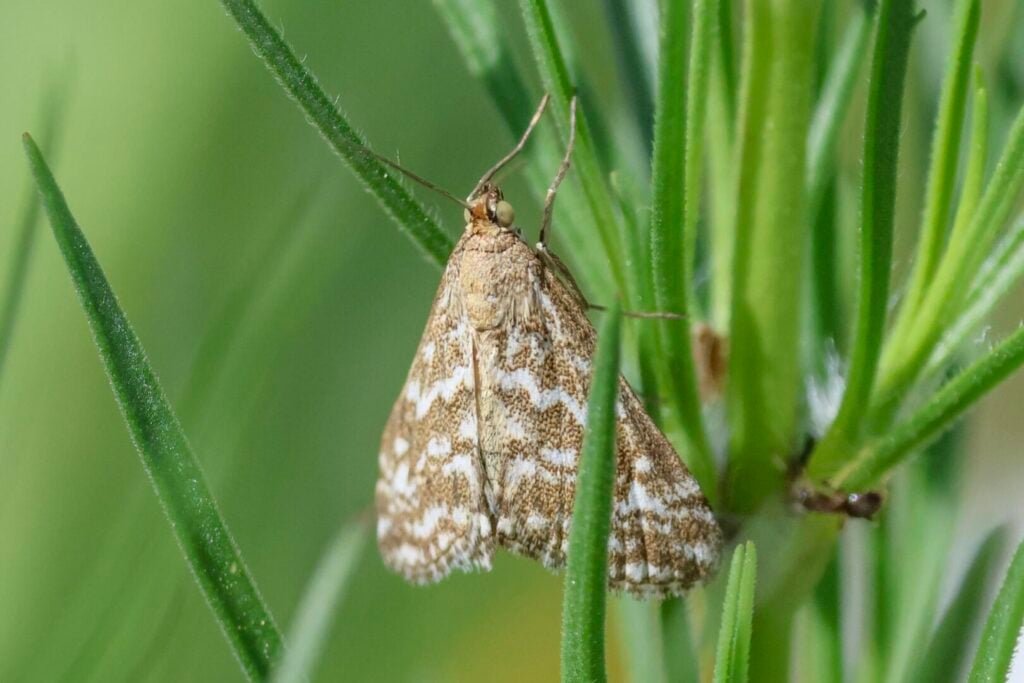
There were some moths too, including a single Synaphe moldavica, a Pyralid species we would see a lot of later in the trip, Thistle Ermine, Tawny Wave, Evergestis frumentalis and Clytie syriaca.
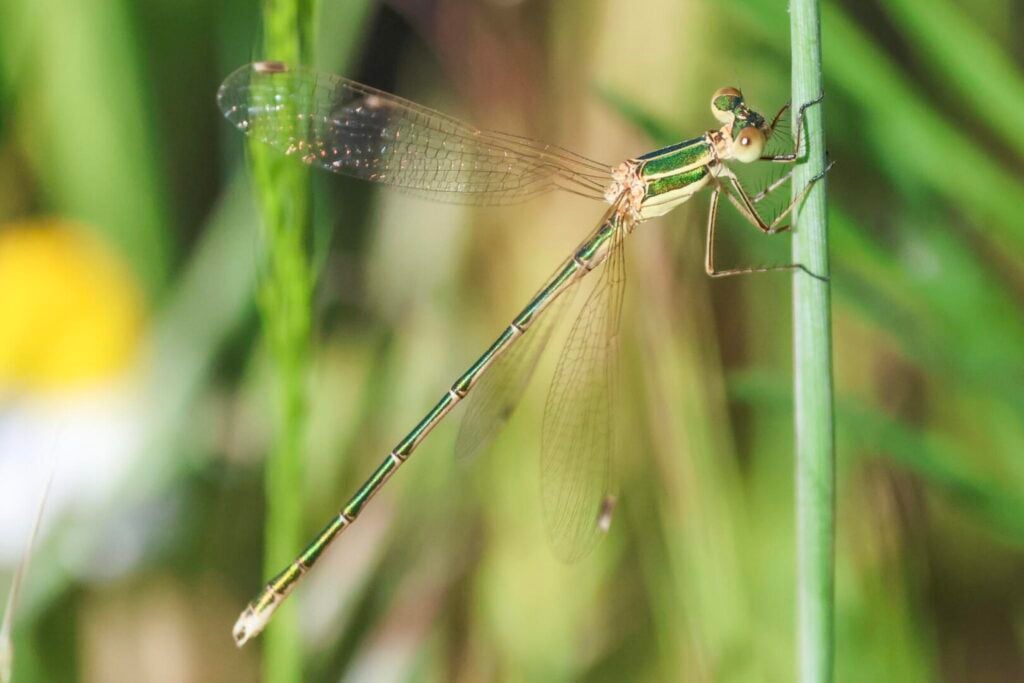
And a few dragonflies – a couple of Lesser Emperors trying to warm up in the grass, several Black-tailed Skimmers and lots of Scarlet Darters,
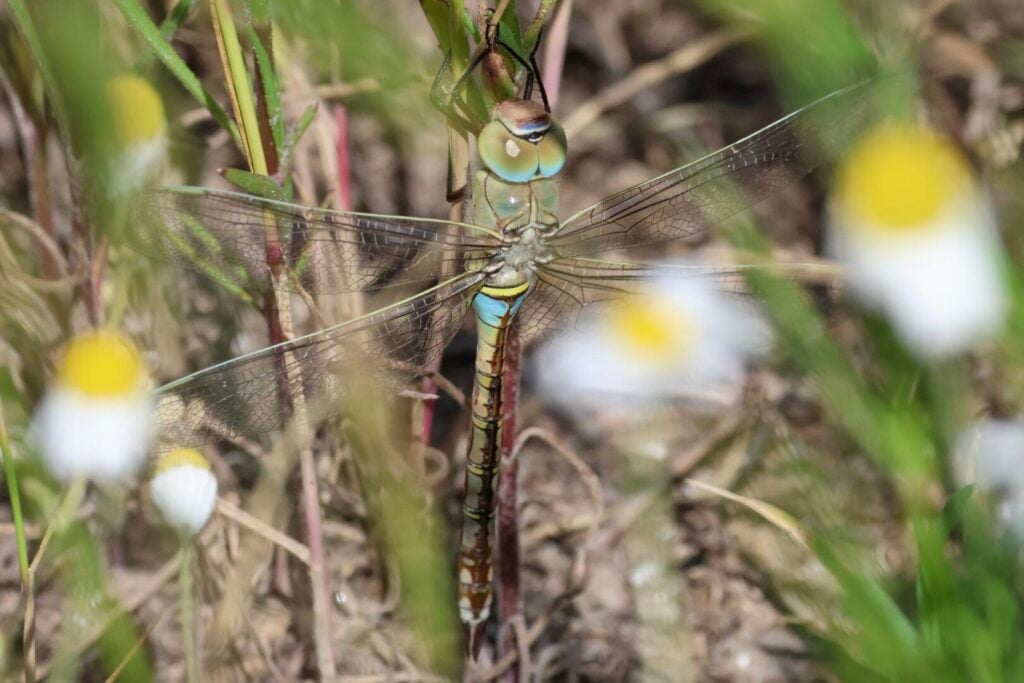
…plus Southern Emerald and Blue-tailed Damselfly.
Scanning the pools in the reeds, we found several Red-necked Grebes and eventually got good views, plus a pair of Red-crested Pochard, as well as Ferruginous Ducks and lots of Coot. One of the group had a Bittern fly across over the back. A Yellow Wagtail flew across and landed in a tree on the bank.
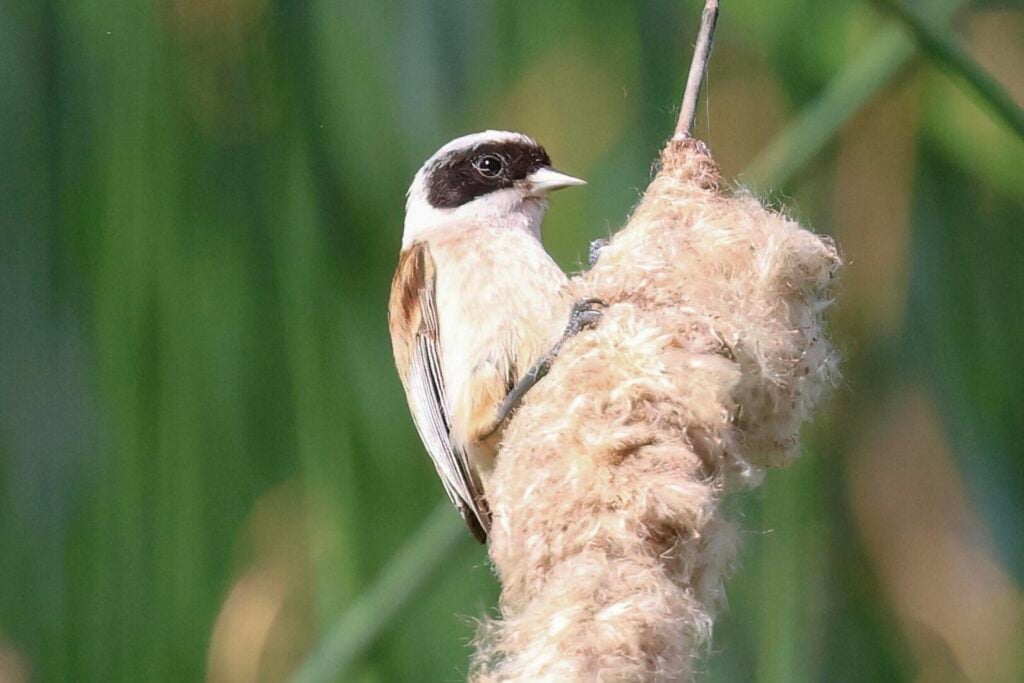
An Eastern Olivaceous Warbler was singing in the oleander bushes but proved typically tricky to see well. A Reed Warbler was singing in the reeds behind and two more flicked in and out between the bushes and the reeds. We found a couple of Penduline Tits in the bushes too, one of which eventually gave great views on a bulrush head right in front of us.
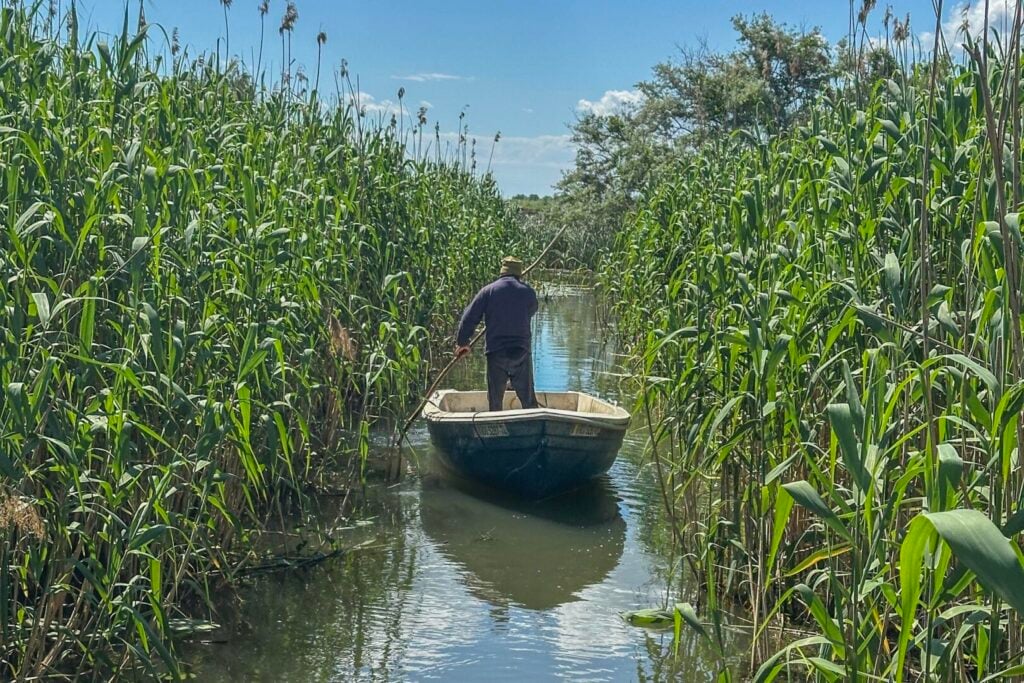
The captain had moved the boat further down so we walked on and back up the gangplank. As we motored on down the narrow channel flanked by reeds, one of the group casually asked what would happen if we met someone coming the other way. There is normally no one here, but of course we then found a smaller boat heading towards us. As we were bigger, he had to punt himself back to where the channel was a bit wider.
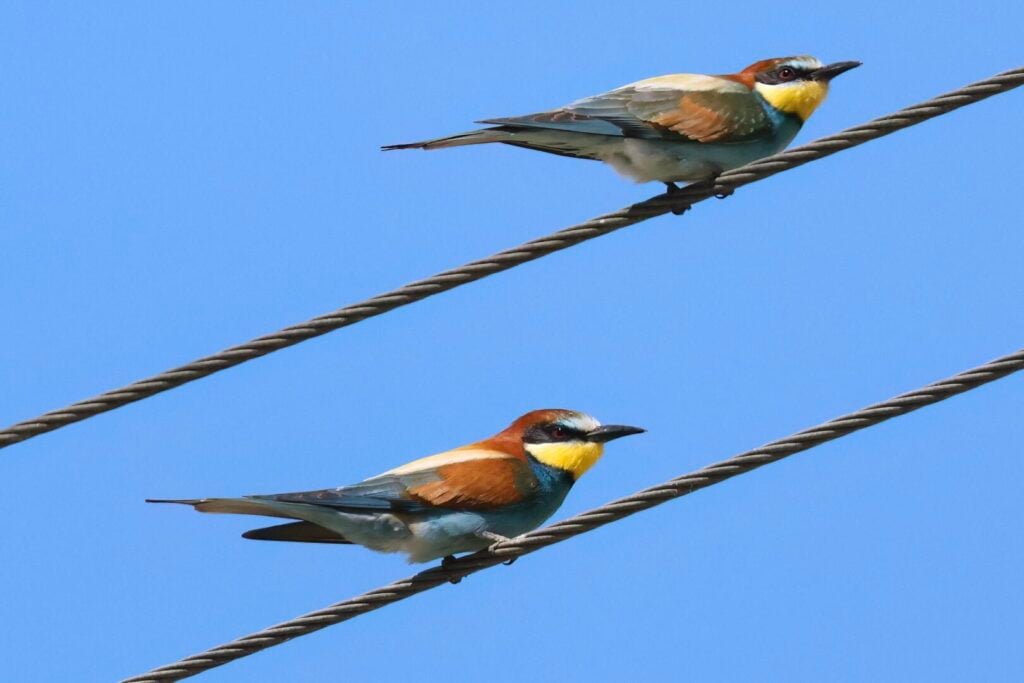
Further down, there are some nice sandy banks at the junction of the channels and several Bee-eaters were flying round, landing in the bushes on the bank and on the wires above us. Unsurprisingly, there were Sand Martins in and out of the banks too. Time for coffee and biscuits.
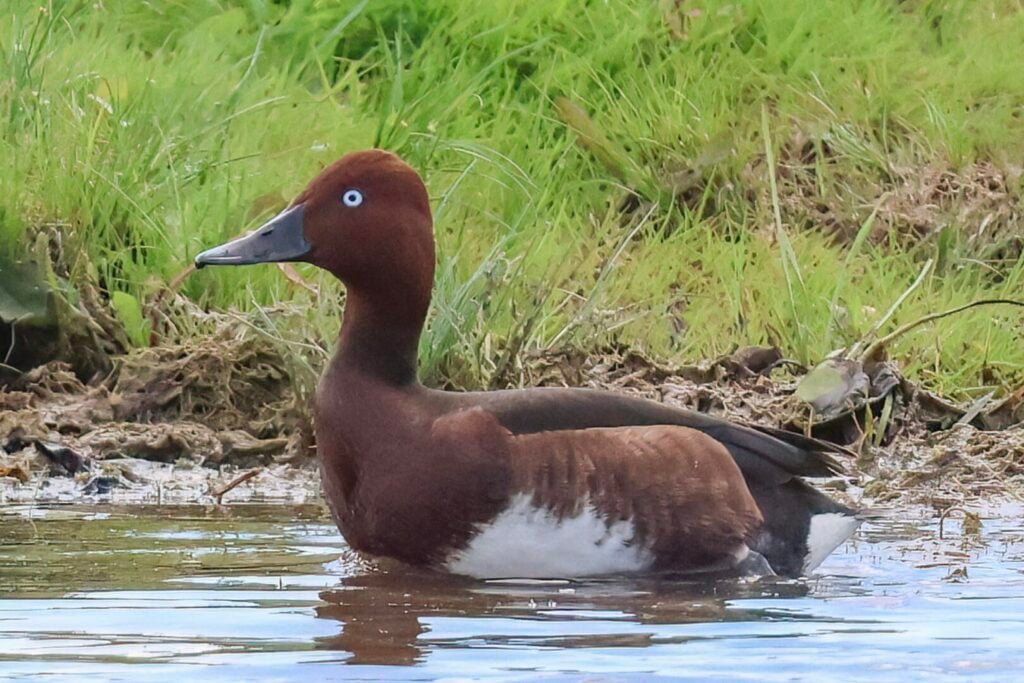
Back out onto the much wider Caraorman Canal, there were more White Storks on the banks here and several Ferruginous Ducks in the shallows.
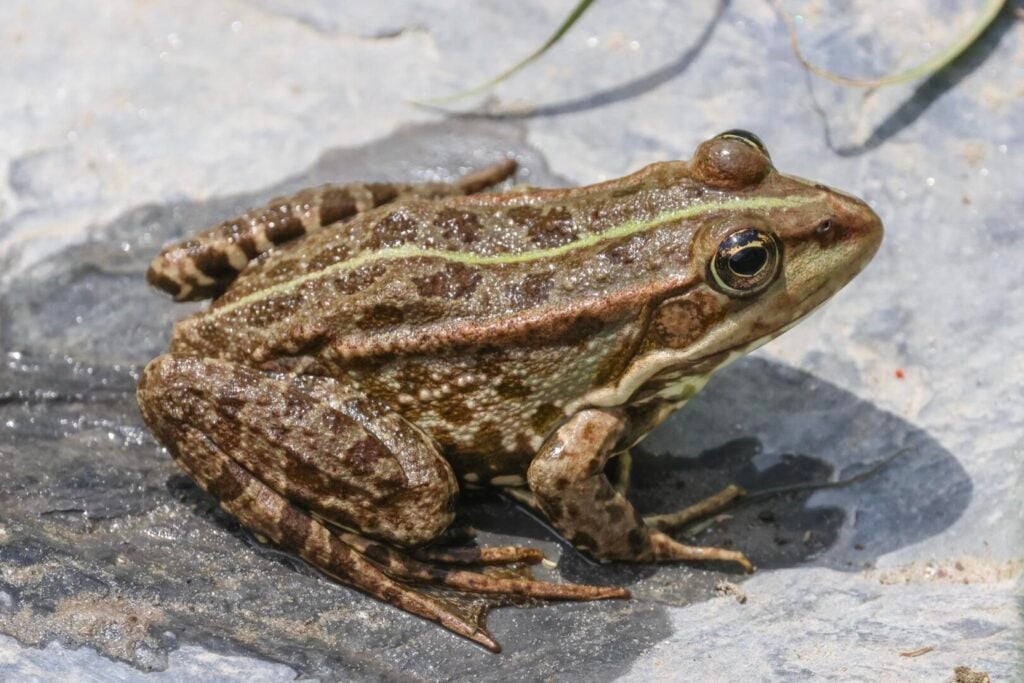
We motored down to the end, with the imposing ruins of the communist-era glass factory ahead of us, tied up at the dock and disembarked for a walk on the edge of Caraorman village. There were a few Pelophylax frogs on the rocks in a small pool on the bank.
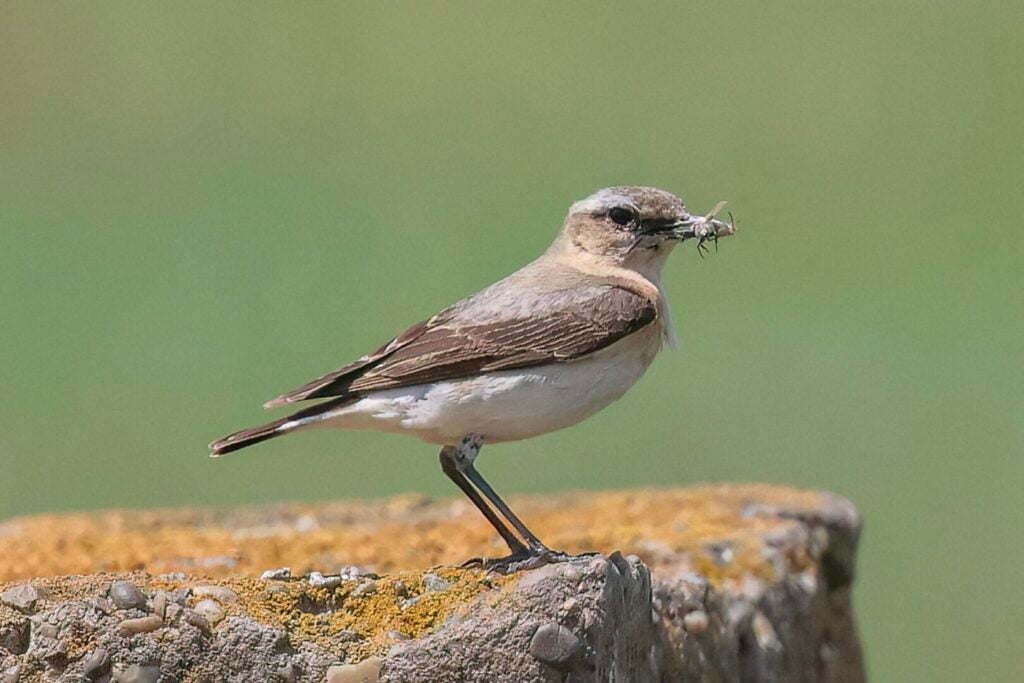
A single Glossy Ibis and three Spoonbills were feeding on the larger pools just behind. Another White Stork was walking in the grass and we could see several Stork nests on various telegraph posts over towards the village. There were some distant Red-footed Falcons on the wires further down and we got the closest male in the scope. A female Northern Wheatear landed on a large pipe by the track behind us and a male flew across behind her.
We walked across the road and through the old factory ruins, with their weird, post-apocalyptic feel. A Roller was displaying, flying across and tumbling, and two were perched on the wires. A Syrian Woodpecker flew over but disappeared away over the village and we lost sight of it behind some trees. Looking back, a Little Owl appeared in the window opening of one of the huge old accommodation blocks.
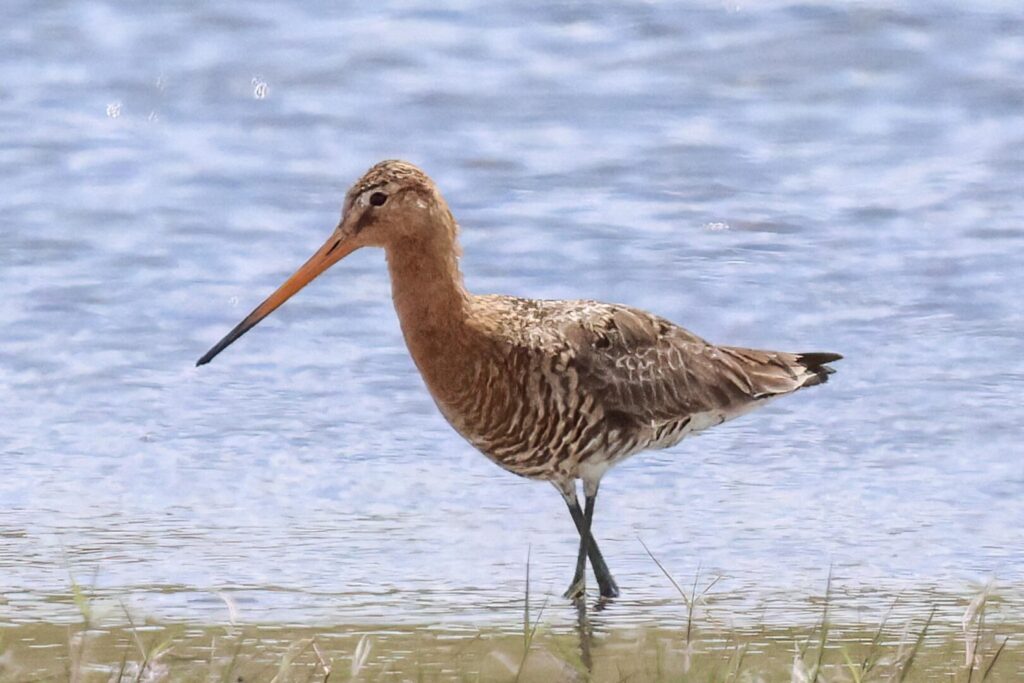
Out to the pools behind, there were only one or two Black-winged Stilts and a couple of Avocets on here this year, but we did find five Black-tailed Godwits. With four of them in full breeding plumage, presumably they were failed breeders already on their journey back south. A Common Shelduck flew over and we could see more on the marshes further back. Several Bee-eaters flew in and out of their holes on the bank beyond.
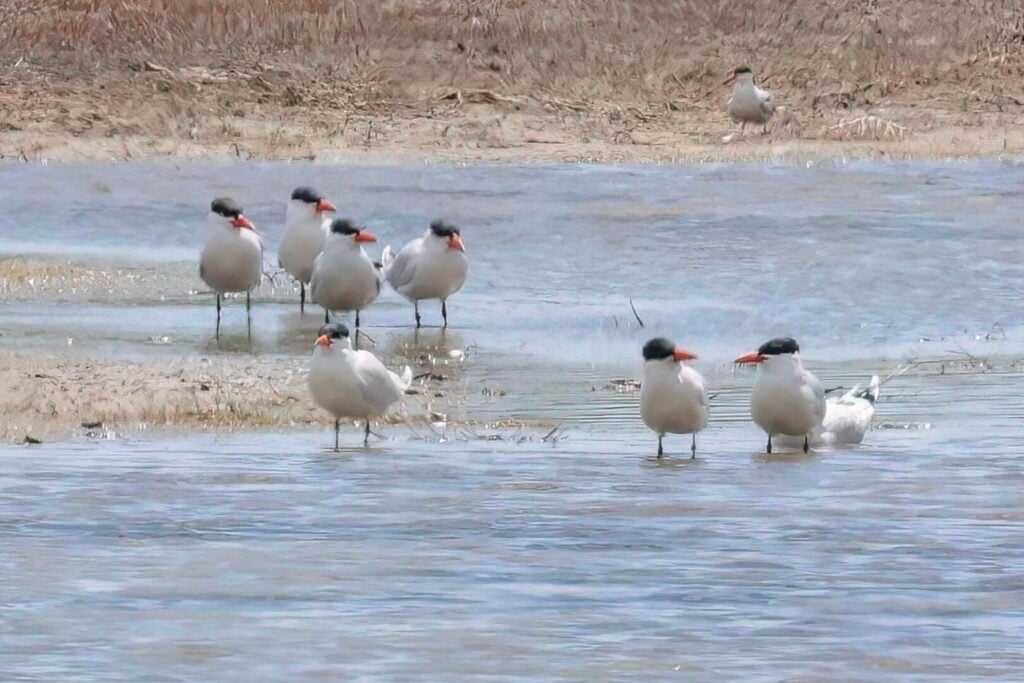
We walked on and climbed up onto the top of the bank to check the pools inside. There was more water this year, probably why there were more Stilts and Avocets on here. Lots of pairs of Common Terns were scattered round and a group of eight Caspian Terns was loafing in the shallow water.
Four Little Stints were feeding on the mud nearby. Two Ruddy Shelduck were on the short grass in the middle along with several Collared Pratincoles, which we got in the scope. We could see a very dark cloud approaching but thankfully it just missed us as we had nowhere to hide out here.
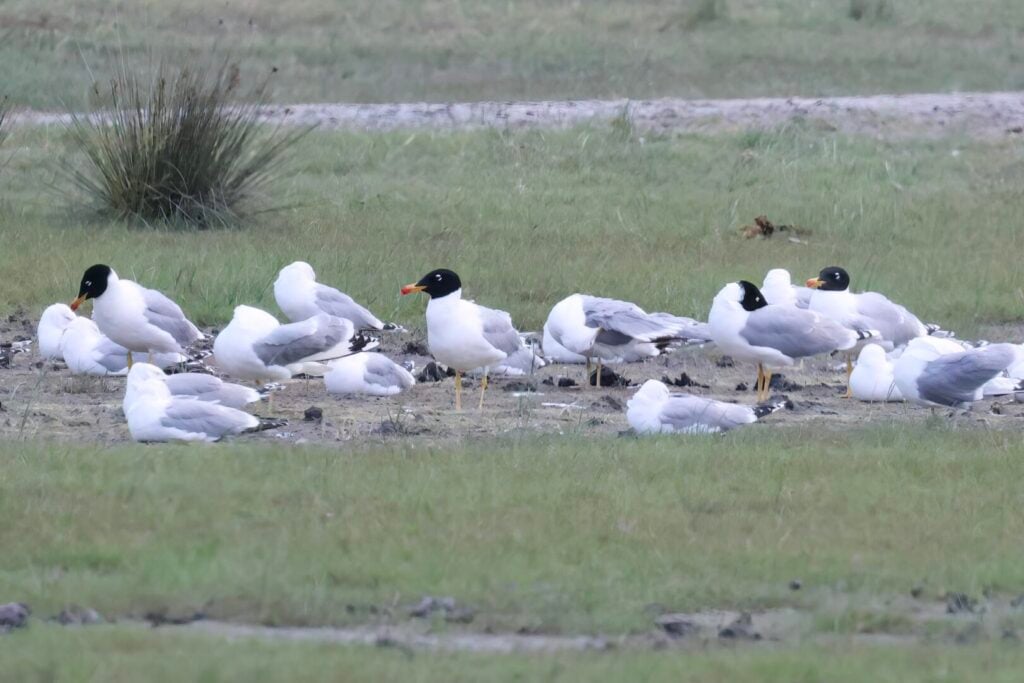
Down off the bank, so as not to disturb the terns, we walked further up to the corner. Looking round the edge of the bank carefully, we found a group of gulls loafing on the grass behind. They were mainly Caspian Gulls but in with them were six smart adult Pallas’s Gulls, in breeding plumage with black hoods. Most were asleep but a couple were awake and preening. A single Caspian Tern was with them too.
After a good look at the Pallas’s Gulls, we walked back the way we had come. A single male Red-footed Falcon had come a little closer, so we got it in the scope again. A Roller landed on the wires in front of us.
The female Wheatear was on the pipe again, with food in its bill now. We realised it had a nest in the end of the pipe and was waiting for us to leave before going in. We walked back to the dock, where the small boat was still waiting for us.
Motoring back up the wide canal, we could see more dark clouds and heavy showers either side. The flotel was still moored where we had left it earlier and, when we got back, it was time for lunch. A particularly threatening dark cloud was heading straight for us now and we heard rumbles of thunder. It did rain now but thankfully we were already back in the dry, and it didn’t last long. By the time we had finished lunch, it had brightened up again.
Afterwards, there was time for a short rest, some downtime or to scan from the deck. A Golden Oriole and a rufous (or hepatic) phase female Cuckoo flew past and we could see a distant White-tailed Eagle circling out over the marshes. The Eastern Olivaceous Warbler was still singing in the bushes, and the Thrush Nightingale started up again briefly.
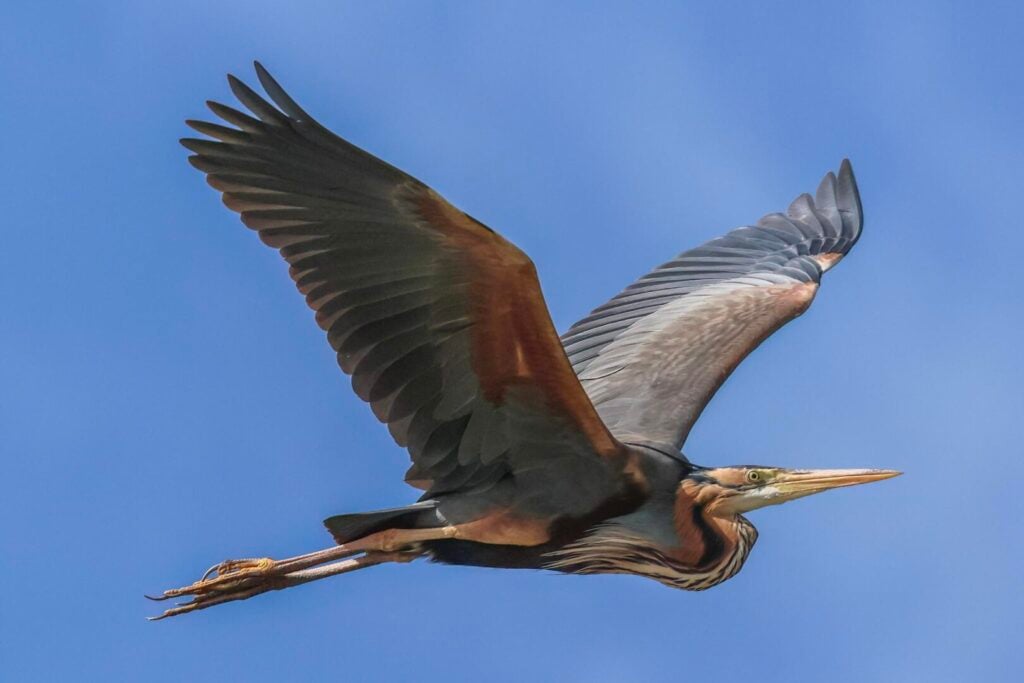
We set off in convoy at 4pm, the tug towing the flotel. Up on the top deck, the wind had picked up noticeably after the rain and it felt cooler. A Hobby flew away over the trees and we picked up a male Red-backed Shrike in the bushes on the bank. Two Red-necked Grebes were on a lake just behind and the usual herons, egrets and ibises were feeding on the edges of the channel. A Purple Heron flew up from the reeds.
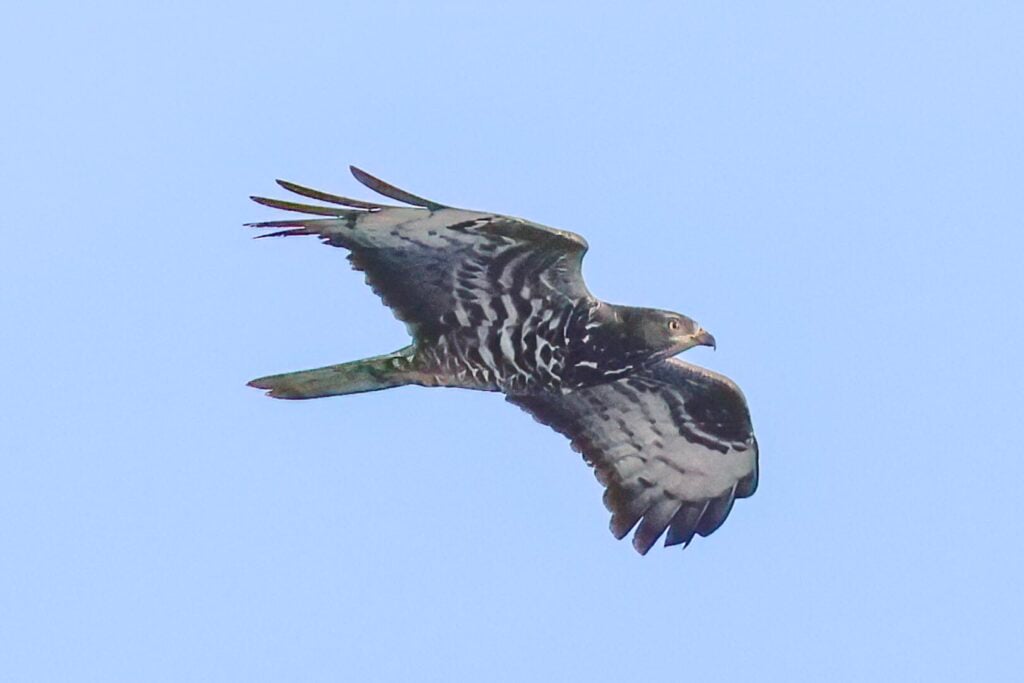
At the top end, we turned onto the wide Sulina branch of the Danube. Lots of Swallows and Martins were hawking low over the water. We could see several Hobbys and Marsh Harriers as we passed by, Bee-eaters and Rollers, and Red-footed Falcons hovering out over the fields. A Honey Buzzard came up over the trees on the bank and drifted past. Scanning the gulls ahead, they were all Caspian Gulls but then a single Pallas’s Gull flew up from behind and overtook us.
After another hour or so, we turned onto the Old Danube channel and further up we eventually arrived at our mooring for the night. The boatmen tied up the flotel on the edge of the reeds. Looking out from the top deck here, there is an impressive view, looking out over the largest compact reedbed in the world. The reeds seem to stretch on forever.
A stark contrast with the agricultural area the other side, drained in the Communist era. The crops look pretty poor quality but apparently the EU subsidies for farming in the middle of a biosphere reserve, with limited chemical inputs, are particularly generous! After a short break, it was time for dinner and the list, before retiring.
Saturday 30th May
It was cloudy and rather cool first thing this morning. From up on the top deck of the flotel before breakfast, looking out across the vast reedbed, we could hear several Great Reed Warblers singing and one perched up prominently on a reed stem. As usual, there was no shortage of Cuckoos, with five on view at the same time at one point. A Hoopoe flew in and a Great Tit sang from the top of a large willow. We couldn’t hear any Savi’s Warblers from here this morning though.
After breakfast, we left on the small boat again. It wasn’t long before we felt the first spits of rain but thankfully it would largely hold off for a while yet. A pair of Rollers perched above us on some dead branches as we drifted underneath. Three Golden Orioles chased repeatedly through the willows ahead of us, two males after a female. Occasionally one landed briefly in view but never long enough for us to get closer to it. A rufous morph female Cuckoo flew across in front of us.
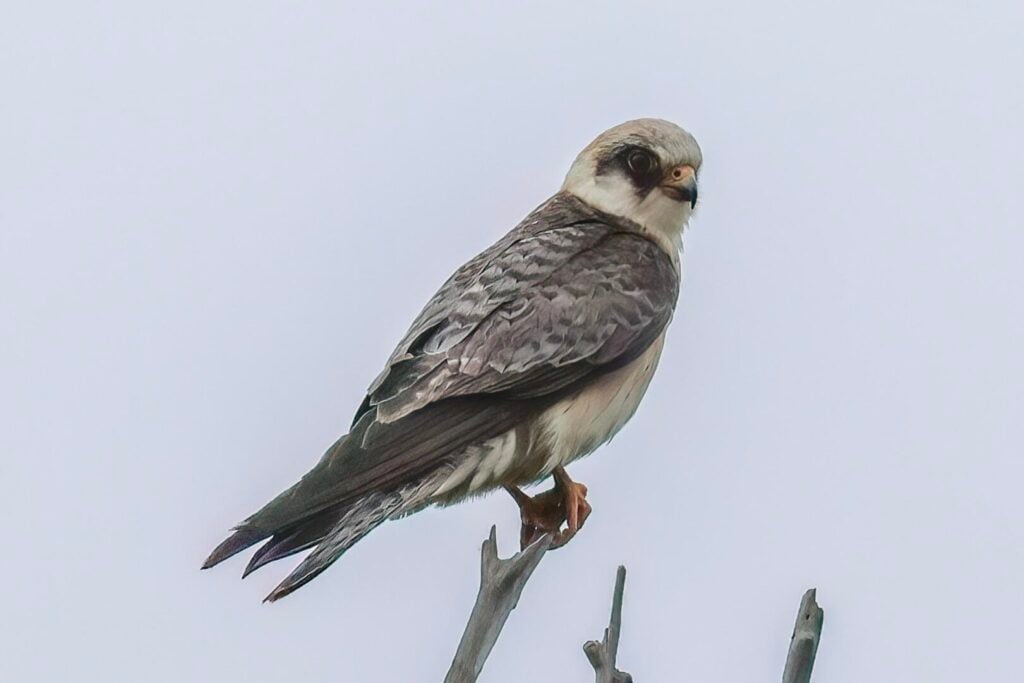
A female Red-footed Falcon was preening in the top of a willow, and just beyond we found the male perched by an old Hooded Crow nest. The Red-footed Falcons will presumably use it now. In the reeds along the channel here, we did finally hear a few Savi’s Warblers. We managed to find one perched halfway up a reed stem in view, but we were looking through lots of reeds in front so it wasn’t easy to get onto.
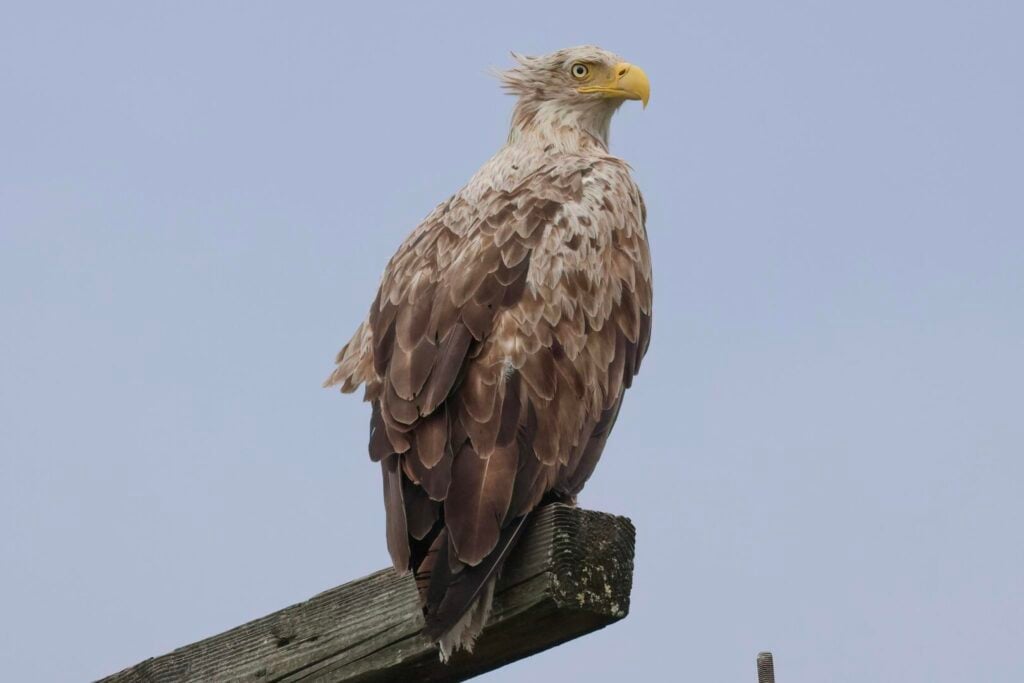
A small group of White Pelicans were feeding in the channel ahead of us and, as we drifted up, two or three Purple Herons flew out from the reeds on the edge. From some way off, we could see the adult White-tailed Eagle perched on the top of the old tower hide platform on the bank, a Magpie perched watching it just out of reach at first. We motored up and then the captain cut the engine and we drifted into the bank right below it, before it finally took off.
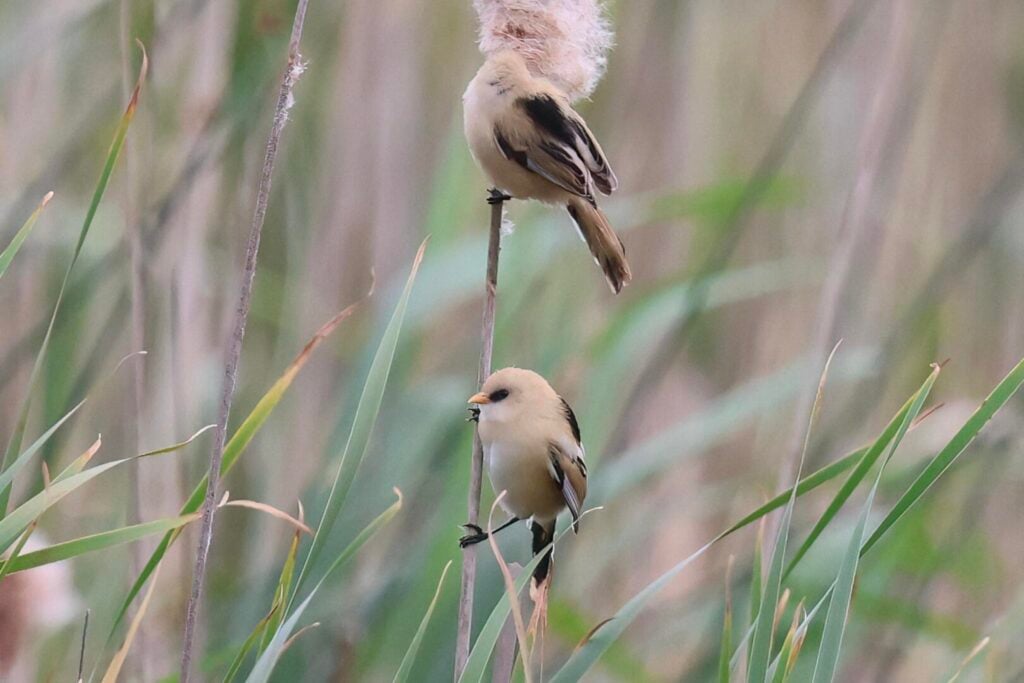
Just beyond, we could hear Bearded Tits calling and managed to find several juveniles which came up out of the reeds. Two juveniles perched up on a bulrush stem. We heard several Penduline Tits in the willows along here too, one of which showed nicely. A Sedge Warbler was singing in one of the more open areas. Several Reed Buntings flew back and forth low over the water ahead of us.
When we arrived at Letea, we pulled up to the shore and the gangplank was deployed. As we got off the boat, a Golden Oriole was fluting in the trees nearby and catcalling. It seemed to answer our attempted whistles but still would not show itself. Three Rollers flew over, one tumbling briefly. A Little Owl was perched on the corner of the roof of a nearby building, where it was then joined by a Hoopoe with food in its bill.
We walked over and up onto the top of the bank. A Pheasant was out on the grass between the grazing horses. We stopped to look at a Yellow Wagtail feeding around the horses’ feet. A male with a dark grey head, blackish ear coverts but lacking a pale supercilium, it superficially resembled the Scandinavian subspecies thunbergi, Grey-headed Wagtail.
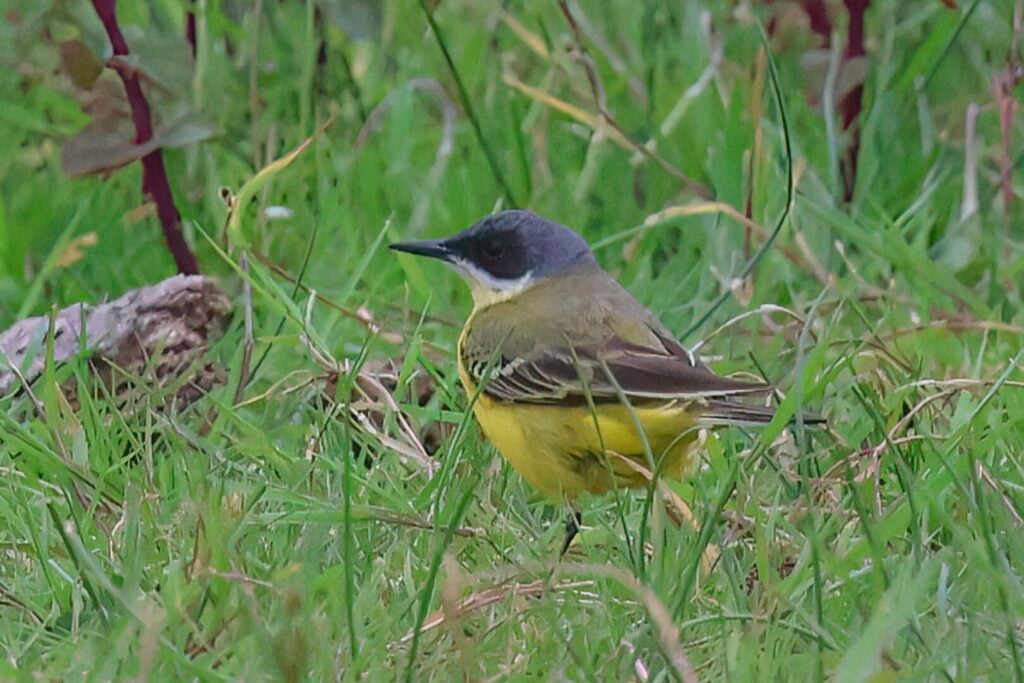
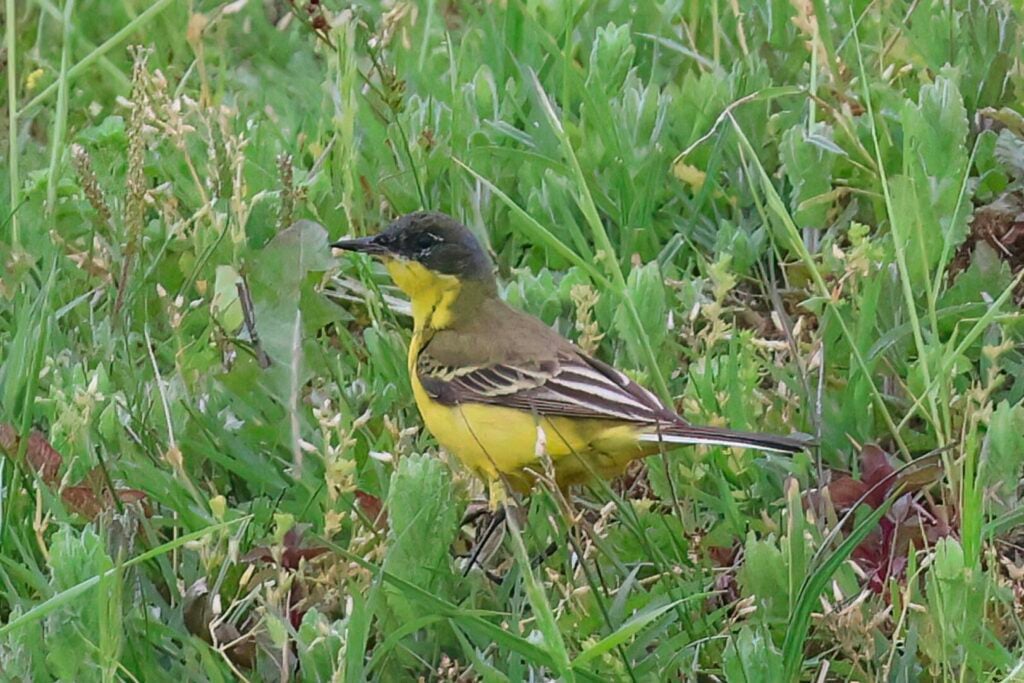
This one had a whitish throat, whereas another similar male a bit further up had a yellow throat. The birds here are all Black-headed Wagtail intergrades, though no two seem to look the same and only some resemble the standard field guide illustration of the local form ‘dombrowski’.
A herd of cows was spread out either side of the bank and we ushered a couple from the top as we walked on. The bull crossed over ahead of us and then started snorting and pawing at the sand with its front hoof. Whether it was really getting angry or just doing it to show off to the herd, we didn’t wait to find out. As it started to come towards us, we backed off and walked down onto the far side of the bank. We continued past out of sight of the bull at the bottom of the bank and then climbed back up to the top just beyond.
It was still spitting with rain, cloudy and cool, and the breeze was starting to pick up. Scanning across the grass we could see lots of Red-footed Falcons standing on the ground, perched on small mounds, cow pats or in the small scattered trees. We counted 26 in view from here, another 40 at least a little further on, grounded by the weather.
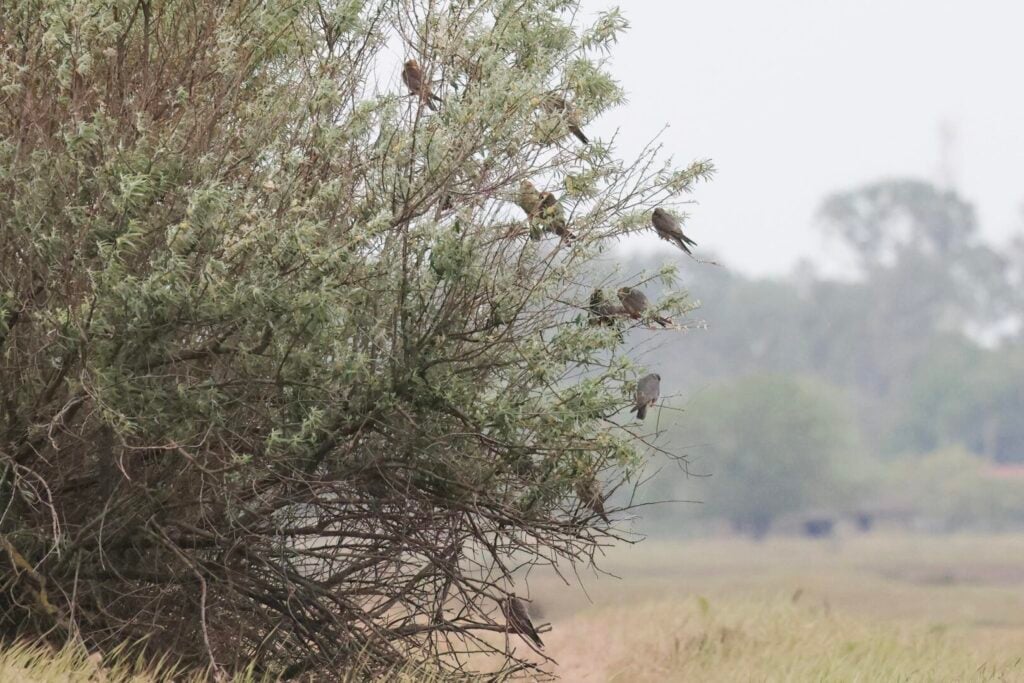
One tree on the bank had 10 Red-footed Falcons on it, all on the same side in the lee of the wind. Occasionally one or two would take off and hover out over the grass. Notably one male flew in and hovered right in front of us on the bank at one point. An amazing sight to see them all gathered like this. We normally see some here but when the weather is fine they are off hunting around the surrounding countryside. A single Black Kite flew past too, pursued at one point by a Hooded Crow.
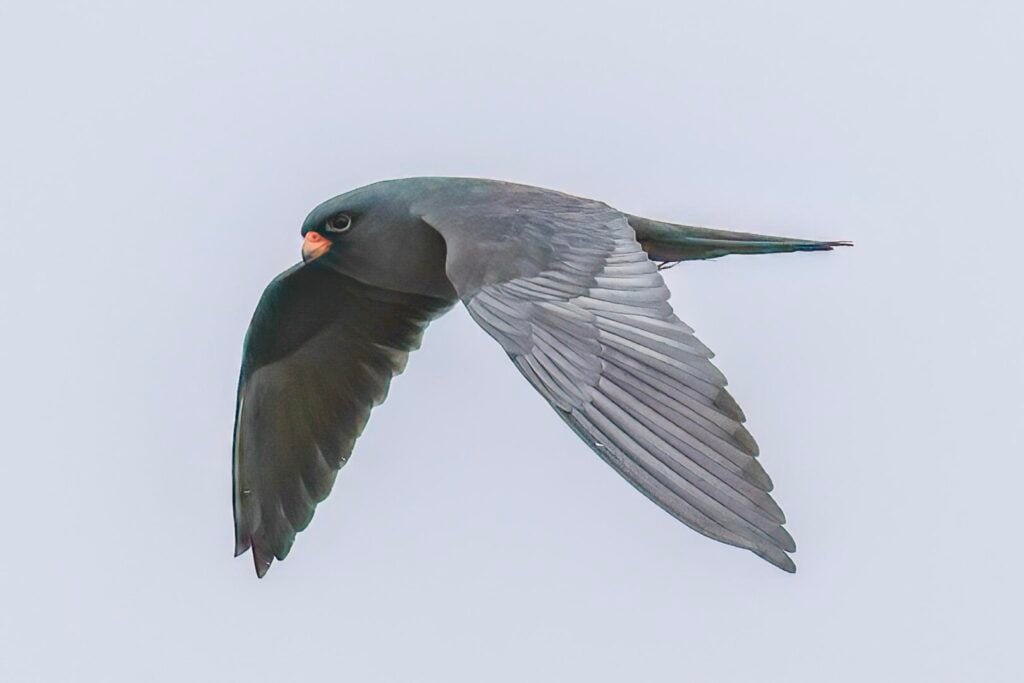
As we walked on along the bank, a group of 33 Little Gulls flew over, all 1st summers. We found another 20 or so on the pools a bit further up.
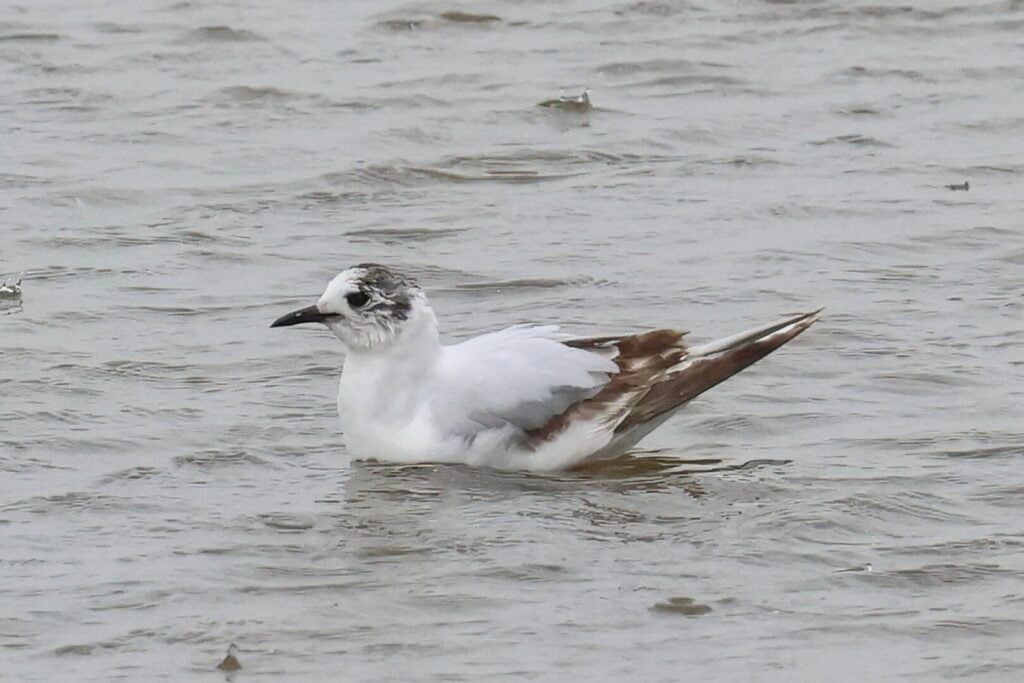
There was a small roost of larger gulls here too, six Caspian Gulls and two Pallas’s Gulls (a single adult and an immature). A lone Curlew was with them. There were lots of Avocets, many with small juveniles, and Black-winged Stilts around the pools, and plenty of Common Shelducks too. We managed to find several Little Ringed Plovers on the muddy islands.
Lots of Collared Pratincoles were scattered around, out on the short grass and dry ground nearby, so we got a couple in the scope for a closer look. Like the Red-footed Falcons, they were staying grounded today with a lack of flying insects. A single Spotted Flycatcher was a surprise to find in the few trees out here.
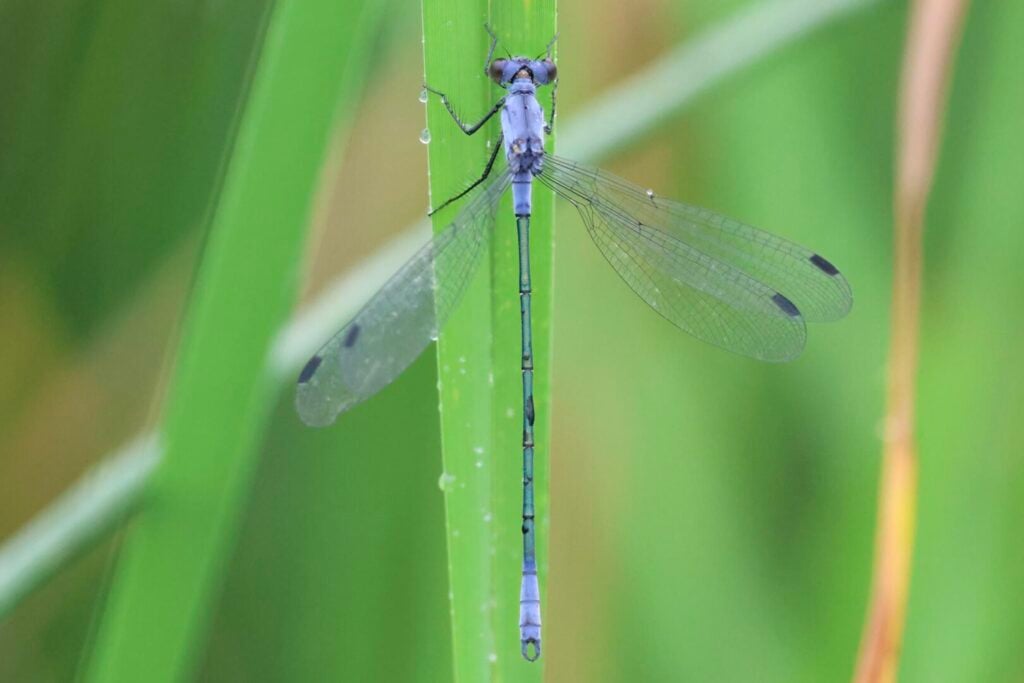
It started to rain more heavily now, so we sheltered behind the trees. While we waited for our transport to come, we had a look in the rushes below the bank on the other side and found lots of Dark Emerald damselflies. A Little Grebe laughed at us from somewhere further out.
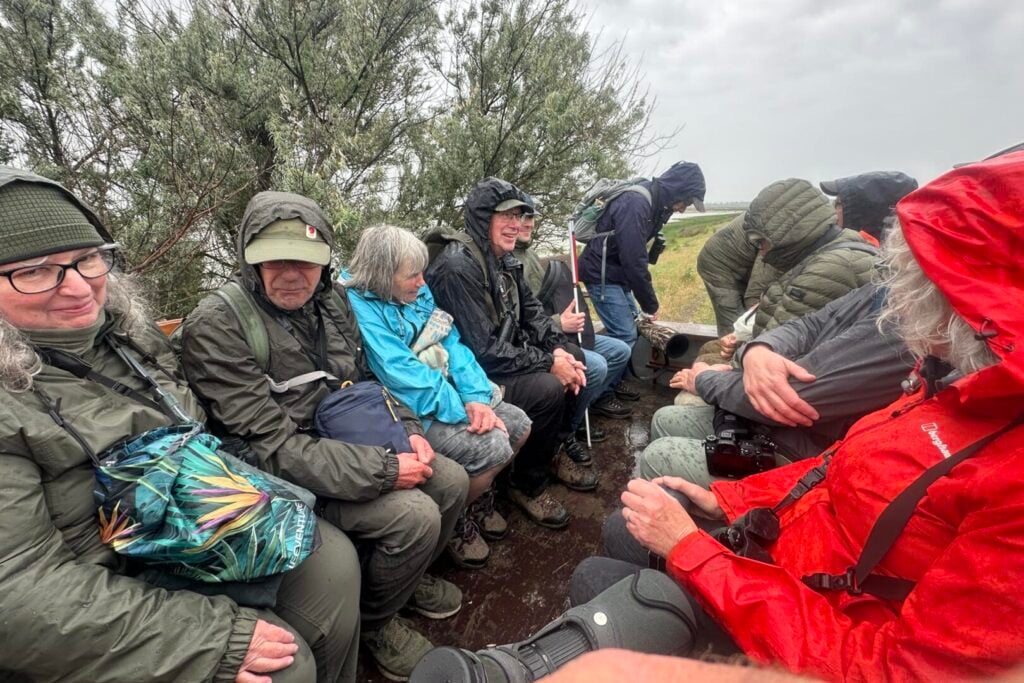
Cristian called and the truck came out to pick us up early. Our usual driver wasn’t available, so we had someone different this year. When it arrived, the back of the truck wasn’t covered so we had to brave the rain but at least it meant we didn’t have to walk all the way back. The truck had come to get us up on the bank, so we didn’t have to walk out round the pools in the rain to where it was flat.
We drove back along the top at first. It was rather bumpy and the truck wasn’t really suited to the task, with no four-wheel drive. When we got to a very sandy area, it was clear we wouldn’t get across. The driver looked like he might try to drive round on the slope but saw better of that idea and drove straight down the slope to the bottom and then round, gunning it back up onto the top the other side of the sand.
Thankfully, we didn’t have to go too much further before he eventually found a way down onto a track on the right side of the bank, back to the village. We would normally get off on the edge of the village and have a walk back to the quay through the houses but for some reason this time no one seemed keen. We were just happy to get back to the boat and out of the rain. Time for coffee and biscuits.
As we motored back along the channel, what was presumably the same pair of Red-footed Falcons we had seen earlier was now perched in a willow looking decidedly damp.
Further on, a Marsh Harrier was standing on a dead branch just above the side of the channel but we were almost upon it before we noticed a second bird perched lower down, just above the water. It took off almost immediately and as it turned we realised it was a Honey Buzzard. We had surprised it and it flew across right in front of the boat, an incredibly close view we could see it in amazing detail. Worth going out in the rain for that alone!
The rain had stopped and as we got back to the Old Danube channel we could see patches of blue sky approaching. Back on board the flotel, the tug hitched up to it and we set off. As we sat down for lunch, the sun came out. Another wonderful meal of soup with meatballs, followed by Romanian ratatouille, then papanași, a traditional dessert of doughnuts made with fresh cheese topped with cream and fruit confit. Delicious, but perhaps not so good for the waistline!
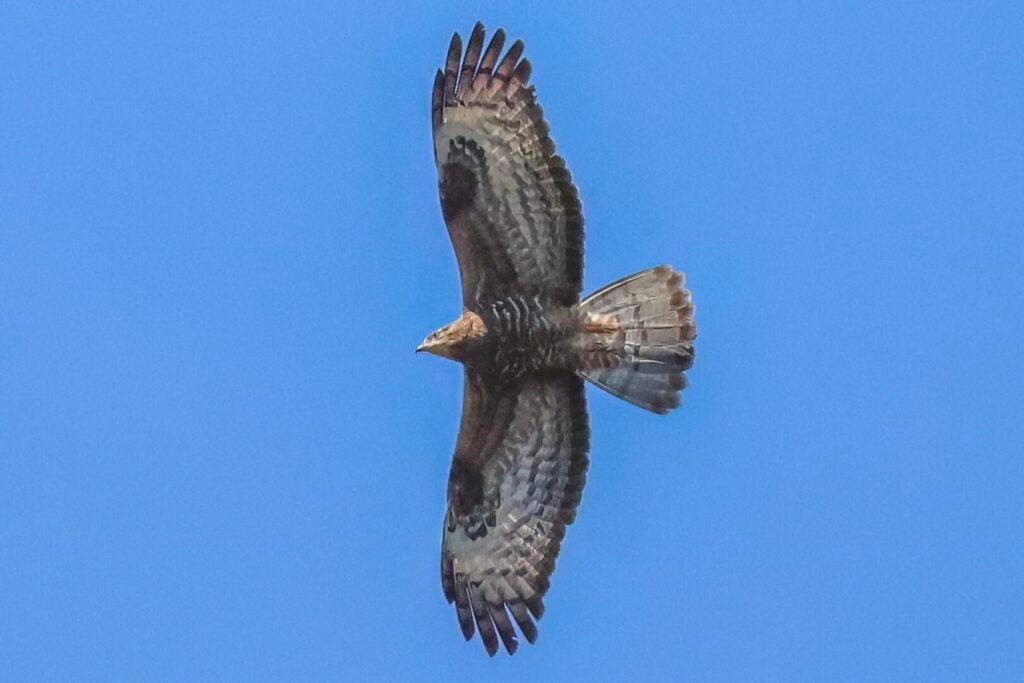
Up on deck afterwards, it was good for raptors now in the sunshine. A Steppe Buzzard drifted over and a White-tailed Eagle circled up mobbed by a Hobby. The Honey Buzzard seemed to follow us for a while and a Lesser Spotted Eagle appeared with it at one point. A Black Kite circled high overhead with a group of White Pelicans. On the bank, a White-tailed Eagle looked particularly striking in a tree in the sun.
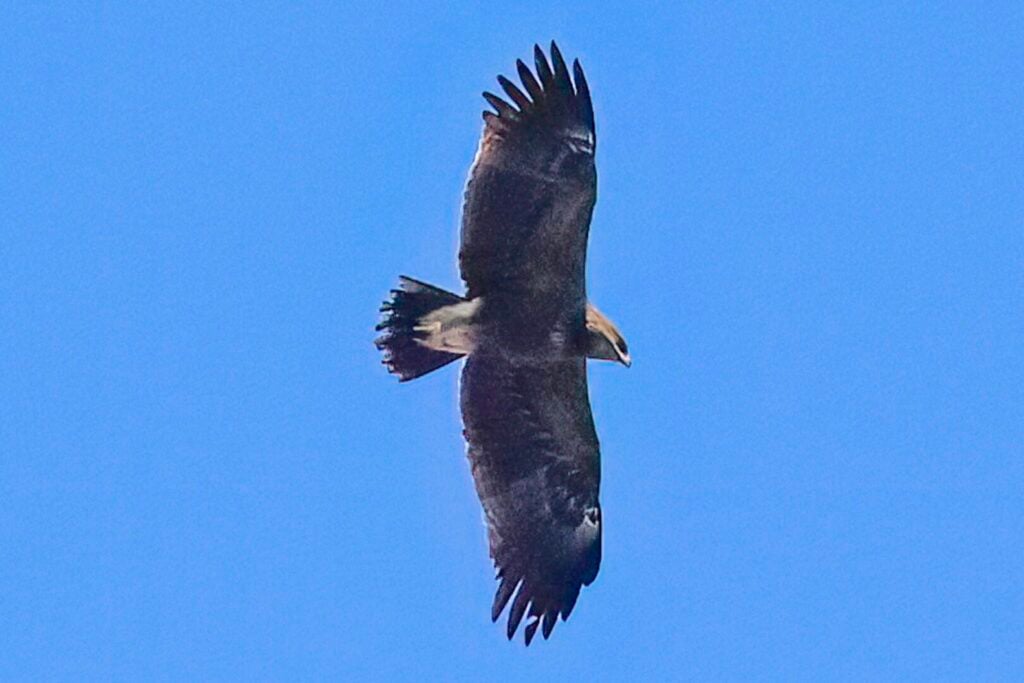
Just when we hoped we had seen the back of the rain, we could see some very ominous dark clouds ahead. More Pelicans looked particularly striking, circling in the sunshine against the black sky behind. The wind picked up too now, a sure sign that rain was coming. We beat a retreat to the dining room and it wasn’t long before it started to rain heavily.
The downpour only lasted for about half an hour, then the sun came out again. Several White Pelicans were loafing on the corner as we turned into Eracle channel.
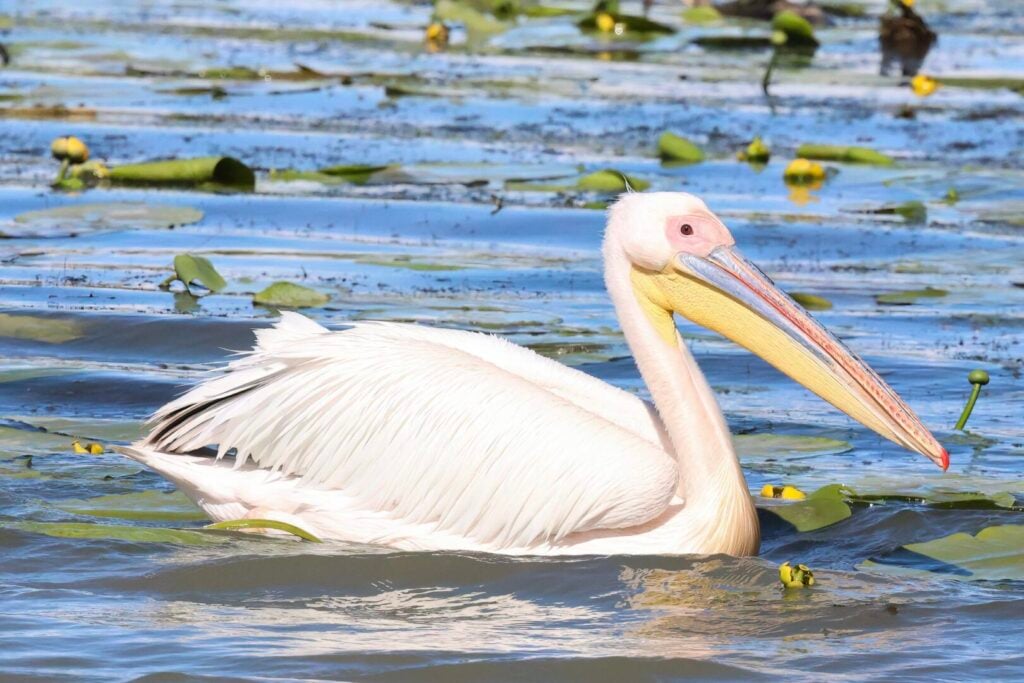
We had planned to leave on the small boat at 4.30pm, but we didn’t get to our mooring for the night until 5pm. Once the flotel had tied up, we set off. Back to blue skies now but the wind had picked up noticeably and the temperature had dropped after the rain. It was decidedly chilly motoring along, we needed extra layers on.
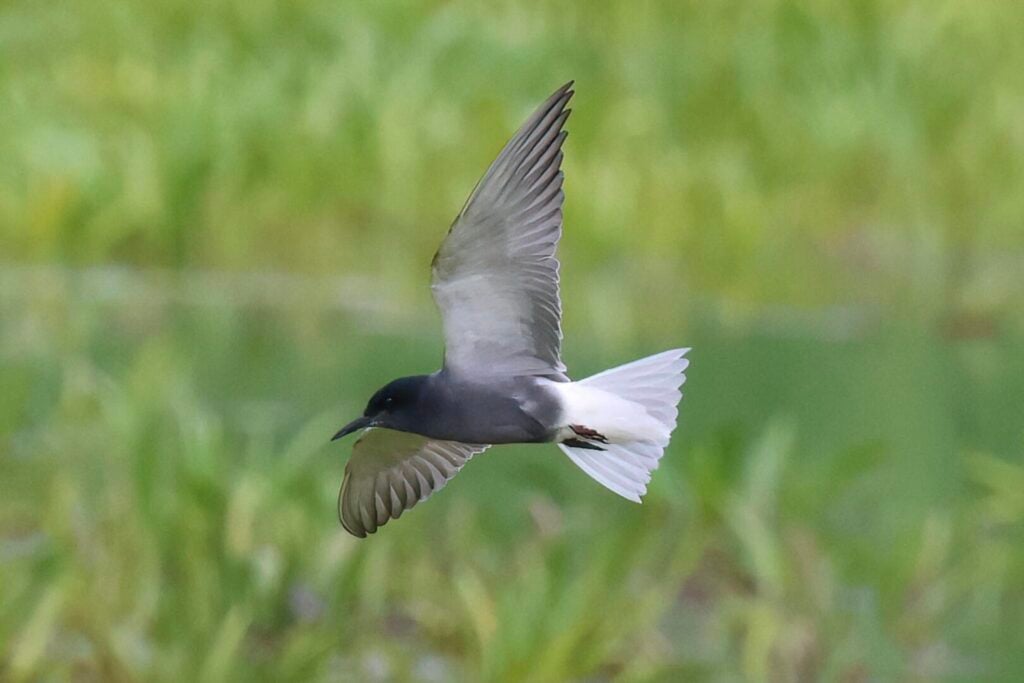
A Purple Heron was lurking in the water soldiers so we could just see its head and neck. A Black Tern flew over, followed by two more. When a Grey-headed Woodpecker called, we turned to see it up in a dead tree just as it saw us and flew off.
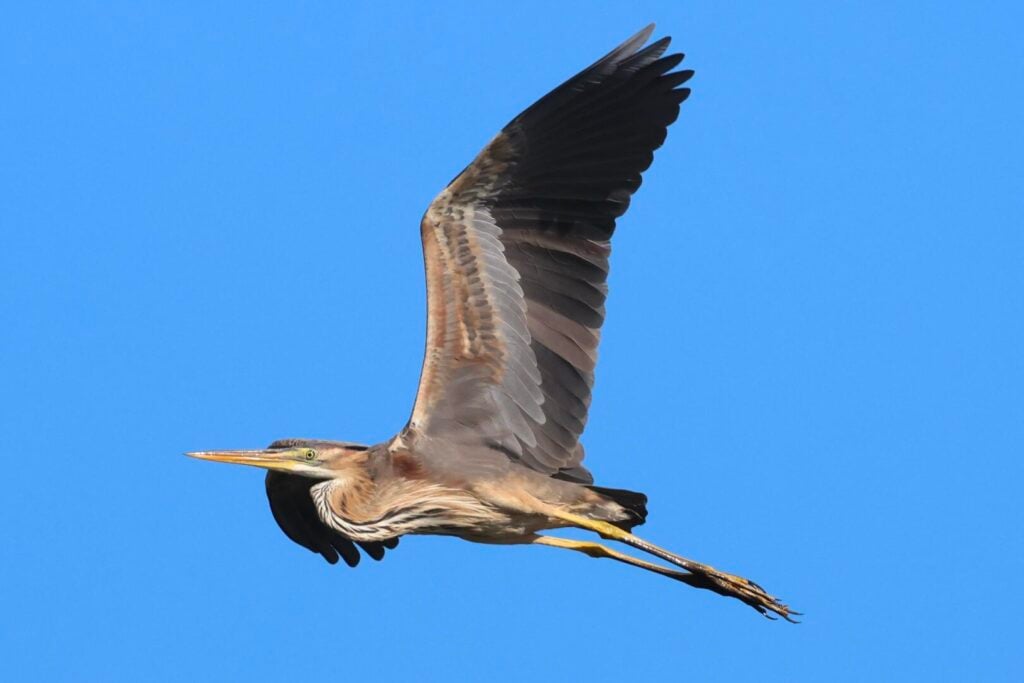
As we turned into the entrance to Trei Iezere lake, we passed several small boats filled with fishermen, beers in hand, even though the fishing season had officially not started yet apparently! There were more Black Terns out in the middle of the lake, along with the commoner Whiskered Terns. A couple of Red-necked Grebes were in the floating vegetation on one side, and a pair of Great Crested Grebes were displaying.
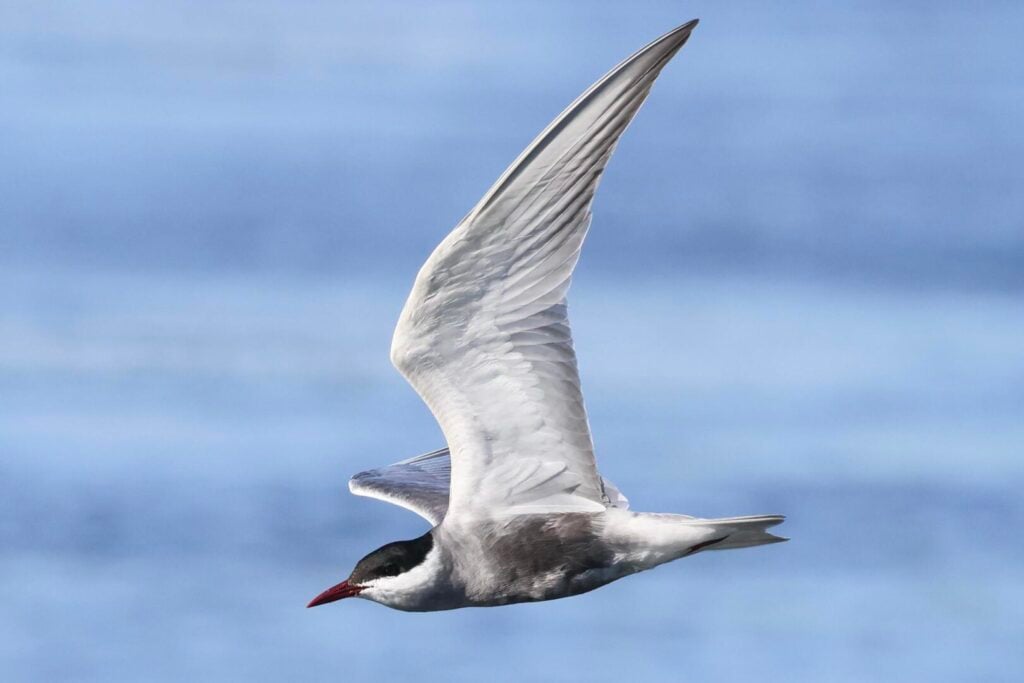
We turned back out on another channel, cutting through in between islands of floating reeds. Stopping at the entrance to a smaller lake, we couldn’t go in because of all the vegetation. Possibly as a consequence, there were several Red-necked Grebes on here, at least two pairs and a lone fifth bird, though they were rather distant. A Whiskered Tern was dip feeding right in front of us, with yet another Black Tern doing the same just behind.
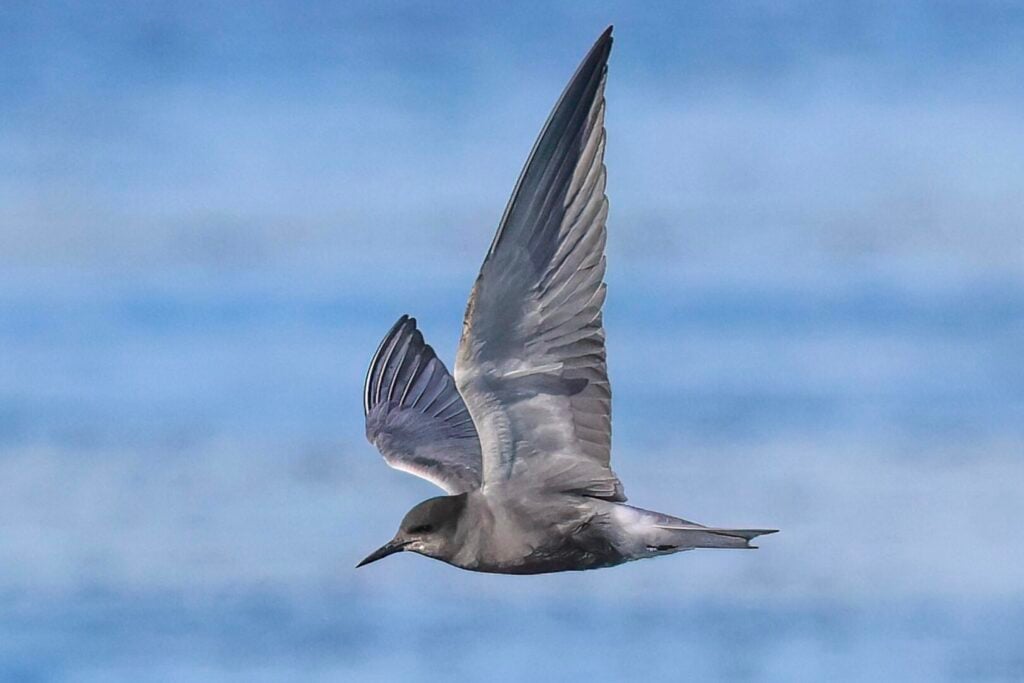
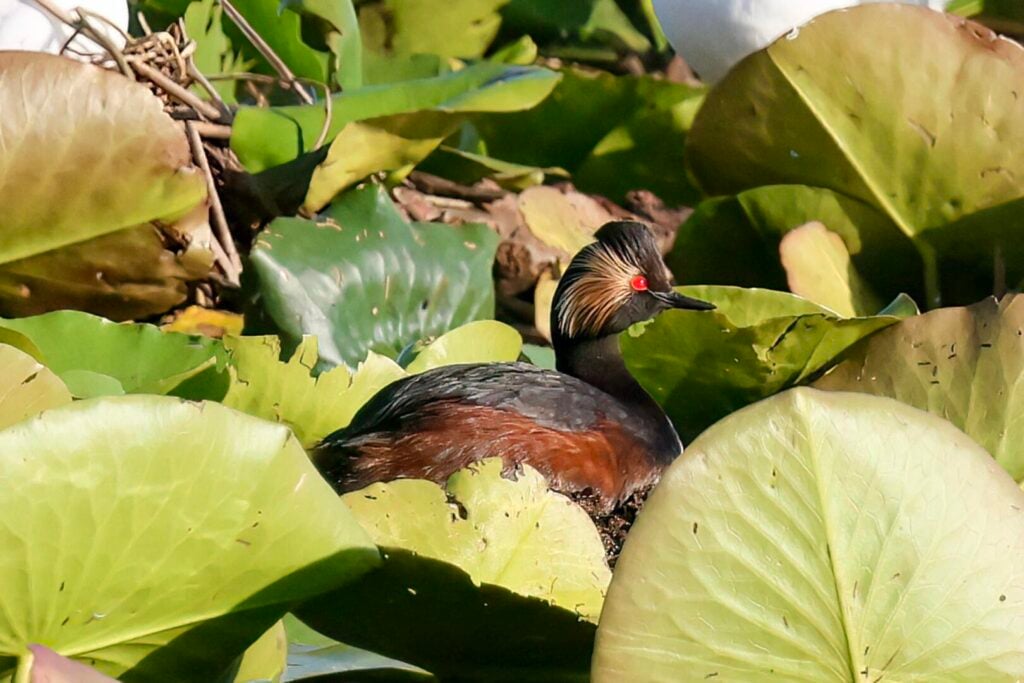
Through a couple more channels and we came to another lake, and this time we were able to go in. There were lots of Black-headed Gulls breeding on the lilypads and several pairs of smart Black-necked Grebes in amongst them. Quite a few Whiskered Terns were mostly loafing on the lilypads, but flew up to chase off a Hooded Crow. They seemed to be a bit late nesting this year, possibly due to the cool weather. A Lesser Spotted Eagle drifted high overhead.
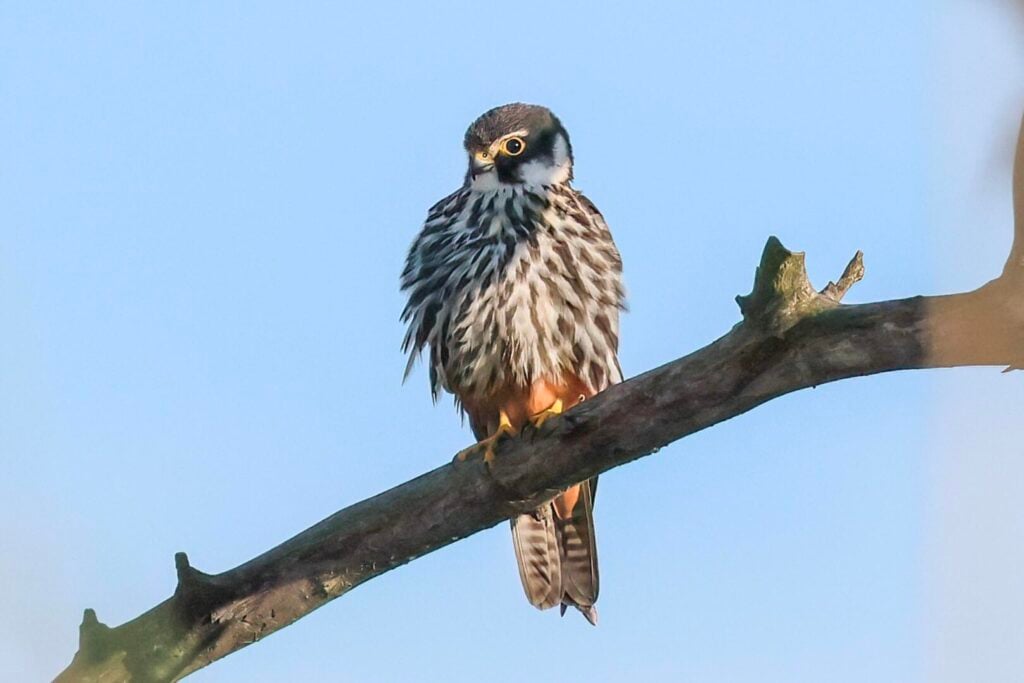
It wasn’t far from here back to the flotel, but on the way a Hobby was perched in a tree.
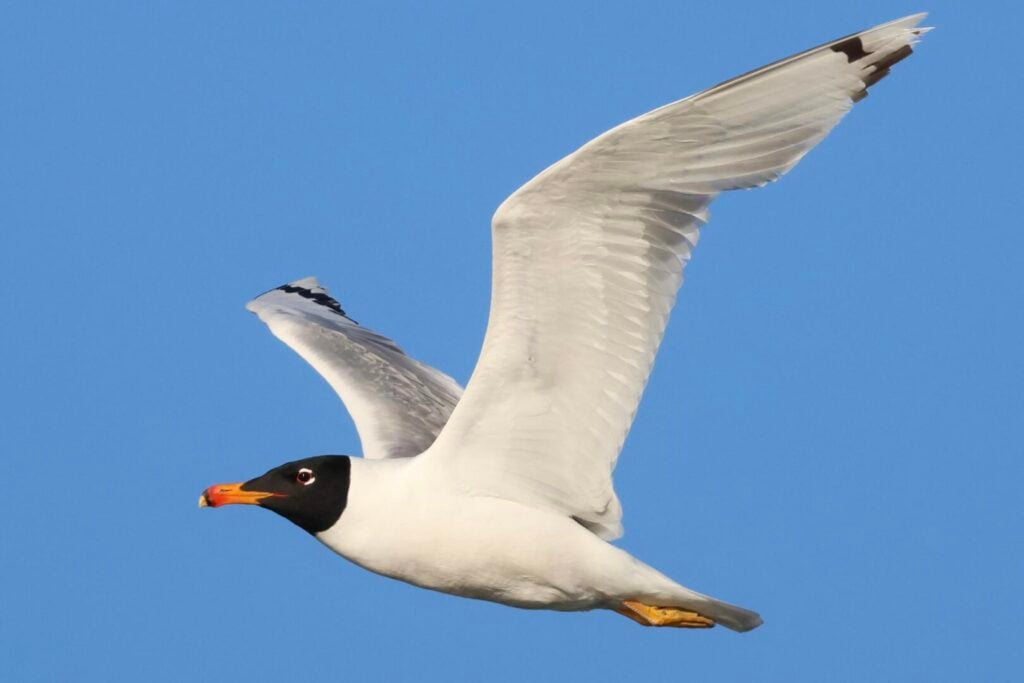
We stopped to photograph the White Pelicans gathered on the snags on the corner close to the flotel, as it was lovely late afternoon light now. A Pallas’s Gull flew over and looked like it would disappear straight off, but then turned and came back past us with the light on it. If gulls can be stunning, this species surely is in adult summer plumage!
Back to the flotel, we only had about twenty minutes before dinner. Barbecue night tonight. As we ate, we watched an amazing sunset over the reeds opposite. A Savi’s Warbler was reeling and a White Pelican flew in and started fishing just off the back of the flotel. Another amazing place to spend the night.
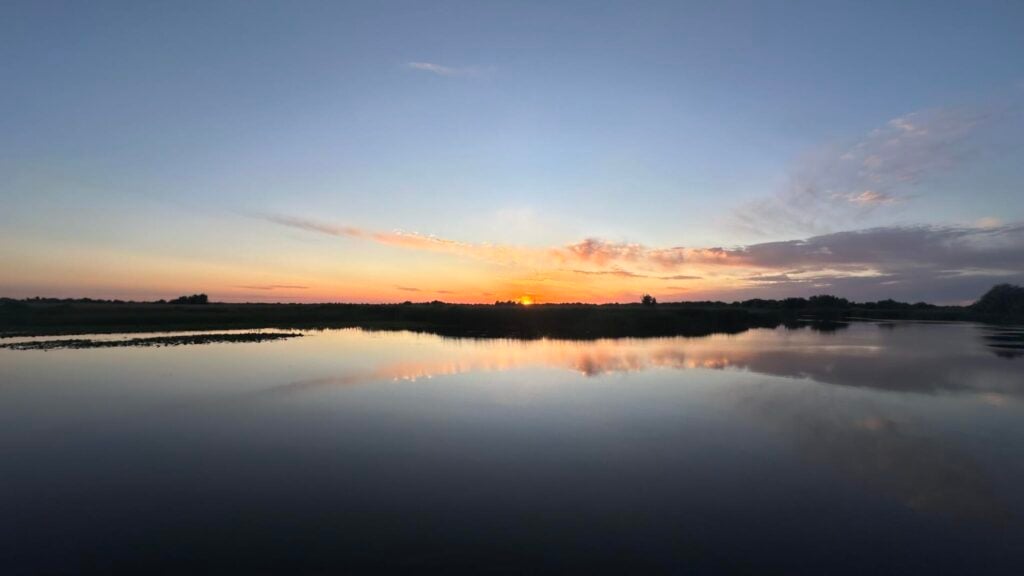
Sunday 31st May
Our last day in the Delta. Before breakfast, from up on the top deck of the flotel again, we stood and watched the squadrons of White Pelicans flying over, coming from their roosts and heading off to feed in the channels. A couple of Savi’s Warblers were reeling, one quite close behind us and the other across the channel, but it was cloudy with a cool breeze this morning and they seemed to be keeping down in the reeds. We could hear a Golden Oriole fluting too, and the ubiquitous Cuckoos.
A few Black Terns and Whiskered Terns were feeding up and down over the channel. Several Squacco Herons and a couple of Purple Herons stalked the lilypads opposite.
After breakfast, we set off in the small boat again. We stopped briefly by a small lake on the edge of the channel to watch a small group of White Pelicans feeding. Several Purple Herons were lurking in the reeds around the edge and a few Whiskered Terns were gathered on the lilypads.
A little further on, we turned onto a tree-lined channel. As we motored down, a succession of Night Herons flew out from the edge under the willows. At the far end, we came out onto a big open lake, where a Pallas’s Gull drifted over and we could hear another Savi’s Warbler reeling from somewhere over the far side. There didn’t seem to be much else here so we turned round and made our way back out.
On the main channel again, we heard a Grey-headed Woodpecker call and found it perched on a dead tree. Another small area of open reeds beside the channel was choked with water soldier. Two Black Terns were feeding with two Whiskered Terns round and round over it, continually dipping down into the water soldier to find food.
Further on, we came across another, larger group of feeding White Pelicans and Cormorants spread across the main channel ahead of us. As we drifted slowly up towards them, more and more Pelicans came streaming out of the reeds on one side. Lots of Great White Egrets and Purple Herons flew up out of the reeds too. The Pelicans started to take off, flying just a short distance and landing again on the channel behind us. Amazing to watch. Eventually we managed to get past.
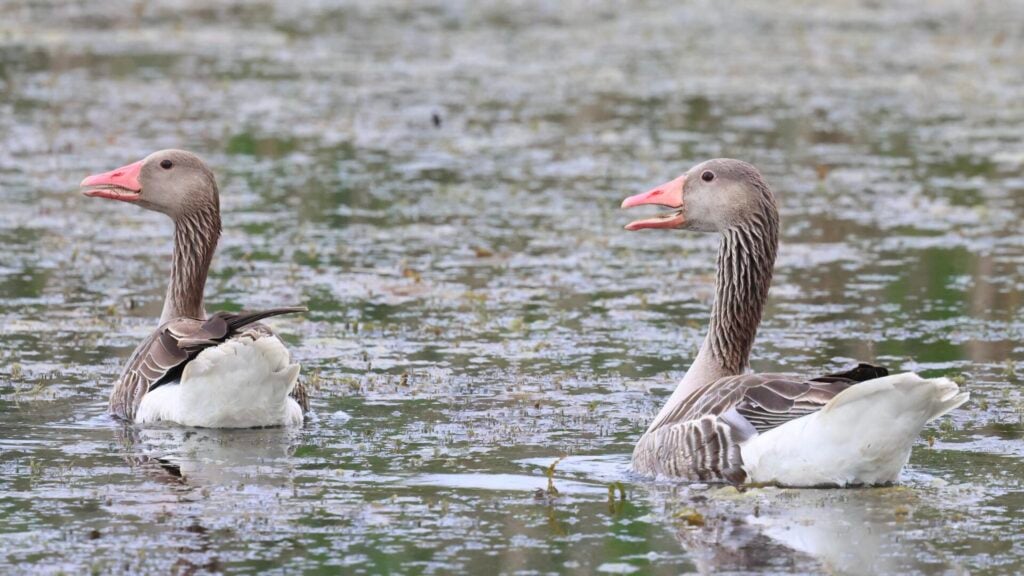
A Marsh Harrier over the reeds the other side was getting mobbed by a pair of Hobbys, repeatedly stooping at it. We slowed down to look at a pair of Eastern Greylag Geese which flew ahead of us a couple of times. We got a good view of their large pink, rather than orange, bills.
Another little lake on the side of the channel held a pair of Red-necked Grebes and two more Black Terns. As we stopped for a closer look at the Grebes, the Black Terns flew round in front of the boat. The cloud was very low this morning and there were occasional spits of very light drizzle. Thousands of Common Swifts were feeding low over the reeds in front of us, looking for insects. An impressive sight.
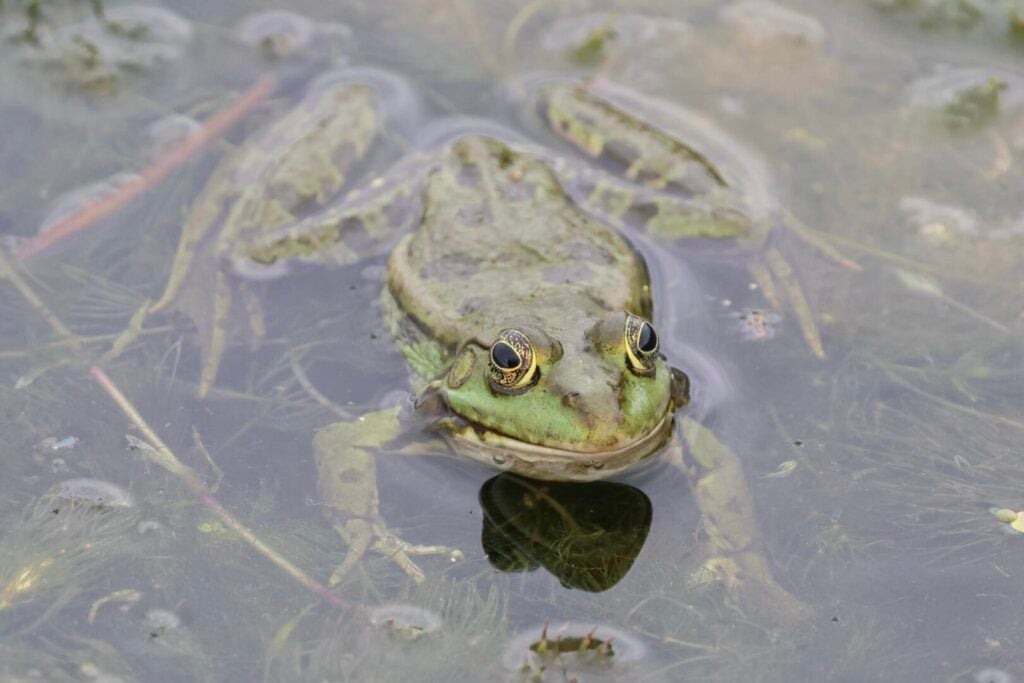
We heard Bearded Tits calling and stopped to see if we could see them. A male appeared briefly on the edge of the reeds. There were lots of frogs calling here too and we could see several in the floating vegetation by the front of the boat. Cristian got out a fishing rod with a red bottle top attached to the end of the line rather than a hook. Bouncing the bottle top on the surface of the water, the frogs chased after it.
Continuing on, our first Honey Buzzard of the day flew over. We sailed into another larger lake which spanned the channel, this one more heavily vegetated with islands of reeds and lots of water soldier. Having not seen so many up until now, it was a good day for Red-necked Grebes. We counted another five at least on here, including one right in front of the boat at one point. A single Black-necked Grebe was a bit further back and several more Black Terns flew round with the Whiskered Terns.
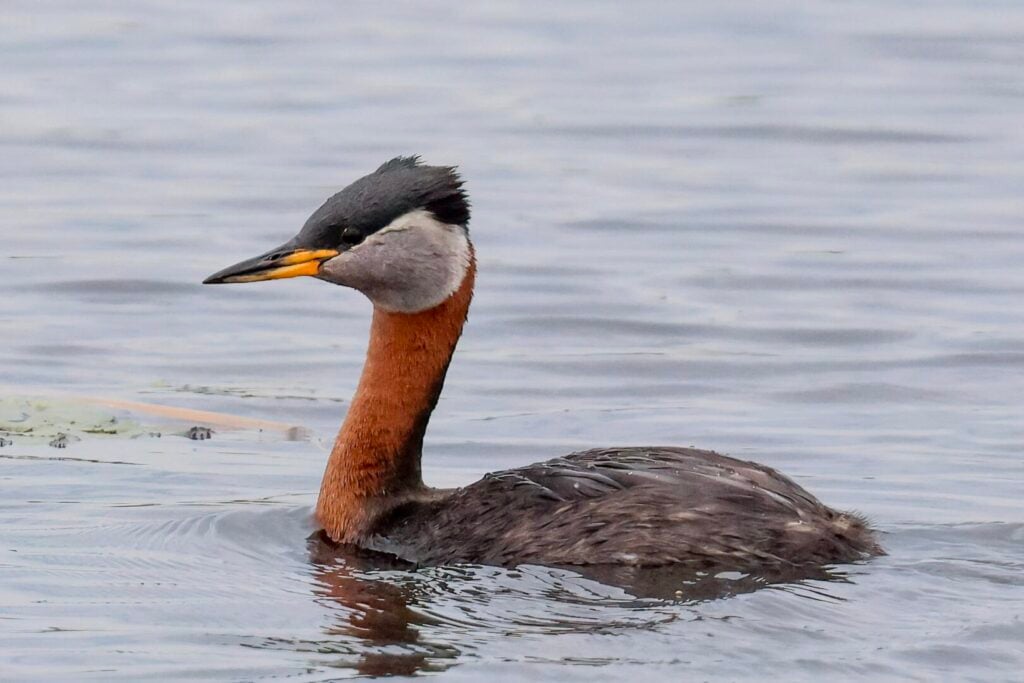
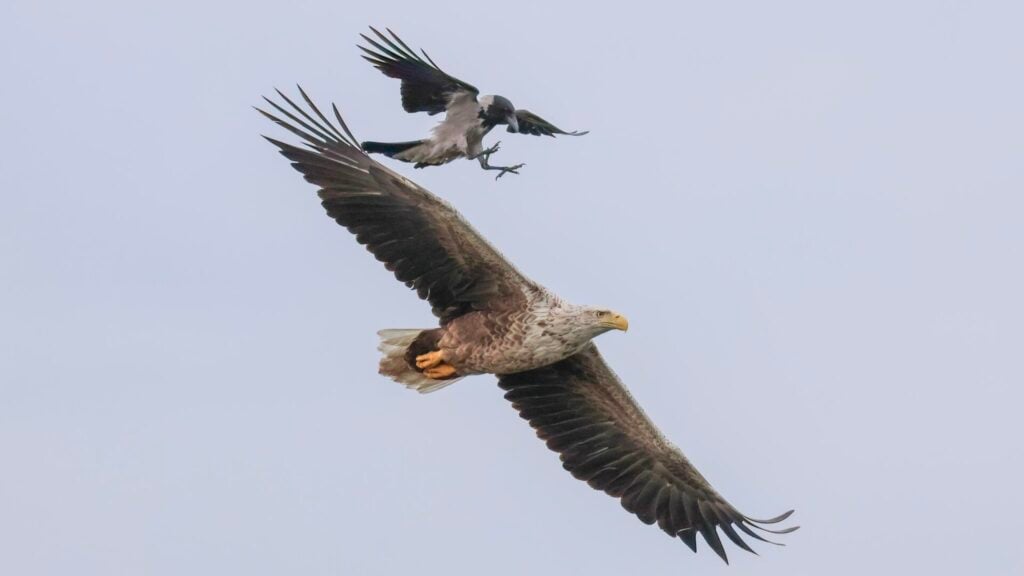
As we got to the channel on the far side of the lake, we flushed a White-tailed Eagle from the trees. It circled round in front of us and was then chased off by two Hooded Crows.
Through a series of narrow channels, we came out onto a wider one flanked by wires. We were getting back to ‘civilisation’. A couple of Hobbys were perched on a tree on the corner and several Bee-eaters were hawking from the wires. At the far end, a Grey-headed Woodpecker was perched on a dead tree and we came to a t-junction with large ruined buildings ahead of us.
Another huge area to the north of here, stretching all the way to the Ukraine border, was drained for agriculture in the Communist era. Apparently they would have gone much further, and drained more of the Delta, if it hadn’t been for the revolution.
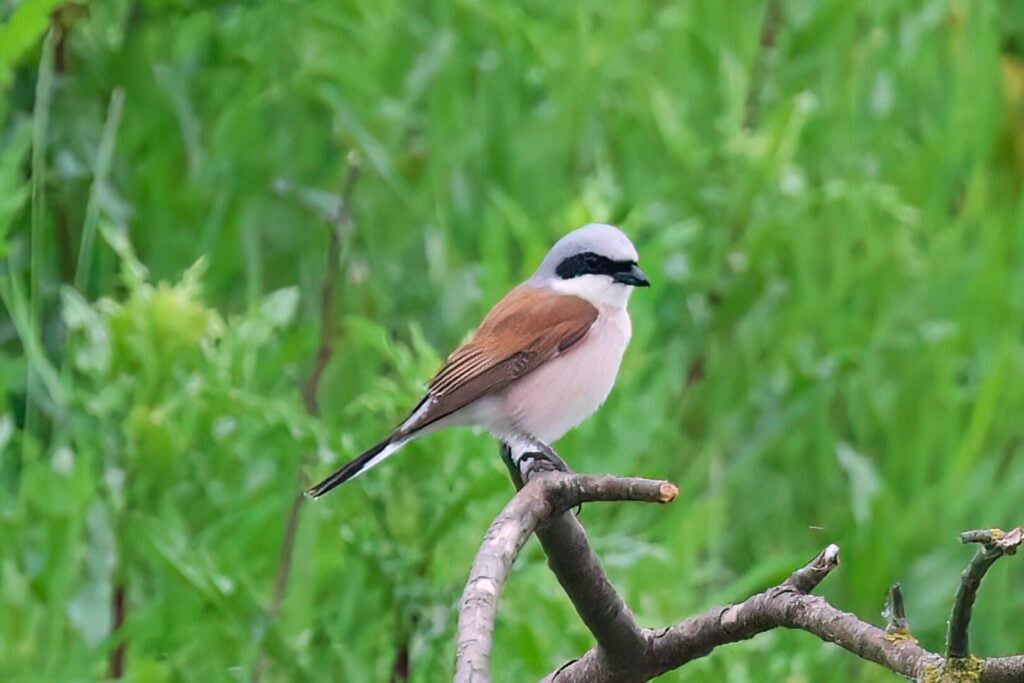
We turned onto the Stipoc channel and it was time for coffee and biscuits. The vegetation is different here, the banks bordering the channel are more open and covered in places in the invasive false indigo bushes. There were several Corn Buntings singing and a couple of Red-backed Shrikes on the bushes. A succession of Rollers and Kestrels were on the wires above.
After a while, we took a side turning heading back into the wilder part of the Delta. The area here was burnt a few years ago and the channel is lined with lots of dead trees, good for woodpeckers. There were a couple of Rollers in the bare branches, and several Tree Sparrows, both of which make use of the old woodpecker holes.
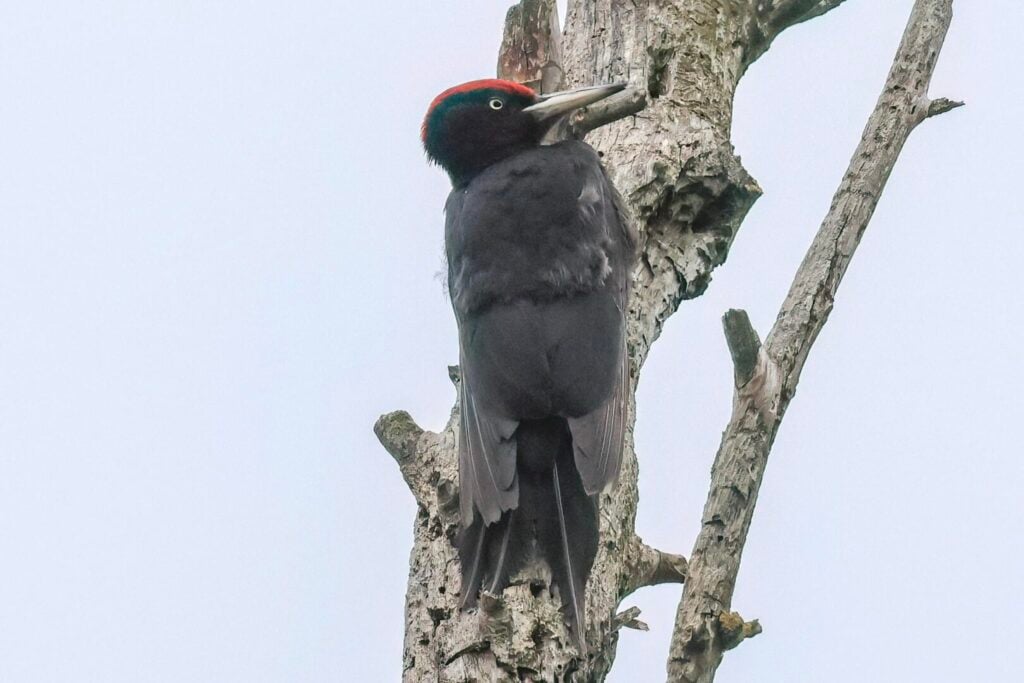
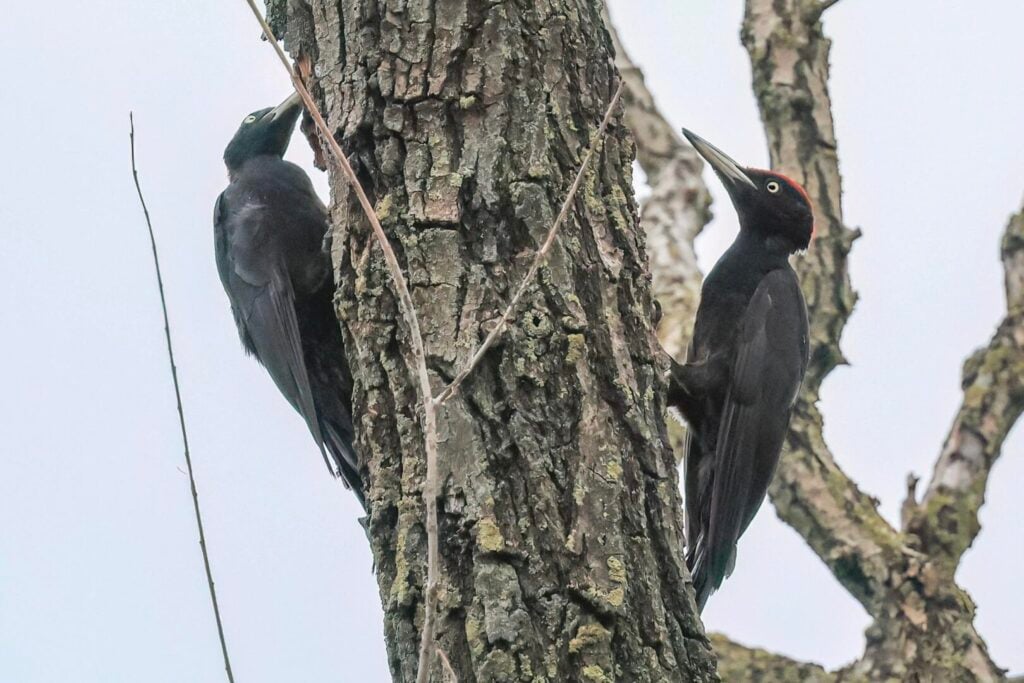
We could see a White-tailed Eagle perched up ahead on the left. As we motored slowly towards it, scanning the dead trees on the right we noticed a Black Woodpecker on the trunk of one. We stopped and watched it, a male – lovely views before it eventually dropped down out of sight.
The White-tailed Eagle flew off before we got to it but landed again further on, where it was mobbed by two Marsh Harriers. They looked very small by comparison! Further down, we found a Grey-headed Woodpecker and then a couple of Great Spotted Woodpeckers.
Black Woodpeckers are a bit like buses and on the next channel, we found another. This time a female, at a recent partly excavated hole. While we were watching it, the male Black Woodpecker flew in and landed on the other side of the trunk beside it.
We took a small side turning down to look at Lake Furtuna. The reeds on one side were all recently burnt and there was still smoke coming from a smoldering tree trunk on the bank. The fishermen here sometimes set fire to the reeds deliberately, but mainly in the winter, so perhaps this was an accident.
Furtuna is a very large, open lake and we could see lots of Mute Swans and a distant feeding frenzy of White Pelicans and Cormorants over the far side. A single Caspian Tern was flying up and down over the vegetation out in the middle and we picked up a very distant Pallas’s Gull flying over. Apparently it is not possible to navigate through the channel on the far side this year, as it has silted up too much. So we turned and made our way back out the way we had come.
It was not far from here to where the flotel was waiting for us but before we got to it we noticed the head of a mammal in the water ahead of us. A Golden Jackal was swimming across the channel. A very unusual sight, it quickly disappeared into the reeds.
Back on the flotel, the tug hooked up to the front and we set off to make our way back out of the Delta. While we ate our lunch, we watched the landscape passing by beyond the windows. It looked quite bright outside but the cloud was obviously thick enough to produce some steady drizzle for a while. Thankfully it didn’t last long and then the sun came out again.
There is a good view here from the top deck and there was still time for some last birding in the Delta. The trees thickened up again and we could hear the usual birds singing – Eastern Olivaceous Warbler, Blackcaps and one or two Garden Warblers, Lesser Whitethroats, Chiffchaffs and Chaffinches.
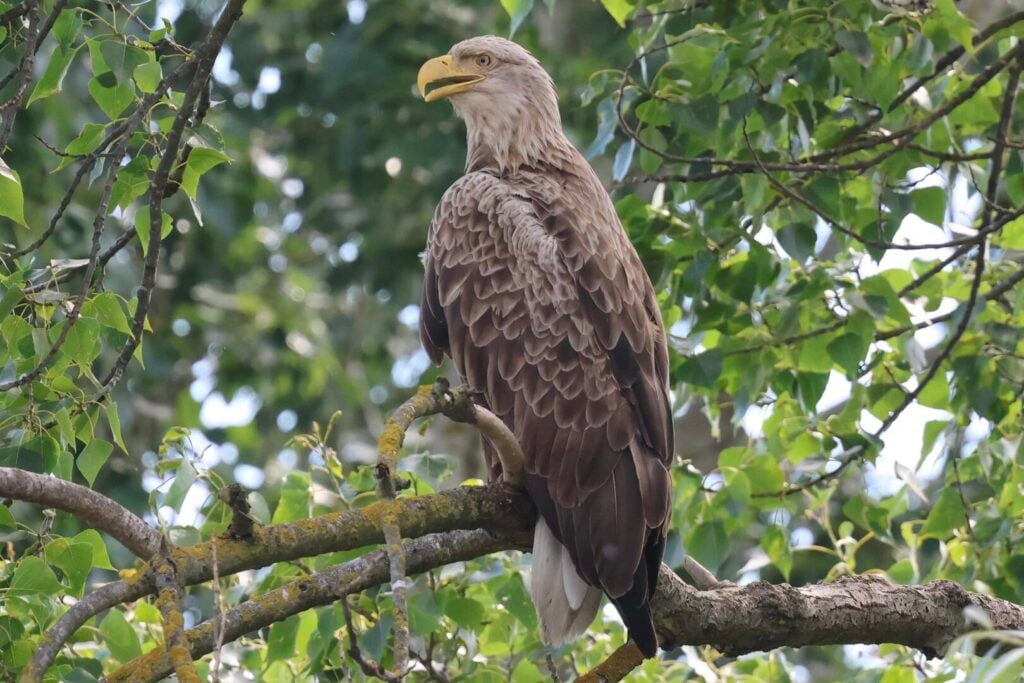
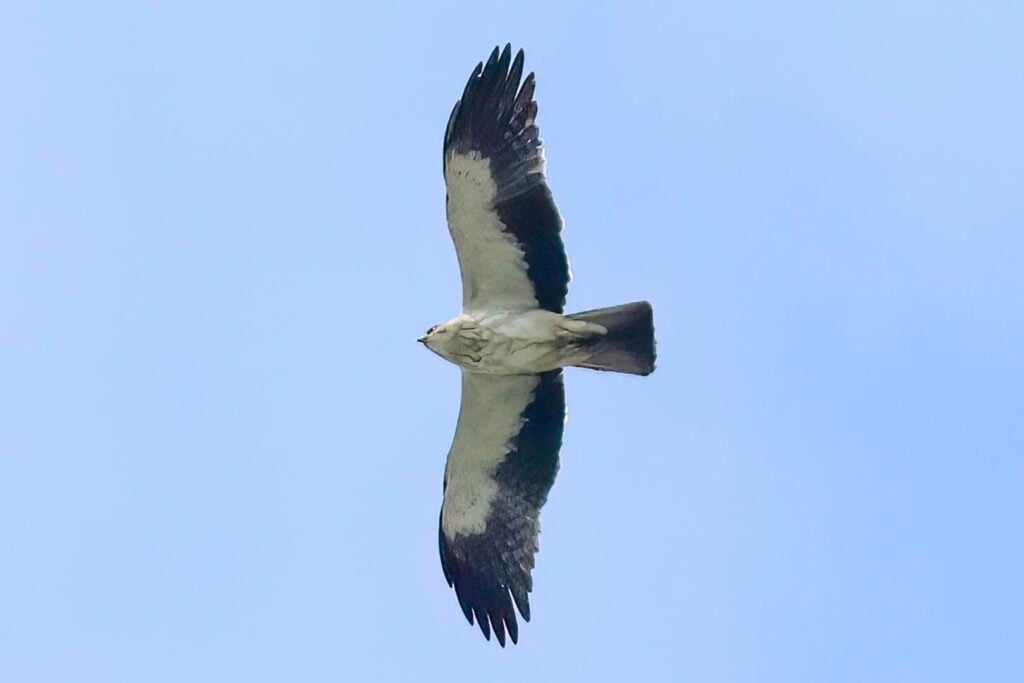
In the sunshine, it warmed up nicely now, good conditions for raptors. We saw at least a dozen Honey Buzzards, presumably mostly migrants on their way north. There were several White-tailed Eagles too, mostly circling over but one was perched in the trees almost at eye level as we passed by. We also saw a single pale phase Booted Eagle and two Lesser Spotted Eagles circling together.
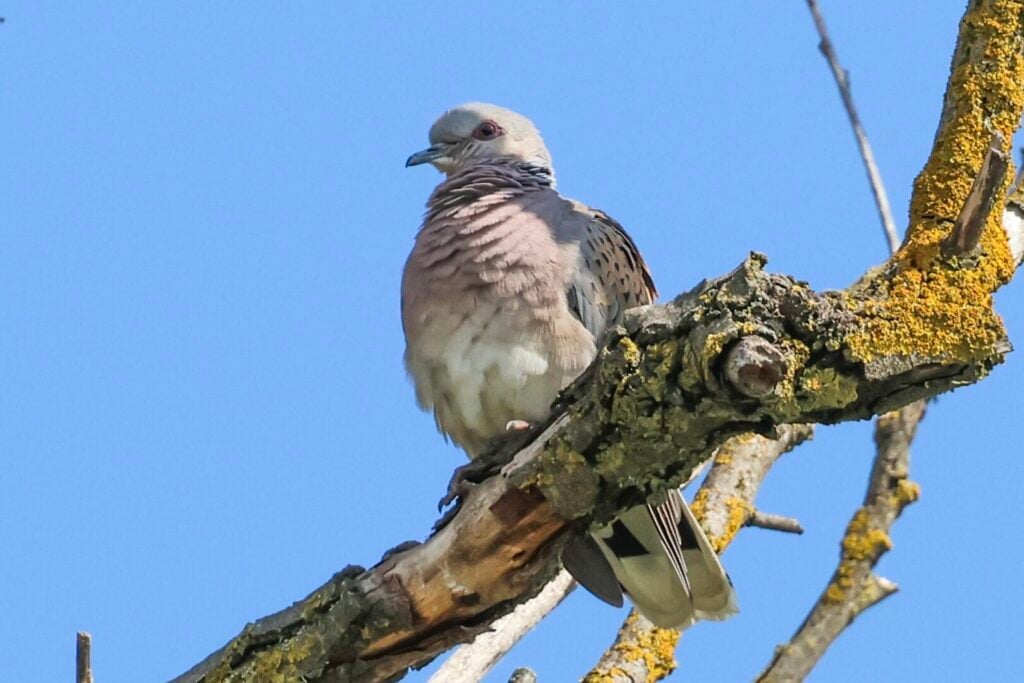
The surprise of the journey back was a Turtle Dove perched in a dead tree by the side of the channel. A couple of Redstarts flicked out of the trees and a Spotted Flycatcher perched nicely in the open but the Collared Flycatchers were less obliging. Always hard from the flotel, when we can’t stop, we heard a couple in the trees but managed only a brief glimpse of one, too quick for anyone to get onto.
On the larger channels, there were lots of tourist boats racing in and out of the Delta. With their massive outboard engines, they drive very quickly creating a huge wash behind them. This is a growing problem in the Delta, as the wash erodes the banks and disturbs the wildlife, probably starting to have a detrimental impact on species like Little Bittern and grebes already.
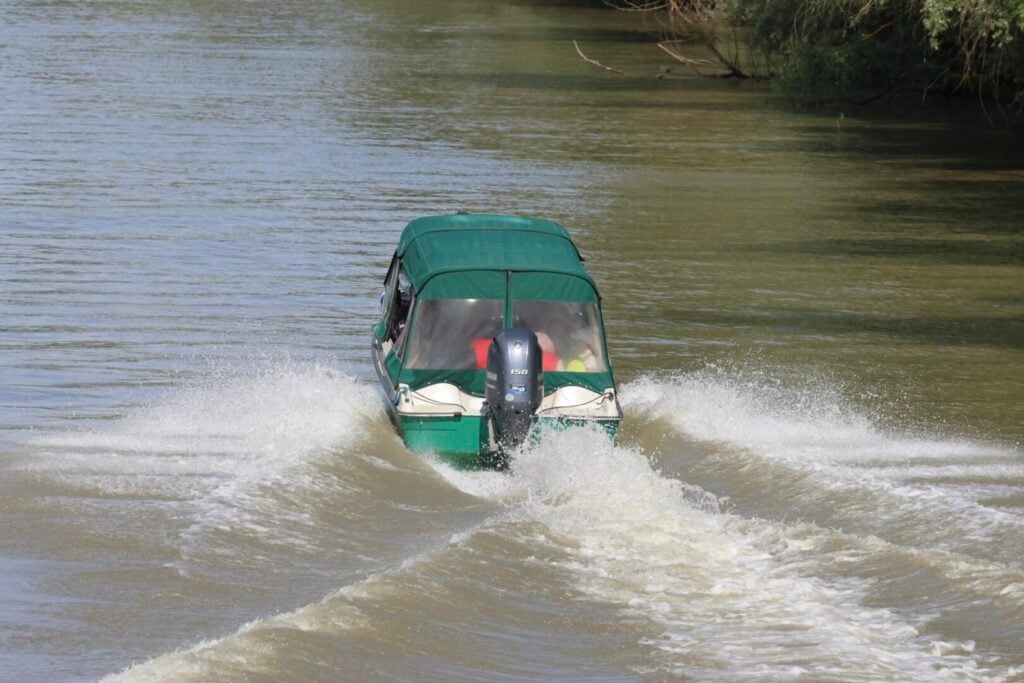
Just after 5pm, we came back out again onto the wide Tulcea branch of the Danube. There were still birds to see even here. A Pallas’s Gull drifted past and a Levant Sparrowhawk came out of the trees chasing Starlings. We picked up a couple more White-tailed Eagles, one mobbed by Jackdaws, and a Black Stork circled up over the far side.
There were a couple of large bulk carrier ships which looked like they were already filled with grain, moored up in the channel. Another sailed past, heading further upriver. The wonders of modern technology, we could look up where they had been and where they were headed. As we got closer to Tulcea, we passed lots of old boats abandoned and rusting beside the riverbank.
We got back to town around 6pm and the boatmen secured the flotel back on the jetty which we had sailed from just a few days ago. We were staying on board tonight but after dinner there was time to go for a walk into town for those who wanted to explore.
Monday 1st June
We had breakfast as usual on board the flotel this morning, for the last time. Afterwards, we packed up and said our goodbyes to Roxana, Lili and the boatmen. The minibus was waiting for us at the far end of the gangway as we disembarked. The weather forecast was better today (it didn’t look so good for tomorrow), so we headed down to our first destination for the morning at Histria.
Driving through the wide open farmland, there were lots of Rooks and Jackdaws in the fields, several Marsh Harriers quartering over and Rollers on the wires. A Calandra Lark flew across. Through the town of Babadag, a couple of woodpeckers flew across, presumably Syrian Woodpeckers but unfortunately there was nowhere to stop and they disappeared off over the gardens.
Further on, we stopped to photograph a White Stork nest in one of the villages. One of the adults was standing on the nest when we arrived and we could just see the heads of two small juveniles looking over the edge. Lots of sparrows were flying in and out from the sticks underneath, nesting in the bottom of the Stork’s nest. Looking closely, we could see a mixture of Spanish Sparrows and House Sparrows.
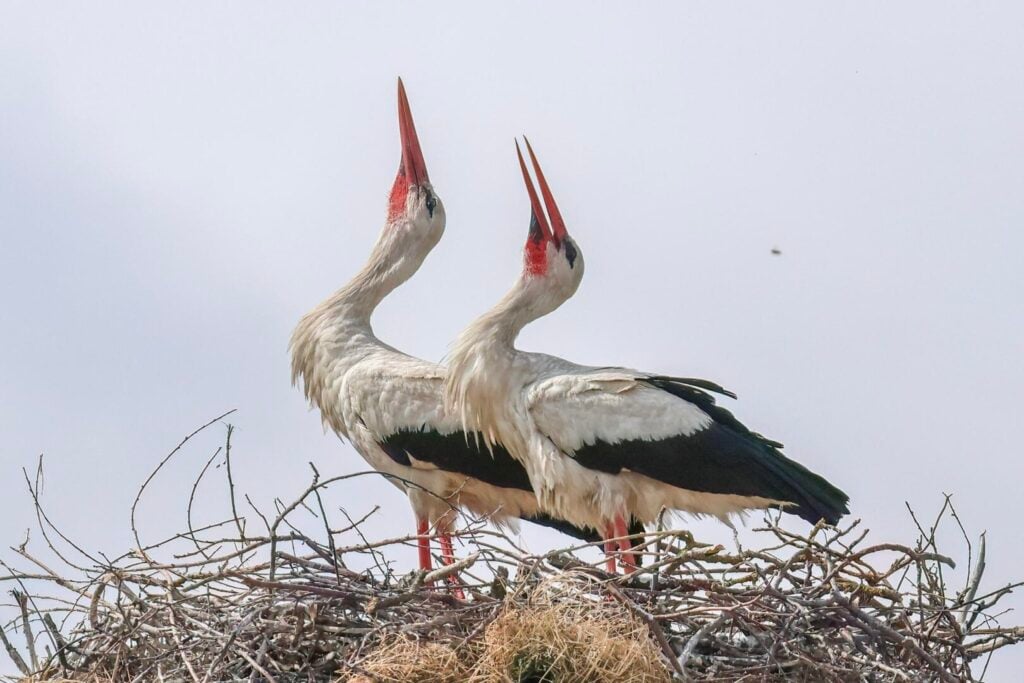
The other adult White Stork flew back in and landed on the nest. It had brought a bit of an old plastic sack in its bill to adorn the nest. Suitably decorated, then the two adults greeted each other, throwing their heads back and bill clapping. It was funny to see the juveniles then mimicking the adults, trying to do the same.
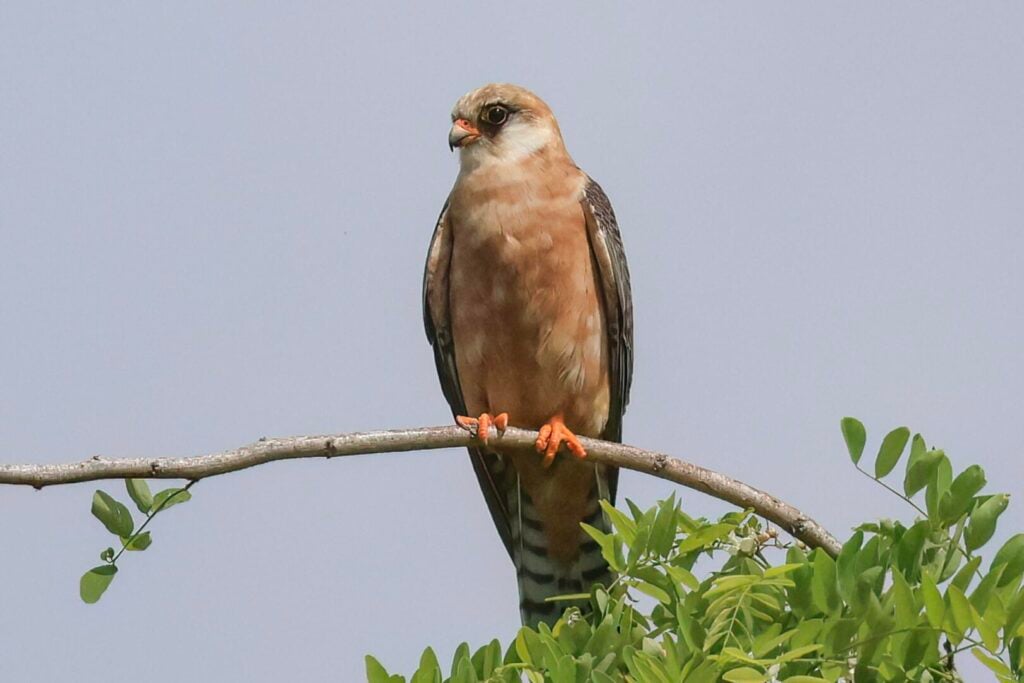
We stopped again just outside the village, next to a small block of trees beside the road. Lots of Rooks were on their nests in the branches and flying in and out. We could hear the Red-footed Falcons calling first. Cristian managed to find one female on the nest – they use the unoccupied Rook nests – but it was settled down and we could only see its head.
Down at the far end, there was lots more activity with several Red-footed Falcons flying in and out, chasing each other. A female landed in the top of the trees.
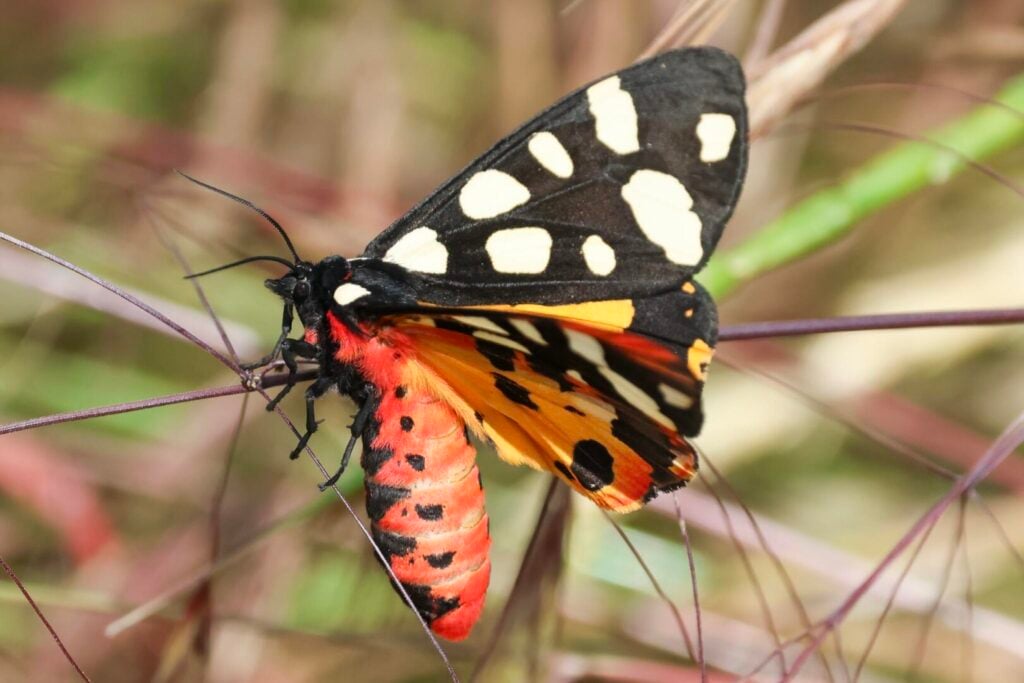
A Lesser Grey Shrike flew out of the trees and over the crop beyond, where it landed on a tall umbellifer. Nice views in the scope. Several Cardinal butterflies and teneral Southern Migrant Hawker dragonflies were flying round on the edge of the trees and a smart Cream-spot Tiger moth landed in the vegetation on the verge.
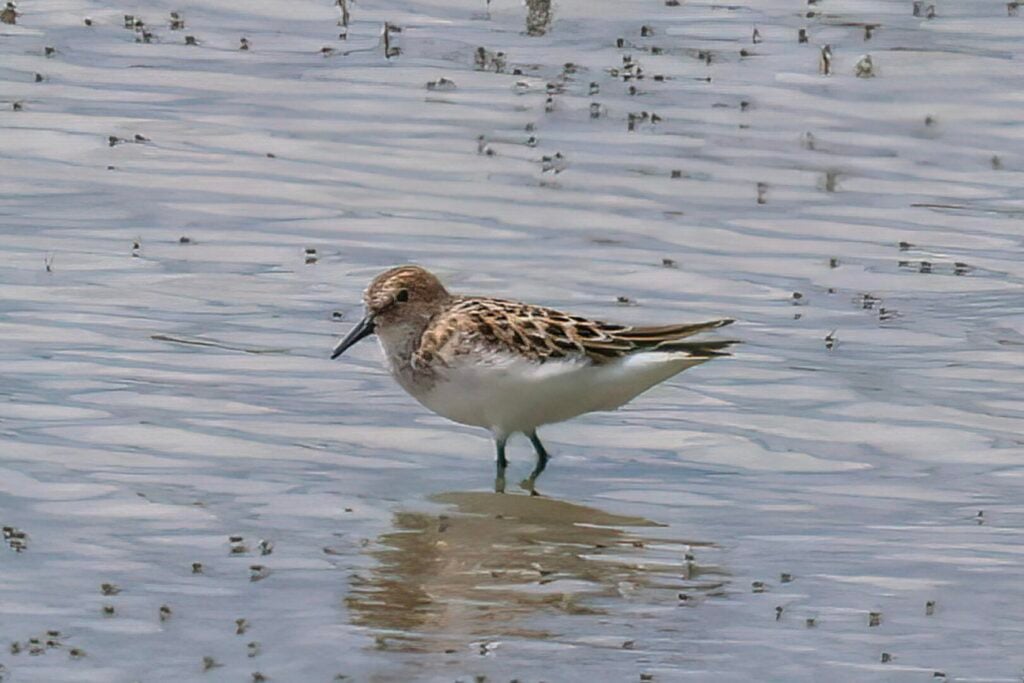
Further on, we stopped again at the start of a track across the marshes. A small pool opposite held twelve Little Stints, all adults in breeding plumage, and two Common Shelduck. A White Stork flew past.
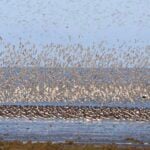
Walking down the track, there were lots of Skylarks singing. A constant steam of small groups of Little Gulls flew over, mainly 1st summers but a couple of 2nd summers with black heads and dark underwings. They were all heading in the same direction and when something spooked them, a huge cloud of over 1000 Little Gulls came up from a pool in the distance.
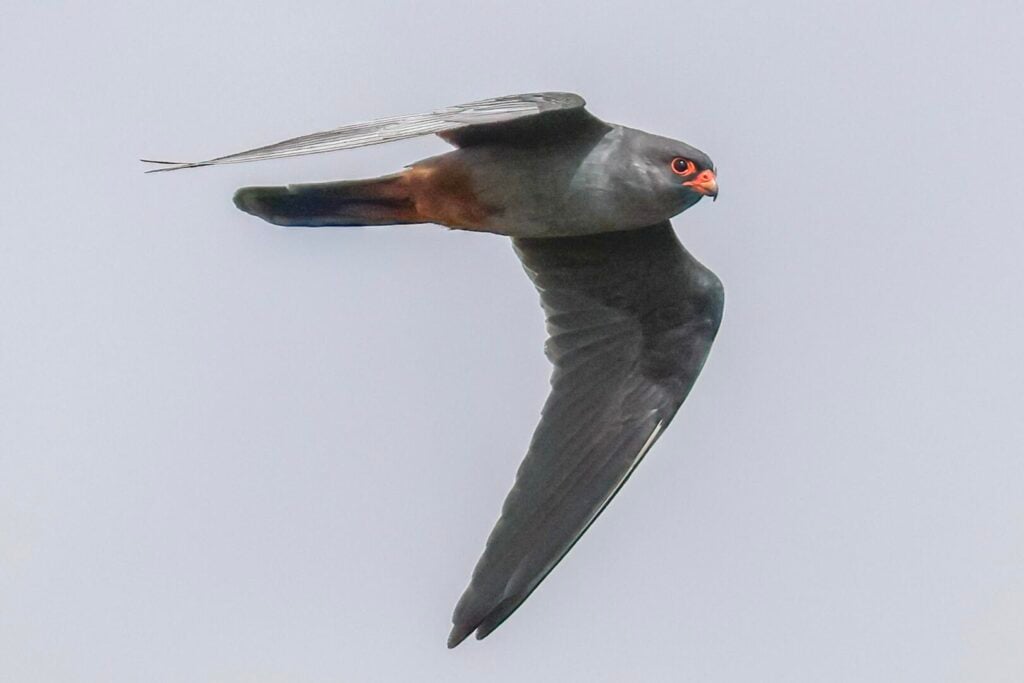
A few Pelicans, Grey and Purple Herons and a Spoonbill flew over too. We could see lots of Marsh Harriers, including a male displaying high overhead at one point. A few Red-footed Falcons were hunting out over the marshes and a male stopped to hover right in front of us.
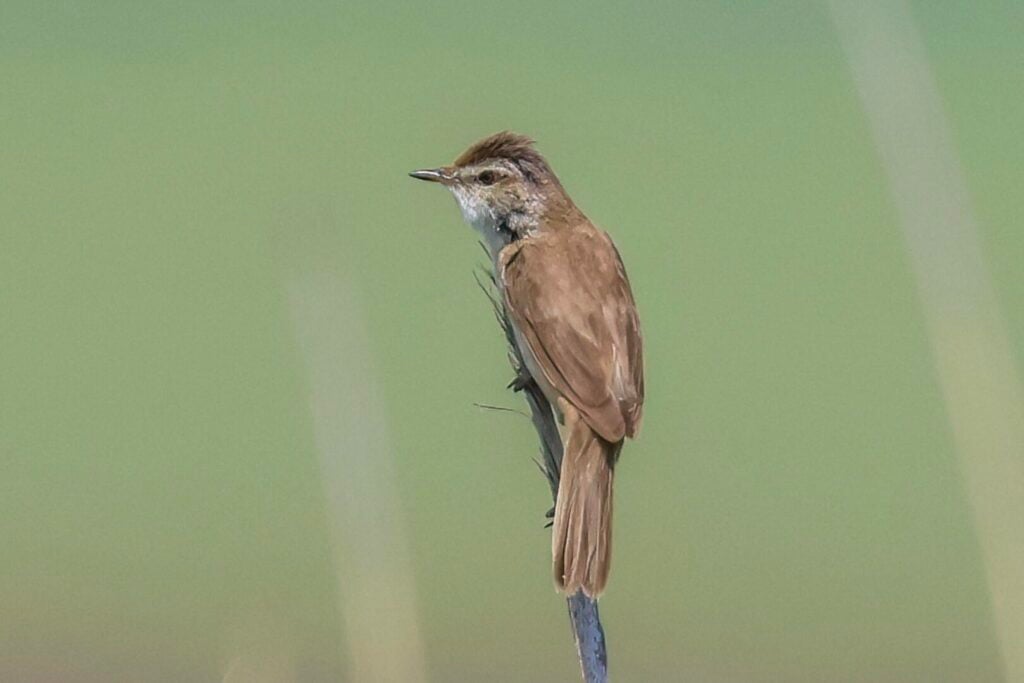
Cristian had hoped to get over to the lake but we found the track passed through a swampy area which was still rather wet and we couldn’t get further on foot. We hadn’t heard any on the way out but as we turned round we found a couple of Paddyfield Warblers briefly in the reeds. It was a bit breezy though and they were reluctant to come out.
Then we found another two Paddyfield Warblers a bit further on, one of which perched up nicely several times. Good to see this species here, as it is at the westernmost point of its breeding range on the Black Sea coast of Romania.
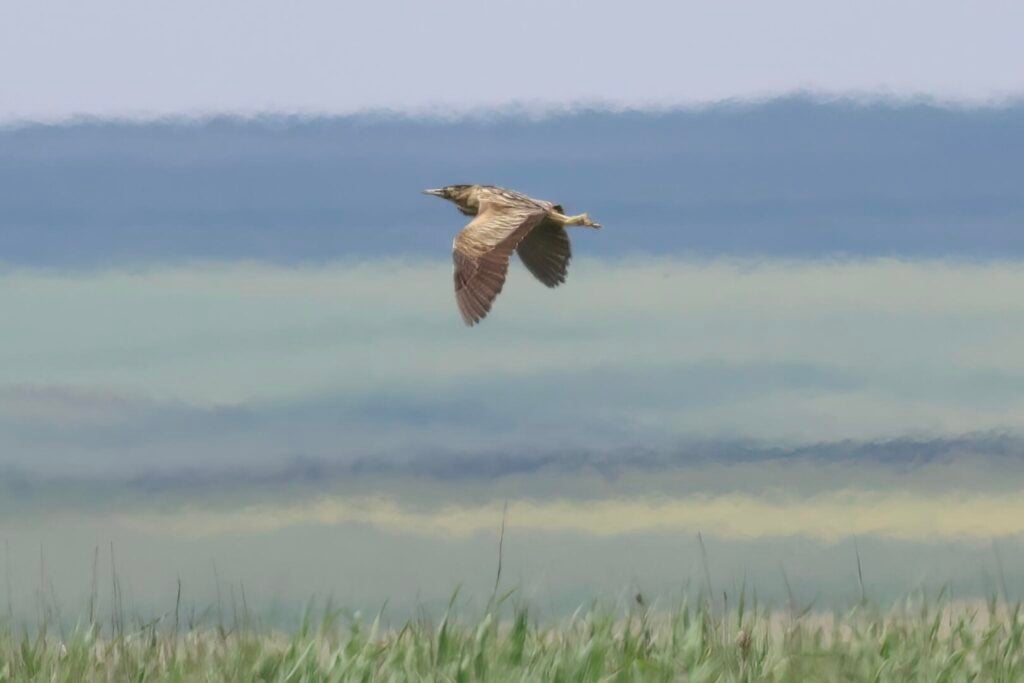
Having achieved our main target here, we walked back. A Pallas’s Gull and a Honey Buzzard both drifted over. Then a Bittern appeared over the reeds and flew right across, unusually in view for a long time.
With a bit of time to spare now, we drove on for a quick look at Vadu. Sad to see the old Communist era factory here is in the process of being demolished now, as it has become a familiar landmark.
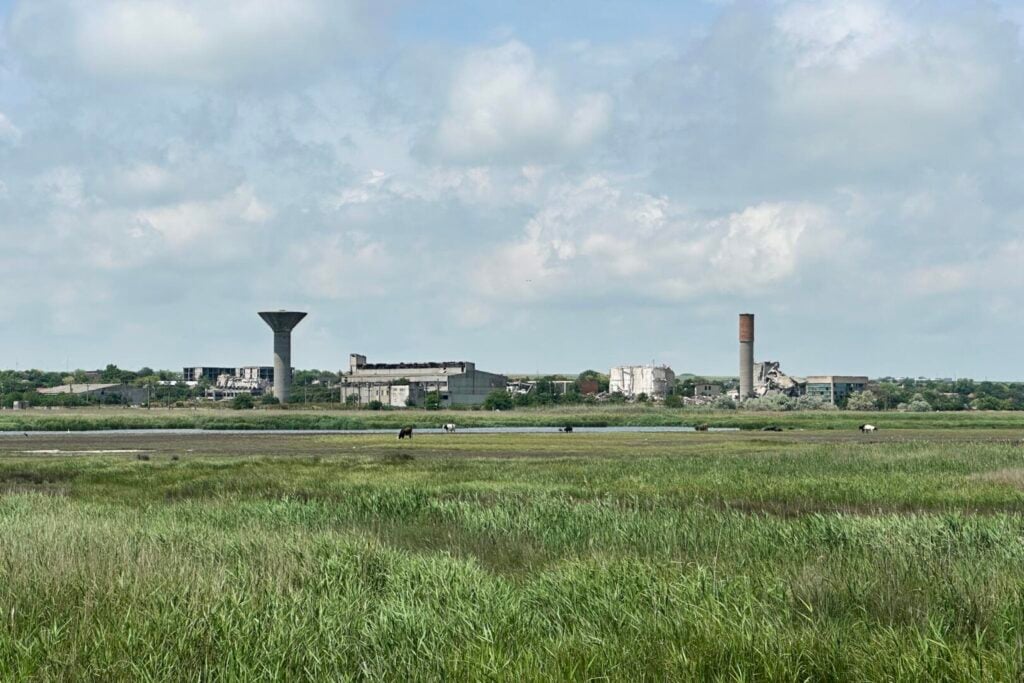
We stopped opposite the big pool in the reeds and got out to scan. A single Gull-billed Tern was loafing on the edge of the water with the Common Terns. We got it in the scope but when they all flew round, it disappeared. There were several Collared Pratincoles out on the dry ground beside the pool and flying round over the grazing cows.
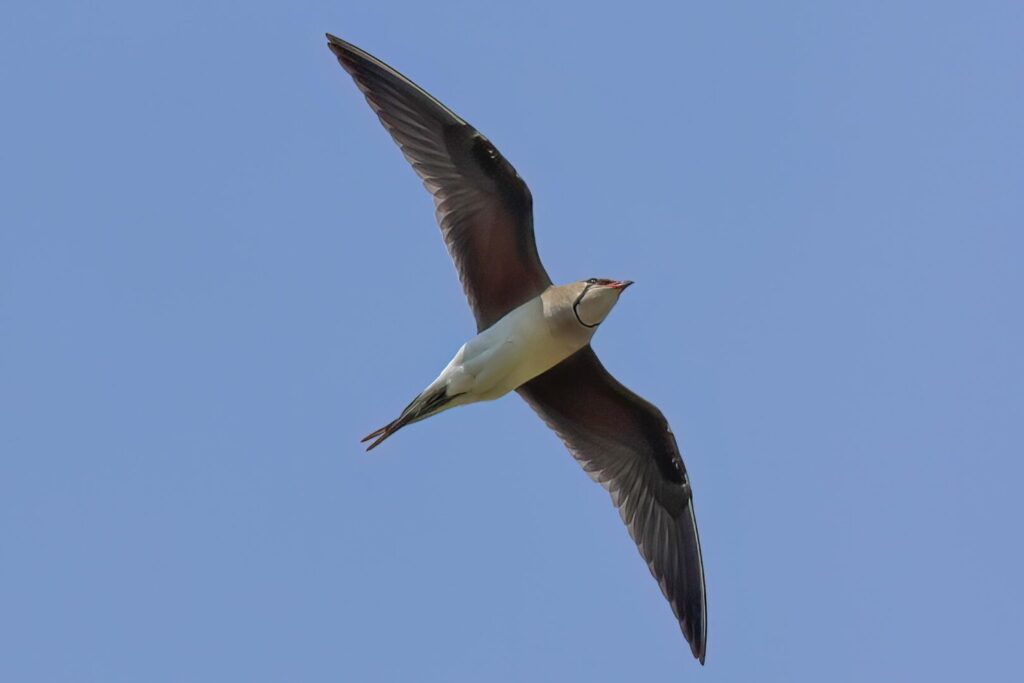
A single female Red-crested Pochard was out on the water, with several Ferruginous Ducks, Black-winged Stilts and Avocets. Scanning the edge of the water, we found a few more passage waders, two Marsh Sandpipers in breeding plumage with the local Redshanks, a couple of small groups of Little Stints and three Curlew Sandpipers with one of them.
We heard the begging calls of young birds coming from the rocks around the base of one of the pillars where we were standing. A Hoopoe was walking around on the bridge further along the road with food in its bill and then appeared to be waiting on the concrete so we walked away in case it was trying to come in to feed its young. There were lots of Marsh Harriers up over the reeds and Reed Warblers and one or two Great Reed Warblers singing.
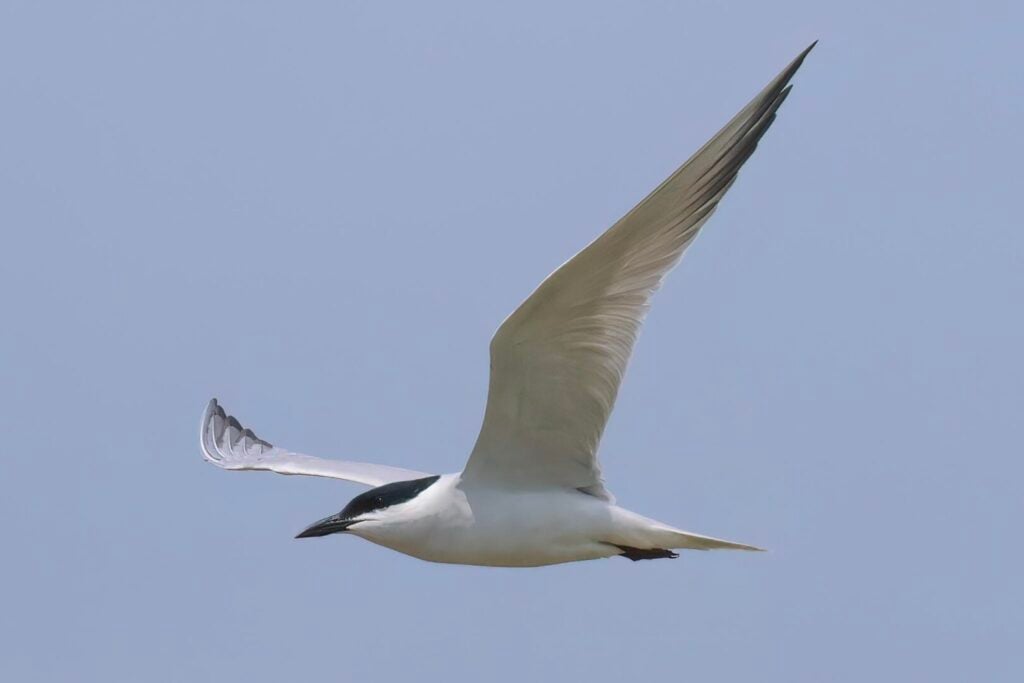
Just beyond, there is a large pool behind a tall bank so we walked up onto the top to see whether there was anything on there. There were around 40 Common Terns gathered on a mud spit and the Gull-billed Tern was with them now. We got it in the scope. When all the terns were flushed by a Marsh Harrier over the bank at the back, the Gull-billed Tern took off too and flew off straight past us giving us some lovely flight views.
We picked up a very distant Long-legged Buzzard high in the sky behind, which hovered briefly, then folded its wings and plummeted to the ground. The minibus had parked nearby and Cristian and the driver had got the picnic lunch out, spread on the top of the concrete blocks. A delicious selection of cheeses and cold meats, followed by pears, marble cake and coffee.
After lunch, we set off again. Driving through the fields, we passed a Booted Eagle and a Long-legged Buzzard, and flushed two Calandra Larks from the verge. Our last destination today was Dobrogea gorge. It is a popular spot with locals though and today was a public holiday, so when we arrived it was very busy. Still we thought we would try our luck and Cristian assured us the birds are used to it.
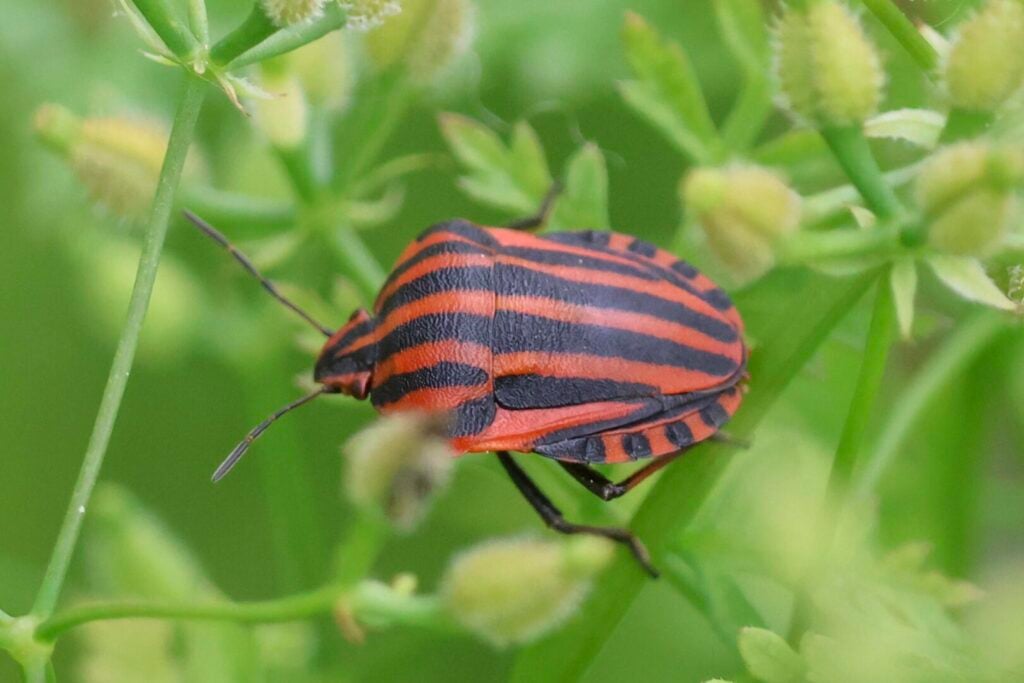
As we got out of the minibus, there were lots of insects in the long grass – a Golden-bloomed Grey Longhorn beetle, an Ornate Bluet damselfly, lots of Striped Shieldbugs, and a selection of Grasshoppers and Bush Crickets. One of the group spotted a brief Suslik on the slope beyond, but it disappeared presumably into its burrow.
Walking round the base of the rocks, we thought we might struggle to find a Pied Wheatear, given the amount of disturbance. But we quickly found a male perched on the top, then a female with it. As we watched them, a Black Redstart flew in and out too, collecting food.
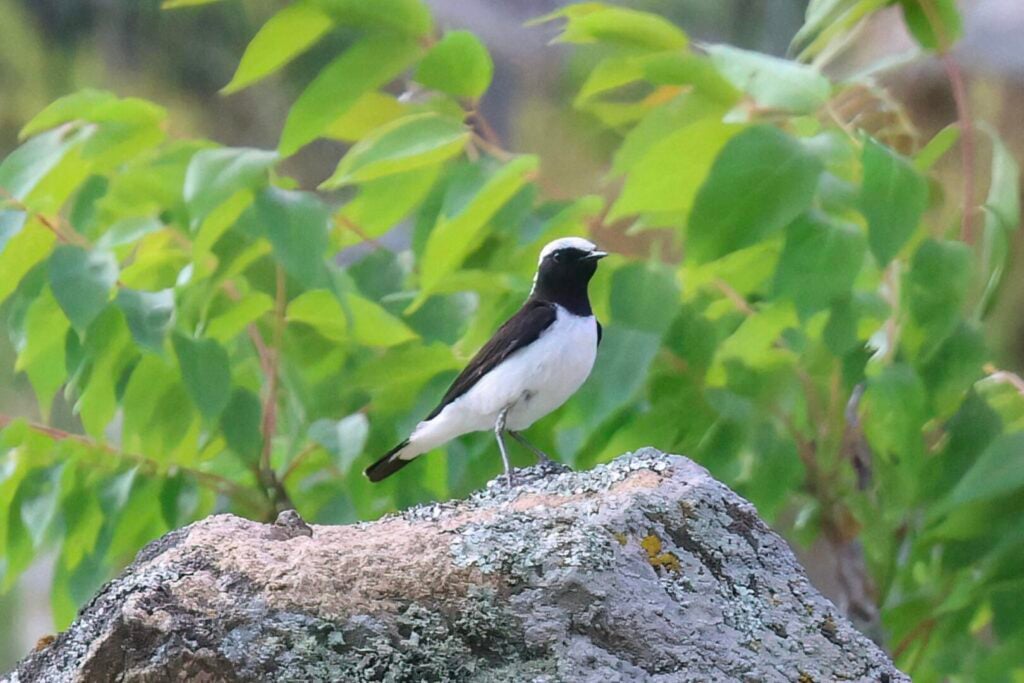
Up onto the top, we had better views of the Wheatears. We could see the male had more white on the back than a typical Pied Wheatear – consistent with a Pied x Eastern Black-eared Wheatear hybrid. Hybridisation is assumed to occur on the west side of the Black Sea (as well as in the Crimea and Iran) but the Dobrogea of Romania is north of the breeding range of Eastern Black-eared Wheatear.
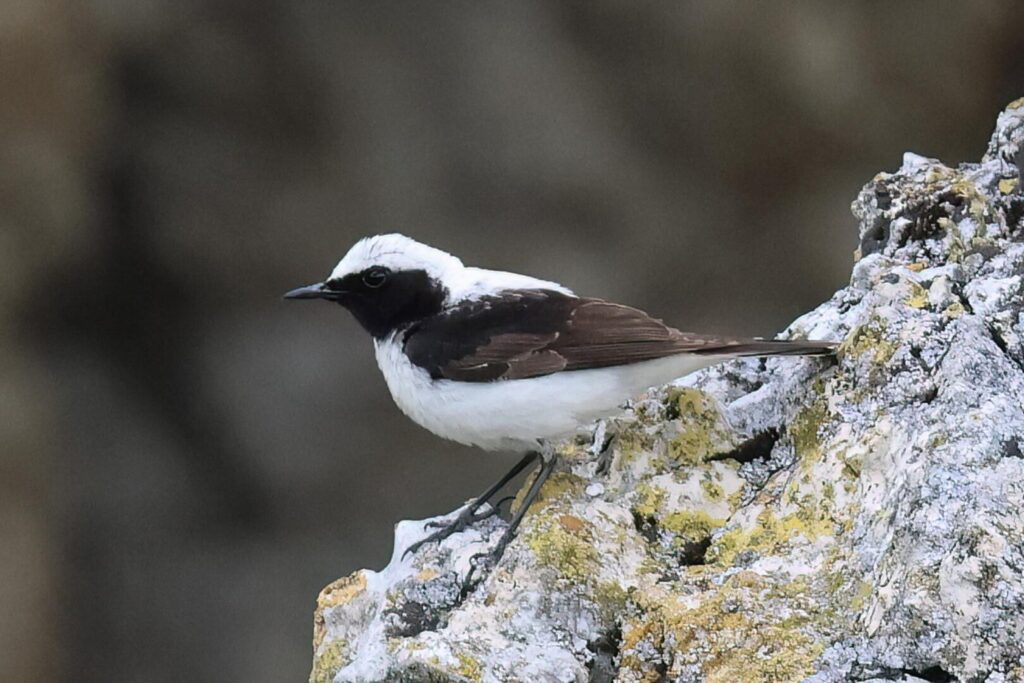
These apparent hybrids may be increasing in frequency in Bulgaria, where the two species do both occur, and it seems that birds with a complete range of colouration occur in Romania. There are suggestions they could be a different subspecies of Pied Wheatear or even a separate species (‘Pontic Wheatear’). Further research is needed to understand what is going on here. Better to just enjoy them for now!
While we were watching the Wheatears, Cristian spotted four Rose-coloured Starlings flying over, followed shortly by another four. We could just see the pink underparts on the second group as they headed strongly away. The surrounding hills here are good for raptors – a Lesser Spotted Eagle drifted over, a Short-toed Eagle was hovering over a distant hillside, and we saw a Booted Eagle and two Long-legged Buzzards too.
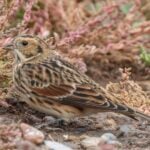
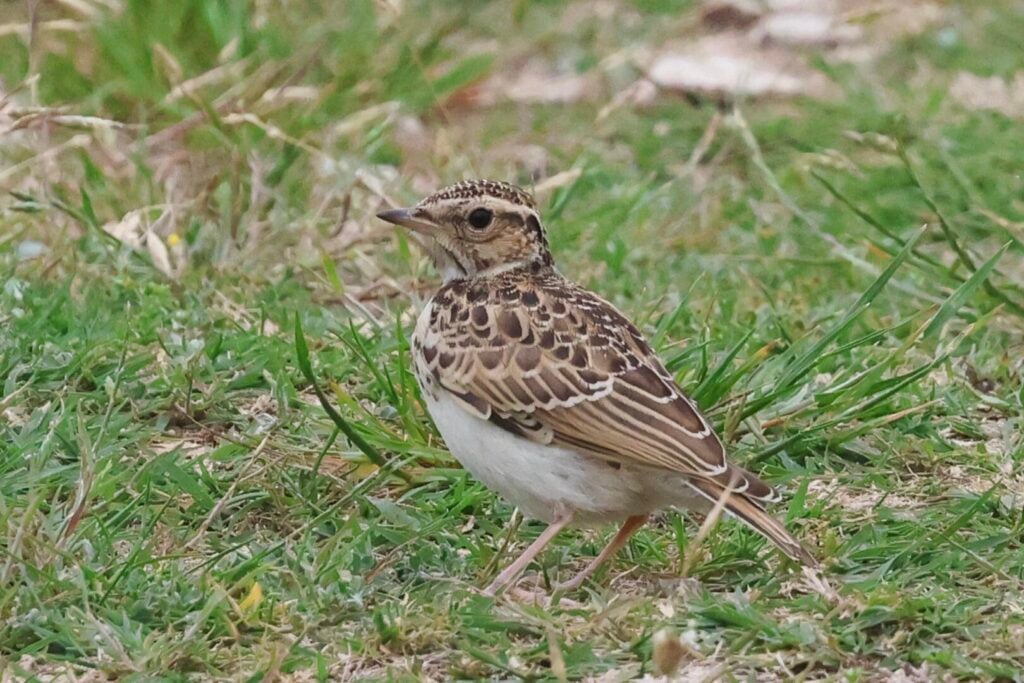
We decided to have a short walk further uphill. Several Corn Buntings were singing and chasing round and a juvenile Woodlark was on the path ahead of us. A Tawny Pipit flew up in song flight further up and landed in a bush where we got it in the scope. A couple of Golden Orioles flew out of the trees calling and disappeared off over the ridge. Further up, we found a pair of Red-backed Shrikes in the bushes, and a Jay.
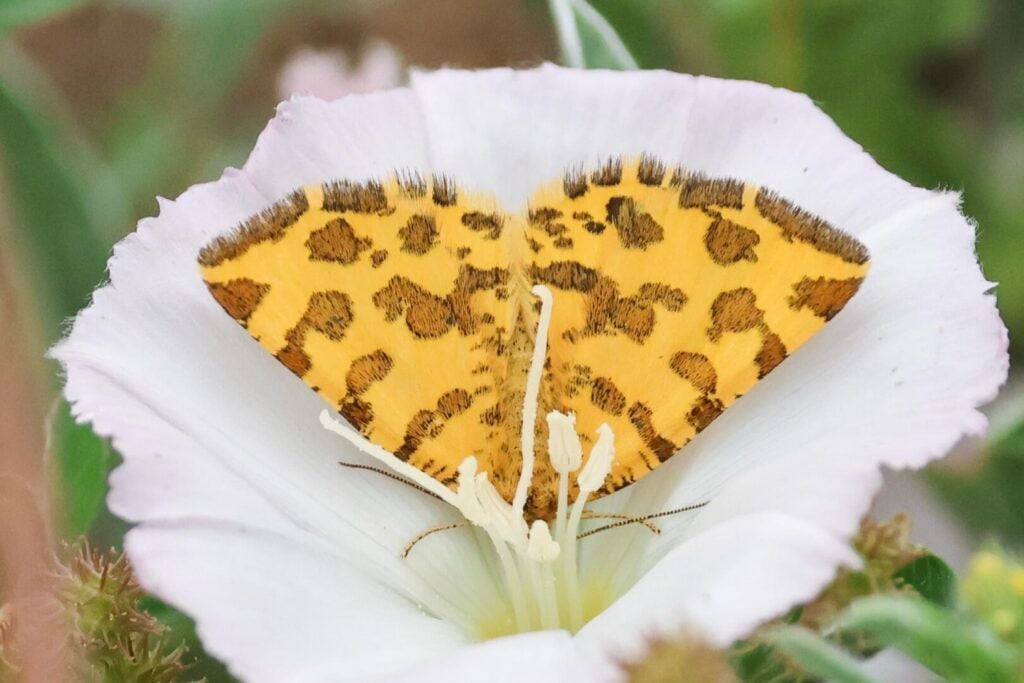
There were lots of moths in the grass here, mostly Synaphe moldavica, but also singles of Speckled Yellow and Lace Border. A few butterflies too, including Cardinals, Small Heath, Adonis Blue and Brown Argus. Then we turned round and walked back down to the bus.
It was about an hour and a half’s drive back to Tulcea from here. Lots of Corn Buntings were on the wires but no sign of the hoped for Black-headed. We were not sure if they had arrived yet, particularly with spring being a bit late this year. Plenty of Rollers and Bee-eaters on the wires too. Two Turtle Doves flew over the road ahead of us.
We had been very lucky with the weather. We could see ominous dark clouds ahead now, and as we drove towards them it started to rain. Thankfully we were in the bus! It was also only brief, probably we just caught the edge of it, and quickly drove through. By the time we got back to Tulcea, the sun was out again.
We were staying in the Hotel Select in town so we had to check in when we arrived. Our bags had been brought over from the flotel and were waiting for us there. We had a chance to get sorted out and freshen up before dinner in the restaurant tonight.
Tuesday 2nd June
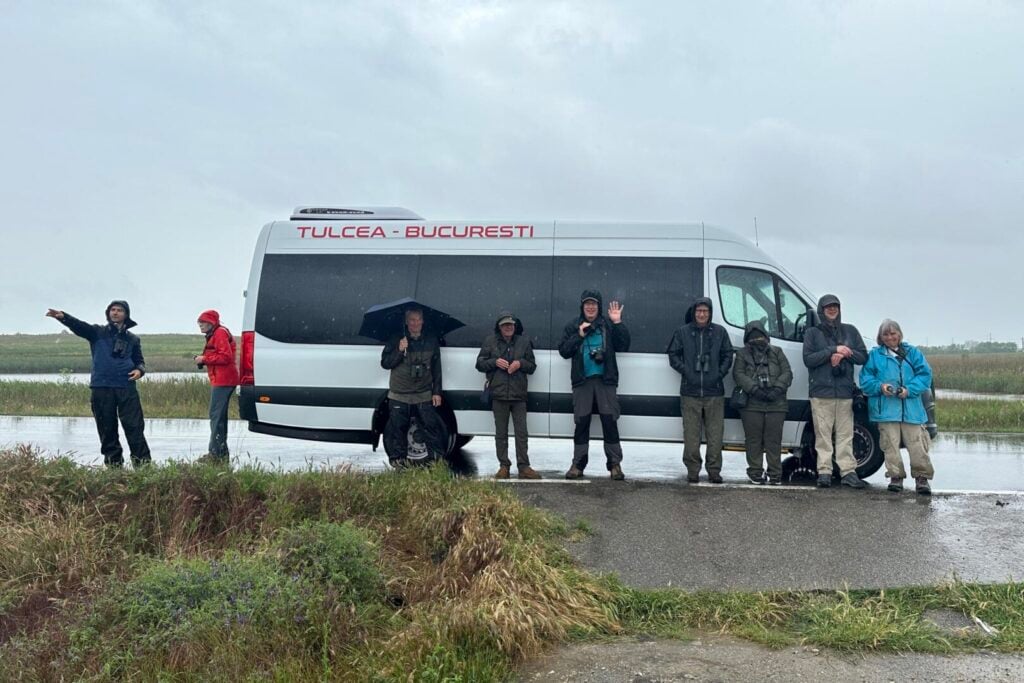
Breakfast was served from 7am in the hotel. It was cloudy outside at dawn but at some point while we were in there, it started to rain. Cristian and minibus came to meet us as usual, and we left at 8.30am. Our first stop was at Bestepe. When we got out of the minibus, it was still raining, not too heavy but steady, so we wrapped up in our waterproofs.
There is usually a great view out across Delta from here but not so much in the low cloud today. We started on the sheltered side of hill but as we walked up the track, we came out into the wind. There was no shelter up here, and the rain was driving at us. Not very pleasant so we decided to turn round and walk back down. There was at least a nice selection of wildflowers by the track, including Pale Bugloss.
We drove on further to Murighiol and stopped in a layby overlooking a couple of lakes. It was still raining but less windy here. A Corn Bunting was perched on the fence, singing. We could hear a Cuckoo calling, and watched it fly round and then land on the wires in front of us. A Great Reed Warbler was singing from the reeds behind.
There were plenty of Black-winged Stilts and Common Shelducks on the pool out in front. A few Caspian Gulls and Common Terns were out on an island in the middle and we found two White-winged Black Terns distantly with them.
A couple of small groups of Little Gulls flew over and some stopped to feed on the pool behind, mostly immature 1st summers but with one or two 2nd summers and a single adult. A Glossy Ibis drifted over. Looking at the rainfall radar, we could see that the worst of the rain appeared to be in a narrow band which should eventually blow over, so we persevered.
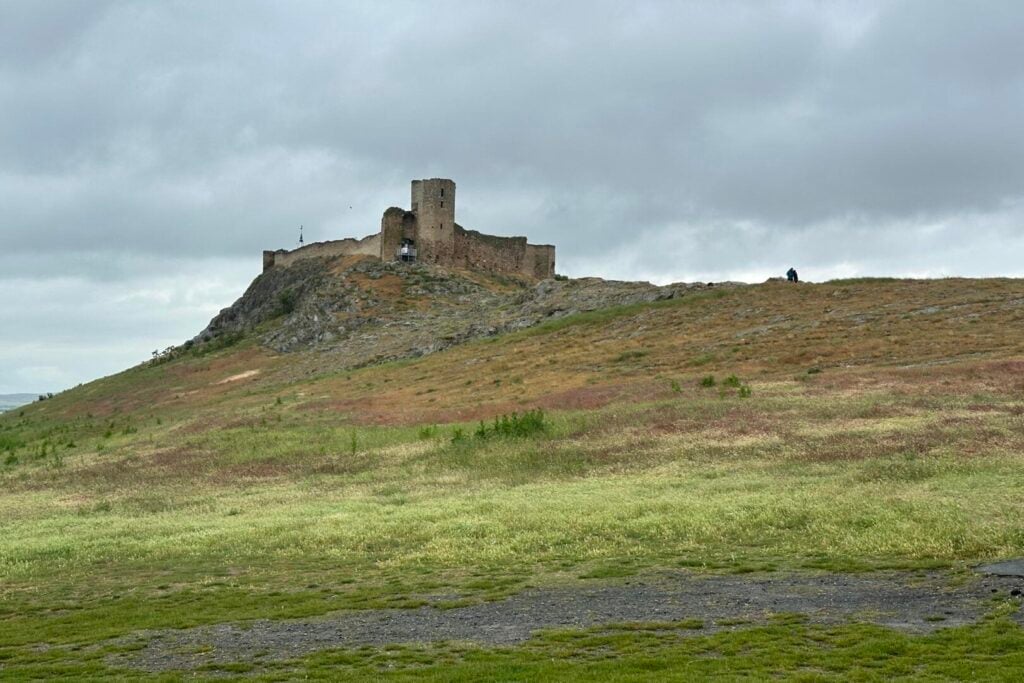
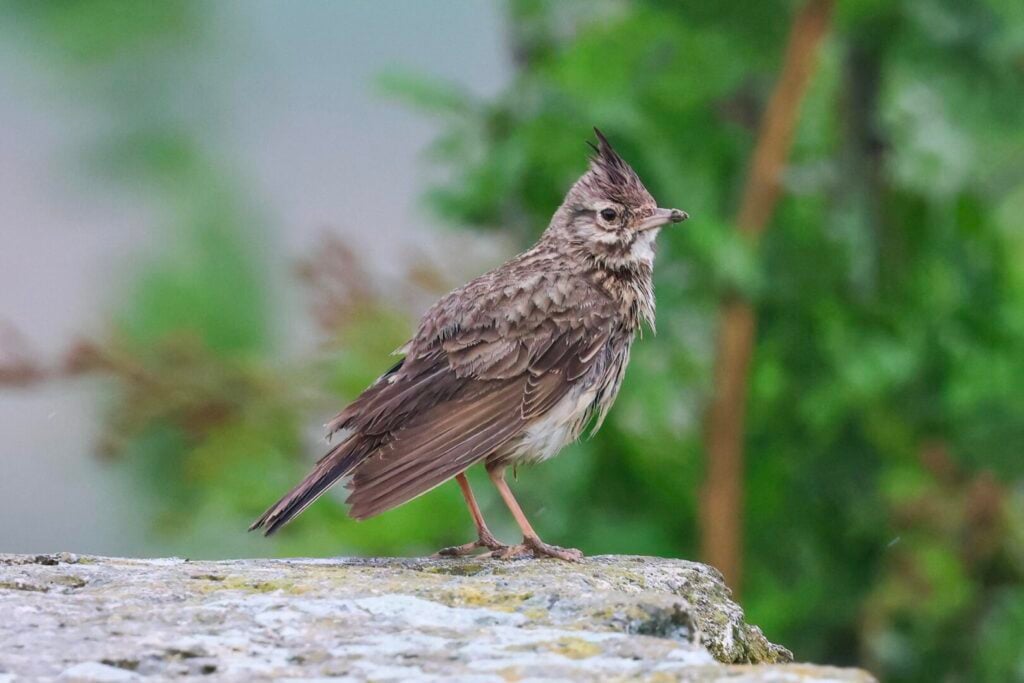
Moving on before we got too wet, we drove on to Enisala castle next. By the time we got there, the rain had indeed stopped. A very soggy Crested Lark was perched on a rock by the entrance barrier. We walked up for a closer look and it flew in and landed right next to us. Very accommodating! There were still some dark clouds overhead but once those passed over we decided to have a walk down the hill and stretch our legs.
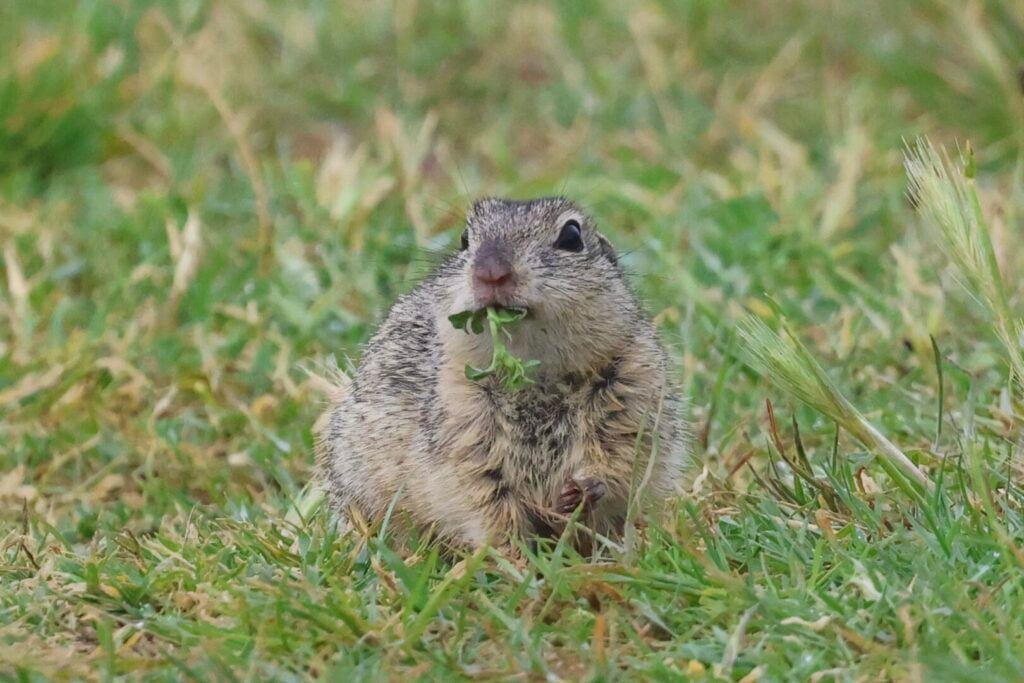
A Suslik was feeding on the track in front of us, at least until the feral dogs walked on ahead of us and it scuttled into its burrow. A couple of Northern Wheatears were on the rocks on the hillside below the castle. Lots of Swallows and Bee-eaters were hawking for insects over the meadows and around the flock of sheep on the hillside. A lone male Pheasant was in the grass. Four Collared Pratincoles flew high overhead calling and a White Pelican circled over the rocks below the castle presumably looking for lift.
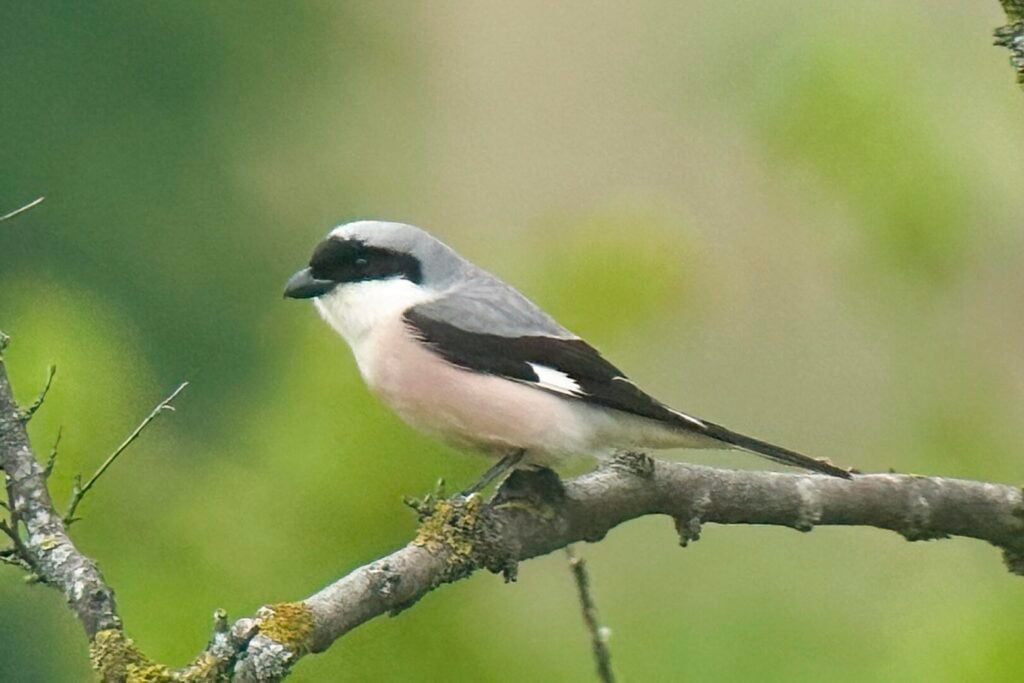
Looking out over the marshes opposite, we could see a few Marsh Harriers and Grey and Purple Herons flying round. Down towards the bottom of the hill, there were more Bee-eaters. A Lesser Grey Shrike and a pair of Red-backed Shrikes were all perched in the dead umbellifers, at least until the Lesser Grey chased the Red-backed Shrikes off. The minibus had driven down to meet us at the bottom and, as we walked across the road, we picked up a distant Rose-coloured Starling flying over the marshes.
It was still dry, if a little windy, so we drove over to a nearby area of open oak woodland for lunch now. A pair of Turtle Doves flew off up the hillside beyond as we got out of the minibus. Another Lesser Grey Shrike was in the trees next to where we parked and we watched it flying from perch to perch, tree to tree while we ate. There were several Meadow Brown butterflies out now, in the grass. After lunch, we moved on to Babadag. Driving through the town, a woodpecker flew across in front of us again, presumably another Syrian Woodpecker.
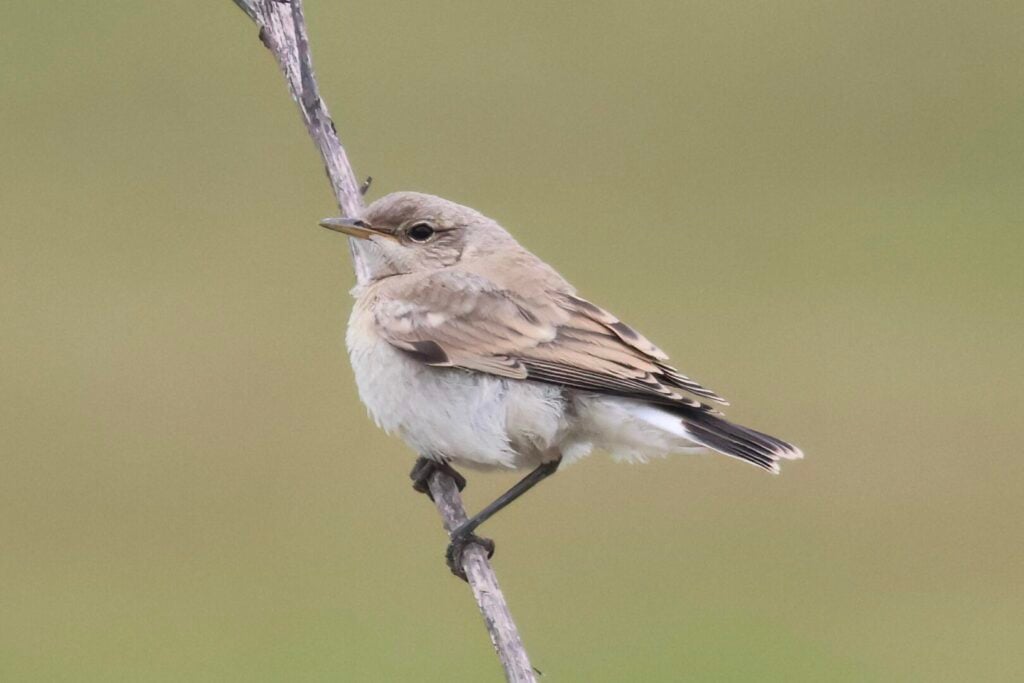
Stopping in the grassland on the far side of the hill, a juvenile Isabelline Wheatear flew up and landed in a dead stem right in front of the bus. When we got out, we found at least four on the track and we got one in the scope, perched on a nearby rock. When a dog walked through them, one hovered over it, showing off its tail pattern. Three Turtle Doves flew past but disappeared off over the trees.
Walking up the track towards the monastery, a couple of Red-footed Falcons were perched in one of the small trees further up. A Corn Bunting was singing from another tree out in the grass. We heard an Ortolan Bunting singing the other side of the track, on the edge of the wood, and found it perched up in the top of a dead tree.
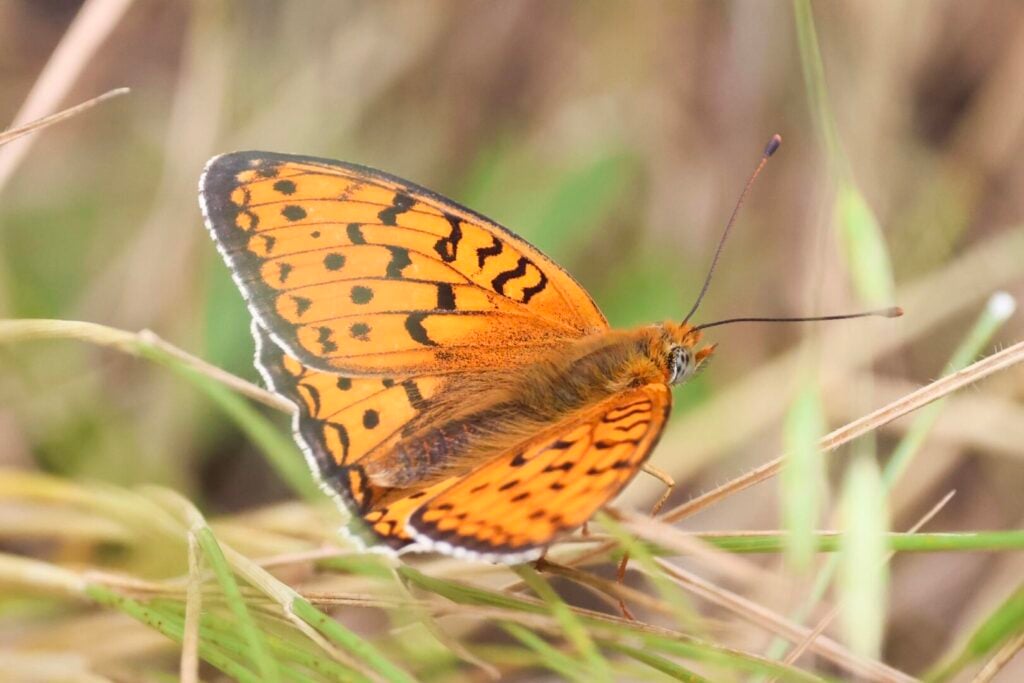
The weather had improved a lot from early this morning but was still rather cool and cloudy. Despite that, we found a few butterflies and moths – Niobe Fritillary, Adonis and Common Blue, Meadow Browns, lots of Synaphe moldavica, Four-spotted, Yellow Shell and a Rush Veneer.
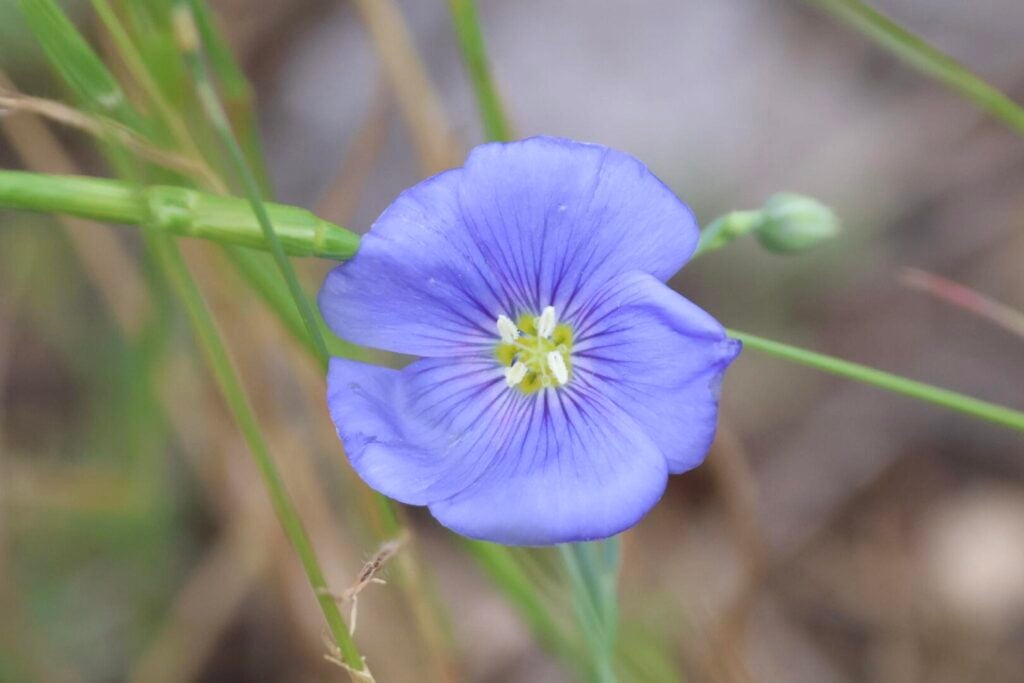
This is a good area for wildflowers too, and as we walked along we noted Pyramidal Orchid, Asian and Narrow-leaved Flax, Crownvetch, Great Milkwort, Ground-pine and Round-headed Leek, among others.
Another Ortolan Bunting flew up and landed in a dead tree ahead of us. When it flew down again, it was replaced by a Chaffinch. As we turned to walk back, two Woodlarks flew over the trees behind us calling and one started to sing. A distant Red-backed Shrike was perched on the fence up by the monastery. We could hear a Common Nightingale singing in the distance too, on the edge of the woods across the road.
We drove on a little further to a filling station, to use the facilities, then turned around and came back through Babadag again. Our last stop of the day was at Denis Tepe. As we drove in, we saw several Lesser Grey Shrikes on the wires and bushes, and a few of the ever-present Rollers. They are still present here in good numbers but the population of both seems to be declining even here, particularly where agriculture is intensifying. Catch them while you can!
A Grey Partridge ran out from the verge and we watched it as it walked back across the margin of the field and disappeared into the crop. We stopped at the far end and got out. Several Corn Buntings were on the wires, singing. Lots of Bee-eaters were hawking low over the grass. A Skylark fluttered up from the cultivated field where several Northern Wheatears were feeding too.
We walked on, up to the bottom of the hill, where several Hoopoes were flying in and out with food. Scanning along the track through the grass around the bottom of the hill, we found a Tawny Pipit and another pair of Northern Wheatears. A brief Isabelline Wheatear flew across behind.
It had been dry since this morning but now it started spitting with rain again. It didn’t look like it would come to much though so we walked down along the track. A pair of Crested Larks was on the rocks above, then one landed on the path behind. Several Kestrels were hanging in the wind over the top of the hill.
The one species we hadn’t found here which we normally can was Short-toed Lark. As we walked back, we heard one singing and found it fluttering up high up in the sky over the cultivated field back near the entrance track. After a while, it plummeted down into the long grass.
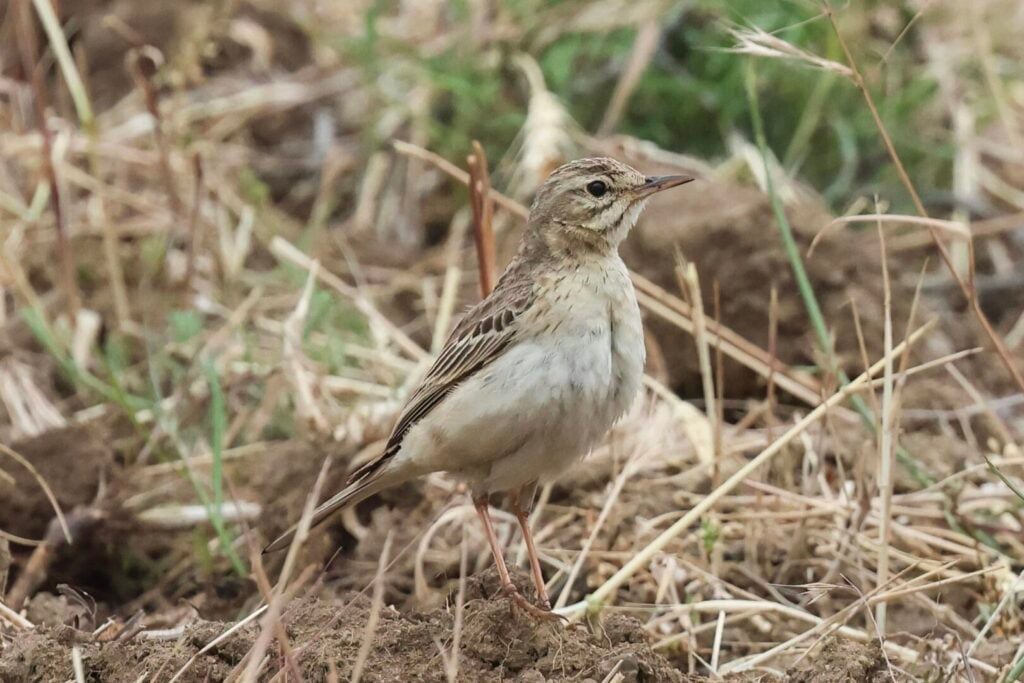
Another started singing and sounded like it was out in the field. We scanned across and couldn’t see it but we did find a Tawny Pipit feeding out in the middle. It gradually worked its way towards us until it was very close, just in front of us. Lovely views.
It was still spitting with rain – only light, but people didn’t want to get wet, so we got back in the minibus. It was already after 5pm by the time we got back to the hotel. After the wet start, we had been very lucky with weather. It could have been much worse and we had still managed to see a lot. The forecast looked a lot better for tomorrow.
Wednesday 3rd June
Breakfast was served from 7am in the hotel again. A large coach group of Romanian tourists had arrived last night and had packed out the restaurant the minute it opened, eating everything in sight. Thankfully, once the rush died down, the staff refilled the buffet. We met Cristian in reception and the minibus was waiting outside again.
It was only about 25 minutes’ drive to our first stop, a grassy hillside covered with open woodland near Somova. As we got out of the bus, we could hear Golden Orioles and Great Tits calling, and Chaffinches singing. There were several Bee-eaters and one or two Rollers in the trees, and a Lesser Grey Shrike. After a cloudy start, the sky was clearing steadily now and it was warming up. A distant Booted Eagle was hanging in the air over the ridge opposite and several Honey Buzzards and a kettle of White Pelicans circled in the sky ahead of us.
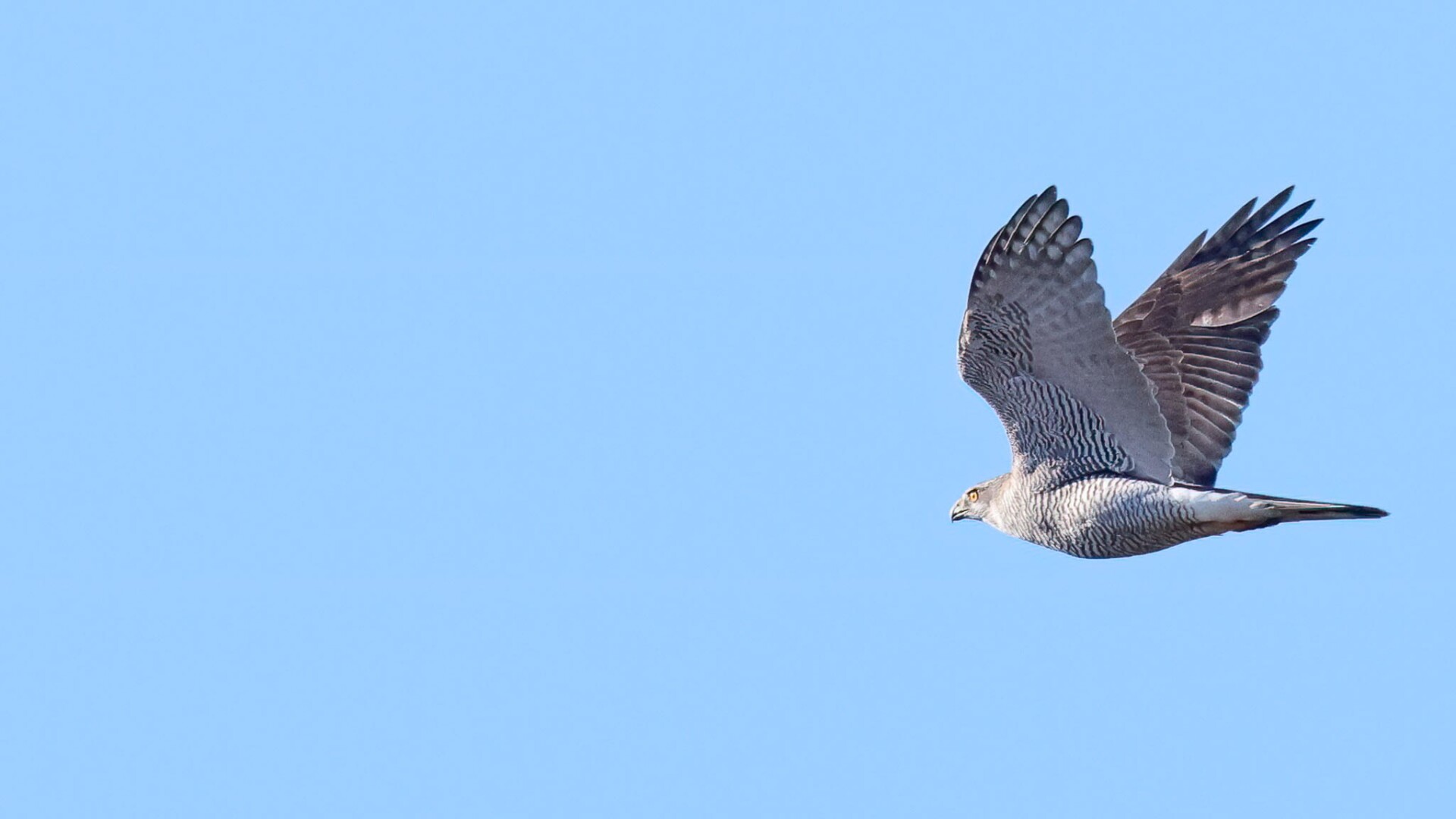
Walking along the track through the trees, we caught a glimpse of a Levant Sparrowhawk as it flew from a dead branch. Thankfully it appeared again, out from behind some trees, and landed again in full view. A female, we got it in the scope and had good views of it. We could see its distinctive dark eye.
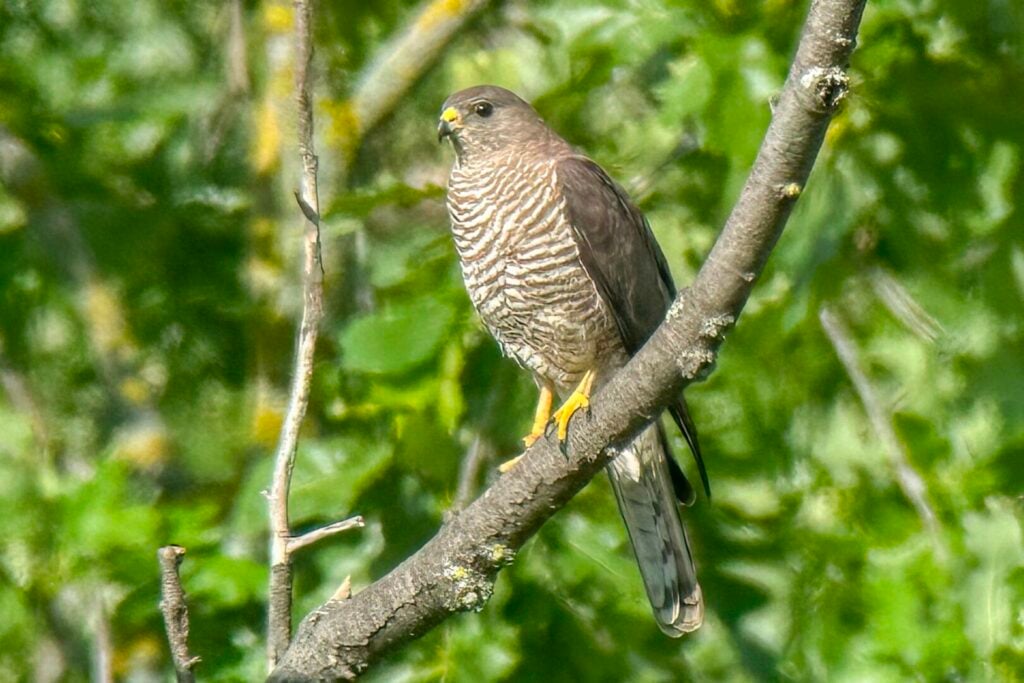
When it finally flew again, we continued on. Two Woodlarks flew up from the grass with food in their bills and landed briefly in one of the trees. A Green Woodpecker was perched on a dead branch in the crown of another. We could hear a couple of Hoopoes calling and got one in the scope.
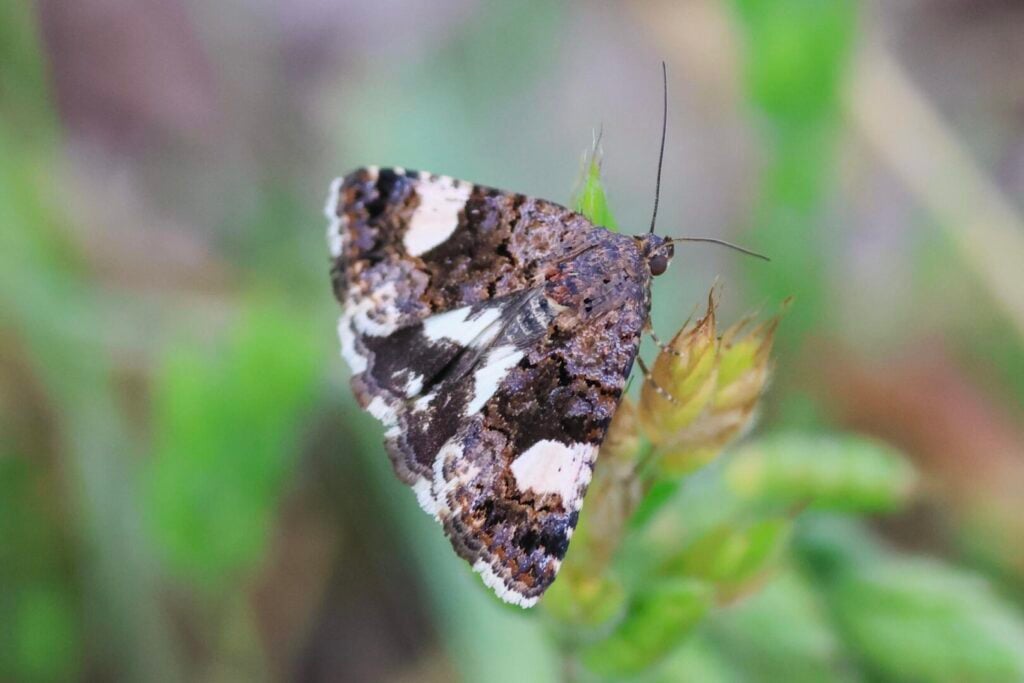
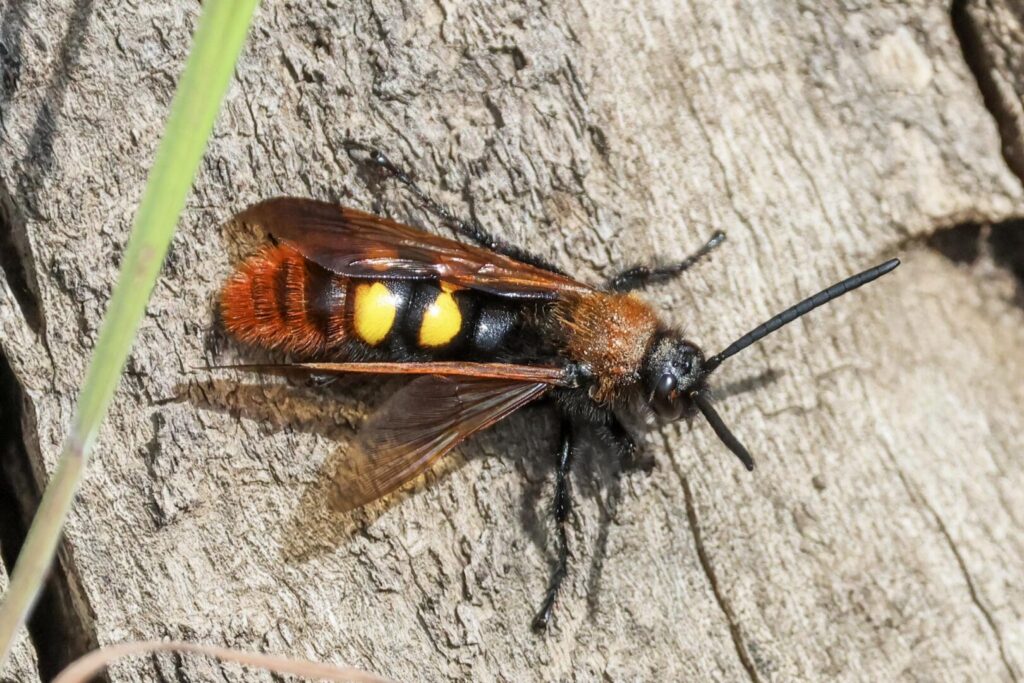
Lots of grasshoppers scattered ahead of us as we walked through the grass. There were several butterflies and moths too, including the first Queen of Spain fritillaries of the trip and Four-spotted moth. Lots of Large Four-spotted Scoliid Wasps were swarming round a couple of dead tree stumps.
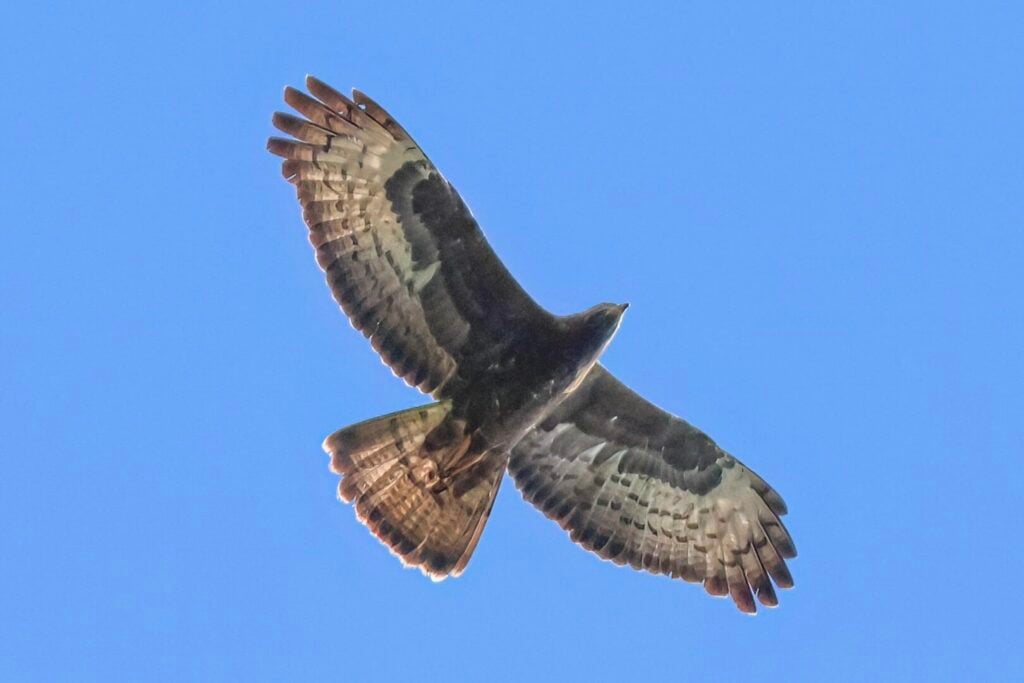
Two Honey Buzzards circled overhead much lower, with a single Steppe Buzzard just above.
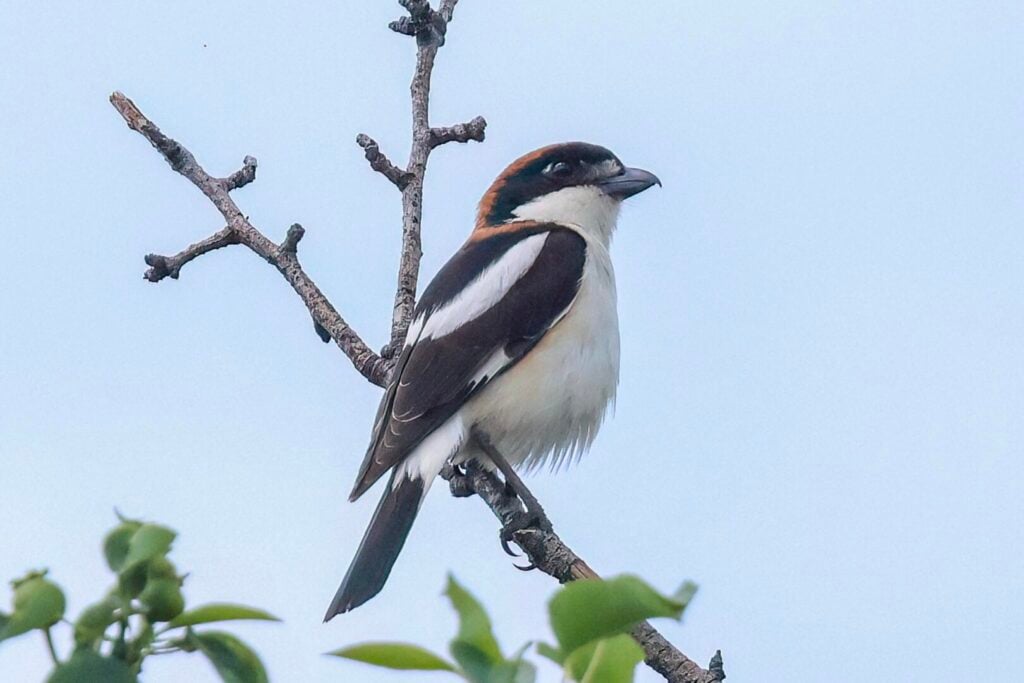
A Woodchat Shrike was perched in the very top of a large oak tree some way off. When it flew, a male Red-backed Shrike then appeared low in a bush nearby. We had turned our attention to a Steppe Buzzard which was perched low down in a small tree when the Woodchat Shrike reappeared in the top of the oak right above us. Very obliging of it!
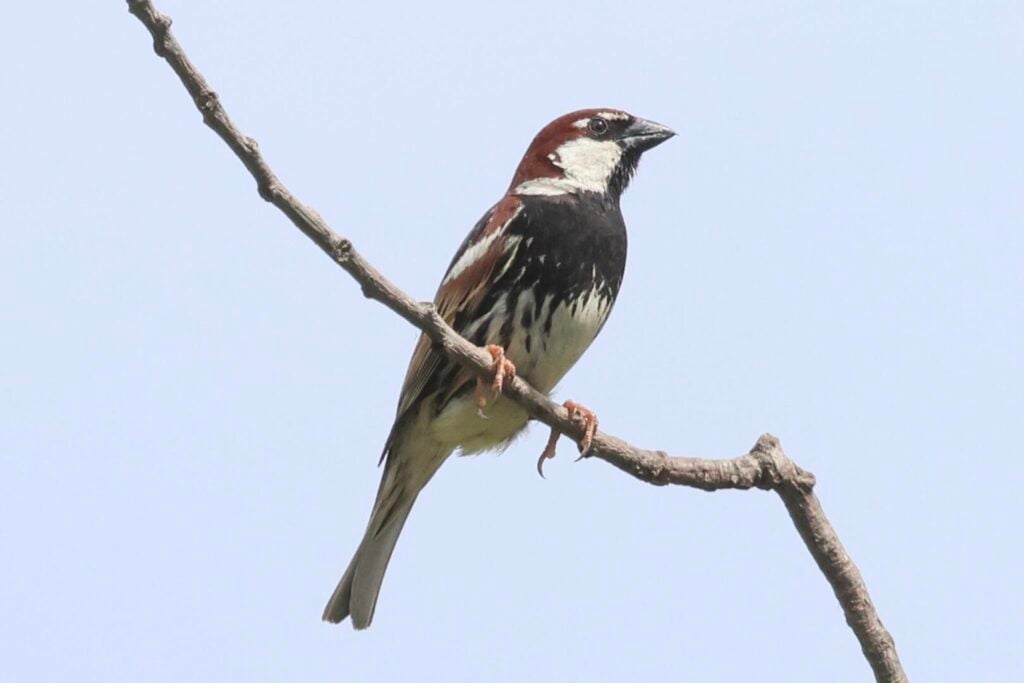
Further on, we could hear Spanish Sparrows calling and found a smart male perched in the top of a tree. A Red-rumped Swallow circled high above and another Levant Sparrowhawk flew over.
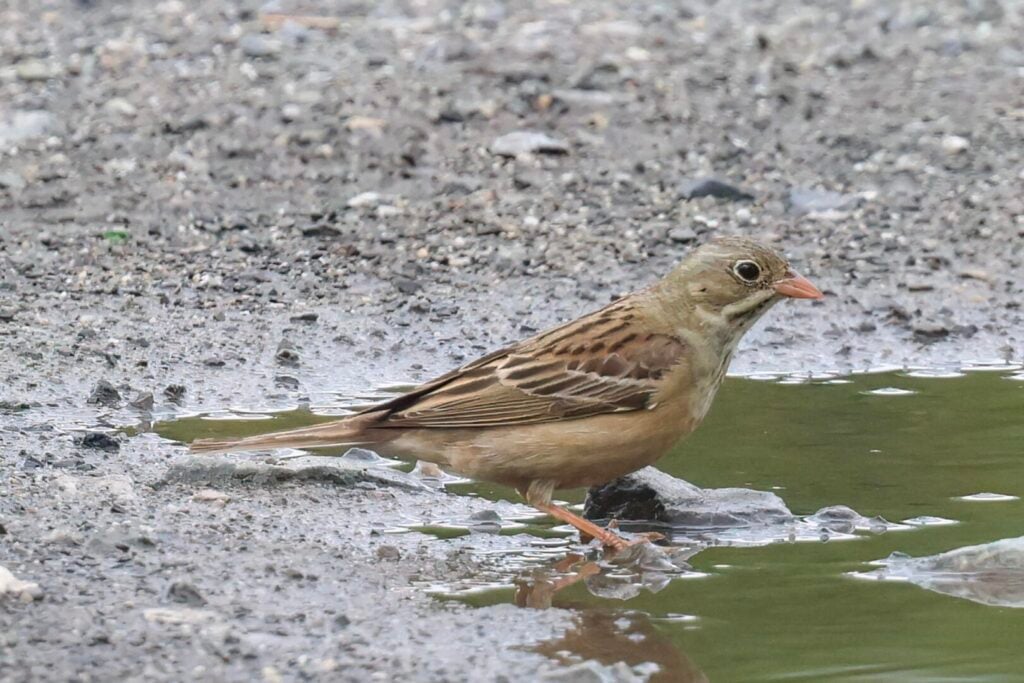
The minibus had driven on and was waiting for us now down by the road. While we stopped to refill our water bottles from the back, we noticed an Ortolan Bunting drop down to bathe in a puddle just in front of us. There were lots of Spanish Sparrows in the oak tree above and several of those came down to bathe too, as did three Linnets. The pair of Red-rumped Swallows came in several times to collect mud.
We could hear more Golden Orioles calling from across the road and noticed a brief Spotted Flycatcher moving through the trees. A pair of Levant Sparrowhawks circled up.
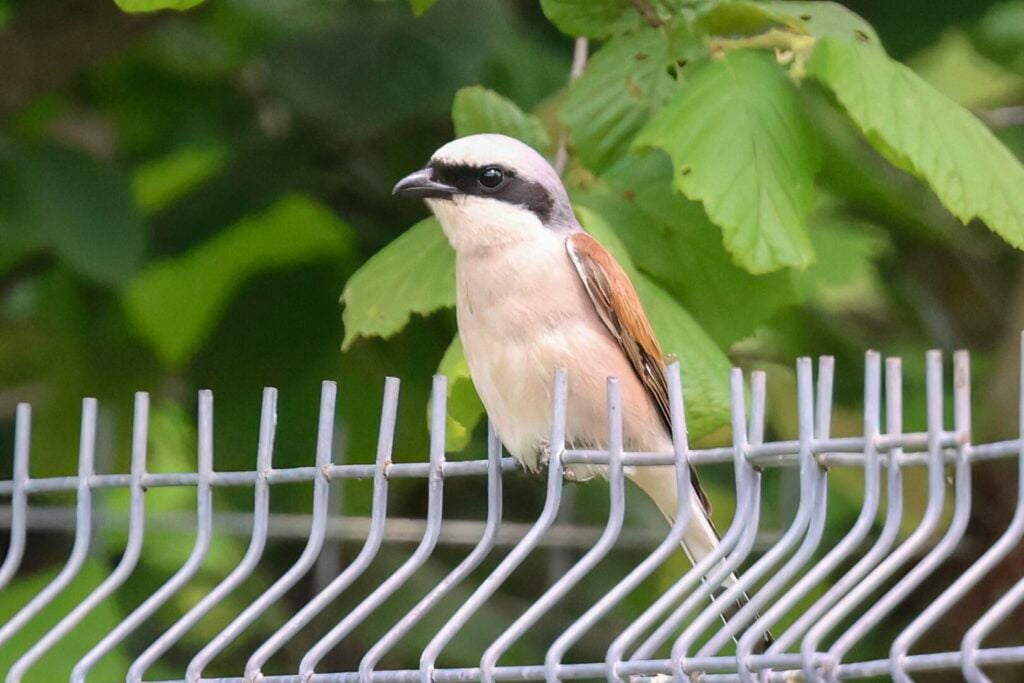
Moving on, we drove over to the monastery at Celic Dere. As we got out of the minibus in the car park, a Nuthatch was in the pine trees just beyond. Walking down the track, we found a male Red-backed Shrike perched in a tree in the garden, preening. It flew out, flycatching, and then returned to the fence. The female Red-backed Shrike then flew out with food in its bill and disappeared into a bush right in front of us. When the male followed, we figured they probably had a nest in there.
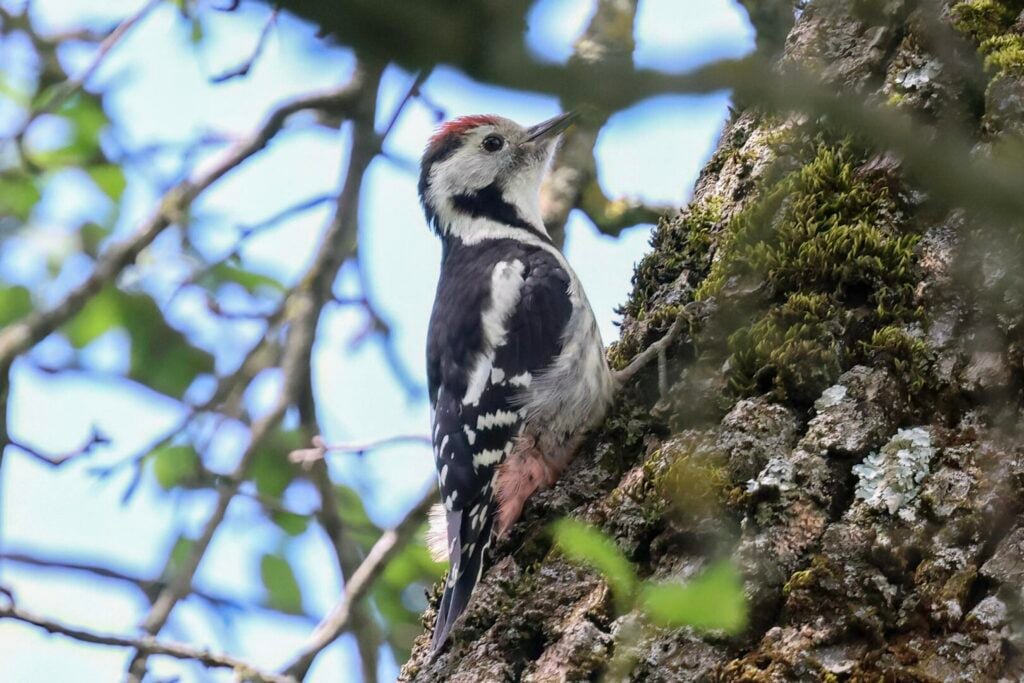
A Booted Eagle, Black Kite and a Steppe Buzzard circled over. A Common Nightingale was singing in the bushes and we could hear a Middle Spotted Woodpecker calling. Further up, Cristian showed us the woodpecker’s nest hole. Another was calling agitatedly nearby, so we backed off, but there was no sign of them going into the hole. Perhaps the young had just fledged. We had a nice view of one of the Middle Spotted Woodpeckers in a nearby tree, where it was joined by another Nuthatch.
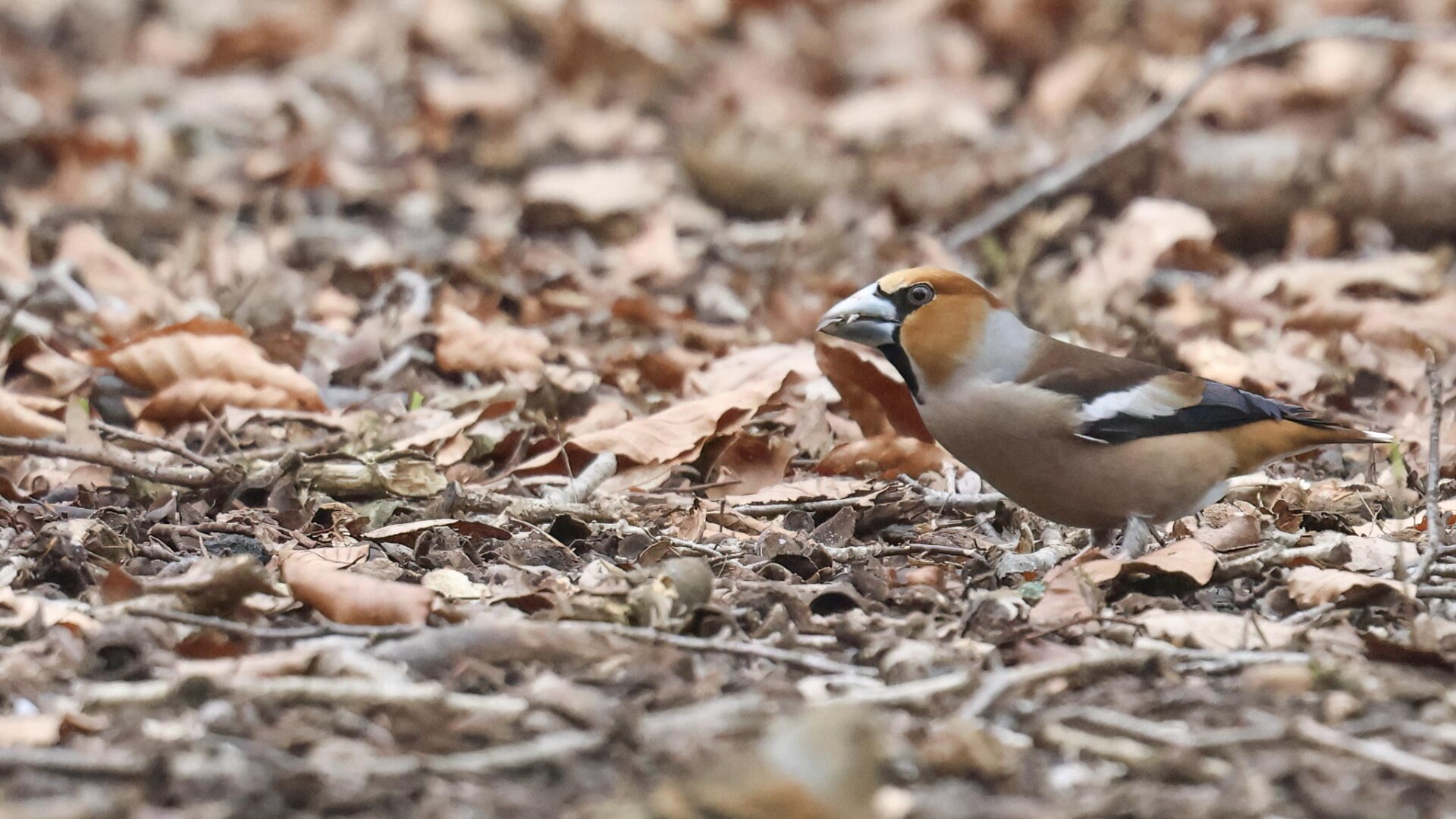
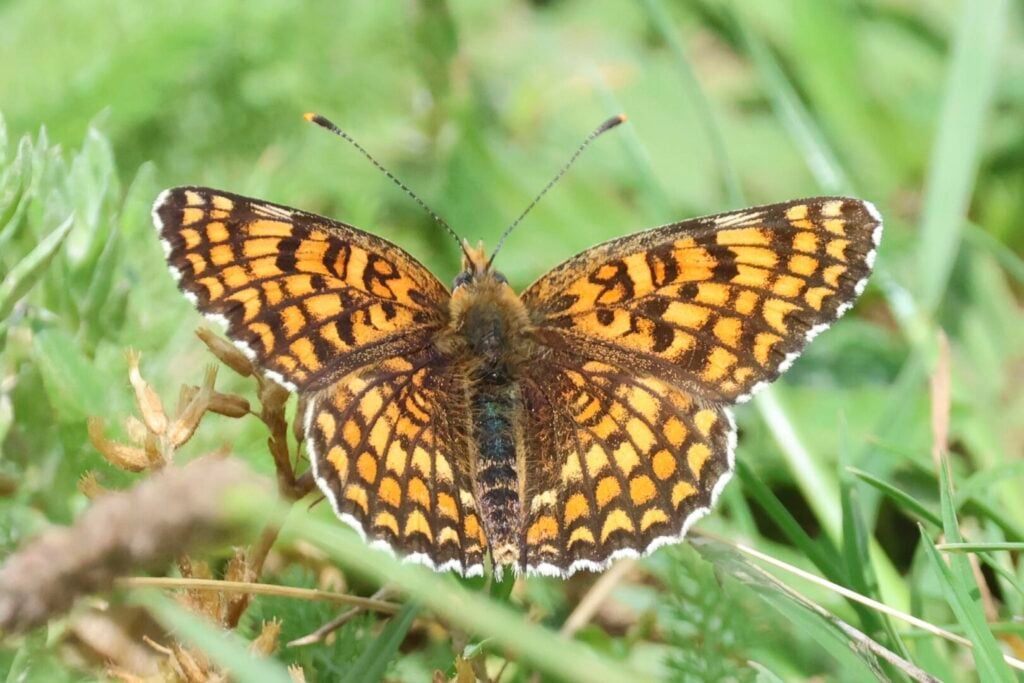
Walking round the edge of the field, there were quite a few butterflies out – a brief Knapweed Fritillary, Queen of Spain and lots of Cardinal Fritillaries. Another Red-backed Shrike was flycatching from the top of the trees just across the stream. We stopped to talk to one of the other guides, Florin, who had just come out of the woods and was walking the other way with a Swiss group. A Hawfinch flew over.
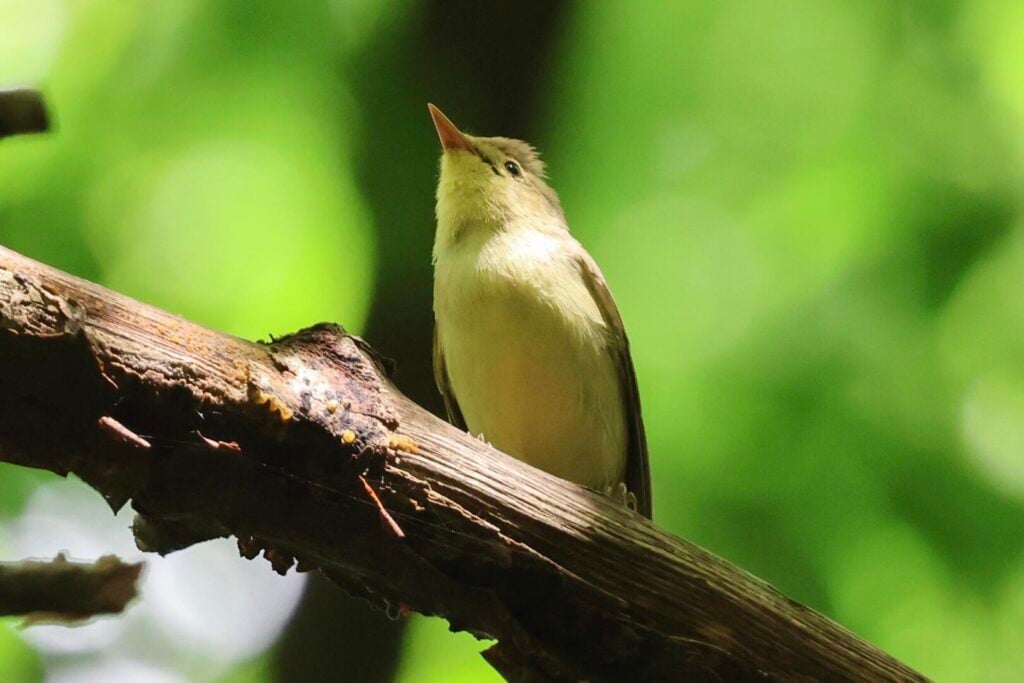
Even from here, we could hear Wood Warbler and Icterine Warbler singing in the wood across the field. An Eastern Green Lizard was basking in the long grass. We cut across at the far end of the crop and into the trees.
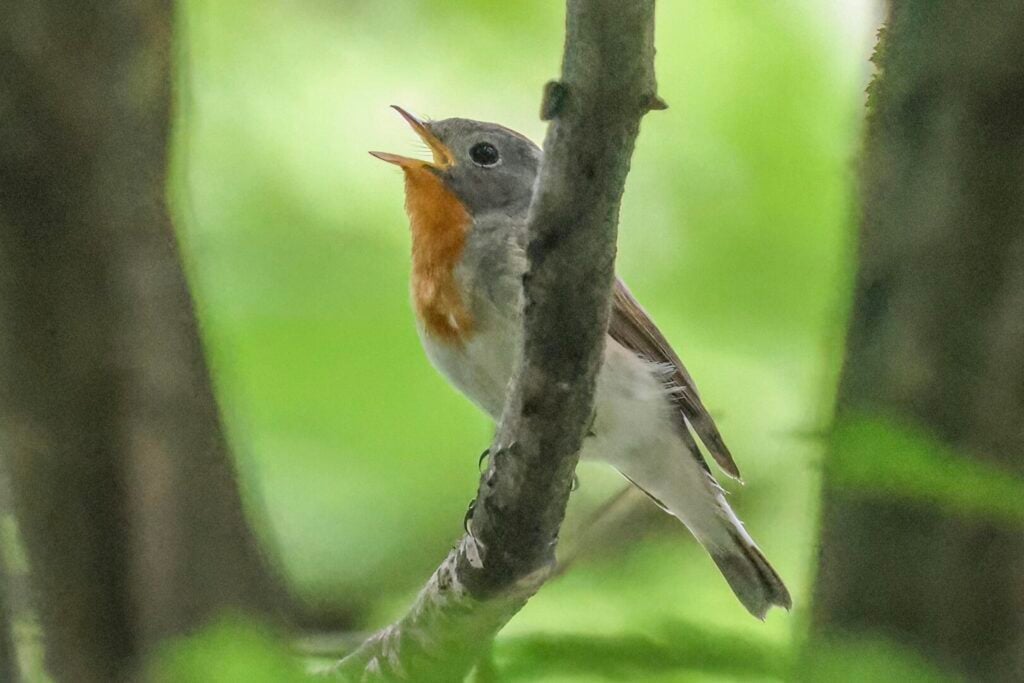
Two Wood Warblers were singing now and we had a brief view of a Red-breasted Flycatcher. We figured they would be easier to see from the track so we walked up. Good views of a singing Wood Warbler now and two Icterine Warblers in the branches right above us at one point.
Another Red-breasted Flycatcher started singing ahead of us and we managed to find it up in the trees just as it chased off by two Chaffinches. It was very mobile at first, singing in bursts from different places, but eventually we tracked down to a low branch. It stayed here for a while, singing and flycatching, so we could get in scope. Smart birds and always nice to see a male in breeding plumage.
We walked back down the track and out of the wood. The minibus had come down to the clearing by the edge of the field. It was time for lunch and Cristian and the driver set up the picnic table. A pair of Golden Orioles was singing and calling from the ash trees nearby and a couple of Hawfinches appeared in the tops of the trees too, briefly.
After lunch, we got back in the minibus. It was about an hour’s drive over to the Macin Mountains. Driving in along the entrance track, there were lots of Corn Buntings on the wires and lots of White Storks feeding in the long grass beyond. Parking up under some trees, a Lesser Grey Shrike flew out and landed in the bushes in front.
It was hot and sunny this afternoon, and more humid too after the rain. Walking down the track through the grass, an Isabelline Wheatear was perched on the National Park signs. We could see the huge quarry ahead of us and hear all the machinery mining the face of the hills. Strange to see this happening in a National Park!
We turned right and headed away from it, up towards the hills. A couple of Balkan Wall Lizards scuttled across the path ahead of us.
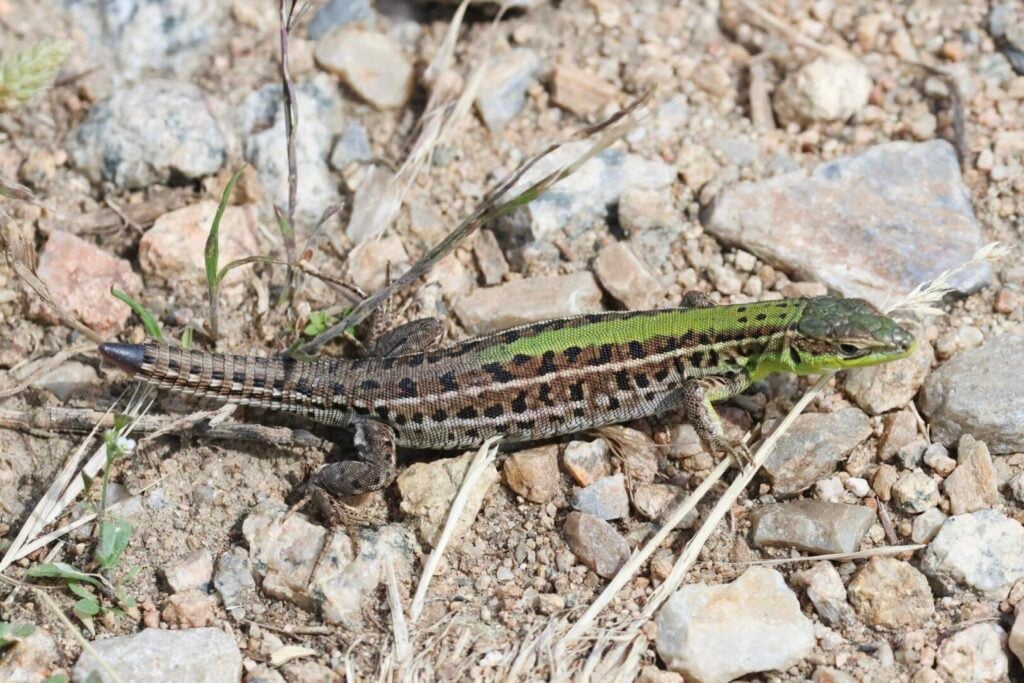
There were lots of butterflies here, Cardinals everywhere, Common, Adonis and Silver-studded Blues, Small Heath and Eastern Bath White. A diverse selection of Grasshoppers, Coneheads and Bush Crickets too, and one of the group found a Ladybird Spider.
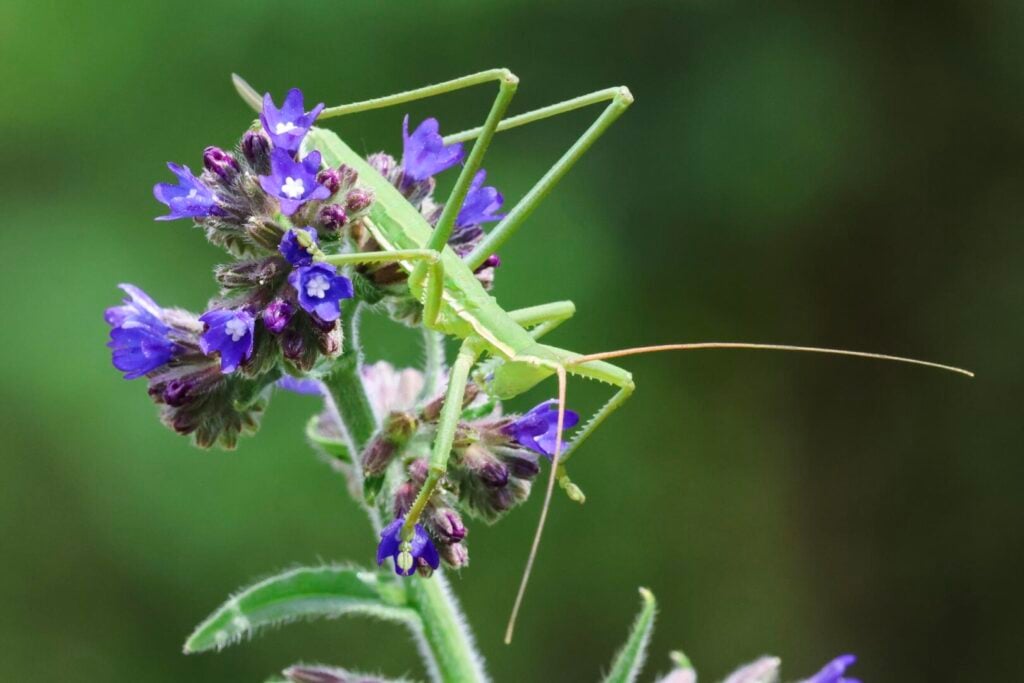
A Red-backed Shrike was perched in the shade in the trees, and we could hear Turtle Dove purring and Common Nightingale singing. A couple of Steppe Buzzards and a Long-legged Buzzard appeared high over the ridge ahead.
Several of the group decided to walk slowly back to the minibus. Into the valley and the trees, it was a bit shadier. Several very impressive Bronze Glandular Bush Crickets were in the grass.
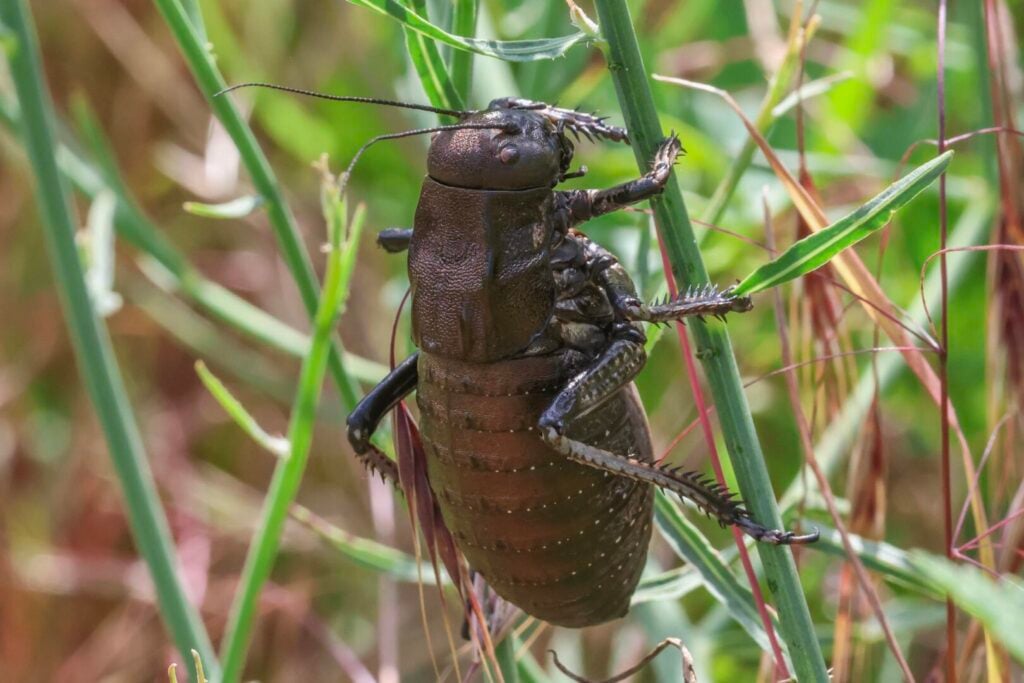
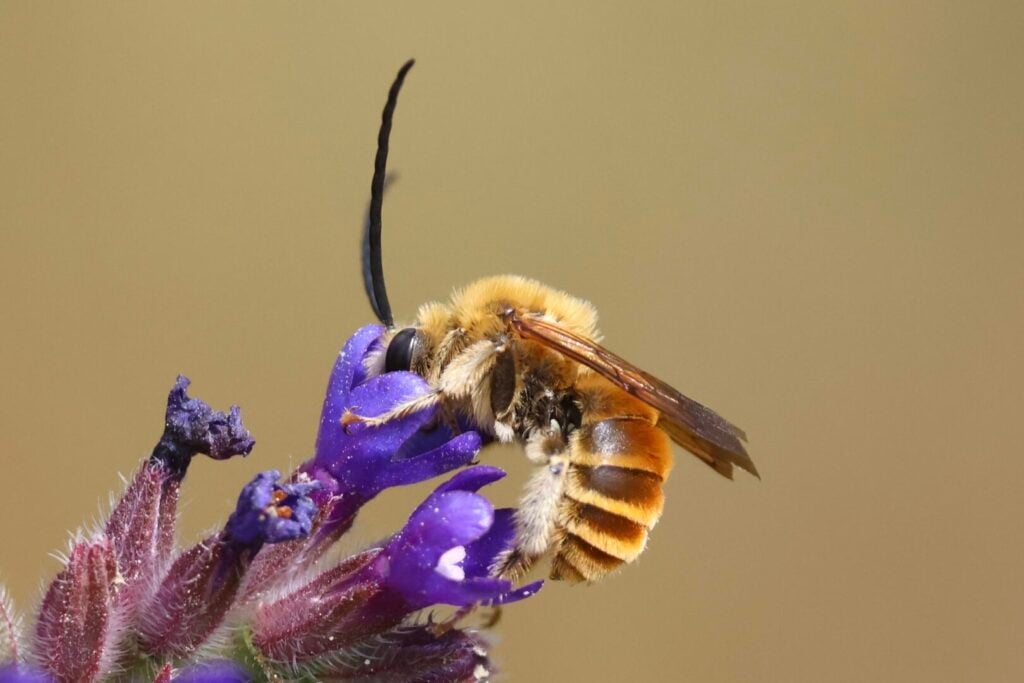
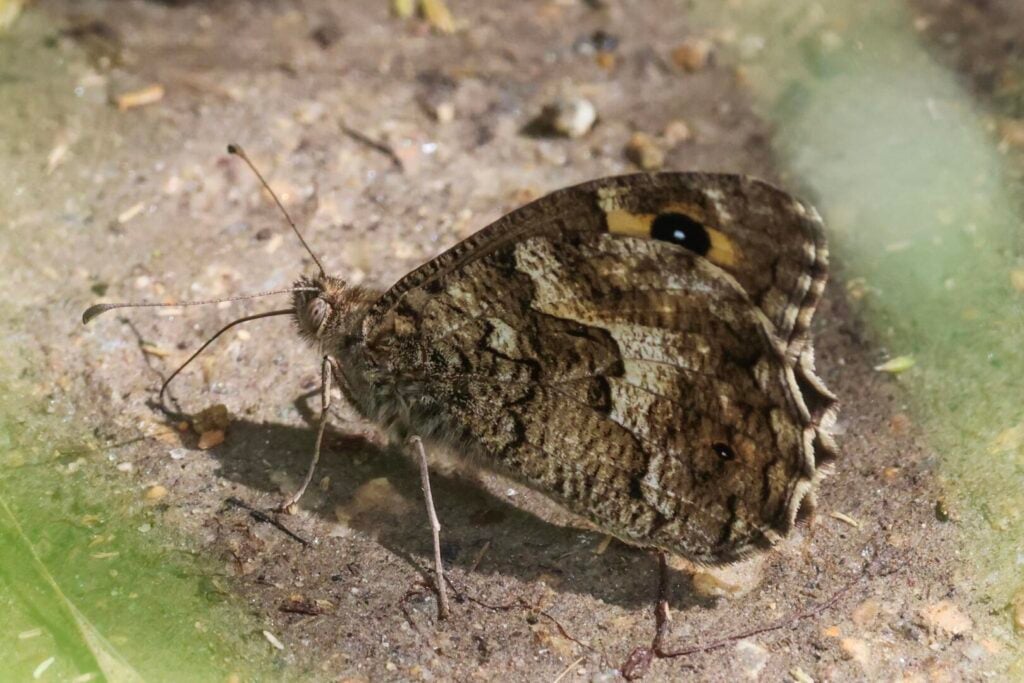
Several Gold-coloured Longhorn Bees Eucera pollinosa were nectaring on the flowers.
Where the stream trickles down along the path, there were more butterflies. Impressive number of Cardinals again, plus Green Underside Blues, Comma, Meadow Brown and one or two Delattin’s Grayling now.
It was about an hour’s drive back from here to Tulcea and with everyone tired we decided to walk back. On the way down, a couple of the group stopped to look at an Ortolan Bunting singing high on the rocks in the scope. A male Pied Wheatear (or hybrid) appeared on the low Sumac trees in front of them, much lower down. It dropped down to feed on the rocks and was joined by the female, before the two of them flew back round towards the start of the quarry behind.
Further down, an Isabelline Wheatear was on the rocks on the edge of the open grass. The minibus was waiting for us at the bottom of the track. We climbed on board and settled in for the drive back to the hotel.
After a break, we met in the restaurant for dinner. It was nice sitting out on the terrace tonight. Afterwards, we went through the list and then discussed everyone’s favourite birds and moments of the trip. The impressive displays of feeding White Pelicans in the Danube Delta came out top for birds, and the huge Bronze Glandular Bush Crickets we had seen this afternoon won the prize in the Other Wildlife category.
Thursday 4th June
Mainly a travel day today. After breakfast, we had a bit of time to pack and, for those that wanted, to explore the town. We checked out and met Cristian and the minibus outside at 9.45am, for the long drive back to Bucharest.
We had time for one quick stop so, after about half an hour, we pulled into a layby at the bottom of a rocky hillside. We were planning to get out to look for Stone Curlew here but looking out of the window now, we saw a family of three, two adults and a half grown juvenile, walk out of the long grass on the verge right beside us. We watched them through the windows as they walked back away from us up the hillside.
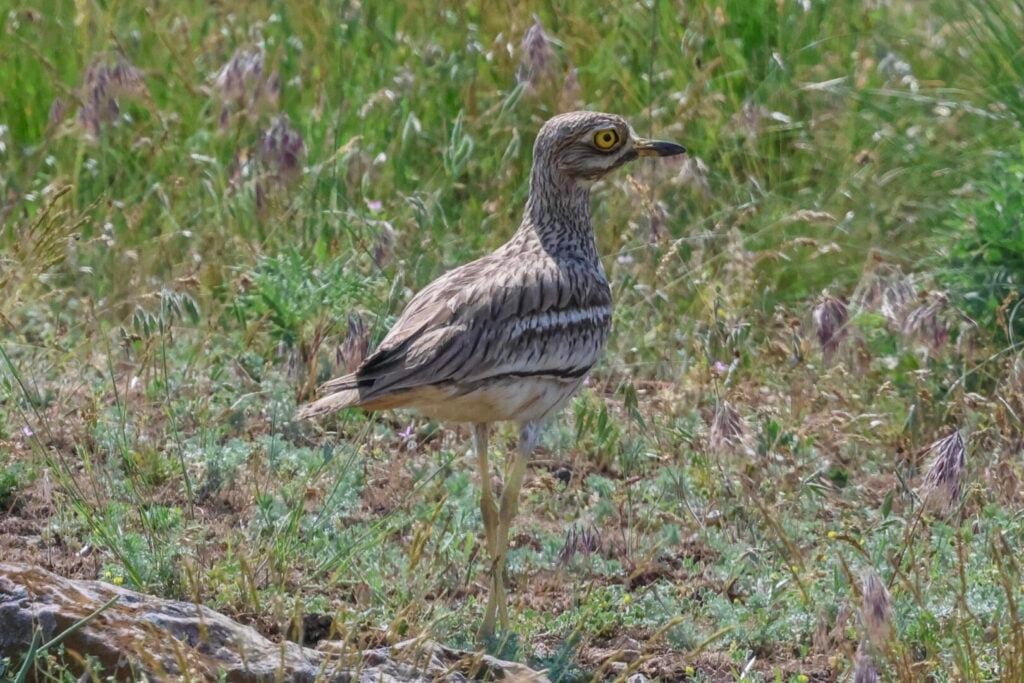
Once they were sufficiently far up, we could finally get out and get them in the scope. A Crested Lark was preening on a rock lower down and we found a male Northern Wheatear and a couple of Isabelline Wheatears further back. A Suslik was feeding in the grass but ran off to its burrow, then another posed on a large boulder, standing up on its back legs like a Meerkat.
Scanning the surrounding countryside, a couple of Yellow Wagtails flew in and out of the field behind and a Hoopoe flew across. We picked up a very distant Long-legged Buzzard over the hills way off over the fields, which was nigh on impossible to see. Then another appeared much closer. A distant field was coated in purple larkspur. Mission accomplished here, we pressed on.
There were certain species we had seen every day so far, so we scanned the skies as we drove on. A little further on, one of the group managed to spot a small group of White Pelicans circling over the hilltops on the right of the bus. Cuckoo had been pretty much ever present this week but eluded us on the journey though, as did Honey Buzzard. We did manage to see a couple of Steppe Buzzards which drifted over the road.
There were a few Rollers and Bee-eaters on the wires and we saw a single Red-footed Falcon hovering over the grass nearby as we passed a large Rook colony in some trees.
As we got out onto the plains, much of the journey was through mile upon mile of open fields with no hedges. The lines of trees which grew on some of the verges until recently, sheltering the roads from the sun, have been chopped down, presumably to allow cultivation closer to the edge of the field. There were still lots of poppies and purple larkspur growing in the verges here but fewer in the fields, which used to be a riot of colour. Fewer Rollers and no shrikes in these areas too now.
A signal of the increasing use of large quantities of herbicides, agricultural intensification and the curse of the EU’s CAP. Thankfully, as we had seen, it is still possible to find large areas of low intensity agriculture here, but for how much longer? A reminder to visit now, before it is all gone.
About half-way, we stopped at a filling station to eat our packed lunch and use the facilities. The rest of the journey was uneventful, the traffic round Bucharest was not too bad and we arrived at the airport in plenty of time, just before 3pm. We said our goodbyes and thanks to Cristian and the minibus driver, then made our way into the terminal.
Our Ryanair flight back to Stansted was not scheduled until 6.20pm so we had to wait for the check-in information to appear. When it didn’t, and in the absence of any updates from Ryanair, we had a look at flight tracking information online. We discovered that the plane which was going to take us home had not even arrived at its previous destination yet and was running about one and a half hours late.
The check-in information finally appeared two hours before our scheduled departure and we could at least go through to the departure lounge and find somewhere to sit down. Still no updates from Ryanair or the airport here, but at least we had confirmation from the office in the UK now that the departure time had been delayed to 7.25pm. Even that seemed ambitious and so it proved.
We were loaded onto buses to take us out to the plane, which again had parked some way out on the tarmac. It was raining outside, so rather than make us queue at the base of the steps up to the aircraft, they kept the doors closed until the plane was ready. We spent about fifteen minutes here, watching the cabin crew chatting with each other through the open door, before finally we were allowed to board the plane.
We eventually took off around 8pm and landed in the UK just after 9pm (two hours behind Romania). Thankfully we were quickly through passport control and miraculously our bags were already coming out onto the carousel when we got to baggage claim. We said our goodbyes and headed off into the Stansted night.