An International Tour organised in conjunction with our friends at Oriole Birding. In 18 days, just in north and central Thailand, we recorded 426 species of bird and a great selection of other wildlife too. We already have dates for 2027 – you would be very welcome to join us next year! You can find all the details here.
This blog has been split into two. The first, covering our time in North Thailand, begins below. Part 2 to follow…
Tuesday 3rd February
Our Thai Airways flight to Bangkok from London Heathrow was scheduled to leave at 11.50am. The group all arrived early, before we were due to meet by the check-in desks in Terminal 2 at 9.00am, which meant we were quickly through security and had plenty of time before boarding. The plane pushed back on time. With a +7 hour time difference and an 11 hour flight time, we settled in for the rest of the day on the plane.
Wednesday 4th February
The plane landed on schedule in Bangkok at 6.15am local time. As we had a connecting flight to Chiang Mai at 10.15am this morning, we walked down to the transit desks and quickly cleared through immigration. Several of the group were keen to get started birding already so we walked down to the gates and on to the far end where we could look out across the aprons and taxiways. The sun was just rising over the airfield. It wasn’t ideal conditions, looking into the light, but quickly we started to amass a respectable airport list.
As ever, there was no shortage of Feral Pigeons but there were also several Red Collared Doves around the outside of the terminal. Many of the Tree Sparrows were actually inside the building. There were quite a few Great Mynas flying round and looking for insects on the top of the skybridges, and eventually we found a couple of Common Mynas in with one group.
A Painted Stork flew across over one of the drainage channels, which also held several Grey Herons, a couple of Little Egrets and an unidentifiable Pond Heron in non-breeding plumage. A Common Sandpiper appeared on the edge of a small pool in the channel right in front of the windows. There were several White Wagtails and a couple of Paddyfield Pipits feeding more distantly out on the tarmac.
The swallows over the terminal roof were hard to get a good look at but we did see an Eastern Red-rumped Swallow which perched preening. A couple of Germain’s (now usually lumped into Edible-nest) Swiftlets flew past. After a while, we made our way down to the gate. While we were waiting to board, a House Sparrow landed on the railing in front of us briefly, surprisingly the first we had seen. We had amassed quite a decent list already and we hadn’t even left the terminal!
The aircraft on which we were due to fly out was late arriving. Thankfully we were only about 20 minutes late taking off and we arrived in Chiang Mai at 11.50am (scheduled at 11.30am). Our first Black Kite of the trip (the eastern race, lineatus) was circling out over the airfield as we waited for everyone to get off the plane.
Having cleared immigration in Bangkok, there was no need to do so again here so we were directed straight through to the international baggage reclaim area. All our bags came out pretty quickly. After a short stop to change money in the terminal, we met up with our local guide Dteng, who took us outside to where our minubuses were waiting.
It was just a short drive to our hotel, where we would be staying just for the one night. After checking in to our rooms, we had time to get everything sorted out and have a rest. A peak of 32C here this afternoon was a bit of a change from the UK.
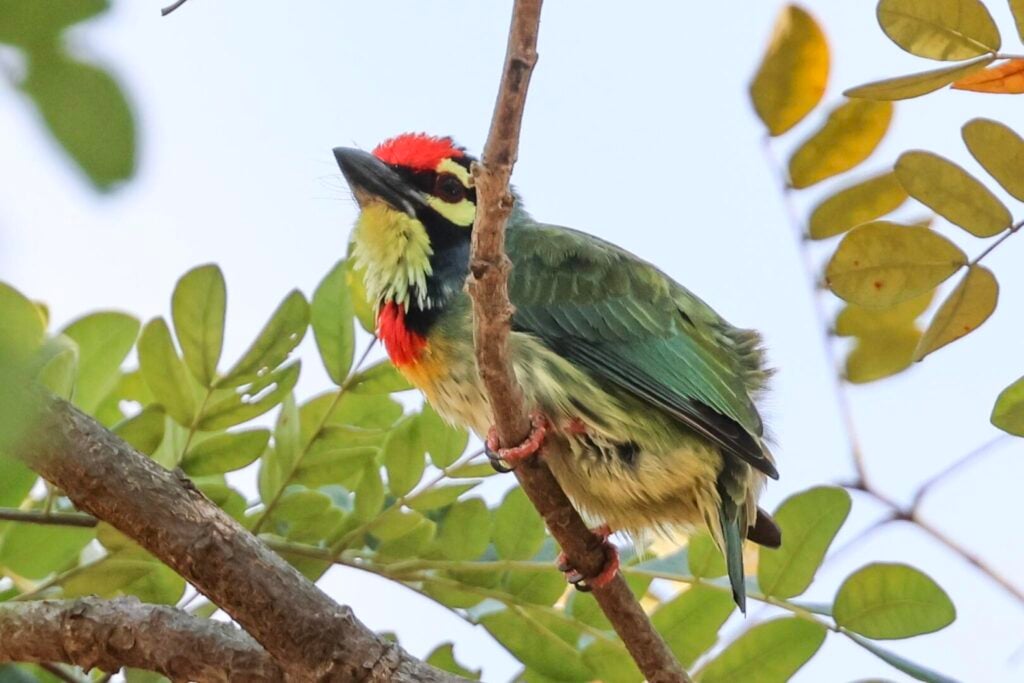
We waited until the temperature started to ease a little later in the afternoon before we met again in the lobby for our first proper birding excursion. A Crested Treeswift was perched on the wires opposite, which we got in the scope. An Ashy Woodswallow and a couple of Wire-tailed Swallows flew past. A brief Coppersmith Barbet landed on the wires.
It was just a short drive from the hotel to the Agricultural College at Mae Hia. As we got out of the minibuses, we could see lots of Asian Green Bee-eaters hawking from the wires around the communications tower. A pair of Pied Bushchats flicked up and down from the ground and a brief Oriental Magpie Robin hopped up onto the fence.

Scanning the ricefields beyond, we picked up both Long-tailed and Brown Shrikes and an Indochinese Roller. There were Red-whiskered and Streak-eared Bulbuls in and out of the trees in front of us, along with a couple of Zebra Doves. Lots of Himalayan Swiftlets circled overhead.
Crossing over the road, we stopped to scan the ricefields. Lots of Baya Weavers were perched up in the tall grass at the back. There were Scaly-breasted Munias with them and another group was feeding in the rice crop closer to us.
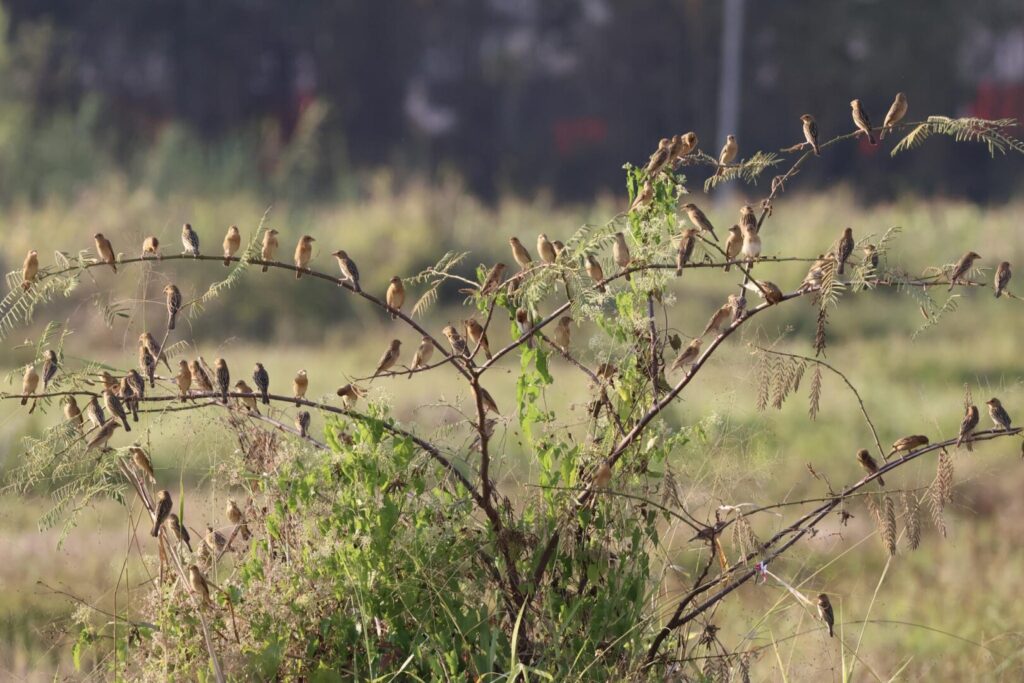
Striated Swallow has – for now at least – been lumped back in with Eastern Red-rumped Swallow. There were several here of this distinctive form, gathering on the support wires at the top of the tower and flying round over the fields.

A couple of White-throated Kingfishers appeared on the tower too and a Black Drongo was flycatching from the wires the other side. A female Eurasian Kestrel circled over. Several Chinese Pond Herons flew up out of the rice, flashing their white wings. Here in the north, they are safely identifiable as this species. As well as lots of Great and Common Mynas in the trees, we picked up several Black-collared and Siamese Pied Starlings too.
A Hoopoe flew across and landed in a tree further back, but it was hard to see in all the leaves. It appeared to drop down to the ground, so we walked on to see if we could relocate it. There was no further sign but we did flush a couple of White-breasted Waterhens from the side of the path. We had a nice view now of a male Amur (Siberian) Stonechat perching on the top of the sprinklers in one of the fields.
We had seen a few flying over, so it was nice now to get a small group of Ashy Woodswallows perched on the wires in the scope. A Common Kingfisher was fishing in a small irrigation pool below.
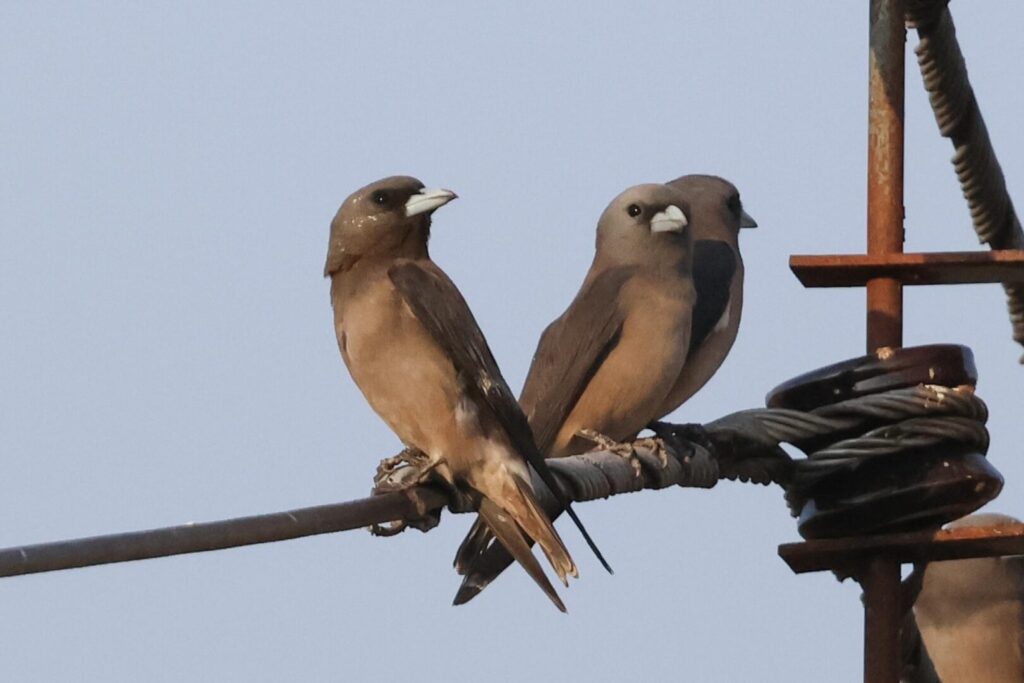
As we walked on, we spotted our first Taiga Flycatcher of the trip on one of the fences. A Red-wattled Lapwing came up from the field. Dteng managed to call a Plain Prinia out of the ricefield, which eventually posed nicely on top of a post. Scanning the larger trees, we spotted an Asian Barred Owlet perched in one. Three Hoopoes flew in to mob it. We found a Lineated Barbet in another tree, perched in the bare branches in the top, though we were looking into the last of the setting sun now.
Lots of hirundines and swifts were hawking low over the ricefields now, as the light was going. We could see at least one Crested Treeswift in with the Himalayan Swiftlets. An Asian Koel was calling again (aren’t they always!), but this time we managed to get it in the scope.
We walked back to the minibus and drove straight over to a nearby restaurant for dinner. Dteng ordered a selection of dishes for us all to try, typical Thai food although a bit milder for Western taste buds. Everyone was tired after a long couple of days travelling. Back to the hotel, it was time for an early night. We could catch up on the trip list tomorrow night.
Thursday 5th February
We had an early start this morning, and it was still dark as we packed up and left the hotel. We stopped for breakfast at a 7-Eleven in town. Lots of House Sparrows were roosting in the trees in the car park, chattering noisily, as we got out. The toasted sandwiches were very popular.
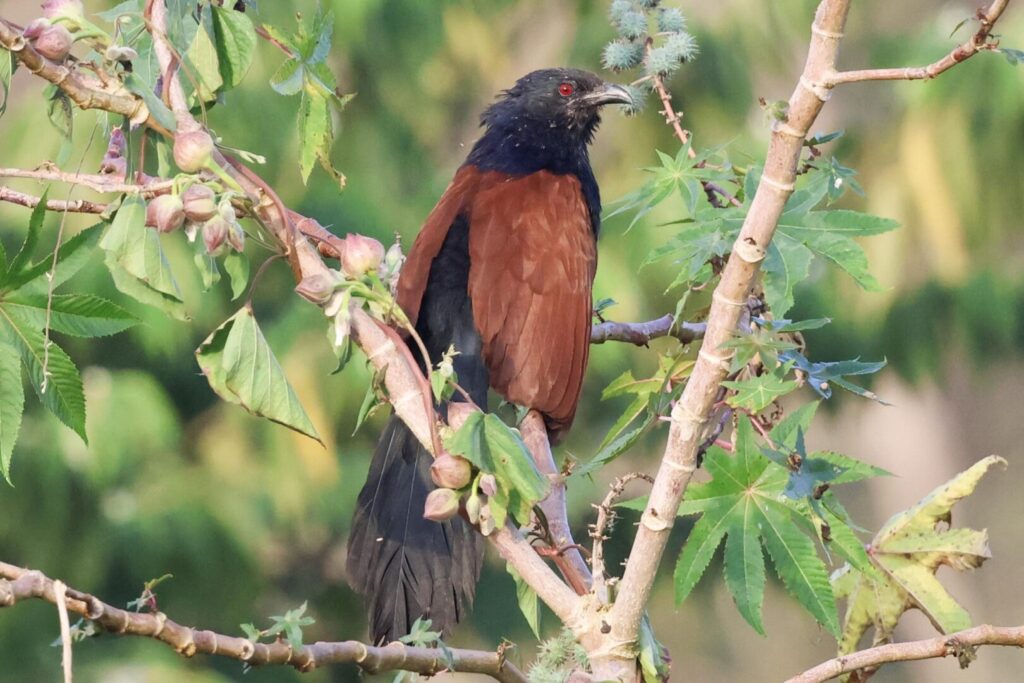
It was already getting light when we arrived at the Mae Taeng Irrigation Project. We stopped at the start of a rough track and a Greater Coucal was perched in the bushes nearby. As we walked up along the track, there was lots of activity. Several Black Drongos, Siamese Pied Starlings and Mynas, Red-whiskered and Streak-eared Bulbuls and an Asian Koel were all perched up in the early morning sun.

We could hear Dusky and Yellow-browed Warblers calling either side and eventually got good views. A Malaysian Pied Fantail flicked through the bushes ahead of us and a Wryneck perched up on the top so we could get it in the scopes. Dteng heard Chestnut-capped Babblers calling and we eventually managed to see them despite their best efforts to hide in the thick vegetation.
There was not much on the lake beside the track today. Looking out over the water, we found a single Little Grebe and a Grey Heron. Lots of Barn Swallows were gathered on the small trees sticking out of the water. Further on, we found lots of Zebra Doves and Red Collared Doves on the track.
A couple of Racket-tailed Treepies moved through the taller trees on one side and a Red-billed Blue Magpie flew across and landed in front. There were several Chinese Pond Herons perched up in the tops of the trees and a couple of Asian Openbills flew in and landed with them.

We couldn’t find any buntings where they had been roosting last year, but the vegetation was much thicker and the cows had been trampling through. Carrying on along the track, a couple of Two-barred Warblers were in the trees and a male Purple Sunbird perched up. Our first Black-crested Bulbul appeared with the other bulbuls in the trees above the river. Lots of Himalayan Swiftlets were hawking over the ridge on the other side of the river, and looking through we found a single House Swift in with them.
The lake at the far end was very overgrown, not much water in it this year either. A couple of Asian Openbills were over on the far edge. As we made our way back, it was starting to warm up and activity was already dropping. Always the best time to be out is first thing. We did add a couple of Sooty-headed Bulbuls in the riverside reeds and a couple of Scarlet-backed Flowerpeckers in the trees by the track.
Back to the minibuses, the drivers had made coffee and brought snacks. While we had a break, we scanned the small pools above the dam. Lots of Black-winged Stilts were on the mud on the far side of the river, a Wood Sandpiper with them and a Grey Wagtail. A Green Sandpiper and a couple of Common Sandpipers were feeding around the edges of the muddy pool.
Two Little Ringed Plovers were on the sandbar in the middle but there was no sign of our main target here, Long-billed Plover. A scarce winter visitor to Thailand but regular at this site, there had been up to 5 reported here recently. We flushed a Common Snipe from the vegetation, then found another nearby on the edge of the mud, along with a single Red-wattled Lapwing.
After we had finished coffee, we walked down to scan the pools below the dam but there was nothing on here today. A digger was working in the river bed on the near side, so there was a lot of disturbance. We could see a couple more Little Ringed Plovers much further downstream so we walked on past the works. As we did so, we flushed several Paddyfield Pipits ahead of us, and more Red-wattled Lapwings.
We kept stopping to scan the rocky riverbed. We found more Green Sandpipers, as well as the Little Ringed Plovers, but couldn’t locate the other plovers at first. We did caution the group that they can be very hard to see if hunkered down on the gravel islands and we should persevere. So it proved – looking back, we found a single Long-billed Plover down on the riverbed back behind us. We had managed to walk past it!

As it walked across, two more came up out of stones. Good views now through the scopes, and a nice comparison side by side with a Little Ringed Plover at one point. While we were watching them, a pair of Chestnut-headed Bee-eaters landed briefly right in between us.
Mission accomplished, we drove back round to the other side. We scanned the edges of the river and pools but there was no sign of any Pratincoles today. Several Wire-tailed Swallows were coming down to the mud.
Lots of Great Mynas were feeding in the flowering trees opposite now, back on the other side of the river, where we had been earlier. Scanning through, we found several Chestnut-tailed Starlings in with them. They were distant and hard to see from here at first, then everything flew out. Down onto the island in the shade, we continued to scan and gradually the Mynas started to back fly back up into the trees. Then the Chestnut-tailed Starlings followed too.
While we were watching the Starlings, we happened to notice some movement behind us, back in the trees by the car park. Looking across, we could see a Green-billed Malkoha climbing about in the leaves, then a Rufous Treepie appeared with it. They were hard to see from here so we walked quickly back round.
The Treepie perched up briefly, then dropped back towards the road. A Greater Racket-tailed Drongo flew out too and a Coppersmith Barbet perched up in the branches above us. After a couple of minutes, we relocated the Malkoha and two Rufous Treepies now in the trees on the other side of the road. Nice views in the scopes. A White-faced (Eurasian) Jay appeared with them briefly.
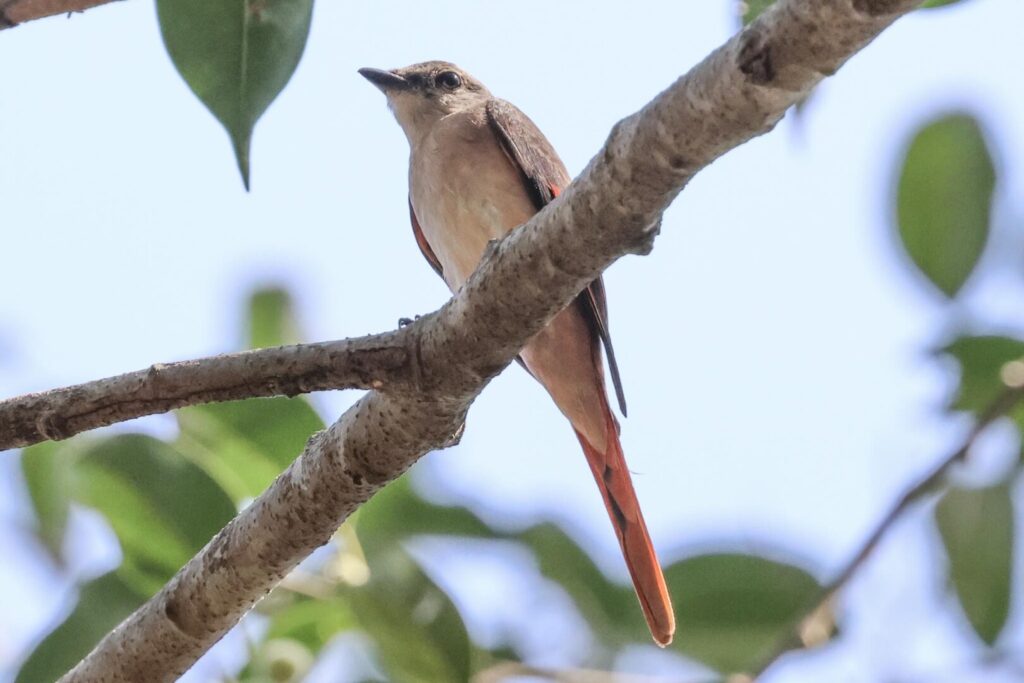
A small group of Red-billed Blue Magpies flew in to the top of the fruiting tree above us now. A pair of Rosy Minivets was flicking around in the leaves lower down. We heard a Common Tailorbird calling further back but it went quiet when we walked round. There were a couple of Fulvous Forest Skimmer dragonflies, plus Great Eggfly and The Psyche butterflies fluttering around in the shade beneath the trees.
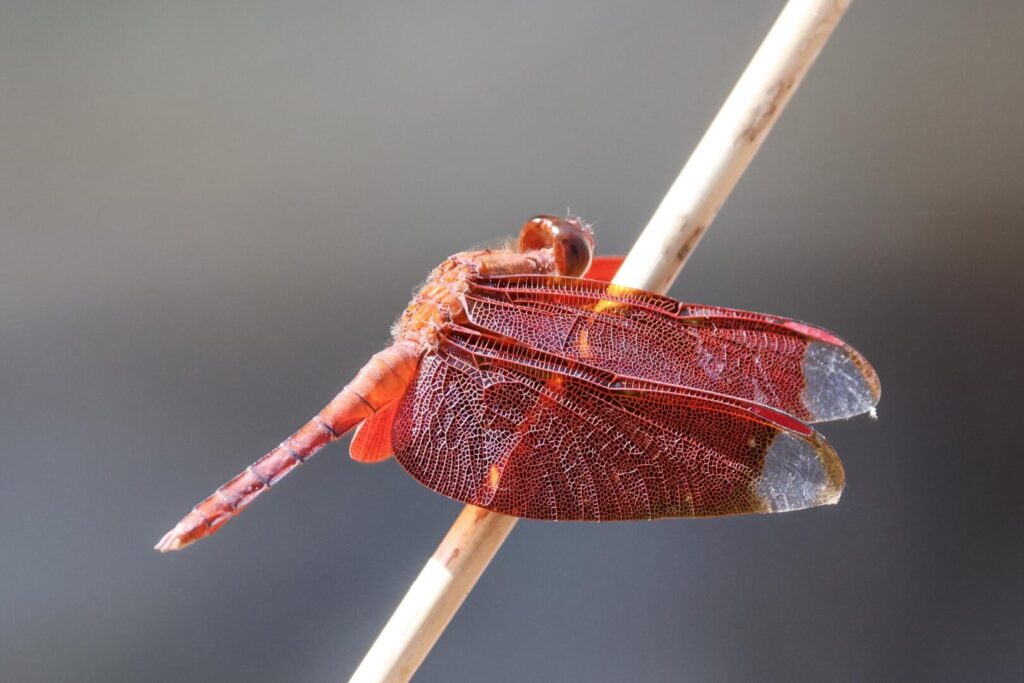
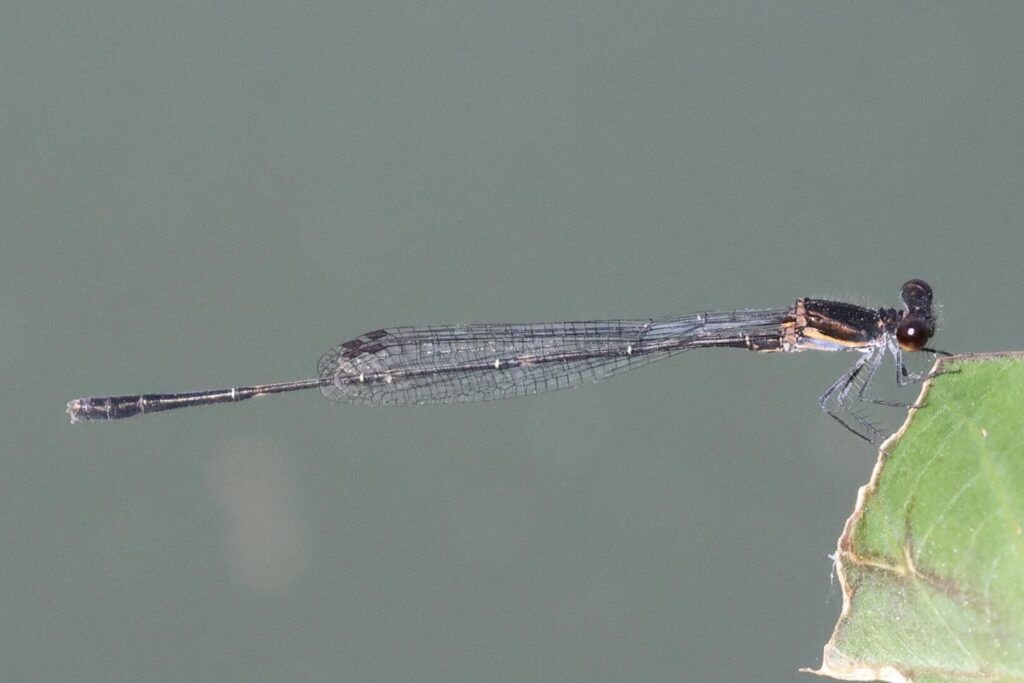
It was time for us to head off now and start making the long journey north to our next base at Fang. We had a quick loo stop first, then stopped for lunch at a local restaurant. Always a good sign to see it packed with local workers. Carrying on north, we made another quick facilities stop at a local coffee shop and a chance to admire the elephant topiary in the car park. The ornamental lake behind had no birds but a good selection of dragonflies and damselflies, including Ditch Jewel, Orange-faced Sprite and Orange-striped Threadtail.
It was nearly 3.30pm by the time we arrived at our hotel in Fang, where we would be staying for the next three nights. After checking in, we had about half an hour to get sorted out before we left again and drove on to Thaton. The driver took a wrong turn and we ended up at a dead end by the river, where the road had washed away. We were initially aiming to get down to the river a bit further on, but there were plenty of birds here.
We could immediately see several Small Pratincoles on the sandbar on the far side of the river. There were a few Little Ringed Plovers, Common and Green Sandpipers. Further up, on another sandspit, we noticed a good number of Pacific Golden Plovers and several Common Snipe. A Temminck’s Stint flew in and landed on one of the sandbars directly opposite us.

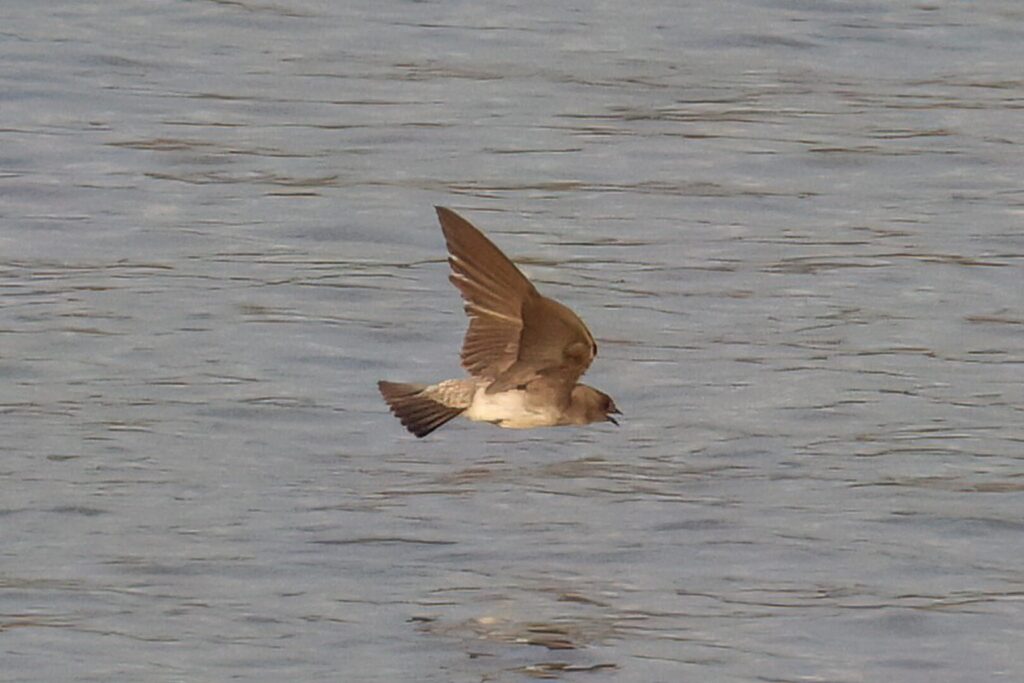
A couple of Grey-throated Martins flew round over the water and landed briefly on a snag in the middle. A scarce bird here. There were lots of White Wagtails around on the mud, mainly of the subspecies leucopsis, but we found a single ocularis distantly too. We could see its black eye stripe in the scopes. We were just about to leave when a Citrine Wagtail dropped in. A female, with a yellow face, we watched it feeding on the edge of the water.
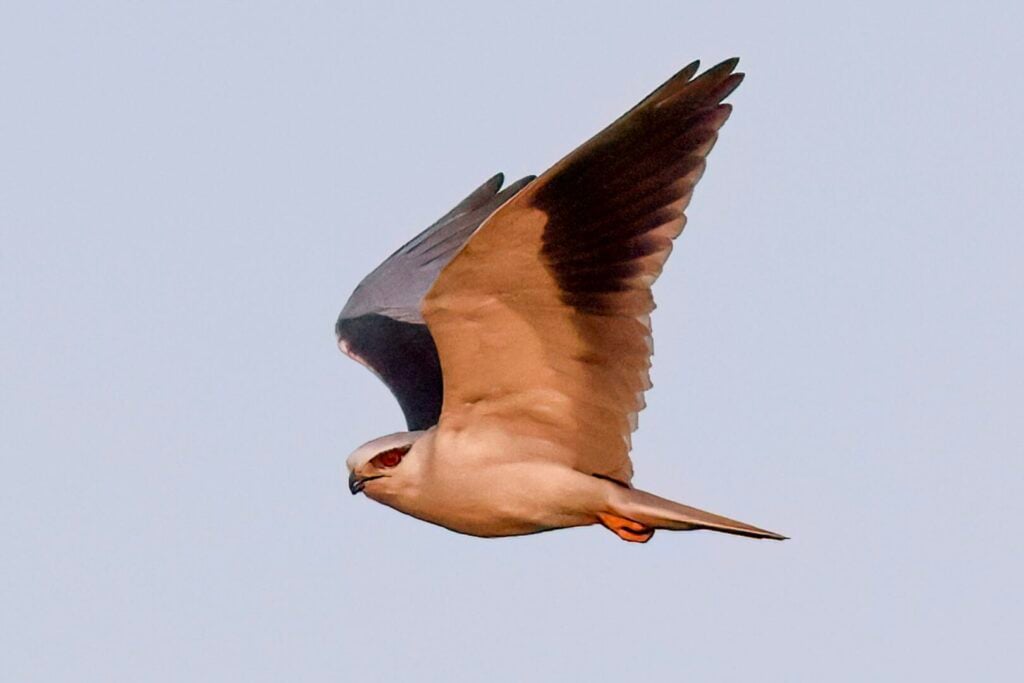
A very successful spot in the end, we drove round for one quick last stop at some rice paddies near Mae Ai. As we pulled off the road, a Black-winged Kite was hovering over the fields ahead. We got out and it did a nice pass across straight in front of us. Walking down the path, several Dusky Warblers were calling and flicking around on the edge of the ditches. Three Citrine Wagtails flew up and one perched on a bund briefly, but they quickly dropped back down into the rice out of view.
At the far end, we stopped to scan the fields. A Bluethroat hopped up onto a bund in front of us and a pair of Plain Prinias were calling in the ditch nearby. Several Amur Stonechats were scattered around. We were hoping for a Pied Harrier but the paddies here were very wet now – they had apparently been drier a couple of weeks ago, but had since been replanted with rice.
Lots of egrets were flying over, heading off to roost, mainly Eastern Cattle Egrets but a few Great White Egrets with them. Lots of Asian Openbills were gathering in the trees out on the far side of the paddies.
Time to head back now, it was already after 7pm when we got back to the hotel. No time for a break today, we dropped our stuff in the rooms quickly and then headed straight in for dinner at the restaurant. Dteng ordered another interesting selection of different Thai dishes for us. Afterwards, we ran through the list quickly for the last two days in reception. Then it was time for bed.
Friday 6th February
An early start again, we set off in the dark at 5am. We would be out for breakfast and lunch today and we had one packed meal from the hotel, so we stopped in 7-Eleven again to get supplies. It was about an hour’s drive up onto Doi Lang West. Only one vehicle was already there ahead of us when we arrived at the Mrs Hume’s Pheasant stake-out. A couple of photographers who had set up their portable hides on the verge. We got out quietly and gathered between the minibuses where we wouldn’t cause disturbance.
Surprisingly, we didn’t have long to wait this morning. After only about 10 minutes, a female Mrs Hume’s Pheasant came out onto the verge in front of the hides and started to feed. We were watching that when a male and a second female appeared too. It was still rather gloomy at first but the light gradually improved and we had great views of them on the side of the road in front of us.
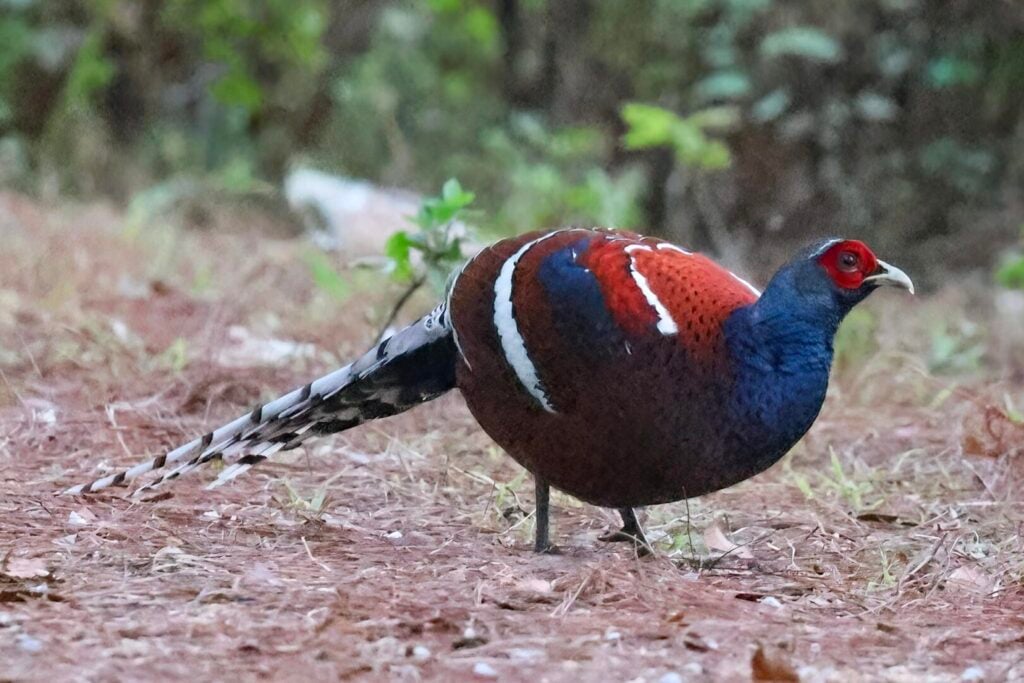
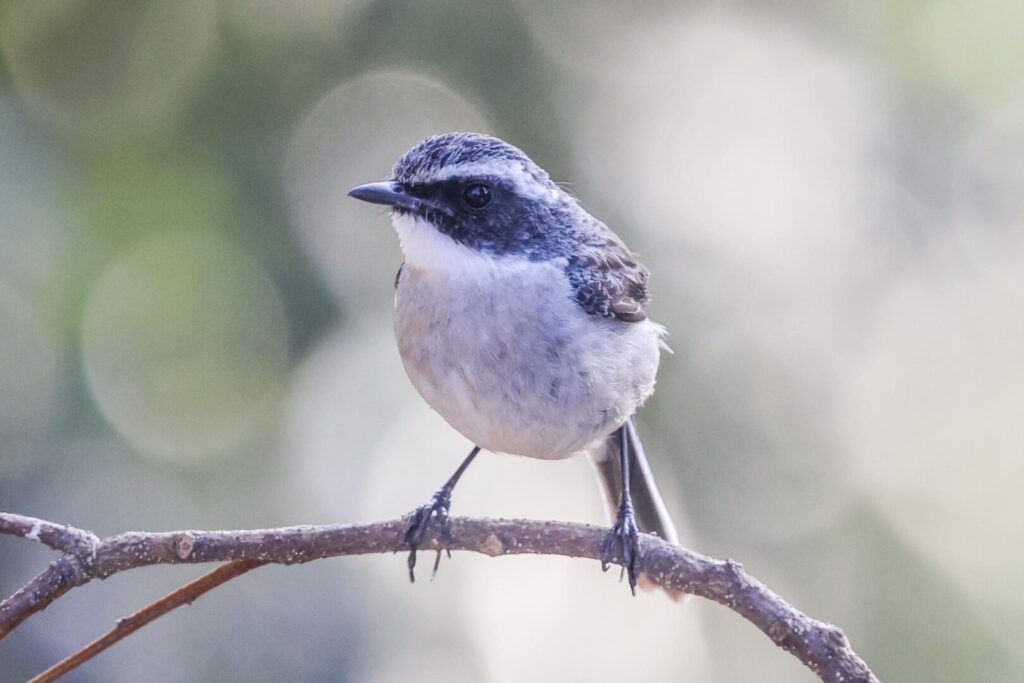
Several Rusty-cheeked Scimitar-Babblers came out to feed on the ground too, along with a Grey Bushchat and Rufous-gorgeted Flycatcher. Lots of Hume’s Warblers were flicking around up in the pines. After about half an hour, the Mrs Hume’s Pheasants disappeared back into the vegetation and the photographers came out of their hides. We decided to take advantage of our very quick success here and move on.
Normally it is much later when we get away, so as we were early today we headed straight down to the military checkpoint at the far end of the road. As we got out of the minibus, several Dark-backed Sibias flew out and landed in the bare trees above. We could see Mrs Gould’s Sunbirds flicking around too, and our first Ashy Drongos.
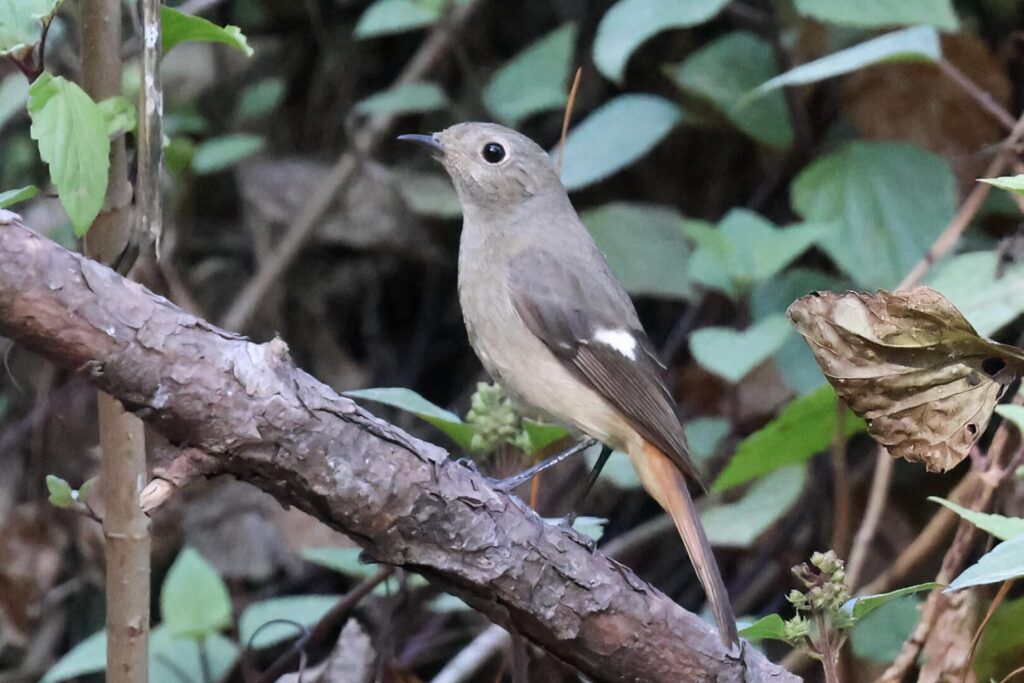
The Scarlet-faced Liocichlas were already waiting to be fed at the nearby feeding station. We often miss them as we are too late, they only seem to come in early, so it was good to catch them today. Dteng put out some mealworms and they fed for a while, then disappeared back in. After the Liocichlas disappeared, a female Daurian Redstart and several Sooty-headed Bulbuls came in too.
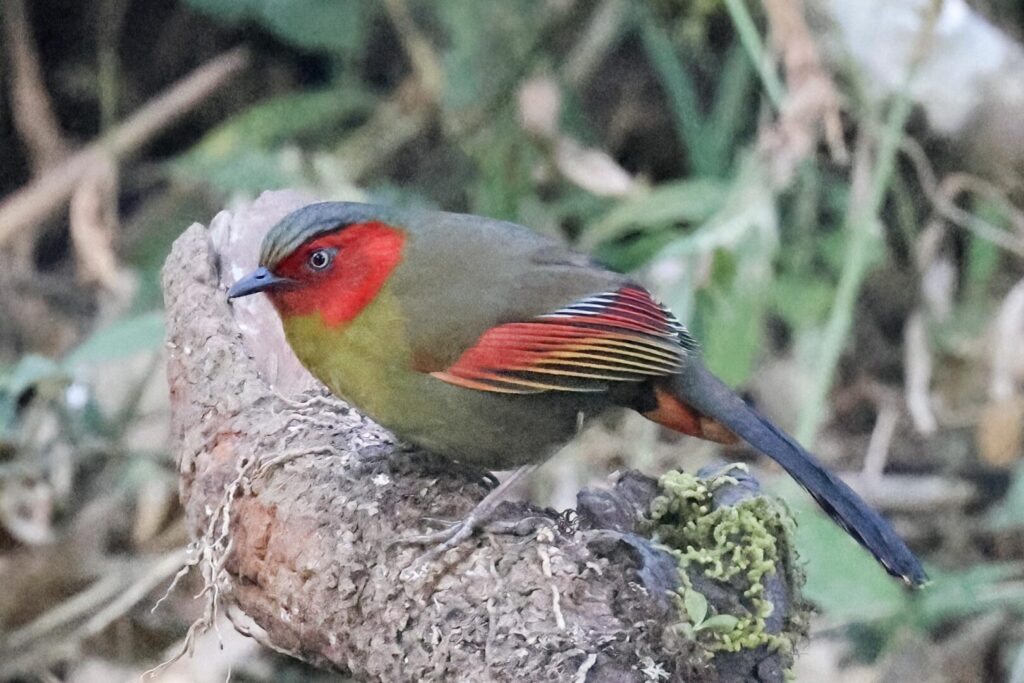
Several Black-breasted Thrushes moved quickly through the trees. One landed on the road behind us, feeding with some Flavescent Bulbuls. A female Hill Blue Flycatcher appeared in the trees beyond the checkpoint but dropped down out of view.
A male Scarlet Minivet posed in the top of a tree above us and a we had a brief view of a Claudia’s Leaf Warbler. A male Little Pied Flycatcher landed on the edge of one of the taller trees in the sunshine. We had just set off to walk down the road when Dteng heard a Banded Bay Cuckoo and we turned to see it land in the trees behind us.
Continuing on, two Striated Bulbuls moved through the bushes in front of us. We then found a couple more further down with a Mountain Bulbul feeding in a fruiting tree. There were more Flavescent Bulbuls feeding in the bushes along the road too, and warming up in the early sunshine.

Further down, we noticed a male Wedge-tailed Pigeon perched up in the bare branches of a tree before it dropped down out of view. An Eye-browed Thrush landed on a branch high above our heads. We could hear a Collared Owlet calling in the distance.
A Black Bulbul flew out and landed in a dead tree above us. When it eventually flew off, it was followed by a second which came out of the trees the other side. An Indochinese Cuckooshrike was in a leafy tree just beyond but very hard to see, not everyone could get onto it before it disappeared. We could hear Mountain Imperial Pigeon calling and looked up to see one flying over.

The minibuses had driven down ahead of us and were now parked by the road. The drivers were just making coffee as we walked up. We were going to stop for a break but heard a Spot-breasted Parrotbill calling just beyond so continued on to look for it. With a bit of patience, it gradually came up into the bushes by the road and eventually came up into view in the undergrowth. A smart bird. A Streaked Spiderhunter called as it flew past and landed in a bush behind us by the road briefly.
The coffee was ready now so we walked back to the buses. Afterwards, while making use of the bushes a Maroon Oriole flew up from lower down the slope and landed in a tree, calling. The Spot-breasted Parrotbill was still calling, now on the other side of the road, and we had more good views of it in the bushes below the helipad.

There are several areas set up along the road here where photographers put out food. We drove back along the road now and stopped by one of them. A female Slaty-blue Flycatcher was already waiting in the bushes by the log as Dteng put some mealworms down. After a few seconds, a stunning male Siberian Rubythroat hopped through the undergrowth behind and out onto the log in front of us.
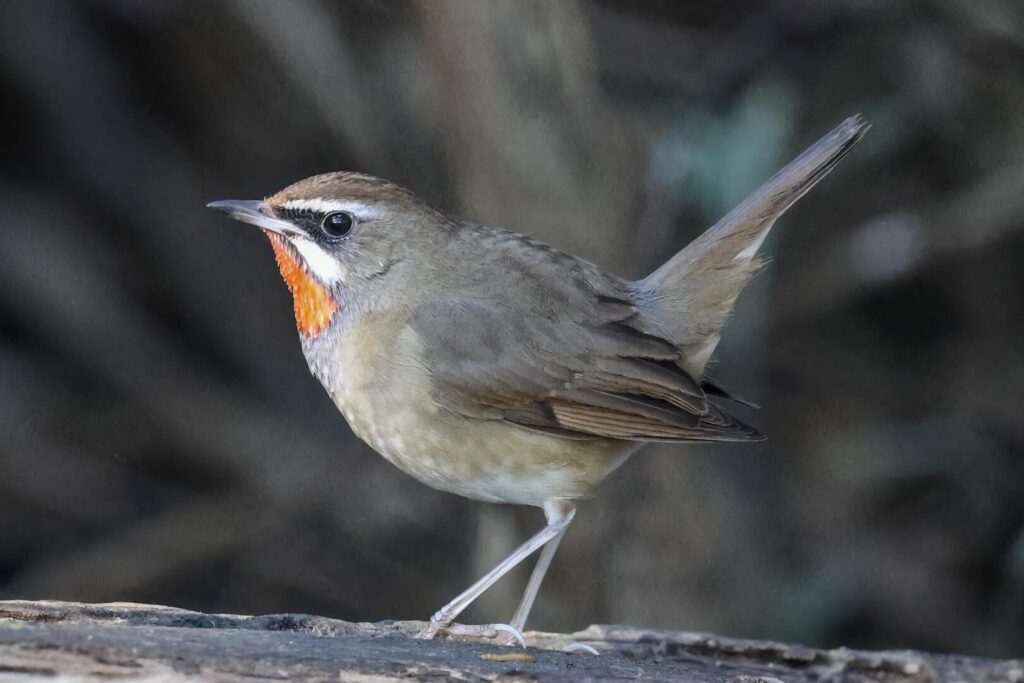
We walked on from here, as the minibuses drove further down to the layby in the shady area. A photographer had set up their mobile hide at the next feeding station, so we continued on past. A couple of Grey Treepies were calling in the trees and we managed a typically brief view. Scanning the skies, there were no raptors up but lots of Cook’s Swifts now overhead. A female Hill Blue Flycatcher was the only bird which came in to feed at the next feeding station.
It was quiet along the road under the trees – although we still added a Pallas’s Warbler and a pair of Bronzed Drongos. So we took one of the paths further in up the hillside above. As we walked up, we found a couple of Orange-bellied Leafbirds and some Blue-winged Minlas. Out into the sunshine towards the ridge, we could hear a Davison’s Leaf Warbler singing, but couldn’t see it high in the trees. There were a couple of Scarlet Minivets, an Indochinese Cuckooshrike we all managed to get on now and a Banded Bay Cuckoo.
As well as a couple of Chestnut-vented Nuthatches and Velvet-fronted Nuthatches, we managed to locate a pair of Giant Nuthatches too in one of the trees up on the top. While we were watching them, a Crested Goshawk landed in the tree above and they disappeared – understandably! We had brief views of a Grey-capped Pygmy Woodpecker and, following some tapping, found a very showy Stripe-breasted Woodpecker hammering on a branch. There were more Grey Treepies calling, taunting us now.
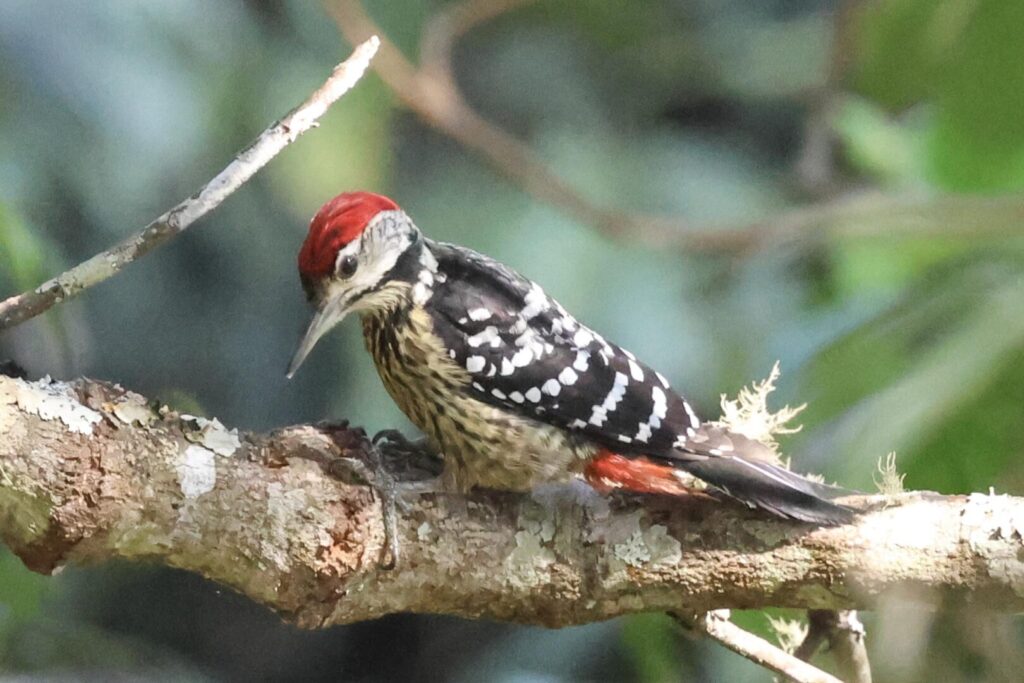
Then a flock of Himalayan Cutias appeared in the trees below us. They were moving quickly, so we tried to follow them. We managed to get some good views when they stopped to feed on the moss covered branches, around the epiphytes. Then they carried on swiftly down through the trees towards the road.
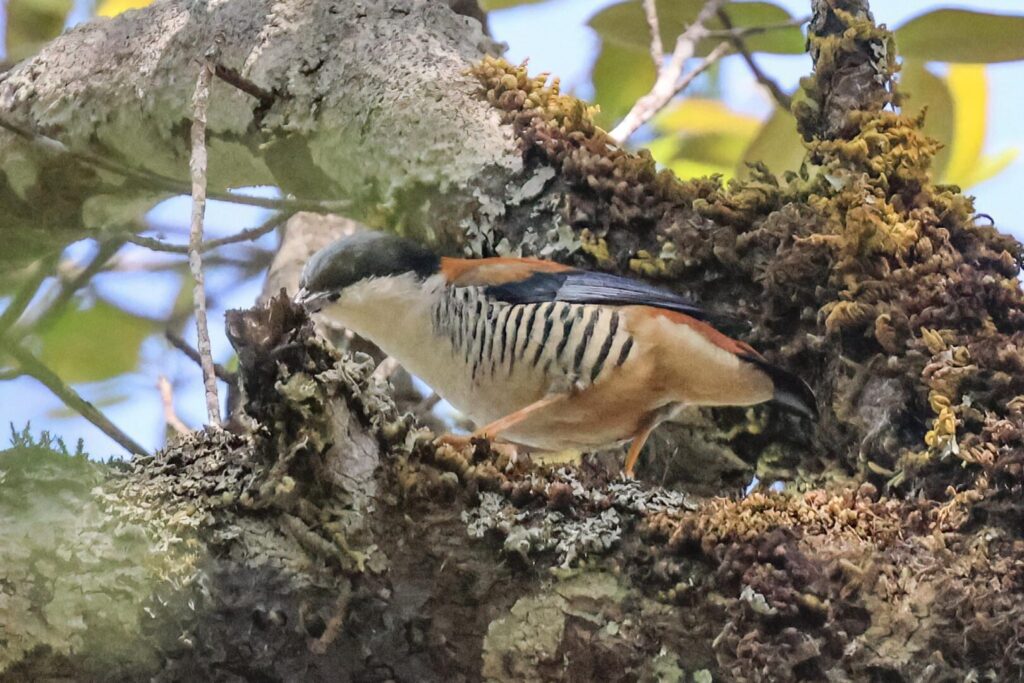
We made our way back down and out onto the road. The photographer had finished at the feeding station now, so we stopped to see what was coming in. Dteng put out some food and various things quickly appeared from the bushes – a single Rusty-cheeked Scimitar-Babbler (unusually on its own), a Black-breasted Thrush, a female Rufous-bellied Niltava and a Rufous-gorgeted Flycatcher.
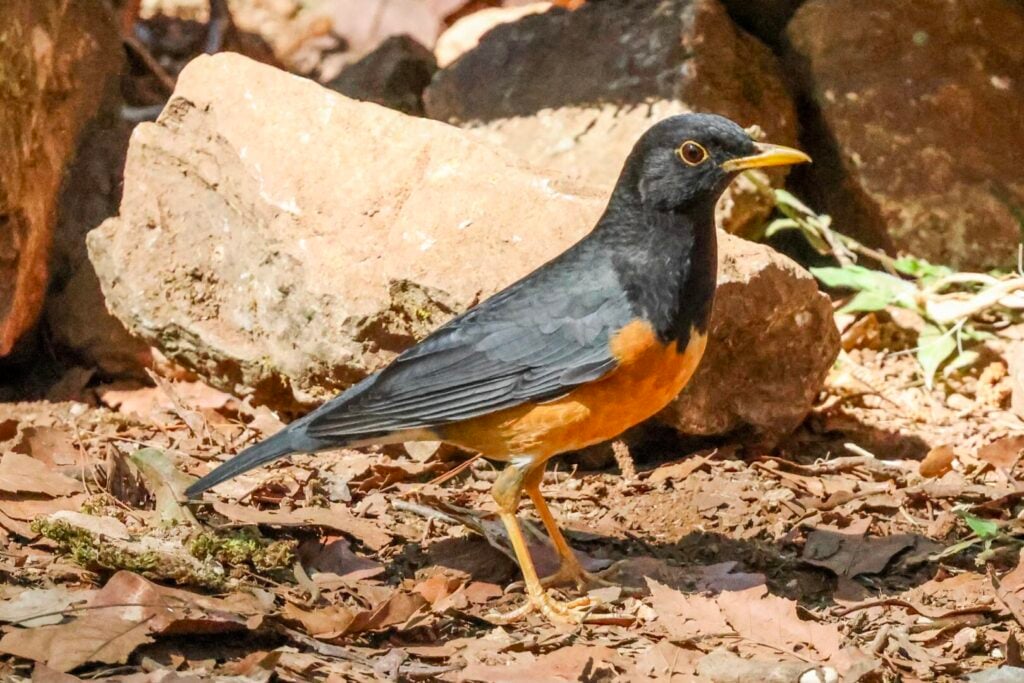
Walking back to the shady area, a couple of Pale-blue Flycatchers were in the trees. Another female Rufous-bellied Niltava was waiting at the feeding station there and a flock of Yunnan Fulvettas came in for mealworms. We relocated the Himalayan Cutias in the trees below the road now. As we stood and watched, there seemed to be a bit of a mixed flock here. We found a White-browed (or Blyth’s) Shrike-Babbler with them and a brief Sapphire Flycatcher, which was unfortunately not seen by the group.
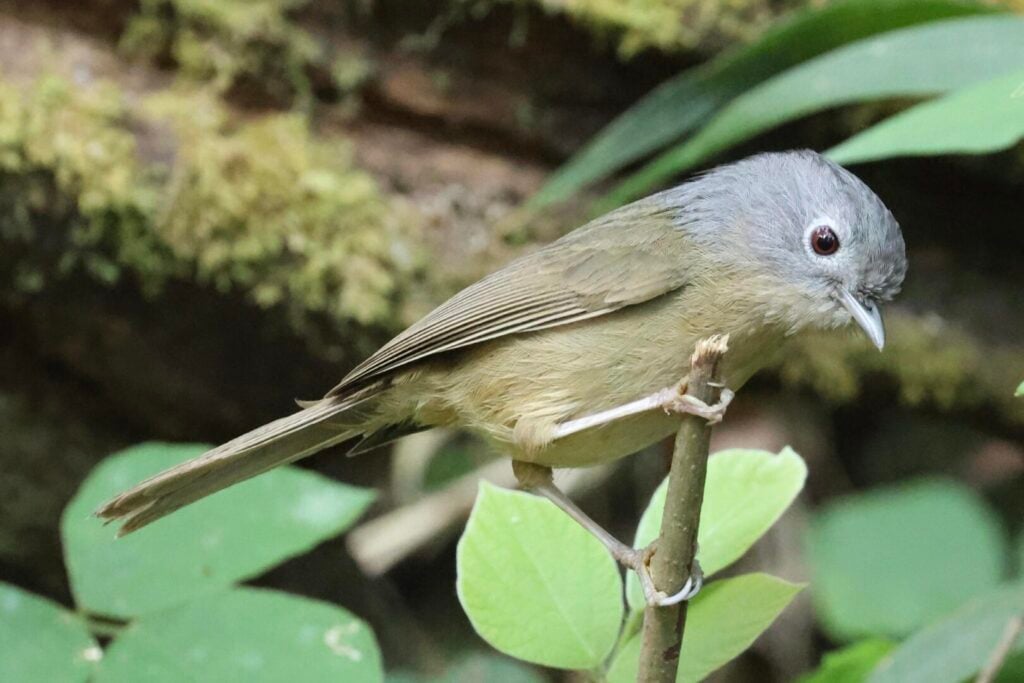
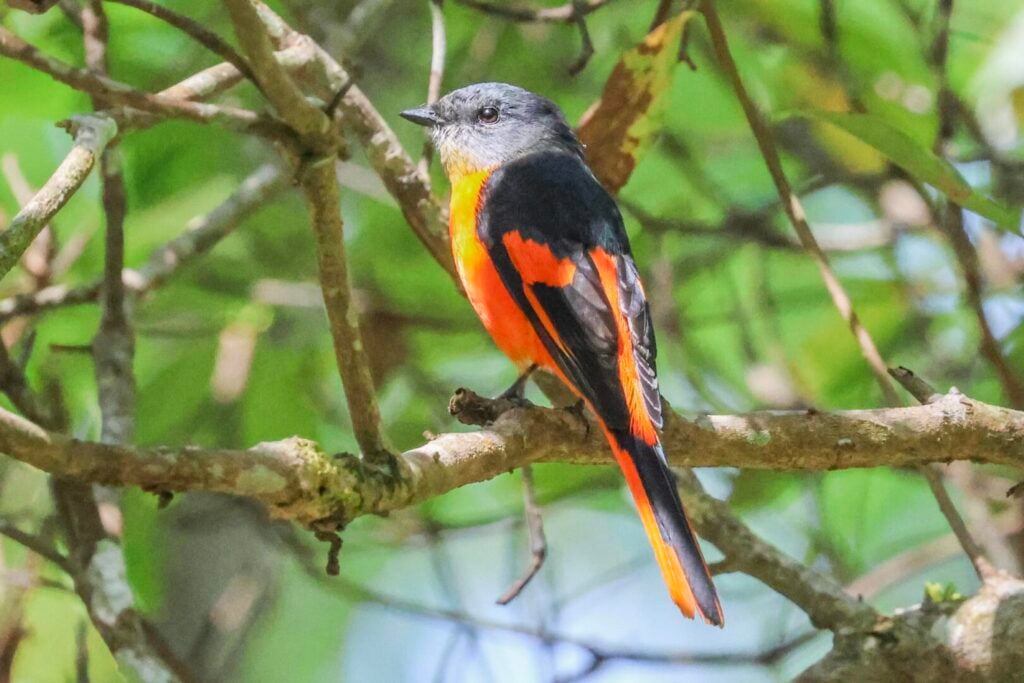
A Grey-headed Canary-Flycatcher was a bit easier to see. There were several Grey-chinned Minivets and more Scarlet Minivets too. It was time for lunch so we walked over to the minibuses. One of the drivers had just seen a Mrs Hume’s Pheasant and we had a very brief view of it when it ran out of the undergrowth by the road.
While we were eating, there were lots of Davison’s Leaf Warblers in the trees and a single Claudia’s Leaf Warbler. We saw our first Pallas’s Squirrel here too.
After lunch, we walked a little further down to the edge of the pines. A pair of Rufescent Prinias was calling in the undergrowth and eventually came up into view. A Golden-throated Barbet was calling in the trees further back but it proved impossible to see. It is a bit more open here and we found at least four Grey Bushchats flitting around in the bushes. A couple of Grey Treepies were calling either side of the road and one eventually flew across.

Back to the minibuses, and the trees in the shady area were still a little quiet. We tried each of the feeding stations in turn again. Two Grey-throated Babblers and two Puff-throated Babblers came in with the Yunnan Fulvettas now. The lone Rusty-cheeked Scimitar-Babbler was still hanging around where the photographer had been earlier. We were hoping to catch a flock of White-browed Scimitar-Babblers here but they didn’t come in while we were watching. After we retreated, the Black-breasted Thrush came out again.

Back to the minibuses again and we decided to move on. Down at the pheasant stakeout, the lead minibus flushed three Rufous Turtle Doves from the road as we pulled up but most people missed them. Scanning the trees, we found a couple of Slaty-backed Flycatchers, a female first, then a male, and lots of Hume’s Warblers.

Walking along the road, we flushed another Rufous Turtle Dove from the ground in the vegetation on the verge. It landed very briefly in the trees then disappeared off down the slope. As we walked in a short way, we could see several more Rufous Turtle Doves in the trees. They were very nervous though, and kept flying round. With a bit of perseverance we managed to find one perched and get everyone onto it. Not the best view though, as it was looking away. Probably planning its escape route!
Dteng put some mealworms down on the log in front of where the hides had been earlier. Another female Daurian Redstart quickly appeared from the bushes, followed by a Rufous-gorgeted Flycatcher and a male Grey Bushchat.
We continued our descent now, all the way back down to Fang, and made our way out into the ricefields. As we pulled up and got out, we could see a Medium (formerly Intermediate) Egret in the green paddy in front. More Medium, several Little and a couple of Great White Egrets, plus a few Chinese Pond Herons were further back.
Lots of Starlings and Mynas were on the bunds in between the wet paddies. Several Amur Stonechats and Pied Bushchats were flitting around in the drier rice stubble patches. A Racket-tailed Treepie landed in the tree behind us. Four Garganey flew up and circled round over the small lake beyond the paddies.
A male Pied Harrier appeared and we watched it fly across in front of some buildings in the distance. Then what was presumably the same bird reappeared much closer. It landed in the rice and we had some nice views of it in the scopes. A brief Oriental Skylark flew up from one of the dry paddies out in the middle. Several Striated Swallows and Barn Swallows were hawking over the fields. Lots of White Wagtails were scattered around.

We walked out along one of the wider bunds and stopped to scan the dry paddies. One person walked in and round through the stubble, flushing several Oriental Skylarks, Paddyfield Pipits and a single Richard’s Pipit, a couple of Zitting Cisticolas and two Bluethroats. We were hoping to find some buntings here though but we couldn’t find any today. Working back round, two Greater Painted Snipe flew up from the stubble. They flew off towards the small lake at the back and seemed to drop down.
We decided to walk across to the far side and see if we could refind them. Another Bluethroat flew across ahead of us and landed on one of the bunds briefly. There were lots of Black-winged Stilts in the wetter paddies over this side and a Wood Sandpiper flew round calling. Two or three Citrine Wagtails were on the bunds here too.
We found a way to climb up onto the bank around the edge of the lake. As well as the Garganey and more Black-winged Stilts, we could see several Moorhen and lots of Little Grebes out on the water. Eventually we located the female Painted Snipe, well hidden on the far bank, under the vegetation at the back. The duller male then dropped down in front, much easier to see, out in the open with the Stilts.

It was time to head back. It was just a short drive from here to the hotel, so we had a chance to get a shower and some downtime before dinner tonight. Then after going through the list back in the comfy chairs in reception, it was time for bed.
Saturday 7th February
A lie in today, we met for breakfast in the restaurant at 6am. Our destination for the day was Doi Ang Khang. After breakfast, we boarded the minibuses and drove up the steep and winding road to the top. We stopped first at the small campsite along the road to the Chinese Cemetery. As we got out, a Peregrine drifted overhead. There were several Yellow-browed Warblers and Indian White-eyes in the trees.
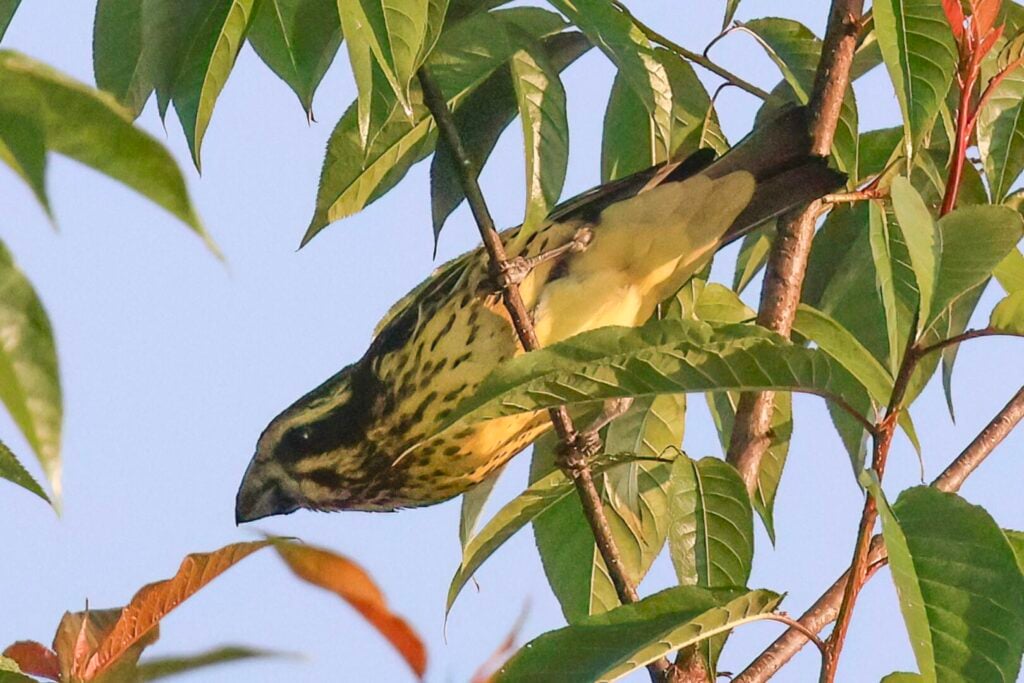
Dteng heard Spot-winged Grosbeaks calling but we couldn’t find them at first. Then four flew out of the back of some cherry trees. We thought they might be off but then circled back and landed again in the same trees. They were hard to see through all the leaves, but we eventually got OK views through the scopes.
Walking further down along the road, there were a few birds around the piles of rubbish dumped over the verge down the side of the hill. A Silver-eared Laughingthrush moved off back into the bushes as we arrived, so we waited to see if it would come back out. A tame Grey Bushchat was hanging around the dump. Lots of Common Rosefinches flew up from the ground behind and landed up in the trees. Several bulbuls were perching up in the sunshine, including a Striated Bulbul.
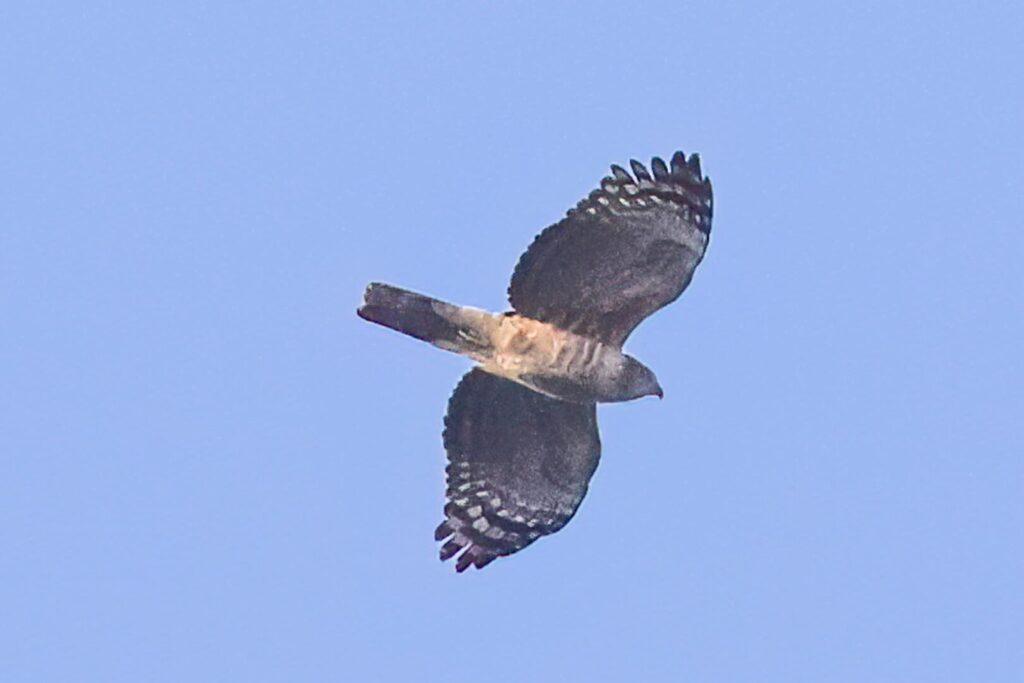
There was no sign of the Laughingthrush reappearing so we walked on along the road. A raptor drifted over but we only caught the back end of it as it disappeared behind the trees. We assumed it would be a Crested Honey Buzzard but it didn’t look right. We managed to snap a couple of photos and reviewing them later we realised it was actually a Jerdon’s Baza. Not a species we expect to see here at this time of year.
It was still a bit early and the main rubbish dump was still in the shade so was quiet. Another birding group was already in the Chinese Cemetery beyond so we decided to move on and try somewhere else. We drove round to the main campground next. There is another small dump just across the road (we visit all the most attractive sites on these trips!), so we walked across to see what was around.
There were lots of thrushes which flew up from the ground and up into the trees, including Black-breasted, Eye-browed and a couple of Grey-sided Thrushes too. However, the biggest surprise was to see at least four Grey-winged Blackbirds come up. A rare winter visitor to North Thailand from the mountains further north, it has been a good year for them. We could see them moving around in the trees, including a smart male with very white wing panels.
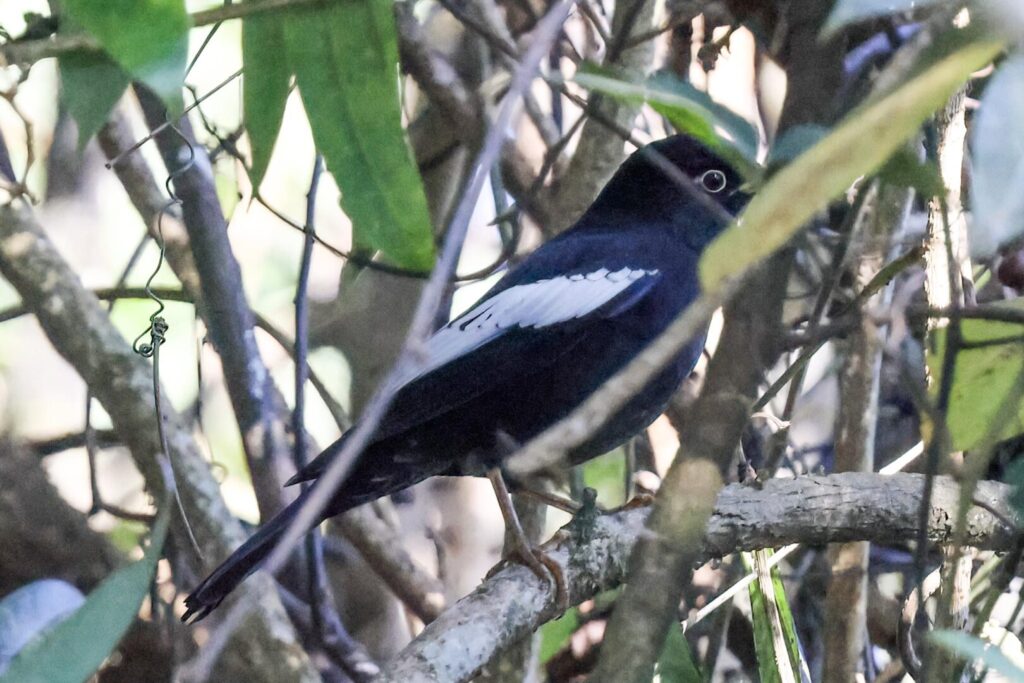
As well as all the thrushes, we found a Silver-eared Laughingthrush, a Scarlet-faced Liocichla and a male Rufous-bellied Niltava around the tip. A mixed flock of Rufous-backed Sibias, Silver-eared Mesias and Blue-winged Minlas came through the trees. A group of Yunnan Fulvettas came in too. Two Golden Babblers appeared briefly in the trees at the back, where the thrushes were. Then we could hear them calling closer but they wouldn’t come out.
After a break for coffee at the campsite, we drove on round to the buddhist temple. Another Grey-winged Blackbird was down on the ground from the terrace as we arrived and came up for a bath in the small pool.
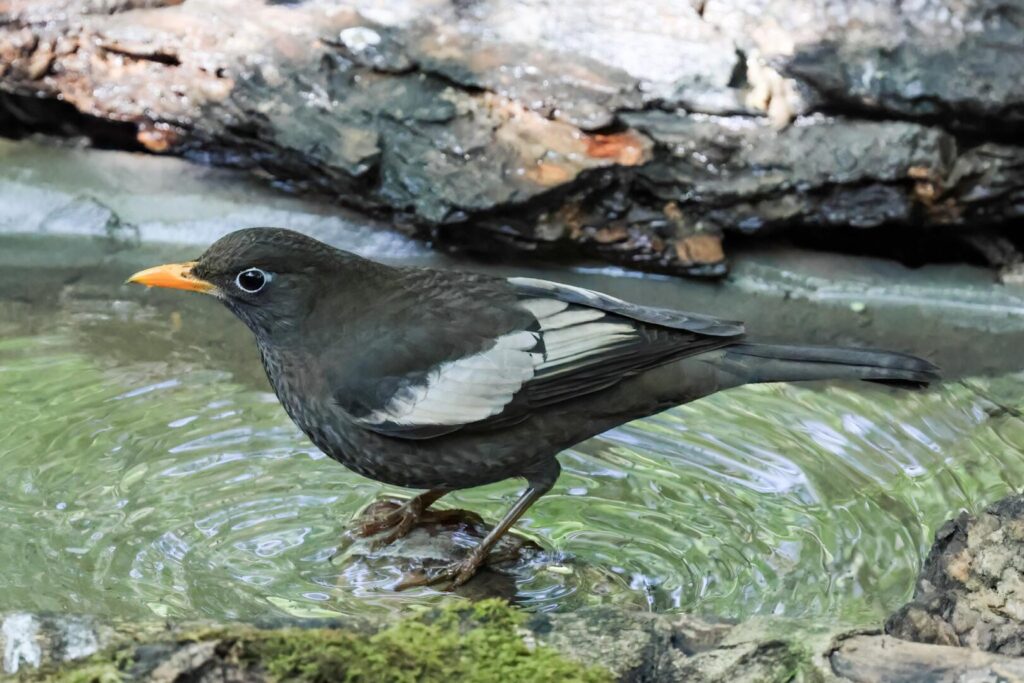
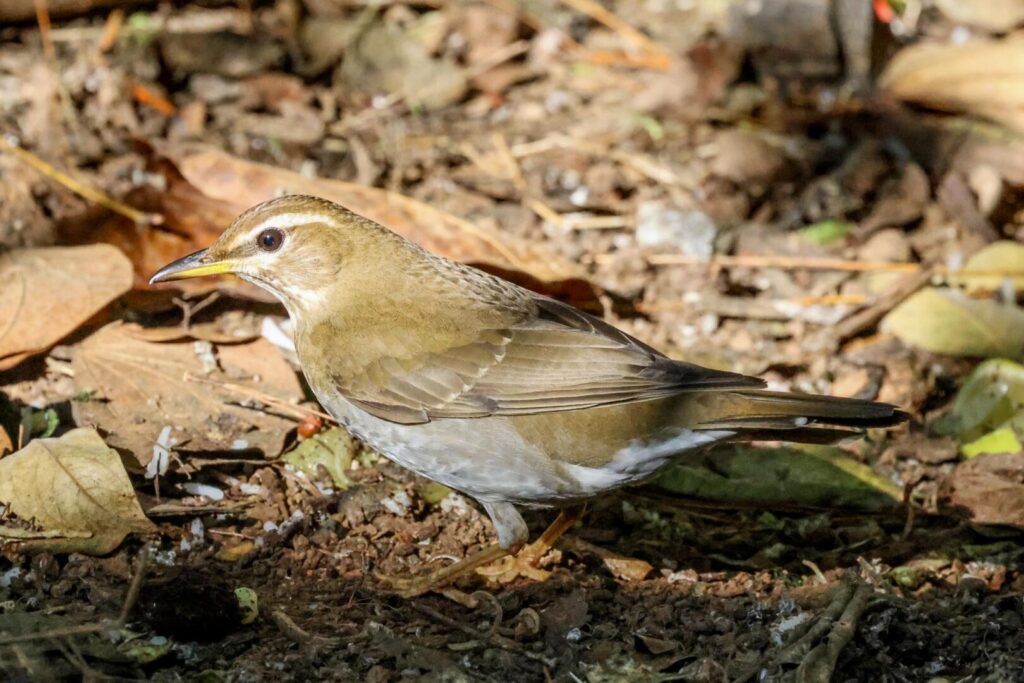
There were lots of other thrushes here too again, including lots of Black-breasted and Eye-browed Thrushes…

…and better views of at least one Grey-sided Thrush…
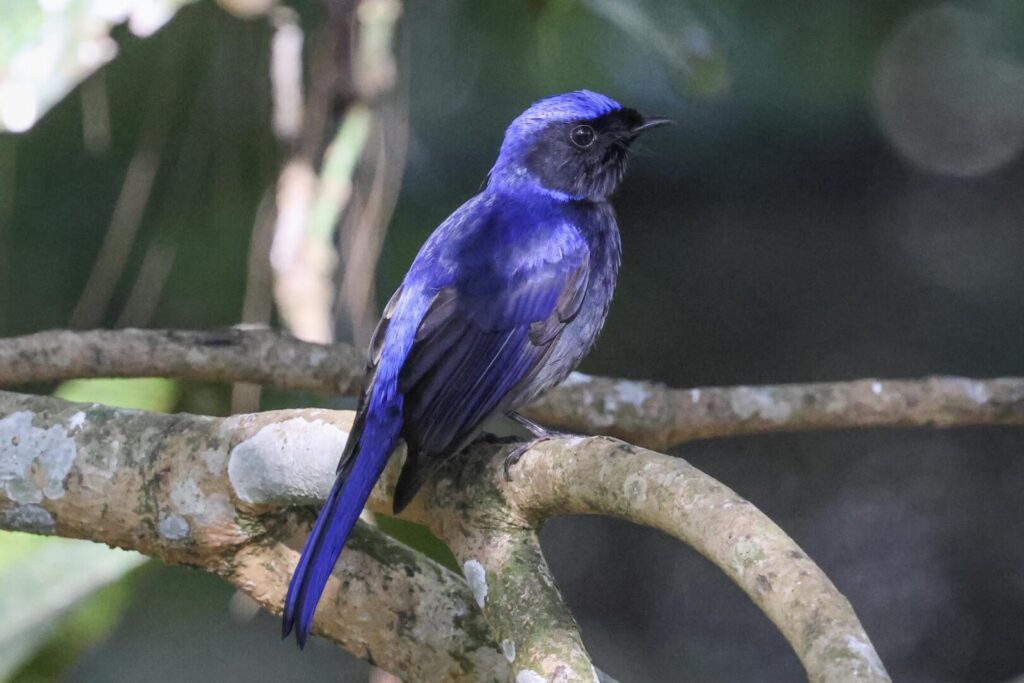
…as well as a pair of Large Niltavas. The male Niltava posed particularly nicely in the trees in front of us.
Two Olive-backed Pipits were creeping around in the leaves below the trees. We had great close views of the groups of Silver-eared Mesias…
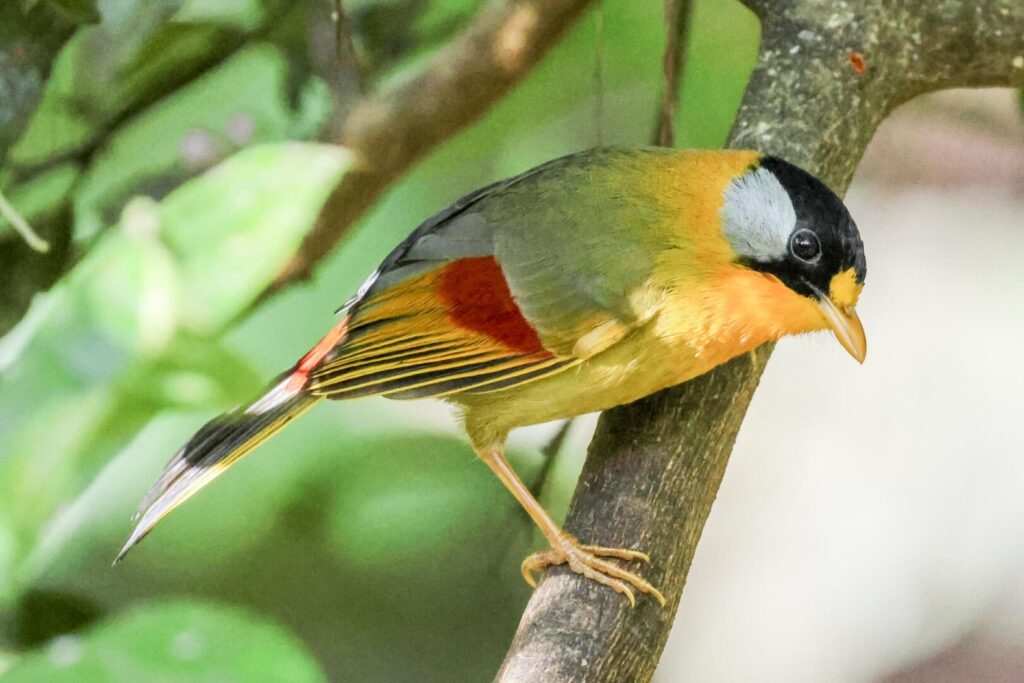
…and Blue-winged Minlas as they came in to feed on the rice put out by the monks, right in front of us.

A couple of Mountain Bulbuls came in too. A very worn Arctic Warbler flitted around in the trees above us. The Blue Whistling Thrush whistled through quickly in a flash of electric blue the first time. Eventually it came back but still didn’t hang around long. At least we got to see that it had a black bill, a winter visitor of the migratory subspecies.

We moved on to the nearby Royal Agricultural Station next. As we parked in front of the restaurant, an Eastern Buzzard was circling high over the gardens beyond. While we stopped to use the restrooms, a Two-barred Warbler was flitting around in the trees in front. A Blue-throated Barbet was up in the top of a very distant bare tree calling.
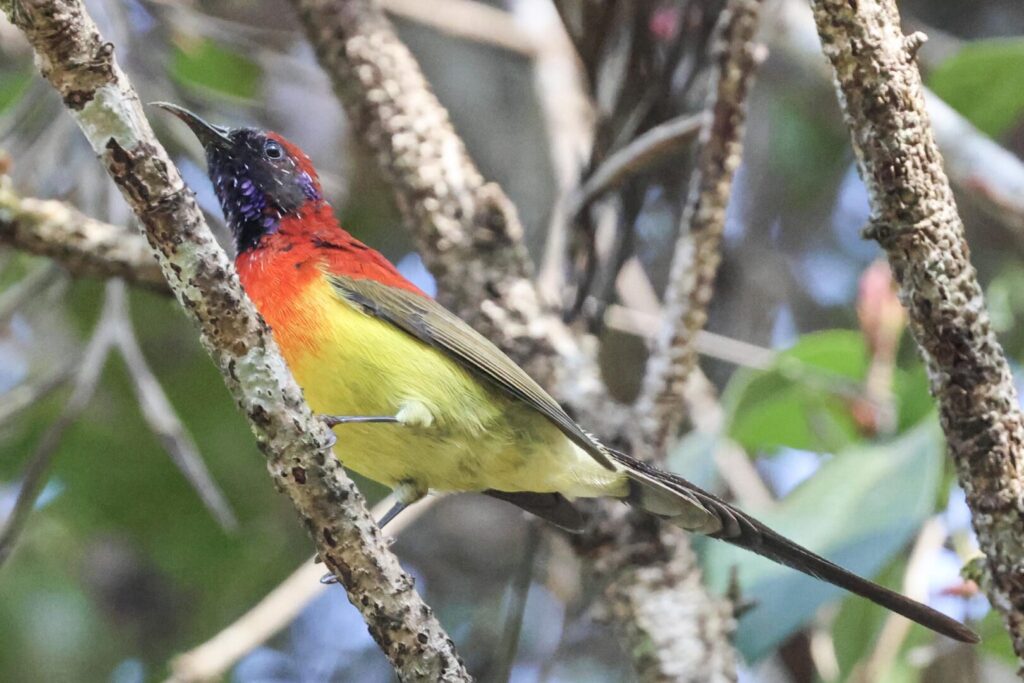
Walking across to the gardens opposite, lots of Mrs Gould’s and a few Black-throated Sunbirds were feeding in the bottlebrush bushes, along with several Indian White-eyes. Further round, we found a little group of Chestnut-flanked White-eyes too. They were very mobile at first but eventually we managed to get good views.

Cutting back across to the restaurant, we checked the dump behind and found lots of Black-breasted Thrushes feeding on the rubbish but no other thrushes today. A Grey-capped Pygmy Woodpecker was now in the top of the tall tree along with the Blue-throated Barbet.
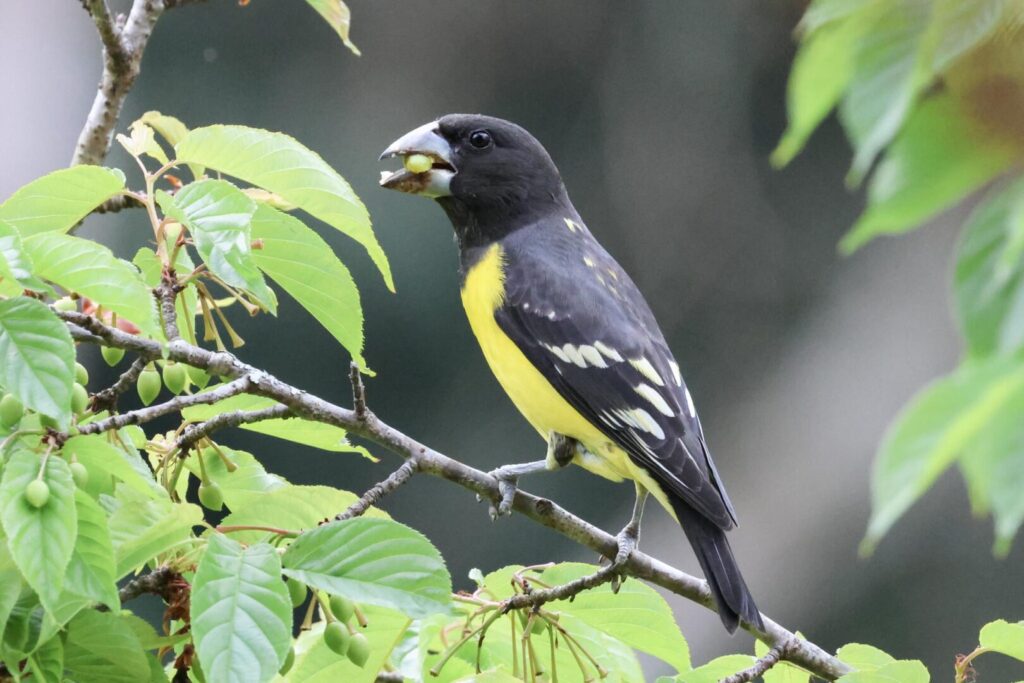
Scanning from the edge of the sunken garden, we found a couple of Spot-winged Grosbeaks in the cherry trees beyond. They were flushed by a couple of photographers walking past but then dropped down again. From round on the road the other side, we had ridiculously close views as the male Spot-winged Grosbeak fed on the young cherries. A Crested Honey Buzzard flew low overhead.
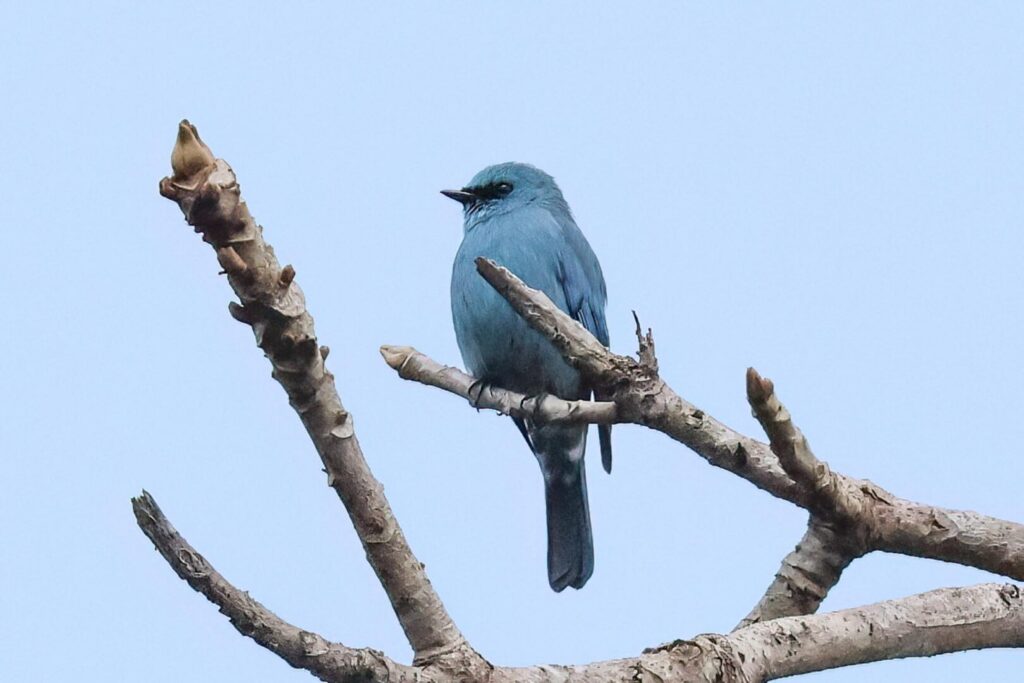
It was time for lunch, so we made our way back towards the restaurant. On the way, we stopped to watch a Verditer Flycatcher in the trees, and a much closer Blue-throated Barbet nearby. Dteng heard a Blue-bearded Bee-eater calling and found it perched high in a tree. We ate lunch in the restaurant here and afterwards had half an hour downtime, a chance to sit and have a coffee or walk round the gardens again.
On our way to the border post, we stopped to see if we could catch up with the Black-headed Greenfinches. We walked up the hill to the top and scanned the pines but at first we couldn’t find any, just a White-browed Shrike-Babbler. Then we realised that there were several Greenfinches there, but they were sitting quietly right up in the highest branches. We only noticed them when some started to move and quite a few flew off. Thankfully at least a couple stayed and we eventually managed to get them in the scopes.
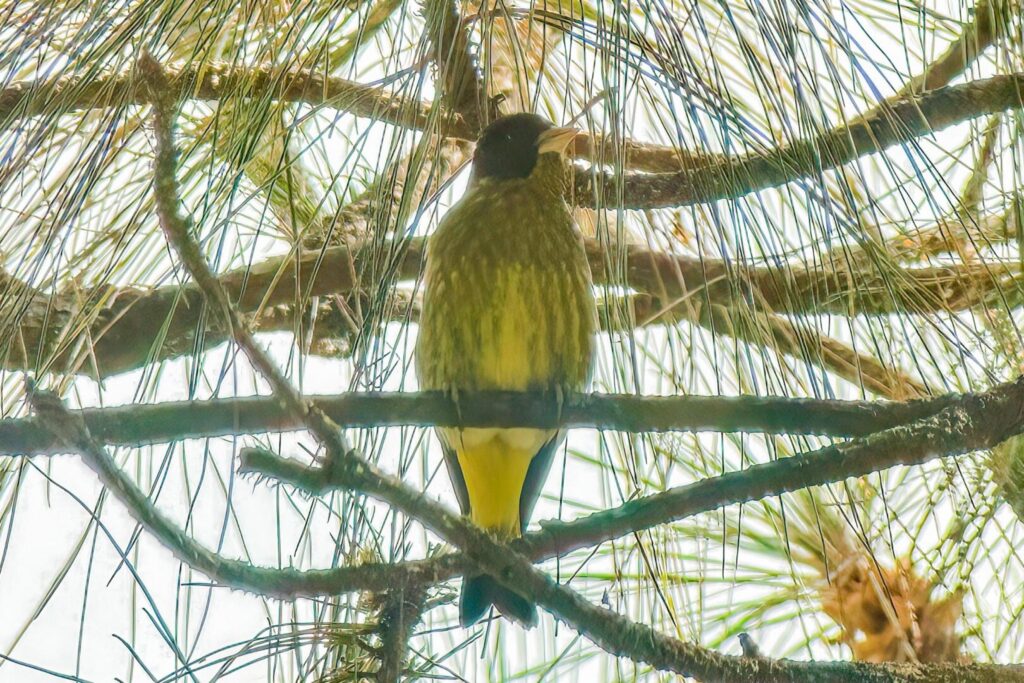
From there, it wasn’t far to the military camp and border post. As we walked across the helipad, a Burmese Shrike flew across in front of us. Two more were calling by the fenced-off lawn nearby and one eventually perched in the top of a tree on the edge of the helipad singing.
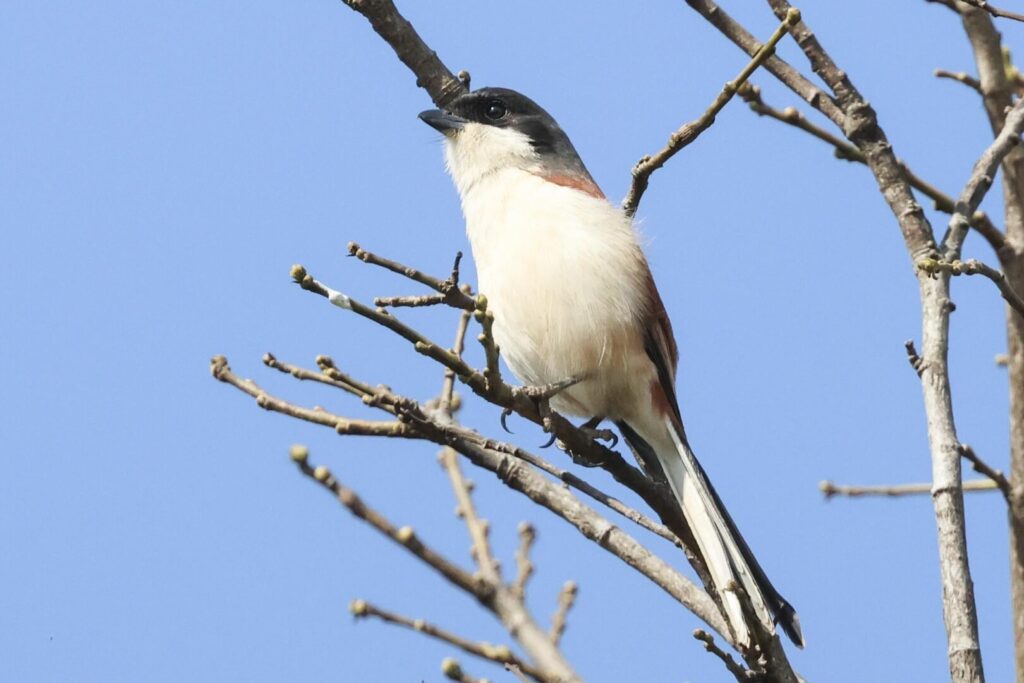
There was a Long-tailed Shrike too, just beyond perched on the border fence razor wire. Several Cook’s Swifts flew over. It is a slightly bizarre experience to walk through the military bunkers here to get to the viewpoint. Looking across the fences into Myanmar, we could see a pair of Brown-breasted Bulbuls and several Sooty-headed Bulbuls, a Common Iora and a couple of Grey-chinned Minivets. All on our Myanmar list!
As we made our way back, we stopped again at the campground. A Long-tailed Shrike was perched in the bushes beyond the toilet block and a Chestnut-vented Nuthatch was up in the pines. Dteng had a Spectacled Barwing briefly but it wouldn’t show itself for the rest of us. The dump across the road was quiet now.
Having not managed to look round there this morning, we drove back to the Chinese Cemetery. We stopped on the road and had a quick look at the rubbish dump first. Another Long-tailed Shrike was hiding in the bushes and dropped down onto the track briefly. Several bulbuls were up in the trees above.
Walking into the Chinese Cemetery, a Hill Prinia flitted around in the bushes between the tombs carrying nest material. There were lots of warblers in the trees, mainly Yellow-browed Warblers and Davison’s Leaf Warblers, plus several Indian White eyes. Further in, we found a couple of Grey Bushchats and more Bulbuls. Continuing on further in it was rather quiet. Just a single female Slaty-backed Flycatcher in the trees up at the top of the hill.
It was quite a long drive down off the mountain and late afternoon now, so we set off back to the hotel. When we got back, we had a little bit of time for a shower before dinner, list and bed.
Sunday 8th February
We had a long drive up to Chiang Saen today, but breaking the journey with a birding stop on the way this morning. Back to an early start, we left the hotel at 5am with a packed breakfast to eat on the way. We stopped for coffee at a filling station on the main road. A couple of Red Collared Doves were on the wires and Common and Great Mynas on the buildings. Several House and Tree Sparrows were around the forecourt.
We drove back and turned off, winding down on narrow roads through the houses and out into the countryside beyond. Interesting to see the local small scale cultivations. We crossed a bridge over the river and the bus drivers skilfully managed to negotiate some increasingly narrow and steep tracks. Finally the track ran out by the river and we stopped. A woman on a motorbike was waiting for us there. She led us on a narrow path through the fields down alongside the river, stopping at each junction to show us which way to go.
We passed a makeshift hide set up in the bamboo, but apparently the birds we had come to see here are not coming in to that one any more. So she led us on to what appeared to be someone’s garage, where a couple of cars were parked. A viewing area was set up on one side, a tarpaulin hung with viewing windows cut in. We positioned ourselves and looked out.
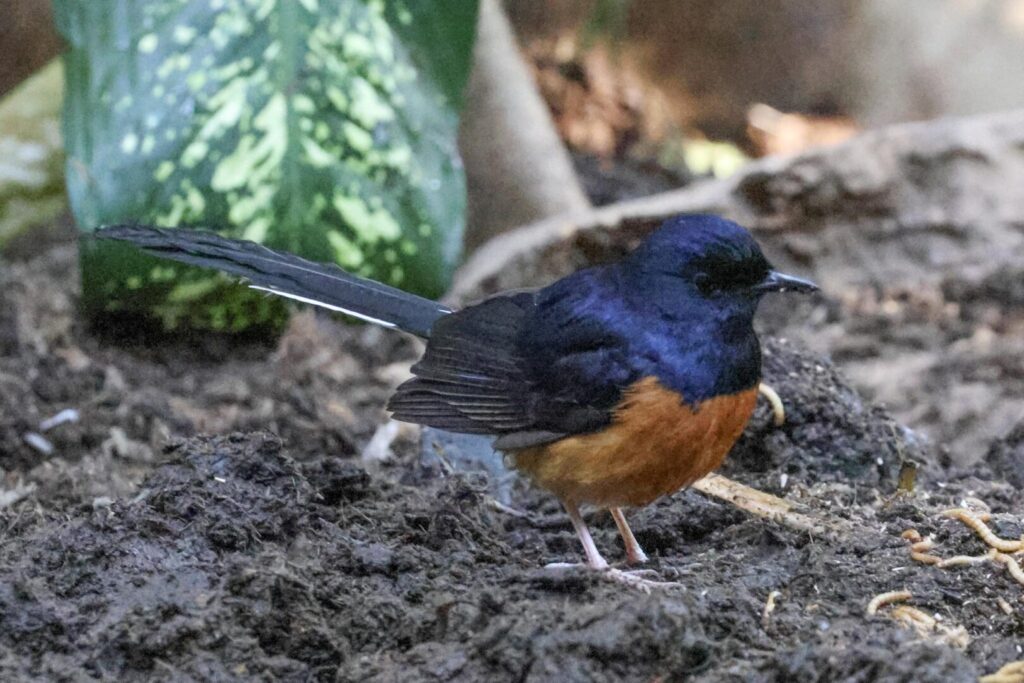
A male White-rumped Sharma was right in front of the tarpaulin, waiting. The woman went out and scattered some mealworms on the ground, tapping the tub against the branches as she did so. The Sharma was straight back in and set about chasing everything off at first.
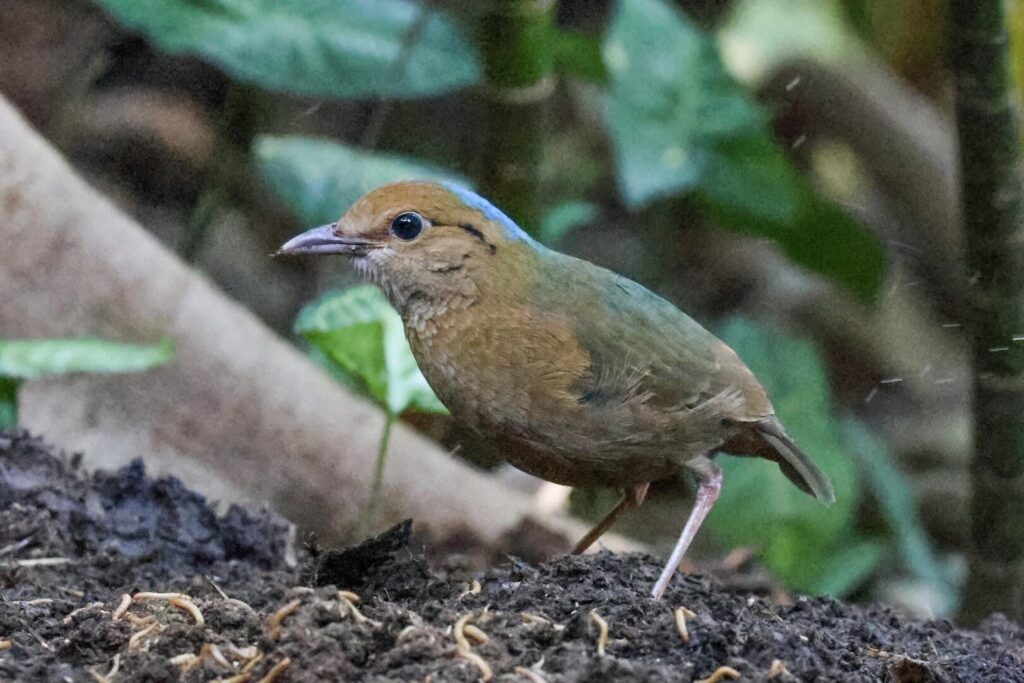
We didn’t have to wait long before the Blue-naped Pittas appeared. The male appeared first, and came in slowly through the vegetation behind, then out into the open to feed on the mealworms. It was followed shortly after by the female, together briefly than the male retreated and left her to feed. Amazingly close views. A rare species here, only first found in Thailand in 2009. So a great opportunity to see them as we were passing.
When the Sharma was not chasing them off, some other birds were coming in for the mealworms too. We saw at least three different Black-breasted Thrushes and a female Hill Blue Flycatcher. Just as we were wondering where it had got to, the Siberian Blue Robin came in too. We watched it tail quivering as it stood waiting to grab some mealworms. Apparently there had been a Dark-sided Thrush coming in recently too, but there was no sign of it this morning. Gradually, activity seemed to drop so we decided to move on.
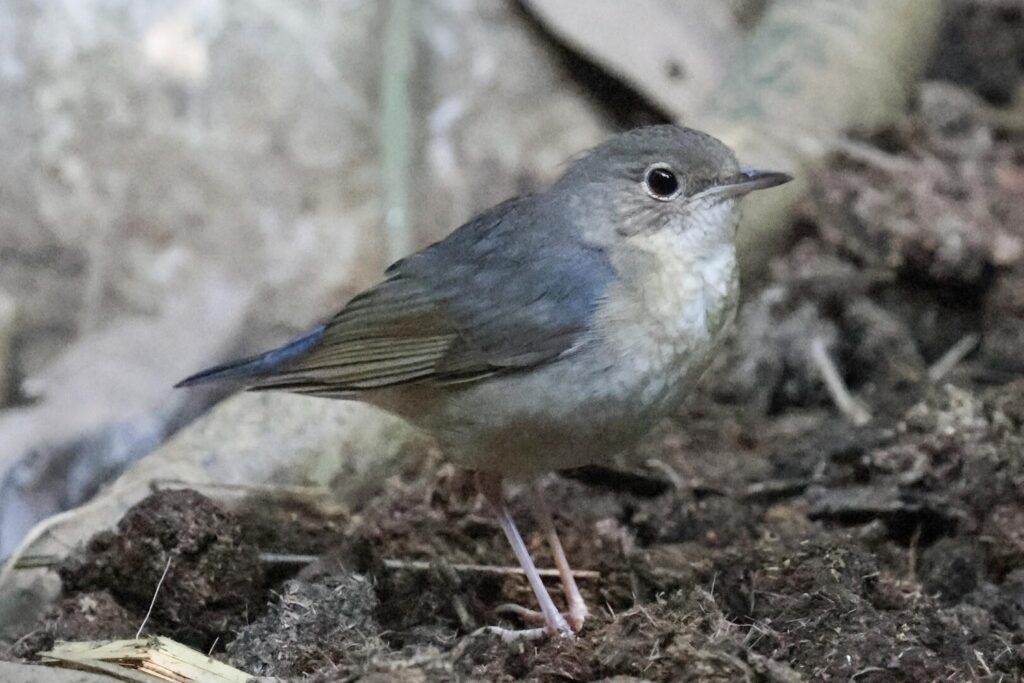
On the way back beside the river, we could hear several Blue-throated Barbets calling and managed to spot one perched in the top of a tree. It was hot now, and three Crested Honey Buzzards circled up over the hillside above us. A Chestnut-capped Babbler was calling in the reeds by the river but remained typically well hidden. Back to the minibus, an Asian Openbill drifted over following the river valley.
We drove back out to the main road and on to Chiang Saen. Into the town, past the old city walls, we turned and drove along the bank of the mighty Mekong river. It was already time for lunch when we arrived, so we drove to a restaurant on the edge of town. Dteng had been gradually easing us in, and some of today’s food was a little spicier. Delicious morning glory in tempura batter with a red dipping sauce, fried shrimp and squid with red chillis.
It was hotter here, lower down, so we had some time for sightseeing in the heat of the day. On our way back into town, we stopped at the Golden Triangle, the point where Thailand, Laos and Myanmar meet, where the Ruak river flows into the Mekong. Scanning from the viewpoint, we could see several Great White and Little Egrets on the side of the Mekong (in Myanmar) and some distant Barn Swallows on the Laos side.
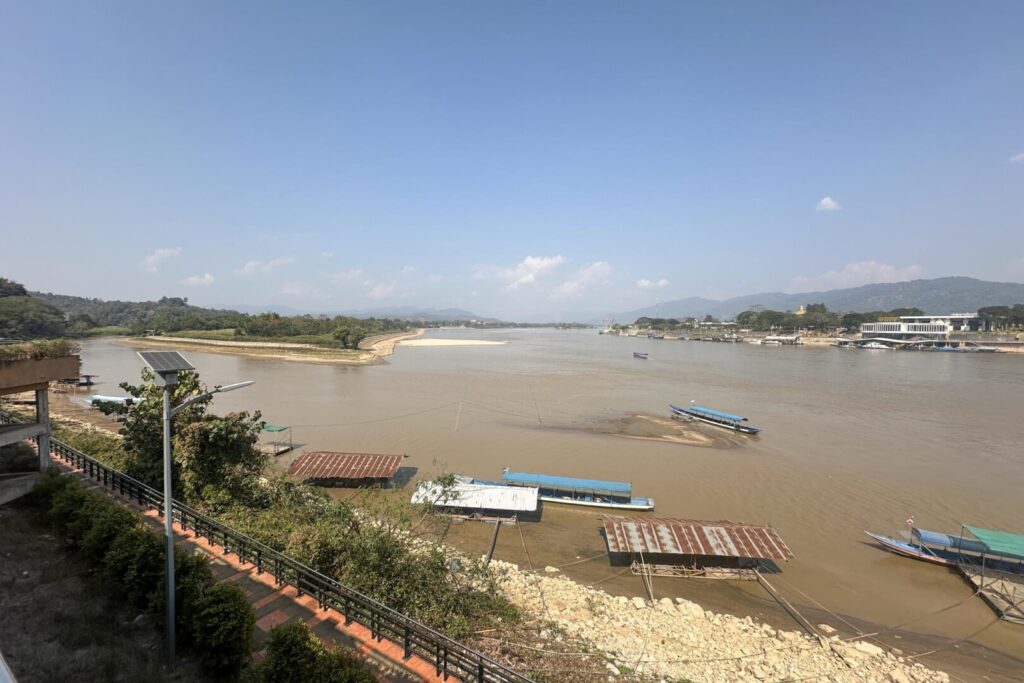
We called in at our hotel to check in and drop our bags, then headed out again to visit the old temple Wat Chedi Luang. Originally built in the 13th or 14th century, though parts have been rebuilt and added to since. The impressive main chedi was rebuilt in 1515 and stands 88 metres high. A pair of ‘Red Junglefowl’ in the car park were sadly not tickable! From there we walked down for a look round the old city walls.
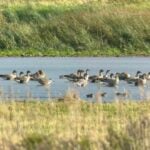
As the temperature had dropped, we walked back to the minibuses and drove over to Chiang Saen Lake. As we got out in the car park, we could hear and see thousands of Lesser Whistling Ducks out on the water. Scanning with the scopes, we found a lone pair of Indian Spot-billed Ducks and four Garganey, lots of Little Grebes and a single Great Crested Grebe (a rare winter visitor here) and several Little Cormorants. A few Oriental Darters were flying in and out of the island in the middle.
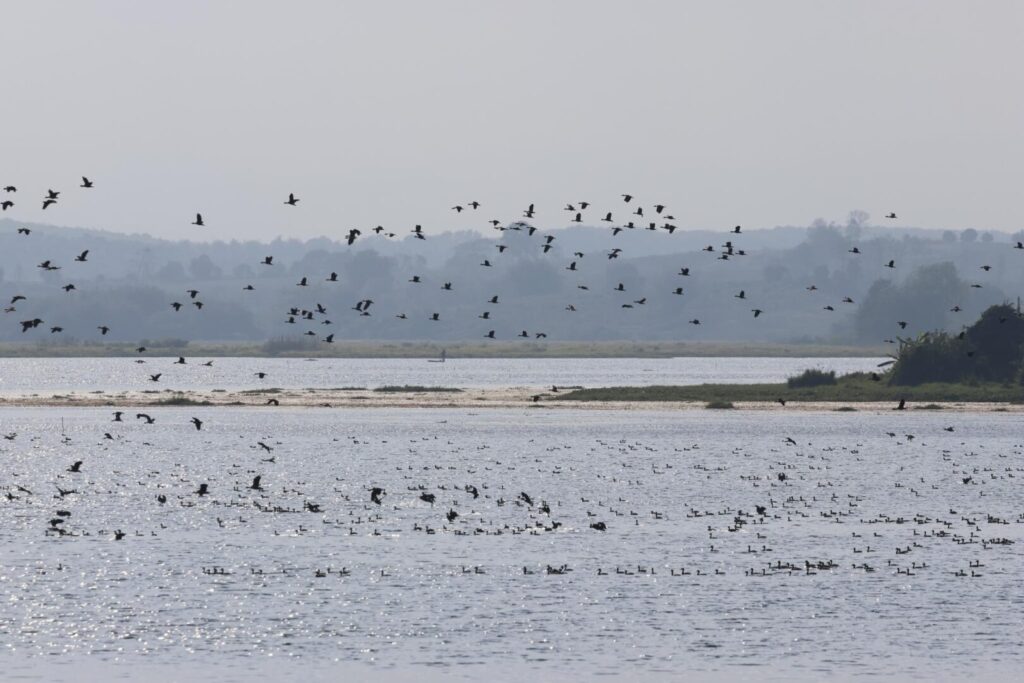
We picked up a Bronze-winged Jacana over on one side and a distant Pheasant-tailed Jacana out the other way. A Common Kingfisher flashed past and landed on a thin stick out in the water. We could hear a Coppersmith Barbet singing in the tree above us and managed to find it in the leaves. A small group of Water Buffalo swam past in front of us.
We could see some distant Ferruginous Ducks but we were looking into the sun from here. So we decided to drive further down along the side of the lake, to try to find a better angle. Several Grey-headed Swamphens were walking around the margins of the lake as we passed (now relumped as part of the Purple Swamphen complex ‘pending further research’, so they might be split again in the future).
There were still quite a few Ferruginous Ducks visible from here but they were scattered all round in small groups and we couldn’t find anything with them at first. We kept scanning. Lots of Coot were out in the middle. A Purple Heron was hiding on the near shore, hiding motionless in a mat of vegetation, and we found a couple more Pheasant-tailed Jacanas a bit closer than the one earlier.
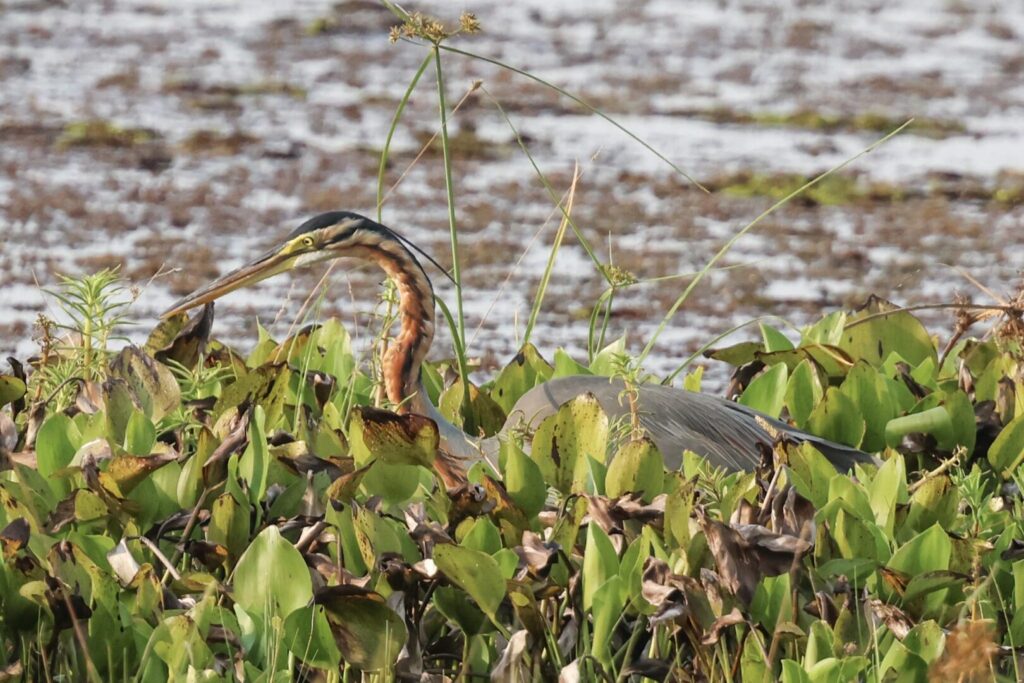
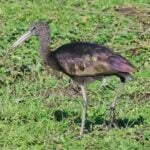
An Eastern Marsh Harrier flew round over the edge of the lake, flushing everything. Looking back along the shore, we could see a couple of Glossy Ibis now with the Swamphens.
Our main target species here was Baer’s Pochard. Classed as critically endangered, it is thought that there may be just 150-700 mature individuals still remaining. It used to be a regular winter visitor to Thailand from breeding grounds in China, with flocks of hundreds recorded in the past. In recent years only one or two individuals have been seen each winter.
There had been a male reported here in the last few days and a second bird suggested to be a hybrid Baer’s Pochard x Ferruginous Duck, so we knew at least one was around this winter. They are usually found with the Ferruginous Ducks and now we found what appeared to be a female Baer’s Pochard with one of the groups. It was very distant, right over the far side of the lake, and the light still wasn’t great from here. It looked good for Baer’s, but we couldn’t be 100% sure it wasn’t the reported hybrid.
Then we found the male Baer’s Pochard a little further round, so we lost interest in the female. It was over on the far side too and we realised it would be better viewed from the other side of the lake. After quick looks at it from here, we drove quickly round.
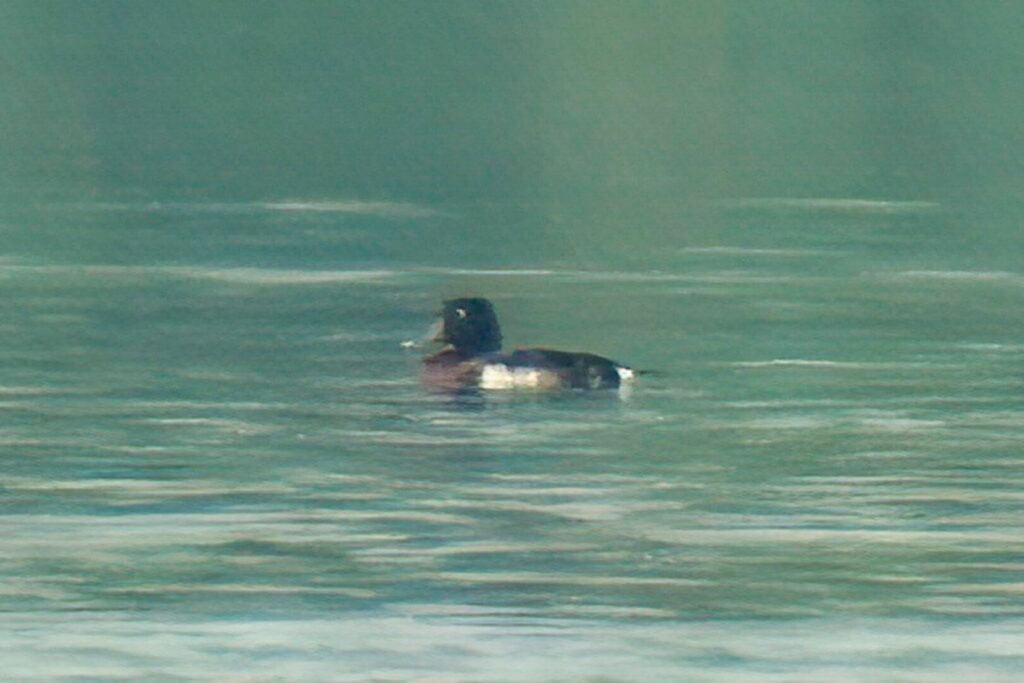
We quickly relocated the male Baer’s Pochard. The light was better from this side and the ducks a bit closer. We spent some time watching it, swimming with a small group of Ferruginous Ducks. Definitely not a hybrid, this one had a nice clean green head and extensive white foreflanks.
Eventually we turned our attention to trying to relocate the female we had seen earlier. We managed to find it, but the light was starting to go now. It looked good for a pure Baer’s Pochard too, with no obvious signs of hybridization, but it was still not particularly close.
With the main target here in the bag, we realised we had not really looked at the other birds around the lake. One of the group did spot a small group of Cotton Pygmy Geese feeding in the floating vegetation in front of the ducks out on the water. Flocks of egrets were flying over now, heading in to roost. The sun had set and it was time for us to head back.

We called in at a local restaurant on the way, another delicious dinner. Different food every stop. Then back to the hotel and we gathered down in reception to go through the day’s list. Not so many species today, but some great and very rare birds.
Monday 9th February
Another lie in! Breakfast in the hotel today at 6am. Afterwards, we gathered our bags and checked out. It was a cloudy start this morning and almost felt like it might rain. We drove out in the countryside and stopped at the start of a track down through the fields.
As we walked slowly down, lots of Mynas, Bulbuls, Red Collared and Spotted Doves were perched in the bushes and trees, just coming out of where they had roosted. A young male Asian Koel flew across and landed in a tree right in front of us. We could see it still had scattered brown feathers in amongst its adult black ones.
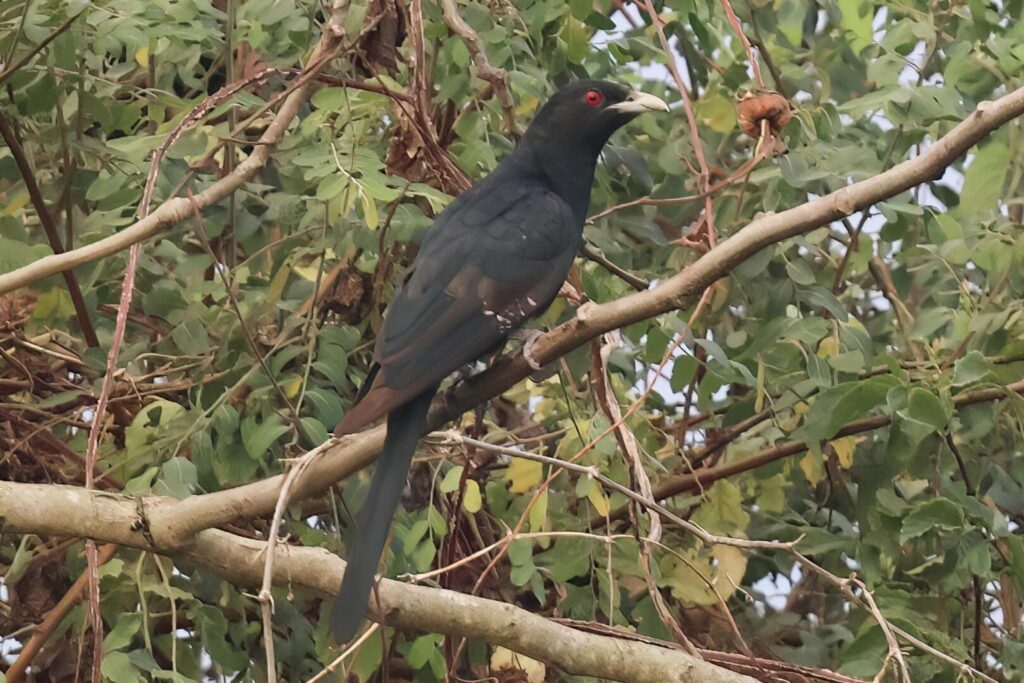
There were lots of egrets perches in the trees and flying off to feed. Two Black-crowned Night Herons flew up and one, a juvenile, landed in the tree with the egrets. A Chinese Pond Heron joined them and then we noticed a male ‘Red Junglefowl’ (unfortunately domesticated) in the branches too! There were a couple of Grey-throated Martins flying around over the track ahead. A Brown Shrike flew down into the field and caught something, flying back up to the bush on one edge to eat it.
Down to the corner, we scanned the river and found Green and Common Sandpipers and a Little Ringed Plover on a sandbar. We could hear Chestnut-capped Babblers calling in the vegetation below us but they remained typically well hidden. The sun was starting to poke through the clouds and more birds were coming out onto the edge of the reeds. Small groups of Baya Weavers and Scaly-breasted Munias flew round and landed in the tops to warm up.
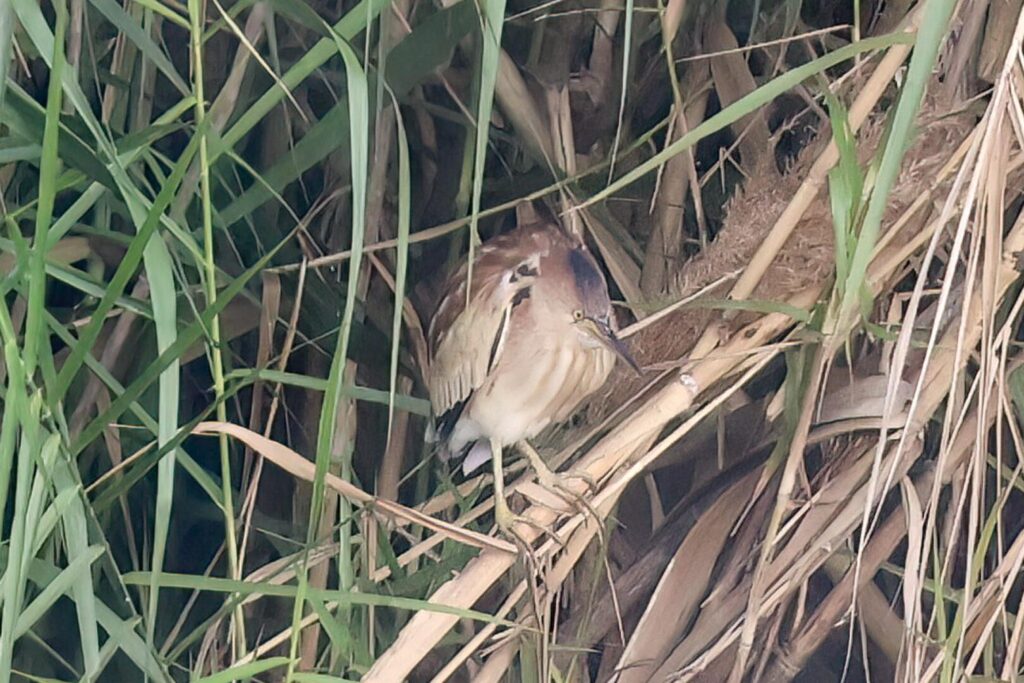
There seemed to be lots of activity in a large line of reeds out in the middle of the fields now in particular. Two Wrynecks flew out and perched up. Lots of Moorhen and a couple of White-breasted Waterhens had come out along the edge of the dried up pool in front, along with two Grey-headed Swamphens. As we walked on, a Yellow Bittern flushed from a small pool below the track. It landed in the reeds at the back, where we managed to get a good view in the scopes. A female Plaintive Cuckoo flew across in front of us.
–
From further round, we could see an interesting looking recently cultivated field on the other side of the same line of reeds. A few Amur Stonechats were flitting around out in the middle. There seemed to be much more activity here, so we stopped to watch. Several birds flew out of the reeds and down onto the edge of the field – another Wryneck, a male Siberian Rubythroat, a Bluethroat.
A couple more White-breasted Waterhens came out this side too, then a Watercock appeared out of the reeds. Typically skulking and usually hard to see, it didn’t stay out long. Two Streak-eared Bulbuls were preening in the reeds and a Brown Shrike was hunting from the scattered stems out in the field. A small flock of Eastern Yellow Wagtails dropped in briefly.
There had been a Jerdon’s Bushchat reported here earlier in the winter but we weren’t sure we would be able to find it. Then we spotted a small bird drop out of the reeds into the edge of the field briefly. A female Jerdon’s Bushchat, it darted back up and disappeared into the reeds again. It kept doing the same and wasn’t easy to see, never staying out for long and not close. But eventually everyone managed to get onto it. A very scarce bird in Thailand these days.
The minibuses had driven down to meet us, so we climbed back onboard. We stopped to use the restrooms at a nearby filling station, then continued on back to the lake. It had been a quick whip round yesterday, while we were trying to find a Baer’s Pochard, so we wanted to spend a bit more time to look round today. A Hoopoe was in the car park and flew up into the trees as we got out. There were fewer Lesser Whistling Ducks in this corner of the lake today but still plenty.

We walked down to the far end of the car park to scan the wet grass on the edge of the water. There were lots of Grey-headed Swamphens here…

…several Bronze-winged Jacanas…
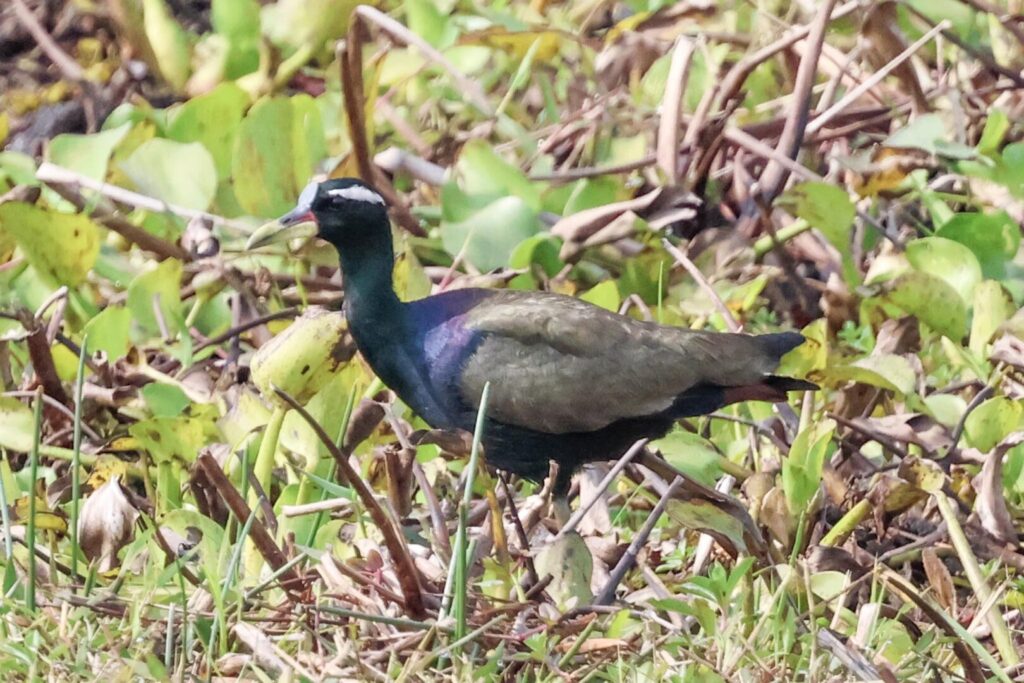
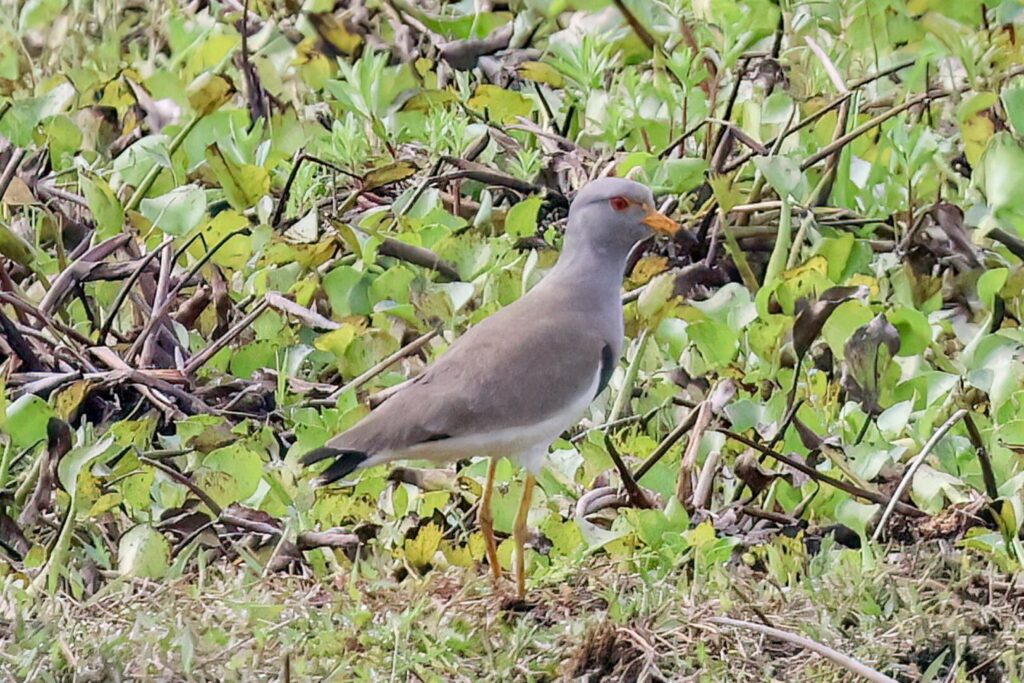
…and a few Grey-headed Lapwings. Good views of all of them in the scopes now. A couple of Common Snipe were feeding in the grass and two Glossy Ibis were a bit further back. A Citrine Wagtail flew up and landed on a small dead tree where it perched, preening.
It was better light this morning, and we realised the Baer’s Pochards were closer from here today. We could see the male and female together now, with a few Feruginous Ducks. Nice to get a chance to see them again. Two Shoveler were out on the water, plus six Pintail new for the list, and a single Garganey. An Eastern Marsh Harrier drifted over flushing all the Lesser Whistling Ducks. We could hear lots of Dusky Warblers and Yellow-browed Warblers calling in the bushes.
There was another wetland site not far away we hadn’t managed to visit yet, Hellscape Water Pits. We were already a bit later than planned and we had to get back to the National Park HQ in Fang by 4pm to get tickets for tomorrow. Dteng thought we just about still had enough time to get there, so we set off in the minibuses. The drivers were following Google Maps, which was trying to take us in from the other side to normal, starting from the lake rather than the main road.
We made our way down through a large area of ricefields along a series of ever narrower dirt tracks. There were lots of Wood Sandpipers in the paddies as we passed, a few Grey-headed Lapwings, lots of Asian Openbills and Egrets, several Brown Shrikes.
We got most of the way there before we discovered that a track crossing over one of the main irrigation channels that Google wanted to use did not exist! There wasn’t time to go all the way back round via the main road and come in the other side now. We couldn’t see an obvious way in from here, so we had to admit defeat.
We stopped for lunch at a small restaurant out on the main road. It was hoped to be just a quick stop, but a large group of about a dozen people who looked like they might be from the army had arrived shortly before us. Even when we thought their lunch was served, they kept getting more. We had to wait before our food eventually arrived. It was a long drive back to Fang but the drivers managed to get us there just in time.
The cloud had mostly lifted after this morning but now, on the edge of the hills, there were some thicker patches. It even started spitting with rain briefly as we made our way round to the National Park HQ by the Hot Springs, though the sun came out again by the time we arrived. While Dteng went to arrange the permits for tomorrow, we headed over to use the facilities. Then we walked down to explore the Hot Springs.
It seemed rather quiet at first. An Oriental Magpie Robin was singing in the trees in the middle as we walked across on the path and a Grey Wagtail flew up from between the rocks. A single Black-crested Bulbul was in the trees by the geyser over on the far side and a Taiga Flycatcher flicked out of a small bare bush by the track.
We stood and scanned from the platform and found a couple of Black Drongos and a pair of Black-collared Starlings. Just as we were about to leave, one of the group found a Blue Rock Thrush on the roof of one of the buildings further over.
As we started to walk back round on the road, two Little Cuckoo Doves flew over in front of the hillside above, followed shortly after by another six or so. We saw some movement in the bushes and found a Grey-backed Shrike halfway up the slope in the bushes so we stopped and got it in the scopes. Dteng had managed to get the permits so he joined us again now.
As we carried on further round, we found an Asian Barred Owlet in the trees which was chased off by two Pallas’s Squirrels. Two Blue Whistling Thrushes around the buildings were of the resident yellow-billed form and a White-faced (Eurasian) Jay was feeding on something in the trees.

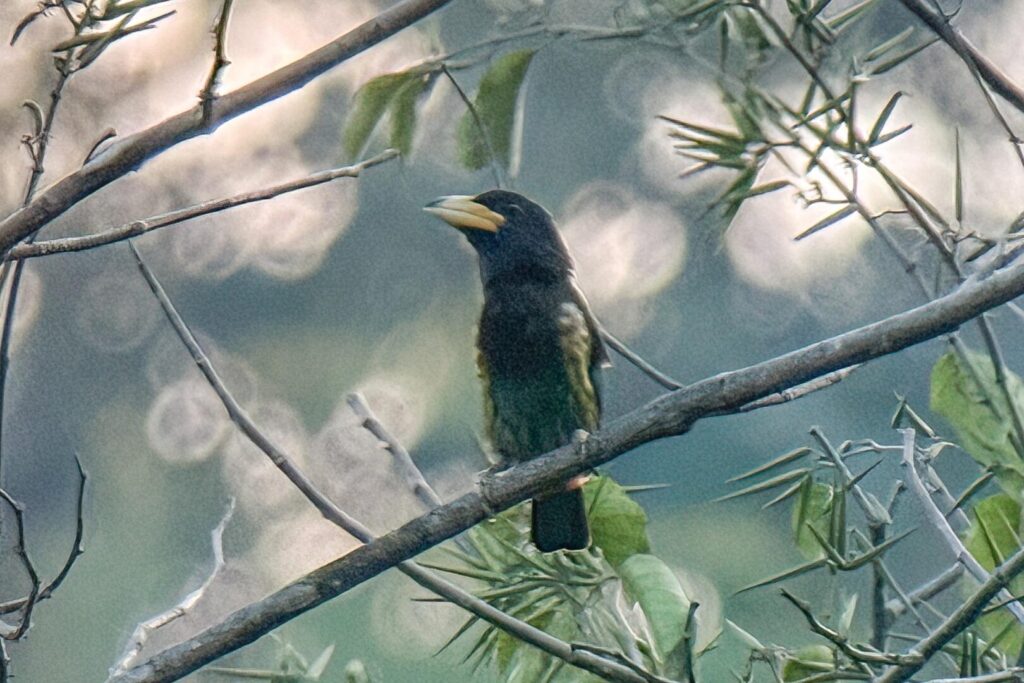
Just as we were walking on, we heard a Great Barbet singing behind us. We turned to walk back, and noticed several Green Pigeons circling round. Most seemed to fly off but two landed back in one of the trees in view. A pair of Pin-tailed Pigeons, we could see the male’s long tail hanging down through the scopes. Dteng thought the Great Barbet might have come in to fruiting trees just beyond the pigeons but we couldn’t find it now. Several Greater Racket-tailed Drongos disappeared back through the trees.
We continued on round and up to the campsite. A flock of Black-headed Bulbuls was feeding in a fruiting tree, with a Black-crested Bulbul by the lake closer to us for comparison. Hundreds of Himalayan Swiftlets were gathered in the skies over the ridge and we picked up a few Asian Palm Swifts too.
While looking up, we found five or so House Martins high overhead now. They looked to be Asian House Martins but one stood out, clearly different. A Nepal House Martin, we could see its distinctive shape, small with broad wings and a square tail, and blacker sides to its head.
We could hear Lineated Barbets singing, and managed to find a couple perched in the surrounding trees. A Great Barbet started singing too, but it sounded like it was further back. We scanned the trees but all we managed to find was a Hair-crested Drongo briefly. Just as we were about to give up, the Great Barbet finally came in and started singing closer. We could see it now, perched up in a tree at the back of the campground.
Time to head to the hotel now, we checked back in. After a break for a shower, we had dinner in the restaurant and then went through the list in reception, as before.
Tuesday 10th February
It was another early start today. We left the hotel at 5.00am with a packed lunch and stopped to get coffee and breakfast at one of the many 7-Elevens on the way. Hundreds of Barn Swallows were roosting on the wires on either side of the road in front of the shops, and one was on a nest above the doorway into the 7-Eleven.
We were heading up Doi Lang East this morning, and the minibuses aren’t suitable to get up the bumpy track to the top. So we drove up to the back of Mae Ai, where we were met by two trucks just before the ranger station and barrier. We climbed into the back for the long drive up.
We stopped half way for a short break at an area of old rice paddies. Three Rufous Turtle Doves were feeding in the fields and another flew in and landed in a tree the other side of the road. Better views than we had on Doi Lang West the other day. A single Paddyfield Pipit and several Oriental Magpie Robins were out in the fields too.

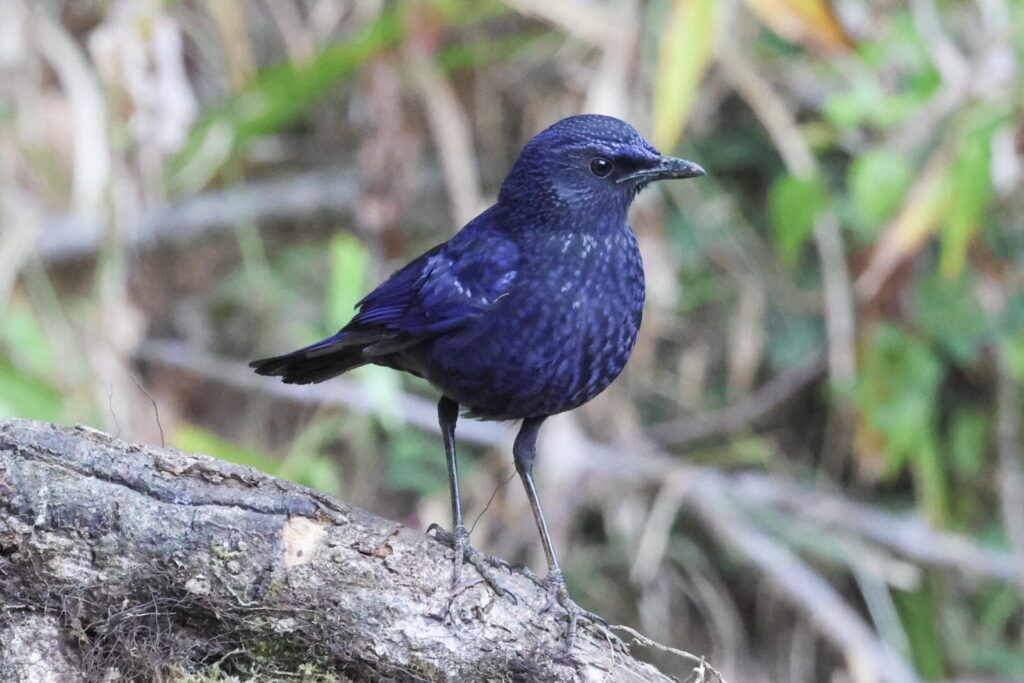
When we got up to the ranger station at the top, we parked in front of the barrier. Several birds were already waiting by the pile of logs arranged nearby. Dteng put some fruit out, bananas and papaya, and a black-billed Blue Whistling Thrush was straight in.
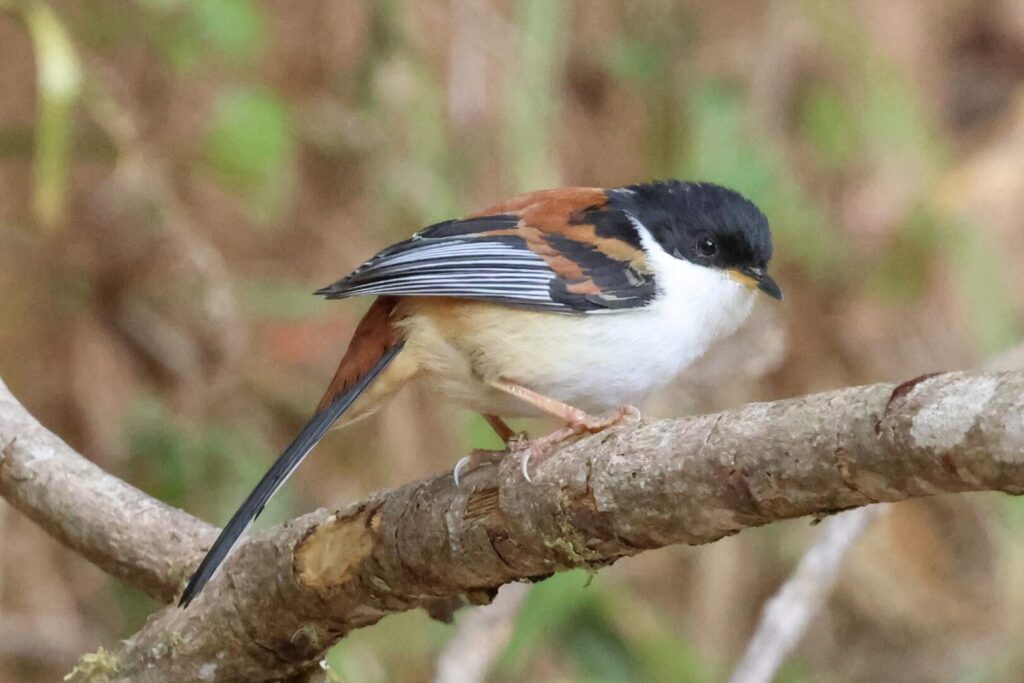
A flock of Dark-backed Sibias appeared next, and brought a couple of Rufous-backed Sibias in with them. After that, they seemed to be hanging around throughout our stop here.
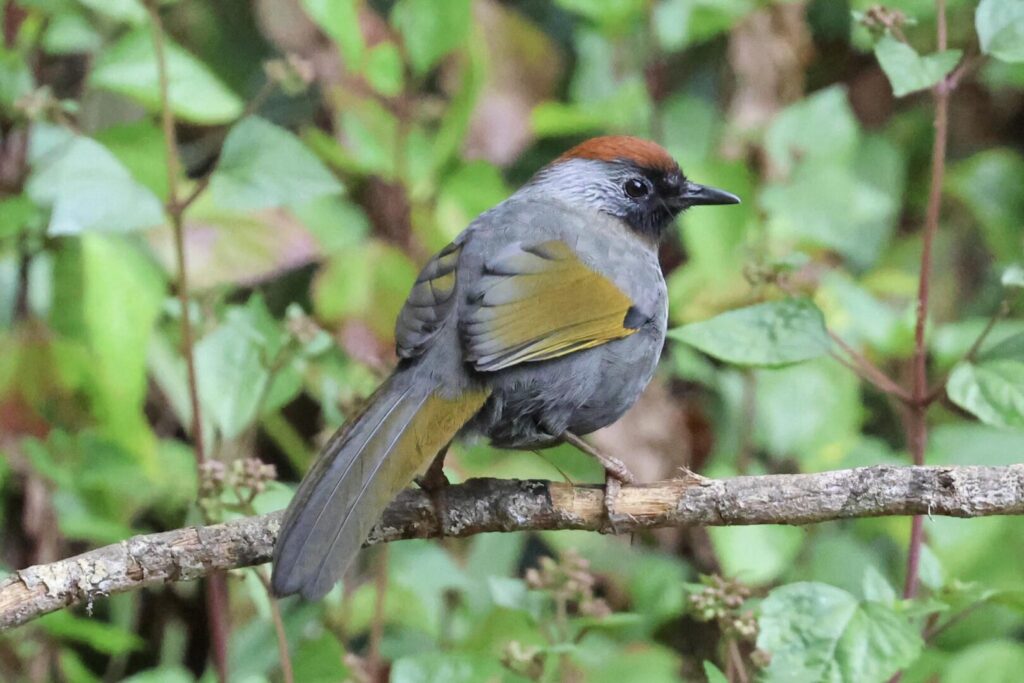
A Silver-eared Laughingthrush came out onto the log…
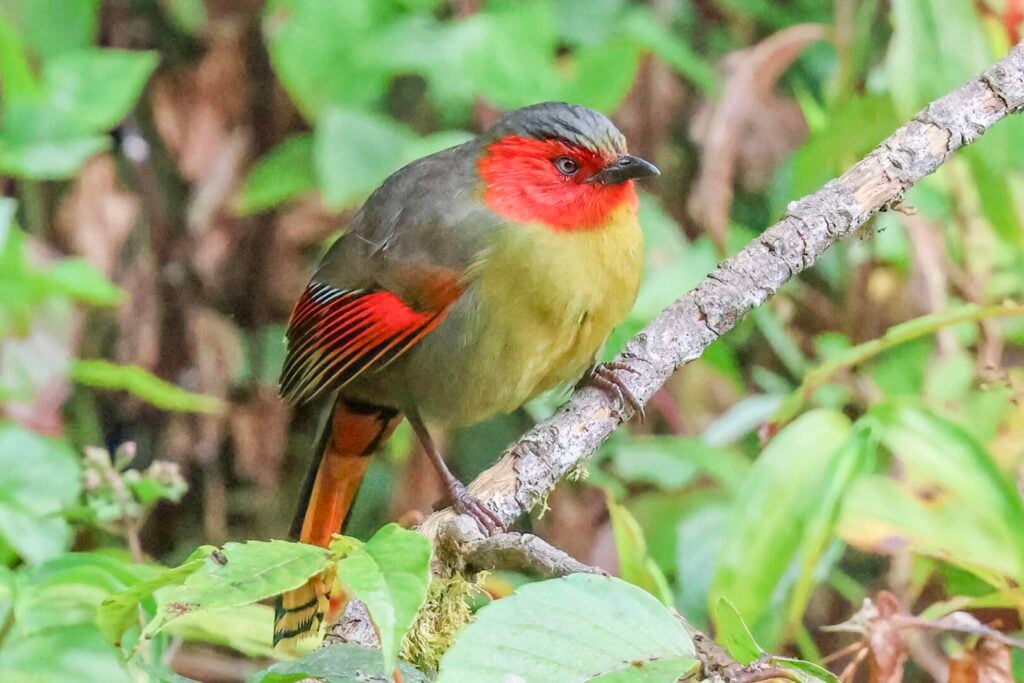
…followed by a pair of Scarlet-faced Liocichlas.
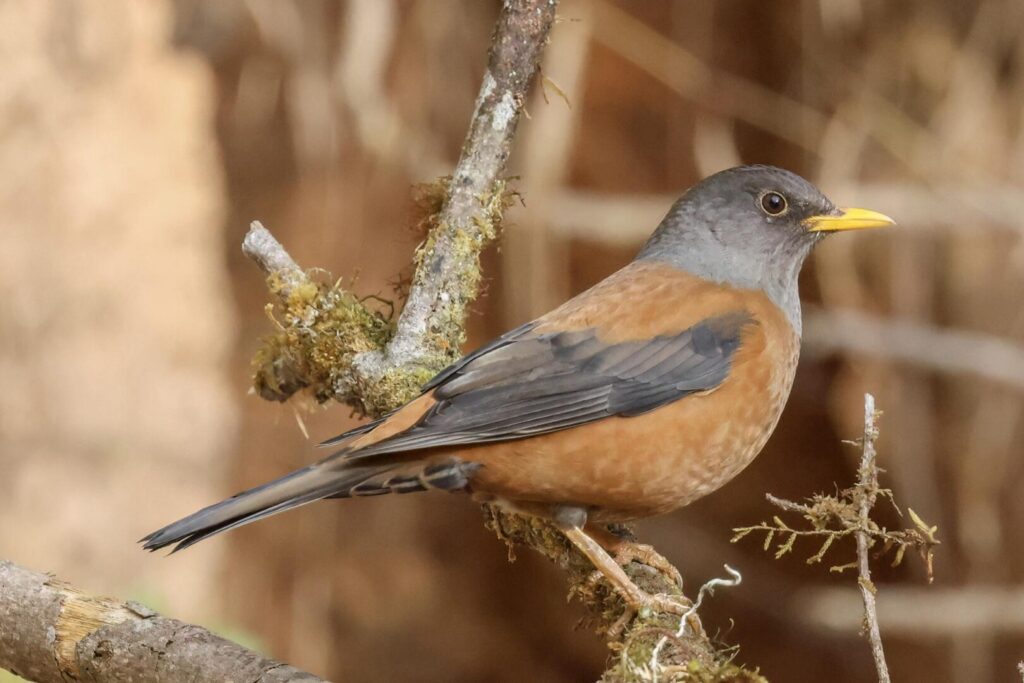
This has been a good winter for Chestnut Thrushes in north Thailand, after several poor years. A rare, irruptive winter visitor from China. There were at least two here now, with one coming out onto the pile of logs and a second hanging around on a tree trunk by the barrier, waiting for mealworms. A female Large Niltava was hanging around in the trees to one side. A small group of Flavescent Bulbuls came in to the logs too.
One of group saw a Yellow-cheeked Tit briefly further up beyond the barrier, in the trees on the side of the road. As we turned to look, a large mixed flock flew across but unfortunately quickly disappeared into the trees the other side. We could hear a Collared Owlet calling now.
The drivers had made coffee so while we stopped for a break and a snack we tried to see if we could find it. Unfortunately it wouldn’t come in close enough to see. A couple of Buff-barred Warblers were in the trees above the feeding station now, flashing their white outer-tails feathers.
After coffee, we walked further down past the barrier. A pair of Yellow-bellied Fairy-Fantails were in the trees just behind another feeding station which had been arranged on the verge. A brief Himalayan Bluetail appeared unprompted but was immediately chased off by a male Large Niltava. Dteng put some mealworms down but even the Niltava had disappeared.
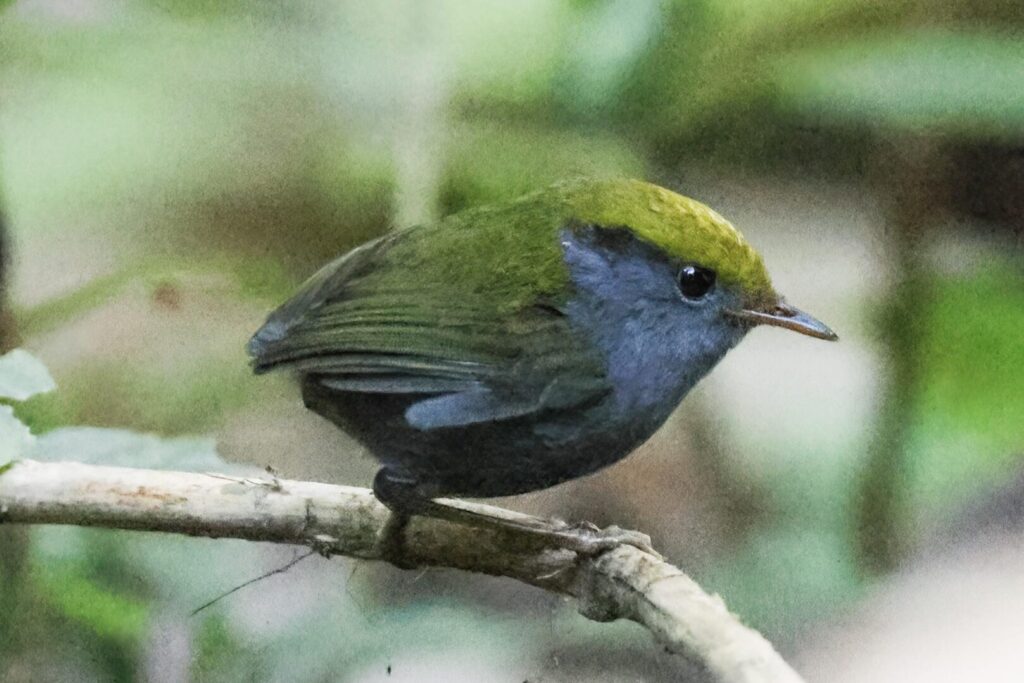
Further on, we took a small path in through the trees and down a steep bank into a gully. There were already Slaty-bellied and Chestnut-headed Tesias hopping around on the ground when we got to the bottom.
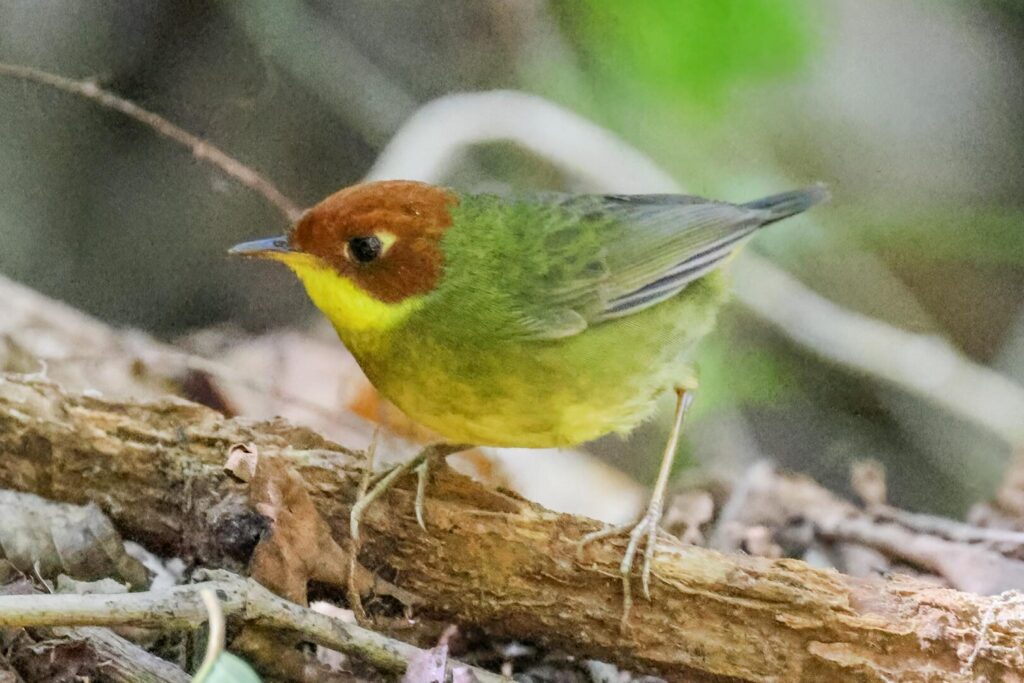
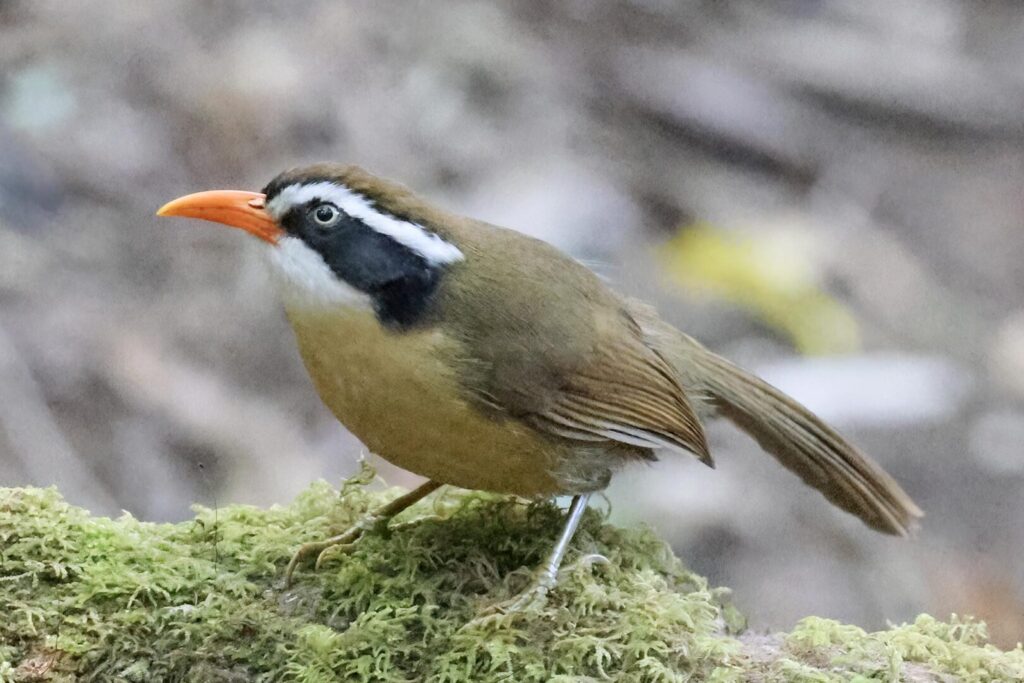
Then a flock of Brown-crowned Scimitar-Babblers took over and the Tesias quickly disappeared further back. A brief couple of Spectacled Barwings moved through the bushes. When the Scimitar-Babblers moved off again, the Tesias quickly reappeared. Very close views out in the open now, down to only a few feet at times, of what can sometimes be very hard species to see.
Dteng sprinkled some mealworms on the logs in front of us and more birds came in. A female Himalayan Bluetail, a couple of White-gorgeted Flycatchers,…
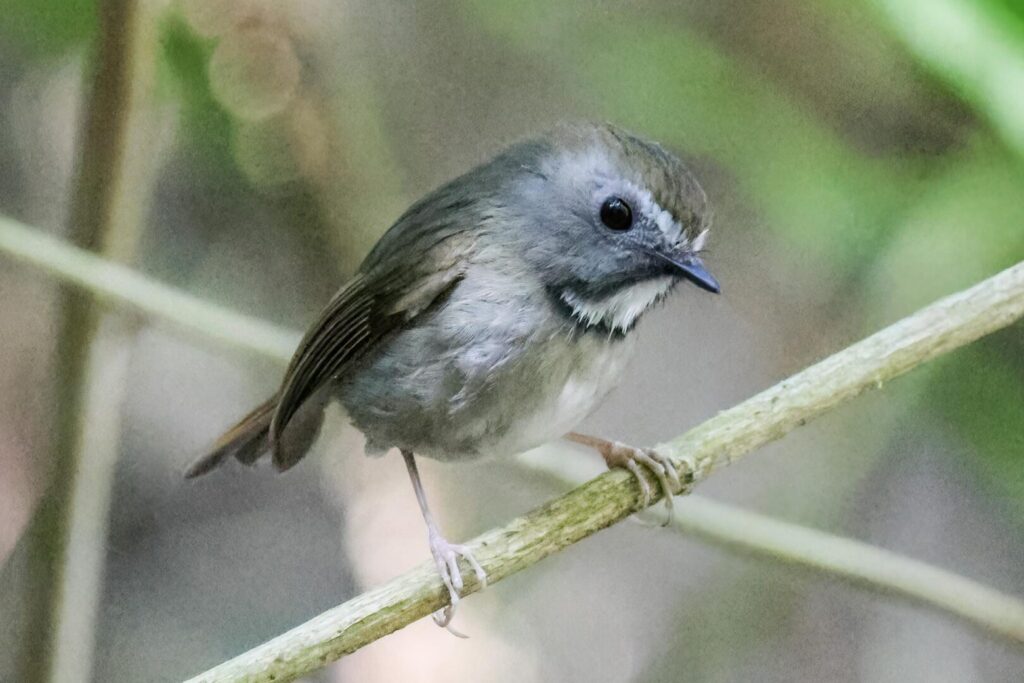
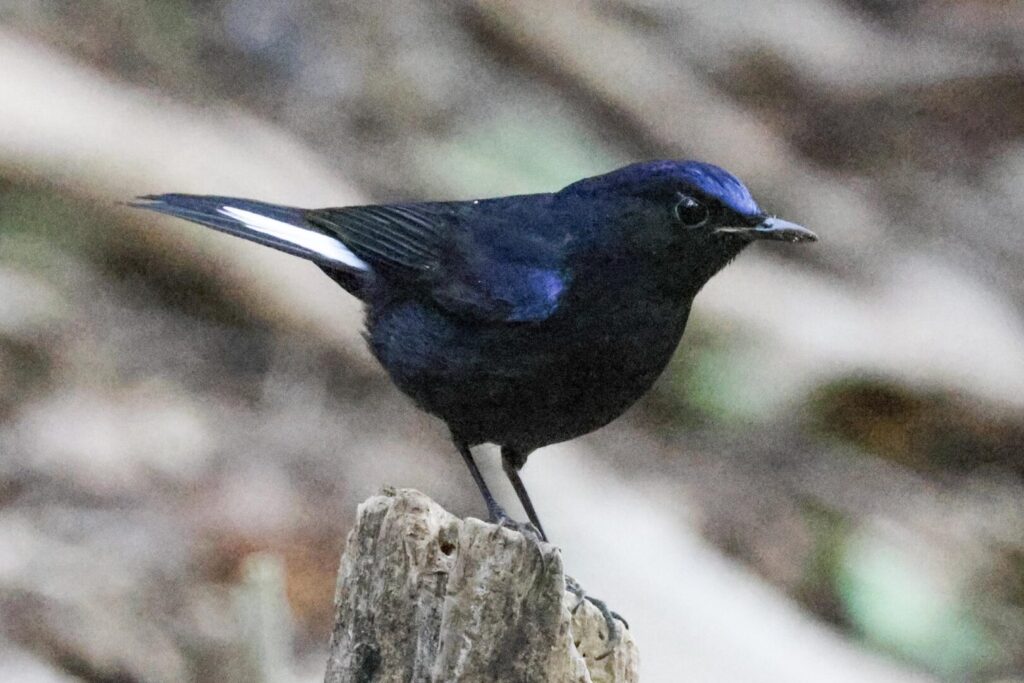
..a male White-tailed Robin, a Blue Whistling Thrush and a Chestnut Thrush. Hard to tell if some of them had just moved in from up on the track or they were different individuals, but the Chestnut Thrush was certainly not one we had seen at the feeding station before the barrier.
The Brown-crowned Scimitar-Babblers came back in, fantastic close views of them too now. A couple of Rufous-winged Fulvettas came down to feed in the leaves beside us. Another Fairy-Fantail appeared in the branches overhead and a White-throated Fantail moved through the trees higher above us briefly. A Mountain Tailorbird skulking in the bamboo at the back eventually came out into view.
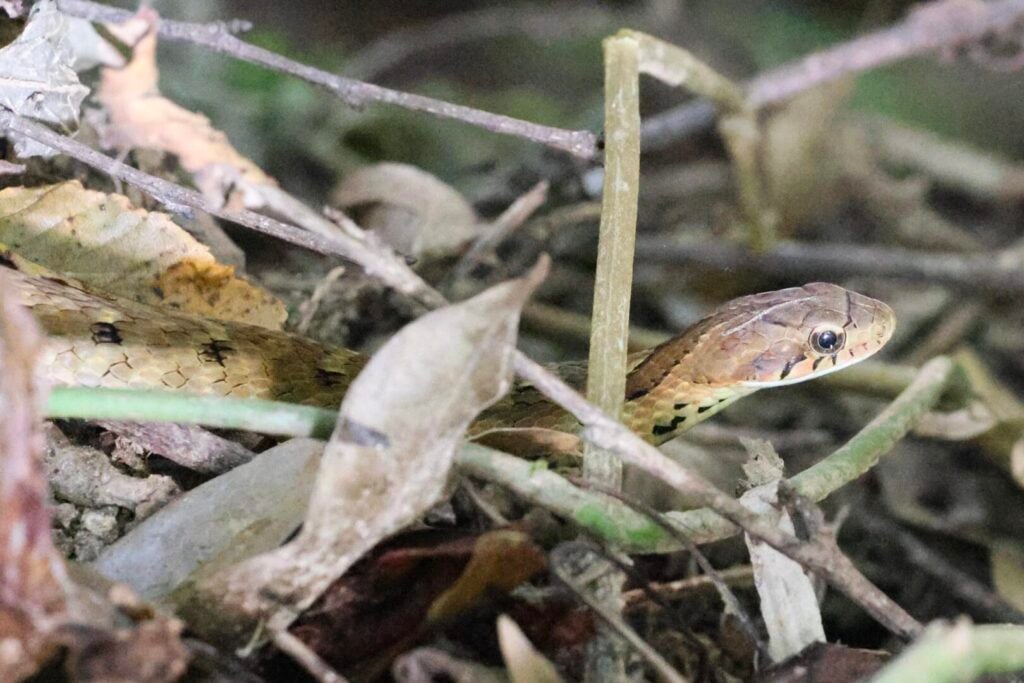
Eventually we had to tear ourselves away from all the great birds down here. As we climbed back up out of the gully, a Large-eyed Bamboo Snake was in the leaves by the path.
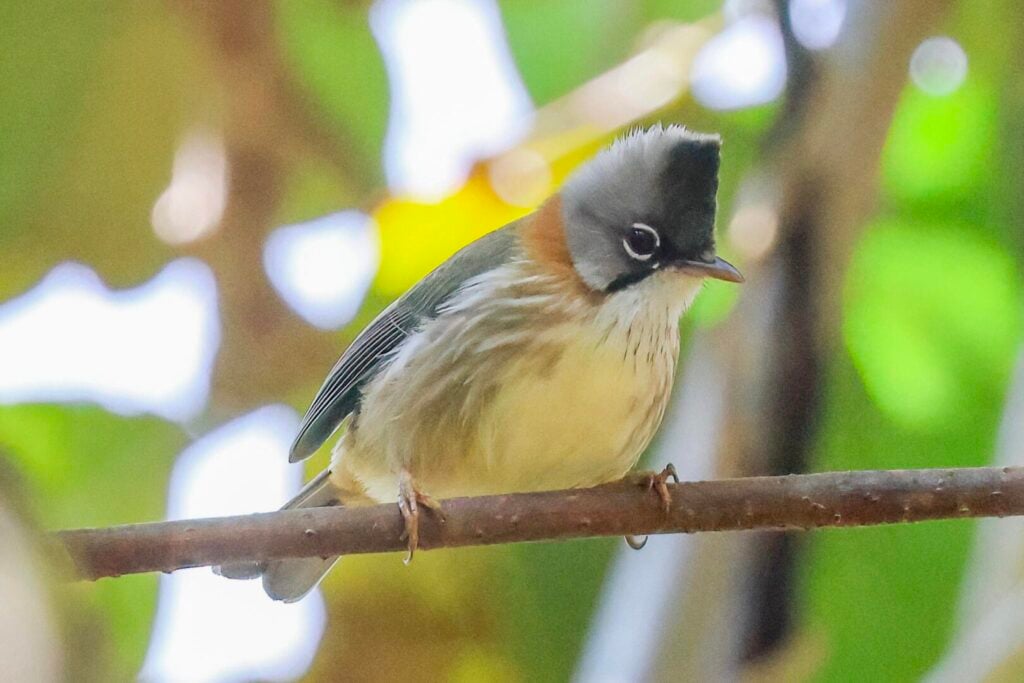
Back out on to the main track, we walked on further. A Whiskered Yuhina called in the trees above the path and we eventually had good views of a pair above our heads. A Chestnut-crowned Warbler flicked in and out of the tangled creepers too. Looking down the track ahead of us, a Crab-eating Mongoose ran across. We could hear a Blyth’s Leaf Warbler singing in the trees but couldn’t see it.
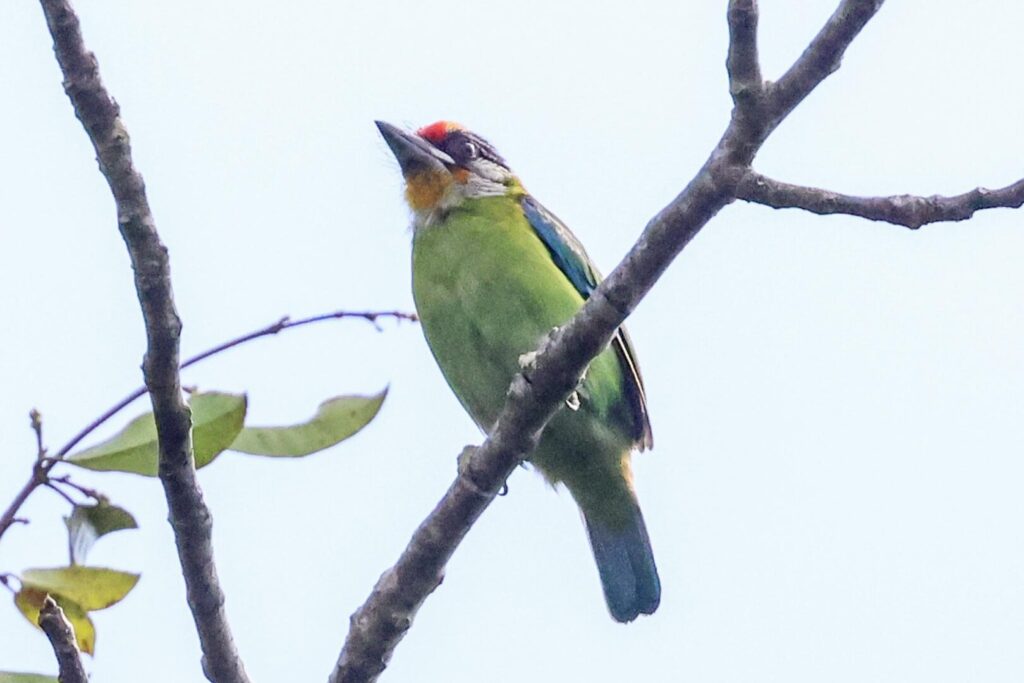
A couple of Golden-throated Barbets were calling too, and we eventually managed to see one perched out in the top of a tree eating fruit. We turned round now and headed back. On the way, a Slaty-bellied Tesia was singing in the low vegetation by the path and came up to dance on one of the stems briefly.
A female Himalayan Bluetail was waiting on a coil of razor wire by another feeding station.

Dteng put some mealworms down and a male Large Niltava and a Chestnut Thrush appeared. We were just above the gully here so the latter at least was probably the one we had seen there earlier.
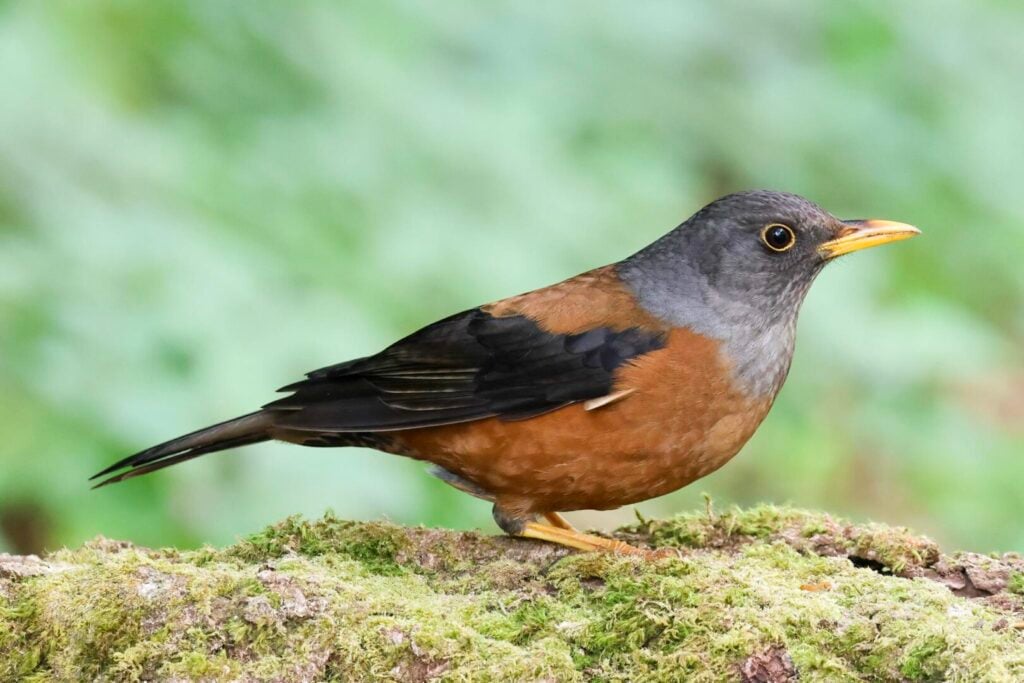
Back to the trucks, we stopped to eat our packed lunches and watch all the birds which were still coming in and out to the feeding station. Several Spectacled Barwings were feeding on the fruit put out on the logs now. Better views than we had earlier. After lunch, we set off to walk down the road a short way, to see if we could find any feeding flocks.
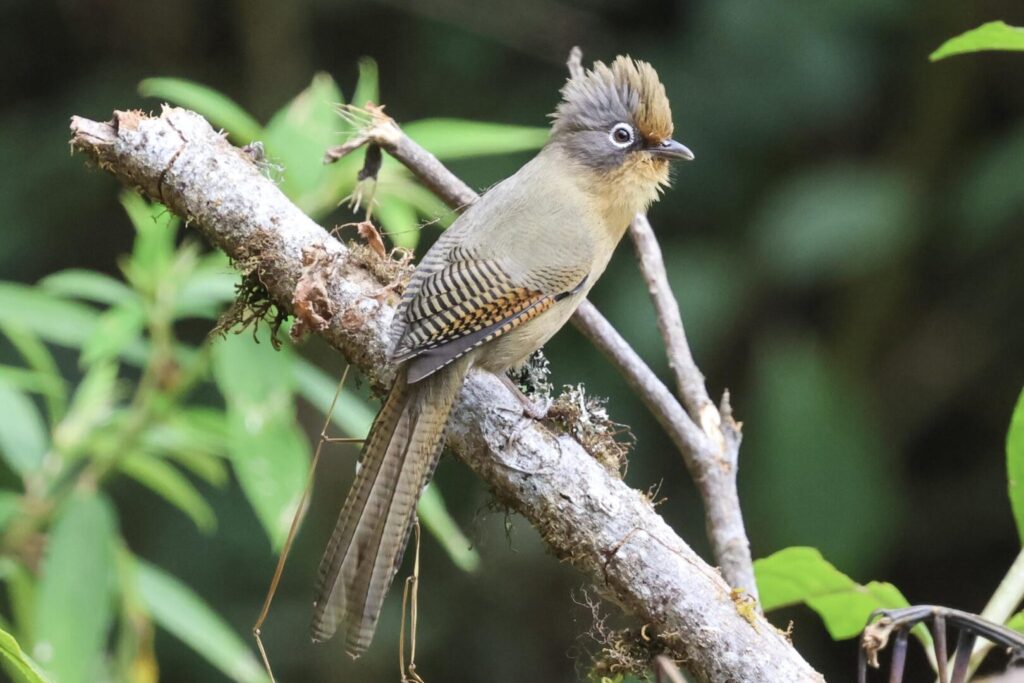
In the middle of the day, it was rather quiet though. We did find a couple of Striated Bulbuls in a fruiting bush. We could hear Mountain Bulbuls, more Golden-throated Barbets and a couple of Maroon Orioles calling but they remained hidden in the trees. The trucks came down to meet us and we drove back down the bumpy track all the way to where they had picked us up first thing this morning.
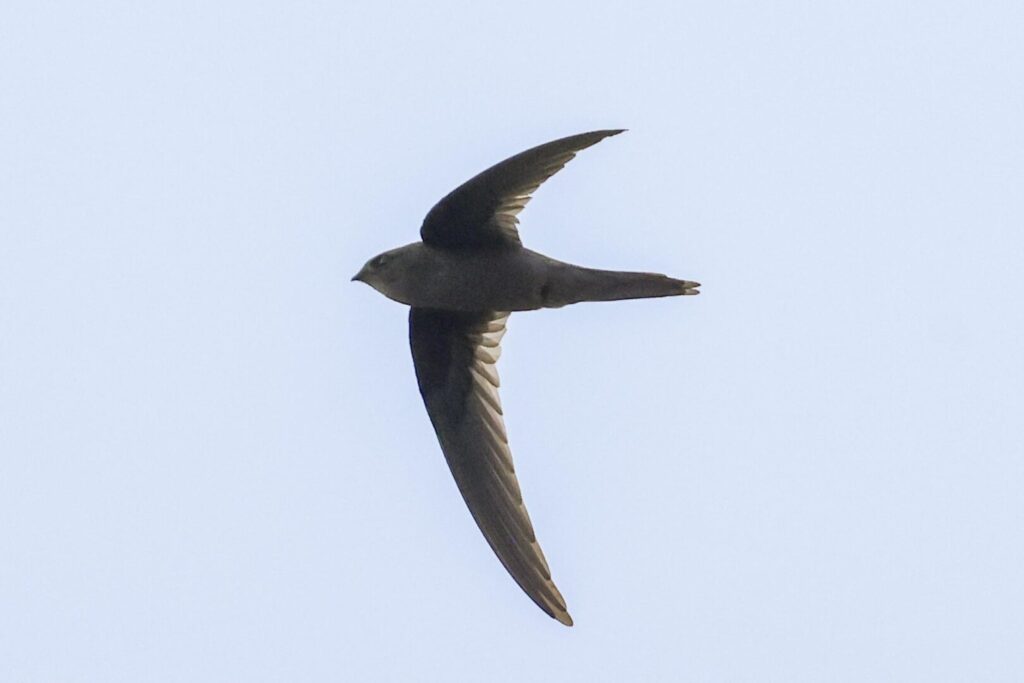
Back in the minibuses, we drove to a nearby filling station to use the restrooms and get a coffee. Lots of Asian Palm Swifts were flying round the palm trees in the parking area behind.
Then we drove out into the ricefields. As we made our way along a high bank, we could see a large group of Grey-headed Lapwings in the paddies. We stopped and got out, flushing a Green Sandpiper from the ditch below us. One of the group counted the Lapwings and got to at least 120! Scanning the reeds over by the river, the other side, we could see some distant Yellow-breasted Buntings flying back and forth. One landed in the tops so everyone had a quick look, even though it was rather distant from here.
Then we walked further on down the track, to try to get a closer look. On the way, we continued to scan the paddies, finding lots of Asian Openbills and egrets, Amur Stonechats and Black Drongos. We stopped to scan some slightly drier blocks where there were lots of White Wagtails, and found several Paddyfield Pipits and a Richard’s Pipit. A Yellow-bellied Prinia was in the ditch by the irrigation canal below us.
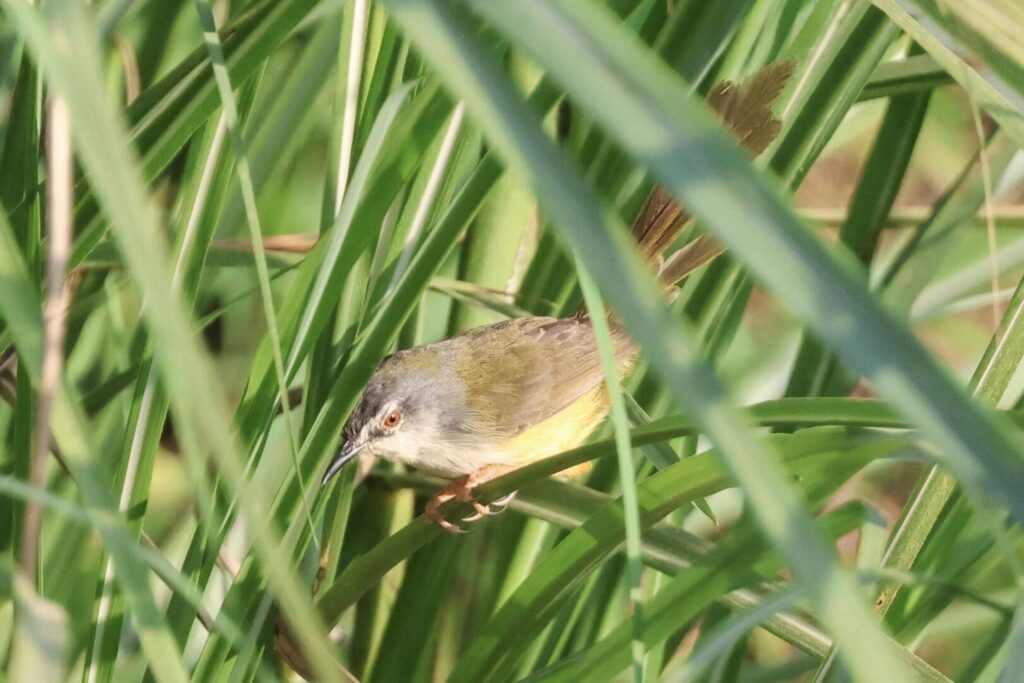
Dteng asked the farmer nearby for permission and then we walked down along a track across the fields to the edge of the river. We could see one Yellow-breasted Bunting on the edge of the reeds further round now, then another dropped down to drink on the edge of the water. As we stood and scanned, more perched in the tops of the reeds opposite, much closer views now. Eventually we found a smart winter male.
A Bluethroat came out on the sand on the far side of the river, down to the water’s edge to bathe. A Dusky Warbler was flitting in and out of the reeds behind. There were a couple of Little Ringed Plovers and Red-wattled Lapwings on the edge of the river, plus a Green Sandpiper and two Common Sandpipers. Several White Wagtails were feeding on the sand and a Citrine Wagtail dropped in too. A couple of Chestnut-headed Bee-eaters flew up and down along the river bank.
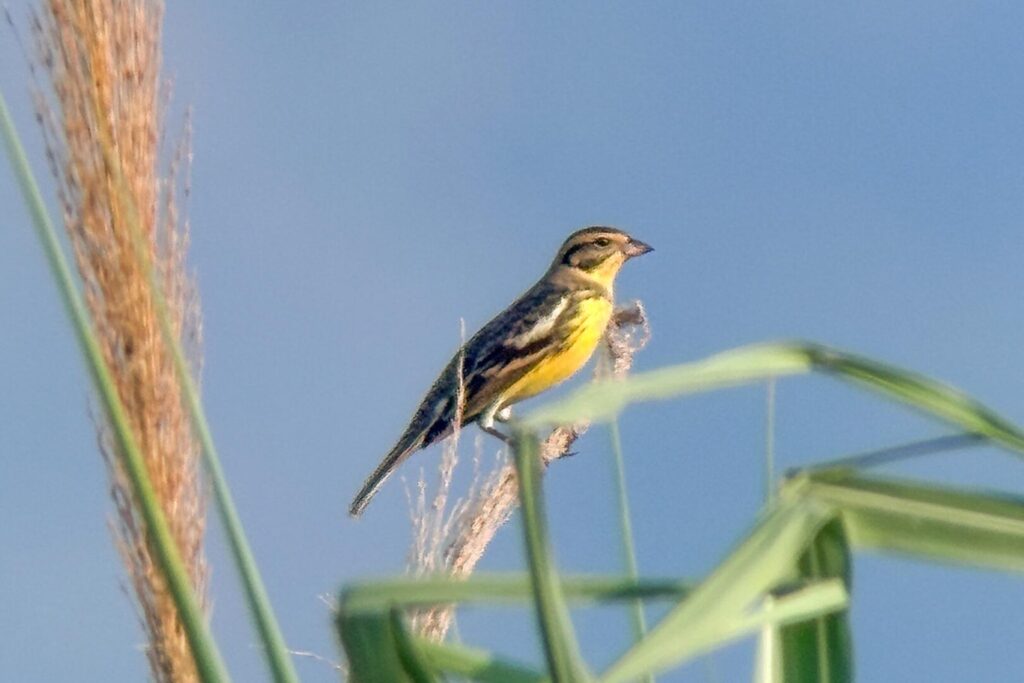
Small flocks of Yellow-breasted Buntings started flying up out of the reeds now, over the river and off over towards the fields behind us. Presumably they were heading out for another feed. We counted well over 40 but there were probably a lot more. Another flock circled over but it was hard to tell if they were coming back in or going out. And we could still see lots in the reeds. Classified as critically endangered after rapid population declines driven by unsustainable trapping, it is always nice to see some larger flocks of them still.
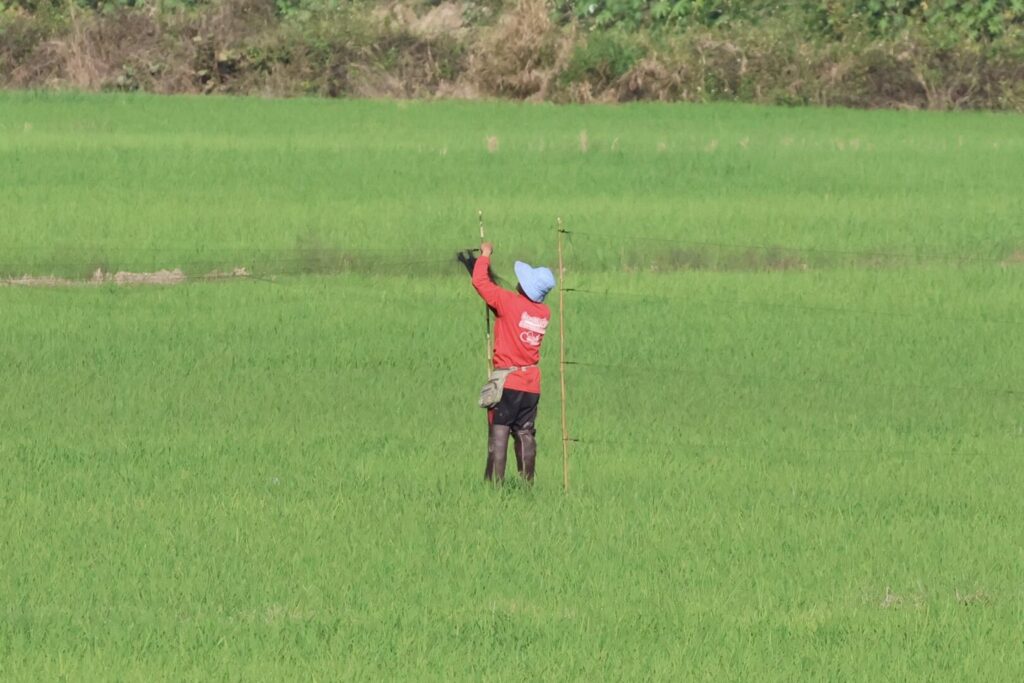
Worryingly, we saw one man setting up mist nets across the ricefields here, although thankfully in some wetter fields which looked unsuitable for feeding buntings.
Having enjoyed good views of the buntings, we walked back to the main track and scanned the ricefields again. This can be a good area for other pipits, but most of the paddies here looked too wet for them now. We were running out of time, but we decided to have a drive round and a quick look on the other side of the river. The pin we gave the drivers proved to be past some of the best looking paddies so we drove down beyond them.
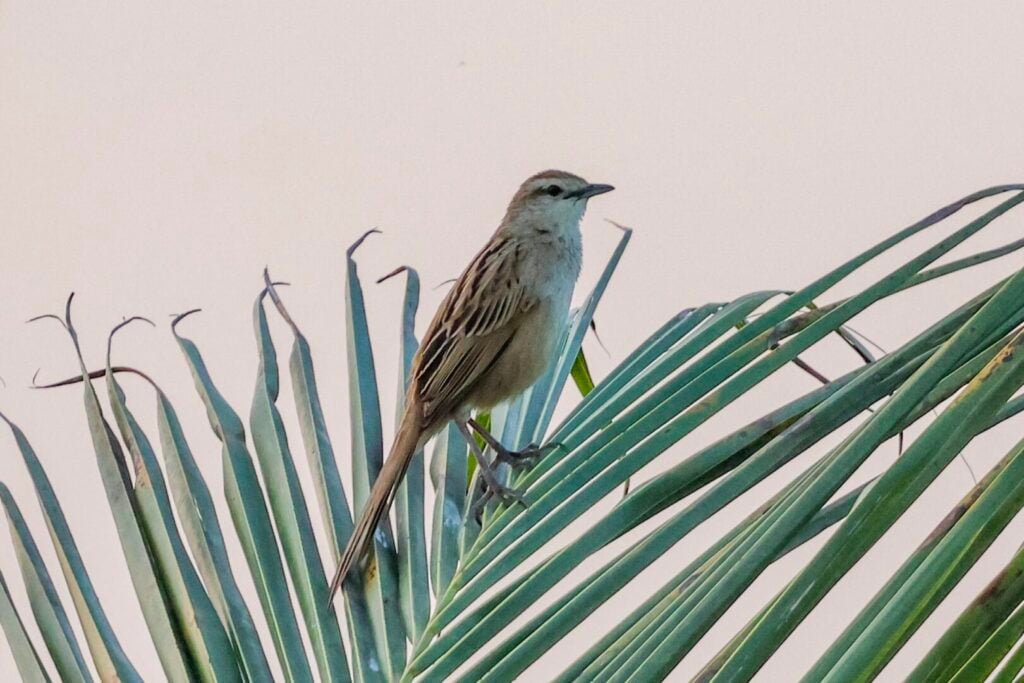
As we got out, a few Grey headed Lapwings and lots of Snipe flew up from the fields, which were all fairly wet here again. We set off to walk back along the road and flushed a Wryneck from the verge into nearby tree. There were large flocks of House Sparrows flying round over the reeds beside the river, waiting to go in to roost, and several Black Drongos. A flock of Chestnut-tailed Starlings flew over. We could hear a Striated Grassbird singing and found it singing in the top of a nearby palm tree.
It was a bit further back to the drier fields than we realized and we were out of time. Everyone was tired after a long day. We never made it but could just see them in the distance from here. A last scan revealed hundreds of White Wagtails, presumably gathering before heading in to roost.
We stopped in a local restaurant on the way for dinner, on the outskirts of Fang. We were just about the only customers and they had live music tonight, someone playing the guitar and singing cover versions of a variety of western classics. Given we were the larger part of the audience, we felt rather sorry for him! We were rather late back to the hotel tonight, so we decided to forego the list and catch up tomorrow. Time for bed now.
Wednesday 11th February
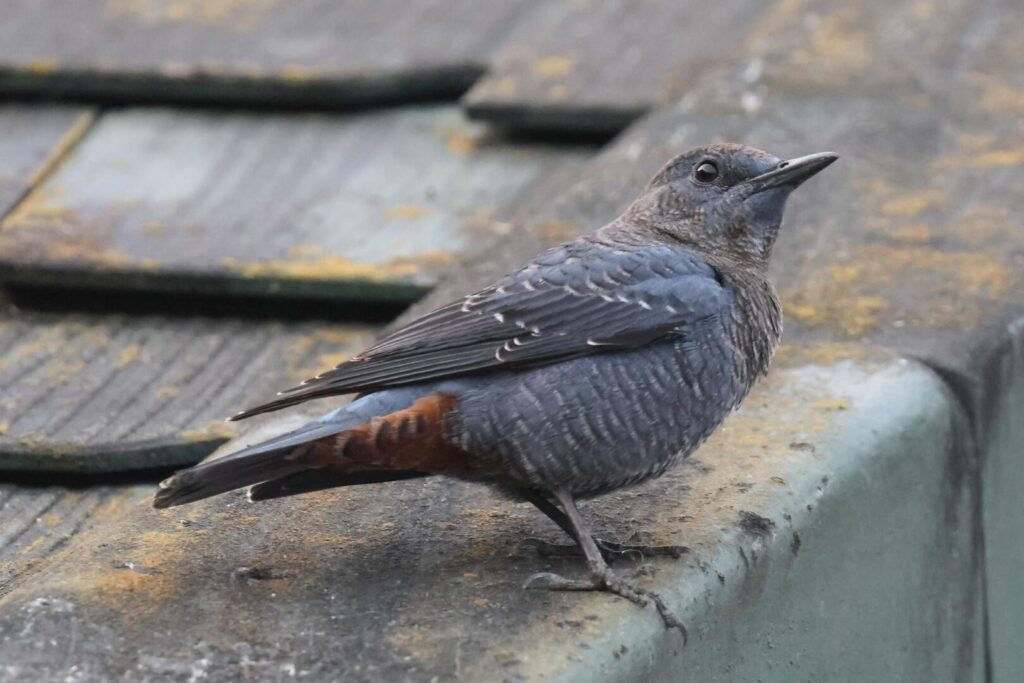
Another slightly more relaxed start this morning, we met for breakfast in the restaurant at 6.30am. Afterwards, we checked out of the hotel and loaded up the minibuses. A Blue Rock Thrush was perched on the roof of the hotel entrance, this one a young male of the subspecies philippensis, with rusty orange undertail coverts. A couple of Ashy Woodswallows circled over and landed on the wires, where there were already several Striated Swallows too.
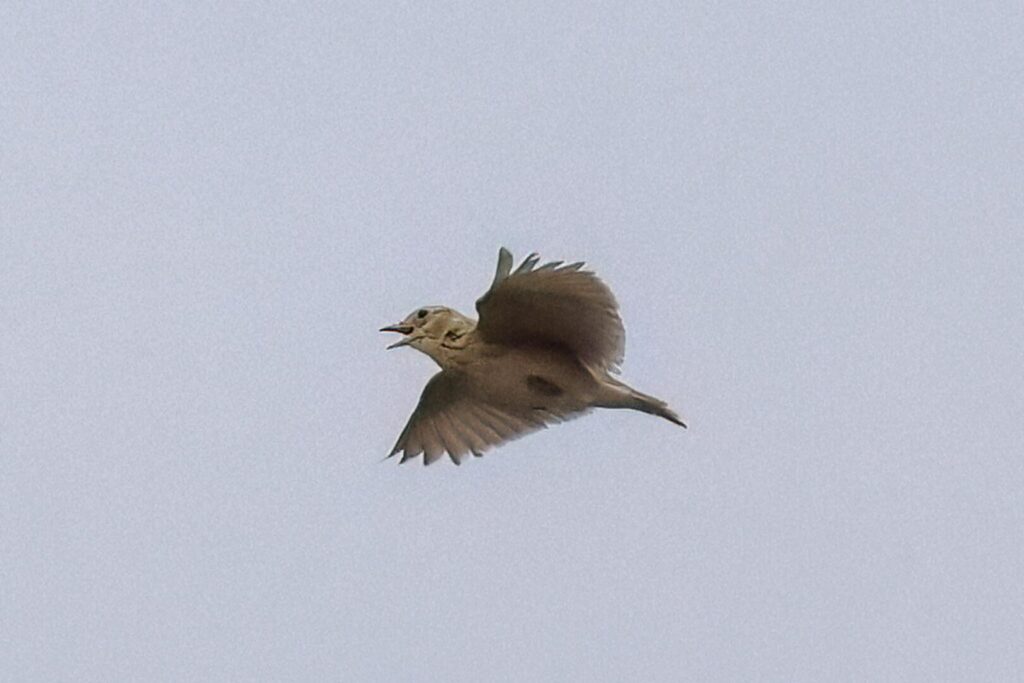
We were moving on to Doi Inthanon today but we had a birding stop on the way this morning. Turning onto a minor road, we pulled off the road and got out to scan the fields. There were a few Paddyfield Pipits and several White Wagtails, plus a single Eastern Yellow Wagtail. A couple of Oriental Skylarks flew in and landed in front of a line of chilli bushes. Several Amur Stonechats and a pair of Pied Bushchats flicked up and down from the sprinklers.
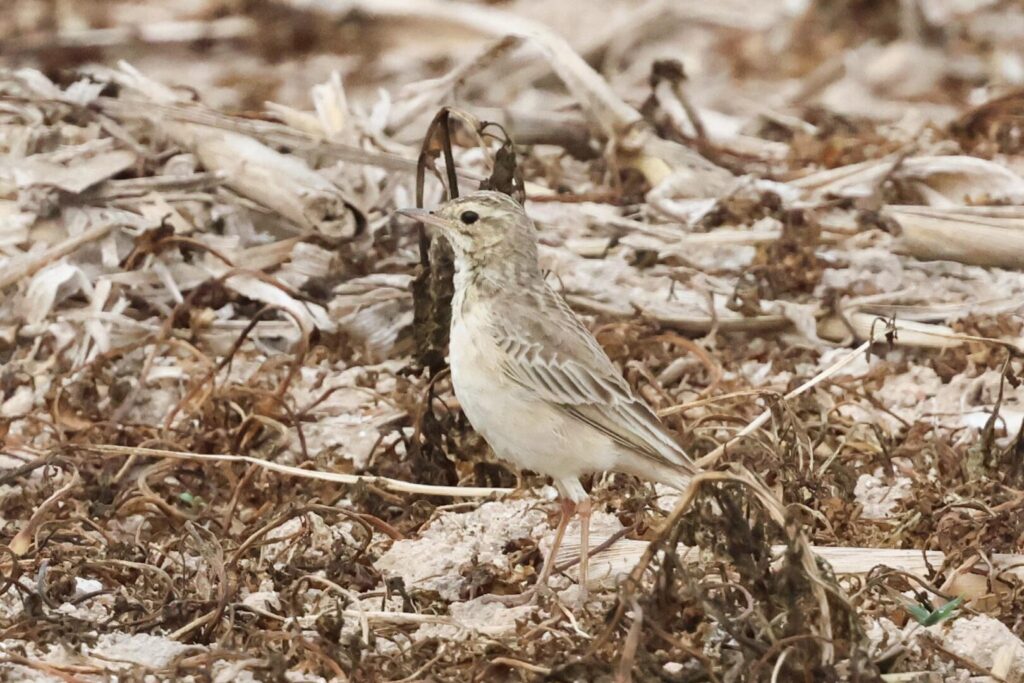
Small groups of Baya Weavers and Scaly-breasted Munias flew in and out of the overgrown bank on the far side. Away to the right, a Bluethroat flew across over the edge of the next field and landed on a sprinkler head. A pair of Grey-breasted Prinias were flicking around in the vegetation in front. A Crested Honey Buzzard flew across above the hillside in the distance beyond. Several Plain-backed Sparrows flew out and landed on the side of the road.
Walking on down the road, a couple of Dusky Warblers were in the taller crop in the next field. Just beyond, a narrower strip had recently been cultivated and was full of birds. Lots of wagtails, mostly Eastern Yellow Wagtails of various forms plus a couple of Citrine Wagtails and several White Wagtails. There were several more Paddyfield Pipits and another Oriental Skylark. A Siberian Rubythroat hopped out from the tall crop over in the far corner.
There was an opening between the low trees behind us and walking through we could see across to a part of a large lake beyond. There were lots of Coot and a few Moorhen, a large group of Black-winged Stilts, a few Garganey and the usual egrets. More surprising was a Great Crested Grebe, our second of the trip this year.
A couple of Chestnut-capped Babblers were in the reedy scrub calling and with a bit of perseverance we managed to see them moving about in the vegetation. There were a couple of Yellow-browed Warblers and a Two-barred Warbler in the trees here too.
Back out onto the road, and we carried on down. In the next weedy field, we stopped to scan and found more pipits and wagtails. Two smaller pipits were harder to see at first, creeping around in the furrows. They seemed to have rather bold and contrastingly pale mantle stripes and we thought they were going to be the commoner Red-throated Pipits. On closer inspection though, we realised they were actually Rosy Pipits – two had been reported here back in January and Dteng had seen them here a week or two back.

As we walked on, a rather dark looking snipe came up from the back of the next field briefly and landed straight back down in some weeds by a track. Dteng walked down and it came up again, a Pin-tailed Snipe, we had a good view as it flew off. A second came up from nearby as we walked on. A very distant Eastern Buzzard was perched in a tree on the hillside beyond.
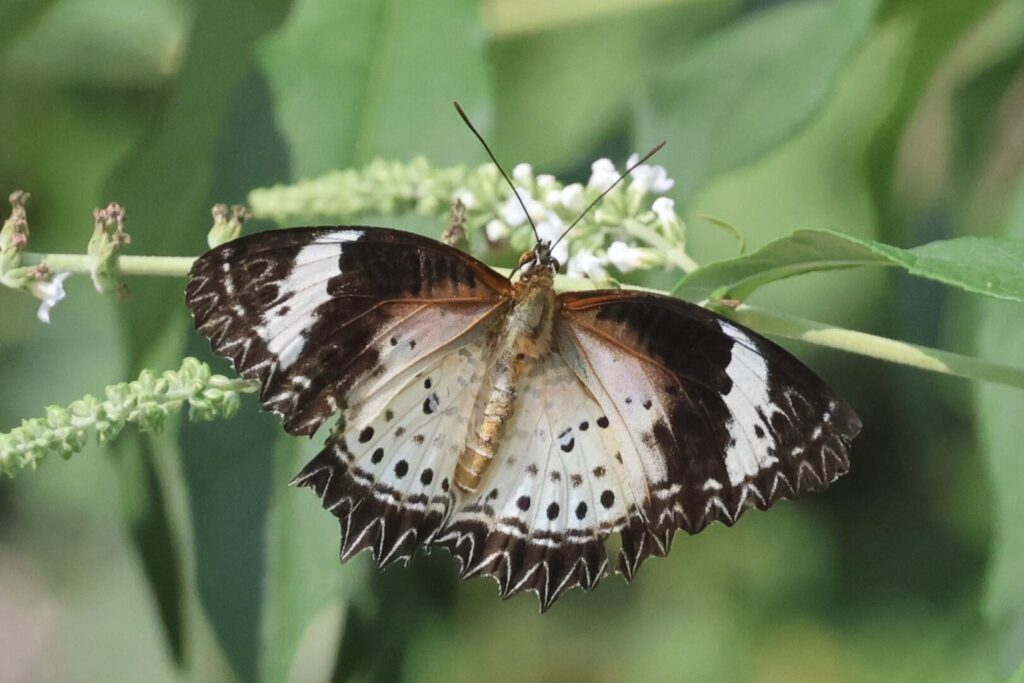
We took a side track down between the fields and the reeds on the edge of the lake. There were a couple of Red-wattled Lapwings in the field. We were hoping to find Yellow-eyed Babbler along here but all we managed was one calling briefly from the reeds. A Yellow-bellied Prinia and a Common Rosefinch both perched up more obligingly. A female Leopard Lacewing butterfly was feeding on a flowering bush.
Further down, we had a better view out across the lake again. We could see more Garganey from here and a single Eurasian Teal in with them, plus a lone Shoveler and one Ferruginous Duck. The Great Crested Grebe was a little closer from here.
The minibuses came to meet us and we set off on the long drive to Doi Inthanon. After about half an hour, we stopped at a filling station for coffee and to use the restrooms. Several Crested Treeswifts were flying round and landing on the wires by the road. After another hour and a half or so, we had another break for lunch near Chiang Mai. The restaurant Dteng took us to specialised in the local Khao Soi noodle soup, which was delicious. We also enjoyed some nice satay and some of group couldn’t resist the coconut ice cream.
It was another two hours drive on from there to our hotel at Doi Inthanon. After checking in, we had about half an hour to get sorted out before we met again at reception with our passports, so they could be copied.
Afterwards, we walked across the road to the Highland Resort. There were a couple of Purple Sunbirds feeding in the pink flowers by the entrance. A Burmese Striped Squirrel scampered up through the trees. A Great Orange Tip flew past. Walking further in along the road, we found a Brown Flycatcher in one of the gardens and a Taiga Flycatcher in the trees over the other side of the road.
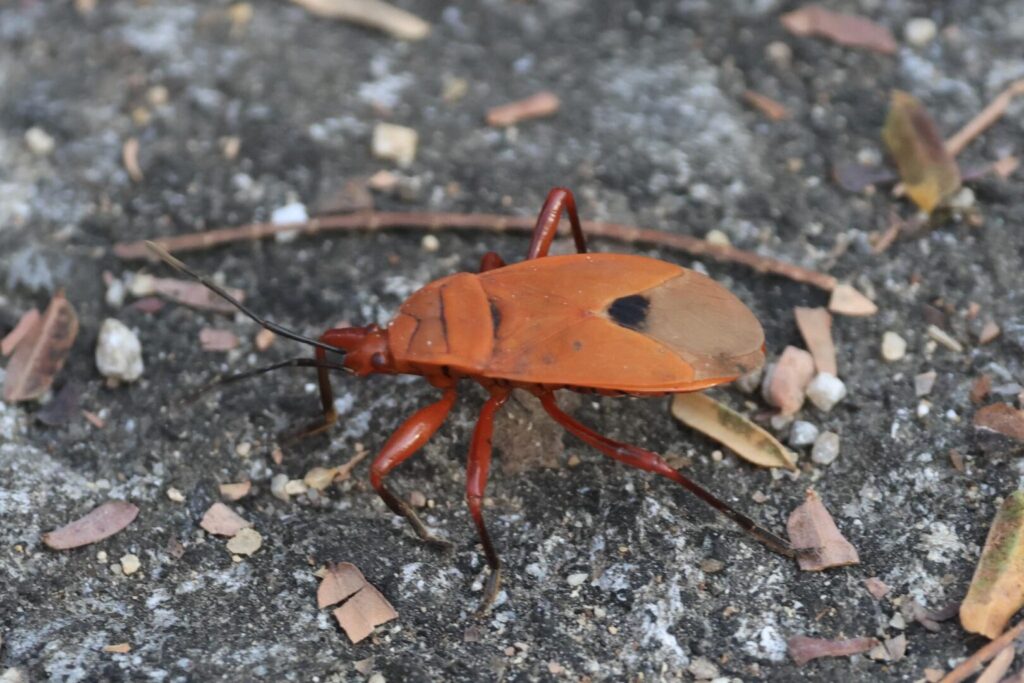
Down along a side track, there were several Coppersmith and Lineated Barbets in the trees. As we turned to walk back to the road, a Puff-throated Babbler flew up from the ground beside the track and disappeared into the undergrowth. We could hear it singing. A Kapok Bug and then a Red Cotton Stainer Bug were on the path.
Continuing on, a Blue Whistling Thrush landed briefly, then flew off through the trees. Along the next track, we found a small group of White-crested Laughingthrushes feeding on the ground on the verge. A Verditer Flycatcher was flying in and out of a tree in the garden. Down to the far end, a Banded Bay Cuckoo was calling. A female Hill Blue Flycatcher appeared in the trees briefly.
Trying a third track, Dteng was slightly ahead and disturbed a Red Junglefowl which ran off into the undergrowth. Too quick for the group to see. We could hear Rufous Treepies calling, and two flew across and landed in the trees ahead of us briefly.
We made our way round to a clear area overlooking some fields and stood for a while scanning. We could see another Brown Flycatcher and several Green Bee-eaters and heard White-crested Laughingthrushes calling. A White-throated Kingfisher flew across. Lots of Streak-eared and Sooty-capped Bulbuls were in the bushes. As we made our way back, a Scarlet-backed Flowerpecker was up in a tree above the road but hard to see. We found an Indochinese Roller and two more Rufous Treepies, but the light was going.

Back by the entrance, we went in to the restaurant here for dinner today. We found an owl looking at us from a tree from the terrace but unfortunately it was made of wood. Perhaps unsurprisingly, it wasn’t calling! After dinner, we walked back over the road to our hotel. After dropping our gear in the rooms, we met back at reception. Two days of list to catch up on tonight.
Thursday 12th February
On our way across to breakfast this morning, we could hear a Brown Boobook calling somewhere in the trees. A bit too far off to be able to locate it. Afterwards, we set off to drive up into Doi Inthanon National Park. On the way, a couple of Red-billed Blue Magpies flew up from the side of the road. We made our way straight up to the summit and parked in the car park at the top. While we stopped to use the facilities, an Ashy Woodpigeon flew over.
We tried the path round the summit first but it was quiet, no sign of any partridges. Out at the café the other side, just a single Dark-backed Sibia was in the tree in front. Crossing the road, we made our way down to the summit marsh. A female Snowy-browed Flycatcher landed on the railing at the start of the boardwalk and two Rufous-winged Fulvettas were collecting lichen off the trees above.
Out into the open area in the middle, the sun was just catching the tops of the trees on one side. A large mixed flock was busy feeding up there, including several Chestnut-tailed Minlas and more Rufous-winged Fulvettas. We could hear both Blyth’s and Davison’s Leaf Warblers singing and see lots of leaf warblers high up. A couple of Mrs Gould’s Sunbirds flicked about. An Eye-browed Thrush appeared in the fruit tree nearby.
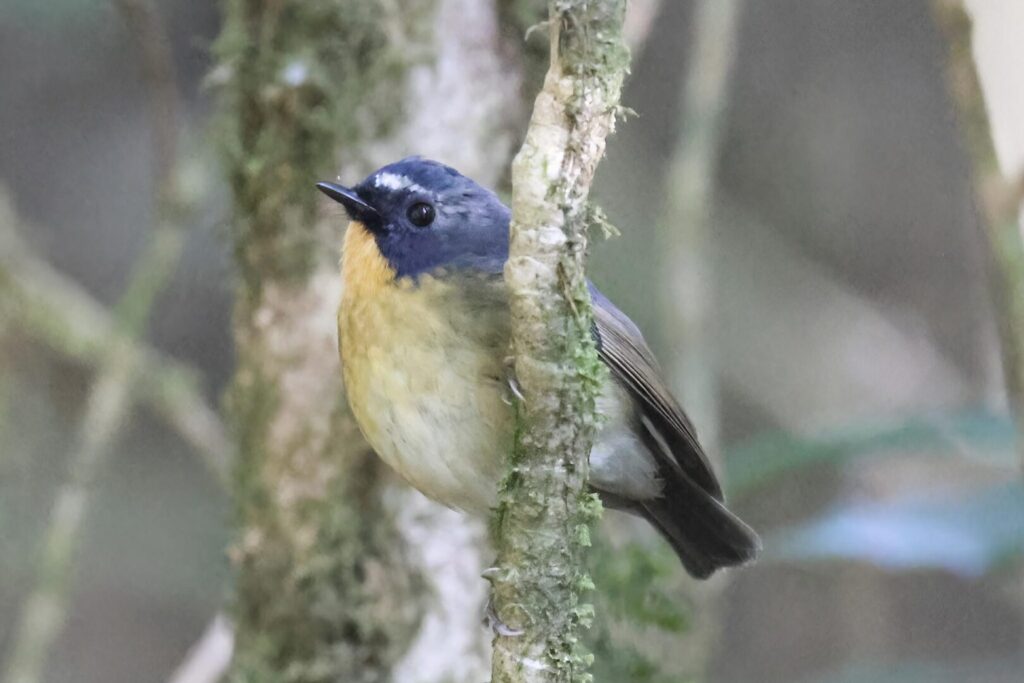
Further on, back under the trees, the warblers gradually started to come lower down as the sun rose. Now we could get a proper look at a Blyth’s Leaf Warbler and also a Buff-barred Warbler, both at eye level. A male Snowy-browed Flycatcher was flitting around in the low vegetation on the slope above the boardwalk. Hard to see when it stopped.
A little further on, a male Himalayan Bluetail was feeding in the stream in the bottom. A couple of Silver-eared Laughingthrushes moved through the tangles ahead of us.

Back round to the open area again, several Ashy-throated Warblers were out in the sunshine now and a Fairy-Fantail was flycatching over at the back. We walked back out and over the road to the café. Time for hot chocolate and brownies while we had a look for Ashy Woodpigeon. It didn’t take long to find one in the trees, but it was hard to get a clear view. It was moving around but usually partly hidden, so we could only see bits of it at a time.
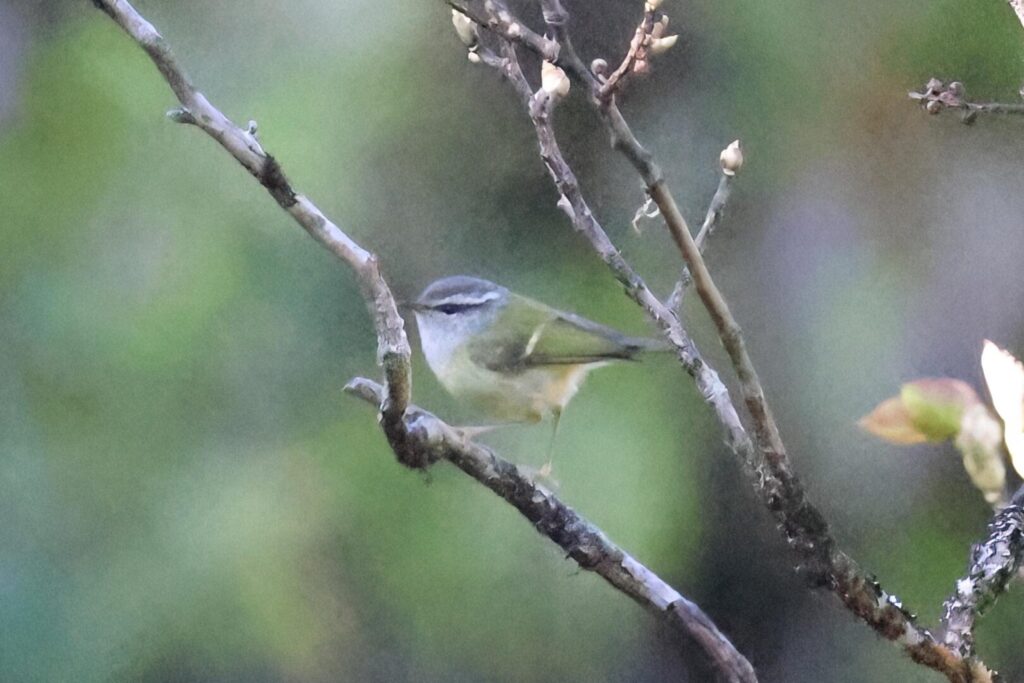
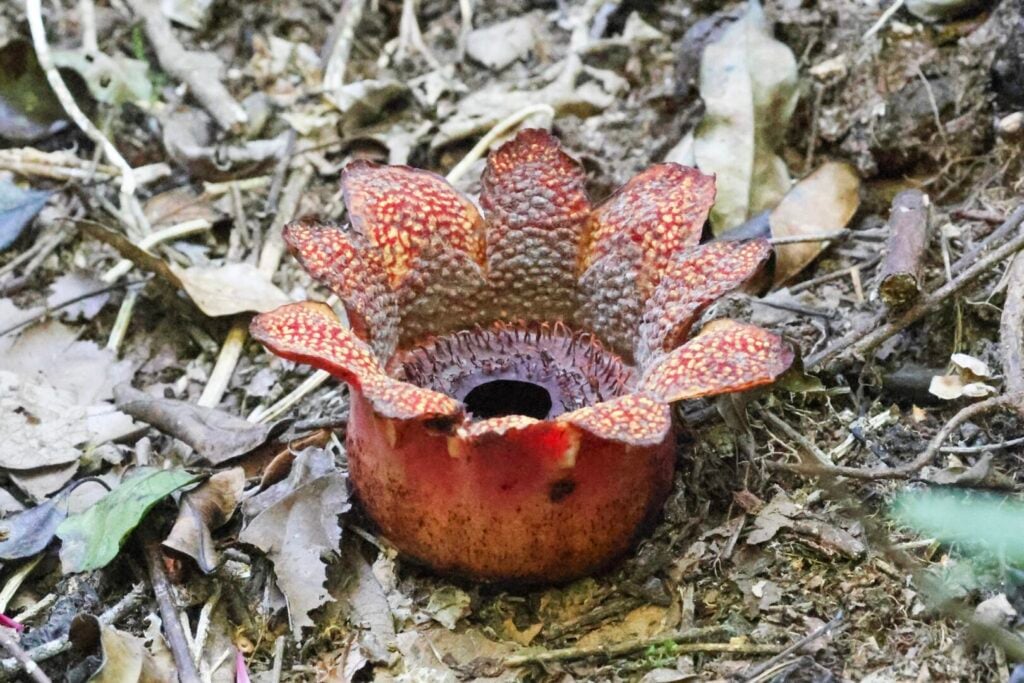
Moving on, we drove back down from the summit and turned off onto a narrow side road. Two minibuses were already parked at the end of the path where we wanted to stop but we managed to pull over just past and get out. Dteng knew the guide from the other buses and they were just leaving, so we walked back and down the path. We stopped briefly to look at the parasitic flowers of Sapria himalayana (sometimes known as ‘hermit’s spittoon’) on the bank above the path.
Then we pressed on and descended down the steep slope to the bottom of the gully. Dteng sprinkled some mealworms on the logs placed strategically in the bottom and the birds came in quickly. First a male Himalayan Shortwing…
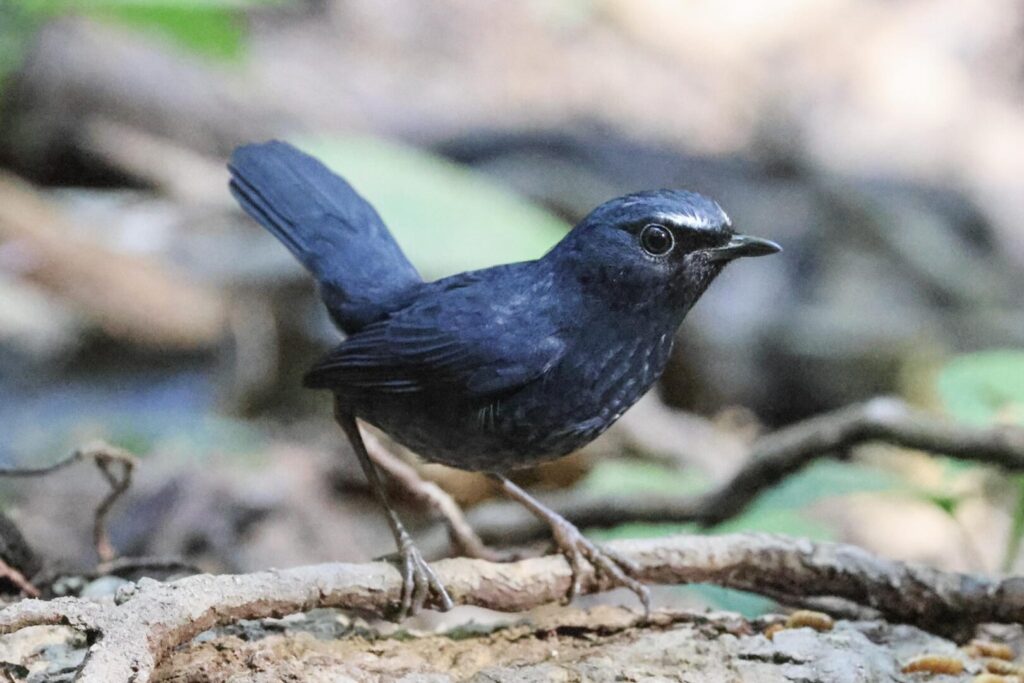
…and then a Lesser Shortwing appeared – 2 for 2 on shortwings in seconds!
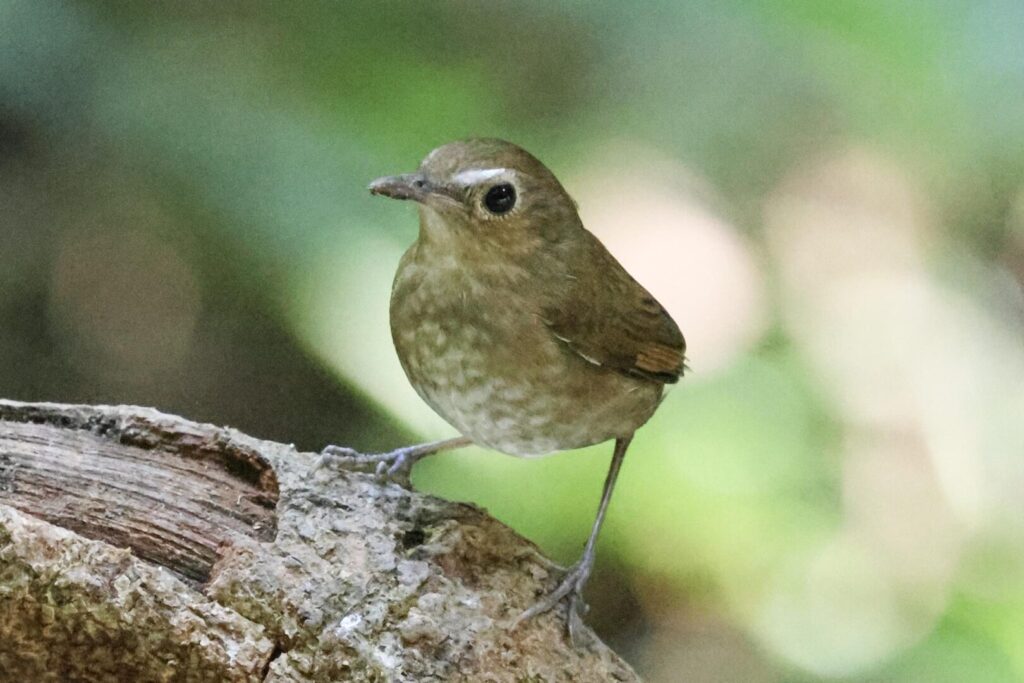
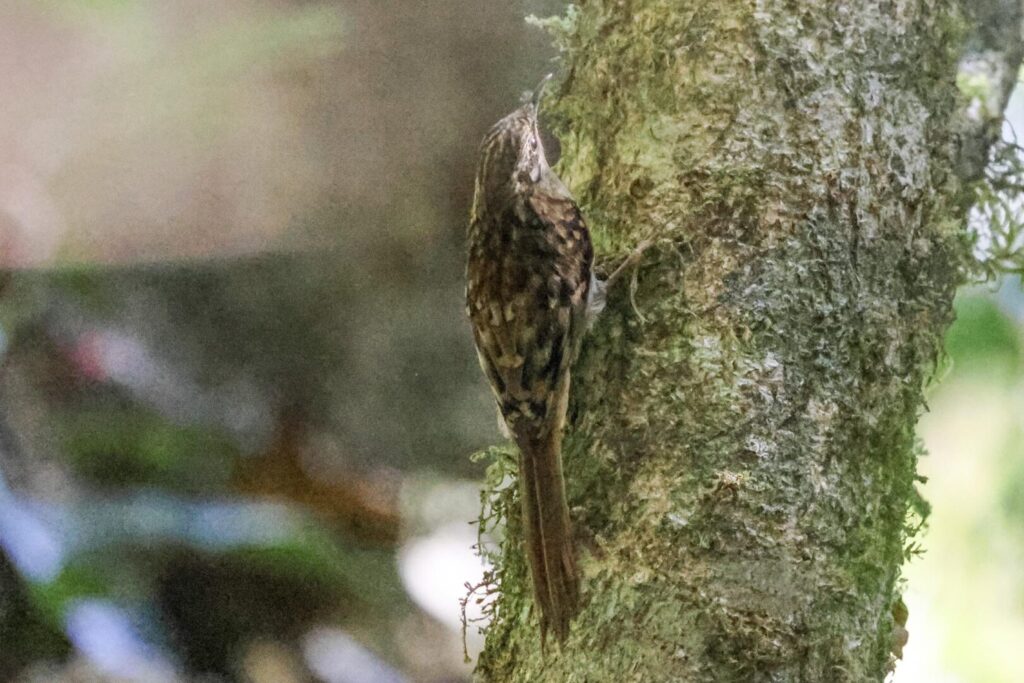
A pair of Large Niltavas flew in to the trees, followed by a pair of White-gorgeted Flycatchers down for the mealworms. A Slaty-bellied Tesia was singing and flitting around in the low vegetation behind. A Hume’s Treecreeper appeared on a tree overhead, but quickly moved up the slope behind. Hard to see from where we were sitting. We were hoping to see Pygmy Cupwing here too but there was no sign of it now. Perhaps it had plenty to eat already this morning.
Climbing back up out of the gully, as we got back onto the path the Hume’s Treecreeper was now climbing up a nearby tree. Good views now to make up for those who had missed it earlier.
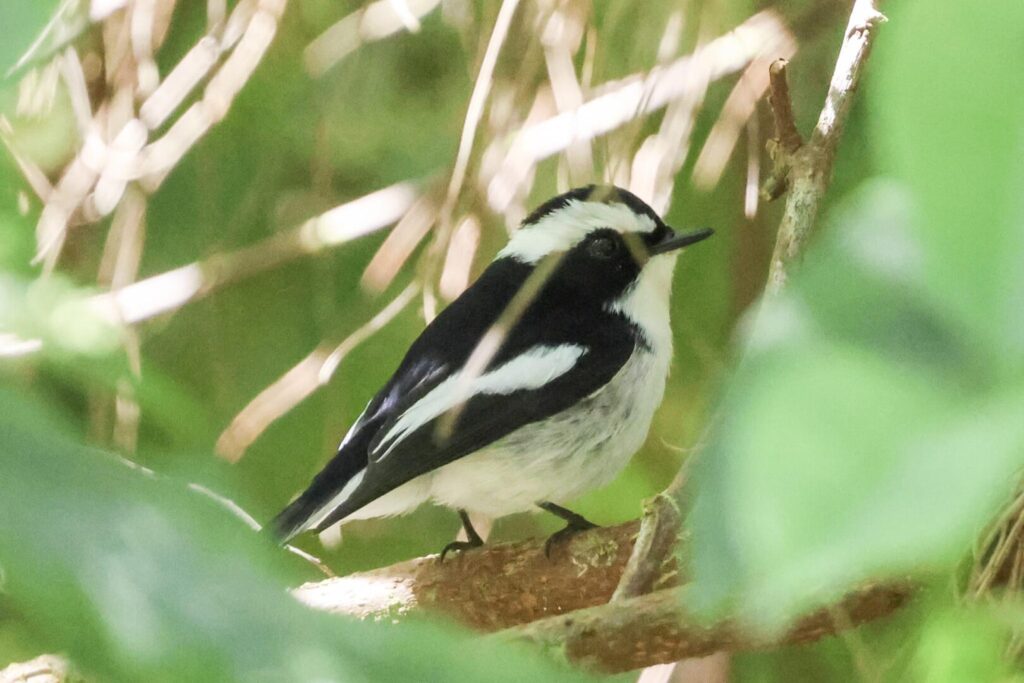
Back out on the road, a Lesser Racket-tailed Drongo was in the trees. As we walked further up, it all seemed rather quiet now. Often the case in the forests here, as most stuff goes around in one large mixed flock. A Little Pied Flycatcher flew across right in front of us and landed in a small tree beside the road. Just beyond, a male Slaty- backed Flycatcher was in the branches above the road.
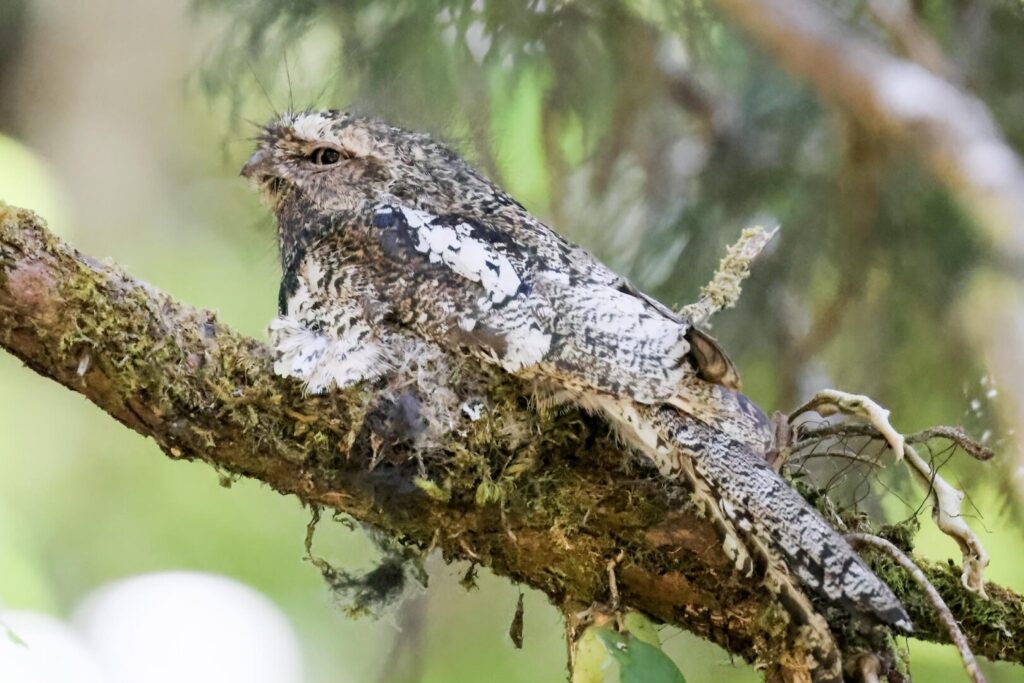
Standing even just a few metres away from it, it was hard to spot the Hodgson’s Frogmouth on its nest on a low branch until you knew where it was. Back for its third year, nesting in the same tree, it was found here just a few days ago. Perfect timing for us! Not an easy species to find away from the nest.
Having enjoyed great looks at the Frogmouth, we walked back up the road. Two White-browed Shrike-Babblers were in the trees above. Further on, we found a mixed flock moving through the trees. A White-throated Fantail came out onto a branch right above the road and a couple of Yellow-cheeked Tits were feeding in the leaves nearby. We finally got better views of a Claudia’s Leaf Warbler as it crept up and down the larger boughs like a nuthatch. The flock then moved quickly across the road and down through the trees the other side.
It was lunchtime already, so we drove to a restaurant in the nearby village. After lunch, we had some time booked in a nearby hide. We parked by the hide owner’s house and walked the short distance along the track and in through the trees. The owner was singing as he put out food and water, and the male Siberian Blue Robin was waiting almost under his feet right in front of the hide. It stayed in much the same place most of the time we were there.
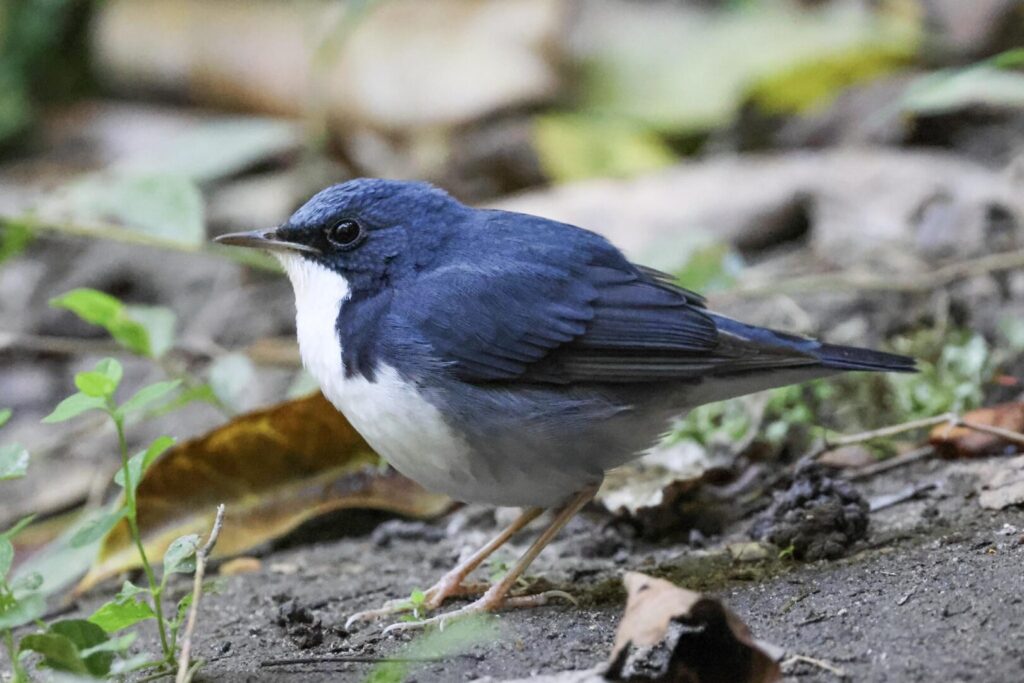
A male White-tailed Robin was hanging around too. When another male tried to come in several times, it got chased off round and round through the trees.

A male Hill Blue Flycatcher came in too, along with a female White-rumped Shama.
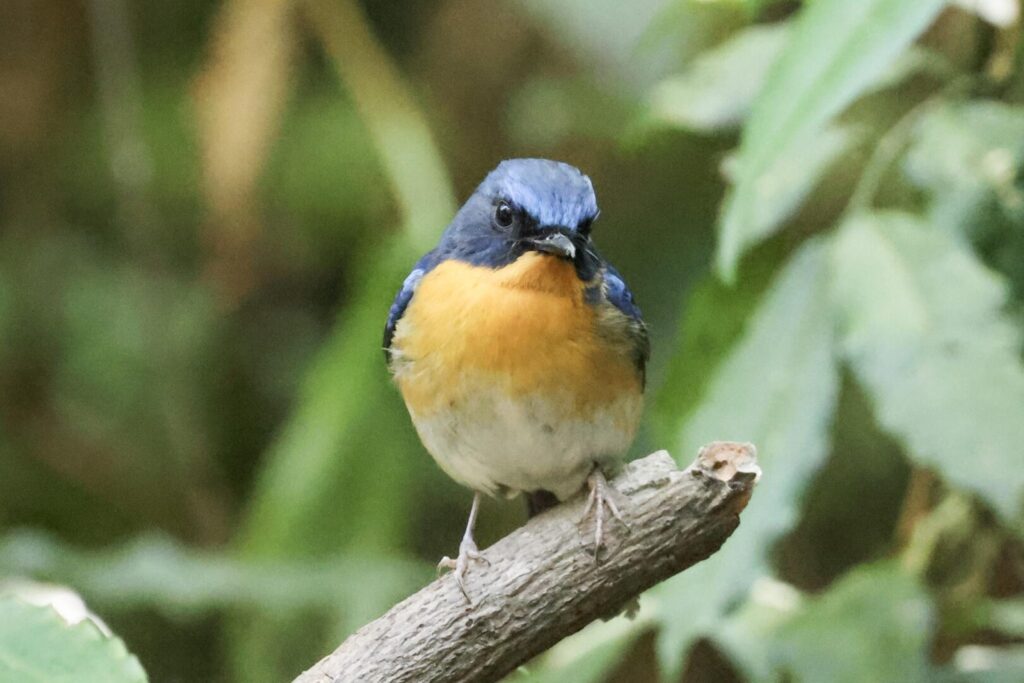
There were Puff-throated and Grey-eyed Bulbuls on the bananas…

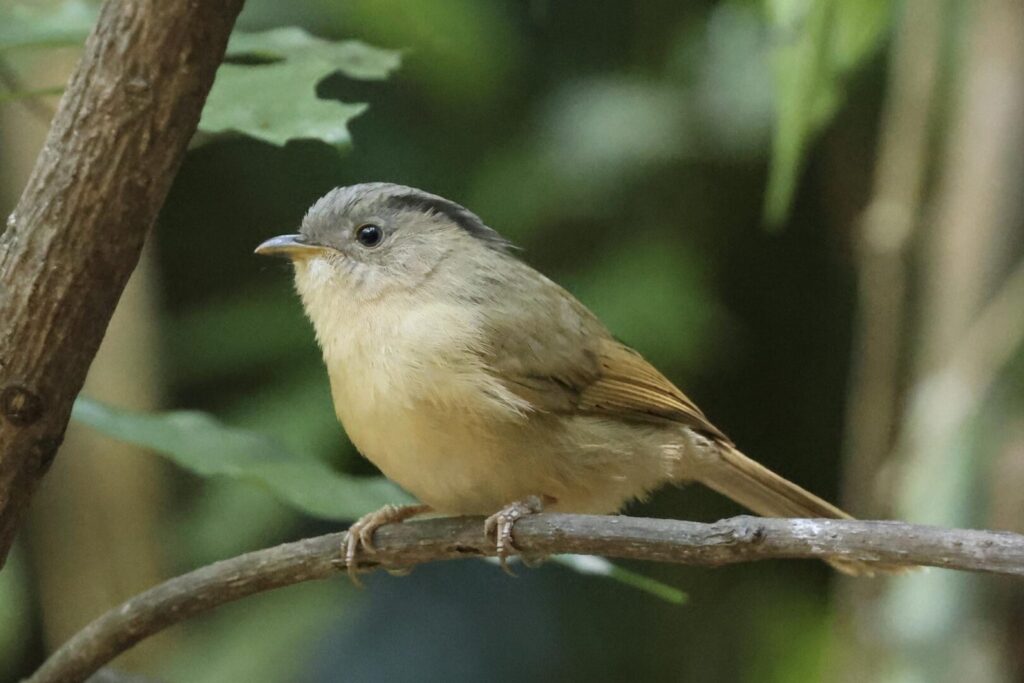
…and Brown-cheeked Fulvettas in and out regularly for the mealworms. Single Grey-throated and Buff-breasted Babblers hopped around on the ground below.
A Little Spiderhunter in several times to drink the sugar water put out for it but the Streaked Spiderhunter was more nervous. It landed briefly twice in the trees above but never came down to drink with us there.
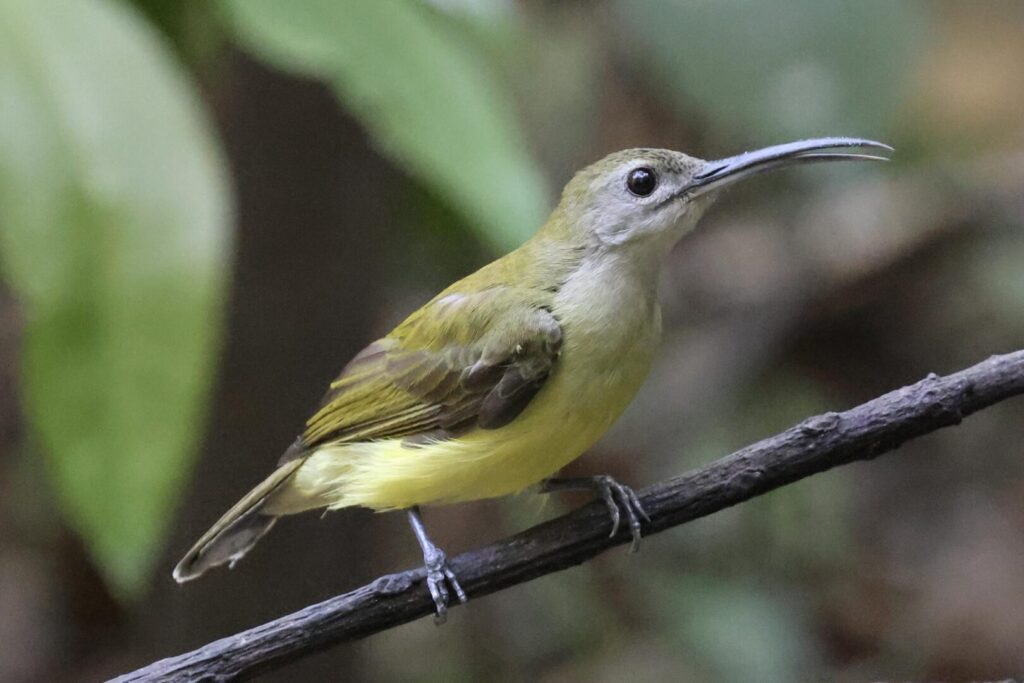
Pretty much everything we hoped to see here, so we decided to move on. As we made our way back out to the track, we could hear something tapping above so stopped to see if we could find it. As we scanned the trees, a Scaly Thrush flew in. It only landed briefly and unfortunately flew straight out again before anyone could get a good look at it.
Back to the minibuses, we drove to nearby coffee shop on our way back to the road. Time for a coffee or a chance to buy some local Inthanon shade-grown coffee beans. For those who didn’t want coffee, we had a quick look round the small ricefields beside the coffee shop, which yielded a Grey Wagtail and a pair of Pied Bushchats. It was interesting to see the coffee beans drying on racks set up in one of the fields.
We drove back up for another look around the summit. The trees by the café were still quiet, not much in the way of either fruit or flowers left now this year. The wind had picked up noticeably too. Walking round over the top again, there was still no sign of any partridges. We were going to find some sunbirds in the top car park, but the wind was catching the bushes here. Two Fairy-Fantails were down in the shelter below the trees further down.
We decided to try further down the road, where it might be a bit less windy and that paid off. We found two Yellow-cheeked Tits in the tops of the trees first and then a mixed flock, Chestnut-tailed Minlas, Rufous-winged Fulvettas and several warblers. Finally we managed to catch up with a couple of Green-tailed or Doi Inthanon Sunbirds now, first an immature and then an adult male.
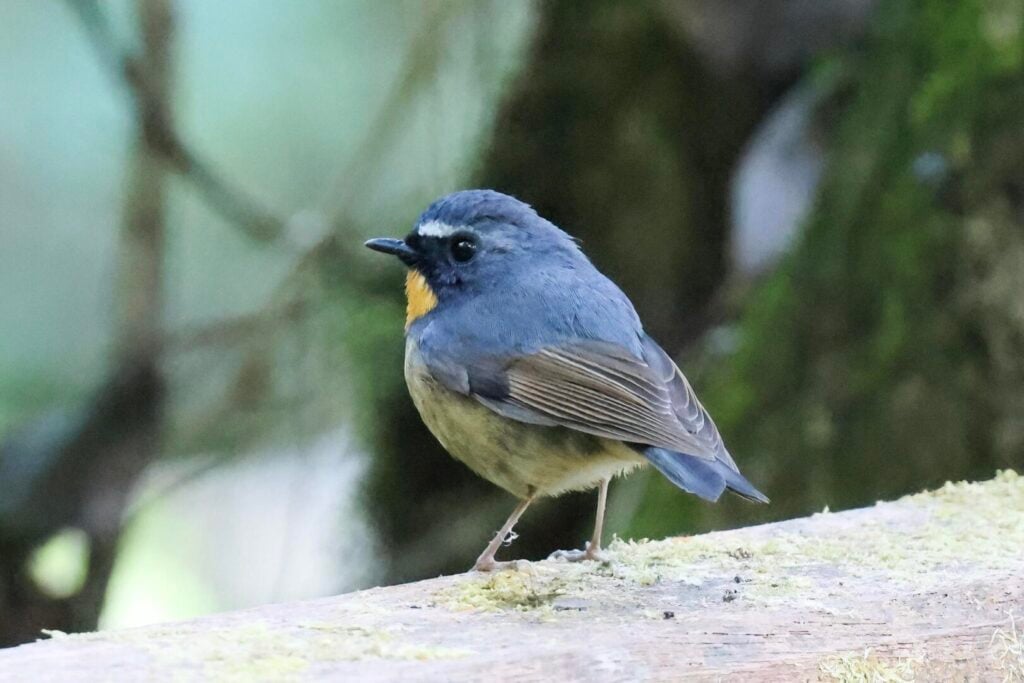
Down into the Summit Marsh, a male Snowy-browed Flycatcher was now flicking around the start of the boardwalk, where the female had been earlier. Someone was flying a drone up over the edge of the open area – presumably with permission as a couple of rangers were looking rather bored on the ‘boredwalk’ nearby. Very noisy! Some Chestnut-tailed Minlas came into the fruit tree nearby but were quickly spooked by the drone and moved off. We couldn’t see any thrushes now.
Into the shade of the trees beyond, we couldn’t find anything in the wet areas under the boardwalk now. The drone had probably scared everything off. We walked slowly round to the start of the boardwalk and then did another circuit. By this time the drone had gone and it was thankfully a bit quieter. We found a Blue Whistling Thrush and a Chestnut Thrush down below the boardwalk.
Further on, a Grey-sided Thrush flew up into the trees ahead of us. We were hoping to find partridges but our hopes were probably ruined by all the disturbance. At the base of the steps, a very showy Blue Whistling Thrush was right next to the path. Coming out again, now everyone had gone.
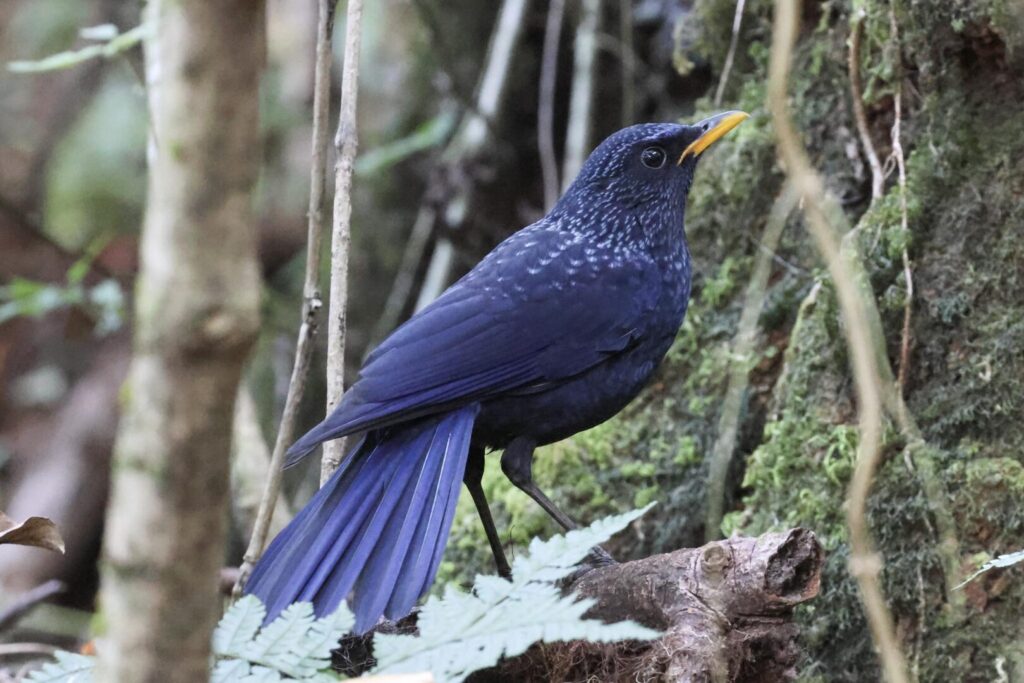
Back to the minibuses, we started to make our way back down. On the way, we stopped to look for the Speckled Woodpigeons which come in to roost in the trees by the road. We had parked in a different place to usual and it took a couple of minutes to work out which tree we needed to look in. Once we did that, we quickly found a Speckled Woodpigeon up in the top. Then we drove back down to the hotel. Time for a short break tonight before dinner and the list.
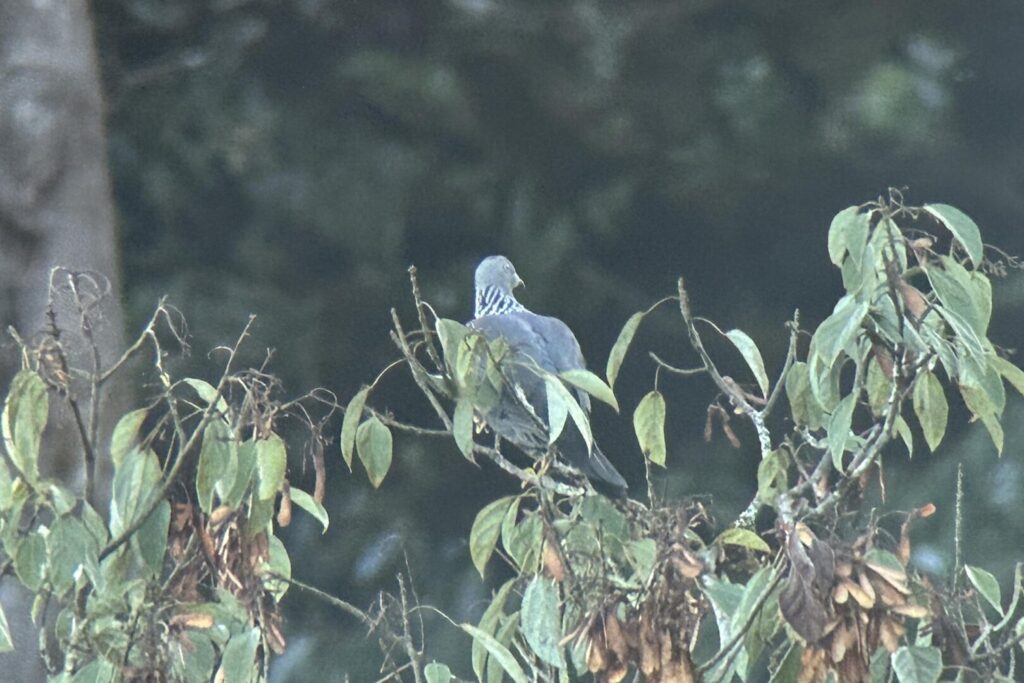
Friday 13th February
After breakfast at the hotel, we set off into the National Park again. Our first stop was not far into the lower part of park. We pulled off the road and walked slowly down to a nearby bridge. A Grey Wagtail was on the rocks below.
Scanning carefully, we managed to find what we had come to look for – a Black-backed Forktail on the rocks upstream. It was hard to see at first, over to one side of the river behind some overhanging branches, then it came out into the rocks midstream, in the open. One of the group saw a second Black-backed Forktail fly across. It landed briefly on some rocks closer to us, then flew on to join the first. We watched the pair together on the rocks now.
We hadn’t seen either of the pair fly back past us but we found a Black-backed Forktail on the rocks downstream now. A third? Before we could get the scopes on it, it flew up over some rocks and disappeared into a side stream. There were small groups of Eastern Cattle Egrets moving up the valley, presumably heading up to feed in the fields. One flock landed in the trees in the sunshine above the parking area as we walked back to the minibuses.
Driving on higher, we stopped in a large car park by a viewpoint. A female Grey Bushchat and several Cinereous (Asian) Tits were in the trees on one side and the tits were coming down to the fence posts near the guard hut. A flock of minivets flew over and dropped down behind the house over the far side of the car park. We decided to walk round to look for them.
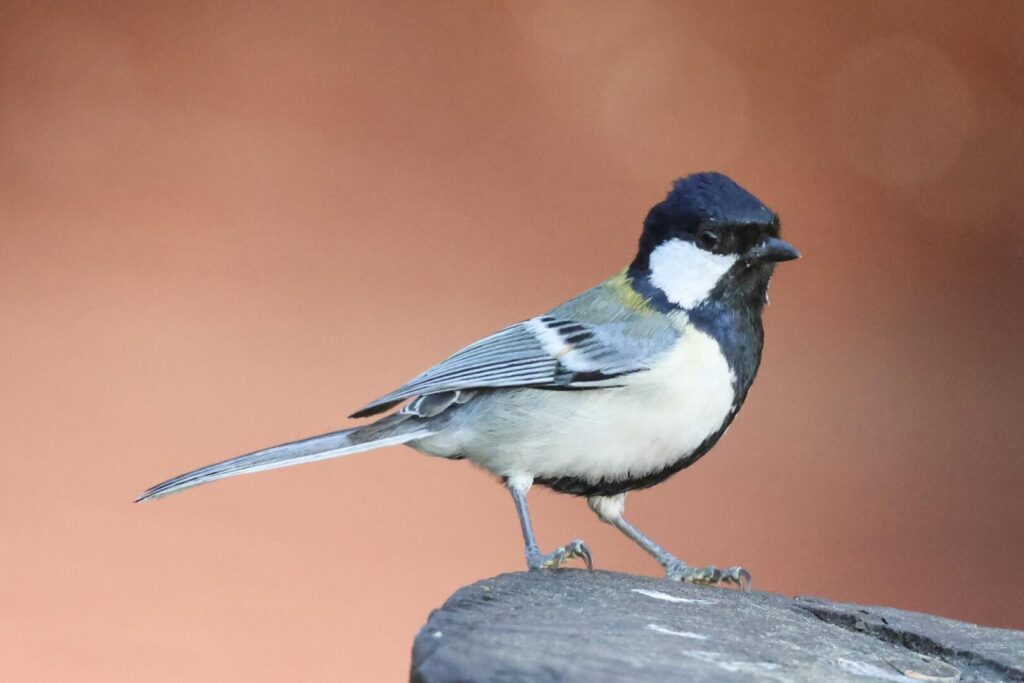
On the way, one of the group spotted a Crested Serpent Eagle circling in front of the viewpoint, so we stopped to watch that first as it drifted quickly away. We quickly found the minivets again, in the trees behind the house, all Long-tailed Minivets. Great views perched in the tops in the sunshine.

There was a large mixed flock here too. Several Davison’s Leaf Warblers and a brief Sulphur-breasted Warbler flitted around in the leaves and a pair of Velvet-fronted Nuthatches moved from trunk to trunk. Plus a Lesser Racket-tailed Drongo, an Ashy Bulbul, and a Black-throated Sunbird. There were several White-eyes which included at least two Swinhoe’s White-eyes. We could hear a Collared Owlet calling but it was distant again. No chance to tempting it in. Four White-faced Jays flew over calling.
The flock eventually moved deeper in, so we walked on round the gardens. A Brown Shrike was in the open trees and three Olive-backed Pipits walked away from us, on the edge of the lawn in the shade. We could hear a Chestnut-vented Nuthatch calling. Up to the road, several more White-faced Jays were in the trees. A Grey-backed Shrike flew across and landed on a post beside the road.
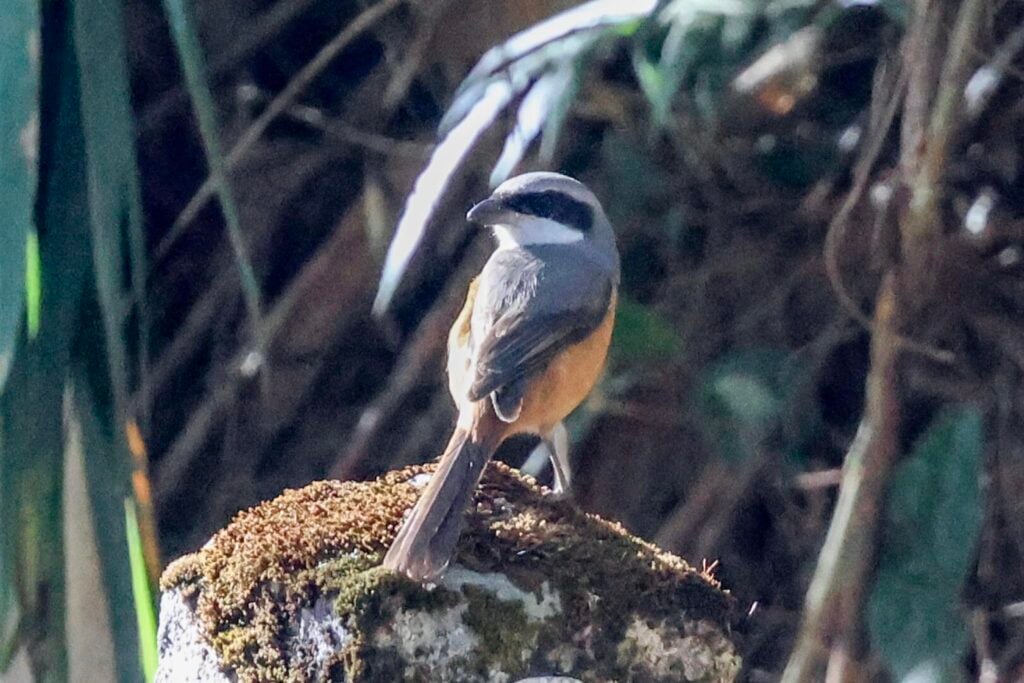
Walking back towards the car park, several Indian White-eyes were feeding in the trees. The drivers had set up the stove in the car park and brewed coffee for us. We stood at the viewpoint to enjoy the view while we drank it and a couple of Ashy Woodpigeons flew past. A couple of Black-throated Sunbirds came in to the flowers just below. After coffee, we moved on to try another nearby site. We parked by a small area of polytunnels and took a track up the hillside beyond. A Banded Bay Cuckoo was calling in the trees here.
We hadn’t gone far before we found another mixed flock. Several Brown-cheeked Fulvettas and Rufous-backed Sibias, a pair of Yellow-cheeked Tits, another Lesser Racket-tailed Drongo and a Golden-throated Barbet. We heard a Clicking Shrike-Babbler singing (clicking!) now and eventually managed to get good views of it overhead, in the trees above the track.
A little further on, we found a male Slaty-backed Flycatcher and heard Mountain Tailorbird and White-browed Shrike-Babbler calling. Otherwise, it was a little quiet now away from the flock, so we turned to walk back. We could hear a Maroon Oriole singing in the distance, further down the valley, and back at the minibus, a Hill Prinia was singing on the edge of the trees.
Driving down into the village, we parked by the mini-hydro power plant. As we got out, a Large-billed Crow flew over high, the first we had seen for several days. Looking down into the stream behind the restaurant, we found a White-capped Redstart on the rocks. At least that was relatively obliging, but we knew our other target would be harder.
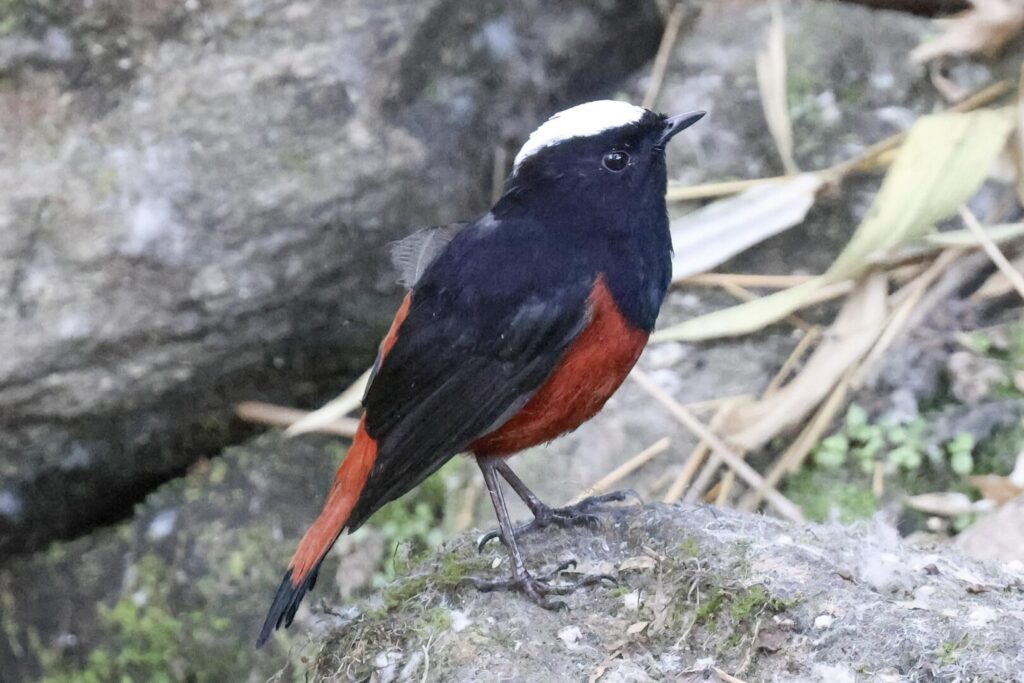
The Slaty-backed Forktails here are always very shy and easily disturbed. Dteng tried upstream, behind the hydro plant, but there was no sign of it. Looking downstream next, we found one on the rocks. By the time we got back with the group though, it had disappeared round the corner. There was no way to get to it and it was showing no sign of coming back out of its own accord. We decided to leave it for a while.
We walked back out to the road and continued further uphill. There were lots of Black-crested Bulbuls in the flowering trees, plus a Maroon Oriole and a Golden-throated Barbet. An Ashy Drongo and a pair of Ashy Woodswallows were perched in a dead tree the other side of the road. We were hoping to find some White-headed Bulbuls but we couldn’t find any different bulbuls here today.
Back down the road, we had another look for the Slaty-backed Forktail. There was no sign at first but just as we were about to leave, two flew out and landed on the rocks in the river further down. Great views now, once again perseverance had paid off. Two Forktails for the day!
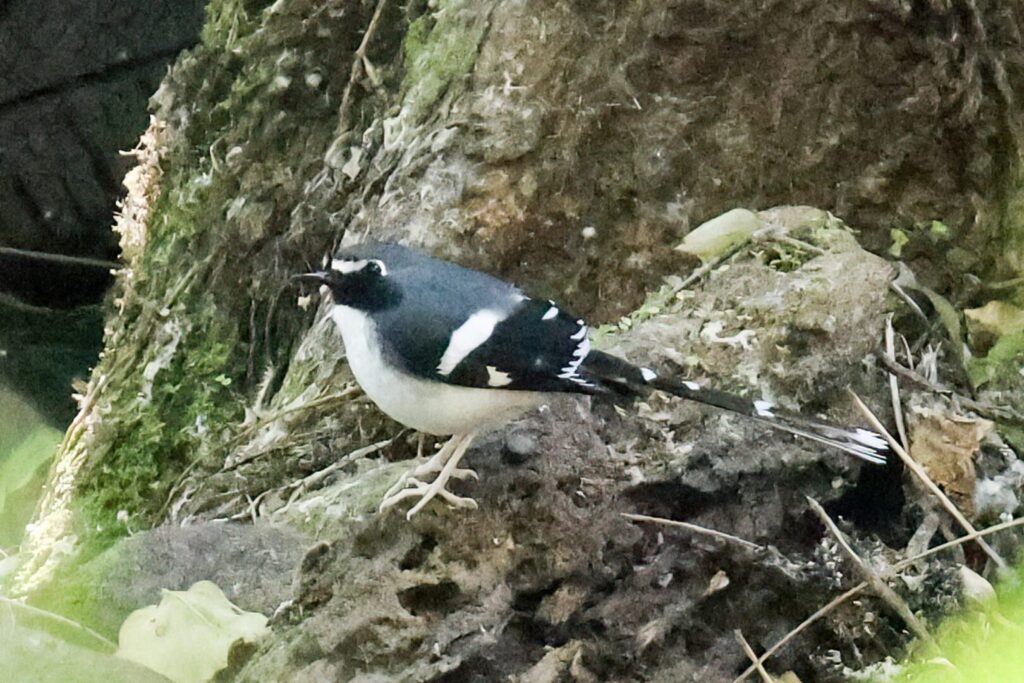
Back to the village, we stopped for lunch in the same restaurant we had visited yesterday. Afterwards it was hot, the middle of the day, so we stopped at the nearby hill tribe village market to do some quick souvenir shopping – dried fruit, local coffee and rice cakes! A Chinese Pond Heron flew past, up along the road.
Shopping over, we drove to Siriphum Waterfall next and walked in through the fern gardens. Several butterflies were coming down to drink on the wet mud by the pool at the entrance, including both Fourbar and Sixbar Swordtails.
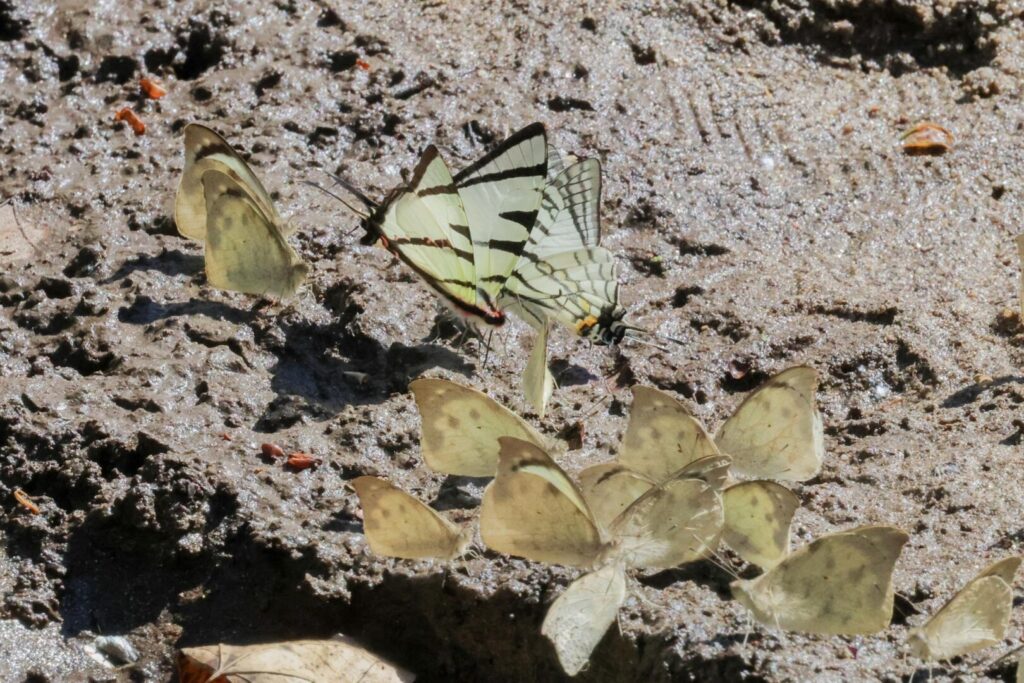
We didn’t find anything under the ferns so we walked straight on to the waterfall at the back. Another Slaty-backed Forktail was down at the base of falls and climbed slowly up and over the top as it saw us. Like buses! Dteng had seen Pygmy Cupwing here before, but we couldn’t find one now. No sign of Plumbeous Redstart along the stream either.

The Pygmy Cupwing had been seen again just after we left the gully yesterday, so we decided to go back there now for another try. Again, there were several vehicles parked at the start of the path but Dteng went in to look and there was no one down in the gully. We walked into the trees and climbed down again. It seemed quiet at first and we were out of mealworms, but still the birds came out regardless.
Much the same as yesterday, we saw the pair of Large Niltavas, the pair of White-gorgeted Flycatchers, Himalayan and Lesser Shortwings, and a Slaty-bellied Tesia in the vegetation just behind. Then the Pygmy Cupwing started calling and came out onto the log right in front of us. Lovely views, making up for missing it yesterday. Mission accomplished, we climbed back up to the road and moved on.
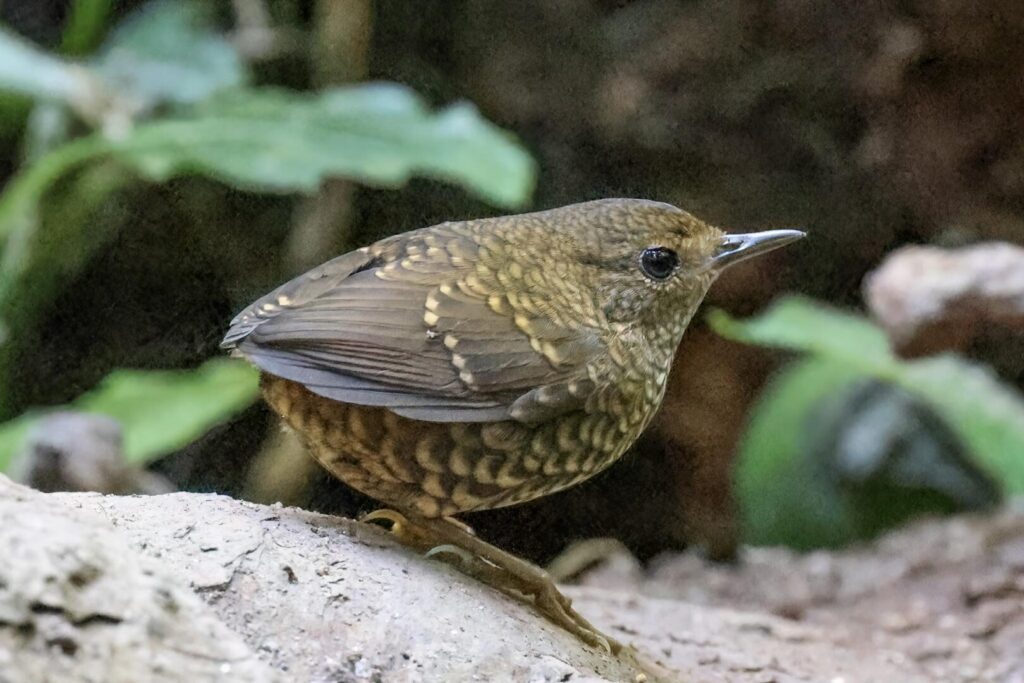
We stopped to use the restrooms at the park HQ. Several Cook’s Swifts and a single Barn Swallow were flying round distantly over the trees behind. Then we drove on to Wachirathan Waterfall. This is a big tourist attraction and always very busy with lots of people, seemingly not a good place for birding. However, it is a good site for Plumbeous Redstart.
Sure enough, as we walked up to the viewpoint, there was a female Plumbeous Redstart at the base of the falls on a rock. We watched it flycatching in the spray from the falling water.
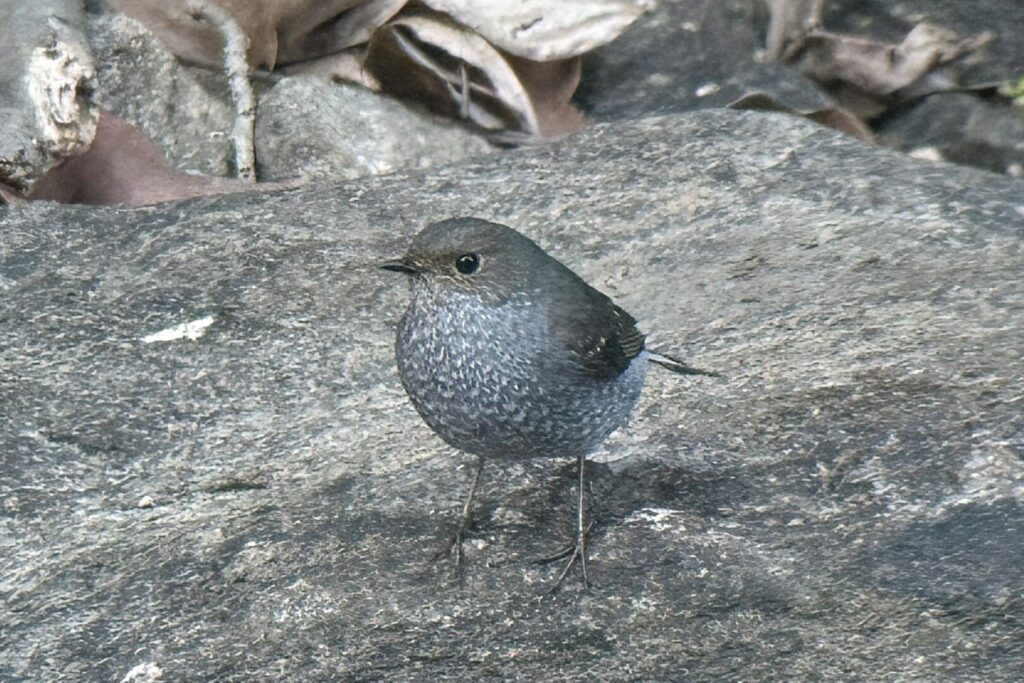
There were lots of bulbuls coming and going from the top of a tall fruiting tree on the far side of the falls. They mainly looked like Black-headed and Black-crested Bulbuls, but there had been some White-headed Bulbuls reported from somewhere here in the last few days, so we kept looking back up just in case. A White-capped Redstart appeared on the falls too, half way up on the far side.
Moving round a little, we found another Plumbeous Redstart on the rocks in the stream below the waterfall and what was presumably a second White-capped Redstart too, plus a Grey Wagtail and a Blue Whistling Thrush. There were more birds in the trees on the slope above. As well as lots of bulbuls, we found a pair of Bar-winged Flycatcher Shrikes briefly. Both Bronzed and Ashy Drongos were flycatching from the trees. We got a Blue-throated Barbet in the scope and could see it throat moving as it sang.
One of the group, spotted a White-headed Bulbul on the top of the fruiting tree now. It dropped down the back and we just managed to get the scope on it when it took off. Two flew out but we lost sight of them behind the trees further down. We walked down to the car park and scanned from the back, but there was no further sign of them.
Lots of birds were enjoying the sunshine, plenty of other bulbuls including an Ashy Bulbul, and a pair of Scarlet Minivets. Back to check the fruiting tree again, there was another Ashy Bulbul here now, plus a pair of Thick-billed Flowerpeckers briefly. A strange looking bird which flew in was an intermediate morph Black-headed Bulbul. But there was no further sign of any White-headed Bulbuls here either.
Dteng had been checking some more fruiting trees in the car park and there were yet more bulbuls coming in here. Mainly Puff-throated and Grey-eyed Bulbuls here, different to the ones coming to the tree by the waterfall.
The sun gradually went off the tree by the waterfall, and the bulbuls moved on. Birds seemed to move off down the valley and it gradually went quiet. Time to head back. Dteng took us to a restaurant in Chom Thong for dinner tonight. Sitting at the table, looking out over the ricefields beyond, we saw several Asian Palm Swifts, Ashy Woodswallows and Common Mynas fly past. A few Streak-eared Bulbuls were on the fence. An Asian Openbill flew over. A reminder of the birds of lower levels below the park.
After dinner, we drove back to the hotel and met up in reception to go through the day’s list. Everyone had gone to bed and the lights were out by the time the Brown Boobook started calling again, in the trees up by the car park.
Saturday 14th February
A late breakfast this morning, not until 6.30am! But we had to be packed and ready to go, as we would be heading to the airport today. After breakfast, we checked out for the long drive to our birding stop first. Less than 5 minutes away! We walked in along the track and climbed up to the top of the Parakeet tower. The owner had put new netting up, presumably to reduce disturbance. While great for photographers, it was a lot harder to see all round. We struggled to try and tie it back so we could see out.
There were lots of birds coming and going from the flowering tree in front. A nice selection of commoner bulbuls, Great and Common Mynas. Lovely close views of several Golden-fronted Leafbirds,…

…Black-hooded Orioles and a female Black-naped Oriole. Coppersmith Barbets and Lineated Barbets perched up in early sun calling. A Blossom-headed Parakeet flashed through but didn’t stop. Three Red Junglefowl walked across the slope in front, a male and two females. We heard Green Peafowl call further up the slope in the bamboo but couldn’t see it.
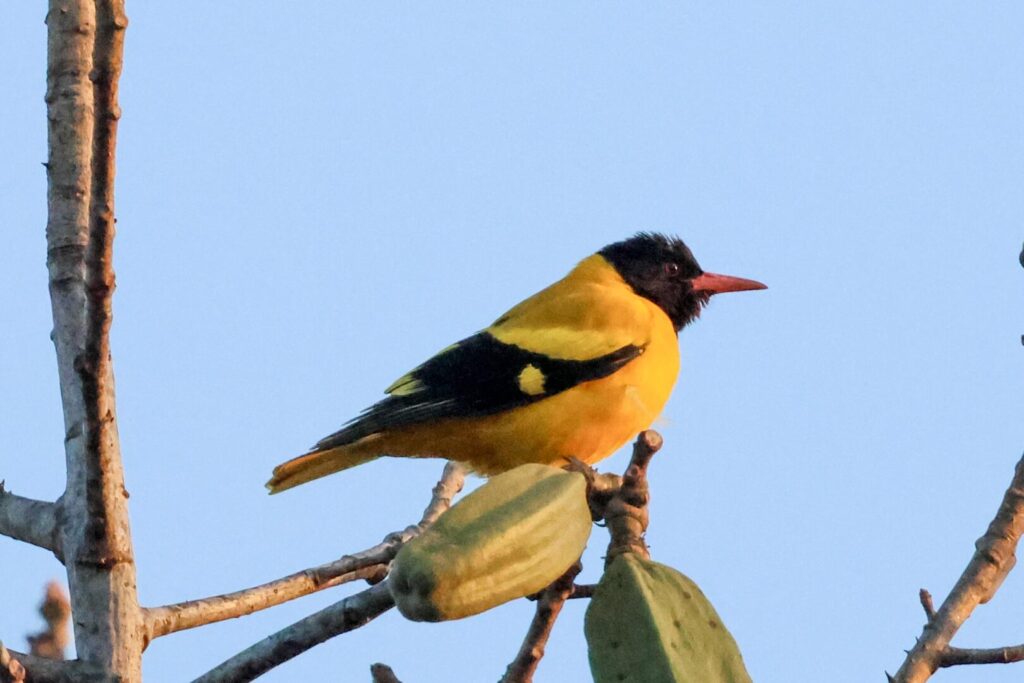
A couple of sunbirds came in to feed on the yellow flowers close to the tower – female Ornate Sunbirds and a male Purple Sunbird – and a Common Iora came in too. A flock of Short-billed Minivets flew round over the trees beyond and landed a couple of times briefly. We saw a couple of Red-billed Blue Magpies flying through the trees too, several Ashy Drongos and two Hair-crested Drongos which landed in a dead tree further back.
A flock of Chestnut-tailed Starlings came in to feed in the flowering tree and a Chestnut-headed Bee-eater landed there briefly.

A distant Crested Serpent Eagle was perched in the tree behind us and a Hoopoe perched up briefly. A Scarlet-backed Flowerpecker, a Plain Flowerpecker and a male Ornate Sunbird all appeared in another flowering tree this side too.
We continued to scan the bamboo on the slope in front of the tower. Lots of doves came down to feed on the corn but there was no sign of the Peafowl coming out. Unfortunately, we had a flight to catch today and were out of time. On the walk back to the minibuses, we stopped to watch a Bar-winged Flycatcher Shrike flycatching in the trees. Two or three Black-naped Monarchs were in some denser evergreens here too.
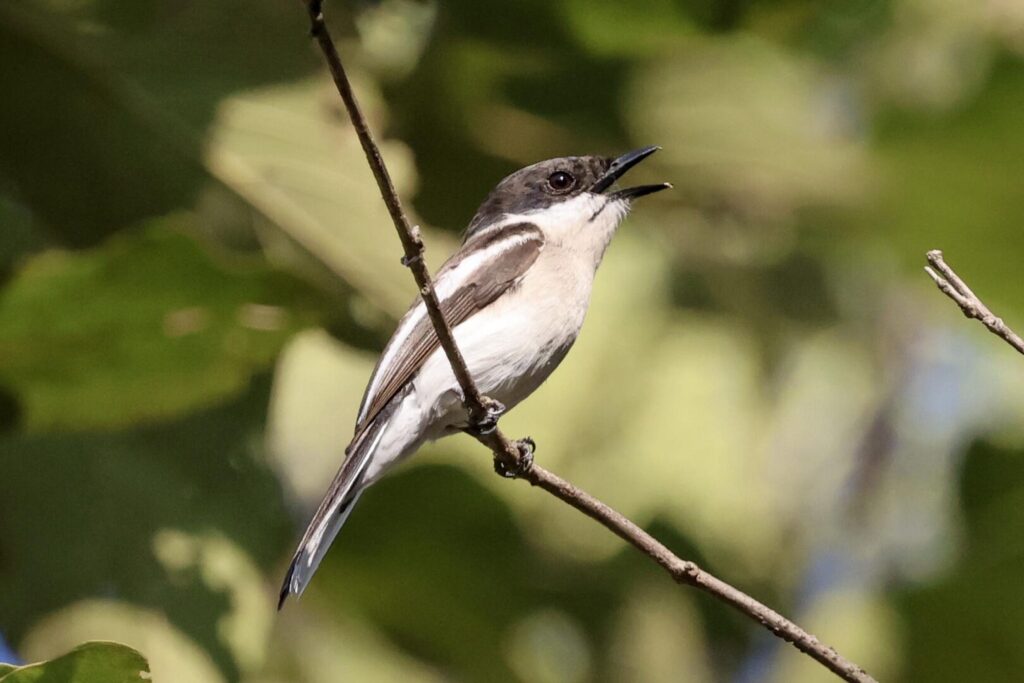
Some of the group needed to use the bushes so we waited for them to catch up. We heard a parakeet call but half of the group were already on their way to the buses to pack up tripods etc.. We couldn’t walk back towards the tower to look, as people were still in the bushes. When they eventually emerged, one found a Blossom-headed Parakeet perched up in a tree a short distance up the slope.
We tried whistling and waving to those who had walked on, jumping up and down, but it took a while for anyone to notice. They came running back, but just as the Blossom-headed Parakeet flew off.
It took just a little over an hour to drive to the airport in Chiang Mai – it was Saturday and the traffic wasn’t too bad. We said goodbye outside to one of the drivers who lives here and would not be coming down to Bangkok with us. The other would drive down and meet us tomorrow. Then we checked in and made our way through security. Sitting in departures, we had time for coffee and the ricecakes we had bought in the hill tribe market yesterday.
All seemed to be going well until there was an announcement that the runway had been closed and all flights were on hold. Our plane was still circling and in a queue to land. It appeared that an aircraft had broken down out on the airfield, as we saw a plane being towed back to the terminal. Thankfully, everything reopened quickly but there were still delays. Our flight was due to leave at 11.15 but the incoming plane didn’t make it on to the stand until 12.10. They managed to turn it around fairly quickly and we eventually pushed back at 12.54.
The second part of this blog, Central Thailand, the Gulf and inland to Kaeng Krachan, follows…