Day 2 of a 4-day Spring Migration tour. It was another beautifully bright and sunny day, warm too with temperatures up to 24C in the afternoon, but still with a moderate SE/S wind. We spent the day in the Fens and the Brecks.
An early start this morning, we drove down into the Brecks. As we got out of the minibus, we could already hear our first Nightingale singing. As we walked on down along the road, the Nightingale was down low in the brambles where it would be impossible to see. A Garden Warbler was singing too.
We walked on further, to see if we could find a more obliging Nightingale. There were lots of warblers singing in the bushes – Chiffchaff and Willow Warbler, several Common Whitethroats and Blackcaps. The next Nightingale was croaking from some very dense undergrowth and another was singing where we couldn’t see it either. We could hear a Cuckoo calling off in the distance.
Down to the bottom, the bushes are a bit more open. Another Nightingale was singing here but we couldn’t see that one at first either. Another local birder was down here too, looking for it, and he called us over. It was just visible in a deep thicket, so we got the scope on it and could see its body shaking as it sang. Then it dropped out of view and went quiet.
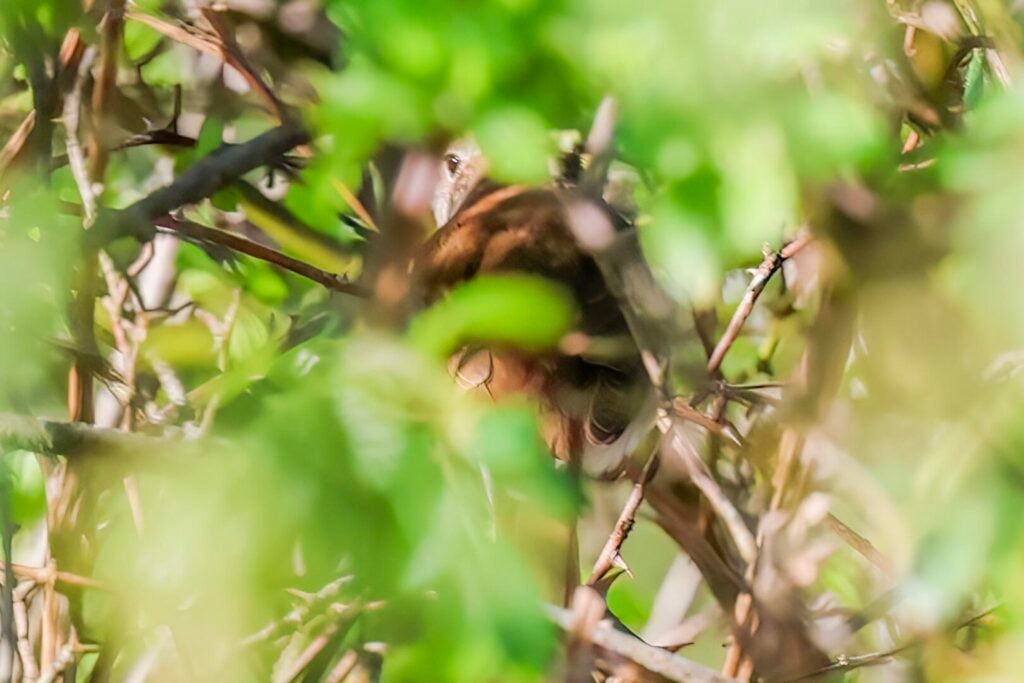
Walking back up, another Garden Warbler was singing in a tree by the track, but tricky to see too. The wind seemed to be keeping things down a bit today. A Lesser Whitethroat was rattling much further over.
We took a small side path up onto the hill. As we did so, two Nightingales flicked round the side of a large hawthorn, probably a pair. The female dropped down but the male landed in view singing. It stayed there for a few seconds, then it dropped down too.
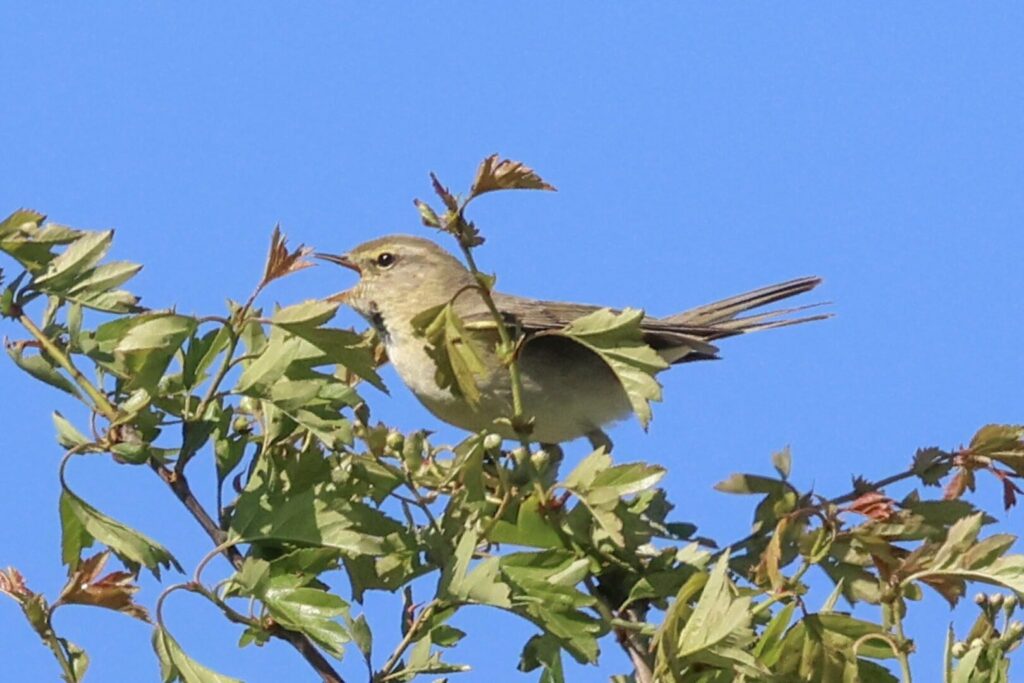
Further up, yet another Nightingale was singing but low down in dense undergrowth. One behind was perched up but you had to be in just the right place to see it and then it dropped before we could get the scope on it. A Willow Warbler was more obliging, singing from the top of a large bush.
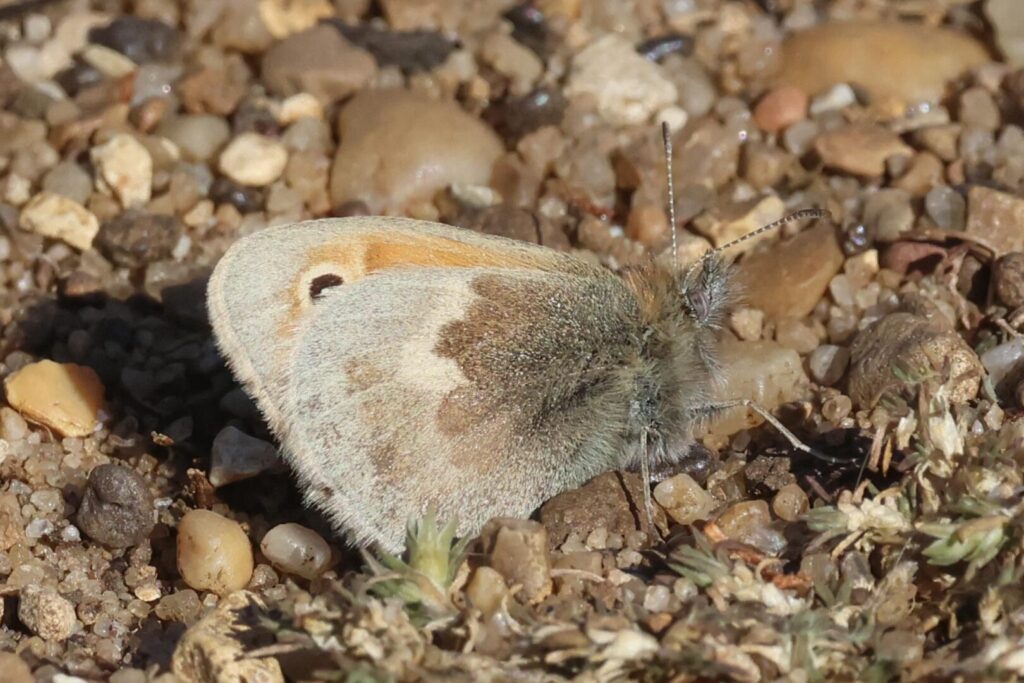
As we carried on up and round the hill, there were a few butterflies out in the sunshine. Our first Small Heath of the year landed on the path in front of us. There were several of the localised and day-flying Speckled Yellow moths flying round too.
Lots of Greenfinches and a few House Sparrows were feeding on the ground under the bushes further up. The Nightingales seemed to be going quiet now. There are several more territories over this side too but we could hear only one in the distance now. We decided to walk back and move on.
We drove round to Lakenheath Fen next. As we got out of the minibus, a teneral Azure Damselfly landed on the ground in car park, our first of the year too. A Chiffchaff was singing on our way to the Visitor Centre.
After checking in, we walked out onto the reserve. A Cuckoo was calling in the willows and a Great Spotted Woodpecker flew off from the feeding station. Several Reed Warblers were singing in the reeds.
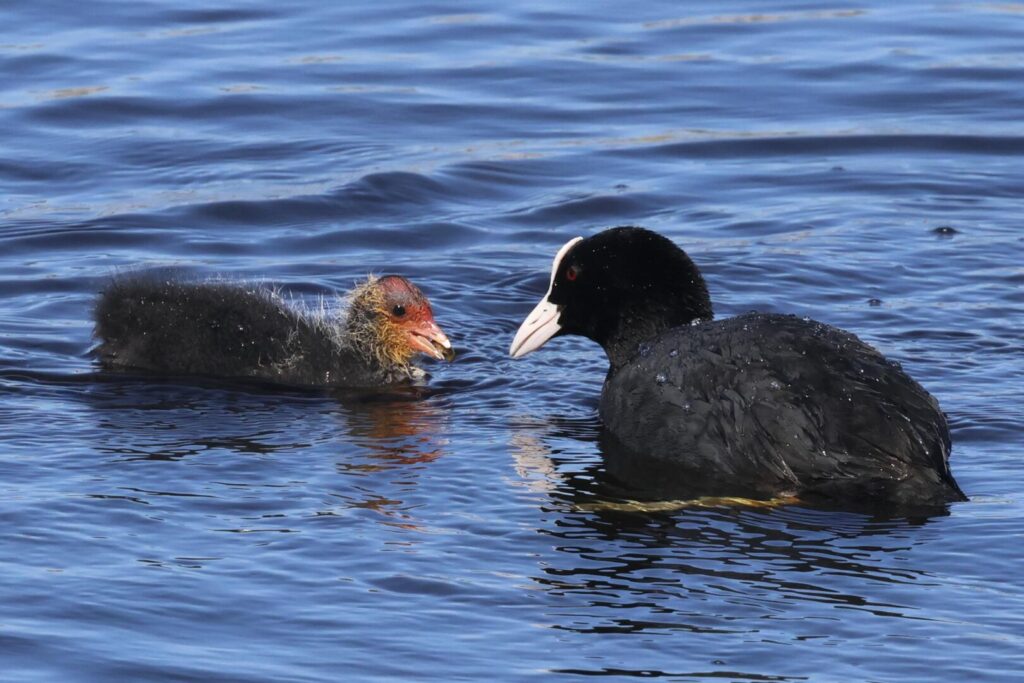
Up to New Fen Viewpoint, there were a Canada Goose and a couple of Greylags on the pool. Several bald and red-headed juvenile Coot were being fed by their two parents down at the front. Not the prettiest of baby birds!
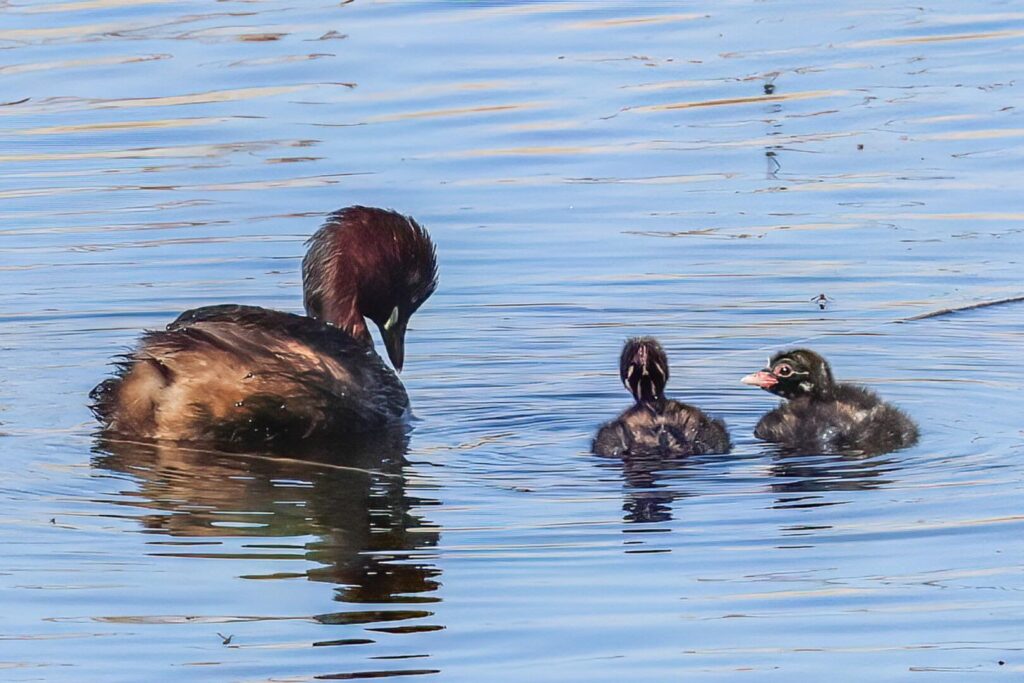
A Little Grebe was also feeding three small juveniles further back, along the edge of reeds. These stripy-headed balls of fluff drew much more admiring glances! A female Common Pochard swam out into the middle of the pool.
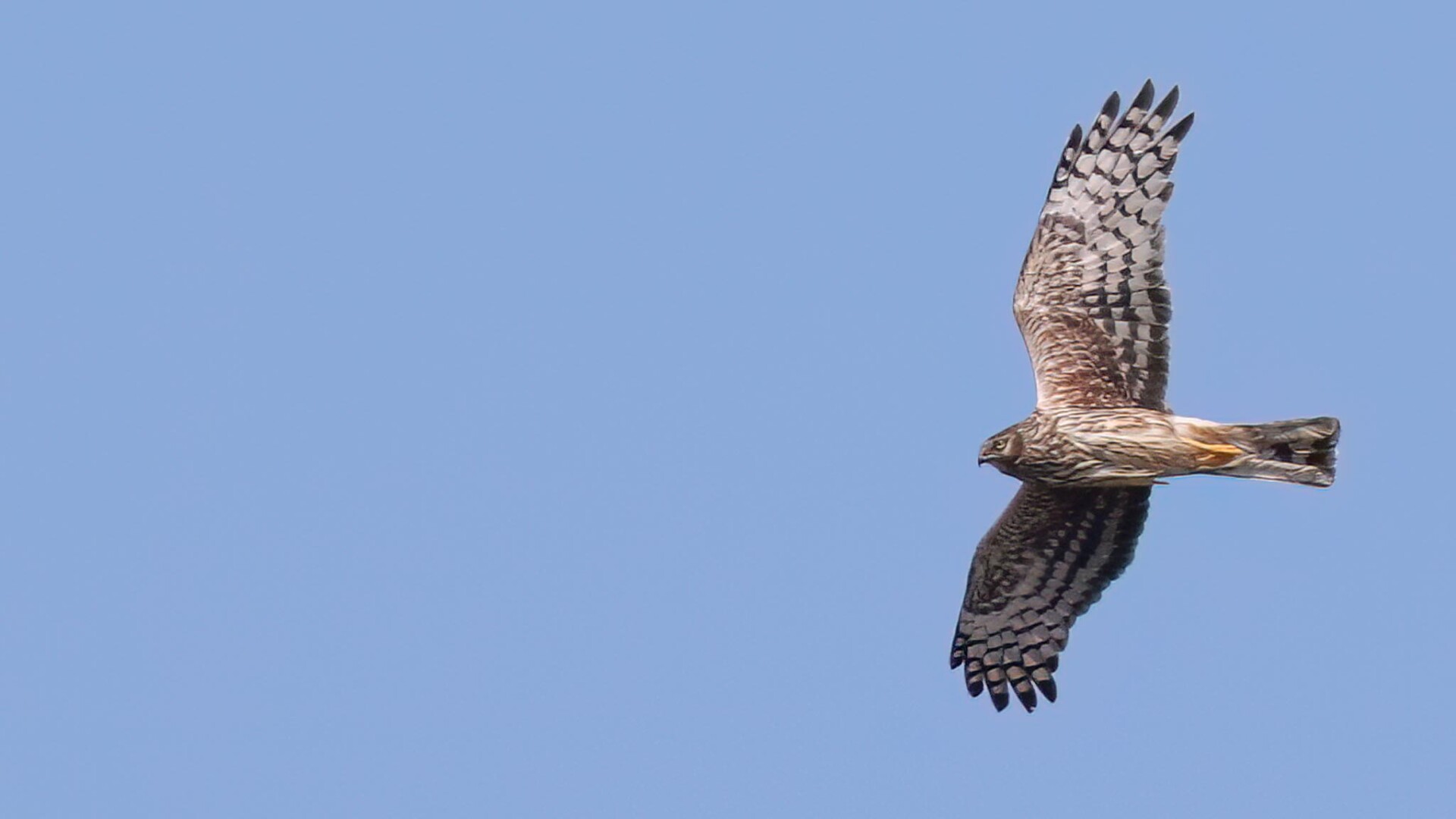
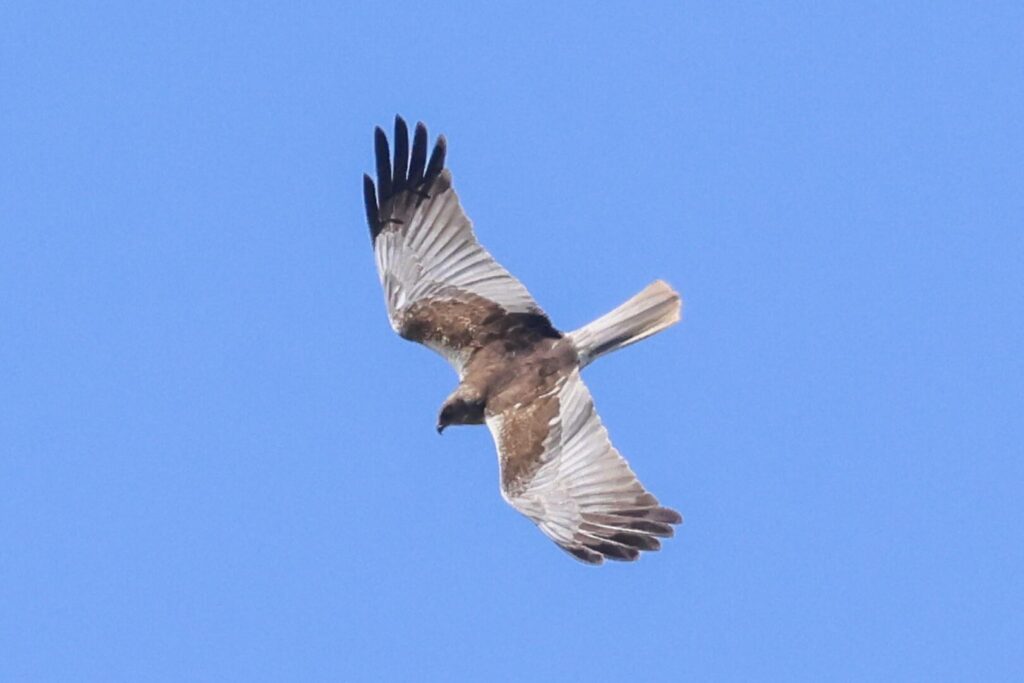
A male Marsh Harrier flew round over the reeds and landed in the top of a large sallow clump, where we got it in the scope. We heard just a couple of brief grunts from a Bittern and it was a surprise that we didn’t hear a Cuckoo at all.
We decided to walk on further. There were more Reed Warblers, Sedge Warblers and Common Whitethroats singing all the way along. Several Large Red Damselflies and Hairy Dragonflies were hawking over the vegetation by the path. We admired the Water Violets growing in an open pool.

Just beyond Trial Wood, we heard a couple of croaks from a sallow in the reeds close to the path. It sounded a bit like a Great Reed Warbler, but that is a very rare visitor here. Then a regular Reed Warbler started up. They can be good mimics so had we imagined it? We were just about to walk off when the Great Reed Warbler started singing too. We could hear its distinctive croaking song.
It continued for about 15 minutes, but the Great Reed Warbler remained deep in the sallow clump. We could just see it a couple of times moving around in the middle. Then it went quiet. Rare but annual in the UK, and an increasingly regular visitor here. A classic spring overshoot from the near Continent. Likely to be a future colonist and breeding bird in years to come.
We decided to walk on, and continued up to Joist Fen Viewpoint. A Water Rail squealed from the reeds as we walked past. We could see several Hobbys in the distance, right up the far end. We counted about twenty here today but there were probably more. Some were very high in the sky.
A male Marsh Harrier circled over the reeds and started displaying, twisting and turning as it dropped. We then watched it come in and out several times with nest material.
The person on the end bench shouted and we turned to see a Bittern flying from one clump of reeds to the other. It disappeared straight back in. We would probably have been satisfied with that, but then it walked out into the edge of the reeds. We could just see it creeping through at first, then it came right out into the open on a small spit of mud.
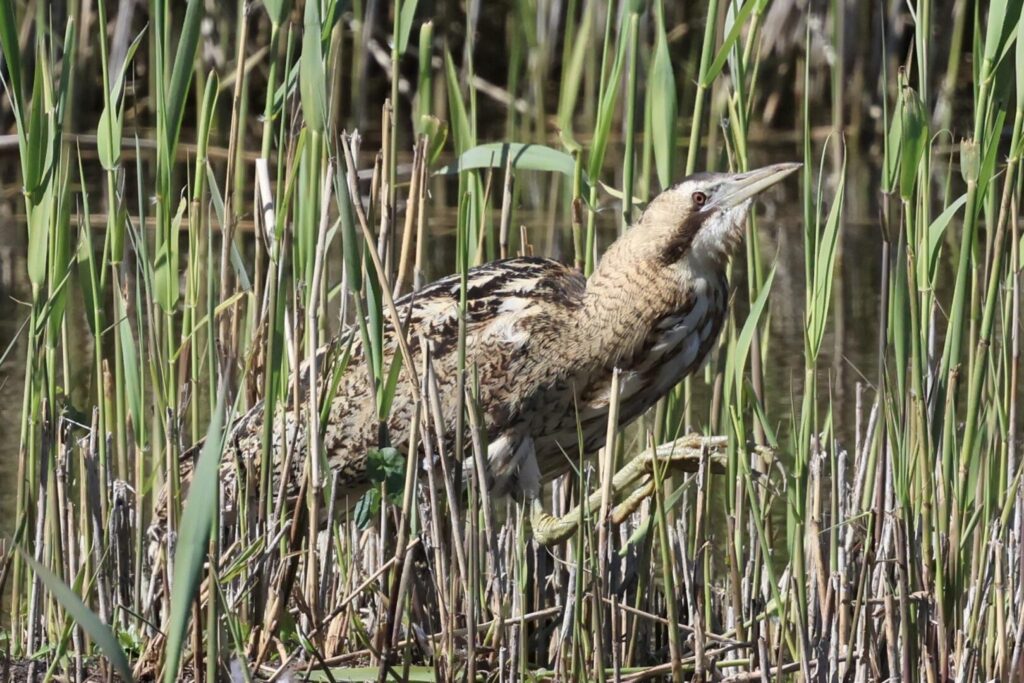
The Bittern crouched on the edge of the mud staring at the water. It’s head shot out and it caught something, which it quickly swallowed. Then it stood up tall, stretching its neck.
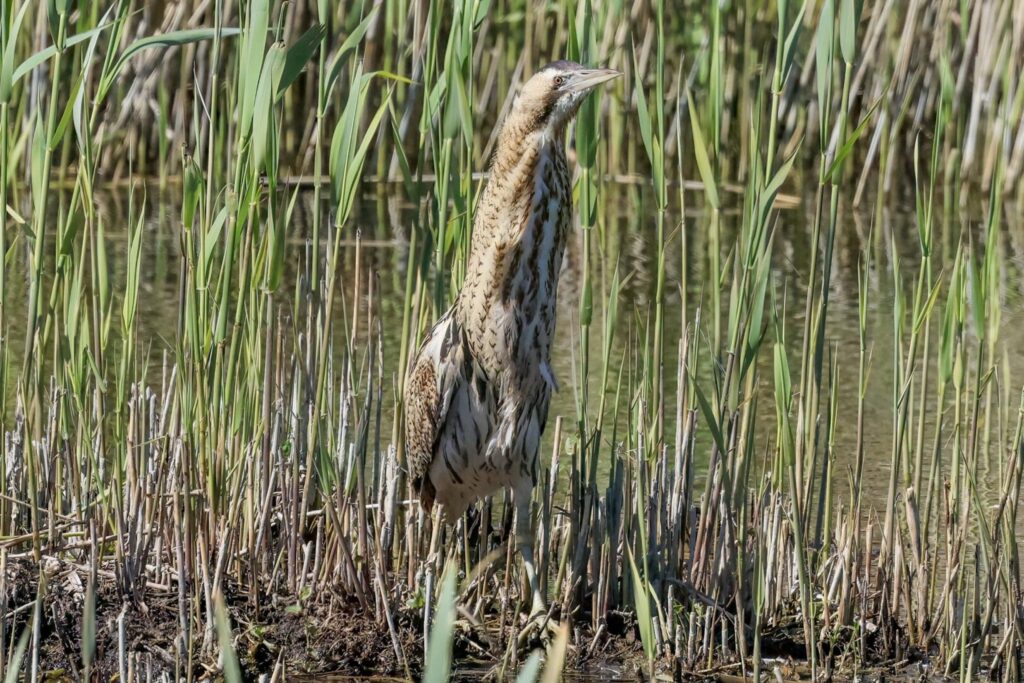
Then the Bittern flew across to the other side of the pool and stalked slowly along the far edge until it disappeared out of view. This was exactly the same place we had seen the Bittern the other day, but this was not the same bird. That was a male and this was a female.
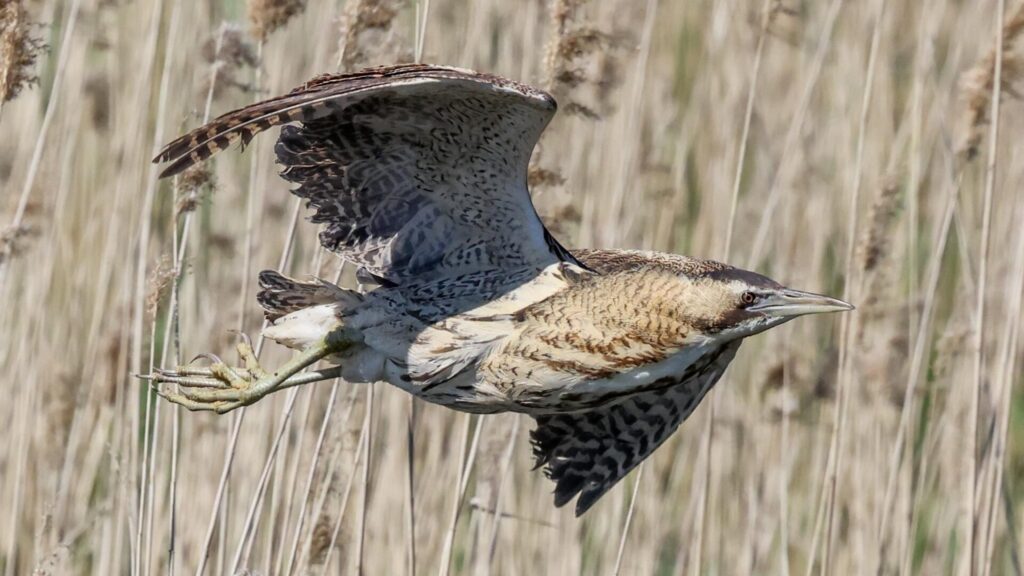
It was time for lunch now and we had worked up an appetite. This is such a great place to sit and watch, we had brought our lunch with us. The birds continued to perform while we ate. A Great White Egret flew across and a couple of the Hobbys eventually came much closer.
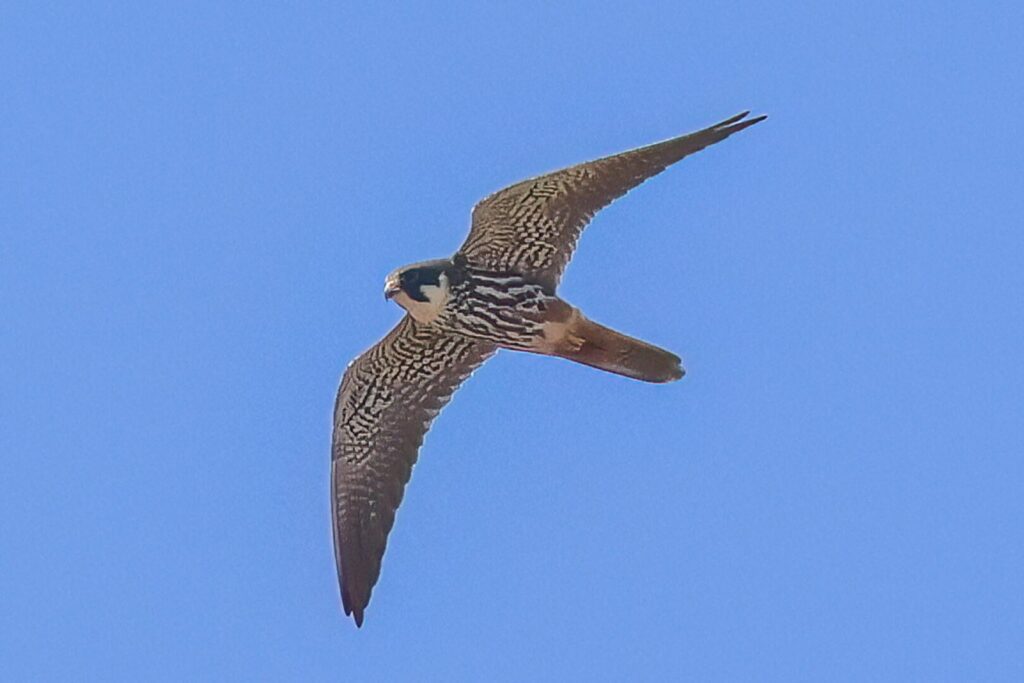
The Bittern then flew out again and across right in front of us, back the other way. This time it continued on over the bank and dropped down the other side out of view.
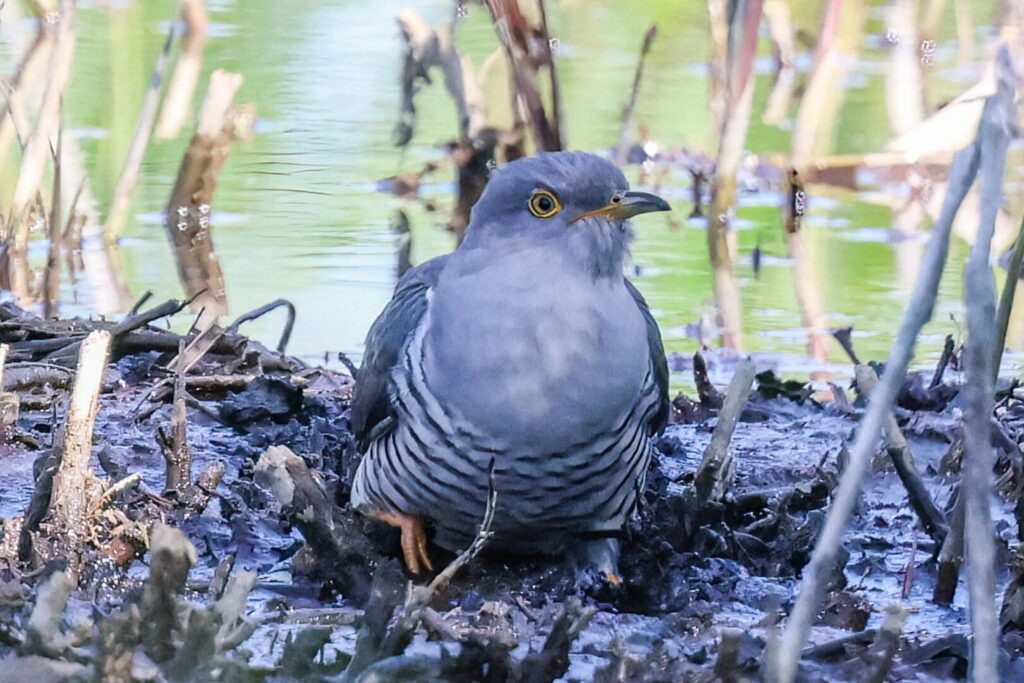
A Cuckoo had been calling behind us, in the end of West Wood, for some time now. We kept looking over but there was no sign of it coming out. We decided to walk back that way and scan the trees. We were almost there when it flew out right past us and landed in the back of a small sallow just behind us. It started calling.
We walked back round to the other side to see if we could see it. We found the Cuckoo perched low in the back of the bush. Then it dropped down onto some open mud where some reeds had been cleared. We could see it hopping around on the ground and then it started to drink from a small depression in the mud. We have never seen that before, great views in the scope. It continued to drink for some time – it must have been thirsty.
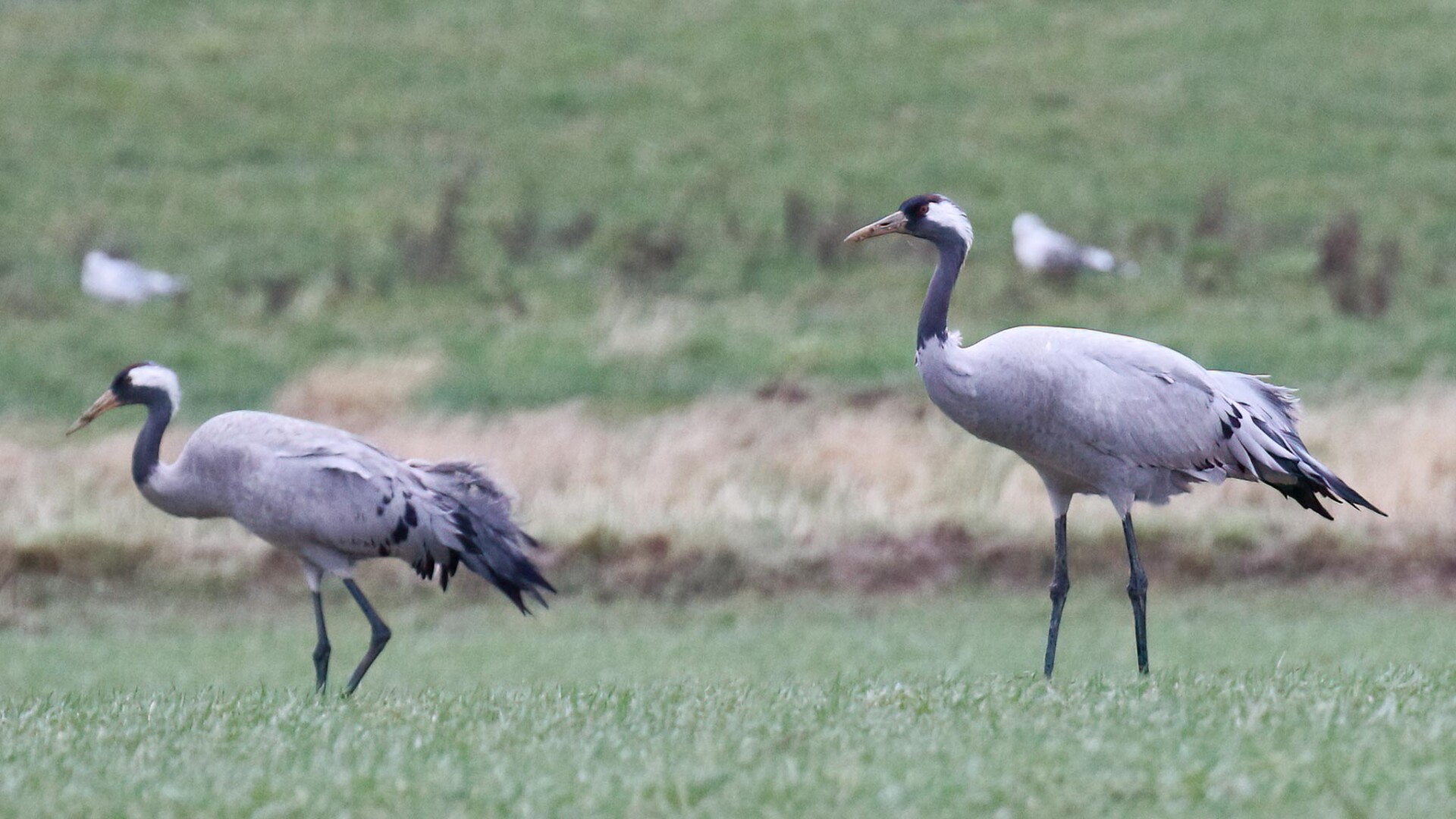
We hadn’t heard any Cranes while we were at the viewpoint but they started to bugle loudly now. We couldn’t see over the reeds but nothing broke the skyline. Eventually the Cuckoo flew back up to West Wood and started calling again. We continued walking back. As we passed the bush where the Great Reed Warbler was, it was still quiet. It was hot today. Everyone was tired after the early start and long walk. Back to the Visitor Centre, we stopped for ice cream (the gooseberry is highly recommended!)
Afterwards, we drove round to Weeting. Scanning from the gate, we noticed a Stone Curlew over on the grass on the other side of the road. Good views in the scope. Another Stone Curlew was further over and we found a Eurasian Curlew walking around out here too. Several Mistle Thrushes were up on the hill further back.
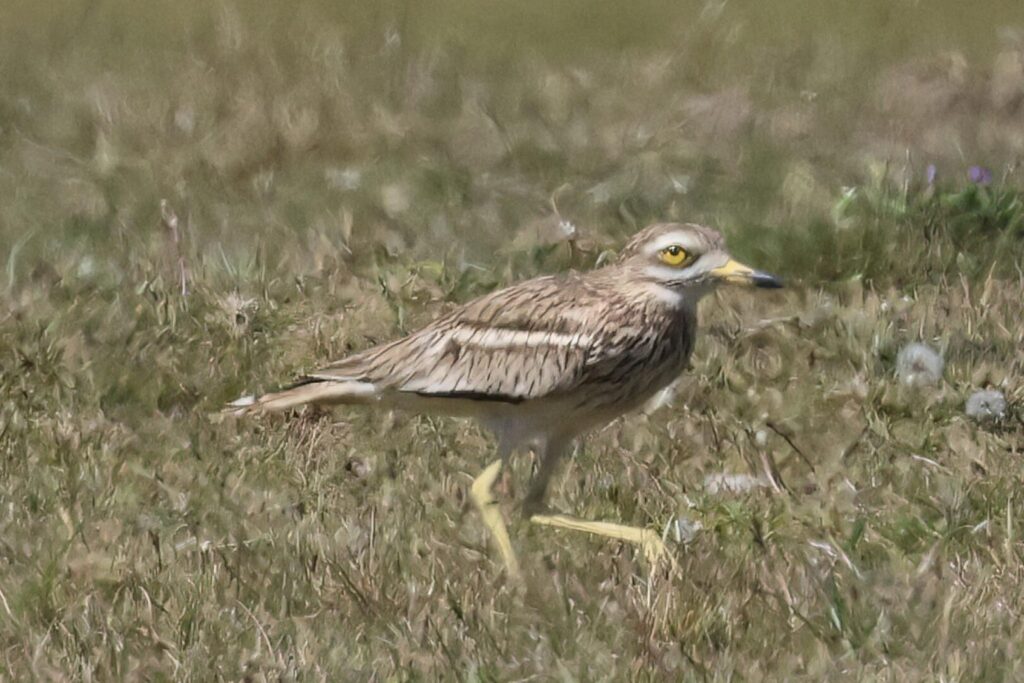
We walked round and had a quick look from West Hide. Another pair of Stone Curlews was out on the edge of the cultivated area, hunkered down. A Eurasian Curlew was on its nest further back, all we could see was its head and bill. A second Curlew, presumably its partner, was feeding in the shade over by the fence. Several Lapwings were out on the grass but there was no sign of any juveniles now.
We still had time for one last stop, so we drove deeper into the forest to look for Tree Pipits. As we walked in, a couple of Small Copper butterflies fluttered over the path. A Cuckoo was calling. We hadn’t walked far when a Tree Pipit flew out of the trees ahead of us, went up in a song flight and then landed back down in the top of a tree behind us. We walked back and got it in the scope, as it perched there singing on and off.
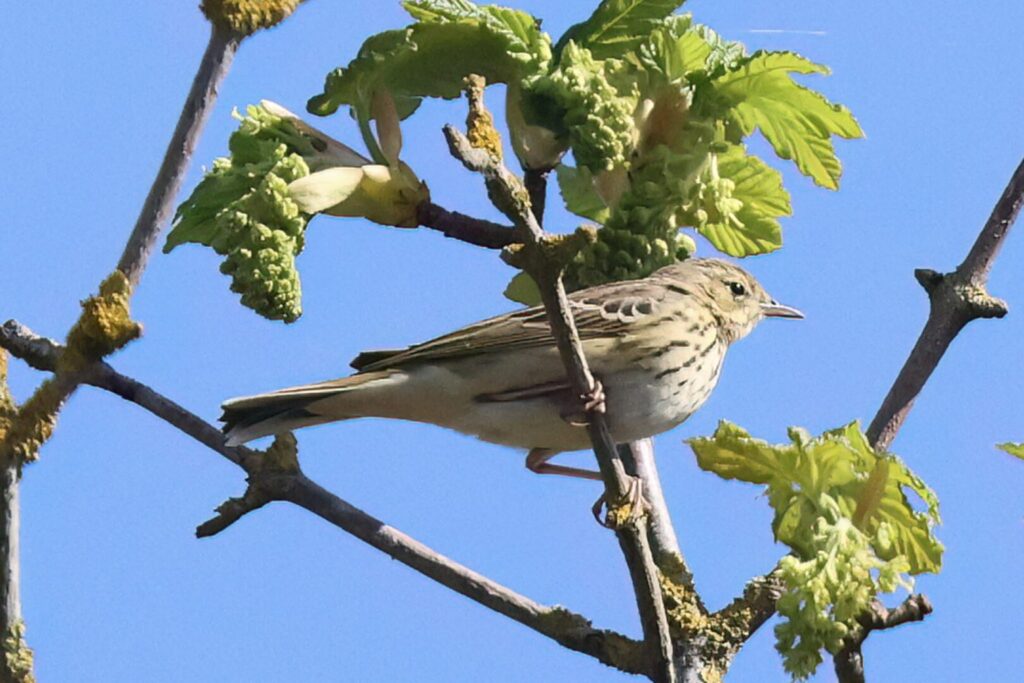
We continued on a little further, to a clearing. Several more Tree Pipits were singing and song flighting from the trees out in the middle. The Cuckoo flew round and off over our heads. A couple of distant Common Buzzards circled up.
Everyone was tired and it was hot now. It was mission accomplished here now anyway, so we didn’t walk on further. Back to the minibus, we drove back up to Hindolveston. We were almost back when two Grey Partridges flew up from the side of the road right in front of us. Unfortunately they disappeared straight off over the hedge. Once again, there was time for tea and cake, or perhaps a long cold drink and a rest before dinner today.