Day 3 of a 3-day Spring Migration tour in Norfolk. It was a mostly bright and sunny day but with a blustery and cool wind again, which eased a little in the afternoon. The only April showers we saw were on the drive back at the end of the day. We spent the day down in the Norfolk Broads.
Several of the group had been particularly keen before the trip started to see the Black-winged Kite which lingered in Norfolk for much of the winter. But by the time the tour came around, there had been no sign of it for about three weeks. It looked like we would be out of luck this time. Then a message came out first thing this morning that it had just been seen again, at Sea Palling. Just in time or too little, too late? We had no idea at this stage if it would be lingering in an area where we could see it.
We met in Hindolveston as usual and after a quick discussion on options there was no question that we were not going to head down to the Broads to at least try to see it. There were other things to see down there too, as ever. We set off to drive across to East Norfolk.
When we arrived at Sea Palling we couldn’t find anyone else looking for the Black-winged Kite. We sent a quick message to the last person to report seeing it and helpfully got a quick response and a pin on the map for exactly where it had been. He was watching from the other side of the marshes. Then one of the local birders appeared on his bike and pointed out to us where he had seen it from. While we walked up along the road, he cycled on ahead.
The area the Black-winged Kite has been favouring was only viewable rather distantly from the road. We had stopped to scan from the verge when we heard a whistle. He had seen the Kite again briefly but it had disappeared into some isolated bushes in the middle of the reeds. We set up the scope and scanned but couldn’t see it from here. There was a cold and blustery wind this morning and the Kite was obviously on the other side of the bushes, where it was more sheltered.
The landowner was out on the marshes in his truck and started to drive towards the bushes where the Black-winged Kite had gone down. Sure enough it came up again. We watched as it flew across before losing sight of it behind some trees. Distant views, but at least everyone had seen it.
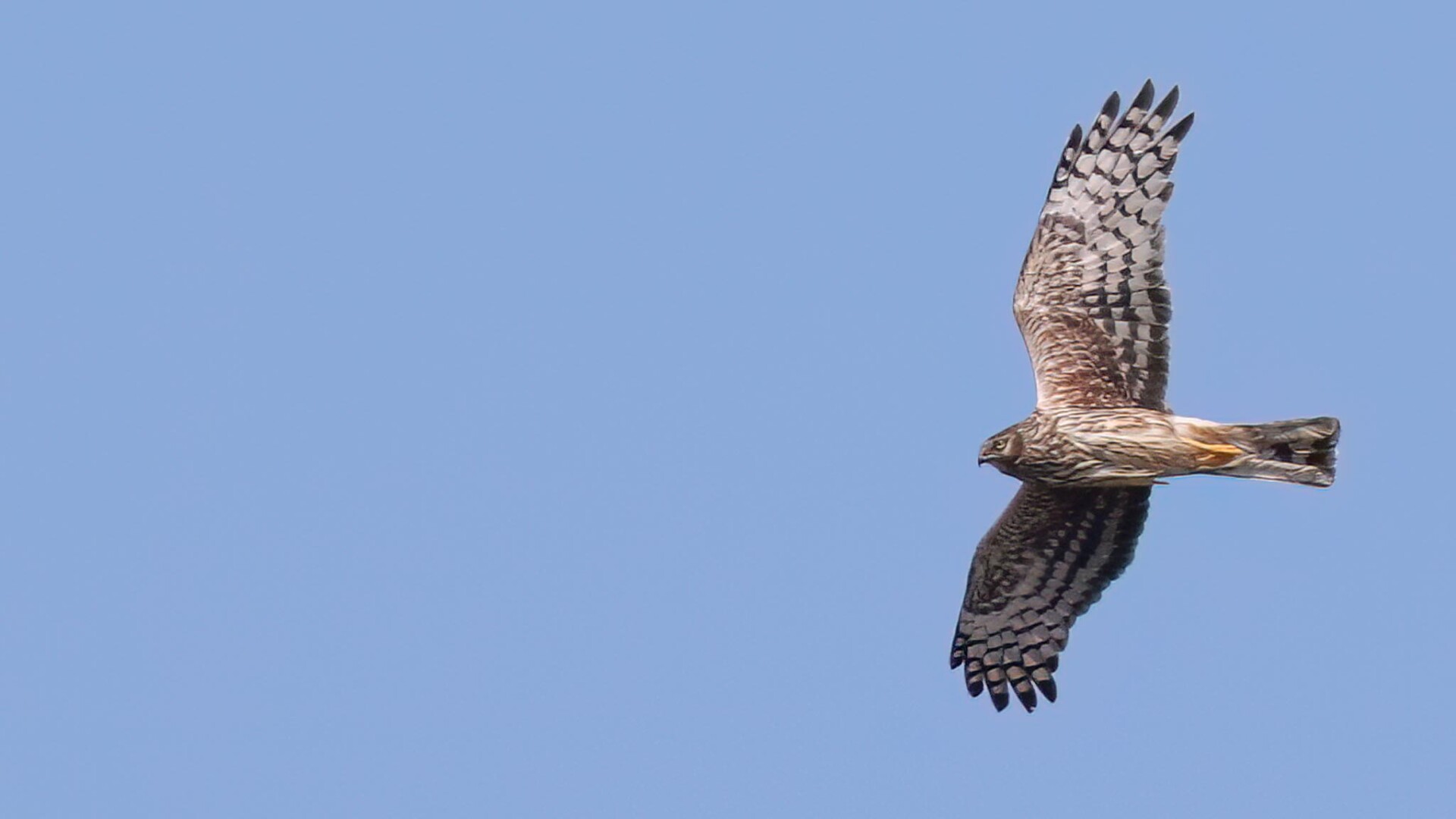
Unfortunately we hadn’t seen where the Kite had gone. We stood and continued scanning for a while, in the hope it would reappear. A Marsh Harrier was quartering the marshes and a Common Buzzard flew across. We decided to move on and figured we could come back later if it was relocated.
We drove over to Hickling. After a quick break at the Visitor Centre to get a hot drink and warm up, we headed out to have a look at Brendan’s Marsh. Walking along the track, a Chiffchaff was singing in the trees ahead of us and a Willow Warbler was singing in the small wood off to our right.
It was rather sheltered around the Visitor Centre but once we got out along the track to Stubb Mill, we were back out in the wind. There were Greylag Geese, one pair with goslings, and a selection of ducks on the first pool. Plus a few Avocets and Lapwings. But otherwise, it looked a bit quiet.
A tractor was out in the field the other side of the track, rowing up the earth planting potatoes. Lots of gulls were following behind, mainly Black-headed Gulls but several Lesser Black-backed Gulls were with them and a couple of Herring Gulls.
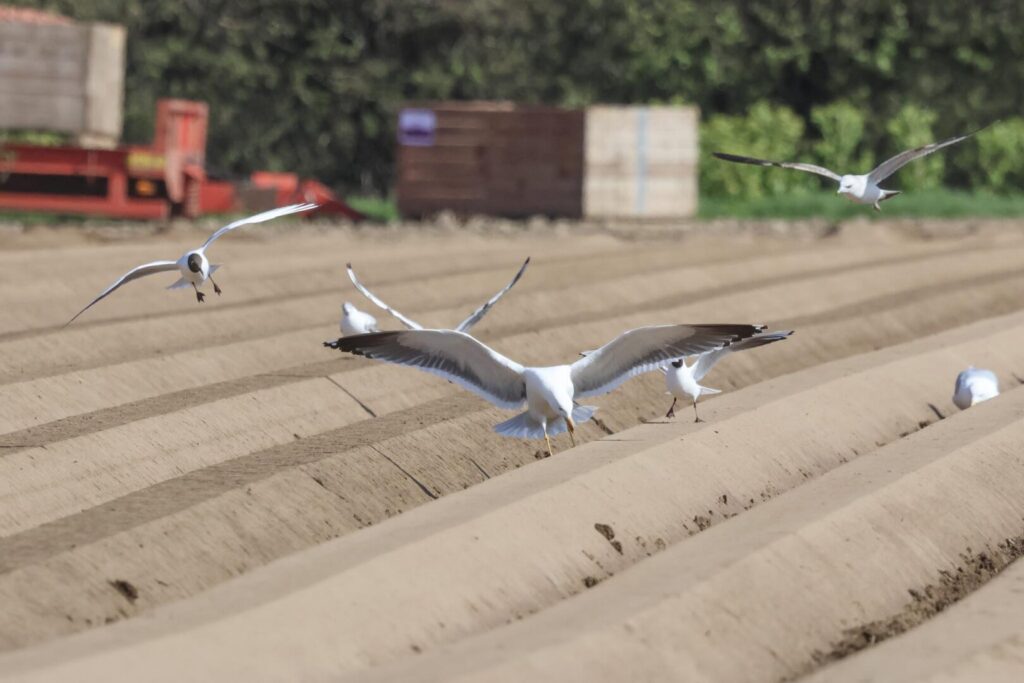
From up on the first platform, we could see lots of gulls on the next pool, mainly immature Great Black-backed Gulls. A couple of Ruff flew round with three Redshanks but otherwise there were few waders on here today. Perhaps they were hiding from the wind.
There was not much more to see from the second platform. We picked up two Little Ringed Plovers on the edge of one of the islands. Several Marsh Harriers were up over the reedbed beyond. At least they were appreciating the wind!
Continuing on further, what was presumably a Weasel appeared briefly from the hedge ahead of us but ran straight back in. We stopped again to scan from the corner at the far end. Once again, there were lots of Marsh Harriers up over the reeds. Another Little Ringed Plover was on one of the islands on the pool. We heard Bearded Tits pinging and managed a brief glimpse of one flying off.
This is usually a good vantage point from which to see Common Cranes but there was no sign of any today. We had hoped to at least hear a Bittern too but that would be hard from here in the wind. We decided to walk back and try our luck up along the Whiteslea track instead.
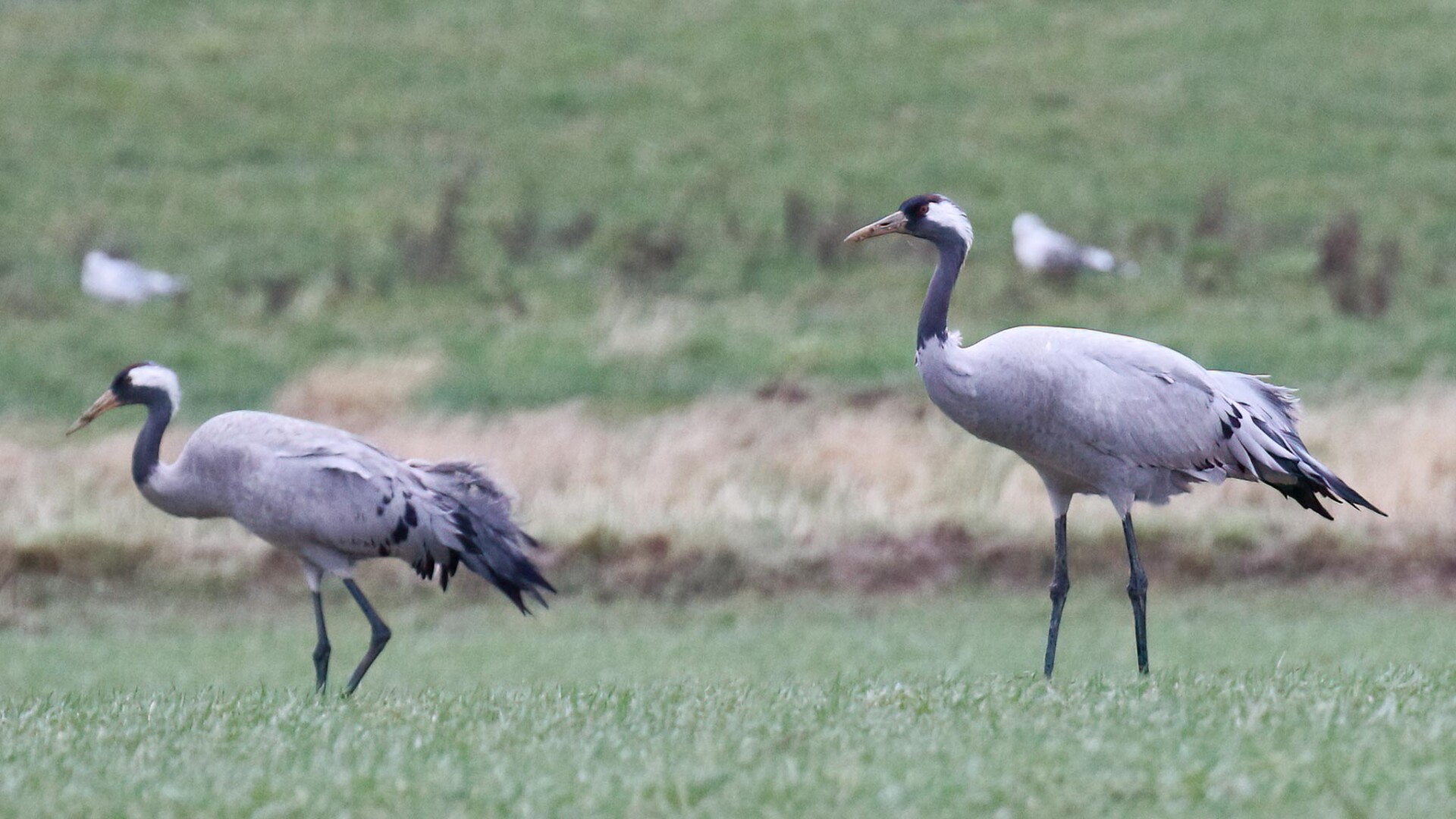
When we got back to the corner, we looked round behind us and noticed a Crane up over the trees beyond the fields. It turned and flew across over the fields and the track back behind us. We watched it fly out over Brendan’s Marsh, dropping down over the reeds beyond, where we lost sight of it behind the trees.

As we walked on up the Whiteslea track, a Willow Warbler was singing ahead of us. We could see it up in the branches of the oaks by the track before it flew round behind us.
As we continued on up to the viewpoint, we could hear Cranes bugling now. Looking across, we could see one circling up over the reeds and then across over Brendan’s Marsh, the opposite way to the one we had seen earlier. We wondered whether it might be a pair, and changeover at the nest. We had a brief glimpse of another pair of Cranes dropping down into hundred acre reedbed.
The birds visible on the marsh from here were much the same as we had seen from the other side. But while we stood scanning, a couple of the group had a glimpse of an Otter disappearing into the reeds by the channel in front. It reappeared in the water the other side of the reeds and then we watched the trail of bubbles as it swam across and resurfaced by the fence on the near edge. Then it disappeared into the reeds.
As we walked on up along the bank, the pair of Cranes we had seen earlier came up again and we watched them as they disappeared round the back of the dead trees and off towards the marshes beyond Stubb Mill. Then we heard a Bittern booming in the reeds several times, before it went quiet again.
We continued on and went for a quick look in Bittern Hide. The wind was really catching the edges of the reeds and all we could see where a couple of Mallard and a single Greylag. We decided to head back.
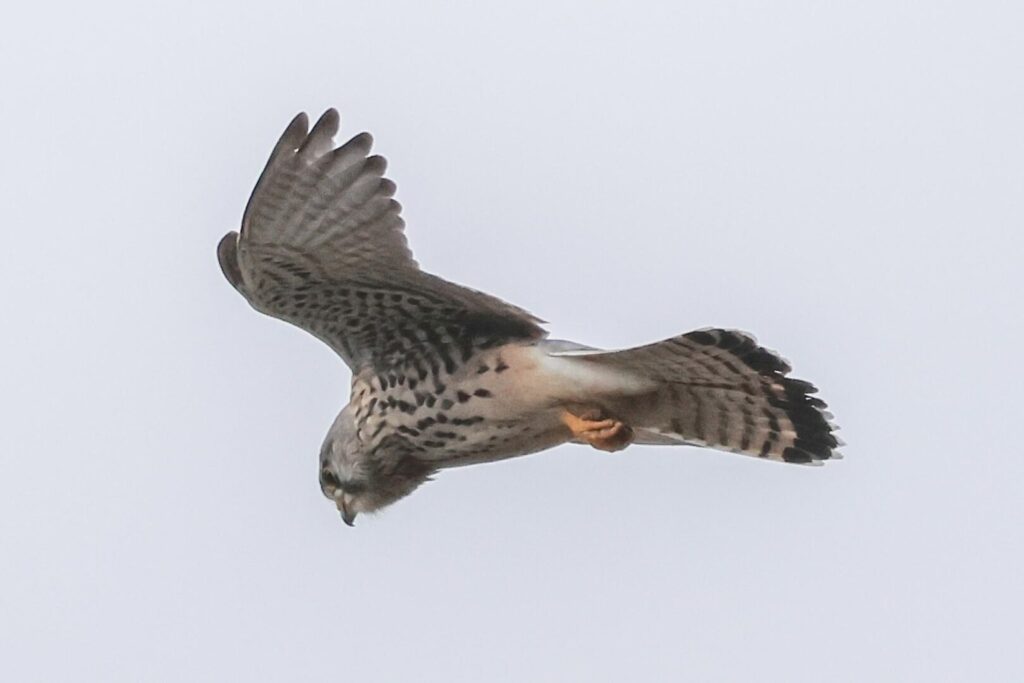
It was time for lunch now, so we cut across on the path through the wood towards the Visitor Centre. A Kestrel was hovering over the edge of the trees – amazing to watch how it still held its head so still, despite the blustery wind.
It was lovely sitting in the picnic area by the Visitor Centre for lunch. Out of the wind, it was warm in the sunshine. A House Sparrow and a Coal Tit came in to inspect the empty feeder. A Sand Martin flew over.
The Black-winged Kite had been reported again a couple of times while we had been at Hickling. We were driving back past where we had seen it earlier, so we stopped to see if we could get another look. Someone we knew was there but hadn’t seen any sign of it in the last half hour.
The wind had dropped a bit but we wondered whether it could still be out of view on the sheltered side of the bushes. So we drove round via the village and out along the road by the beach. We managed to find somewhere to park and walked up along the road to where we could see across to the marshes from the gate. There was the Black-winged Kite perched on a bush!
Everyone piled out of the minibus and we all walked up to the gate. It was rather distant from here too, so we set the scope up. In the sunshine, there was a lot of haze off the tilled field between us and the Black-winged Kite which meant it was a bit hazy. After a few minuets, a cloud went across in front of the sun and views improved a bit. Better than this morning anyway and nice to see it perched.

After disappearing for three weeks, we thought the Black-winged Kite was not going to put in an appearance this weekend. So we were pleased that we could get to see it after all.
Moving on, we drove a little further down the coast to Waxham. There has been an Iceland Gull along the coast here for several months, although it is very mobile. It hadn’t been reported at all today but we decided to have a quick look where it had last been seen yesterday morning.
As we walked down the track across the fields, a Yellowhammer was calling from the bushes on the verge. It was well hidden at first, but eventually came out where we could see it. A Common Whitethroat was calling from the brambles too.

Walking along the path through the dunes, there were lots of Linnets and a couple of Stonechats in the bushes. A few Swallows were on the move this afternoon and a couple of small groups flew north past us, hugging the coast.
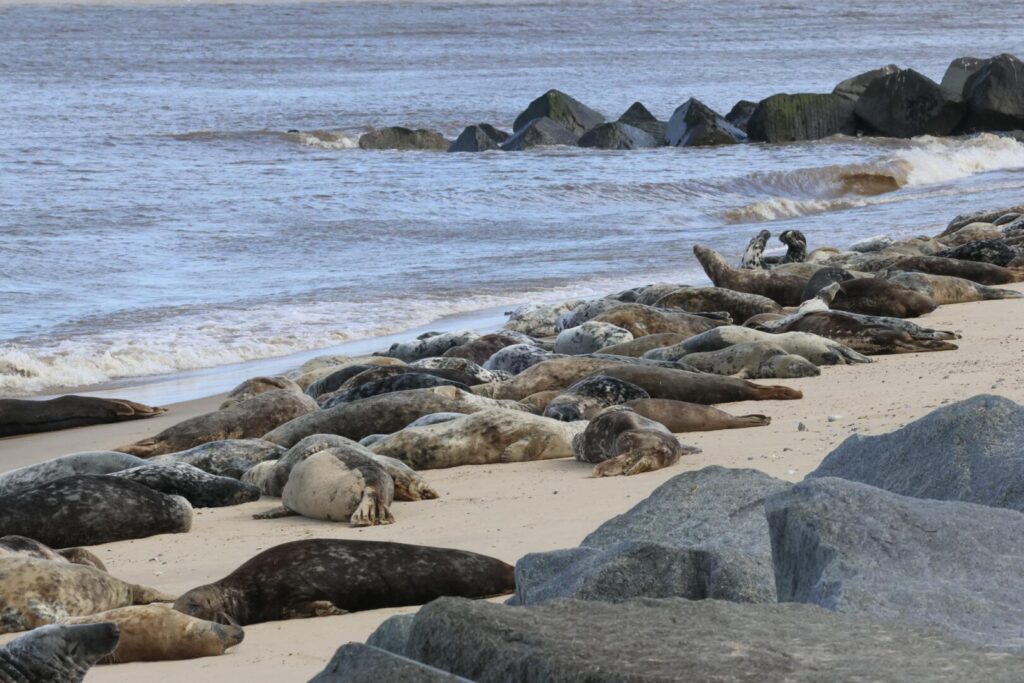
We walked up over the top and down the steps to the beach. The tide was in and lots of Grey Seals were hauled out on the beach just beyond the sea defences. They seemed largely unconcerned by us standing just a few metres away.
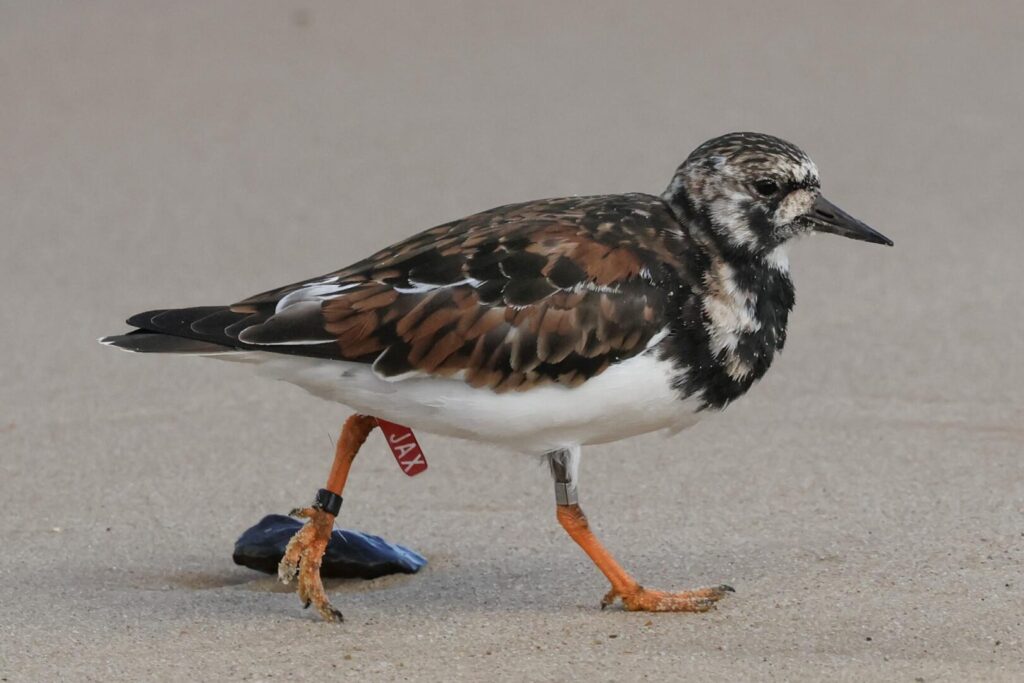
A couple of Turnstones were feeding on the sea defences and more were on the shore, around the seals. On close inspection, we could see that some were starting to moult into breeding plumage, getting some rusty feathers in their upperparts and whiter around the face. One was colour-ringed, with a coded red leg flag.
There were several gulls in amongst the seals too. Scanning through, all we could find were Herring Gulls. We had come down onto the beach just before groyne 21 and the Iceland Gull had been by 23 yesterday. There were more gulls further down, so while the group sat on the steps and admired the sight (and smell!) of all the seals, we walked on to check.
We couldn’t find anything different in with the seals further down, all the way to groyne 24. We didn’t have time, or the legs, to explore much more so we decided to make our way back.
Back up on the top of the dunes, we scanned the field in front of Waxham Sands holiday camp. We couldn’t see any sign of the Ring Ouzel which had apparently been here this morning but we did a Whimbrel feeding on the grass. The first we had seen this year and a nice last spring migrant to finish off the trip. Or so we thought.
It was about an hour’s drive back to Hindolveston. All pretty uneventful until we turned onto the minor road from Melton Constable down towards the village. As we came out of the trees, we looked to our left to see a raptor flying over the field straight towards us. As it turned, we could see it was an Osprey! We hit the brakes and it flew across the road right in front of us. We watched it disappear into the trees the other side, on the edge of Melton Park. What a fantastic last minute bonus!
As we drove into the village, a male Sparrowhawk flew out of one of the gardens in front of us. Back at the guest house, we said our goodbyes. Still time for tea and cake for anyone who wanted, before the journey home.
It had been a very enjoyable three days of spring migration, with a great selection of different spring migrants, summer visitors and even some lingering winter birds.