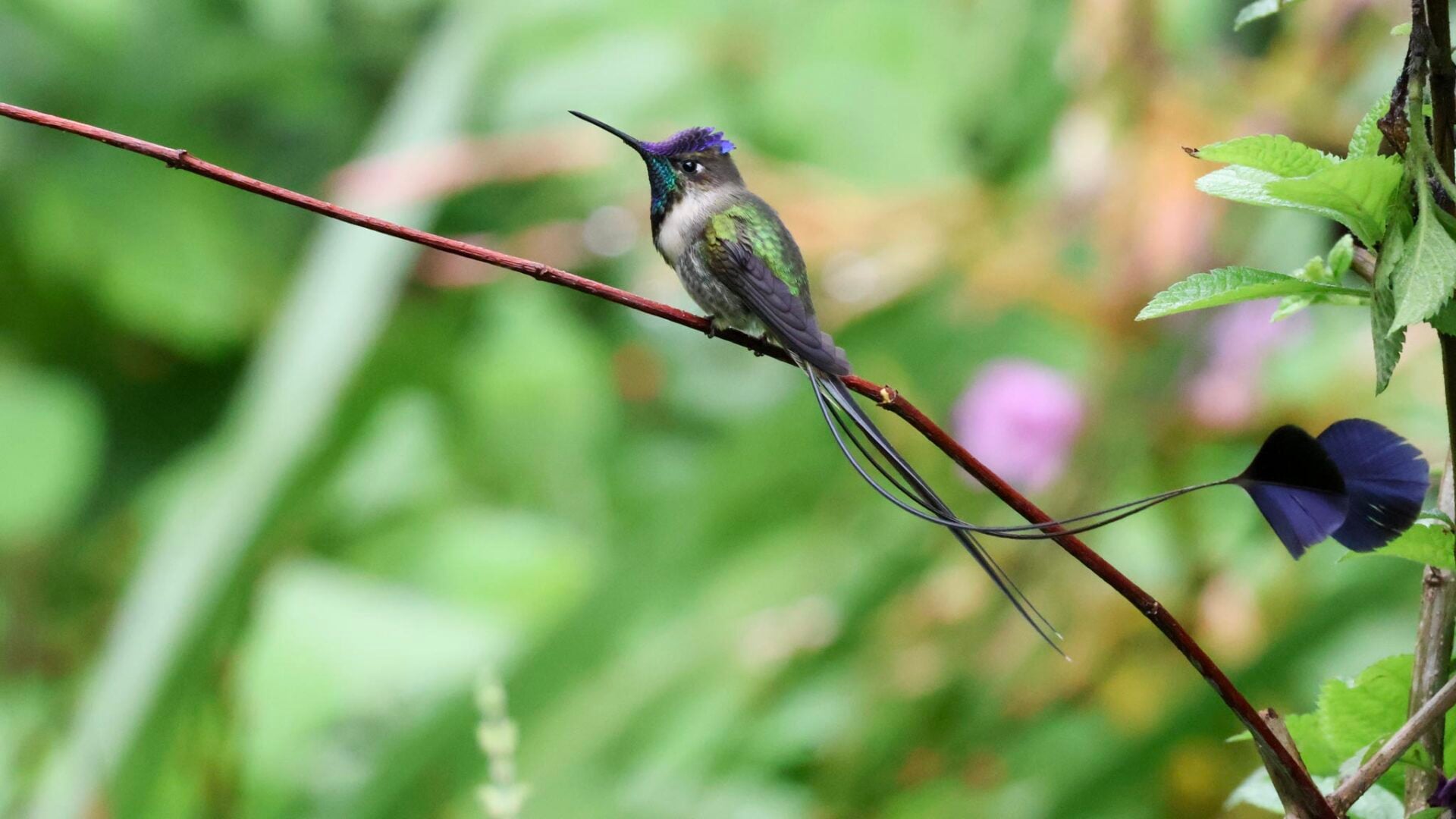
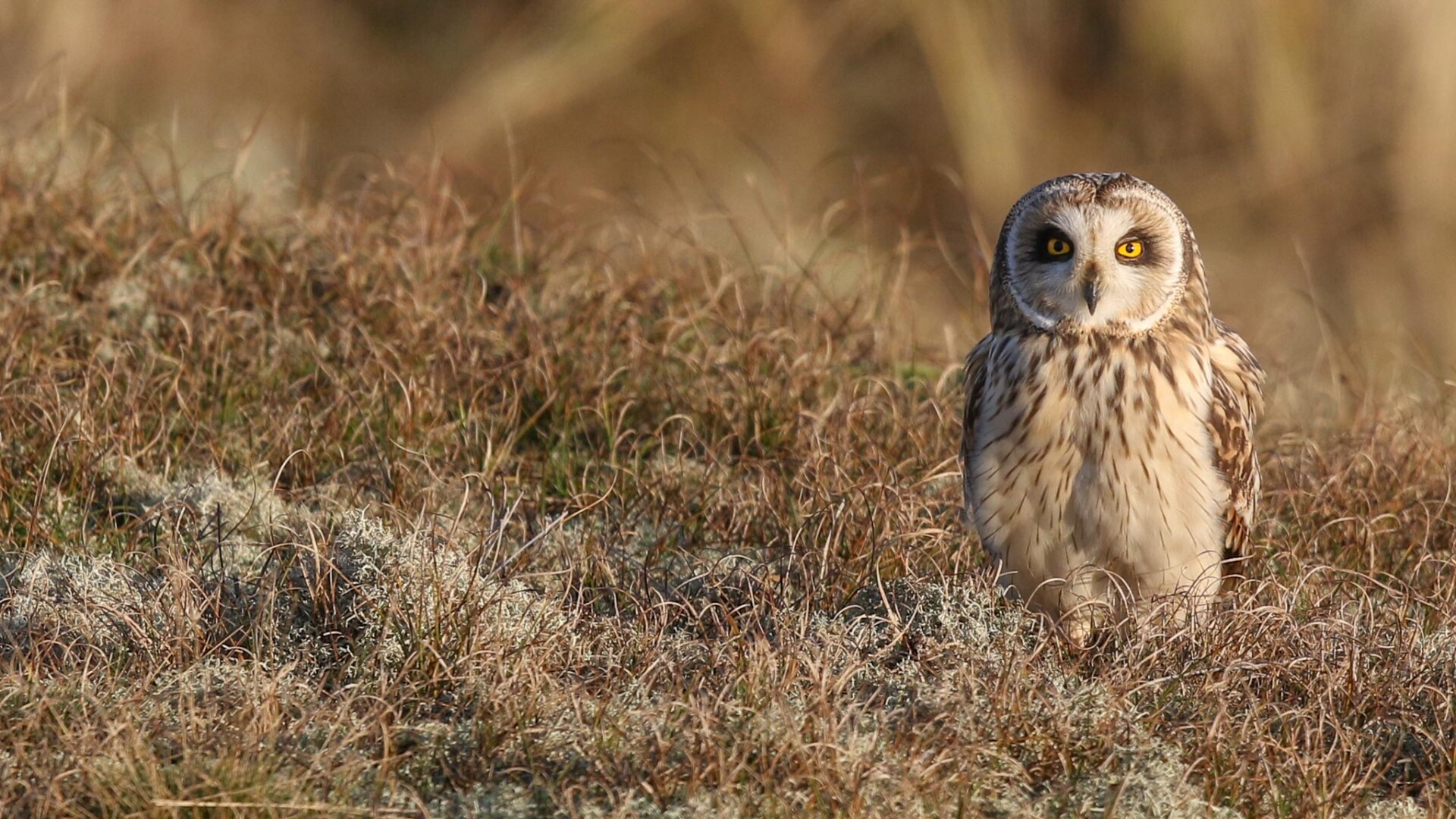
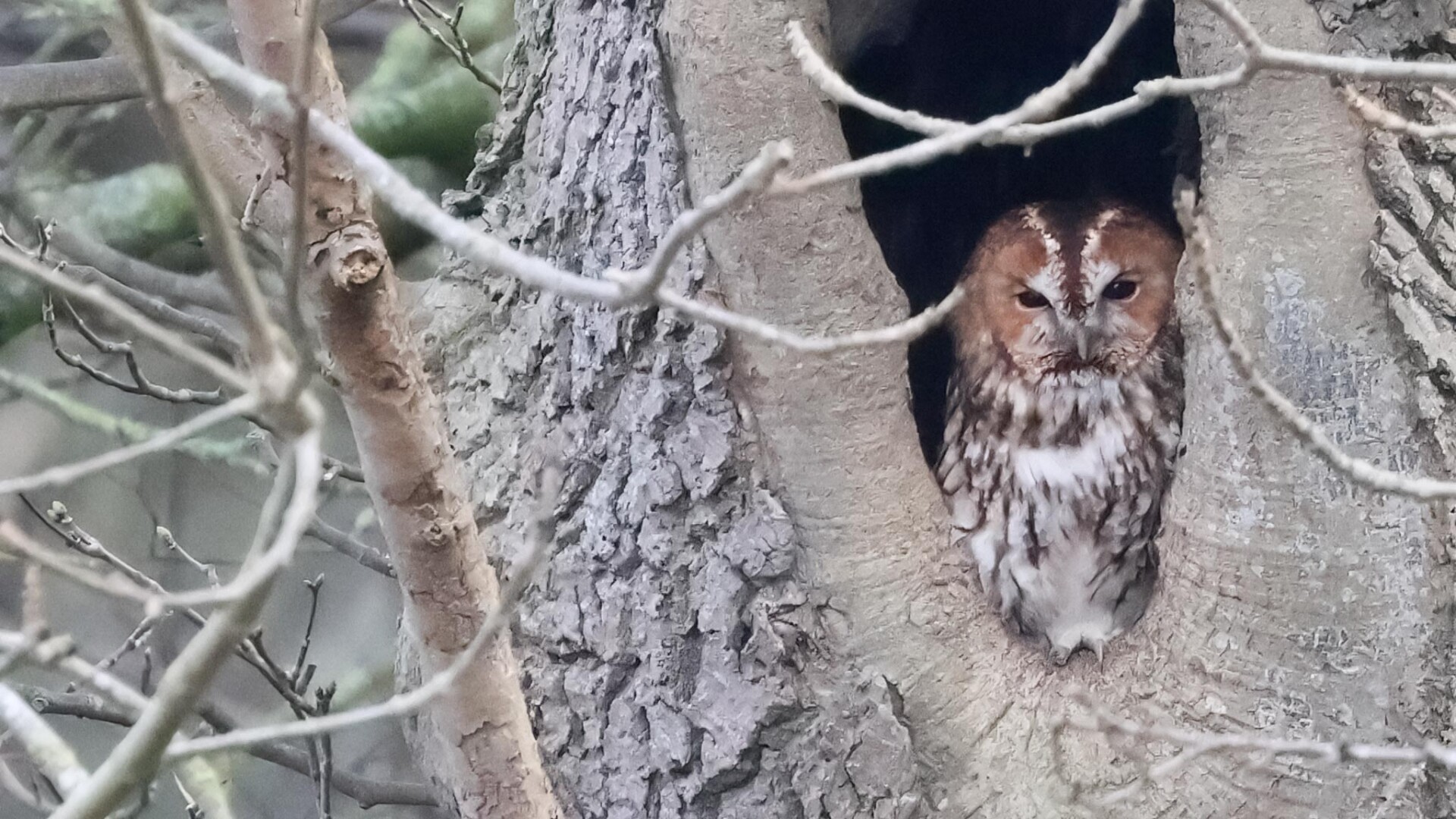
A week-long International Tour organised in conjunction with our friends at Oriole Birding. Our regular spring visit to Romania, to the Danube Delta and the neighbouring region of Dobrogea and the Black Sea Coast.
We plan to run this tour again in 2026, on 28th May to 4th June, so if you like what you read, please get in touch. You can see details of next year’s tour here.
Wednesday 28th May
Cloudy with patchy light rain at times, max 21C
With our Ryanair flight to Bucharest not due to leave Stansted until 6.30am, we had arranged to meet at 4.30am by the check in desks. Everyone was accounted for on time and those who had arrived earlier had already gone off to check in their bags. It was only when we went over to the machines to print our luggage labels that we were told the Ryanair bag conveyor belts were not working and we would have to join a separate queue to drop off our bags. With hundreds of people arriving for early morning flights that queue already snaked up and down the length of the terminal!
In typical style, all Ryanair staff retreated and there was no one to explain what was going on. When modern airports run smoothly, the experience is pretty seamless but when things go wrong they can do so spectacularly. It took well over an hour just to drop off our bags and then we still had to queue again to get through security. Despite all the problems there was no sign on the departures board of any Ryanair planes being delayed to allow the passengers time to board.
It was already 6am now, scheduled gate close time, so it was a bit of a rush to get over there. The gate was already closing and despite explaining to the gate staff that there were more passengers still coming, we were told we had to get on the bus now or it would leave without us. Once on the plane, we established that four of the group had not made it on board and they were stranded at the gate. It would take them more time to remove their bags than transfer them out to the plane, but the flight attendants on board explained there was nothing they could do and we were told “that’s Ryanair, they never hold flights”. Thanks, Ryanair!
Before we took off, with the help of Jane back in the office, we managed to establish there were more flights to Bucharest later in the day with seats available. We could get the others out to Romania later and we just needed to arrange ground transport for them the other end. The scheduled flight pushed back about 5 minutes late and eventually took off at 6.45am.
The flight itself was uneventful and we touched down in Bucharest on time at 11.30am local time. Remarkably, all our bags had somehow made it onto the plane and were waiting for us on the carousel already when we got to baggage reclaim. Florin, our local guide, was just finishing with another group so Irina, his wife, met us at the airport. It was confirmed the others were booked on the 4.00pm flight from Stanstead to Bucharest so Irina made arrangements to pick them up when they arrived.
After a break to use the facilities and get some breakfast, those who had managed to get on the scheduled flight boarded the minibus for the long drive to Tulcea. The weather had apparently been very wet recently and it had been raining heavily again this morning. It was still very damp outside and a few House Martins and Swallows were hawking low around the terminal building.
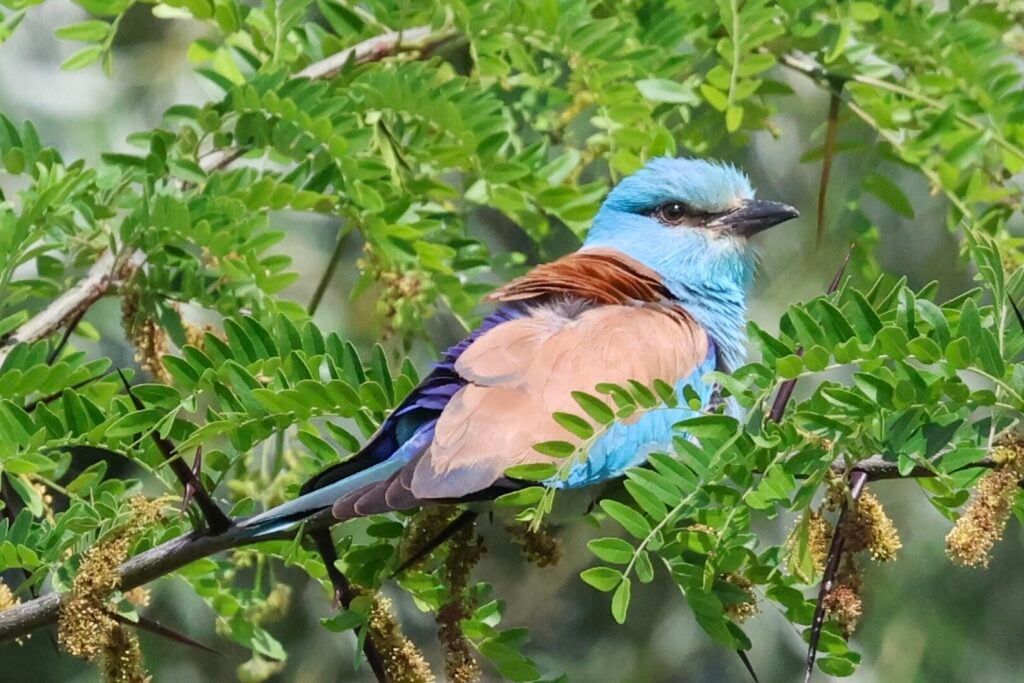
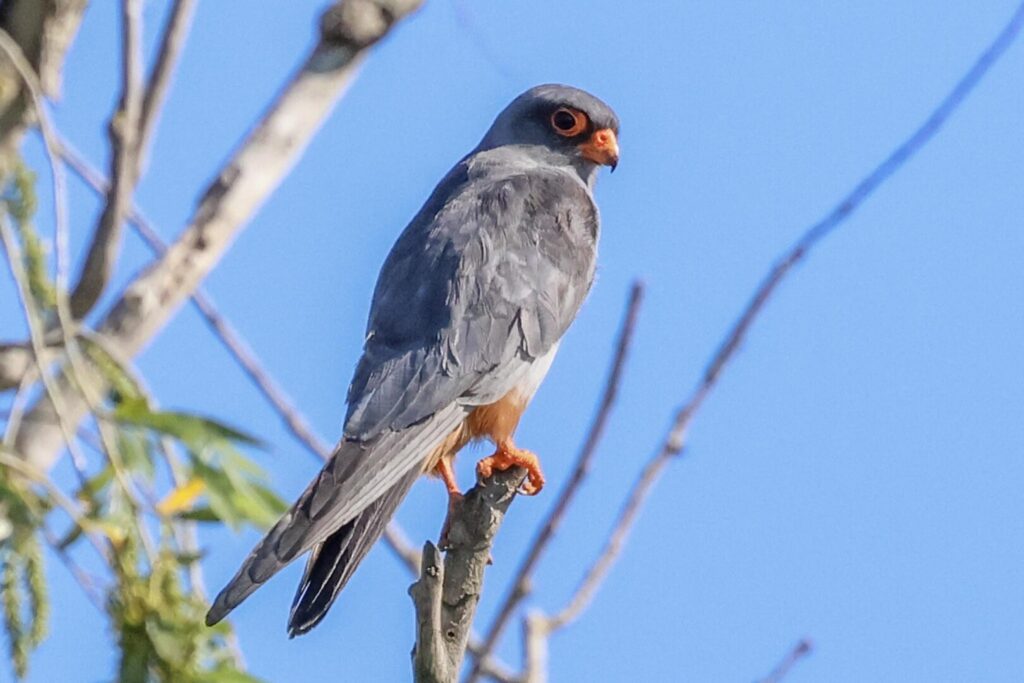
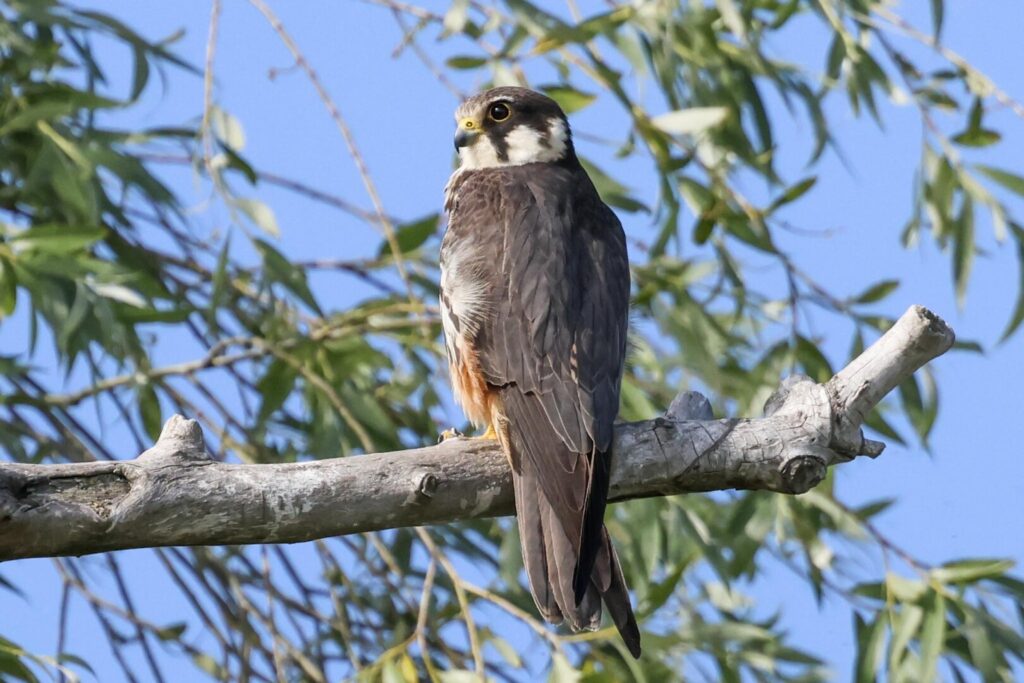
Once we got out of Bucharest, we started to see a few more birds. Jackdaws and Rooks, White Storks in the fields and on their nests, then further on our first Rollers and Red-footed Falcons on the wires and a couple of Bee-eaters flying over. Our driver had to slow to avoid a young Spur-thighed Tortoise which was crossing the road.
After a couple of hours, about half way, we had a short coffee break at a filling station and then pressed on towards Tulcea. The ricefields on the approach to the Danube have a lot of shallow standing water in them at the moment and we could see lots of Glossy Ibis and Black-winged Stilts, a few Whiskered Terns and one or two Great White Egrets as we passed. A Purple Heron flew over the reeds and a Pygmy Cormorant flew across a small lake.
We normally have a short birding stop at a lake on the way but we were not sure we would be able to use the track down to it today as everywhere was so wet. When we got there, it had stopped raining. We had made good time and the driver was happy it wasn’t too muddy to navigate so we pulled off the road. As we drove down the track the minibus was surrounded by dogs though, so we couldn’t get out and would have to content ourselves with scanning from the bus.

The water level is high this year and a large group of birds were gathered on the mud in front. There were at least a dozen White Pelicans, a large group of Great Cormorants along the shore behind and several Mute Swans. Four Whiskered Terns were loafing in front and three immature Caspian Gulls dropped in.
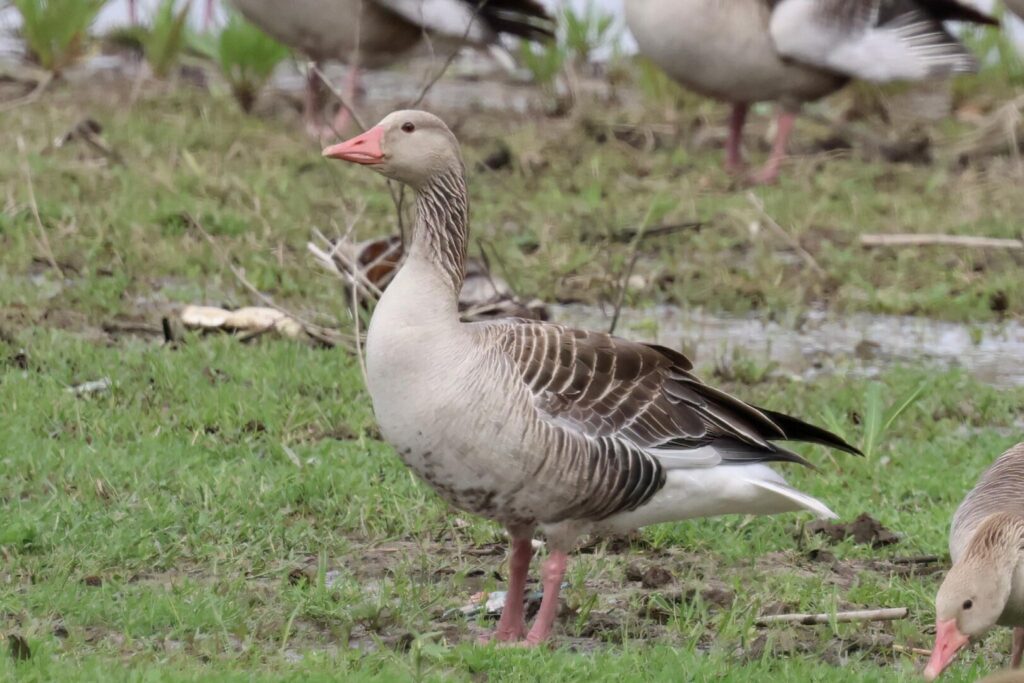
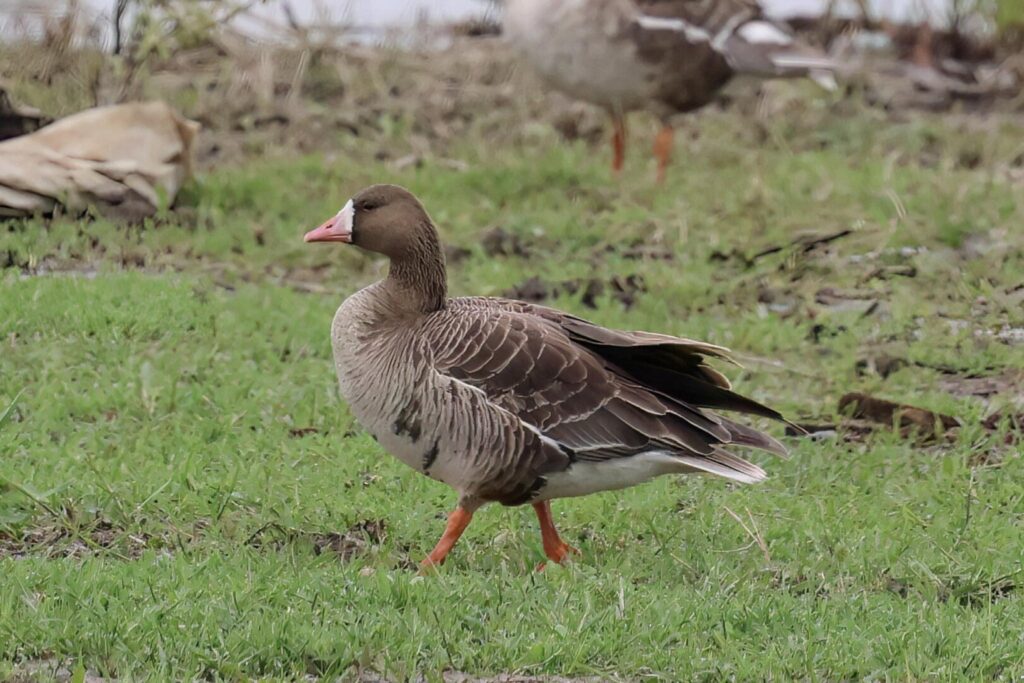
The Greylag Geese here are of the eastern race, rubirostris, and there were several pairs some of which had goslings. While we were admiring their pink bills, we noticed there were two White-fronted Geese with them, an adult and a juvenile. A common winter visitor, they should have left months ago and are very unusual here in late May.
The main target here is Ruddy Shelduck and the local pair were shepherding their three half-grown ducklings past through some of the geese. A small group of Common Pochard were diving in the emergent vegetation further out. We could see a few Great Crested Grebes scattered around the lake but then a single smaller Black-necked Grebe appeared in front of one of the islands of reeds too.

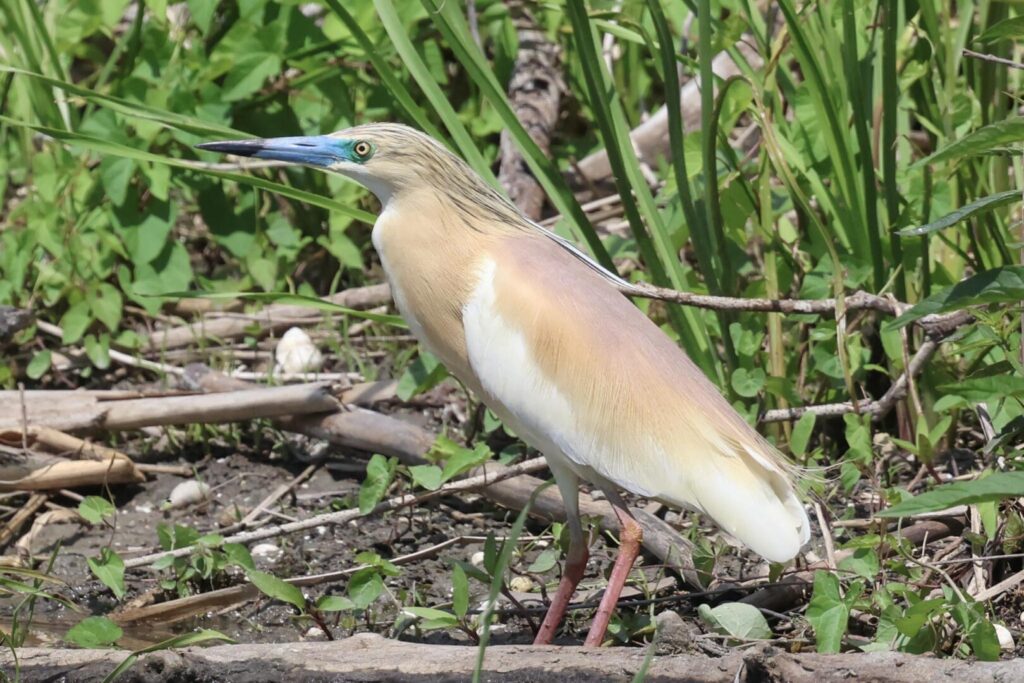
A Hoopoe was feeding on the grass out beyond the front of the minibus and a Roller landed in a small dead bush just behind. Two Squacco Herons were out on the mud over that way, one looking particularly smart in full breeding attire. Several Sand Martins were hawking round low over the lake and a couple of Bee-eaters flew through too. Three Purple Herons flew over and one member of the group spotted a Little Bittern briefly, flying between two of the islands of reeds, but unfortunately it disappeared in round the back out of view. A Pygmy Cormorant was lurking low in the reeds on the other side of the gap.
It had been a very productive half hour here but we needed to carry on towards Tulcea now, which was still over an hour away. There were several more very close Rollers by the road as we drove up over the low hills beyond. Then out through the open fields of the Dobrogea beyond, we added a couple of Western Marsh Harriers to the trip list.
It was just before 6pm when we finally arrived in Tulcea and Florin was waiting for us down at the port. We would be heading out into the Danube Delta first thing tomorrow. On board our floating hotel, we were met by Roxanna and Lili with local cherry schnapps and biscuits while Florin sorted out the room allocation. Then we had a short time to settle in before we met again for an early dinner. We never go hungry here and as usual we were treated to a delicious three course dinner on board – traditional Romanian soup, followed by grilled chicken and a homemade chocolate cake.
After dinner, Florin talked us through some of the practicalities of the flotel and then explained the plan for tomorrow. Afterwards, we were distracted by a freshly emerged Tisa Mayfly which appeared on the window of the dining room, still trying to shed its skin. The first of what would be many! There were several Whiskered Terns hawking round over the Danube, plus more Caspian Gulls and one or two Black-headed Gulls. Then we quickly ran through the day’s list.
Everyone was tired after a very long day, so we turned in for the night, just as news came through that the rest of the group had landed in Bucharest. They finally made it to the flotel in the early hours.
Thursday 29th May
Bright & sunny am, cloudy with showers pm, max 19C
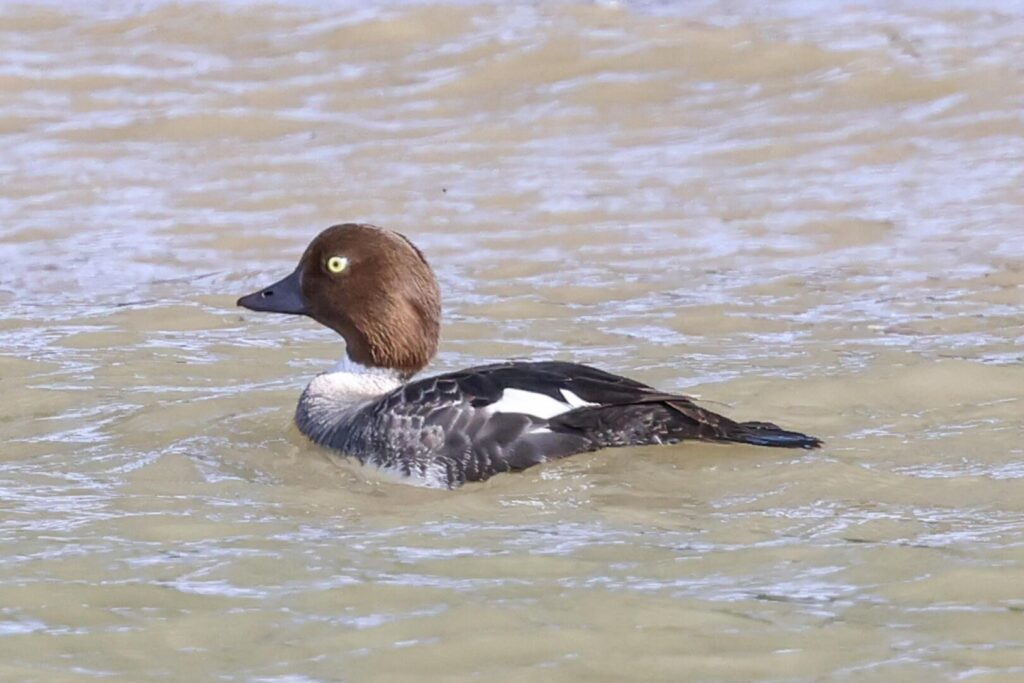
After breakfast on the flotel in the port, we climbed aboard the small boat and set off along the main branch of the Danube into the Delta. Goldeneye is a very scarce breeder at the very southern edge of its breeding range here but there are usually some along the river. We hadn’t gone far when we found a small group of six over by the far bank. Five flew up ahead of us but one stayed behind and allowed us a closer approach before it flew and landed further up. Florin picked up a small group of Bee-eaters flying north high overhead, possibly late migrants.
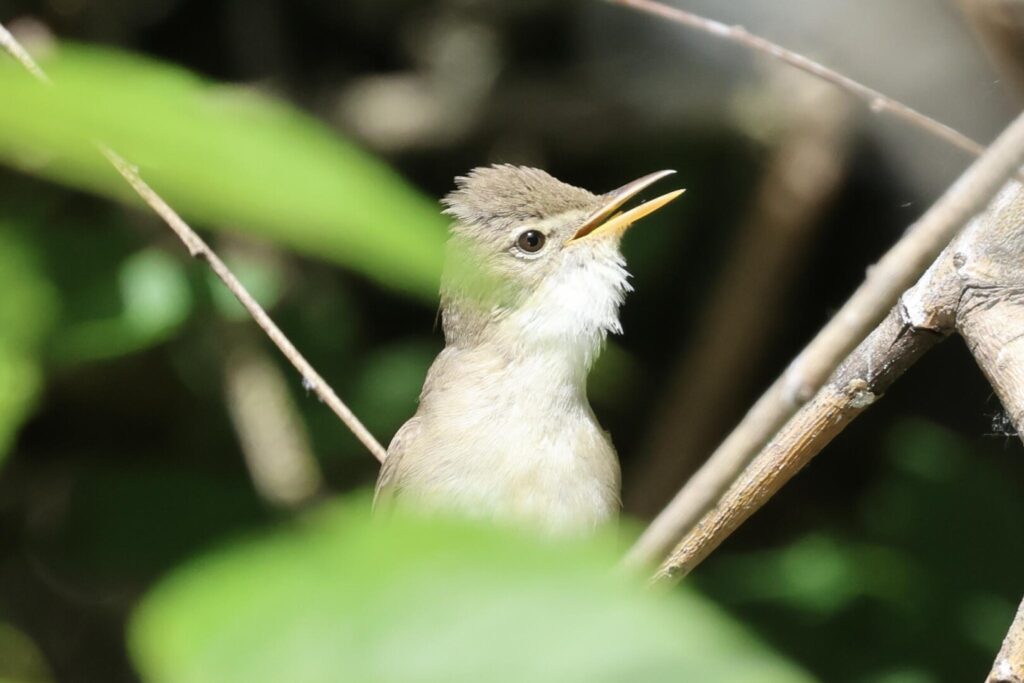
We turned onto the narrower side channel and Senea, the boat driver, cut the engine so we could drift for a while and listen. There were some very familiar birds singing in the willow lining the banks – Chaffinch, Blackcap, Blackbird, Chiffchaff and Great Tit. The Lesser Whitethroats sound a little different here and then we heard our first Eastern Olivaceous Warbler singing. Senea manoeuvred the boat in to the bank where we could watch the Eastern Olivaceous Warbler flitting around in the trees and low down in the false indigo bushes as it sang.
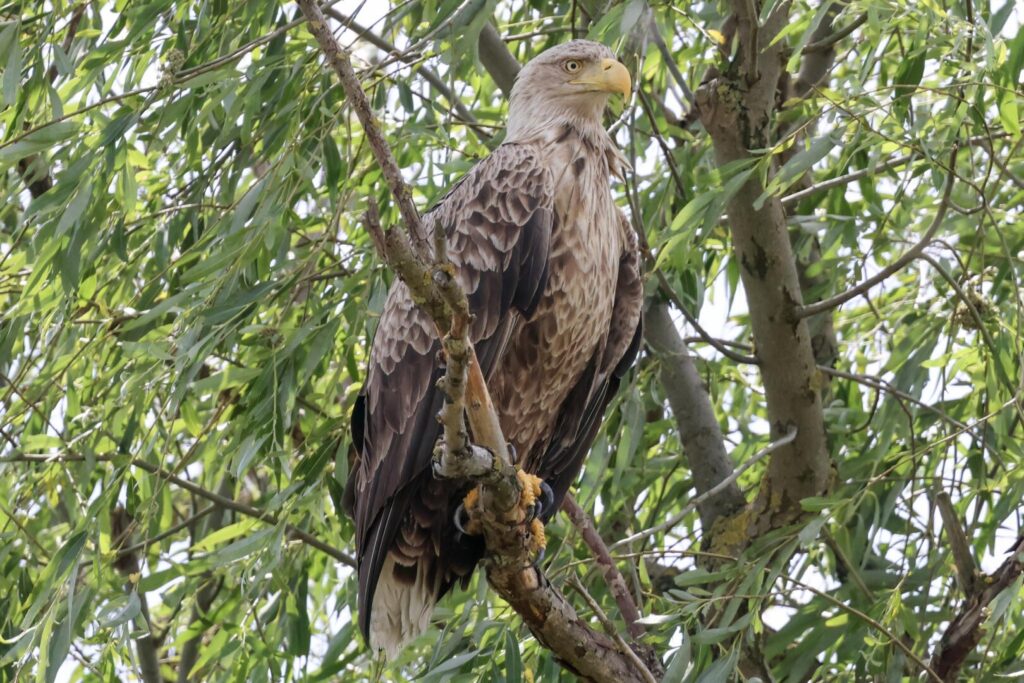
Moving on again, our first White-tailed Eagle of the trip (the first of many!) circled over high and we could see a couple of Hobbys way up in the sky beyond. Florin could hear the begging calls of Middle Spotted Woodpecker in the willows so we stopped and listened and had a brief flight view of one of the adults as it flew out overhead and across the channel. A Kingfisher flashed across the water ahead of us as we carried on.
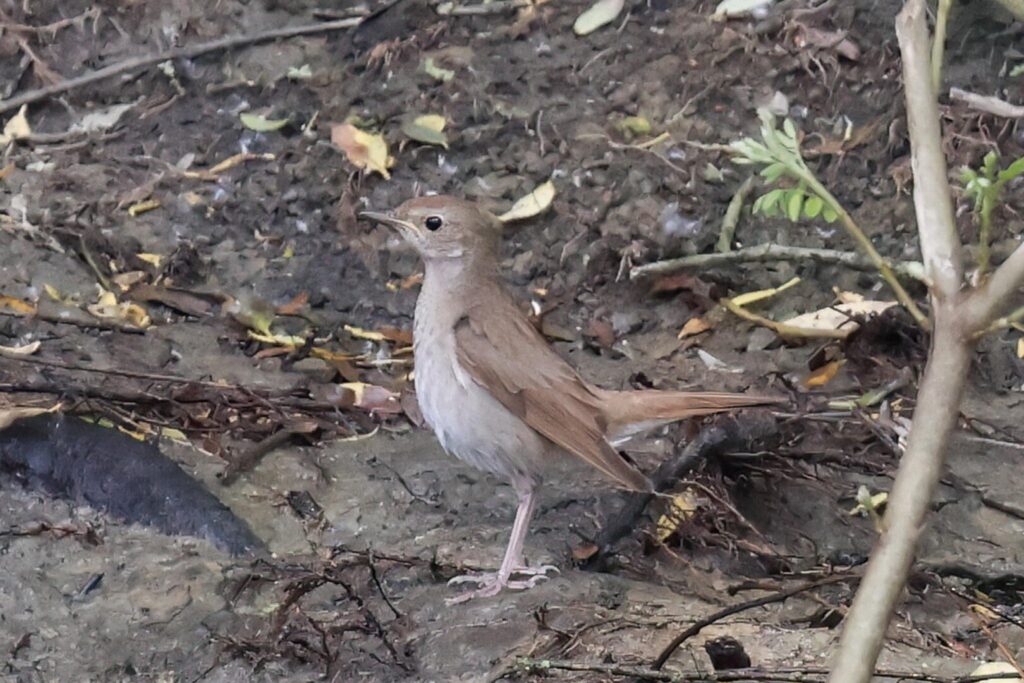
We normally hear a few Thrush Nightingales singing beside the channels here but they were rather quiet today. So it was a bit of a surprise when we saw some movement on the shore to see one hopping around on the ground. We turned back just as another boat came past throwing up a big wash which lapped right up the bottom of the bank. It seemed like the Thrush Nightingale had disappeared. But as we turned again, it reappeared back down on the bare ground just above the water and we had great views of it feeding between the tree roots.
At the next crossroads, we stopped to listen for Black Woodpecker. We did find something black, but it was a Black Stork circling up over the trees behind us. Instead, a Lesser Spotted Woodpecker called and then flew out of the trees right above us. Turning into a narrower-still tree-lined channel, there were lots more Kingfishers all along which called and flew in and out from the banks.
There were a few butterflies out in the sunshine, fluttering around the false indigo bushes, Painted Ladies and Red Admirals but also several Freyer’s Purple Emperors flying in and out of the willows. A couple of males came very close, right in front of the boat, flashing bright blue in their wings as they turned and caught the light. A pale morph Booted Eagle circled over high in the blue sky.
Out of the denser trees, it starts to become more open with areas of reeds between the willows. Here we heard our first Great Reed Warbler singing close to the channel. It was perched up nicely in the top of a dead reed stem, so Senea manoevred the boat again so we had a great view of it. From here on, we would hear them everywhere!

Continuing on, there were birds flying over constantly now, Glossy Ibis, Pygmy and Great Cormorants, Squacco Herons and Grey Herons. A stream of White Pelicans came up from the narrow channel ahead of us. They seemed to be dropping down over the reeds onto a small lake, so we turned in to look. Sure enough, we found a feeding frenzy, a hundred or more Pelicans with Great Cormorants in a tight group up along the edge of the reeds fishing. A crowd of 17 Great White Egrets were standing just beyond them, waiting for them to chase fish in their direction.

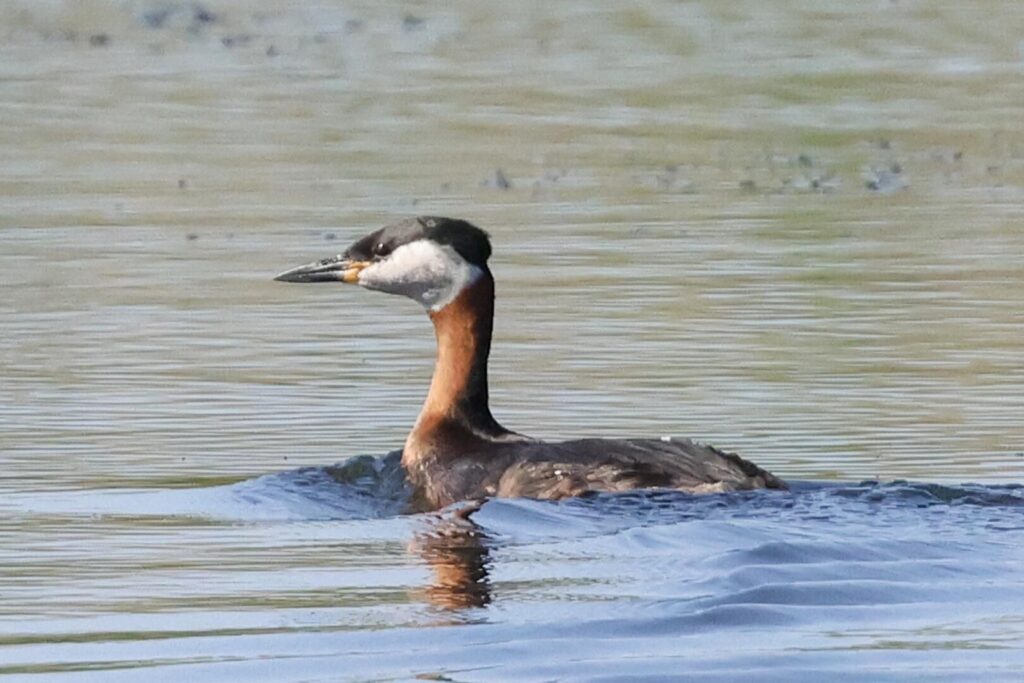
The shoal of fish moved and the birds all started to take off, streaming right past us low over the water and landing again on the other side of the lake. Quite a sight! When we could tear ourselves away from watching the Pelicans, there were at least seven Red-necked Grebes on the water here, as well as several Great Crested Grebes, and our first Pygmy Cormorants on the water. A colour-ringed Common Tern had apparently been ringed originally in Israel. Another White-tailed Eagle circled low over the boat.

Back out onto the channel, there were still more White Pelicans feeding out here, some which flew up ahead of us and others which were still busy feeding deep in some open reeds.
Further on, we came out onto another wider channel, with a more open grassy bank on the far side. A Roller flew across and landed on a small tree on the bank where we stopped briefly to watch it. Just beyond, a Glossy Ibis was feeding on the edge of the water looking very smart in the sunshine. A couple of Golden Orioles flew across the channel ahead of us and as we passed, one flew out and landed in the open briefly in one of the small trees on the bank. A Grass Snake swam across in front of the boat.
Turning off onto another smaller channel, a large kettle of White Pelicans was circling up into the sky ahead of us. A Common Redstart flew into the trees on the bank flashing its red tail. As it opened out into a long narrow lake, we could see large rafts of Coot on the water and more grebes on the edge of the reeds. Lots of Whiskered Terns were flying round out over the floating vegetation in the middle and we picked up a distant Black Tern in with them briefly.

Huge numbers of cormorants and herons nest in the trees in the reeds here, so about half way up the lake we motored over to the far side where there was a gap through which we could just see in to a small part. There were lots of Great Cormorants and Black-crowned Night Herons on their nests and a few Pygmy Cormorants and one or two Squacco Herons perched in the trees with them. One of the group looking out behind us found the Black Tern again, so we turned around and could see it feeding in with the Whiskereds, dipping down repeatedly to the surface of the water.

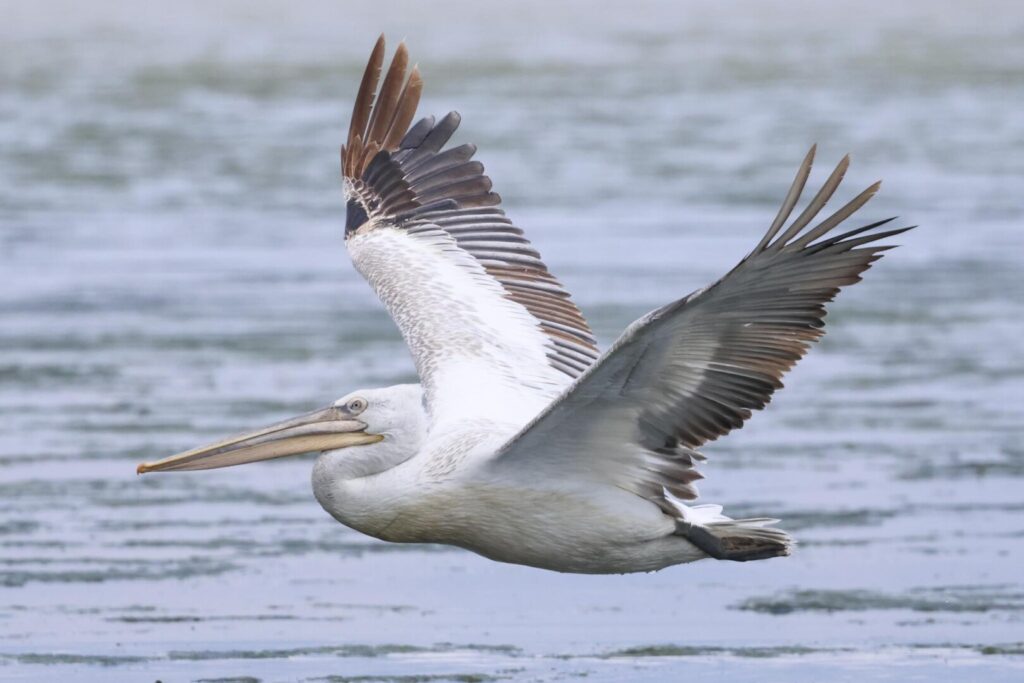
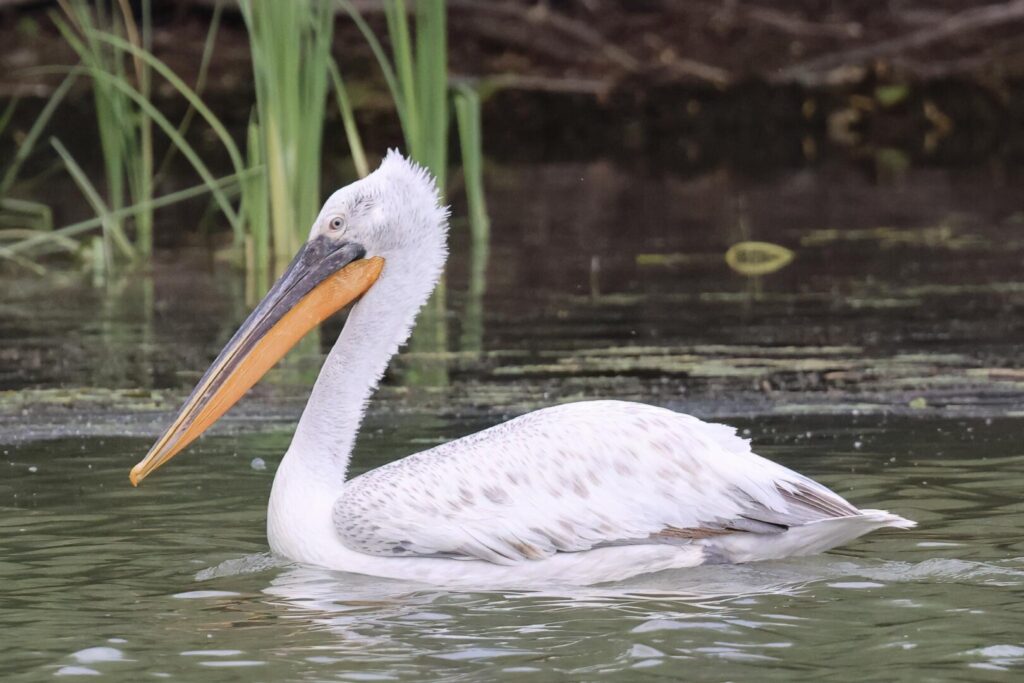
Motoring slowly on into the channels beyond, it was time for coffee and biscuits now. There were lots of Cuckoos calling and flying in and out of the willows along here, another bird which is still very common here. We had just finished our coffee, when our first Dalmatian Pelican of the trip flew over, typically on its own and not in a large flock like the White Pelicans.
At the same time, a White-tailed Eagle flew out of one of the trees on the bank right in front of us, pursued by a Hooded Crow. It landed further down, above the water, the Hooded Crow just above it. Senea cut the engine as we approached and we drifted right underneath it. Great views! We would see lots more White-tailed Eagles this morning, but we had been rather spoilt now.
A large group of Common Swifts swirled round high above us as we pressed on deeper into the Delta. Two Ferruginous Ducks flew over in front of us. A smart male Marsh Harrier was perched on a dead branch above the edge of the water and only took off just as we got up to it – one of the other benefits of birding from a boat.

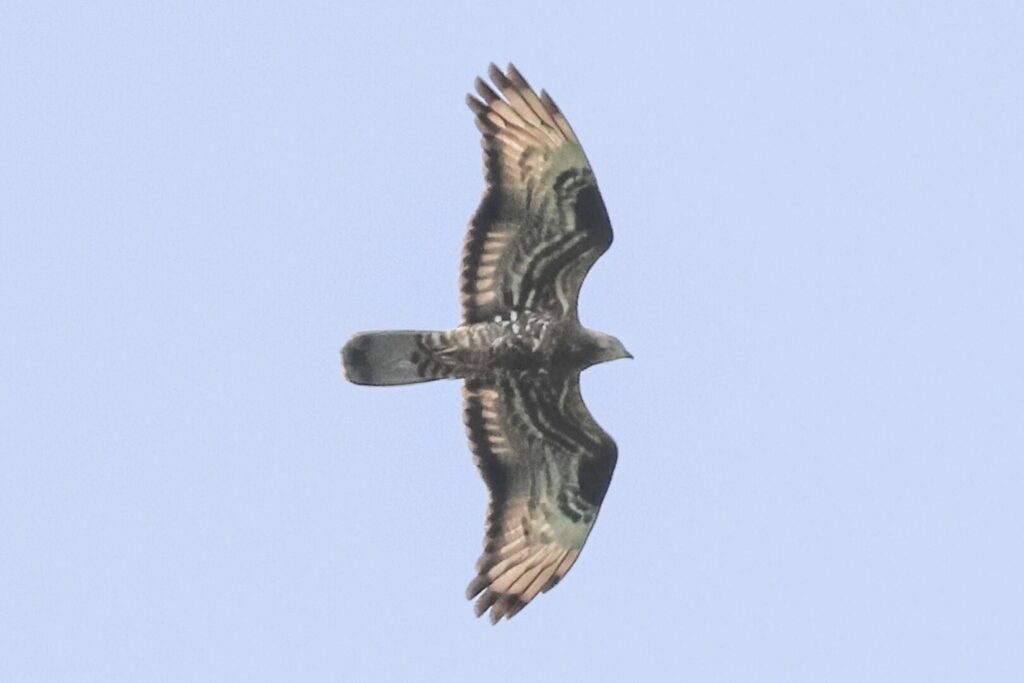
Turning into the entrance to another small lake on the edge of the channel, a pair of Ferruginous Ducks were on the water now along with a couple of Garganey. More Whiskered Terns were flying round and landing in amongst the water soldiers. Continuing on again, Florin picked up a Honey Buzzard soaring high overhead. They have apparently been very scarce here so far this year, probably due to the cold wet weather recently, but the improvement in the weather would probably stimulate them to move.
We came out onto the much larger, more open Lake Furtuna now. There were lots of Coot and groups of Mute Swans scattered liberally around. There were pelicans too and as we motored out into the middle, right ahead of us we had a Dalmatian with a single White Pelican side by side. A nice comparison of the two species, before they took as we approached.
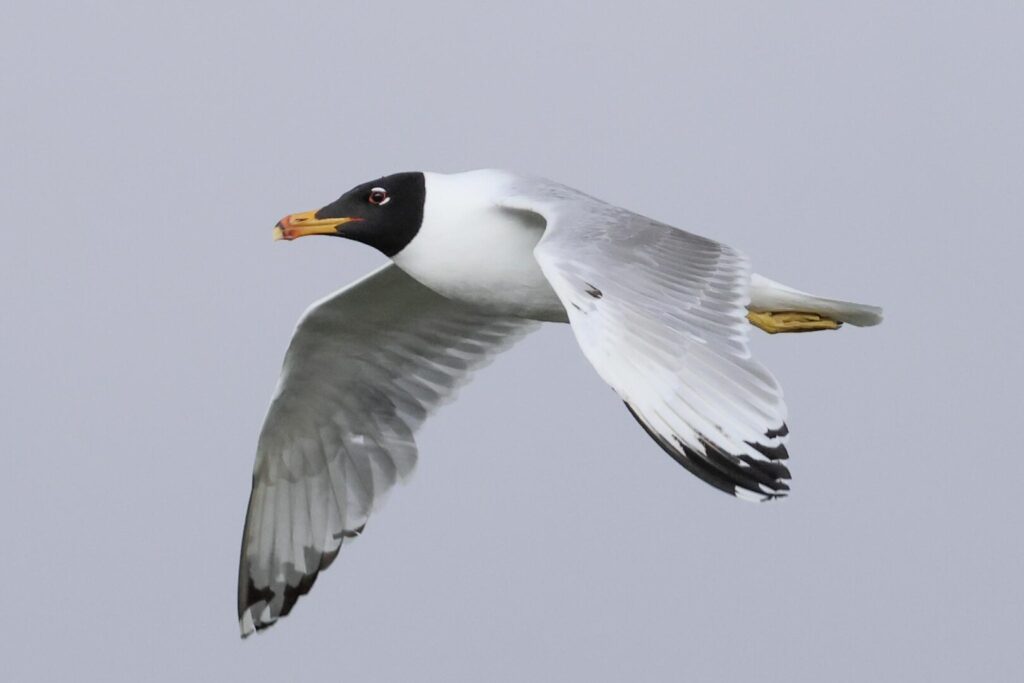
A distant pair of Black-necked Grebes were out on the water and two more Black Terns were flying round with the Whiskereds and even landed briefly with them on the blanket weed. One of our main targets was Pallas’s Gull and as we got over towards the far side, we found a stunning adult on the water so we stopped to look at it. Pallas’s Gull (or Great Black-headed Gull as it used to be known) has to be one of the smartest gulls around, particularly in full breeding plumage like this one. The prize for finding our first was an extra portion of polenta at dinner. Perhaps unsurprisingly, the prize wasn’t taken up!

Winding our way through the channels beyond, we found out first Moorhen of the trip on the edge of the reeds. A Stock Dove was perched in the top of a dead willow and a Reed Bunting flew across in front of the boat.
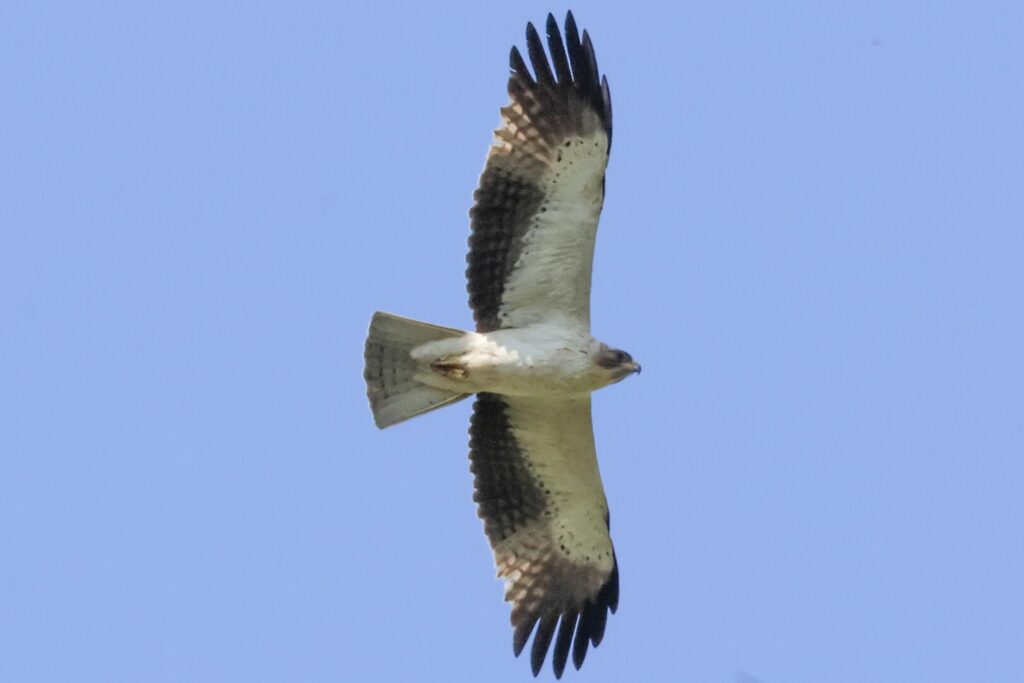
There were more raptors up now in the warm sunshine. A Lesser Spotted Eagle drifted high overhead, and as it stopped to circle it was joined by a smaller Booted Eagle. Another interesting looking eagle was unfortunately always going away from us and we couldn’t get anything on it. It caught up with a group of four more Honey Buzzards but sadly did not stop to circle with them. One that got away, but interesting to see the Honey Buzzards arrive in force.
As we got back towards civilisation, there is more firm ground and a sandy bank lining the edge of the channel. We could see Bee-eater holes and a pair flew in and out of the trees ahead of us. Several Sand Martins were flying round the bank too. Just beyond, we came out onto the main Sulina channel of the Danube. Right on time, the floating hotel was just arriving, towed by the tug direct from Tulcea to meet us here. We tied up alongside and boarded the flotel.
There was just time to freshen up before a late lunch was waiting for us in the dining room, soup followed by stuffed vine leaves and then fruit salad. All enjoyed while watching the world go by from the windows as the flotel was towed on. After lunch, scanning from the deck of the flotel, we picked up a Red-footed Falcon hovering over the fields beyond the bank and a couple of Goldfinches which flew over. We turned off onto the Crisan channel and after motoring on for a while we boarded the small boat and separated off.
As the tug and flotel continued on, we turned into a narrower side channel. Just a short distance along here, we stopped at the entrance to a small lake. There were Whiskered Terns nesting on the lilypads, five Garganey and a couple of Ferruginous Ducks on here. A Pallas’s Gull flew across in front of us, circled round behind and flew up the channel the way we had just come.
It had been threatening for a while and now it started to rain. Thankfully, we were mostly under cover. For a while, it rained quite steadily as we motored further down along the channel but it wasn’t too long before it stopped again. Cutting in through a series of lakes, the willows here were looking rather bare. Pulling in to the bank, we could see why. The trees were covered in Gypsy Moth caterpillars, which were in the process of devouring every available leaf.

Continuing on, several Purple Herons flew up out of the reeds along the edges of the channels and more Pallas’s Gulls flew past. When we heard a Penduline Tit calling, Senea stopped the engine and we saw it come up onto the top of the reeds. We stopped again to look at a Lesser Whitethroat which was singing in the willows, easier to see here with no leaves on the trees. The song is noticeably different to those in UK, must faster and more hurried.

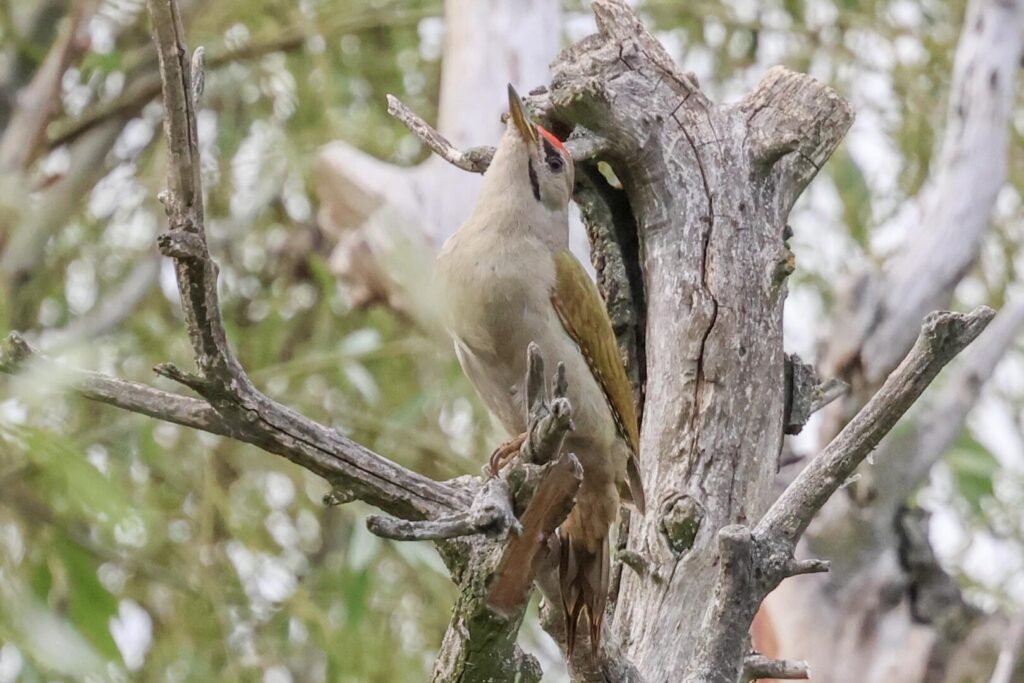
Heading back along the channel the way we had come, a Grey-headed Woodpecker called from the trees ahead of us. When we got to where the sound had come from, we could see two flying off through the willows. Thankfully one landed, and when it was pushed off its perch by the second that Grey-headed Woodpecker took its place and perched there looking down at us. We could hear Golden Orioles fluting, and a couple flew across ahead of us. What was presumably the same Pallas’s Gull we had seen earlier was still patrolling up and down over the water. Almost back to main Crisan channel, a pair of Gadwall were on the water along one bank.
From the main channel, we turned off onto another side channel lined with dense willows. More Golden Orioles were fluting in the trees ahead of us – one flew out and circled round, flying back into the trees further on. We could still hear it calling deeper in as we passed. Lots of Night Herons flew out of the trees ahead of us and a Hoopoe flew up from the bank below and into the willows, where we could just see it in the leaves.
At the far end, we just pulled in to the start of Lake Iacob. Several White Pelicans were loafing on a dead tree trunk lying in the middle of the water, preening. One stood out, with bright orange facial skin, in breeding condition. Another very pink one was further back on another log with several Dalmatian Pelicans. There were lots of ducks, mostly Mallard but a few more Gadwall. Several Ferruginous Ducks were gathered away to our right. Further back, we could see yet more Pallas’s Gulls scattered on the water and scanning across we counted at least 27 in one sweep!
Back out onto Crisan channel, the floating hotel was waiting for us, moored against the bank a short distance further up. After a break to freshen up, dinner was served in the dining room – salad, followed by battered fish, and then pancakes. There was still quite a bit of cloud so it we could not see the sunset but it was still a great backdrop, looking across the channel and out over the marshes beyond, birds passing by outside while we ate. Quite a place to spend the night.
Friday 30th May
Mostly bright & sunny, patchy cloud thicker at times, cool in strong breeze, max 21C
We woke up to pelicans swimming past, up and down the channel outside the window, mostly White Pelicans but with one or two Dalmatian Pelicans too. A Marsh Harrier patrolled up and down over the reeds opposite. From out on the deck, we could hear Cuckoos and Golden Orioles. A Garden Warbler was singing in the trees right next to where we had tied up and a couple of Tree Sparrows were chattering.
After breakfast, we set off on the small boat again. One of the Pallas’s Gulls was still patrolling up and down the main channel. As we motored down, we could hear Penduline Tits calling but it was very windy today and we couldn’t see anything in the trees. A pair of Ferruginous Ducks flew up from the side of the channel and round behind us, a Yellow Wagtail flew over calling and a White Stork was walking along the bank.
Turning onto a smaller channel, we stopped first to look at a Penduline Tit nest in a willow. An amazing construction, hanging from the end a thin branch, one of the adults emerged but flew straight up into the leaves out of view. Just beyond, Senea steered the boat into the bank and we disembarked down the gangplank. Climbing up onto the top of the bank, we could really notice the breeze and we thought we might not find so many butterflies and dragonflies along here today. An Eastern Olivaceous Warbler and a couple of Lesser Whitethroats were singing from the flowering Russian Olive trees on the bank.
As we walked along, we started to put up various insects from the grass, particularly in the lee of the bank and the shelter of the trees. Butterflies included Painted Lady, Red Admiral, Small Heath and Common Blue, but the star of the show were several Large Coppers.

We found a couple of White-tailed Skimmers and several female and immature male Scarlet Dragonflies, plus lots of Blue-tailed and a single Variable Damselfly.

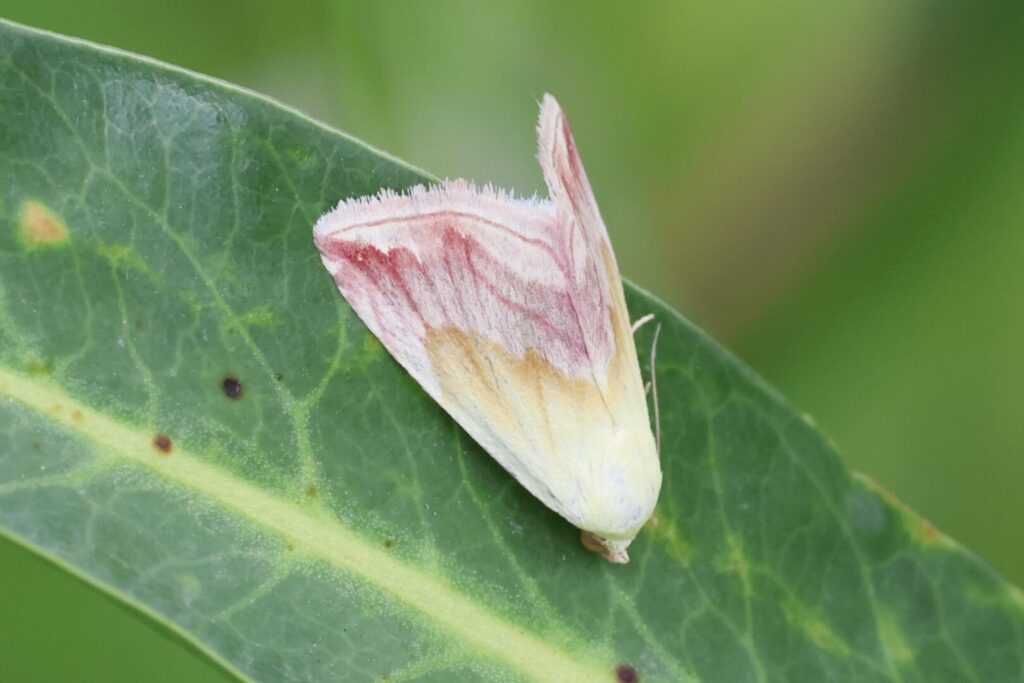
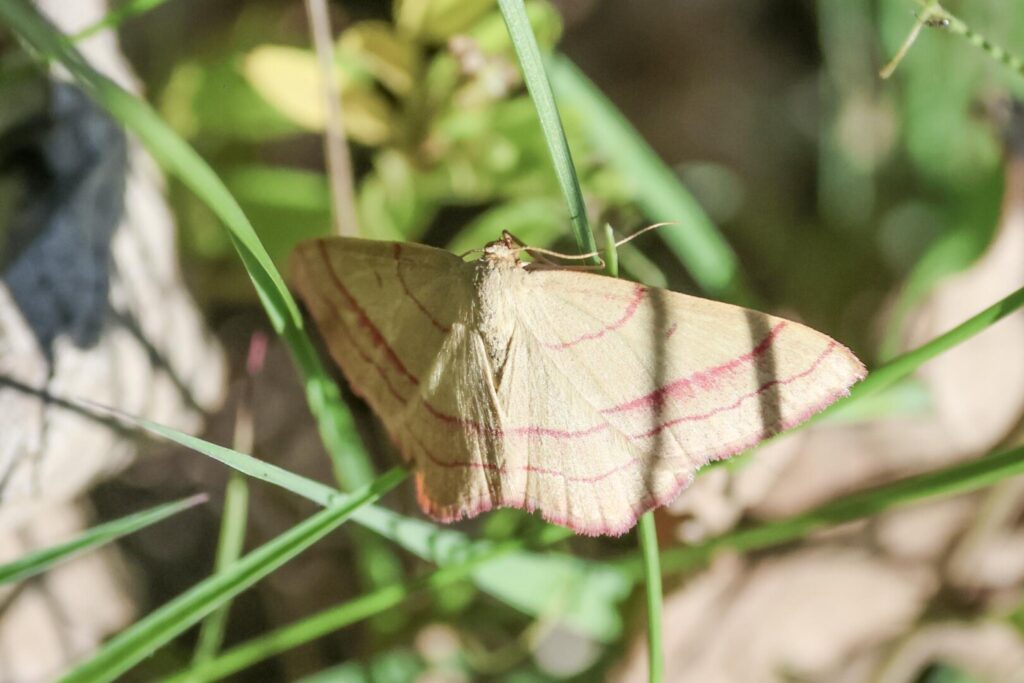
There were a few interesting moths too – including Beautiful Marbled and Spotted Clover.
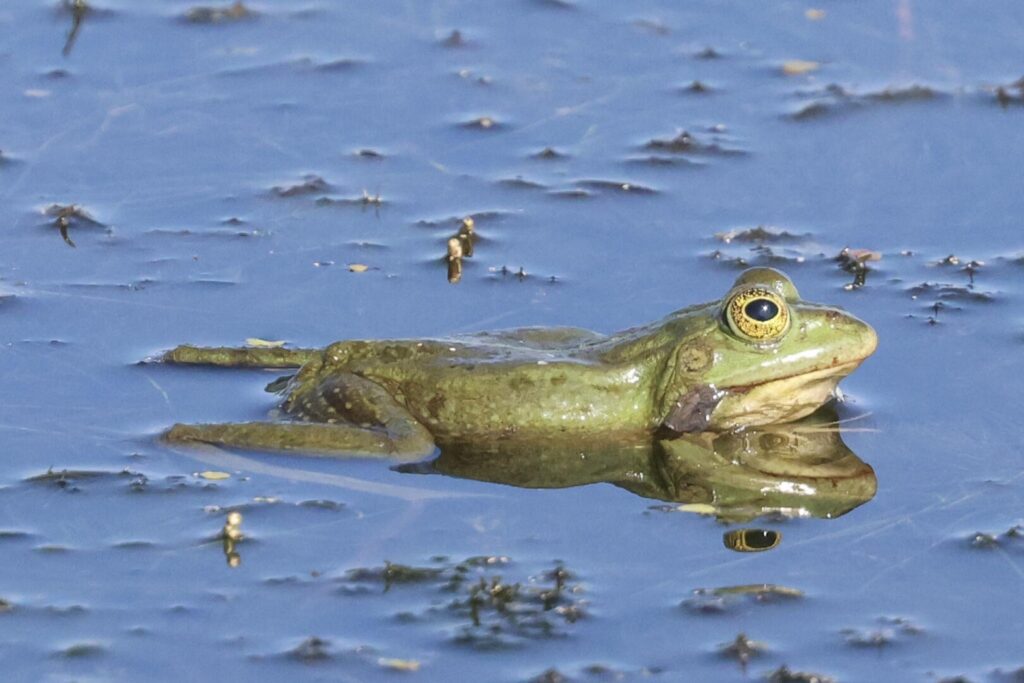
After a bit of searching, Florin found an Oriental Tree Frog resting on a sedge leaf.

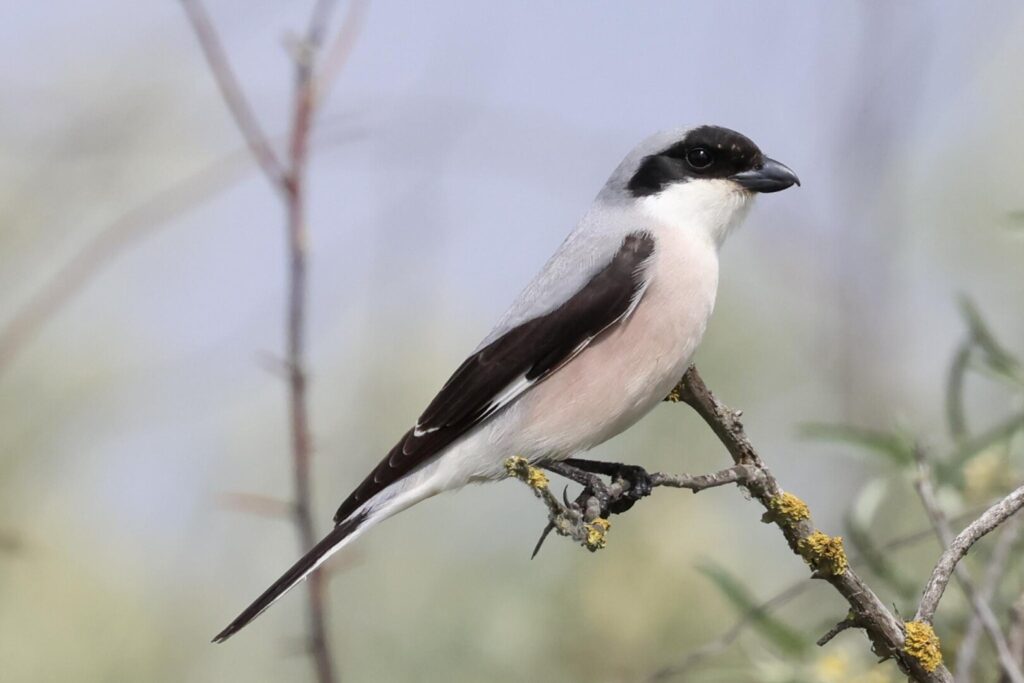
Slowly making our way further down, we found a stunning Lesser Grey Shrike feeding from one of the trees, dropping down to the bank to catch insects. We had a good look through the scopes and then, unusually for a shrike, it wasn’t nervous and let us approach quite close before it flew round behind us.
There were lots of Whiskered Terns flying round over the old fishponds the other side of the bank. Scanning the areas of open water in between the reeds, we found a good number of Ferruginous Ducks, several Red-necked Grebes and a single Little Grebe. Two Spoonbills were tucked up against the edge of the reeds, out of the wind, with a Great White Egret. They were doing what Spoonbills like to do best at first, sleeping, but they did wake up and have a preen.
Further up, we found the boat waiting for us. Back on board, we motored on further along the narrow channel, with tall reeds encroaching on either side. Great Reed Warblers were singing from either side and a couple flew across in front of us. We had a brief glimpse of a Little Bittern disappearing into the reeds on one side further ahead, but by the time we got there we couldn’t find any sign of it.
We made a short diversion down to check a large lake further down. Out in the open, the wind was catching the water. We could see hundreds of White Pelicans in the distance, over by the reeds on the far side off to the left, and more waves dropping in to join them, a feeding frenzy. Away to the right, there were at least a couple of hundred Ferruginous Ducks in the water weed.
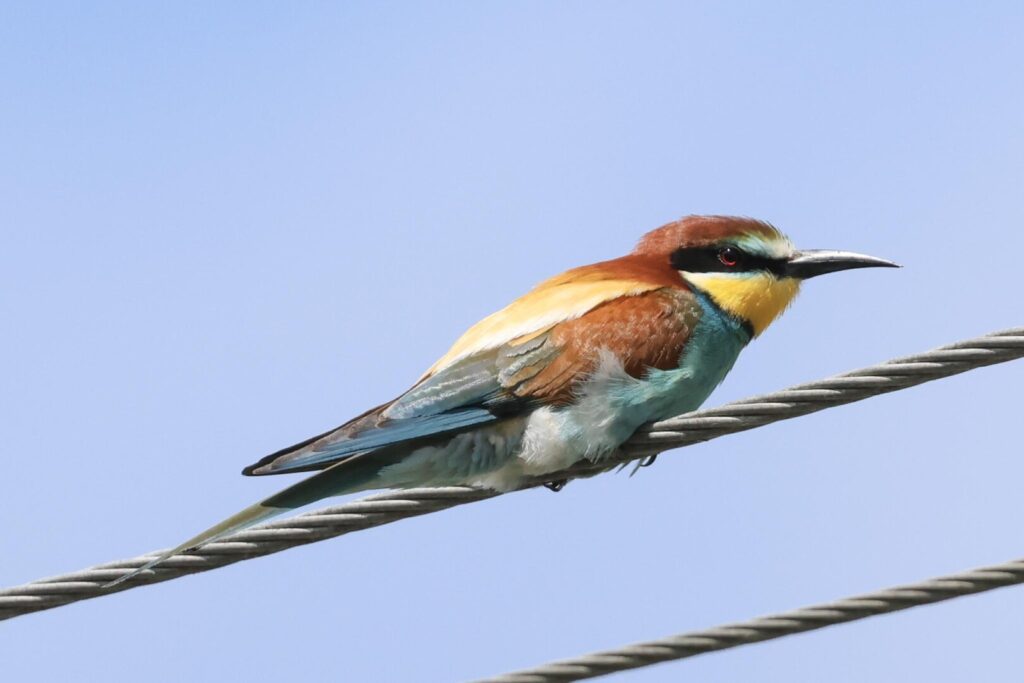
Turning around, we made our way back out, slowly winding our way back towards the main Crisan channel. Where a new channel had been cut through the sandy bank on one side, several Sand Martins were in and out of their holes, one still doing some excavating. A Bee-eater was perched on the wires above as we sailed right underneath. The wider channel beyond was lined with lilypads and a male Western Yellow Wagtail, of the Romanian form ‘dombrowskii’ was running around on them catching insects as we passed.
As we joined the main Crisan channel again, a Moorhen was on the water ahead of us. We turned south, and headed further down, down to the village of Caraorman where we pulled up at the jetty. The view is dominated by the remains of the old Soviet-era glass factory, which was never even finished and now lies in ruins. As we docked, we could see several Red-footed Falcons on the wires over the open grassy area before the village, so we walked over to look at those first.

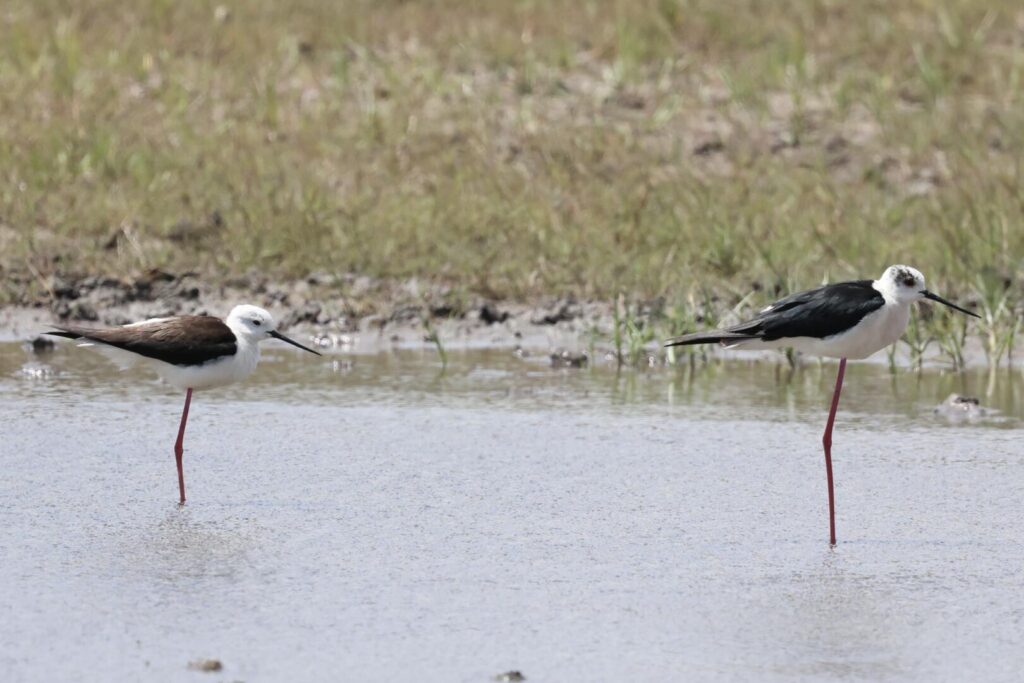
We counted at least 16 Red-footed Falcons along the whole length of the wires, but we stopped closer to the first two or three. Great views of both male and female through the scopes. Occasionally one would drop down to the ground or fly out and start hovering. There were a few Lapwings and Black-winged Stilts on the pools here and a distant pair of Avocets. A pair of Common Shelduck dropped in and a single female Northern Wheatear was flitting up and down from a pile of scrap metal further back.
After watching the Red-footed Falcons for a while, we turned round and walked through the factory ruins. There were several more Wheatears here, perching on the old buildings and the piles of fallen concrete.

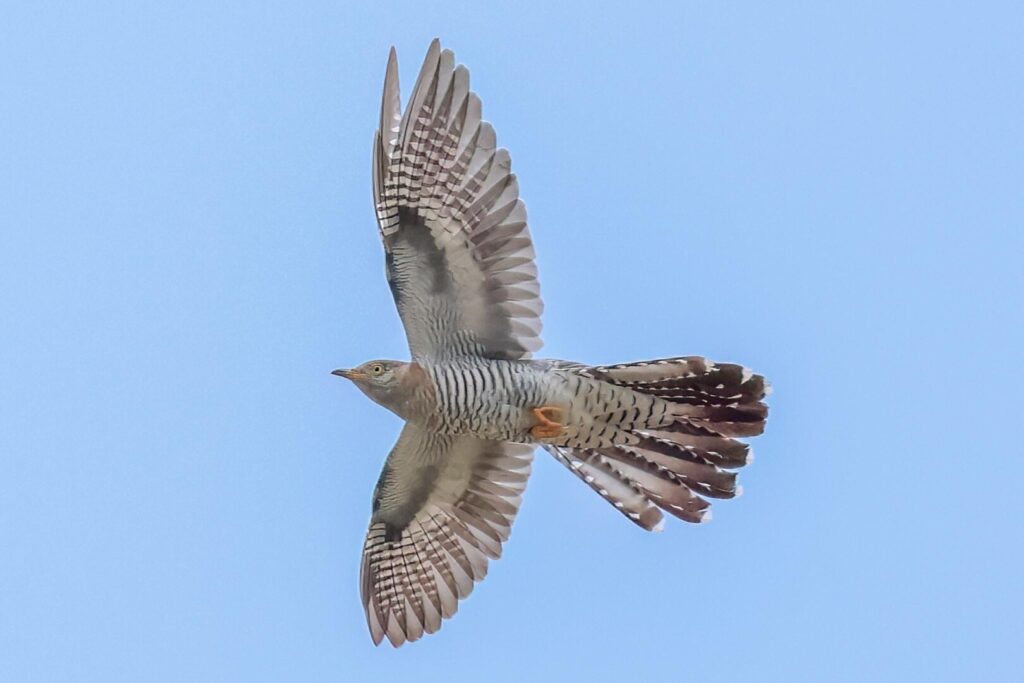
Two Cuckoos were perched on the wires side by side and flew up together, chasing each other round. Several Kestrels and a pair of Rollers were on the ruined accommodation blocks nearby.
Out into the open grass beyond, there were more Stilts and Lapwings on the pools.
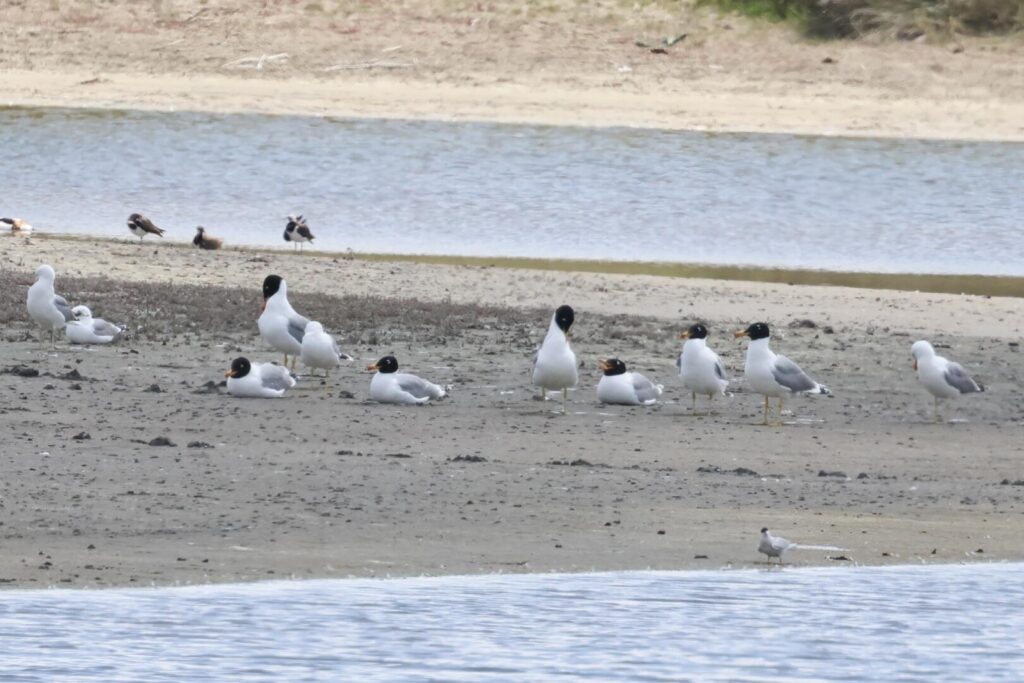
Up onto the bank, we could see a small group of Pallas’s, Caspian and Black-headed Gulls loafing on the sand. There were several pairs of Common Terns but no sign of the hoped-for Caspian Tern here today. We couldn’t see many waders either, although there were several more Avocets on the large pool below and we did find a single Green Sandpiper hiding in the flooded grass at the back.
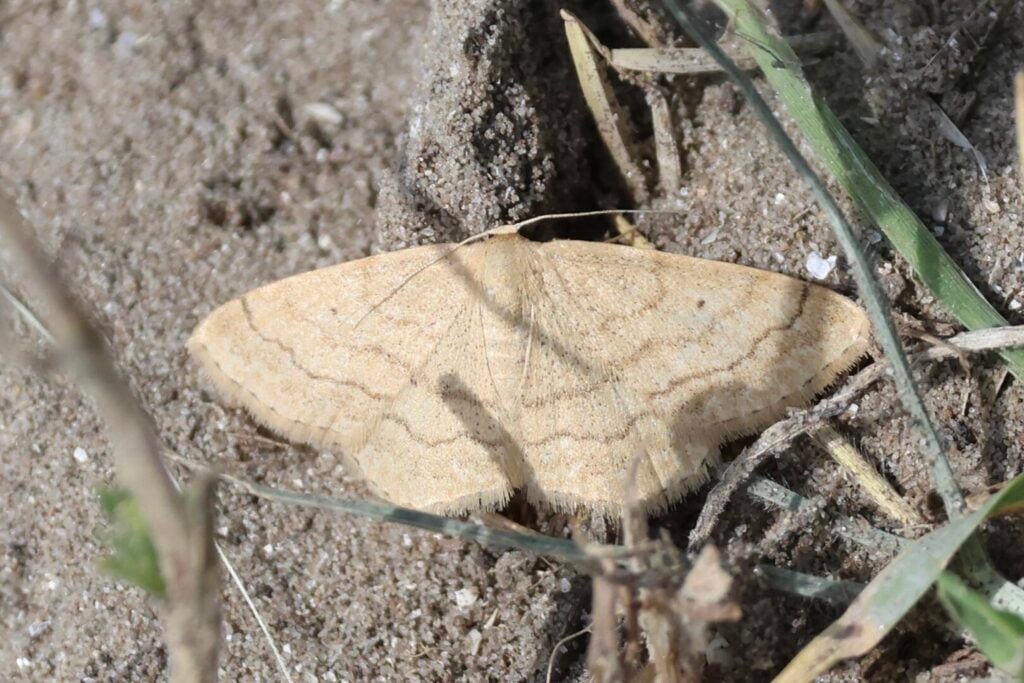
Walking down to the far corner of the bank, we flushed a couple Queen of Spain Fritillary from the grass, along with a Wave moth (Scopula ochraceata) and a few recently emerged Black-tailed Skimmers.
Scanning the grazing marshes here we eventually found four Collared Pratincoles flying but they were way off in the distance, too far for most of the group to see. A White-tailed Eagle circled up distantly too. Turning round, a single Black-tailed Godwit had appeared on the pool behind us now. As we walked back along the bank, we stopped for a closer look, an adult of the nominate Continental subspecies.
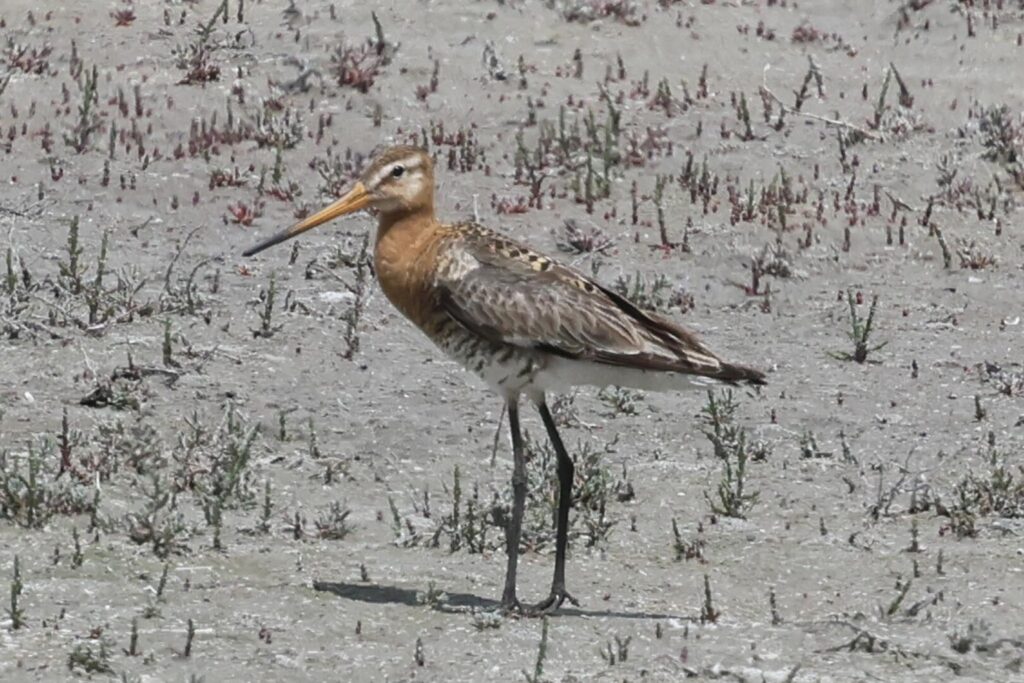
When we got back to the jetty, we stopped for a quick coffee break on the boat. Then we set off back up the Crisan channel. Another Black-tailed Godwit was now feeding on the bank of the channel just beyond the village. Further up, there were lots of Squacco Herons on the other side. Two Spoonbills were feeding in the shallow water under the trees, sweeping their bills from side to side.
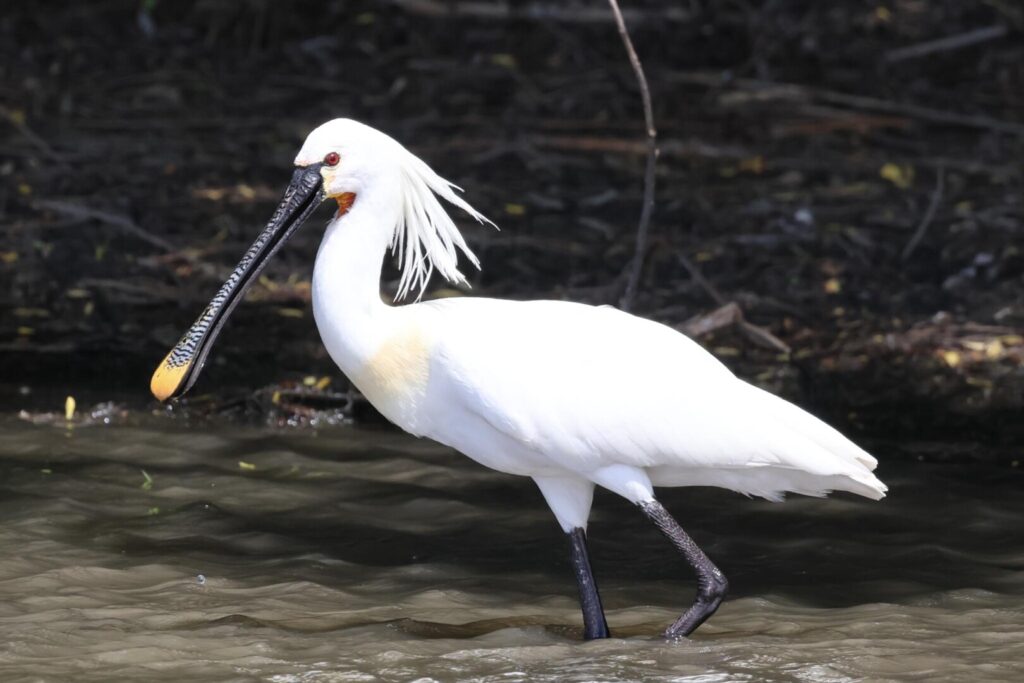
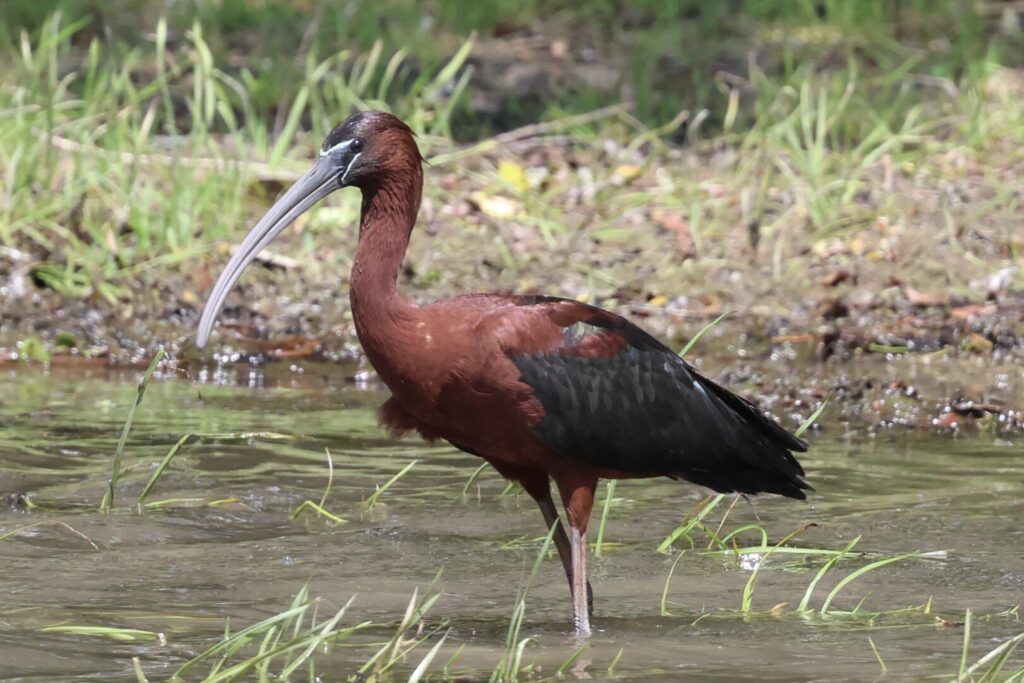
Senea cut the engine and we drifted up to watch them. Just beyond, a Glossy Ibis was looking particularly smart in the sunshine. The flotel was still moored on the side of the channel were we had left it and it was straight in for a late lunch when we got back – soup, varza calita and followed by a traditional Romanian doughnut with jam and cream. We had made the most of a long morning/early afternoon!
After lunch, the tug was hooked up to the front of the flotel and we set off back north along the Crisan channel. We would not be going out on the small boat this afternoon, but there was plenty of birding to be done from the deck of the flotel. There were lots of pelicans on the water, which flew up ahead of us, and the usual herons, egrets, Glossy Ibises, etc by the banks. A young White-tailed Eagle drifted low overhead.

Back to the main channelised Sulina branch of the Danube, we turned east. A succession of Caspian Gulls, Black-headed Gulls and Common Terns were flying round over the water, occasionally dipping down to the surface. Two distant Collared Pratincoles were hawking round over the fields and we watched a Hobby chasing Swallows over the bank. A large ship, a bulk carrier, was coming the other way. It was riding high, empty – probably going to get grain from Ukraine, lots of which is now shipped out via the Danube rather than Ukraine’s Black Sea ports.
After a while, we turned onto the old Danube channel. As we motored up, we looked out over a massive reedbed off to the right. We couldn’t see the far side of it, part of the largest compact reedbed in the world. Quite a sight! There were a few Purple Herons and Marsh Harriers which came up out of the reeds.
The other side of the river is a large drained agricultural area. Always odd to see industrial agriculture fields in the middle of a biosphere reserve, an odd juxtaposition with the wild reedbed across the channel. Apparently, the subsidies are so generous the farmers do not have to worry about growing a commercial crop, and the reeds seemed to be encroaching deep into the fields. Our first Rook for a while flew over.

Our mooring site for tonight was on the reedbed side of the old Danube. When we arrived, the tug towed the flotel towards the reeds on the bank before untying us and sailing round to the other side to push us in closer. It was harder mooring here today in the wind, which kept catching the flotel and pushing it out into the channel and round. Florin was in the small motorboat and helping to push the flotel in and stop it from spinning round the wrong way. Eventually the boatmen wrestled it in to place.
Standing up on the top deck, looking out over the reedbed stretching right to the horizon, we could hear a very loud Great Reed Warbler singing close to the boat. A Red-footed Falcon flew past. As usual, a Cuckoo was calling and we could see it perched on a distant dead tree next to a Roller. Four Cuckoos flew round together over the river, from one side to the other and then back again, chasing each other. A fifth then followed after and we could still hear the one calling. A male Reed Bunting flew back and forth over the river several times, in and out of the reeds, presumably collecting food for its nestlings.
We were so distracted by all the activity, Roxanna had to come and call us down for dinner. Spaghetti carbonara, moussaka, followed by apple strudel tonight, all enjoyed watching the sun set over the river behind us. Another fabulous place to spend the night.
Saturday 31st May
Mostly bright & sunny, cloudier early afternoon, feeling cool in strong breeze, max 23C
Looking out over the reedbed before breakfast, we could hear a Savi’s Warbler reeling. We couldn’t see it at first. It wasn’t close, though we had a clear view across over some green reed to the taller reeds where we figured it probably was. The wind was quite blustery though, which meant it probably wasn’t sitting right in the tops. The Great Reed Warbler was still singing away next to the boat and we saw it and possibly one or two others briefly flying in and out of the reeds.
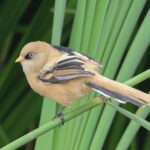
There were lots of Eurasian Reed Warblers too and we had one which was collecting nest material on some bare reed stems so we could get it in the scopes. A couple of Reed Buntings flew back and forth and some Bearded Tits were calling, though they remained out of view.
Just before breakfast, we found the Savi’s Warbler perched on the seedhead at the top of a reed stem but it was some way back and behind some taller reed in front which was blowing around in front of it, so very hard to see. Then it dropped down out of view. After breakfast, we went out for another go. The top deck had dried out and knowing the area it was in now, it was much easier to refind from here. We had a brief glimpse, but it dropped down again, then eventually it came up again and we had a better view.
We had to tear ourselves away from the Savi’s Warbler as it was time to leave. As we set off on the small boat, two Black-winged Stilts flew over the Old Danube. Turning into a side channel, Senea cut the engine and we drifted for a a minute or so. A Penduline Tit flew across the channel ahead of us one way, then a Bearded Tit flew the other and a couple of Eurasian Reed Warblers zipped back and forth too.
Another Savi’s Warbler was reeling – we would hear them all the way up the channel here. Several Night Herons flew out of the trees on the side ahead of us. A couple of Garganey and one or two Gadwall flew up ahead of us and an Otter in the water on the edge of the reeds typically dived and disappeared as soon as it saw us coming.
Motoring on further up, we found several pairs of Red-footed Falcons perched in the trees which meant for great views as we passed by underneath. They will be looking to breed using the old Hooded Crows nests here – one pair were perched by their chosen nest and we even saw another pair mating. A Hobby flew round and right out over the boat too.
The bonus of the day was a Bluethroat singing on the bank. We could just see it perched in a small dead tree as we passed through an area of low sand dune but by the time we had manoeuvred in to the bank, it had dropped down into the vegetation below. It reappeared on a reed stem further over, but was mostly facing away from us until it looked down and we could see a second Bluethroat come up below it. They both dropped down and we had a couple more brief glimpses before they seemed to melt away. We could still hear the male singing from time to time, but it was keeping down in the vegetation out of view now.

Moving on, a couple of Penduline Tits flew across in front of us and one perched nicely in the reeds on the other side briefly. Just beyond, another Penduline Tit was calling from a willow tree and we stopped to look at its nest hanging from one of the lower branches.
When we got to Letea, we stopped at a jetty just before the village and got out onto a raised bank. A pair of Hoopoes were on the top looking the other way and lots of Bee-eaters were flying round and perched on the sandy bank ahead of us. As we walked on, where a path cuts through the bank we could see several Bee-eater holes with their distinctive ‘arched window’-shaped tunnels.
There were a surprising number of butterflies around the bank today, given the fresh wind still blowing. Several Eastern Bath White, lots of Common Blue and one or two Brown Argus, Painted Lady, Queen of Spain Fritillary, Small Heath and a single Clouded Yellow which flew quickly past.

There were more Red-footed Falcons here, with a male hovering over the fields close to the path. We picked up several Collared Pratincoles out over the marshes distantly to the right and one which flew past a little closer so everyone could finally get onto one. There were several Yellow Wagtails flying round calling and when a pair landed on the bank ahead of us we could see they were feeding a half-grown juvenile.
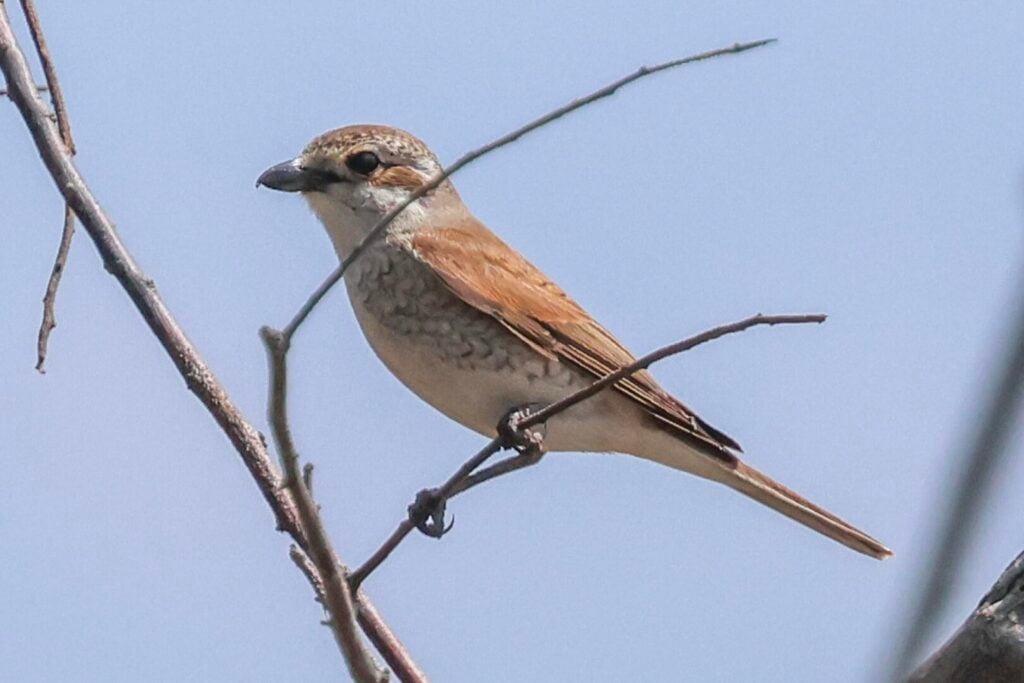
A Lesser Grey Shrike was in one of the bushes, possibly a first summer female with not so much of a black mask, and when it flew to the next bush it was joined by two female Red-backed Shrikes, which it tried to chase off. A little further on we found a male Lesser Grey Shrike too. A Crested Lark fluttered up singing and then parachuted down to a small dried up pool below the bank.
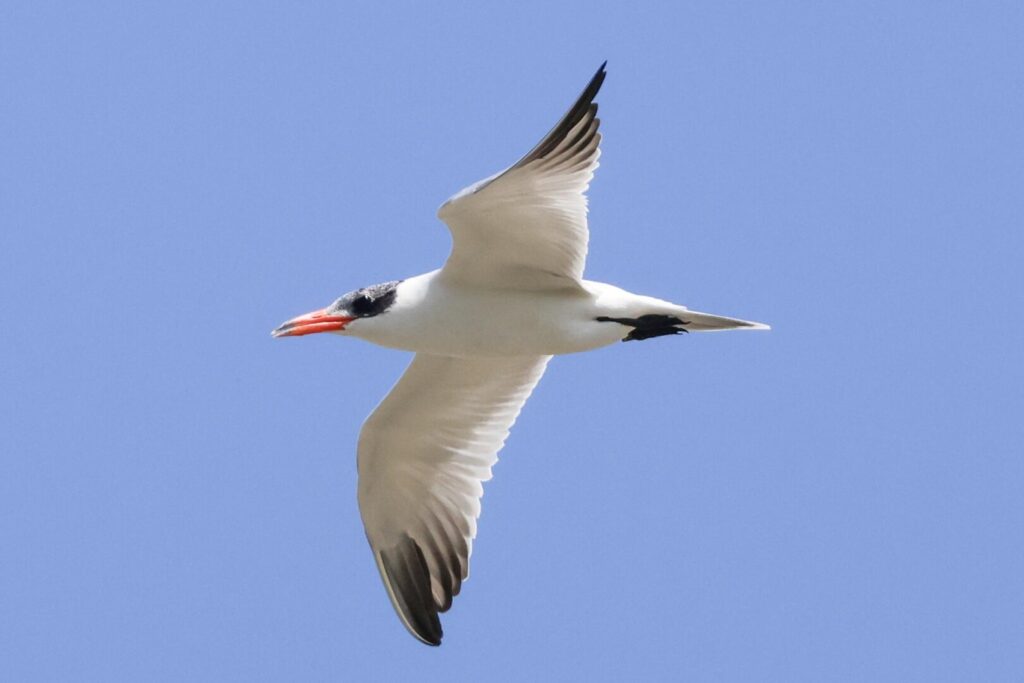
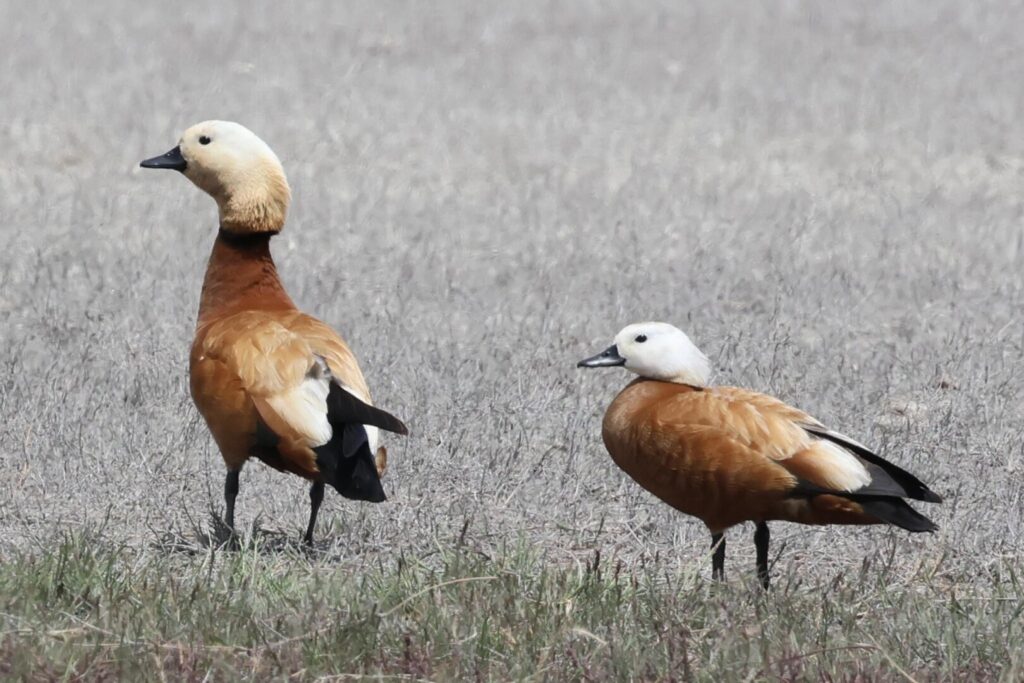
We could see a Caspian Tern and a pair of Ruddy Shelduck distantly on the low salt pools further down, so we pressed on along the bank for a closer look. When we got there, we found a nice selection of lingering migrant waders – a single Little Stint in rusty breeding plumage appeared to have a damaged leg, and a worn adult Wood Sandpiper was picking round the edge of the pool. We had seen a godwit distantly as we walked down and when we got closer up we realised it was actually a Bar-tailed Godwit, a Romanian rarity with only a couple of records per year according to Florin.
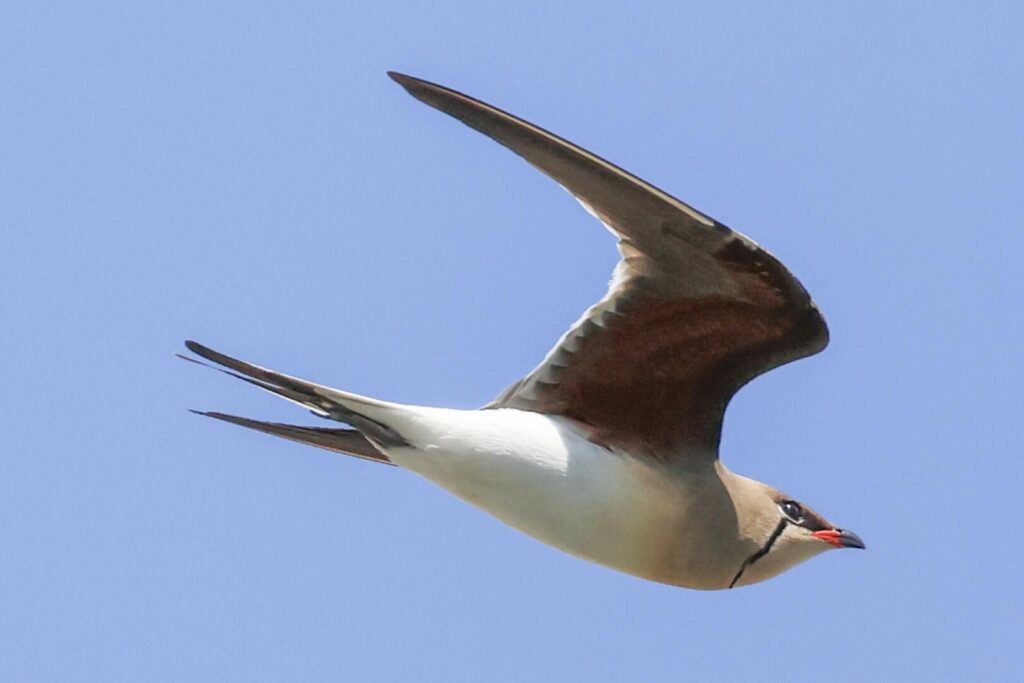
There were several Little Ringed Plovers scattered around the muddy edges of the nearer pools, including a pair displaying, and a few Kentish Plovers with a couple more further back on the bare sandy ground. A succession of Collared Pratincoles flew low back and forth over our heads, over the bank between the marshes one side and the pools the other. Scanning around, we could see lots of Collared Pratincoles on the ground too, a couple of pairs displaying which we got in the scopes. Periodically, when something spooked them, small flocks of them got up and flew round calling.
The Caspian Tern was much closer from here, so we could properly see its large red bill and after a while it took off and flew past above us.
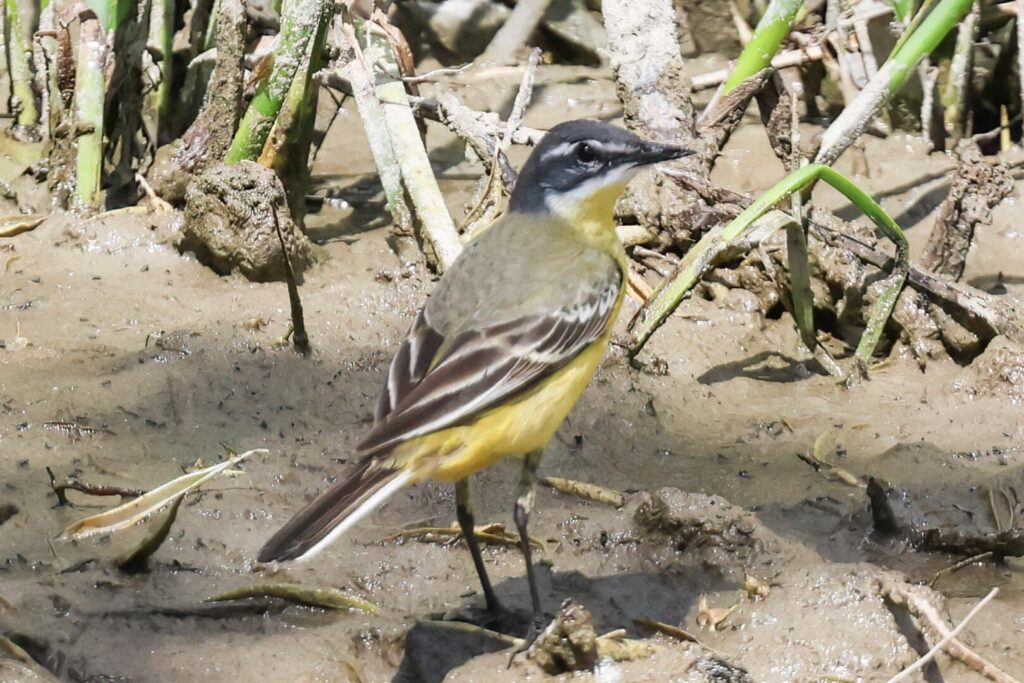
There were more Yellow Wagtails here and when one male dropped down right below us at the base of the bank we had a good look at it. This one was a classic grey-headed ‘dombrowskii’, the Romanian intergrade form, but we could also appreciate how variable they are, it being much paler-headed and with a stronger supercilium than the one we had seen earlier.
One of the group found a Dark Emerald Damselfly in the reeds on the edge of a small freshwater pool below the bank behind us and a single Green-eyed (Norfolk) Hawker and a Scarlet Dragonfly were hawking over the pool too. Walking on along the bank, the Ruddy Shelducks had now multiplied to four, and we had a much better view of them as we passed.
We cut across the far corner of the bare ground onto a low bank along the far edge and we didn’t have to wait too long before our transport arrived, a homemade Mad Max-style open-sided bus. As we had just climbed aboard, Florin shouted and we looked out to see an Osprey flying over the bank behind us.
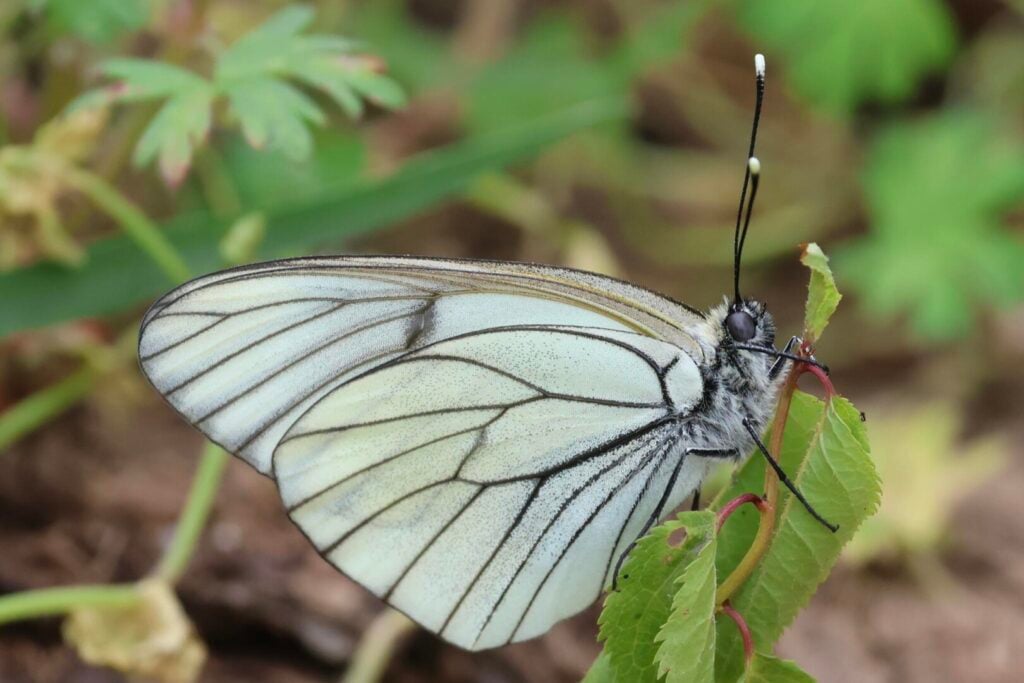
We drove back to the village and got out again by the church. It was only a short walk from here to the quay, giving us a chance to look at the village with its traditional thatched houses. An Eastern Olivaceous Warbler was singing opposite the church, there were lots of sparrows in the gardens, mostly Tree Sparrows, and a single female Wheatear. We found several smart Black veined White butterflies, a couple of which landed and posed nicely, and a Hummingbird Hawkmoth which fed briefly around some Larkspur by the fence of one of the houses.
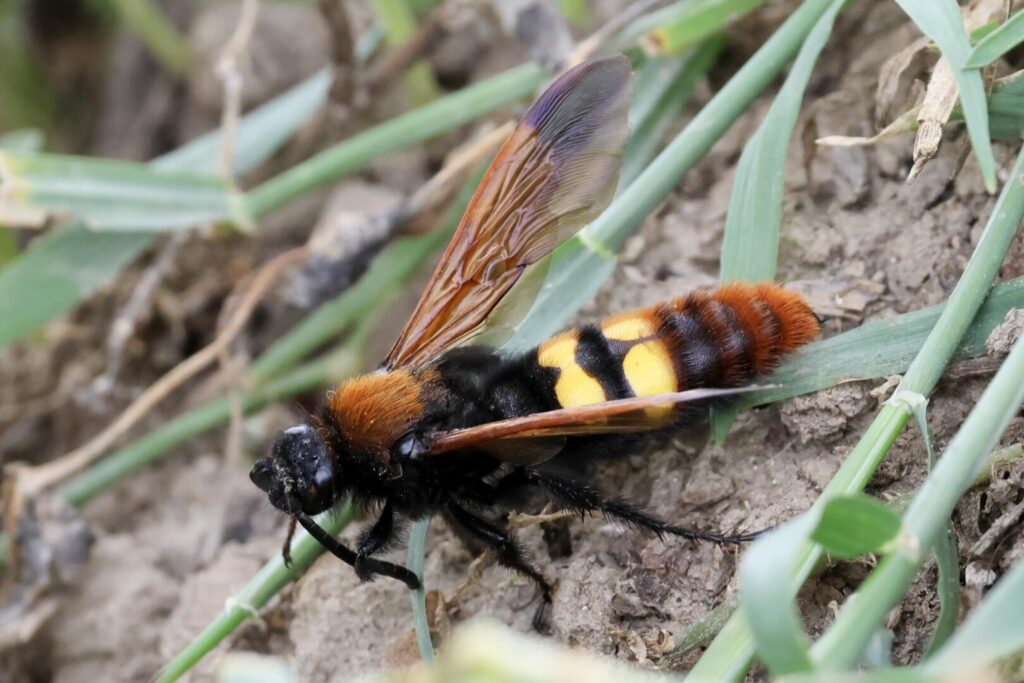
There were some impressive Mammoth Wasps swarming around a pile of old timber and concrete in the garden of an abandoned house.
When we got to the quay and back on the boat, it was time for coffee. As we motored slowly back down the channel, Florin got out his map and explained the history of the whole delta and more about the old sand dunes on which Letea is built.
When we got back to the flotel, there were a couple of distractions before we could disembark. First, the Great Reed Warbler was now singing from the top of a tall reed stem right by the edge of the water, so Senea manoeuvred the boat and we drifted up until we were so close to it we could take photos with our phones. Then as we turned round, a White-tailed Eagle circled round above with three other raptors, which on closer inspection were two Marsh Harriers and our first Long-legged Buzzard of the trip. When we finally got onboard the flotel, it was definitely time for lunch. Soup with dumplings today.

After lunch, the tug attached itself to the flotel and we slipped our moorings and were towed out into the channel. We travelled in convoy for about 45 minutes, before we transferred across to the small boat and separated off. We turned off through a series of side channels and into a small lake where Florin thought we might be able to at least hear a Little Crake.
There was no sound of anything until we turned round and started to leave and one started calling in the reeds by the entrance. A female Bearded Tit was feeding low in the reeds too and then flew across in front of us. Two Little Crakes called repeatedly, very close, but just wouldn’t show themselves, hiding in the dense reeds. In the end, we had to admit defeat and move on. Nice to hear though.

Continuing on down along the channels, a pair of Hobbys were perched in a dead tree on one side. Senea backed up the boat and although one flew off, the second remained perched on a bare branch right above us giving us some great views.
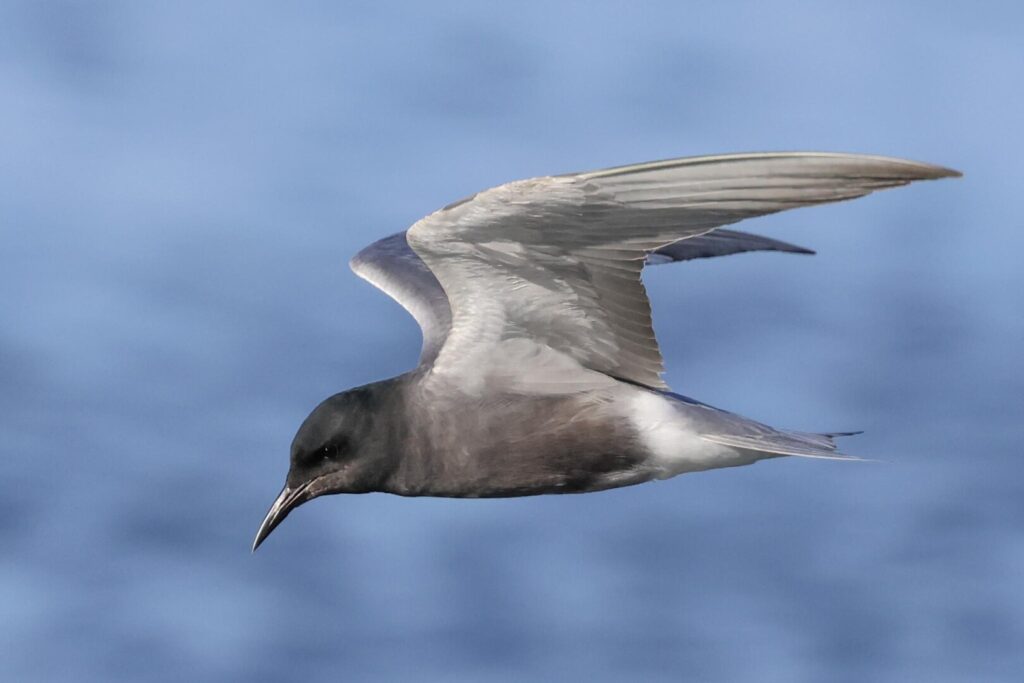
We crossed through a series of larger lakes and it was rather windy today out on the open water. On the first lake, there were a couple of pairs of Mute Swans with cygnets and several Common Pochard. Crossing the next, a tight group of White Pelicans was feeding in the edge of reeds where it had cornered some fish, so we stopped to watch. A Black Tern flew round over the boat calling and, further over, another Black Tern was feeding with the Whiskered Terns, dipping down to the water surface.
Into the next narrow channel, we could hear Bearded Tits calling. There are vast areas of mobile floating reedbed in the Delta, which drift with the wind and currents, and we were passing through an area with several chunks here. Florin talked a little about them, how they are formed and their ecology. He even disembarked onto one at one point and measure its thickness with a pole – at least two metres thick! One large floating reedbed had drifted across and closed off the channel ahead of us, so we had to make a detour and take a different route back out onto the main channel.
We turned into the entrance of another smaller, more sheltered lake and Senea cut the engine. Three more Black Terns were flying round with a few Whiskered Terns. They will probably nest here in the coming weeks, and a pair landed and we watched them courtship feeding on an area of floating water weed.
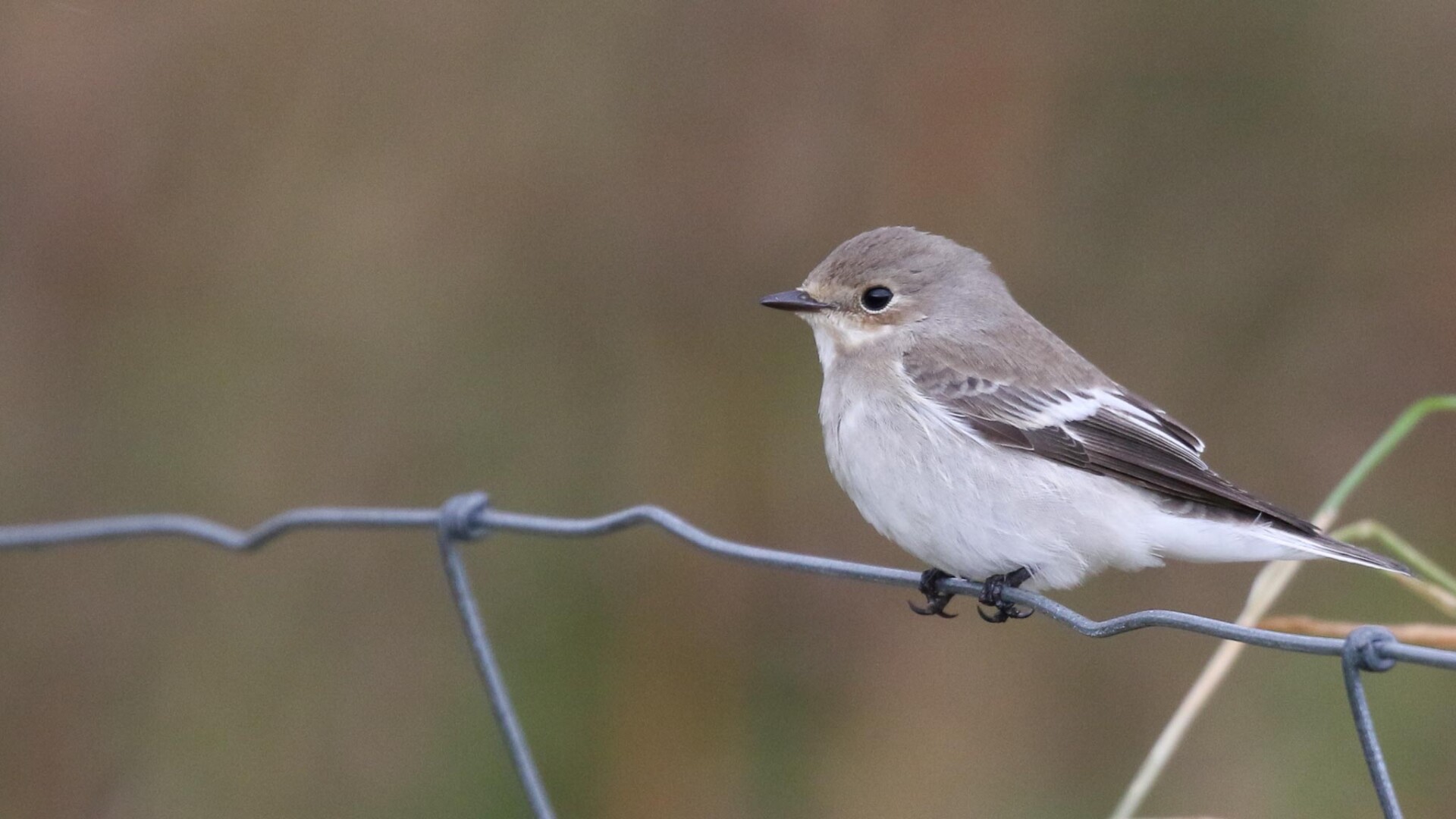
There were also at least five Red-necked Grebes further back here, along with two Garganey and several Ferruginous Ducks. Back out, we motored along a willow-lined channel where a Common Redstart flew across and landed in a tree, and then a Spotted Flycatcher did the same.

We made one last stop at another small lake. As we drove slowly in, two Black-necked Grebes swam ahead of us. In the lily pads beyond, we found a large colony of Black-necked Grebes, lots on their nests amongst a few pairs of Black-headed Gulls. Fantastic views in the low late sunshine, they were not worried about the boat drifting past. There were more Whiskered Terns and a few Black Terns hawking round over the lilypads, getting ready to nest. A Hooded Crow flew over and was promptly chased off by a large mob of terns.
Back out onto the channel, it was time to find the flotel again. We stopped to look at a White-tailed Eagle which was perched in the top of a dead tree, mobbed by Hooded Crows (what goes around, comes around!). A Wryneck called from the willows nearby. Several more Black Terns flew over as we motored quickly back to the flotel. It had been a long day today, and we were later back than normal. Still time for a break before we met again for a slightly later dinner – mixed salad, grilled pork with rice, followed by cake. All eaten while looking out at a beautiful sunset over the reeds beyond the channel.
Sunday 1st June
Bright & sunny, much lighter winds, max 26C
Our last day in the Delta sadly, the chorus of frogs was still going when we woke in the morning. From up on the top deck before breakfast, we could hear Bearded Tits pinging. A male climbed up onto the top of a reed stem from time to time and a female came down repeatedly to the mud on the edge of the water, right by the boat, to collect food to take back to the nest.
We could hear a Savi’s Warbler reeling too and in the lighter winds it was staying up more, perched right on the top of a reed, on the seedhead. Great views in the scope. A Great Reed Warbler was singing and the ubiquitous Cuckoos were calling and chasing each other round through the trees.
Several White Pelicans were loafing on the dead snags in the middle of the channel and more started to fly up in lines over the reeds on the other side of the channel. One squadron did a flypast, turning and flying right past us over the channel. Several lines of Cormorants flew up too, heading off to feed, and a Marsh Harrier was collecting nest material over the reeds opposite. An Oystercatcher flew over calling, followed by a Green Sandpiper. Another amazing place to start the morning, we had to tear ourselves away for breakfast.
After breakfast, we set off on the small boat for the last time. Further up the channel, we passed a small lake which held a pair of Red-necked Grebes and a single Little Grebe, as well as a couple of Ferruginous Ducks. We could hear a Little Bittern barking, so we stopped the boat and drifted to the bank but it went quiet.
Moving on, a Thrush Nightingale was singing in the trees on the bank, less rich and flutey than a Common Nightingale, with more clicks and rattles. A Long-tailed Tit appeared in the bushes briefly and a Lesser Spotted Woodpecker flew across between the trees. We tried down along a smaller channel to a larger lake. This can be a good area for Otters but there was no sign of any today. Turning back, we passed through the same are with the Thrush Nightingale again and a whole family of Long-tailed Tits were in the bushes now. All we could see were juveniles though, with dark faces.
At the next junction, we turned onto a wide meandering channel. There were lots of the usual species which flew up ahead of us – Purple Herons and Squacco Herons, Pygmy Cormorants and Ferruginous Ducks. Great Reed Warblers singing and Cuckoos calling everywhere.

The channel passed through the middle of a lake which was covered with water soldier on either side. A Red-necked Grebe swam off ahead of the boat, we could see a pair each of Black-necked Grebe and Little Grebe further over by the edge and there were more Ferruginous Ducks the other side.
It was warming up now and, in the lighter winds, there were more dragonflies out – a single Blue Emperor and a couple of Lesser Emperor, Green-eyed (Norfolk) Hawker and several Scarlet Dragonflies. This spot was most memorable though for the frogs, which were on every lilypad and small patch of water weed. The sound was deafening!
Continuing on down the channel beyond, there were more willows lining the banks and succession of Night Herons flew out of the trees ahead of us. At the next junction, a Common Redstart was singing from a dead tree and a Kingfisher shot past in a flash of electric blue. A little further down, we stopped to look at a pair of Spotted Flycatchers and found they were being chased around the tree by another Redstart.
Back to civilisation, we came out onto a larger channel, lined with power lines, Mila 23. There were a couple of Rollers on the wires and a green Golden Oriole flitted through the trees. At the junction at the far end, there were lots of Feral Pigeons and Jackdaws around some old agricultural buildings and a Little Owl on one of the clusters of insulators on a post under the wires.

The next channel had more open banks, with a large area of agricultural fields the other side to the north. There were lots of European Pond Terrapins along the edges of the water and sunning themselves on any logs sticking out of the water.

A male Red-backed Shrike appeared on the wires, with a female further on coming up out of the vegetation on the bank briefly, flycatching. A more obliging Squacco Heron in smart breeding condition was on the edge of the water.
We heard a Marsh Warbler singing on the bank so Senea stopped the engine and we pulled up alongside. We could see it flicking around in the base of an indigobush, feeding. Then a second Marsh Warbler started singing just beyond, wonderful mimicry its song stolen from anything it happened to hear on its travels. They are normally a very scarce breeder here, so it was a surprise then to hear a third Marsh Warbler singing a little further on. A Corn Bunting was singing from the wires.
Round the next corner, we could see an amazing tower of White Pelicans circling up, catching the sunlight as they turned. There must have been a thousand or more, stretching from just above the trees to high in the sky above, they looked like a giant twisting tornado. A beautiful male Golden Oriole was flitting from branch to branch in the bare trees ahead of us. With leaves to hide behind, these were out best views yet.
Turning on to a side channel, it was time for coffee. There are lots of dead trees along the sides here, a result of overzealous burning of the reeds, and we could see several old Black Woodpecker holes. We stopped to listen and scanned the trees but couldn’t see anything. The woodpeckers are nesting at this time of year and not very vocal. Moving on, a Green Sandpiper flew out from the bank repeatedly ahead of us.
Florin heard a Collared Flycatcher singing so we cut the engine and pulled over to the edge. The sound was coming from a group of very tall leafy willows but we just couldn’t see it at first. There were some more Long-tailed Tits, at least one white-headed adult with the dark-faced juveniles, the birds here are of the northern and eastern race, caudatus. Several Tree Sparrows kept catching the eye as they moved in the branches.
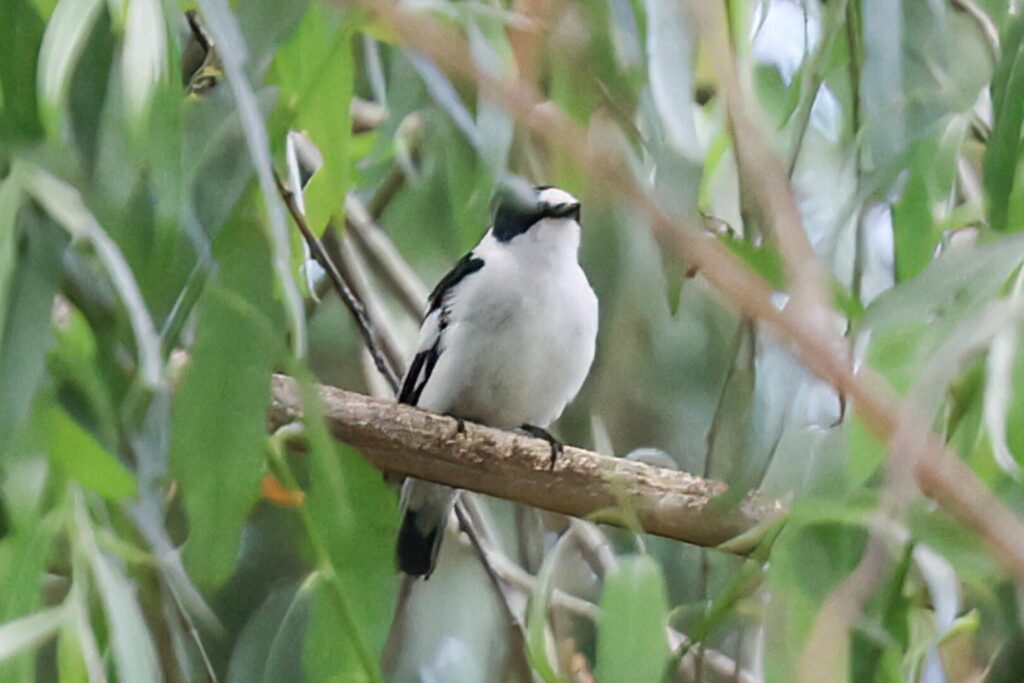
We tried changing angles to see the Collared Flycatcher but it didn’t help. We were just about to give up when one of the group spotted it and we realised it was only visible from one position, looking between some shorter trees in front. It still wasn’t easy to get on, often hidden behind the leaves, but eventually everyone managed to see it. A smart black and white male, between bursts of singing, we could see it was flying in and out of a nest hole on the trunk nearby.
Motoring on along the channel, a Great Spotted Woodpecker flew out of the trees and a White-tailed Eagle circled over. Then we came round a corner and found the flotel waiting for us on the side against the reeds.
We were back in good time, a more conventional hour for lunch, which was ready when we arrived. Delicious soup with meatballs today. As we were eating, we set off to make our way slowly back to Tulcea, the tug towing the flotel.
After lunch, we retired to the covered deck outside and sat on the chairs admiring the view. There were all the usual birds we had seen over the last few days, perhaps a last chance to see several of them. A succession of Redstarts were singing in the trees and we heard another Collared Flycatcher too as we passed. Apart from a brief glimpse and some quick bursts of barking, Little Bittern had eluded us until now. Surprisingly, given it is quite a busy main channel, one was perched half way up in the reeds on the edge of the water.
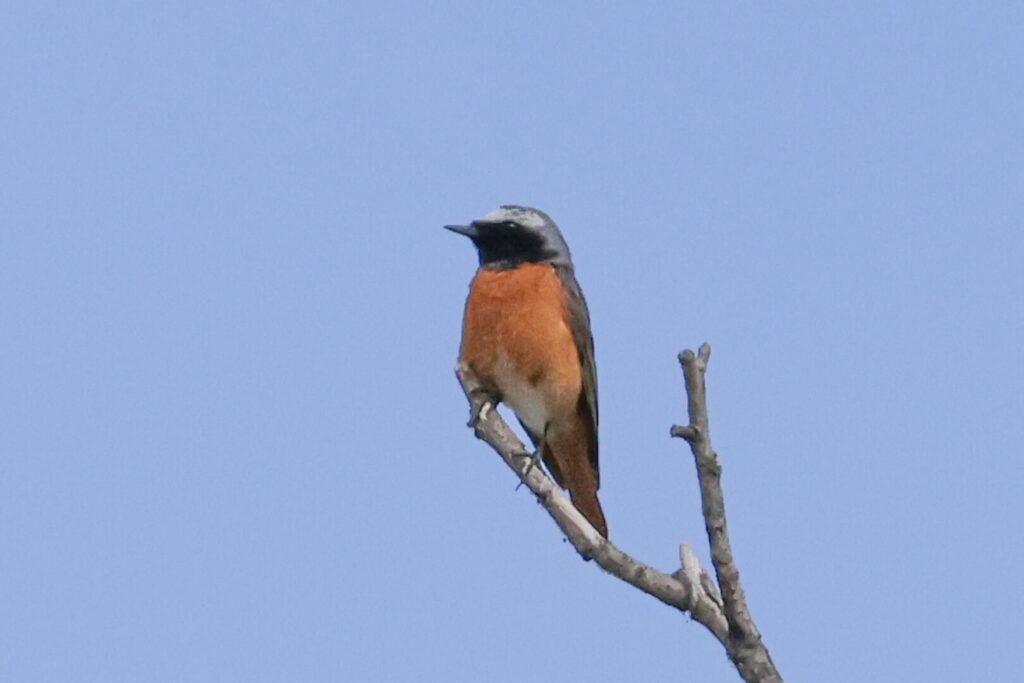
Back into the drier western part of the Delta, the banks are thick with trees and there are progressively less reeds. There are different birds singing here too – we heard more Blackcaps, Chiffchaffs, Blackbirds, a couple of Robins and a Song Thrush. A male Common Redstart finally posed nicely at the top of a tall dead tree and we managed to see one or two more Spotted Flycatchers.
There were a few Great Spotted Woodpeckers and we had a brief glimpse of a Grey-headed Woodpecker as it flew out of a tree. A White-tailed Eagle flew low over the flotel the other way – how many had we seen over the last four days? A Hoopoe flew out from the bank and turned straight past below us. Several Kingfishers zipped out from the banks.

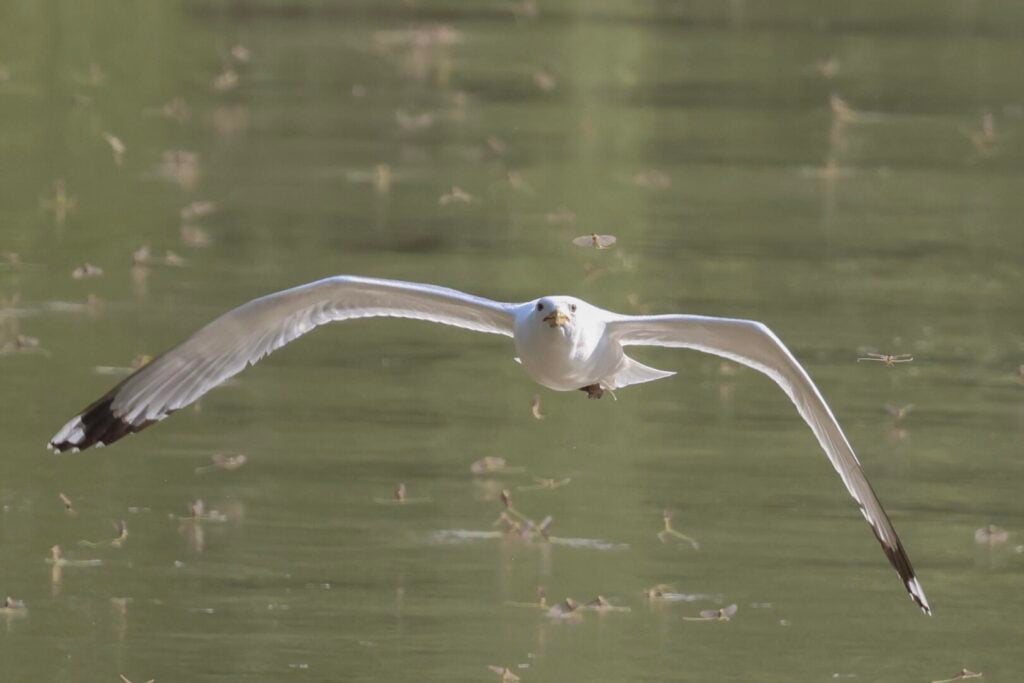
The most amazing sight here was the mass emergence of Tisa Mayflies. There must have been millions of them, fluttering low over the water or flying past in constant clouds, all the way down the Mila 36 channel. The birds were taking advantage of the free food – a Chaffinch flycatching out from the trees on the bank, Starlings collecting them from the leaves or swooping out of the water, a Caspian Gull flying up and down scooping them off the surface of the water, a Hooded Crow on a log trying to pick them off wherever it could reach, as well as a couple of Grey and Squacco Herons. Amazing to watch.
Back almost to the start of Mila 36, the boatman unhooked the tow rope and brought the tug round to tie up alongside, from where it could push the flotel back to Tulcea. As we got to the corner, another Grey-headed Woodpecker was perched on a dead tree and climbed up right to the top. Then it was out onto the wide open water of the main channel beyond.
It took another fifty minutes or so to get back to Tulcea where we moored up at the dock from where we had left four days ago. Our last dinner on board was served in the dining room, salad followed by traditional Romanian tochitura and ice cream. Back to “civilization”, the soundtrack of Cuckoos and croaking frogs was replaced by loud music. It was a national holiday today, Children’s Day, and there was a huge party in Tulcea. A bit of a contrast to the peace and tranquillity of the Delta, thankfully the worst of it seemed to end by about 10pm.
Monday 2nd June
Bright & sunny am, patchy cloud & light breeze pm, max 28C
After our last breakfast on the flotel, we said our goodbyes and thanks to Roxana, Lili and the boatmen. The minibus was waiting for us on the quayside and we set off inland to explore the Dobrogea. Some of the fields close to Tulcea were carpeted with red Poppies and patches of purple Oriental Larkspur and several White Storks were picking around in the recently harvested hay meadows, a reminder of what farmland used to be like.
Our first stop was not far away, at the hill of Denis Tepe. As we drove down the entrance track, a pair of Lesser Grey Shrikes flew out of the trees ahead of us, several Spanish Sparrows and Rollers were on the wires alongside, and three or four Yellow Wagtails flew up from the track. At the base of the hill, we got out of the bus and scanned the surrounding steppe grassland. A Skylark and several Corn Buntings were singing. Two Short-toed Larks were on the dusty track with a Tawny Pipit and flew up singing too. A pair of Crested Larks flew from the track up onto the base of the hill.

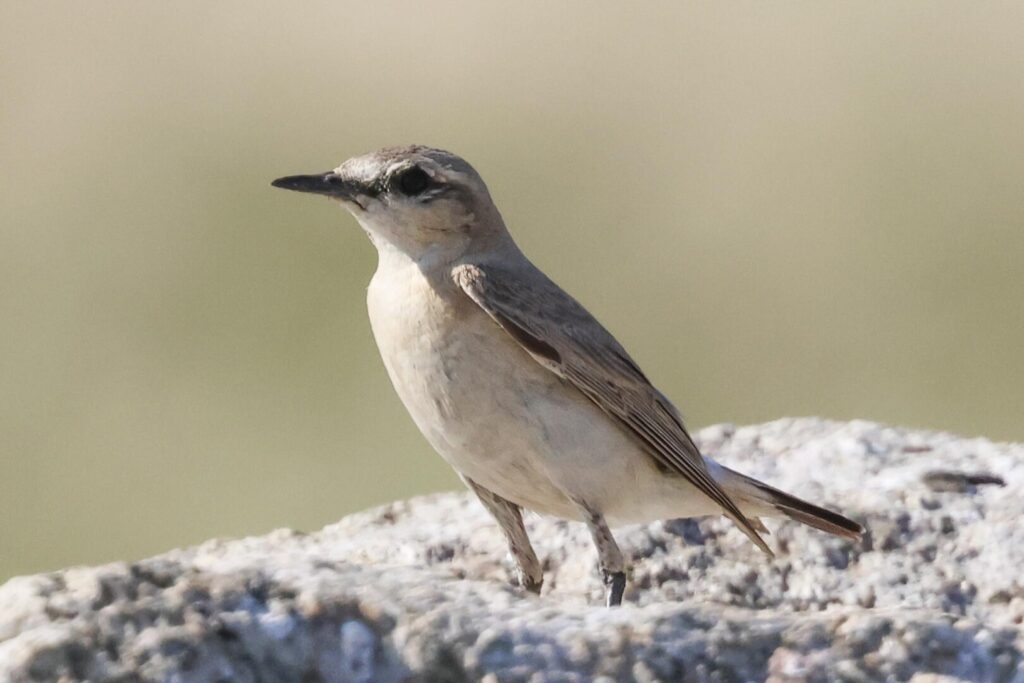
A single Isabelline Wheatear was on the wires with a Corn Bunting when we arrived, with a male songflighting over the grass below. We found two a little closer, on an old concrete structure in the grass in front, which we got in the scopes. Then another Isabelline Wheatear appeared next to us and flew out to feed on the track. There were a few Northern Wheatears too, a couple right on the top of the hill and another pair which appeared at one point on the track further up.
Another Tawny Pipit flew in too and landed much closer to us in the grass. We had a great view of it creeping around with food in its bill, before it gradually made its way deeper in, where it presumably had a nest.

We saw a Suslik as it ran out onto the track and across to the other side. As it warmed up, several raptors appeared circling over the hilltop. First a Kestrel, followed by a Honey Buzzard, a Long-legged Buzzard and a dark morph Booted Eagle. Several Bee-eaters were on the wires distantly away to our left and a Hoopoe seemed to be calling all the time we were there.
Boarding the bus again, we drove back round through the fields to the main road and continued on south, through the town of Babadag and up into the forest. We stopped on the far side of the hills and got out again. The small car park was full of wild flowers – Florin showed us a small clump of Iris sintenisii and we could see lots of Pyramidal Orchids. An Ortolan Bunting started singing across the road and we could see it perched in the top of an oak tree just the other side.
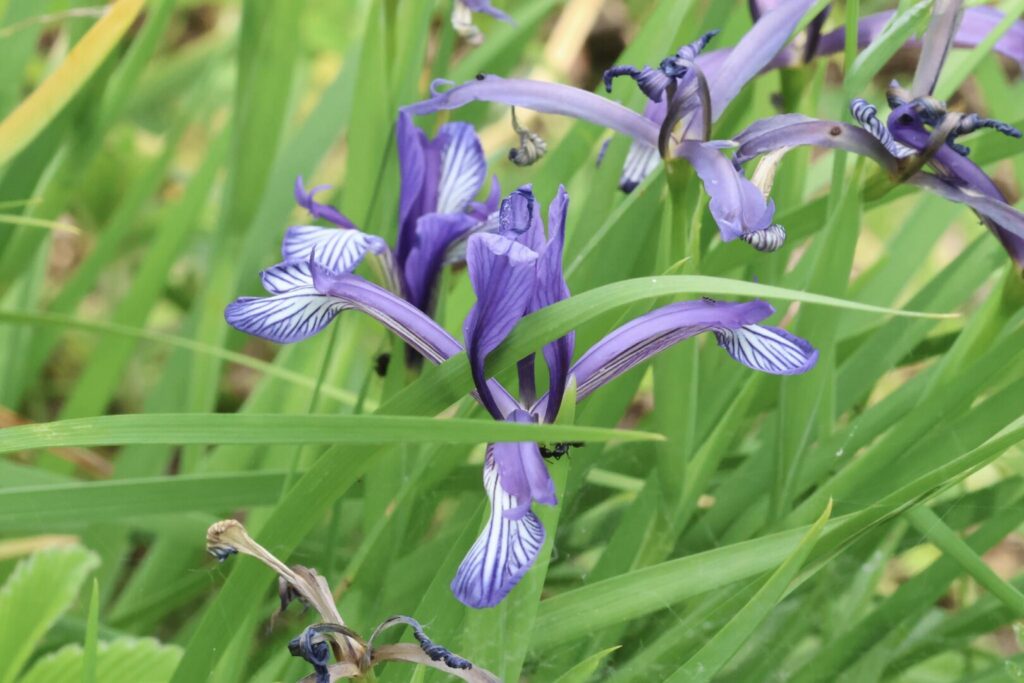
We crossed over and took a small path up through the trees. A Sombre Tit called, but flew out immediately back over the road and disappeared straight in to the trees the other side. There were lots of interesting flowers here, which Florin pointed out as we walked up the path, including Violet Birds Nest Orchids and Red Helleborine. The male Ortolan Bunting was now singing in an oak above the start of the path with a female below at one point. It didn’t seem concerned as we walked right underneath, fantastic close up views.

Out into a clearing beyond, there was a wonderful flower meadow. Florin explained how the vegetation here is very important, typical of ungrazed primary steppe with lots of native endemic plants. Several butterflies were flitting around over the grass, Niobe Fritillaries, and four or five Cardinals were feeding on the thistles.
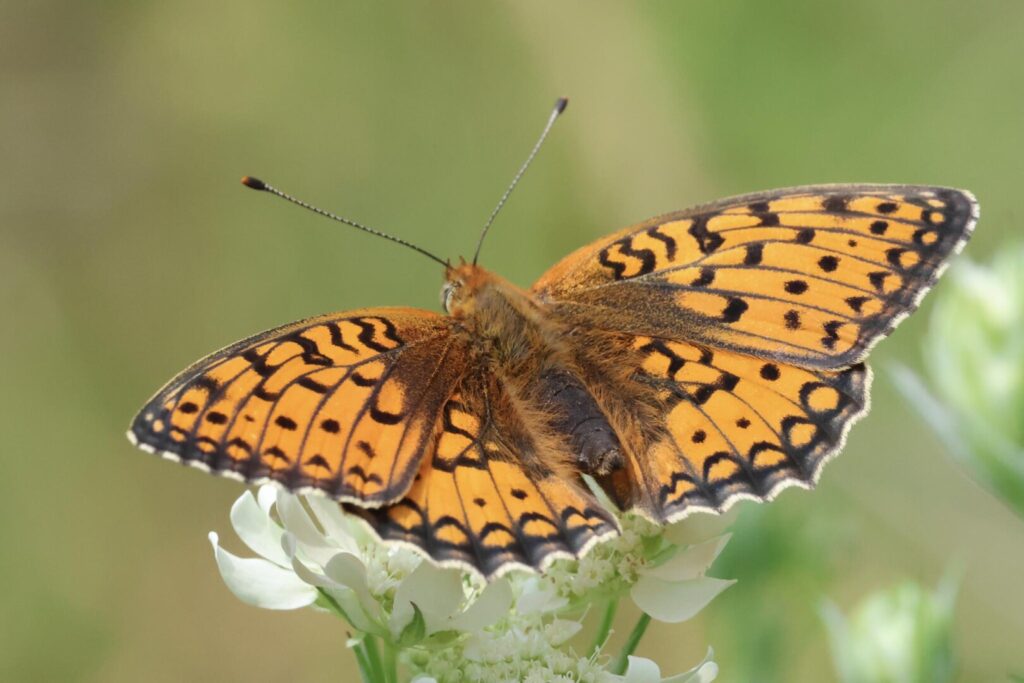
A Honey Buzzard circled overhead and a European Snake-eyed Skink scuttled though the leaves next to the path.
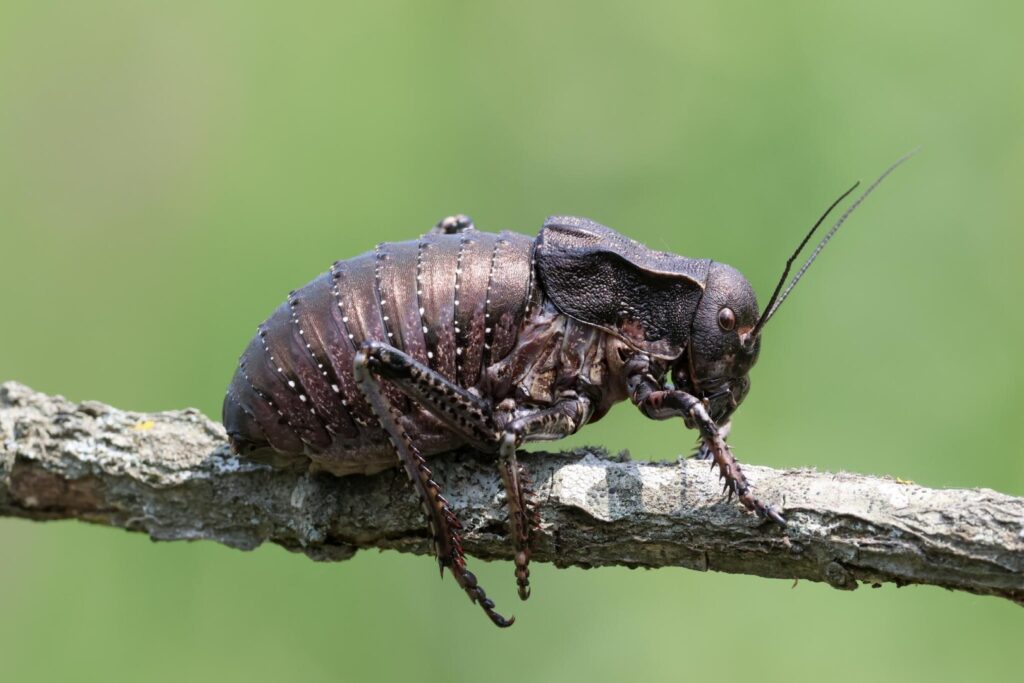
In the next clearing, we found an enormous Bronze Glandular Bush-Cricket which Florin picked up on a stick. A male, lacking the long ovipositor of the female, after having its photo taken, it was placed back carefully in the shade where we found it.
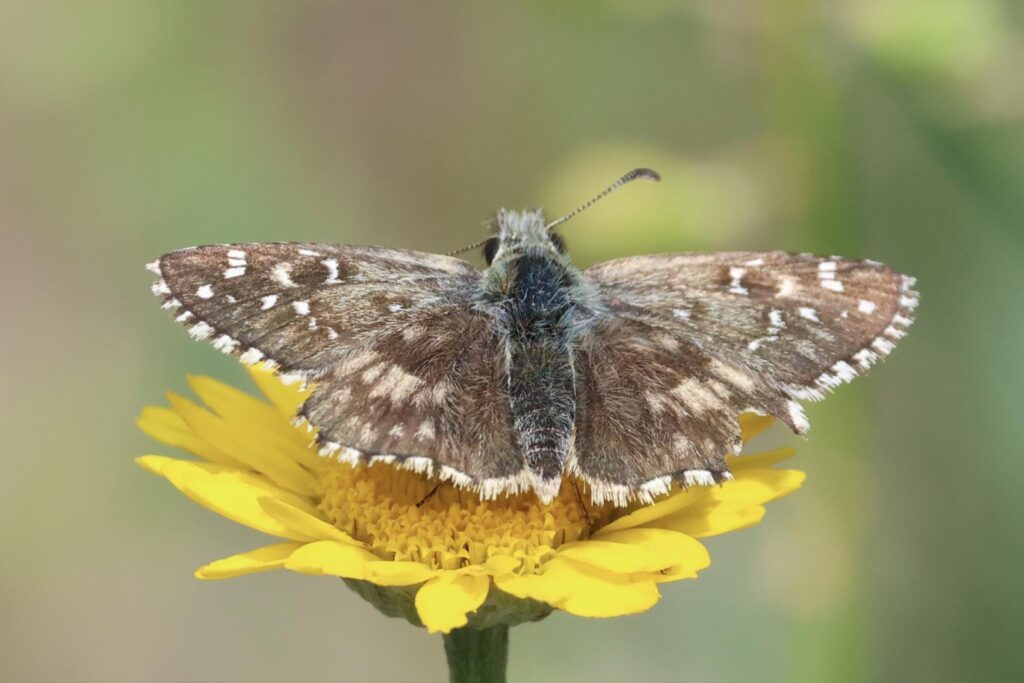
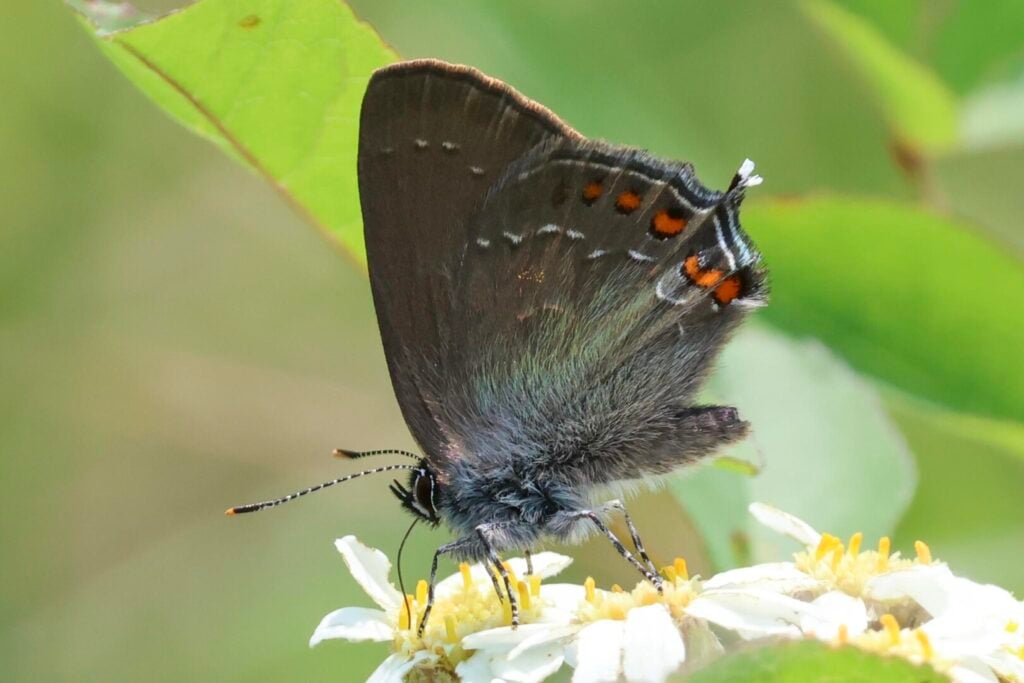
Several small Eastern Baton Blue butterflies were fluttering around over the path along with an Oberthür’s Grizzled Skipper and an Ilex Hairstreak stopped to feed on a flower. An Antlion was resting on a small sapling on the edge of the trees nearby.

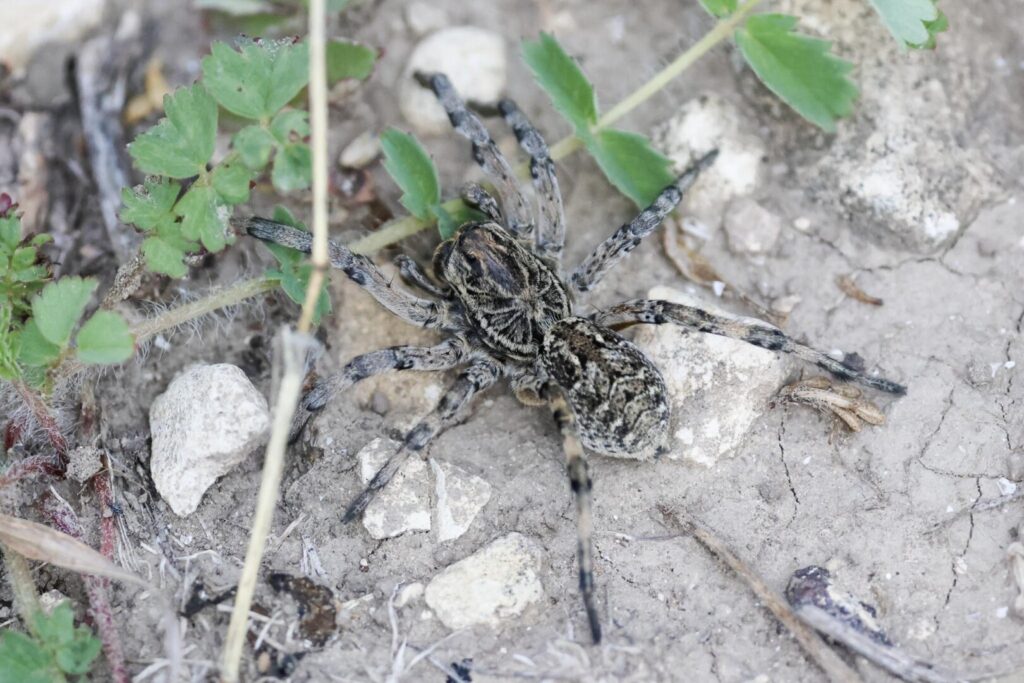
A Romanian Tarantula, a species of wolf spider unrelated to the tarantulas of Latin America, was on one of the paths.
Walking back down the hillside, we found a Greater Butterfly Orchid and then a male Red-backed Shrike flew up onto a low tree ahead of us. Nice views through the scopes. This is a good area for Nightjar and we managed to hear one churring in the trees as we got lower down. Back across the road to the parking area, a Balkan Wall Lizard was trying to hide in the grass.

The bus picked us up again and we drove on south, stopping at a filling station next to use the facilities. A Spanish Sparrow was singing on the wires next to where we parked and several more were on the fence behind. Most of the group got distracted by ice creams inside, while the rest of us watched the Susliks running around in a bare area by the new warehouse behind. Unfortunately, they have graveled over the grass by the forecourt where the Susliks used to live.
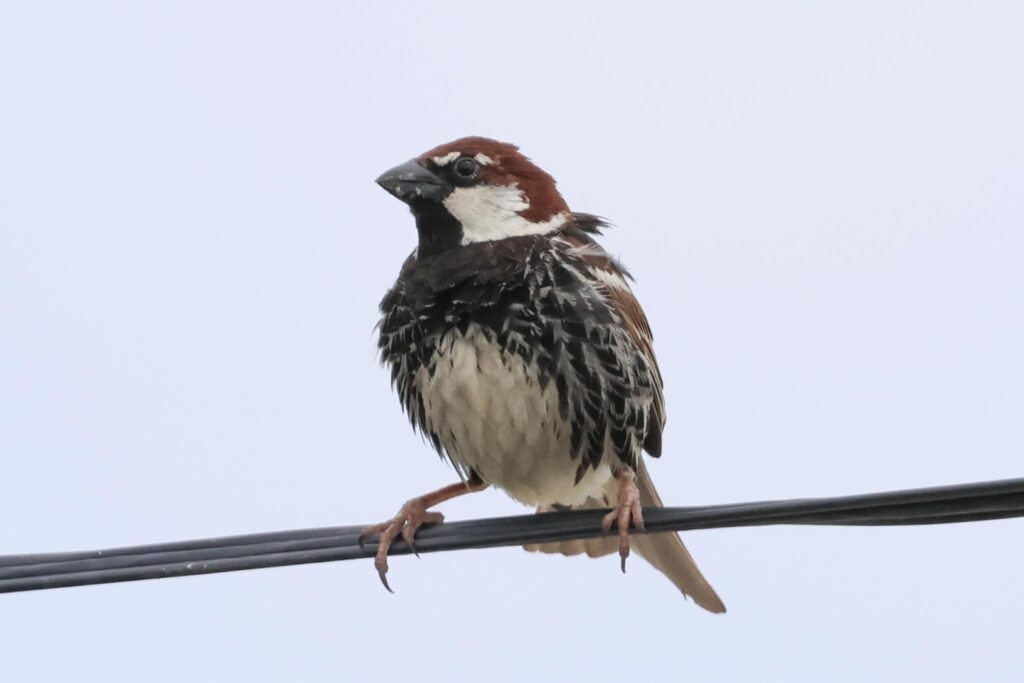
There were several Northern Wheatears here too. As everyone came back out with their ice creams, a Booted Eagle flew in over the fields beyond and circled right over low in front of us. Unsurprisingly, the Susliks ran for their burrows at the first sight of it approaching.

We stopped for lunch a few minutes further on, by a small chapel in a line of trees next to the road. We set up the table in the shade and Florin laid out a selection of bread, cheese, meat and salad which had been sent from the guest house with the bus. Followed by pears, cake and coffee. Several Yellow Wagtails flew in and out of the field opposite, Red-footed Falcons called from the trees and a small group of White Pelicans drifted over.

A Green-eyed Hawker patrolled round and several moths flew up out of the grass, including several Four-spotted, Spotted Sulphur and a Silver Y. After lunch, we got back on the bus and drove down towards the Black Sea coast and the village of Vadu.
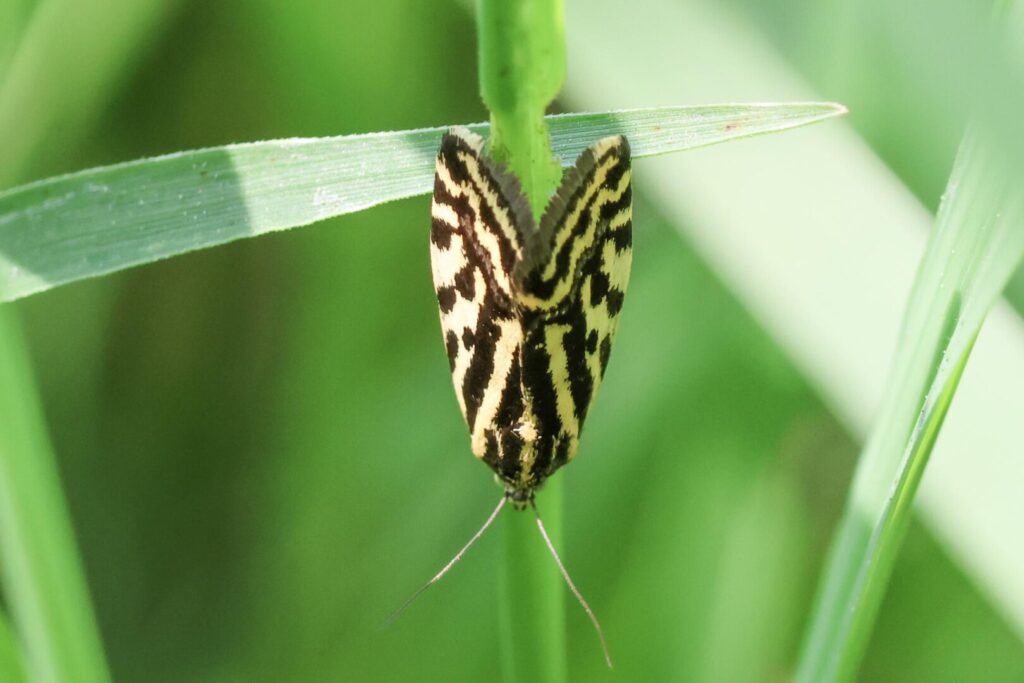
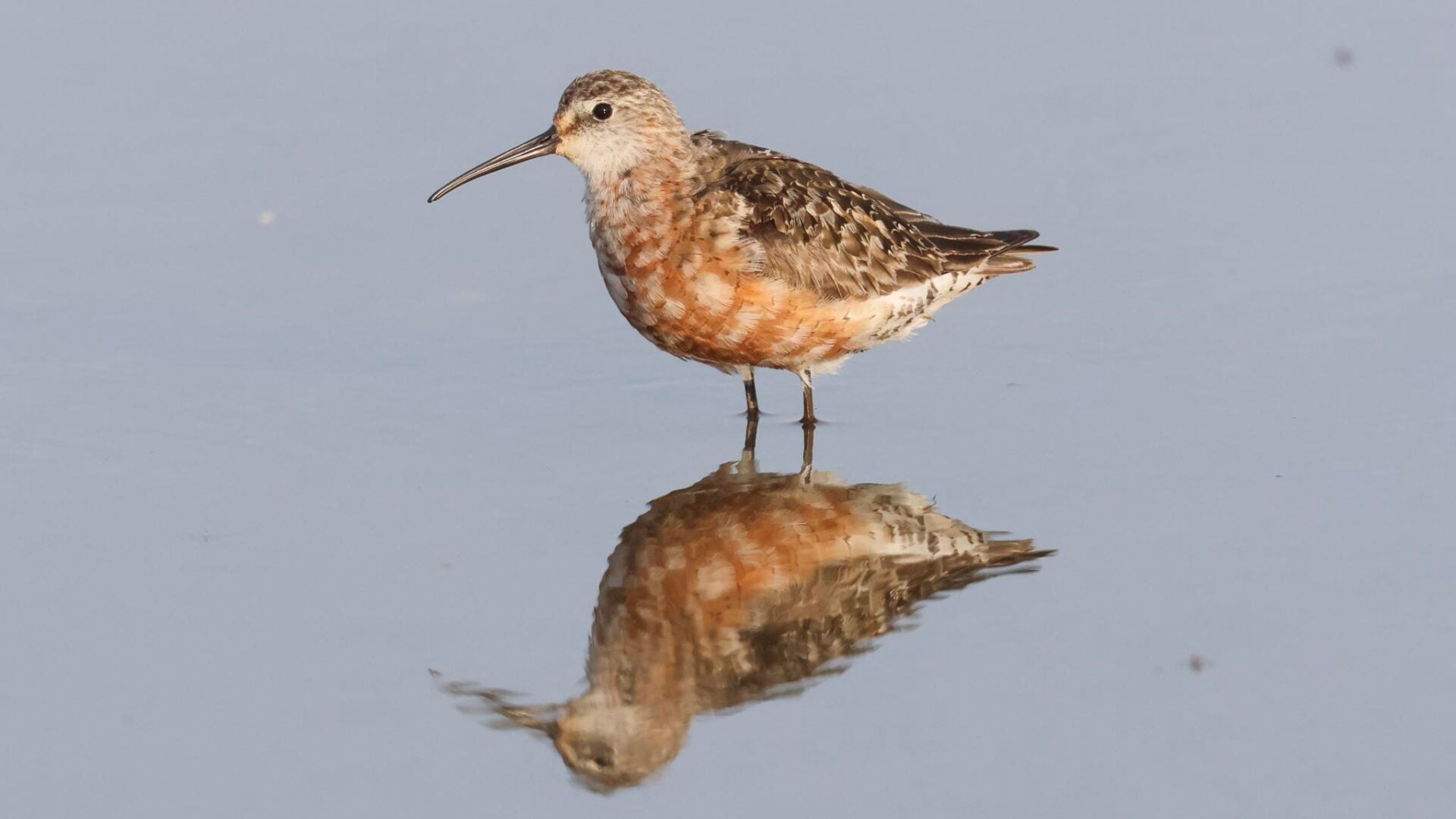
The other side of the village, we stopped in front of the ruined Communist-era factory. A male Red-footed Falcon drifted overhead and a couple of Red-rumped Swallows flew round with the House Martins. A Collared Pratincole was hunting over the reedbed beyond. Walking on along the road, we stopped to look at the first pools. We found a moulting adult Curlew Sandpiper with a Redshank, although the latter tried to chase it away. We stopped to look at it in the scopes. There were a few Common Shelduck here too and a female Red-crested Pochard flew over.

Just beyond, a couple of Bearded Tits flew round over the rushes and disappeared back in to the reeds. We were hoping to find Paddyfield Warbler still singing here, but all we could hear were a couple of brief Eurasian Reed Warblers and lots of Great Reed Warblers. Perhaps they were down to breeding and had gone quiet already, although it possibly didn’t help being mid-afternoon now. A Savi’s Warbler was reeling further back.
There were more Bearded Tits pinging and flying in and out and a brief Bittern grunting. Several Purple Herons flew over, as did another two Red-crested Pochard. We were just about to move on each time but had a couple of brief glimpses of Paddyfield Warblers flying over and dropping into the reeds. Too quick for anyone to get onto, despite staring at the spots they had gone in, neither reappeared.
Florin called us on, down to the next pool which is larger and more open. There was a nice selection of waders here. Three Black-tailed Godwits were feeding with some Glossy Ibis in the shallow water, with another 20 or so Glossy Ibis preening on the mud nearby. Unless the one we had seen earlier had moved, another Curlew Sandpiper was down at the front before it flew off towards the coast. Eight Little Stints, all in rusty breeding plumage, appeared out of the low vegetation to feed on the edge of the water. A Common Snipe was lurking further back.
Eight Wood Sandpipers dropped in on the far edge, against the reeds, and three Greenshank flew in with a single Redshank. A Black Tern was flying round over the water and several more Collared Pratincoles were hawking for insects from the mud. There was a good variety of ducks here too, most notably a pair of Northern Shoveler and several Eurasian Teal, both new for the list. We had seen Garganey in the Delta, but now we had much better views of them through the scopes on dry land.
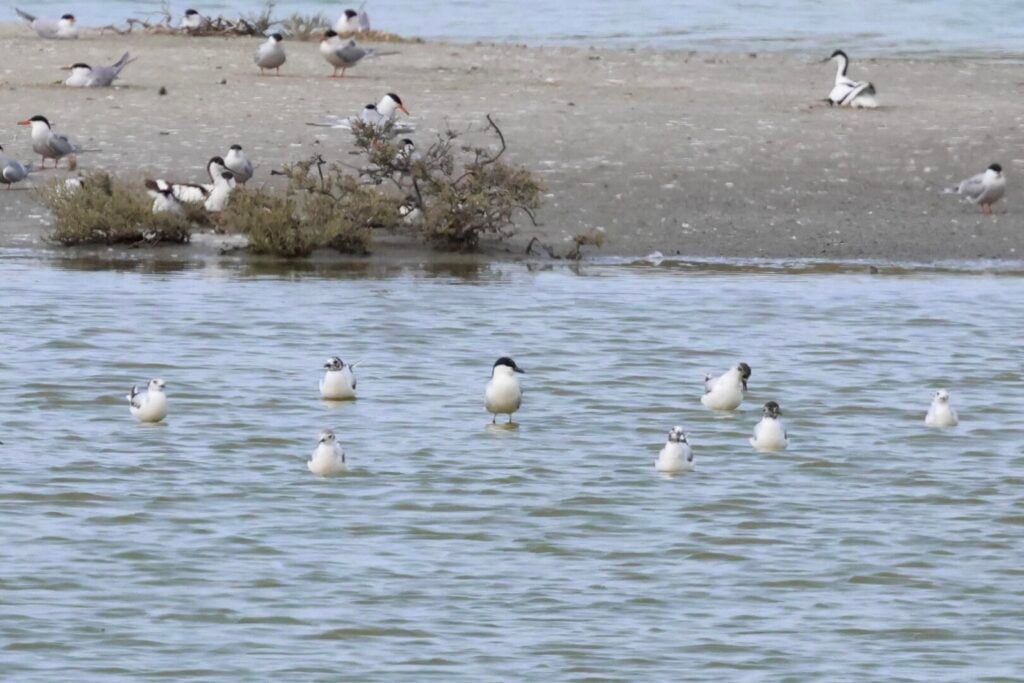
The minibus had driven down to meet us and we were going to drive down to the coast when we saw a couple of Little Gulls come up over the bank beyond. We walked on along the road and then up onto the bank to view the pool beyond. There were lots of Little Gulls on here – we counted 60, all 1st summers. A single Gull-billed Tern was in the middle of them, probably wondering what it was doing there! There were lots of Common Terns on the island just behind and a couple of Black-headed Gulls already on the nest.
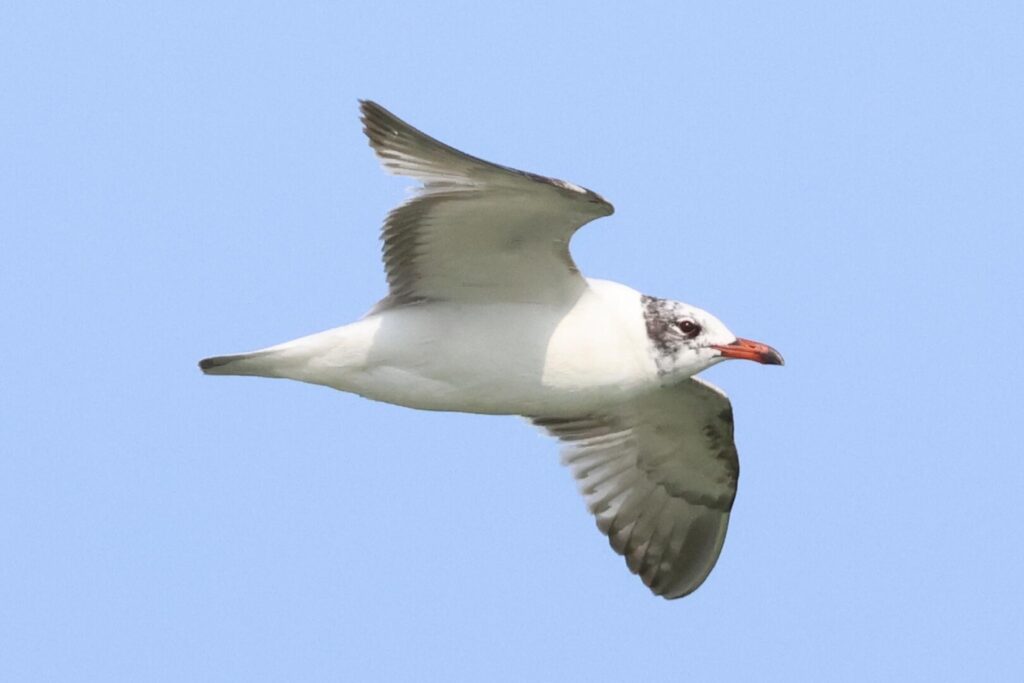
Now we boarded the minibus and drove on down to the beach. A European Hare ran along through the vegetation below the road as we passed. At the far end, we got out and walked up onto the beach to look out over the Black Sea beyond. There was a steady succession of gulls flying past, lots of 1st summer Mediterranean Gulls with the Caspian Gulls. Several Common Terns were feeding just offshore and a single Sandwich Tern flew north. A couple of Arctic Skuas came up off the sea distantly away to our left to chase the terns and were in turn chased themselves by a Caspian Gull. Two more Arctic Skuas flew past.
There were lots of Great Crested Grebes on the sea, and at least six Red-necked Grebes too. A single Dalmatian Pelican was resting with several White Pelicans on the fishing net buoys. A Crested Lark was feeding around the back of the beach and the sandy track.

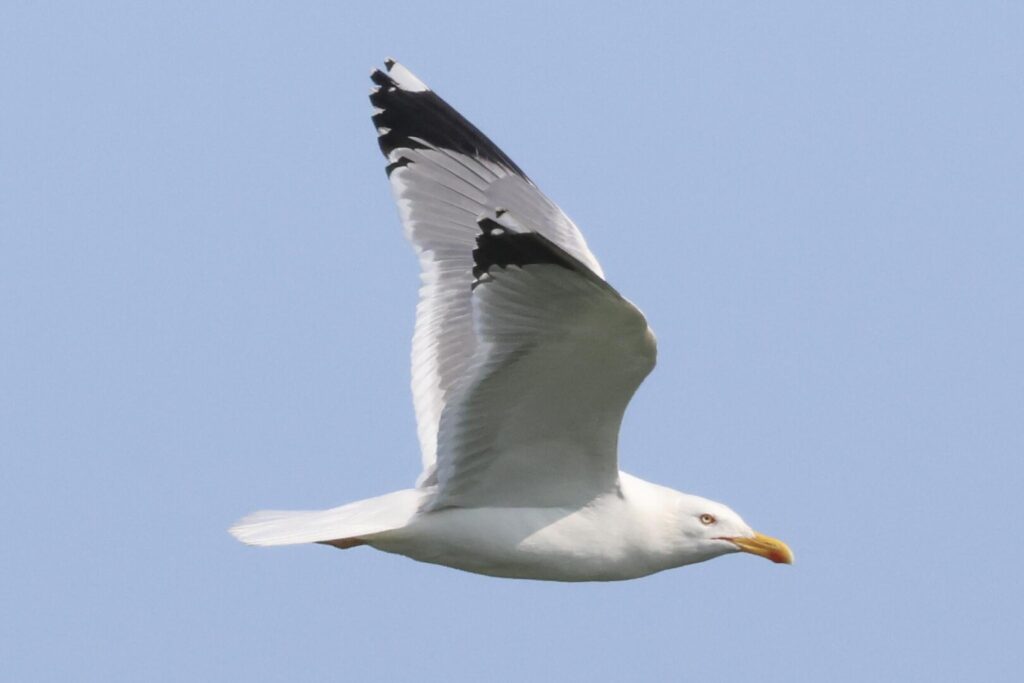
It was unfortunately time to be heading back, but we were just getting back in to the bus when an adult Yellow-legged Gull flew in and landed briefly.
It was a long drive back to Tulcea from here. When we arrived, the bus dropped us at the guest house this time. Our bags were already waiting for us, having been transferred here from the floating hotel earlier. Florin sorted out the rooms and we had a chance for quick shower before dinner. Soup, followed by stuffed breaded chicken and cake.
Tuesday 3rd June
Bright & sunny, max 32C
After breakfast, we set off in the minibus again. It was only a short drive to our first stop at an area of sandy cliffs next to a rewetted polder. As we disembarked, there were lots of Bee-eaters calling and flying round through the nearby trees. We could see their nest holes in the exposed face behind. A Roller flew across and a Kestrel came over with a vole in its talons.
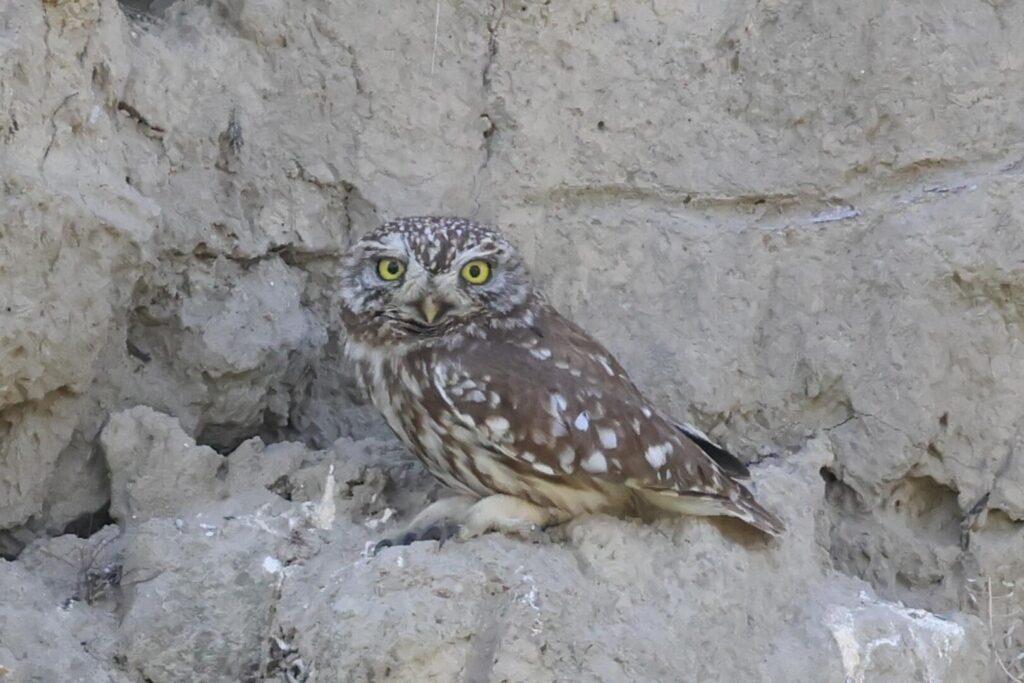
From the reeds and willows the other side, we could hear Golden Orioles fluting, Cuckoos calling and several Great Reed Warblers singing. Walking down along the sandy track, a Little Owl was perched up on the cliff face, looking down at us angrily.
Down on the edge of the reeds, Florin found a Penduline Tit nest in the willows. We watched one of the adults coming in and out repeatedly, presumably bringing nest material as the nest didn’t yet have its distinctive entrance tunnel. A Hobby flew in low over the trees and a couple of Kestrels circled up overhead. We picked up a single Alpine Swift too, high in the sky. Rather unexpected here.

A little further down, there were more Bee-eaters flying around a small disused quarry, again covered in nest holes. A much larger hole was occupied by three well-grown Kestrel chicks. The male Kestrel flew in from the reeds and landed in a nearby tree with a vole. The female flew straight over and took it from him but then didn’t take it straight to the nest. She appeared to eat most of it herself, before taking the remains to the young. They didn’t appear to want it and she came out again to finish it. Back at the minbus, a small group of White Pelicans was now circling up over the middle of the reeds.
We drove a short distance further down the road and in along a track again. A Long-legged Buzzard was flying the other way along the ridge beside us. We pulled up by another larger quarry which was completely coated in Bee-eater holes. There are estimated to be as many as 100 pairs here, and we watched all the activity from the minibus for a couple of minutes as Bee-eaters flew in and out. Back out along the track the way we had come, the Long-legged Buzzard had now landed in the grass over by the road. Two Isabelline Wheatears flew up from the track.

It took about half an hour to drive to our next stop, at an area of open woodland with grazing below. Two Steppe Buzzards circled up over the trees. A couple of Silver-studded Blue butterflies were drinking from a muddy puddle on the ground in the pull in. There were more butterflies in the grass as we walked slowly up through the trees, Clouded Yellow, Eastern Bath White, Cardinal and Queen of Spain Fritillaries, Small Heath and Adonis Blue and a couple of Common Pink-barred moths.
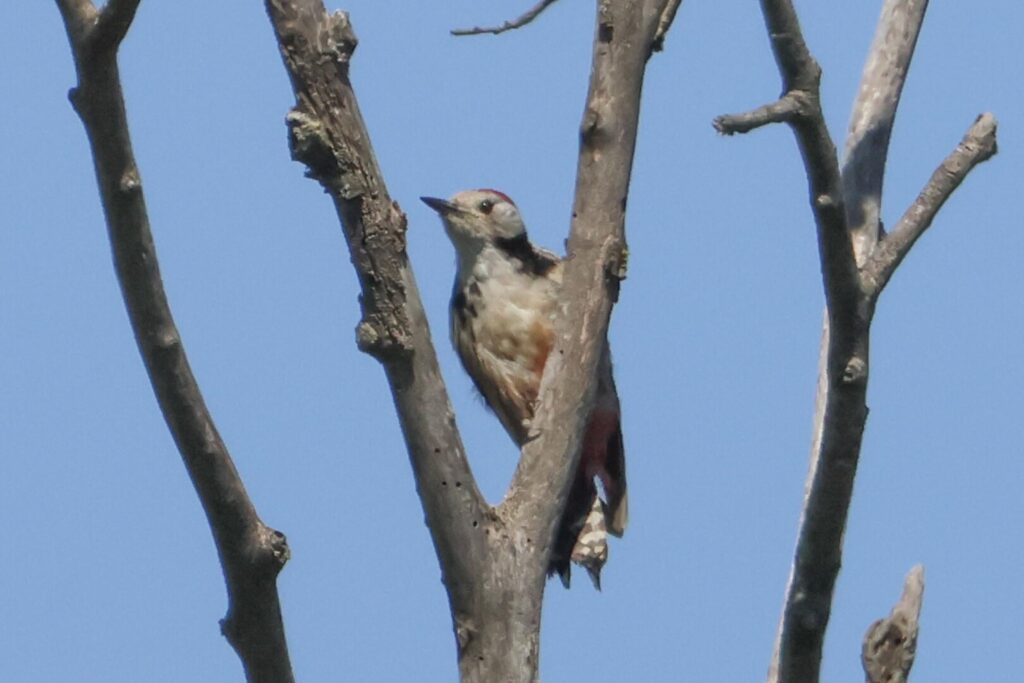
A Middle Spotted Woodpecker called and flew out of some large oaks, landing in a dead tree down by the road where we got it in the scopes. A little further on, a pair of Middle Spotted Woodpeckers flew round through the trees ahead of us. There was a pair of Lesser Grey Shrikes here too and we had good views of them perched in the trees. At one point, we watched a Middle Spotted Woodpecker climb up a dead branch in the crown of a large oak where a Lesser Grey Shrike was perched on the very top. The Woodpecker had it red crown feathers raised and was flicking its wings out, presumably trying to scare the Shrike off. It seemed to work.
A Hoopoe was feeding under the trees and flew up onto a leafy branch where it tried to hide from us as we passed.

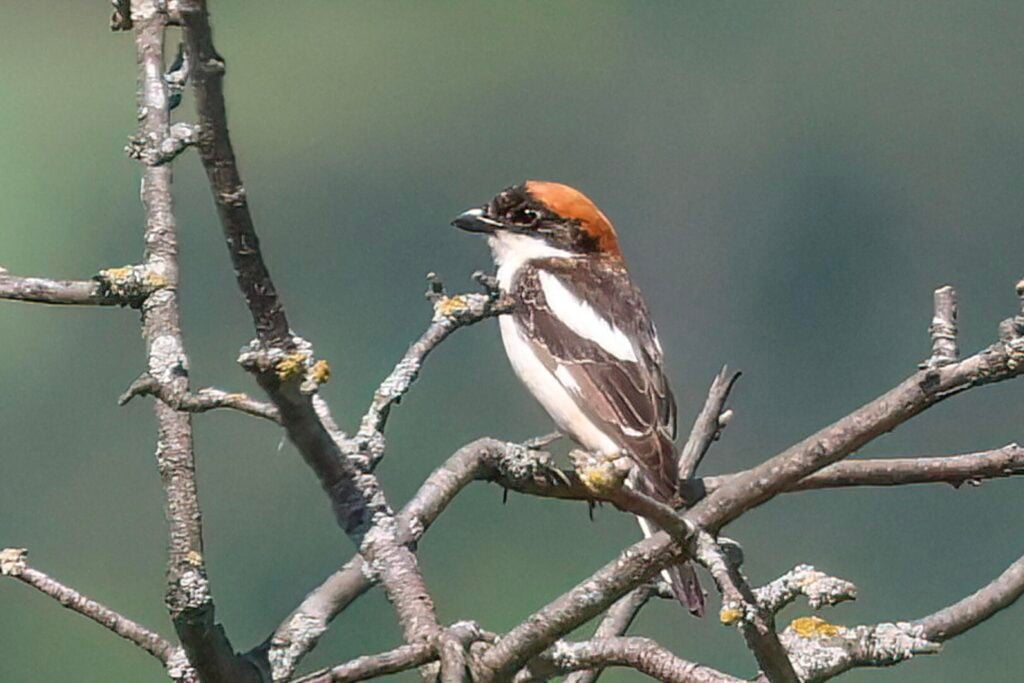
We noticed a smart male Woodchat Shrike in another tree and, while we were watching it, a female flew in to join it.
A Honey Buzzard drifted along the ridge above us and we picked up a Red-rumped Swallow flying round over the hillside too. A Woodlark started singing lower down and flew up briefly between the trees. We could hear Turtle Doves purring and a Common Nightingale singing from the other side of the road.
The minibus had driven down to meet us further along and was waiting in the shade under the trees. As we walked towards it, a pair of Red-backed Shrikes were perched on the top of a bush. Three different species of shrike on what was just a very short walk here. A family of Isabelline Wheatears was perched lower down in the same bush as the shrikes, two adults and a fully grown juvenile. The adults flew up in to the top of a nearby oak tree as we passed and they appeared to be mating at one point. Presumably time for another brood.
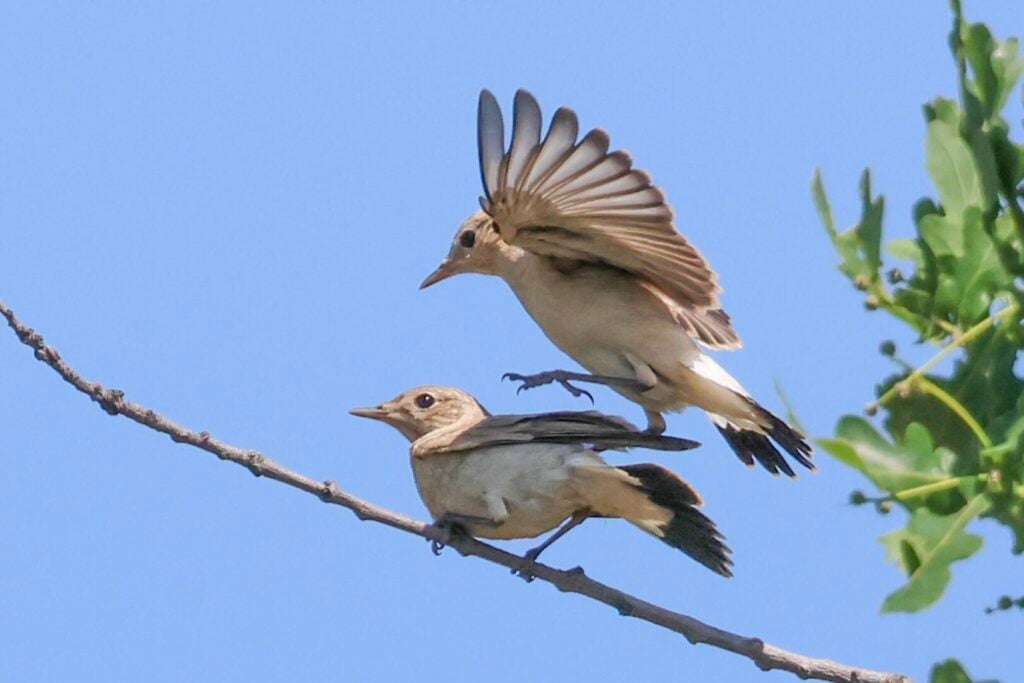
Our next destination was the monastery at Celic Dere. The minibus stopped to let us out in the car park and Florin heard a different woodpecker call. The only one we could find was another Middle Spotted Woodpecker, which was hiding round the back of the trunk in a dense fir tree. A Red-backed Shrike was flycatching from a tree in a nearby garden.
As we walked down the track towards the woods, we stopped to watch a couple of Great Spotted Woodpeckers on the trunk of a tree in the old orchard. A couple of Golden Orioles were calling in here too. There were lots of insects coming down to the wet mud in the track, the remains of a rapidly drying-out puddle. The butterflies included several Green Underside and Silver-studded Blues, Essex Skippers, and three Commas and there was also a tiny Pygmy moth. One of the Green Underside Blues took a particular liking to the shoes and then the leg of one of the group.
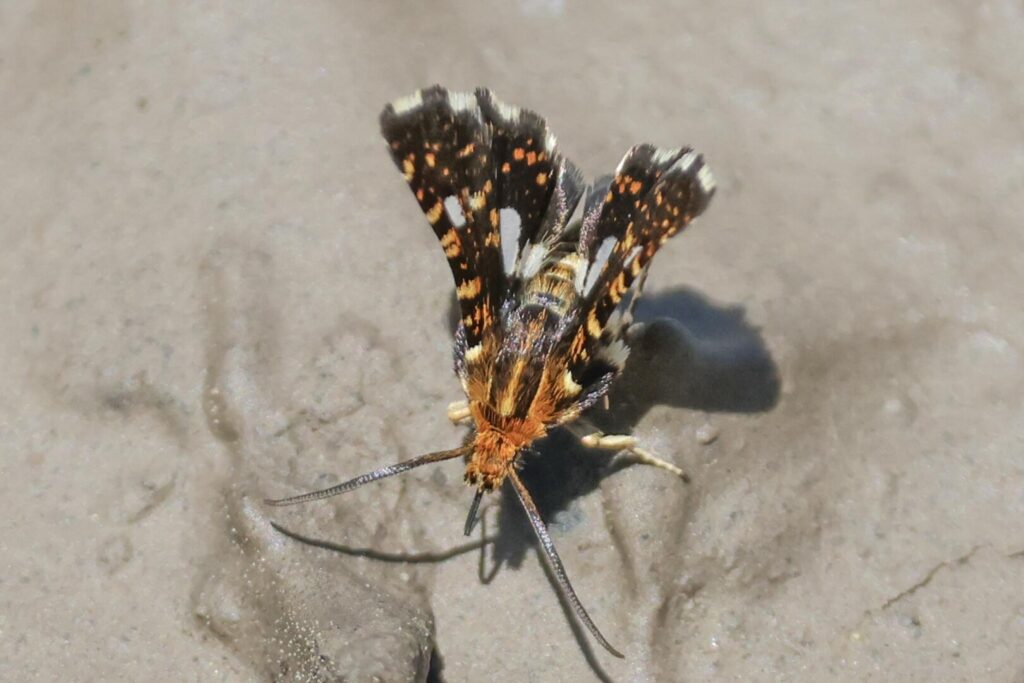
Further on, two Icterine Warblers were singing in the trees. They weren’t particularly easy to see though, mostly high up in some very leafy walnut trees. Two Nuthatches started piping and we could see them in the trunk of a nearby tree, where they were joined by another Middle Spotted Woodpecker. The minibus had driven further on and parked on the grass above a small stream. Walking round the edge of the narrow field towards it, a Woodlark fluttered up singing, two more Red-backed Shrikes were perched in the tops of the trees and a pair of Turtle Doves flew in and out.
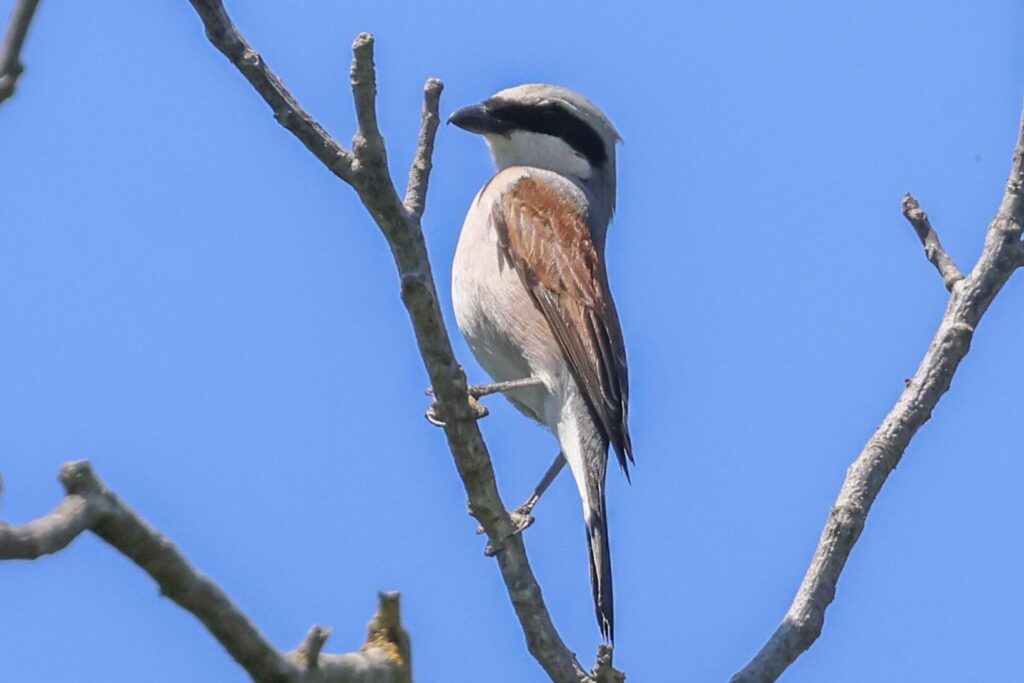
Some of group had seen a female Levant Sparrowhawk but it disappeared before the rest of us arrived. It was time for lunch and the picnic table was already set up by the minibus. The guest house had run out of zacuska but had kindly made some more for us today, a traditional Romanian vegetable spread made with roasted aubergine and red peppers. Delicious! While we were eating, we had a brief glimpse of a male Levant Sparrowhawk as it came out of the trees by the stream and disappeared into the wood the other side of the field.
A Black Stork circled up further up the valley and then drifted low right over where we were picnicking. A Steppe Buzzard and a Booted Eagle drifted over the trees on the hillside beyond. We were just having coffee, when the male Levant Sparrowhawk appeared again. It came in low through the trees right towards us and over the top of the minibus just behind. It was gone in a flash but then circled round and came back up through the bushes by the stream and round over our heads. We could see its blue-grey back and very white underwings with black wingtips. Then it turned again and disappeared off back through the bushes. Quite a place to stop for lunch!

After we had finished our coffee and cake, we set off down towards the wood. A Hawfinch flew over the stream calling but disappeared straight in to the trees. We cut across the far end of the field and into the wood. Walking up through the trees, we could immediately hear a Red-breasted Flycatcher singing on one side of us and a Wood Warbler on the other.
We went to look at the Red-breasted Flycatcher first and quickly found it although it was moving round constantly. It was easy to track though, as it was singing, and eventually came into the trees close to the track where it showed very well. We could see its orange throat and breast and the white sides to its black tail when it cocked it.

Moving on to the Wood Warbler next, it was further up the slope and hard to see in the trees. We could only head it singing at first. Then it too gradually worked its way down closer to the track and we had good views as it flew back and forth through the trees.
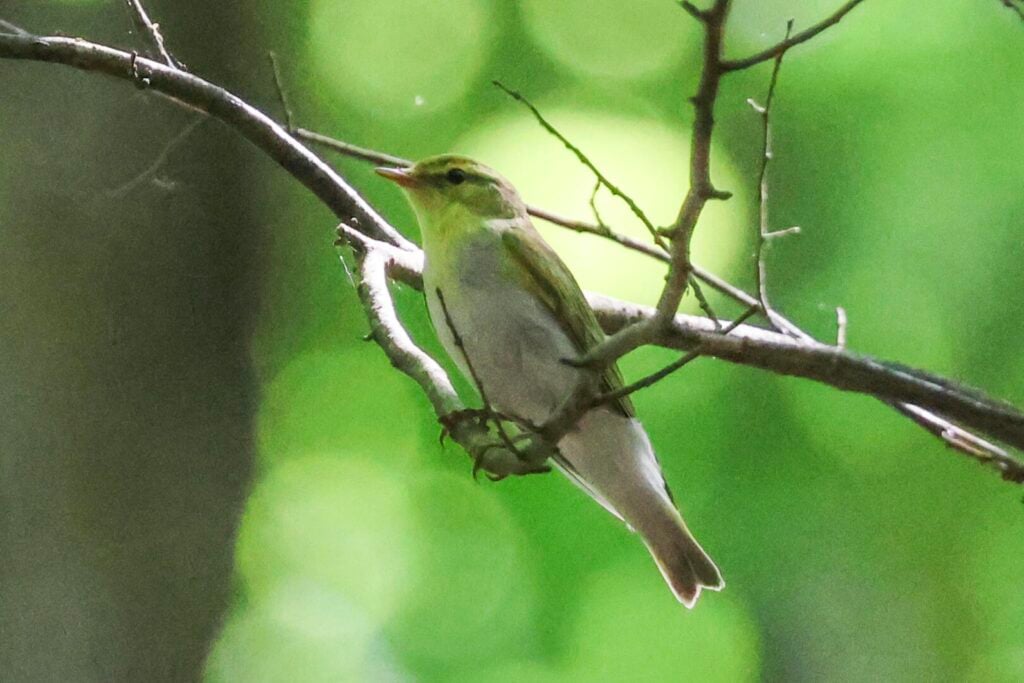
We had a long drive to our last stop of the afternoon, so we had to tear ourselves away and walk back to the minibus. It took a little over an hour to get to the Macin Mountains. As we drove in along the entrance track, a couple of Rollers were on the wires and a Yellow Wagtail flew up ahead of us. A family of Isabelline Wheatears were perched on the rocks in a small fenced off compound and a Crested Lark was feeding on the track.
We parked at the start of a trail which leads up into the hills along a small valley. Walking in, a male Red-backed Shrike was perched in the tops of some nearby trees. We heard a Levant Sparrowhawk calling and stopped to look. One of the group spotted one on a branch in the trees, which was not the bird which was calling. We had great views of it through the scopes.

As we walked on, into the start of the valley, we scanned the rocks. Two Ravens were perched on the very top of the highest ridge ahead of us and a couple of Long-legged Buzzards were hanging in the wind in front.
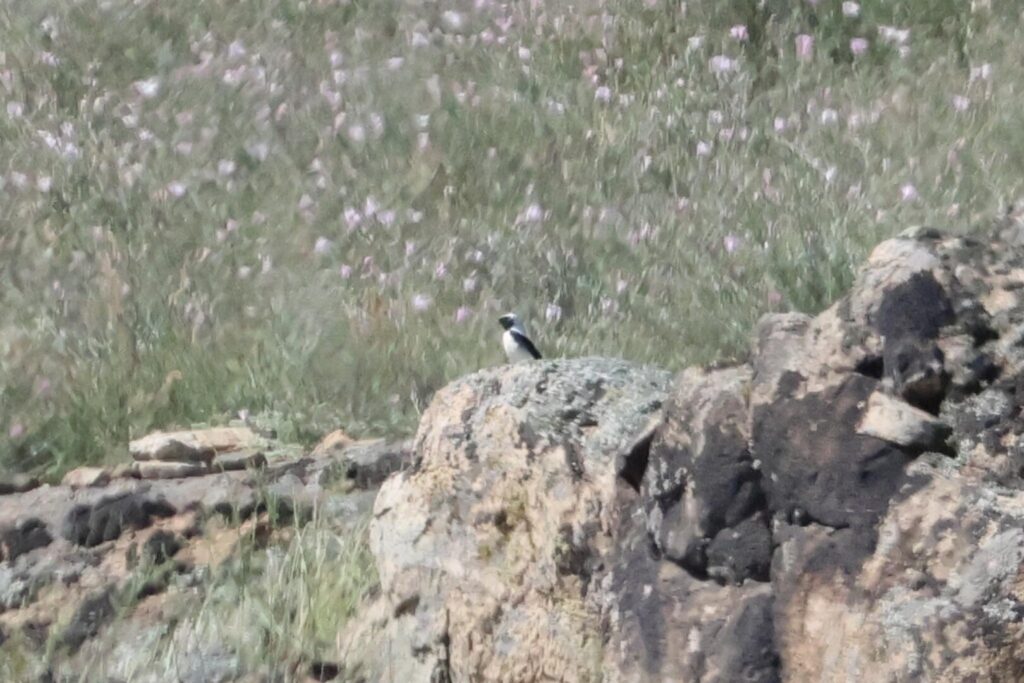
Florin picked up a very distant Pied Wheatear briefly on a distant crag. Then it flew in and dropped lower down, eventually landing in the top of an old quarry a bit closer to us. It dropped down out of out of view at first, but then reappeared on the top of a dead stem nearby. We got the scopes on it and it looked like an immature male, rather brown like a female but with a black throat.
Eventually it flew back higher up the slope and a second, black-and-white full adult male appeared on the top of the crag above briefly. What was presumably the same bird then reappeared on the rocks at the top of the far side of the quarry. They were always rather distant, but OK views in the scopes.
With our main target here in the bag, we carried on along the track a little further up into the small valley. A stream trickles down through here and there are small puddles and wet mud in the shelter of the trees. Lots of butterflies were coming down to drink. We stopped to watch for a while and found lots of Common Blue, Green Underside Blue and a single Adonis Blue, a small group of Small White and Balkan Green-veined White, lots of Cardinals and a few Queen of Spain Fritillaries and a couple each of Grizzled and Oriental Marbled Skippers.
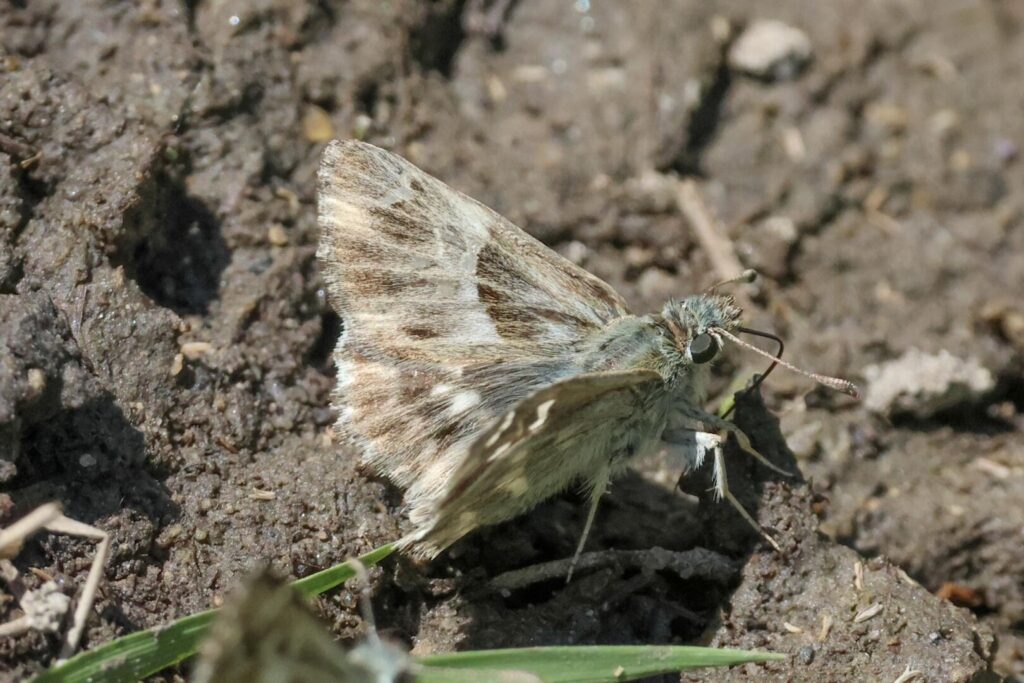
Just beyond, we found a couple of Delattin’s Graylings on the track too. Then, unfortunately, we were out of time and we had to walk back down to the minibus. An Eastern Green Lizard crept away into the undergrowth.

As we refilled our water bottles from the back, an Isabelline Wheatear was standing on a nearby rock.
It was long drive back to Tulcea from here. When we finally arrived, we had time for a break to freshen up before our last dinner. Tonight it was soup followed by grilled chicken, then the cook came out of the kitchen carrying a beautiful cake. It was cut and served with a glass of Romanian sparkling wine, a farewell after our wonderful stay in Tulcea and the Delta.
Wednesday 4th June
Bright & sunny, max 31C
Mainly a travel day today, we would be driving back to Bucharest this morning and then flying to UK this afternoon. We had the chance for a lie in this morning, with breakfast put back by half an hour to give us time to pack. After breakfast, Florin came to the guest house to bid us farewell – he had another group coming in this afternoon – and we thanked him and the staff at the guest house for looking after us so well. We boarded the minibus and set off at 9am, leaving Tulcea and the Danube Delta behind. One last look back through the windows.
We had time for one birding stop on our way this morning. Florin had given us a site close to the road where a pair of Stone Curlews had been recently, an area of steppe only about half an hour from Tulcea. We parked in the layby and got out. As instructed, we scanned the hillside and found a pair of Crested Larks, a few Northern Wheatears with one male singing and songflighting, a single Isabelline Wheatear too and a Hoopoe on a rock, but no sign of the Stone Curlews. A Booted Eagle drifted in over the fields nearby and circled overhead.
We walked slowly up the hill, scanning ahead of us in case anything was hidden from view in the vegetation. All we found was a smart male Linnet which was in the grass, a last addition to the trip list. A Long-legged Buzzard appeared over the top of the ridge and three Bee eaters circled over too. One of the group heard a Stone Curlew call distantly and thought it sounded like it came from over the top of the hill.
It was rather warm already so a few of the group did a quick scout up to the ridge. There was a lovely view over the steppes, with a small Bee-eater colony at the bottom of the valley beyond, but no sign of anything else. We walked back down to the minibus and it was time to continue on our way.
The rest of the journey was fairly uneventful. About half way, we stopped at the same filling station we had visited on the way out. A chance to stretch our legs and use the facilities. There was a bit of congestion on the old ring road round Bucharest but we still arrived at the airport on time, a little over two hours before we were due to take off. Check in was seamless and our transit through security and passport control was quick and easy.
Our Ryanair flight was scheduled to depart at 16.40 and finally got into the air only about 15 minutes late. We arrived at Stansted just after 18.20 (two hours behind Romania), similarly only quarter of an hour behind schedule. Thankfully, there were no queues at security and our bags were waiting when we got to carousel. We said our goodbyes and headed out into the chilly UK summer weather (about half the temperature it had been in Romania this afternoon!).