A 1-day Late Autumn Tour in North Norfolk today. Earlier in the week, it was forecast to be wet and windy today but thankfully that had all changed. We didn’t even see any of the showers which were now said to be possible in the afternoon. It was still a bit breezy but not as bad as we thought it might be and there were some nice sunny spells too. A lovely day to be out looking for autumn migrants on the coast.
Our destination for the morning was Cley. As we disembarked from the minibus in front of Walsey Hills, we looked across the road but couldn’t see the long-staying Grey Phalarope on Pope’s Marsh at first. A couple of Song Thrushes flew out of the bushes on the top of the hill and three Redwings came up out of North Foreland plantation and flew off inland.
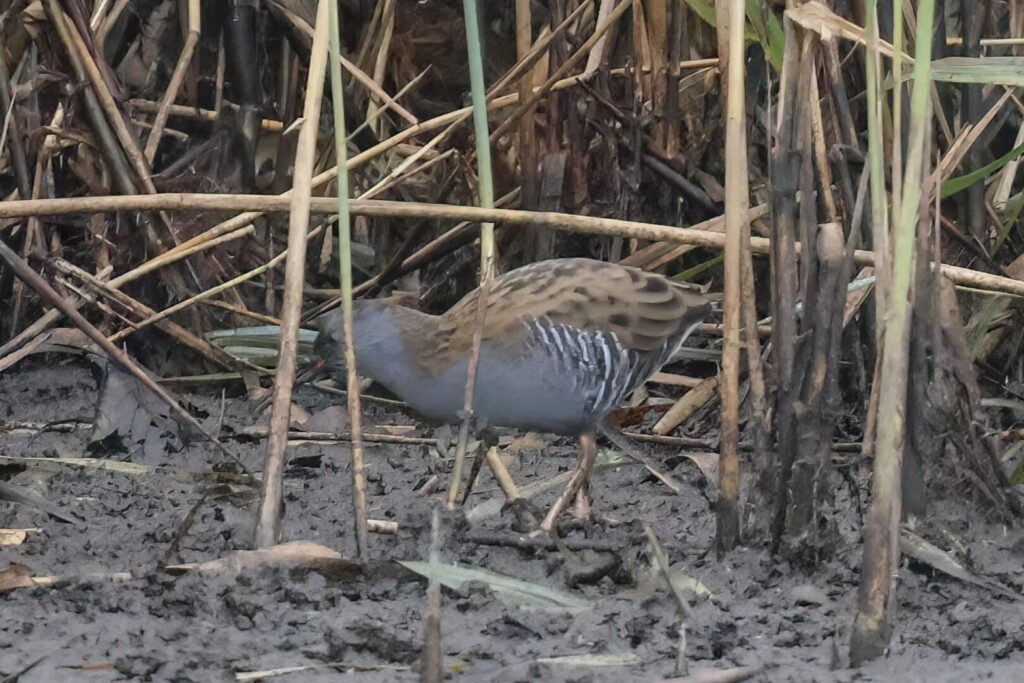
Snipe’s Marsh is still pretty much dry and there were just a couple of Teal round the last remaining puddle as we walked past. Then a quick scan of the reeds on the far end revealed a Water Rail lurking on the edge. It disappeared deeper in but then came back out again. We had a good view of it then as it worked its way round on the edge of the mud.
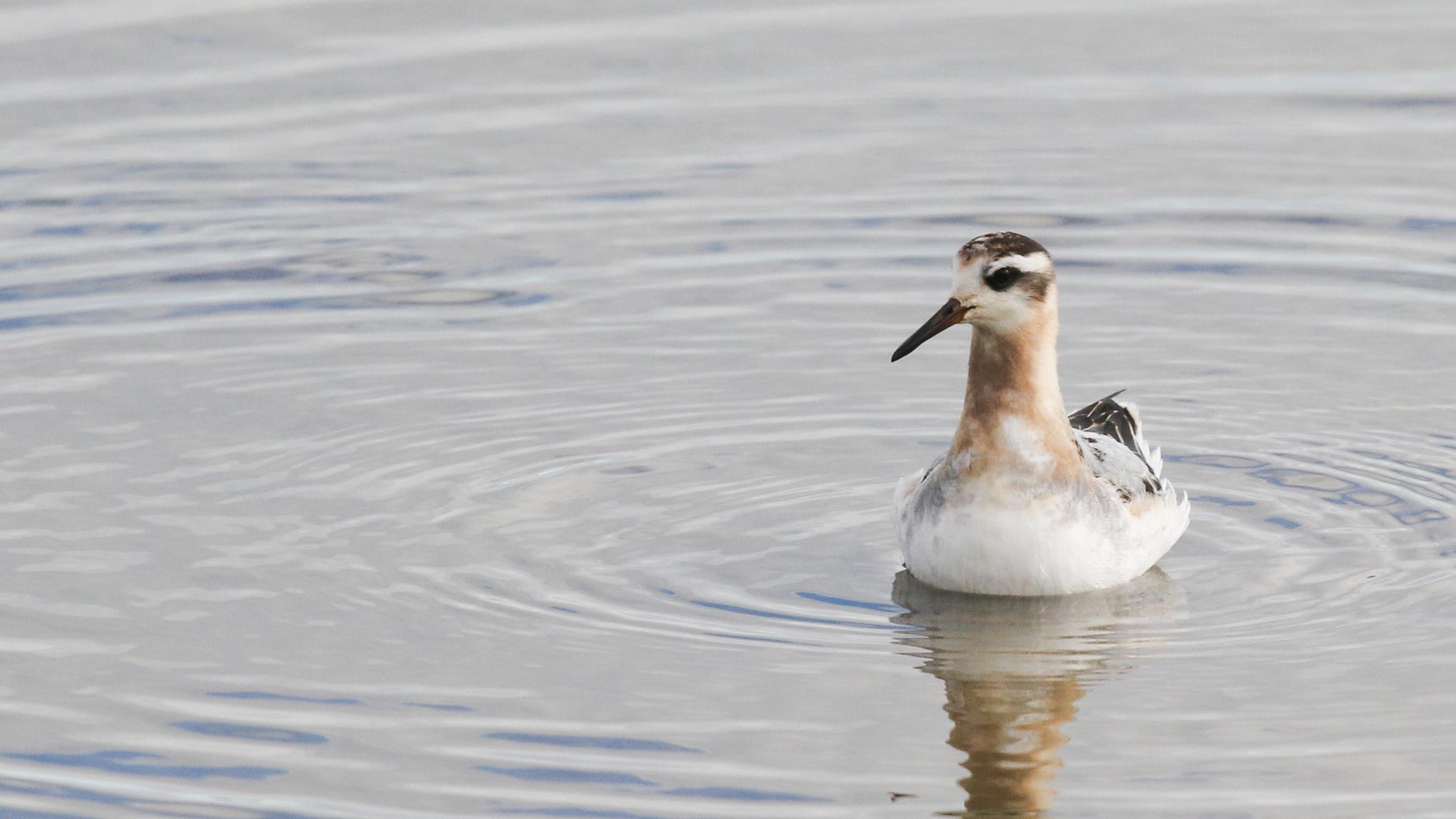
From up on the start of the East Bank, we could see the Grey Phalarope now. It was feeding with the Shoveler distantly on Pope’s Pool, where it has been for the most of the last week. The Shoveler swim round, stirring up the mud, and the Grey Phalarope swims around after them, picking up any morsels which have floated to the water’s surface.
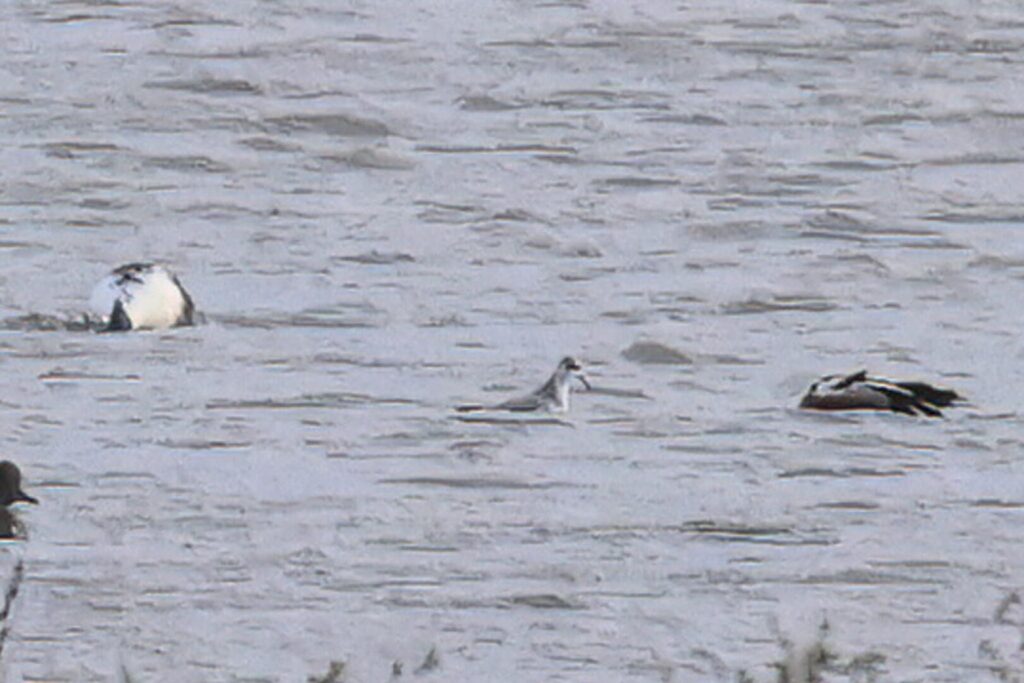
Grey Phalaropes breed in the high arctic, the closest possibly in Greenland and a few pairs also in Iceland. They winter out on the open oceans, mainly off West Africa and South America. They are scarce visitors here, mainly young birds in late autumn, often after storms. This one was probably blown in last weekend.
There were a few other ducks on Pope’s Pool, including several Pintail. Lots of Cormorants were loafing on the islands along with one or two Great Black-backed Gulls. A single Little Grebe was diving at the back. Three Canada Geese dropped in.
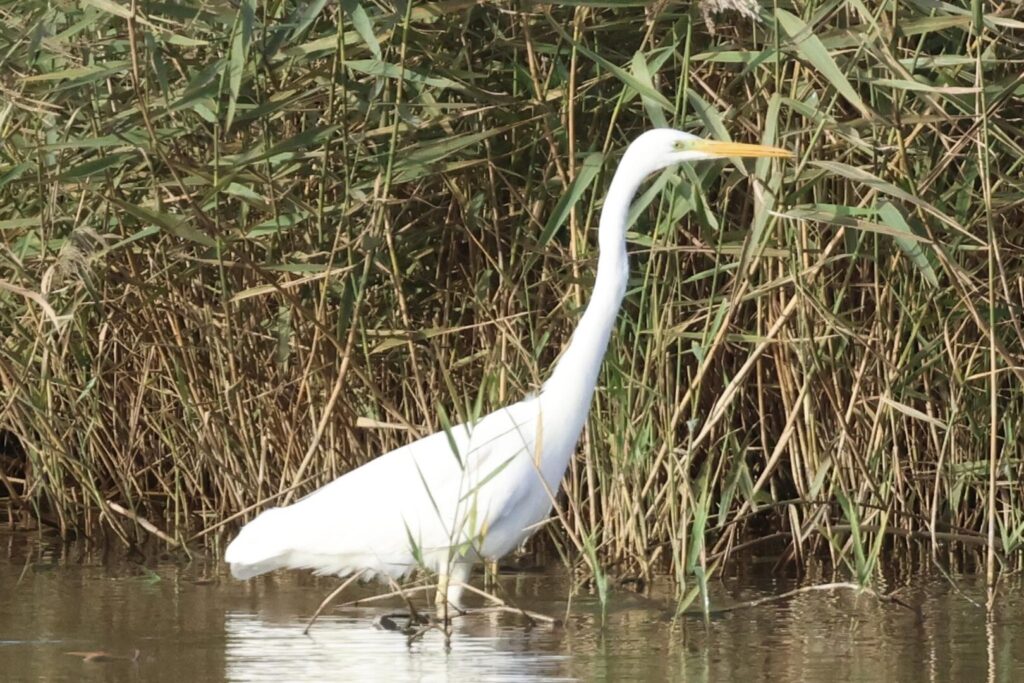
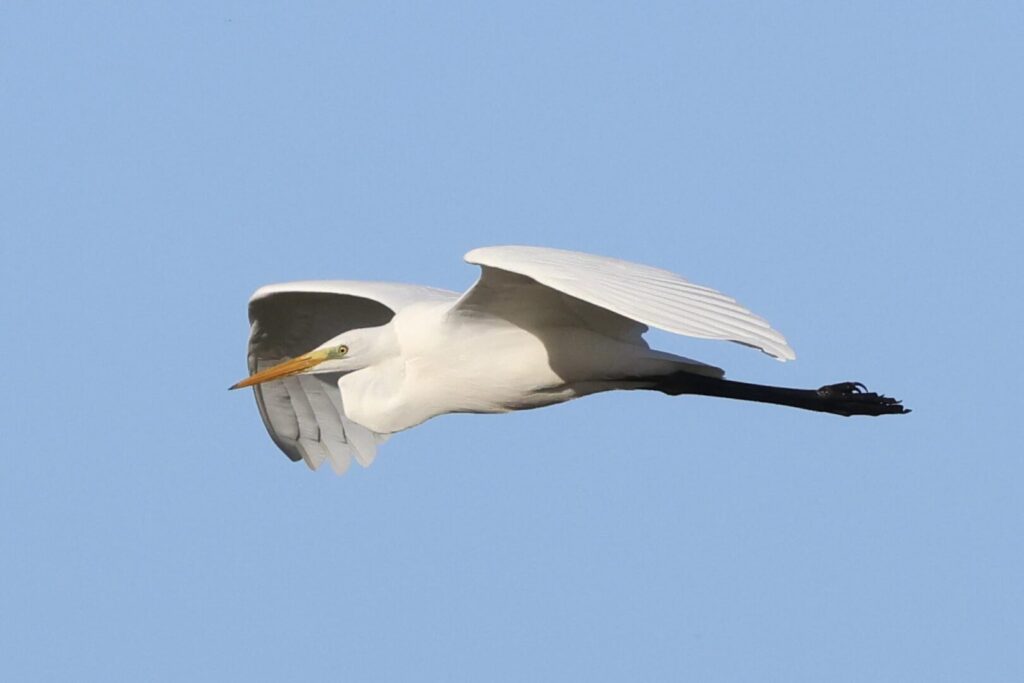
The other side of the bank, we could see a Great White Egret on the Skirts Pool. There were several around all summer but this is the first we have seen here for a few weeks. We could see its long, dagger-like yellow bill.
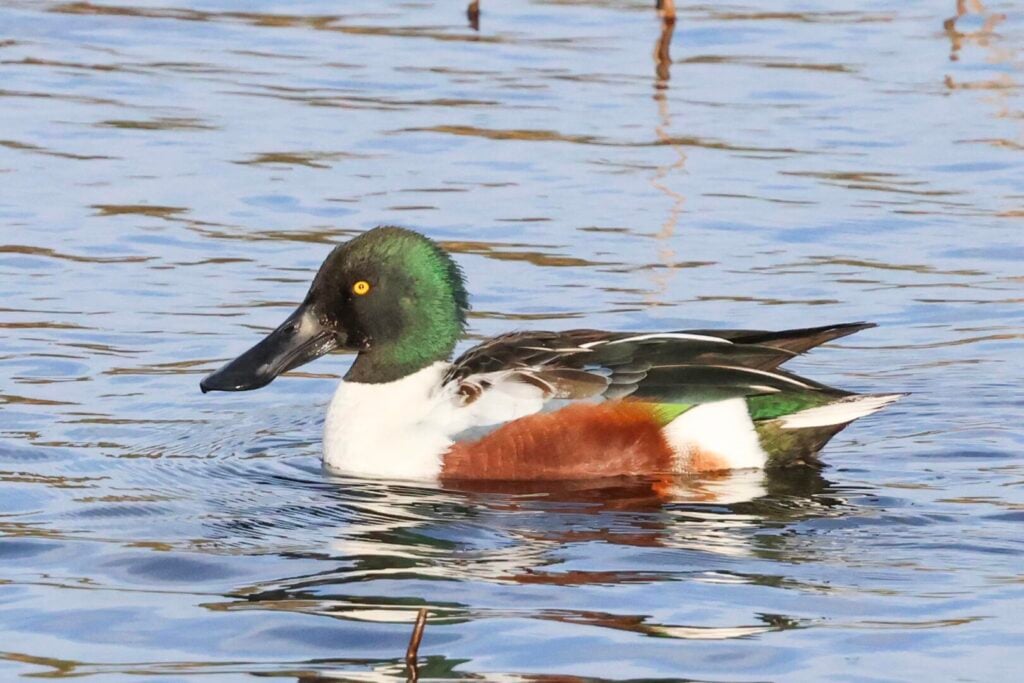
There were more Shoveler on Don’s Pool, looking very smart in the morning sunlight. Another Little Grebe disappeared into the reeds.
Just beyond, we heard Bearded Tits calling and caught a glimpse of one disappearing back down into the reeds. We stood and listened for a while. We heard them several more times but they were keeping well hidden. It was probably a bit too breezy today to see them in the tops of the reeds. A Cetti’s Warbler shouted at us from the bushes, the first of several. They are very vocal at the moment, as were several more Water Rails squealing from the reeds.
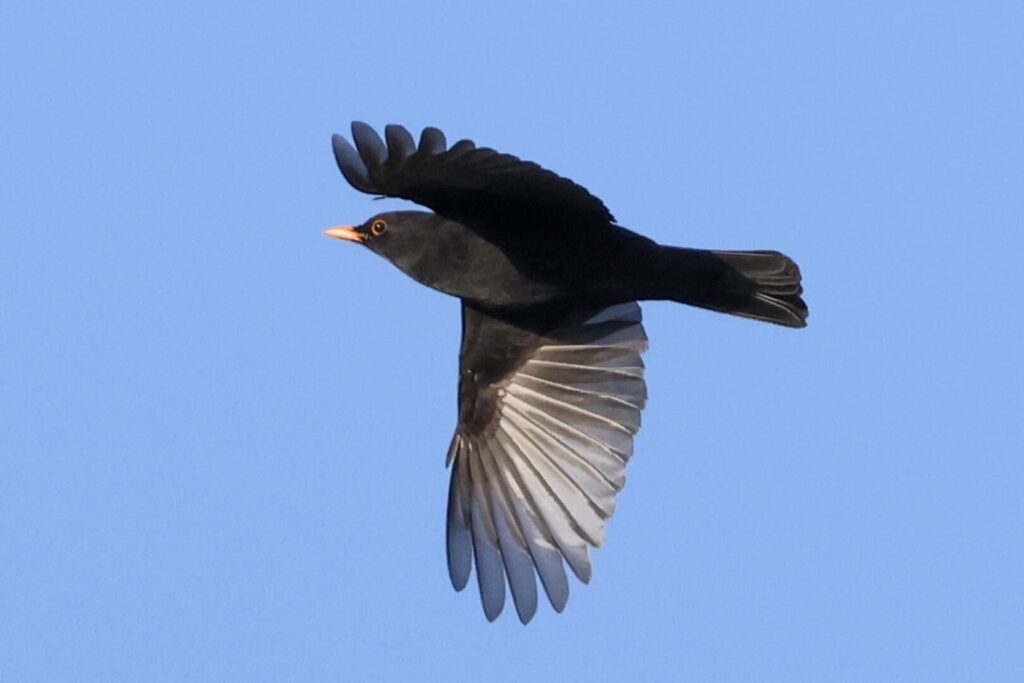
A Blackbird flew in high over the reeds past us and we watched it continue on over the road and into the trees beyond. It was followed shortly afterwards by a second, which did exactly the same thing. Migrants, freshly arrived in from Scandinavia having flown over the North Sea overnight. A little later, a large flock of Redwings flew in over the reedbed too.
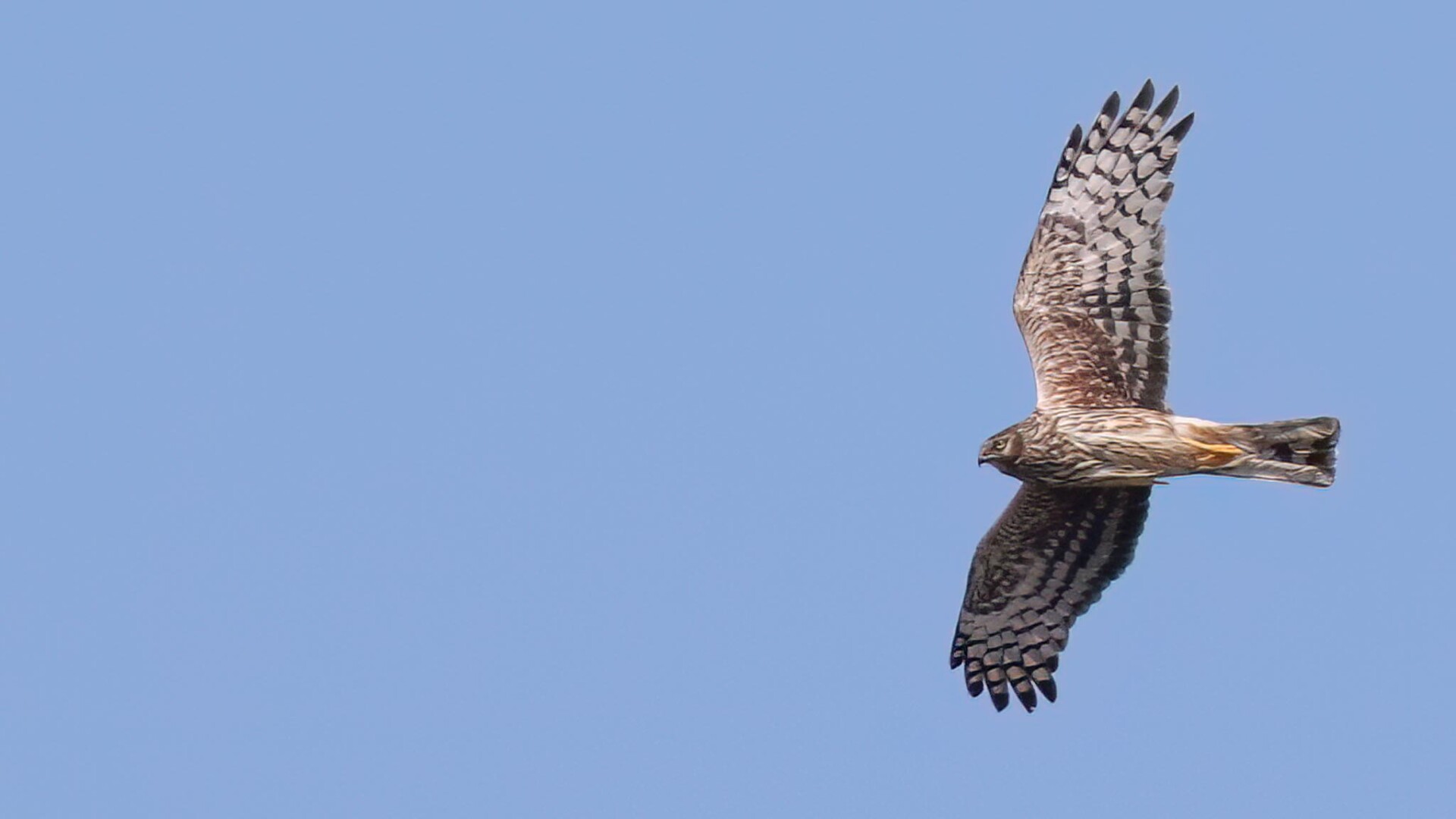
Continuing on up along the bank, a male Marsh Harrier was patrolling over the reedbed in front of the hides. A second was flying round over towards the beach. Three Stonechats were feeding just beyond the reeds on the edge of Pope’s grazing marsh. The female flew up into a bare willow by the bank, just ahead of us.
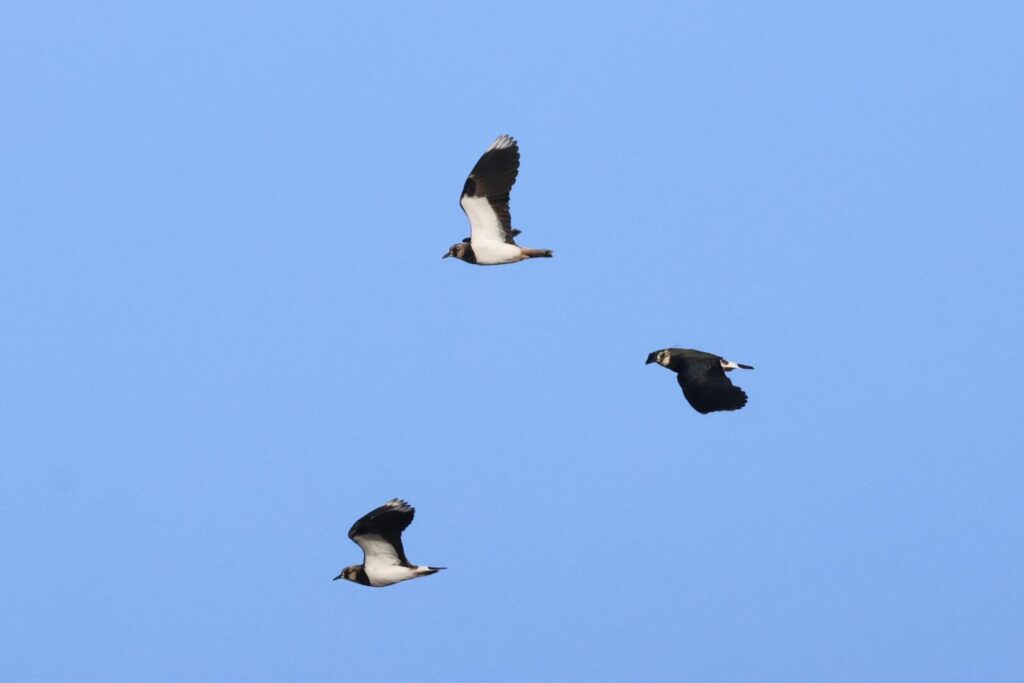
A couple of small flocks of Lapwings flew in over the grazing marsh and carried on off west over the reedbed. Always hard to tell whether they are just local birds moving but they felt like they might be more migrants arriving. Our suspicions were probably confirmed later when we saw some Lapwings actually coming in off the sea.
There were lots of Wigeon on the grazing marsh today. The number of ducks here are still growing steadily, as more and more return for the winter. We stopped to admire some of the Wigeon, the drakes now started to moult out of their drab, rusty eclipse plumage.
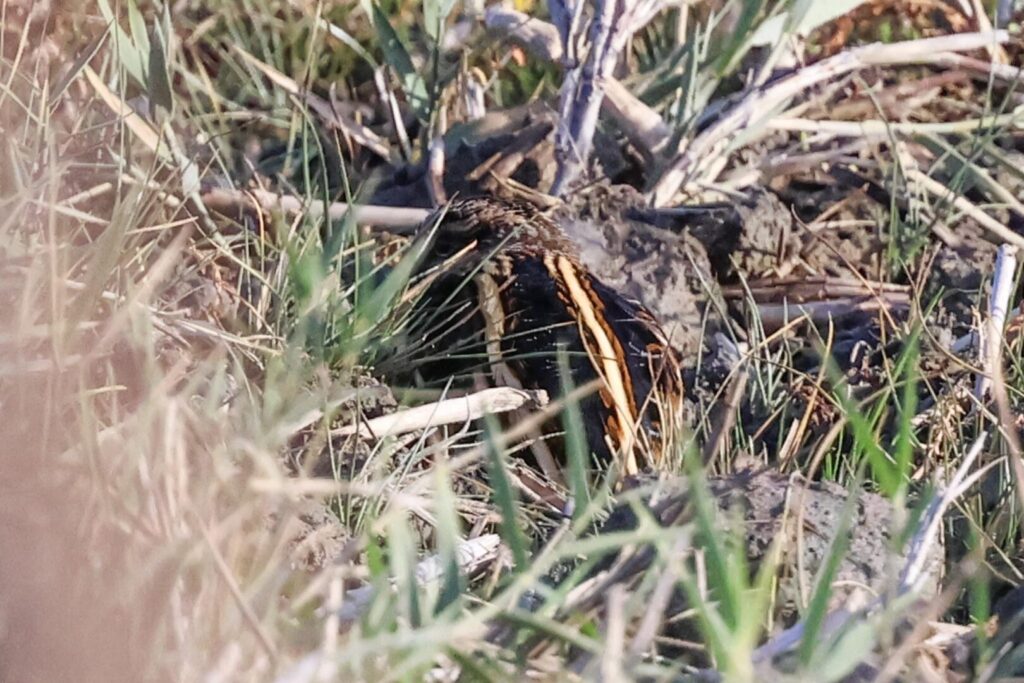
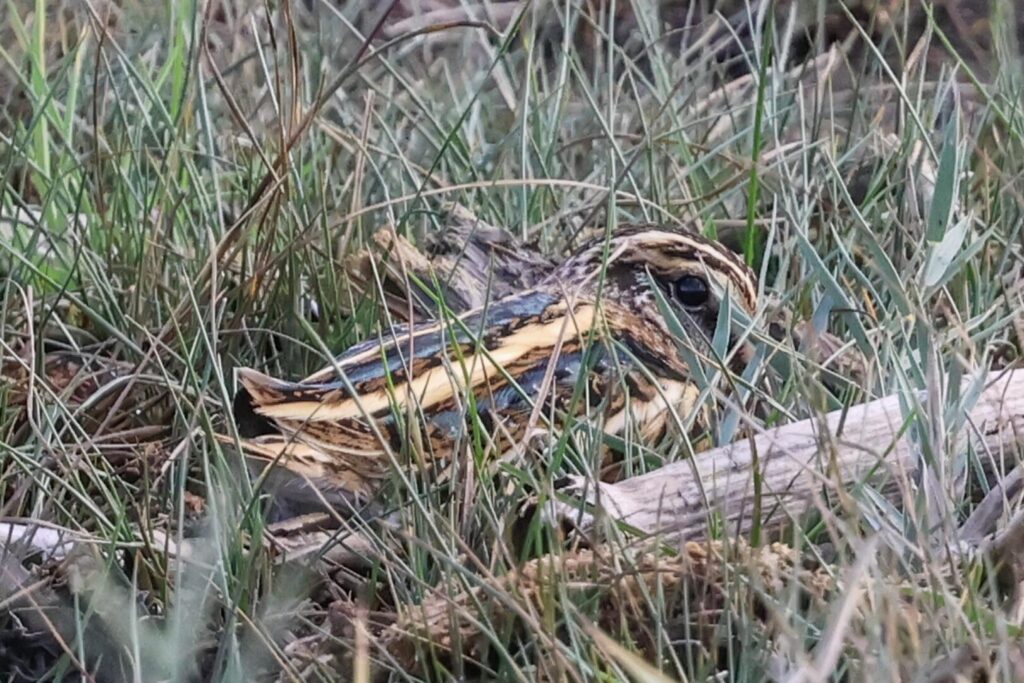
Further up, there were several Common Snipe hiding in the grass by the Serpentine. They were not as well hidden as the Jack Snipe we found though, even though it was close to the bank. At first, we could just see its golden yellow back stripes. Then it started to bob, as Jack Snipes usually do when they are active, and moved a little further out into the open. We could see its dark central crown now and compare its head pattern with a nearby Common Snipe.
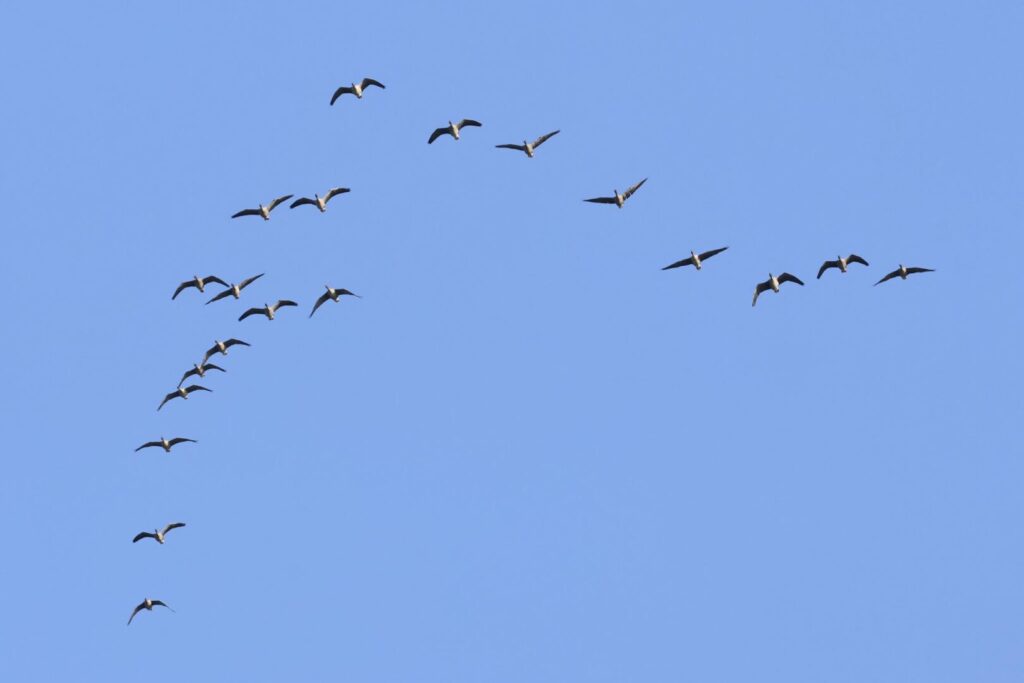
While we were watching the Jack Snipe, we heard Pink-footed Geese calling and looked up to see a small skein flying in from the east. They carried on overhead and off west. There had been a thousand or more still here in recent days, commuting between the reserve, the fields inland and Blakeney Freshes. Strangely, there was no sign of them today and these were the only Pink-footed Geese we saw.
We pointed out the Jack Snipe to some other people coming up the bank and then continued on towards the beach. Looking over the reeds, we could see some Brent Geese very distantly in the Eye Field, beyond the new North Hide. We were just discussing how they are still returning from Siberia for the winter now and, as if on cue, one flew in over the beach and off west towards the others.
A Great White Egret dropped in on the Brackish Pools, by the main path ahead of us. There were several more Pintails on the water beyond, three drakes. They were upending and showing off their pointed rear ends, even if they haven’t got their full pin-tails yet. There was a selection of waders on Arnold’s Marsh – mainly Redshanks and Dunlin, plus a couple of Grey Plover and a few Curlew.
When a Great White Egret flew over and disappeared off west, we presumed it was the same we had just seen land. But as we walked on towards the beach, that one flushed from the pools by the bank. We had seen at least two, maybe three here today.
Out at the beach, it looked to be rather quiet at first. There are often several Red-throated Divers on the sea but we couldn’t see one initially. Scanning offshore, we started to see small flocks of Starlings coming in. Then we picked up a couple of Blackbirds and Redwings, a Song Thrush, and several Skylarks in twos and threes. All birds flying in from Scandinavia as we stood and watched.
Several Shelduck flew past over the sea, probably returning from their moult migration to the Waddenzee. A flock of six Teal flew past, but couldn’t make up their minds and kept landing on the sea and flying back the other way. A lone Common Scoter flew past and then we found a small group of five further back on the sea. There was a steady passage of Dunlin past, ones and twos flying west all the time, and the same of Common Gulls. All migrants arriving fresh from the continent.
Eventually we picked up a very distant Red-throated Diver briefly. It was a winter adult, with a very white face and neck which caught the sunlight. But it dived and we didn’t pick it up again. Thankfully a little later another, greyer first winter Red-throated Diver appeared on the water to the west. It was coming our way, diving all the time and resurfacing closer until it eventually appeared right in front of us. There were a couple of Razorbills on the sea too.
Eventually we managed to tear ourselves away from the beach and set off to walk back. There was a large crowd on the East Bank ahead of us now, gathered to see the Jack Snipe. It was showing a bit better now, creeping around and bobbing up and down again. We stopped for another look through the scopes.
Back to the minibus, we drove over to the Visitor Centre for a quick coffee break and a chance to use the facilities. While most of the group had gone for coffee, we were just locking up the minibus as a Brambling flew over calling and disappeared off west. We still had time for a quick look out on the reserve before lunch, so after a short break we made our way out to Bishop Hide.
There were lots of ducks and Black-headed Gulls loafing out on Pat’s Pool. Several Black-tailed Godwits were feeding in the water in front of the hide and more were over the back with a single Avocet. Most have already gone south for the winter. There were a few Lapwings and a couple of small groups of Dunlin on the islands further back.
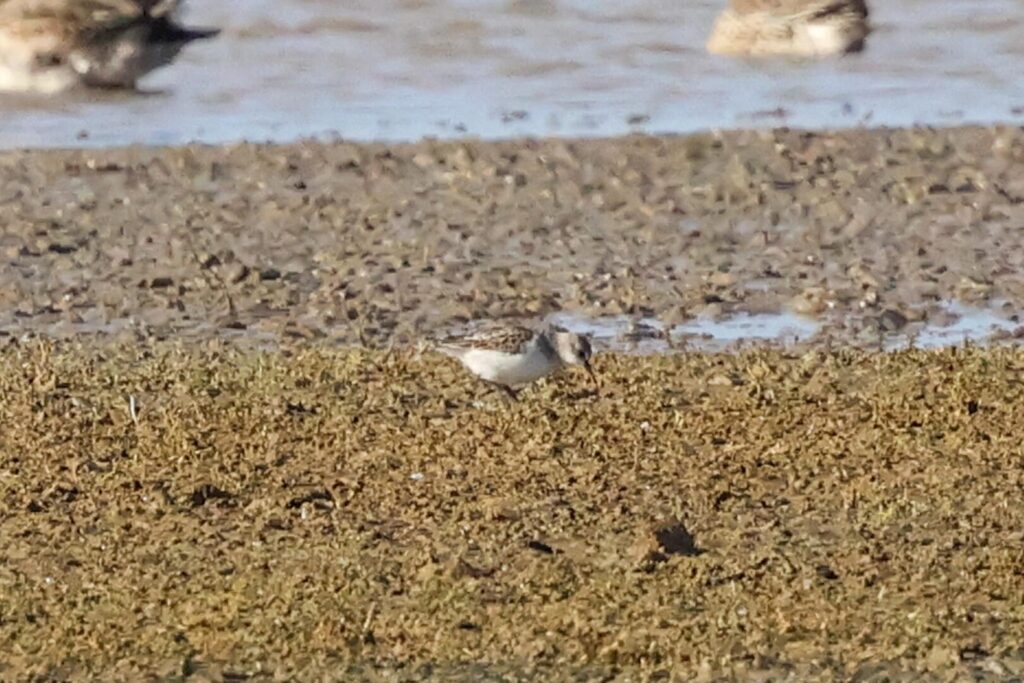
There has been a late Little Stint on the scrape here the last couple of days and we picked it up briefly on the island over towards Teal Hide. But it quickly disappeared behind the reeds in the middle, out of view. While we waited for it to reappear, we picked up the 1st winter Spotted Redshank over the far side of the scrape, beyond the Godwits along the edge of the reeds. It was noticeably paler than the Common Redshanks we had seen earlier. Through the scopes, we could see its longer, finer bill too. A single Ringed Plover was on one of the islands too.
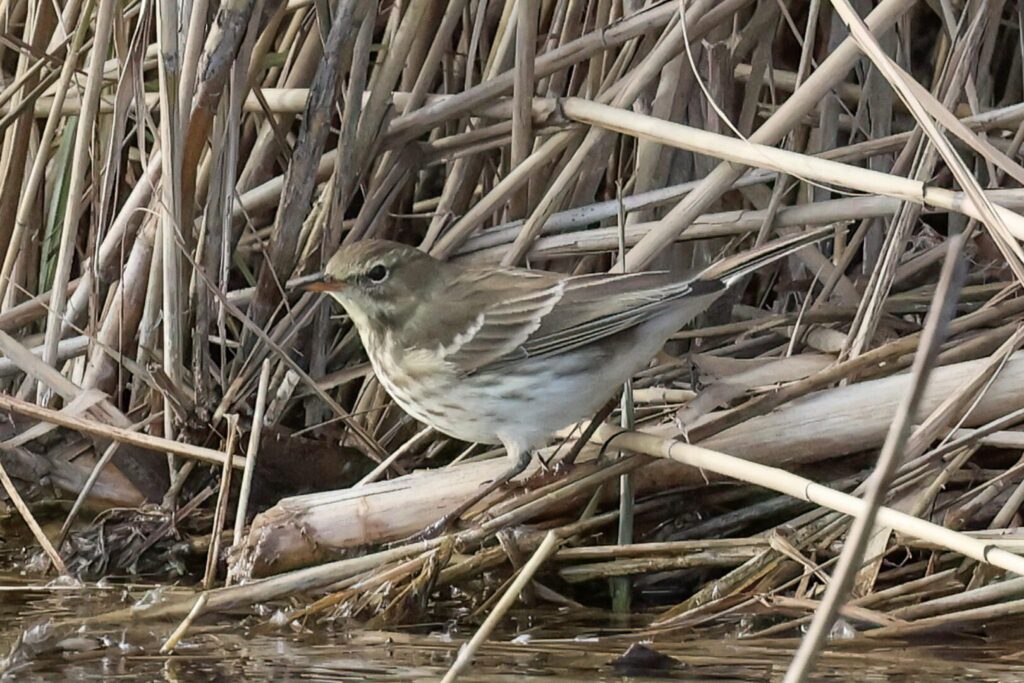
A Water Pipit called as it flew in and dropped down onto the cut reeds in front of the hide. We had a very good view of it as it made its way along the edge of the reeds and picked around on the mud. A scarce winter visitor here, this is a good time to see them at the moment.
A pair of Stonechats appeared in front of the hide too and dropped down to feed on the cut reeds. There had been a very late Whinchat here the last couple of days but we couldn’t see any sign of it now. The wind was whstling over the tops of the reeds, so presumably it was keeping down, finding insects somewhere out of the wind.
A Red Kite drifted over the hide and out across the scrape, flushing everything. The waders all whirled round and the Dunlin eventually landed on the mud on the edge of one of the islands a little closer. Looking across we picked up the Little Stint again too now. It was feeding on the top of the island on the drier mud nearby. We had a good view of it through the scopes, at one point feeding alongside a Dunlin for a good side-by-side size comparison. You could really appreciate how small the Little Stint was.
We walked back to the Visitor Centre for lunch. It was remarkably nice weather for the 1st of November and the picnic area was out of the wind, so we could sit here and enjoy the sunshine. After lunch, we drove round to the Beach Road. Three Egyptian Geese and several Canada Geese were out on the grass on Bull Marsh as we passed but we couldn’t see any sign of the Ruddy Shelduck with them.
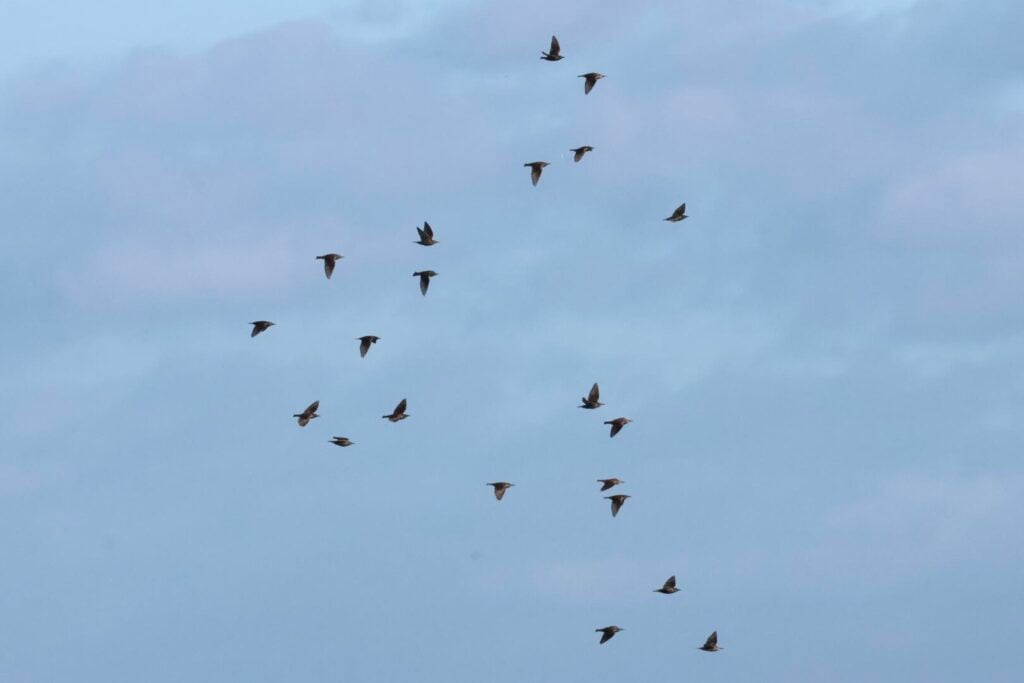
There were still lots of Brent Geese in the Eye Field. We parked in the car park and decided to have quick look at the sea first. There had been a Slavonian Grebe reported earlier but there was no sign of any grebes on the water now. There was still a steady arrival of small groups of Starlings in over the sea. We picked up a Blackbird coming in low over the waves. We pleased to see it make it in safely and crest up over the shingle. Another Redwing made it in too. Several Turnstone flew past and landed on the beach.
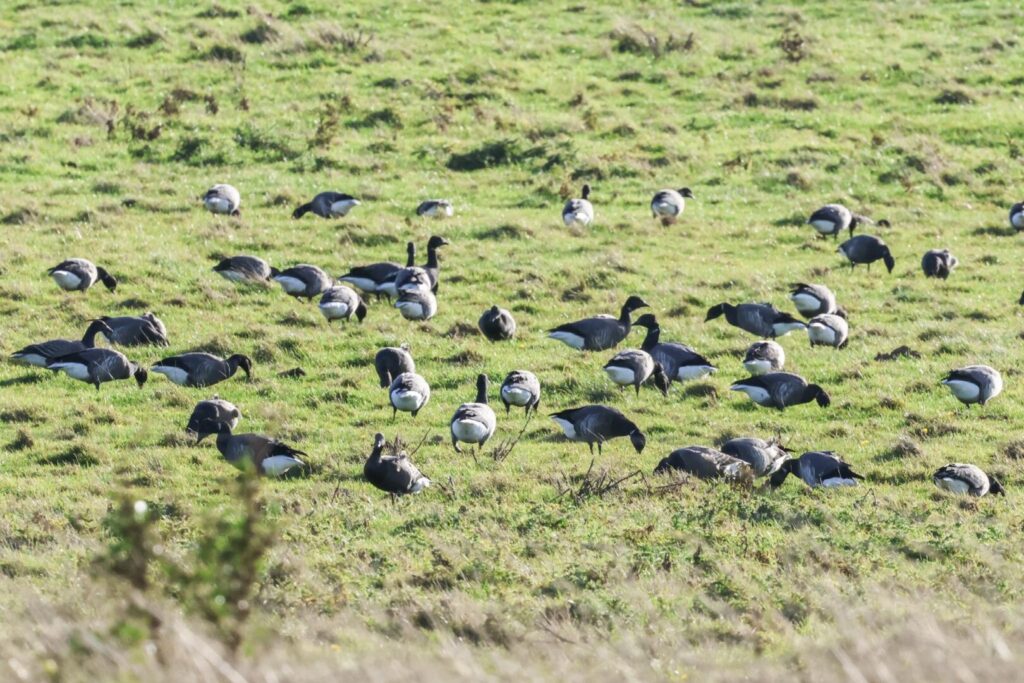
We turned our attention back to the Eye Field. From the top of the shingle, we had a good view of the Brent Geese now. Scanning the grass, we picked up the lingering Ruddy Shelduck distantly too. It was on its own. It arrived with the Pinkfeet but seems to have abandoned them now. There was no sign of the large flock which has been here recently but two Golden Plovers were still out on the grass too.
There had been two Shorelarks briefly seen from Babcock Hide before lunch, but they had flown off east. Earlier in the week, there had been two at Weybourne, so we wondered whether they might be the same and heading back there. It was getting increasing breezy now, so we decided to head round to Kelling next. We could get out of the wind in the shelter of the lane for a bit and maybe head on to Weybourne afterwards. But as we started to walk down the lane, another message came through that the Shorelarks were at Weybourne again briefly but had just flown back west!
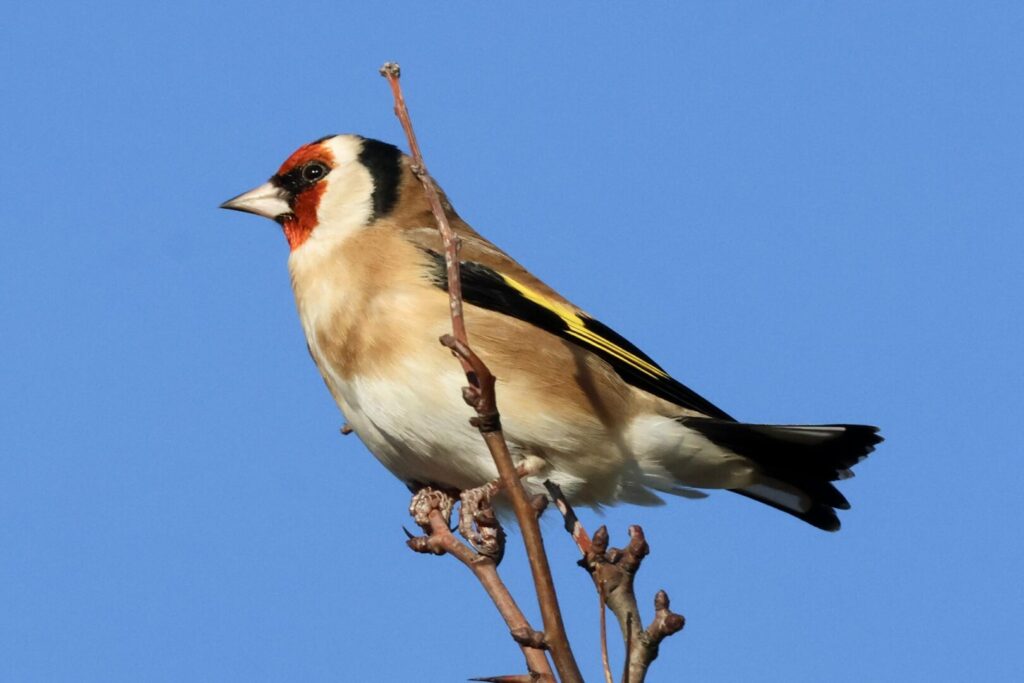
There were a few finches in the top of the lane. A Greenfinch in the top of the big fir tree was joined by two more and a Goldfinch. A Chaffinch flew up out of the beck ahead of us. Further up, another Goldfinch flew up and landed in the top of a hawthorn in the sunshine. We flushed lots of Red-legged Partridges from the other side of the hedge as we walked on – it is a big shooting estate here after all.
We were wondering whether there might be any migrants in the trees here but all was quiet. The wind was catching the edge of the copse. Scanning from the gate, we could see several Brown Hares and yet more Red-legged Partridges. More flocks of Starlings flew over.
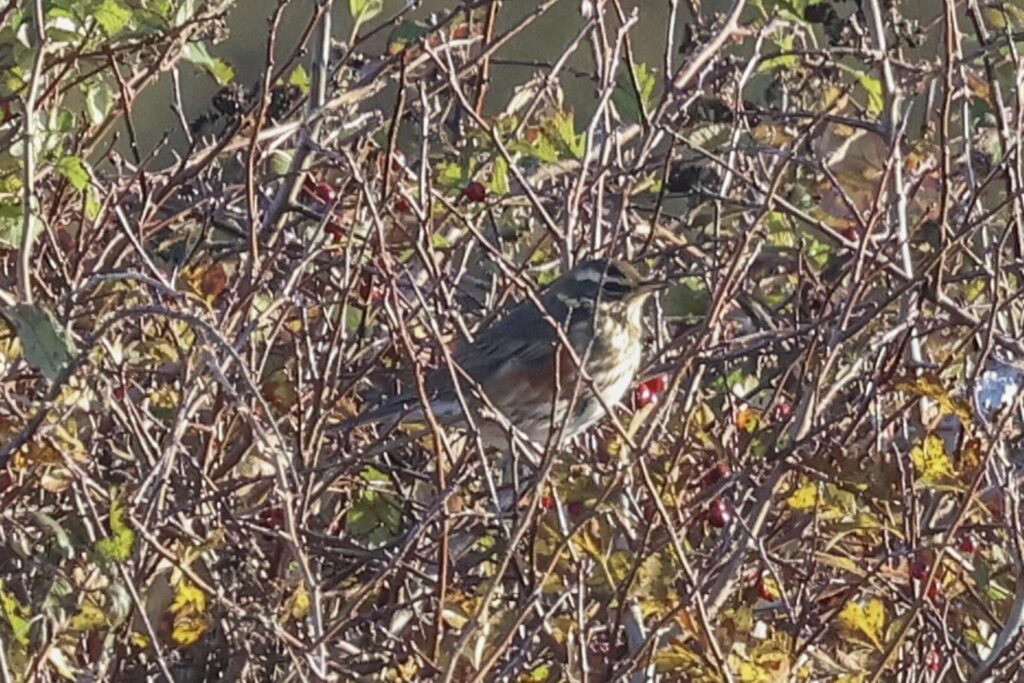
Continuing on down to the pool, a pair of Stonechats flitted ahead of us down the hedge. Looking over the brambles, we could see a flotilla of Shoveler out on the water, busily swimming and upending. Down to the crosstracks, we scanned all the brambles and couldn’t even see a Linnet at first. We heard Grey Partridges calling and looked across to see several running across a gap in the brambles in the field beyond. From the far corner, we spotted a Redwing in the top of a hawthorn on the far side of the pool. We got it in the scope for a closer look.
As we walked on down towards the Hard, we looked over the brambles to see the Grey Partridges again. They were running off up the hillside away from us. We counted twelve now, a very decent sized covey as they have been increasingly scarce and hard to find the last year or two.
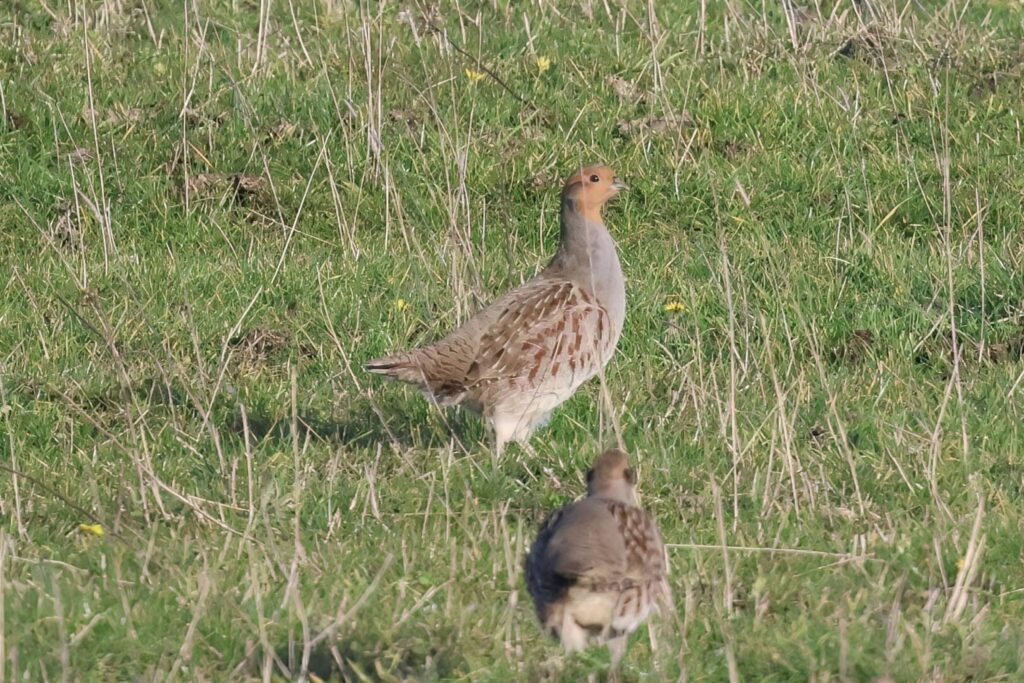
We finally found a flock of Linnets on the shingle ridge – they are normally common here. Another pair of Stonechats flitted along the fence line below and a couple of Meadow Pipits were in the grass. There were more Linnets, Meadow Pipits and Stonechats on the bushes on the way up to the gun emplacements. We had a quick look around the guns but there were no obvious birds there. A Stock Dove circled over. It was windier here too so we decided to make our way back.
The light was already starting to go – it gets dark early now, particularly after the clocks changed. We had time to call in briefly at Iron Road on our way back. There hadn’t been any further reports of the Shorelarks but we wondered whether they might have gone back to Babcock Hide. It was a pretty slim chance but the group was up for a quick look.
There were lots of Canada Geese on the grazing marsh as we passed. A single Greylag was with them, surprisingly the only one we had seen today, and a Greylag x Canada Goose hybrid. There were a couple of Egyptian Geese too.
It was no great surprise to find there was no sign of the Shorelarks from the hide. Nothing ventured. There were just a single Common Snipe, a Redshank and some ducks on the pool. A very large flock of Curlew flew in over the shingle beyond and landed out of view over towards the beach.
As we walked back towards the minibus, we could see several Marsh Harriers flying in towards the reedbed to roost. There were still large flocks of Starlings pouring past too. They had been arriving all day. Always amazing to watch autumn migration in action. As we drove back past Cley, a large flock whirled round over the reedbed and tried to settle in the bushes the other side of the road ahead of us. Time for bed for them and time to head home for us!